Accelerated Early Childhood Education Degree Programs
Compare 640+ accredited accelerated Early Childhood Education programs at 560+ colleges, with net price after aid, graduation rates, earnings and debt from IPEDS and the U.S. College Scorecard.

A bachelor's in early childhood education takes about four years at a standard pace, yet many working adults want it done in half that time without losing a paycheck. Accelerated formats can get there, but only when transfer credits, term length, and course load line up. A student starting from zero credits still faces a 120-credit degree.
The other catch is licensure. Some programs prepare graduates for state teacher licensure, while others lead only to child care, Head Start, or preschool roles. Speed matters less if the credential doesn't match the job you want.
Key Points
- With an associate degree, accelerated completion takes roughly one to two years.
- Southern New Hampshire University accepts up to 90 transfer credits toward graduation.
- Net prices range from $15,543 (North Dakota State) to $36,079 (Loyola Chicago).
The 10 Fastest Early Childhood Education Bachelor's Programs
The programs below are listed in order of the shortest published time to completion for an accelerated early childhood education bachelor's degree. Each entry shows delivery format, the institution's net price after aid, and its overall graduation rate, so you can read the cards as a starting point for comparison rather than a final quote. Net price is a sector-averaged, institution-wide estimate of what students pay after grant aid, not a bill you will receive, and graduation rates describe the whole college rather than the early childhood major alone.
Stonehill College
#1Easton, MA · ~$33,000/yr (est.)
Best for: On-campus students targeting PreK-2 licensure
A private liberal arts college in Easton, Massachusetts, Stonehill builds its teacher preparation around early and frequent classroom work. Early childhood majors begin field placements in the first semester and finish with a full-semester practicum in a PreK-2 setting, which supports initial licensure in Massachusetts. Small classes and faculty-facilitated internships for credit keep supervision close, and an accelerated bachelor's and master's option lets strong students finish both degrees in four years.
- PreK-2 initial teacher licensure in Massachusetts
- Field placements begin in the first semester
- Full-semester senior practicum
- Accelerated bachelor's and master's in four years
- Small classes with faculty-facilitated internships for credit
Appalachian State University
#2Boone, NC · $8,000 – $25,000/yr (est.)
Best for: Future teachers wanting dual special education certification
Appalachian State is a public university in Boone, North Carolina, with teacher education accredited by the Council for the Accreditation of Educator Preparation. Child development students can take the birth-to-kindergarten licensure track on campus or fully online, and they train in the Lucy Brock Child Development Lab. The degree carries dual certification in regular and special education and requires no minor, and an accelerated bachelor's to master's route is available.
- CAEP-accredited teacher preparation
- On campus in Boone or fully online
- Birth to kindergarten licensure track
- Dual certification in regular and special education
- Training at the Lucy Brock Child Development Lab
- No minor required
- Accelerated bachelor's to master's option
University of Rhode Island
#3Kingston, RI · ~$21,000/yr (est.)
Best for: Working preschool staff completing a degree online
The University of Rhode Island is the state's public research university, and its early childhood degree completion track is built for people already working in the field. Courses run in seven-week accelerated sessions entirely online, and graduates are eligible for the PreK-3 teaching certificate. Enrollment is limited to residents of seven Northeast states, and tuition is charged per credit with no application fee.
- Fully online, 7-week accelerated courses
- $654 per credit with a $0 application fee
- Eligible for the PreK-3 teaching certificate
- Enrollment limited to seven Northeast states
- August 4, 2027 application deadline for fall start
- Built for working early childhood professionals
West Chester University of Pennsylvania
#4West Chester, PA · $20,000 – $25,000/yr (est.)
West Chester University is a public institution in southeastern Pennsylvania with one of the larger teacher preparation programs in the state. The PreK-4 early grades degree leads to a Pennsylvania Instructional I certificate and requires a formal Teacher Candidacy application. Field placements sit within an hour of campus, student teaching runs a full semester, and accelerated pathways into literacy and TESOL master's degrees let graduates keep moving.
- Grades PK-4 Pennsylvania Instructional I Certificate
- Formal Teacher Candidacy application required
- Placements within one hour of campus
- Semester-long, full-time student teaching
- Minimum 30 field experience hours in EGP 220
- Accelerated B.S.Ed. to M.Ed. in Literacy pathway
- Accelerated B.S.Ed. to M.A. in TESOL pathway
- Transfer applicants need 12 college credits and a 2.90 GPA
Loyola University Chicago
#5Chicago, IL · ~$36,000/yr (est.)
Loyola University Chicago is a private Jesuit university whose education school places undergraduates in schools and community settings from the start. Early childhood majors complete a one-year internship in a preschool under a licensed teacher and graduate eligible for the Illinois Professional Educator License with an ESL endorsement. A 2+2 track accepts an associate degree in child development or early childhood education, and students meet in professional learning communities every semester.
- Illinois Professional Educator License eligibility with ESL endorsement
- One-year preschool internship under a licensed ECE teacher
- 2+2 transfer track accepts an associate degree; 60 hours at Loyola
- Field-based modules in schools and community settings
- Professional learning communities every semester for four years
- Illinois Early Childhood Special Education exam before final internship
- Coursework spans birth to age 8 in general and inclusive settings
Marywood University
#6Scranton, PA · $20,000 – $25,000/yr (est.)
Marywood University is a private Catholic university in Scranton, Pennsylvania, offering bachelor's through doctoral programs in its School of Education. Early childhood and elementary education majors can add a special education track or a related certification, which broadens the classrooms they qualify for. Accelerated programs let a student earn a bachelor's and a master's degree in five years.
- Combined early childhood and elementary education major
- Special education combined track also offered
- Early Childhood and Special Education certificate available
- Accelerated bachelor's plus master's in five years
Charter Oak State College
#7New Britain, CT · $15,000 – $20,000/yr (est.)
Charter Oak State College is Connecticut's public online college, and its early childhood programs are aimed at adults who already work with young children. The curriculum is NAEYC accredited, terms run eight weeks with six start dates a year, and credit is awarded for prior learning and work experience. Students choose among teaching, program administration and leadership, and Montessori concentrations, and the teaching option qualifies graduates for the state's ECTC Track B credential.
- NAEYC-accredited curriculum
- 30-credit teaching concentration
- Two 6-credit field experience or practicum courses
- Accelerated 8-week terms with six start dates a year
- 100% online coursework
- ECTC Track B eligibility for bachelor's graduates
- Grade of C or higher in prerequisites and major courses
- Prepares students for program director roles
- Mentor-guided culminating practicum
- 6-credit practicum and capstone
- Portfolio option for NAEYC administrators
- Four years of administrative experience accepted
- Covers finance and human resource duties
- Practicum embedded in Montessori training
- AMS and AMI credentials approved
- Montessori infant/toddler or early childhood focus
- Credit for prior learning accepted
George Mason University
#8Fairfax, VA · $15,000 – $20,000/yr (est.)
George Mason University is a large public research university in Fairfax, Virginia, serving Northern Virginia school systems. Its inclusive early childhood education degree is a 120-credit, non-licensure program delivered in person, with a semester-long full-time internship as the capstone. Students can apply to an accelerated master's program and finish an MEd within a year.
- 120 credits, coursework in person on the Fairfax campus
- Non-licensure degree track
- 38 Mason Core, 33 program core and 12 internship credits
- Semester-long full-time internship as the capstone
- VDOE state-approved preparation program
- Accelerated master's: MEd in one year
North Dakota State University
#9Fargo, ND · ~$16,000/yr (est.)
North Dakota State University is a public research university in Fargo with a long-standing human development and family science department. Undergraduates choose among adult development and aging, child and adolescent development, and family science options, and the child and adolescent track covers development from prenatal through adolescence. A 3.0 GPA and 60 credits open an accelerated bachelor's to master's route that applies 15 master's credits to the bachelor's degree.
- 120 credits, including 67 major credits
- Three options: adult aging, child and adolescent, family science
- Accelerated BS-to-master's track applies 15 master's credits
- 3.0 GPA and 60 credits to enter the accelerated track
- 2.50 GPA and C or better in all HDFS courses
- Minor outside the HDFS department required
- Field experience required before graduation
Carlow University
#10Pittsburgh, PA · $20,000 – $25,000/yr (est.)
Carlow University is a private Catholic university in Pittsburgh with a campus laboratory school on site. Early childhood majors work toward PreK-4 Pennsylvania certification with a STEM endorsement, and half of their field and practicum hours happen at the lab school. Fieldwork starts in the freshman year, up to 90 transfer credits are accepted, and the university takes part in TEACH, Rising Stars and PASSHE scholarship programs.
- PreK-4 Pennsylvania teacher certification
- STEM endorsement included
- Field experiences begin in the freshman year
- Half of practicum work at The Campus Laboratory School
- Accepts up to 90 transfer credits
- Three start terms: fall, spring and summer
- TEACH, Rising Stars and PASSHE scholarships accepted
- Accelerated master's option
None of the ranked Early Childhood Education programs match the accelerated lens yet. The full ranking is at the link above.
Cost, debt & payoff
Median earnings of this field's bachelor's graduates (4 yrs after completing, else the school's undergraduate median) vs. their median federal loan debt · U.S. College Scorecard
Across these programs the median graduate earns about $48,046 and finishes with roughly $23,350 in debt — a ratio that clears a common rule of thumb (keep debt below first-year salary). Net price and debt vary widely school to school, so check the per-school figures in the table above before you shortlist.
How Long Does an Accelerated Early Childhood Education Degree Take?
The short answer: a standard bachelor's in early childhood education takes about four years of full-time study, while an accelerated completion program built on an associate degree typically takes roughly one to two years. American International College publishes a one-to-two year range for its online completion degree, which requires an associate degree or at least 39 transferable credits.1 Vermont State University's +2 completion can run five semesters.2
What Compresses the Calendar
The calendar compresses through seven- and eight-week terms and year-round start dates. Liberty University runs 8-week online courses with eight starts a year3, the University of Rhode Island and American International College use 7-week terms, and the University of Maine at Augusta uses 7.5-week classes.4
What "Two Years" Leaves Out
Transfer-credit minimums, practicum and student-teaching hours, and part-time pacing. Completion programs assume roughly half the degree is already finished, so the clock depends on what you bring in.
Live Sessions vs. Asynchronous Work
Liberty advertises no set login times3; Concordia University Wisconsin says students primarily engage online when schedules permit, which still allows for scheduled sessions.5 Many program pages leave this unstated, so confirm it before you enroll if you work full time.
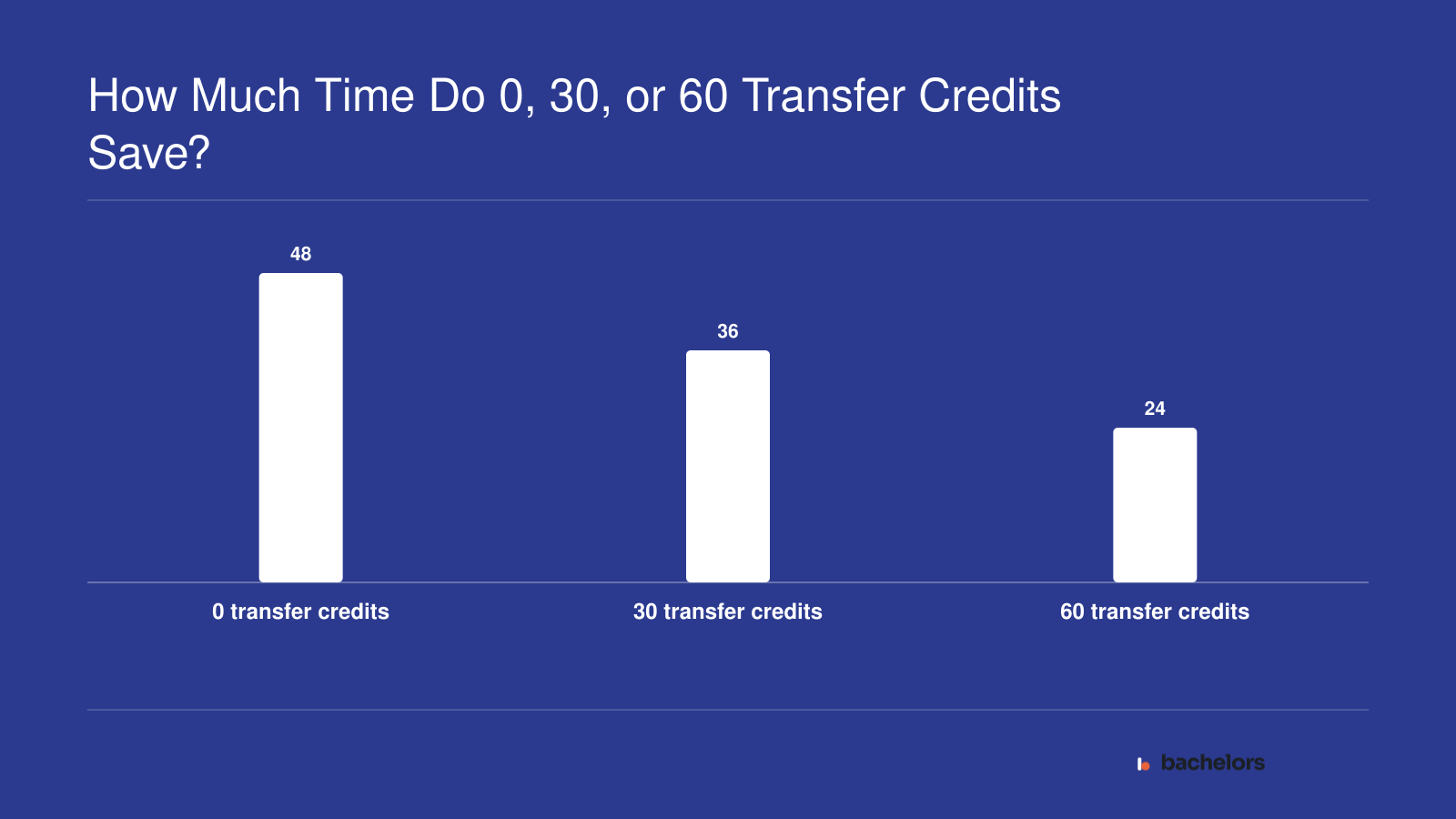
How Much Time Do 0, 30, or 60 Transfer Credits Save?
This chart assumes a standard 120-credit bachelor's completed at a steady full-time pace of 30 credits per year with no breaks between terms. Your own timeline will depend on your program's term length, course load limits, and how many of your credits it accepts. The pattern holds at any pace: each block of 30 transferred credits removes roughly a year of study.
Transfer Credits and Prior Learning: How to Finish Even Faster
Transfer policy, not course length, usually decides how fast you finish. At Southern New Hampshire University, undergraduates can transfer up to 75% of a program, which works out to as many as 90 credits against a 120-credit bachelor's degree.1 Coursework generally needs a C- or better from an accredited institution and has to fit actual degree requirements, so every transcript gets an individual evaluation.
Associate pathways
An AA built on general education transfers more cleanly than an AAS, which loads up on technical coursework that may not map to a bachelor's core. Neither transfers in full automatically. Ask specifically how many credits land inside the early childhood major versus general electives, since electives you don't need save you nothing.
Credit for prior learning
SNHU awards credit for prior learning in professional development, certifications, trainings, military education, and work experience, and recognizes more than 600 qualifying experiences; documentation is required.2 That credit can stack with college credits you already hold.
Before you commit, request an unofficial transfer evaluation. It is free at most schools and turns an estimated finish date into a real one.
Related Articles
What Accelerated Early Childhood Education Degrees Cost
Annual net prices at the schools covered here run from about $15,543 at North Dakota State University to $36,079 at Loyola University Chicago. These are institution-wide averages after aid, not figures for the early childhood major alone, so treat them as a starting point.
Online programs often price by the credit instead. Southern New Hampshire University charges $354 per credit, or $1,062 for a three-credit course1. Across a 120-credit bachelor's degree, that comes to $42,4801. Transfer credits cut that total directly: with 60 credits accepted, tuition drops to $21,240. SNHU accepts up to 90 transfer credits, usually with a grade of C- or higher2, but acceptance depends on whether the coursework fits your degree requirements.
Costs people forget
Tuition is rarely the whole bill. Budget separately for:
- Fees and books: technology fees and textbooks vary by school.
- Background checks: most programs require them before fieldwork.
- Practicum or student teaching: these placements can limit how much you can work.
Complete a FAFSA before you enroll. It determines Pell Grant eligibility and access to federal loans, and many schools use it for their own scholarships too.
Licensure, Student Teaching, and Accreditation: What to Check Before You Enroll
Licensure or Non-Licensure?
Some degrees lead to initial teacher licensure, and others only prepare you for child care, Head Start, or preschool roles. Kansas State and the University of Tennessee offer licensure tracks1, as does Northwestern College (for students who already hold an associate degree or higher). Liberty, Eastern Oregon, Rasmussen, and Cincinnati are non-licensure.2 Cincinnati states plainly that its degree does not lead to Pre-K to Grade 5 licensure.3
Student Teaching and Portability
Licensure tracks require supervised field experience, not just online coursework. Kansas State, for example, places students at an accredited school near them.1 Even non-licensure Eastern Oregon requires two in-person practica.4 Ask in writing about placement location, daytime scheduling, hours, and who arranges the site. Do not assume your workplace counts.
NASDTEC reciprocity is a framework, not a national license.5 Each state decides whether to recognize your credential, and may add tests, coursework, or background checks.5
Your Checklist
- Institution: Confirm regional accreditation.
- Program: Look for CAEP accreditation or state approval of the licensure track.
- State: Ask your state licensing board to confirm it approves the program.
Earnings and Debt for Early Childhood Education Graduates
The figures below are for each school's early childhood education bachelor's graduates specifically, not the institution as a whole, drawn from College Scorecard data. West Chester University of Pennsylvania's PreK-4 graduates earned a median $55,164 five years after finishing. Where debt is reported, it stays well below first-year earnings (for example, $21,875 against $44,363 at the University of Rhode Island), which points to a manageable return on investment for a field known for modest pay.
| School | Page status | Median earnings 1 year after finishing | Median earnings 4 years after finishing | Median earnings 5 years after finishing | Median debt at graduation |
|---|---|---|---|---|---|
| San Francisco State University | In our directory | $38,237 | $59,993 | $58,169 | $12,500 |
| Fresno Pacific University | In our directory | $33,727 | $60,338 | $55,844 | $23,000 |
| University of Rhode Island | Ranked | $44,363 | $56,999 | $55,463 | $21,875 |
| Chaminade University of Honolulu | In our directory | N/A | $51,215 | $54,858 | N/A |
Early Childhood Education programs by state
Accelerated Early Childhood Education Degree FAQs
These answers cover the questions readers ask most before enrolling in a fast early childhood education program. Details vary by school and state, so confirm specifics with the program you choose.
Can you get an early childhood education degree online?
Is an accelerated early childhood education degree accredited?
Does an accelerated early childhood education degree lead to teacher licensure?
Can you finish an accelerated program while working full time?
Compare Early Childhood Education programs on the data that matters
Explore more Education & Teaching majors or browse every field of study.
All Education & Teaching programs Browse every field of study