Accelerated Elementary Education Degree Programs
Compare 1,050+ accredited accelerated Elementary Education programs, with net price after aid, graduation rates, earnings and debt from IPEDS and the U.S. College Scorecard.

A traditional elementary education degree takes four years; an accelerated one can take two, if enough transfer credits carry over. Kindergarten and elementary teachers earned a median $63,820 in May 2025, so each year in school is a year without that paycheck.
The programs below are ordered from fastest completion to slowest. Transfer credits, cost and licensure rules decide how fast you really finish. Speed only counts if the credential qualifies you in your state.
Key Points
- "Accelerated" means 8-week transfer courses or five-year BS/MEd pathways.
- Elementary teachers earned a $63,820 median wage in May 2025, per BLS.
- State approval, not CAEP accreditation alone, determines whether you can get licensed.
Best Accelerated Elementary Education Programs, Ranked by Time to Degree
These ten programs are listed in order of how quickly a student can finish an elementary teaching credential, shortest route first, with the kind of context that matters when you compare them: format, program structure and what the school is known for in teacher preparation. Two caveats apply throughout. Graduation rates are institution-wide figures covering every undergraduate, not just the school of education, and net price is an approximate average after aid across all students, so treat both as a starting point rather than a promise about any single program.
University of Vermont
#1Burlington, VT · $19,000 – $46,000/yr (est.)
Best for: Future teachers wanting early classroom fieldwork
Vermont's flagship public university runs its elementary education degree on the Burlington campus, so methods courses and field placements happen in person from the start. Students begin professional coursework and community-based fieldwork in their first year and finish with a full-semester teaching internship. Teacher education programs hold national accreditation, and an accelerated pathway lets strong students carry the bachelor's into a master's in five years.
- 120 total credit hours
- Four community-based field experiences with partner schools
- Full-semester teaching internship in senior year
- Leads to Vermont K-6 teaching licensure
- Accelerated bachelor's to master's pathway in five years
- Study abroad options in Costa Rica, France and New Zealand
- Ongoing mentoring from an assigned advisor
Sacred Heart University
#2Fairfield, CT · ~$46,000/yr (est.)
Best for: Degree-seekers pairing a bachelor's with a MAT
This private Catholic university in Fairfield, Connecticut, structures its elementary route as an integrated dual degree rather than a standalone bachelor's. Students are admitted to the undergraduate and graduate portions together and keep a guaranteed seat in the master's program if they meet progress benchmarks. The result is initial teaching certification plus a graduate credential in five years, or four for students who arrive with college credit. Delivery blends campus and hybrid coursework.
- Awards a bachelor's and a MAT with initial certification eligibility
- Accelerated 3+1 path finishes both degrees in four years
- Guaranteed admission to the MAT by meeting progress criteria
- Three tracks including elementary and secondary education
- Tuition-paid teaching residencies in partner schools
- On-campus and hybrid delivery in Fairfield, Connecticut
- Adds 30 credits in year five for a PK-12 special education cross-endorsement
- Combines PK-6 elementary certification with K-12 special education
- Same 4+1 structure with guaranteed MAT admission
- Accelerated 3+1 option completes in four years
- Cross-endorsement courses taken during the fifth year
University of Northern Iowa
#3Cedar Falls, IA · $10,000 – $22,000/yr (est.)
Best for: Iowa residents seeking low-cost licensure routes
A public university in Cedar Falls, UNI is one of the largest producers of elementary teachers in Iowa, and its teaching degree is built squarely around the state's K-6 endorsement requirements. The 120-credit major is offered in campus and online formats, and registration in major courses is gated by a 2.5 GPA. Students also satisfy Iowa's social science and area-of-specialization rules before student teaching, which they apply for a year ahead.
- 120 total credit hours
- Leads to a K-6 elementary classroom endorsement
- 2.5 GPA minimum to register in major courses
- Prepares students for the Foundations of Reading Test
- 12-hour area of specialization required for Iowa licensure
- Apply for student teaching one year in advance
- Campus and online delivery options
Temple University
#4Philadelphia, PA · $23,000 – $39,000/yr (est.)
Temple pairs a large urban campus in Philadelphia with a teacher preparation program approved by the Pennsylvania Department of Education. Fieldwork starts as early as the second year and builds toward a year-long student teaching placement supervised by both a cooperating teacher and university faculty. Students can add a special education concentration or continue into a +1 bachelor's and master's option.
- Covers pre-kindergarten through fourth grade
- Fieldwork begins in the second year
- Year-long student teaching with a cooperating teacher
- Approved by the Pennsylvania Department of Education
- Optional Special Education concentration
- +1 BSEd/MEd accelerated option
- Study abroad in Italy, Jamaica and Japan
Drake University
#5Des Moines, IA · $25,000 – $30,000/yr (est.)
Drake is a private university in Des Moines with a long-standing teacher education tradition and more than 30 endorsement options stacked onto the elementary major. The standard route runs four years and 120 credits, with seven practicum assignments culminating in a 15-week student teaching semester. The Three and Teach track compresses coursework into three years for students arriving with 15 AP or college credits and a 3.5 GPA.
- Three and Teach track finishes coursework in three years
- That track requires 15 AP or college credits and a 3.5 GPA
- 120 credits leading to Iowa K-6 certification
- Seven practicum assignments, including a 40-hour first-year practicum
- 15-week student teaching in the final semester
- More than 30 endorsement options
- Admission to teacher education requires a 2.5 cumulative GPA
Milligan University
#6Milligan, TN · ~$21,000/yr (est.)
Milligan is a private Christian university in northeast Tennessee whose educator preparation program holds CAEP accreditation. Elementary candidates combine a K-5 licensure track with a P-12 English as a Second Language endorsement, and field experience begins in the first education course. A 4+1 arrangement adds a master's in education in a fifth year, and eligible students may use a TEACH Grant.
- K-5 elementary and P-12 ESL licensure track
- CAEP-accredited educator preparation program
- Field experience starting in the first education course
- Accelerated 4+1 plan for the bachelor's plus M.Ed.
- May qualify for a TEACH Grant
- Prepares students for Tennessee teaching licensure
Roger Williams University
#7Bristol, RI · ~$38,000/yr (est.)
Roger Williams builds clinical work into all four years rather than saving it for the end, including a full-year residency in an elementary school during sophomore year. The Bristol, Rhode Island campus sits close to partner schools across Rhode Island and southeastern Massachusetts. Students train in a virtual teaching simulation lab, and graduates are certification eligible in most states, with Alaska, Iowa and Minnesota listed as exceptions.
- Four years of clinical experiences built into the curriculum
- Full-year elementary school residency in sophomore year
- Student teaching during the senior year
- Certification eligible in most states except Alaska, Iowa and Minnesota
- Only Rhode Island school with the Mursion virtual teaching simulation
- Accelerated master's in Special Education with one extra year
Adelphi University
#8Garden City, NY · ~$31,000/yr (est.)
Adelphi's Scholar Teacher Education Program is a five-year combined degree on the Garden City campus, awarding a bachelor's and a master's instead of the usual six years. The childhood track leads to New York initial certification for grades 1-6, with optional special education and middle school extensions. Transfer students can bring up to 64 credits, and student teaching runs through New York City public schools and BOCES placements.
- Five-year combined bachelor's and master's degree
- Childhood track leads to grades 1-6 initial certification
- Transfer students may bring up to 64 credits
- 3.0 high school GPA minimum, with test scores optional
- Student teaching in New York City schools and BOCES sites
- Optional special education certification and grades 7-9 extension
- Literacy advanced certificate available in the graduate year
Emmanuel College
#9Boston, MA · ~$27,000/yr (est.)
Emmanuel is a small private college in Boston where elementary candidates complete a liberal studies major alongside the education major. Pre-practicum fieldwork leads into a senior year that pairs student teaching with a capstone seminar and portfolio. Placements reach Boston Latin School and other city sites, and the college reports that most graduates move into jobs or graduate school within a year.
- Grades 1-6 teaching licensure track
- Liberal studies major combined with the education major
- Pre-practicum field experiences before the senior year
- Final year pairs student teaching with a capstone seminar
- Placements include Boston Latin School and other city sites
- Four-year course sequence
University of New England
#10Biddeford, ME · $38,000/yr (est. net price)
The University of New England runs its elementary degree on the Biddeford, Maine campus, with field experience scheduled every semester rather than concentrated in one block. Graduates leave with Maine K-6 certification, and the program reports teaching reciprocity in a majority of states. A five-year accelerated option adds an M.S.Ed., and advanced standing is reviewed at 60 credits.
- Earns Maine K-6 teacher certification
- 15-week student teaching internship
- Field experience scheduled every semester
- Accelerated pathway to the B.S. plus M.S.Ed. in five years
- Physical Education concentration leads to PE certification
- Advanced Standing reviewed at 60 credits
Cost & outcomes by school
Federal data for the highest-earning Elementary Education programs, independent of the ranking above. Earnings are this field's bachelor's graduates four years after completing where the Scorecard reports them, else the school's undergraduate median.
| School | Net price / yr | Grad rate | Earnings | Debt | Grads/yr | Format |
|---|---|---|---|---|---|---|
| Western Governors University UT | $12,548 | 46% | $60,615 | $11,116 | 1,660 | Online |
| University of Florida FL | $6,541 | 91% | $53,079 | $14,757 | 40 | Online or campus |
Sources: U.S. Department of Education. Net price, graduation rate, earnings and debt: College Scorecard (earnings and debt for this field's bachelor's graduates where reported, else school-wide); graduates: IPEDS. A dash means no figure is reported.
Cost, debt & payoff
Median earnings of this field's bachelor's graduates (4 yrs after completing, else the school's undergraduate median) vs. their median federal loan debt · U.S. College Scorecard
Across these programs the median graduate earns about $48,824 and finishes with roughly $24,000 in debt — a ratio that clears a common rule of thumb (keep debt below first-year salary). Net price and debt vary widely school to school, so check the per-school figures in the table above before you shortlist.
What 'Accelerated' Really Means and How Many Transfer Credits You Need
The word "accelerated" now covers two very different routes into the elementary classroom.
Two Kinds of Fast
Degree-completion programs use 8-week terms so transfer students can stack courses quickly. Five-year BS/MEd pathways instead fold a master's into the bachelor's, typically saving about a year compared with earning the two degrees separately. The first route shortens the bachelor's itself. The second shortens the road to a graduate credential.
What the Timelines Assume
An advertised 18 to 24 months assumes an associate degree or roughly 60 transferable credits.4 On 8-week terms with two courses at a time, 60 accepted credits translate to about 24 months, 75 to about 18, and 90 to about 12. Taking one course at a time roughly doubles that.
Caps vary by school:
- American College of Education: up to 90 of 120 credits, with an associate degree and 60 credits as the starting point.1
- Rasmussen University: 40 to 80 semester credits, capped at 80.2
- Texas State University: 72 semester credits from junior or community colleges.3 Its AAT EC-6 route carries 36 to 37 pre-major credits.3
Before you apply, request an unofficial transcript evaluation. It shows what counts, what does not, and whether your timeline is real.
Cost, Debt and Financial Aid for Accelerated Teaching Degrees
The biggest cost advantage of an accelerated teaching degree is finishing sooner: fewer terms of tuition and fewer months without a teacher's paycheck. Prices still vary widely, so check what each figure measures before you compare them.
- University of Vermont: about $19,343 average annual net price; $20,500 median debt for elementary education graduates.
- San Francisco State University: about $12,278 average annual net price; $12,500 median program debt.
- Western Washington University: about $21,193 average annual net price; $20,043 median program debt.
Net price is an approximate average for aided students at public institutions like these, not a quote. Run each school's net price calculator.
The TEACH Grant pays up to $4,000 a year for full-time study in 2026-2027 and isn't need-based. You'll need a 3.25 GPA or a top-quartile admissions test score.1 You must then teach a high-need subject at a low-income school for four years within eight years of leaving school, or the grants become unsubsidized loans with interest.2 Pell Grants depend on financial need reported on the FAFSA. Teacher Loan Forgiveness cancels up to $5,000 after five consecutive years at a low-income school. Check your state's teacher scholarships too.
What Do Elementary School Teachers Earn, and How Strong Is the Job Outlook?
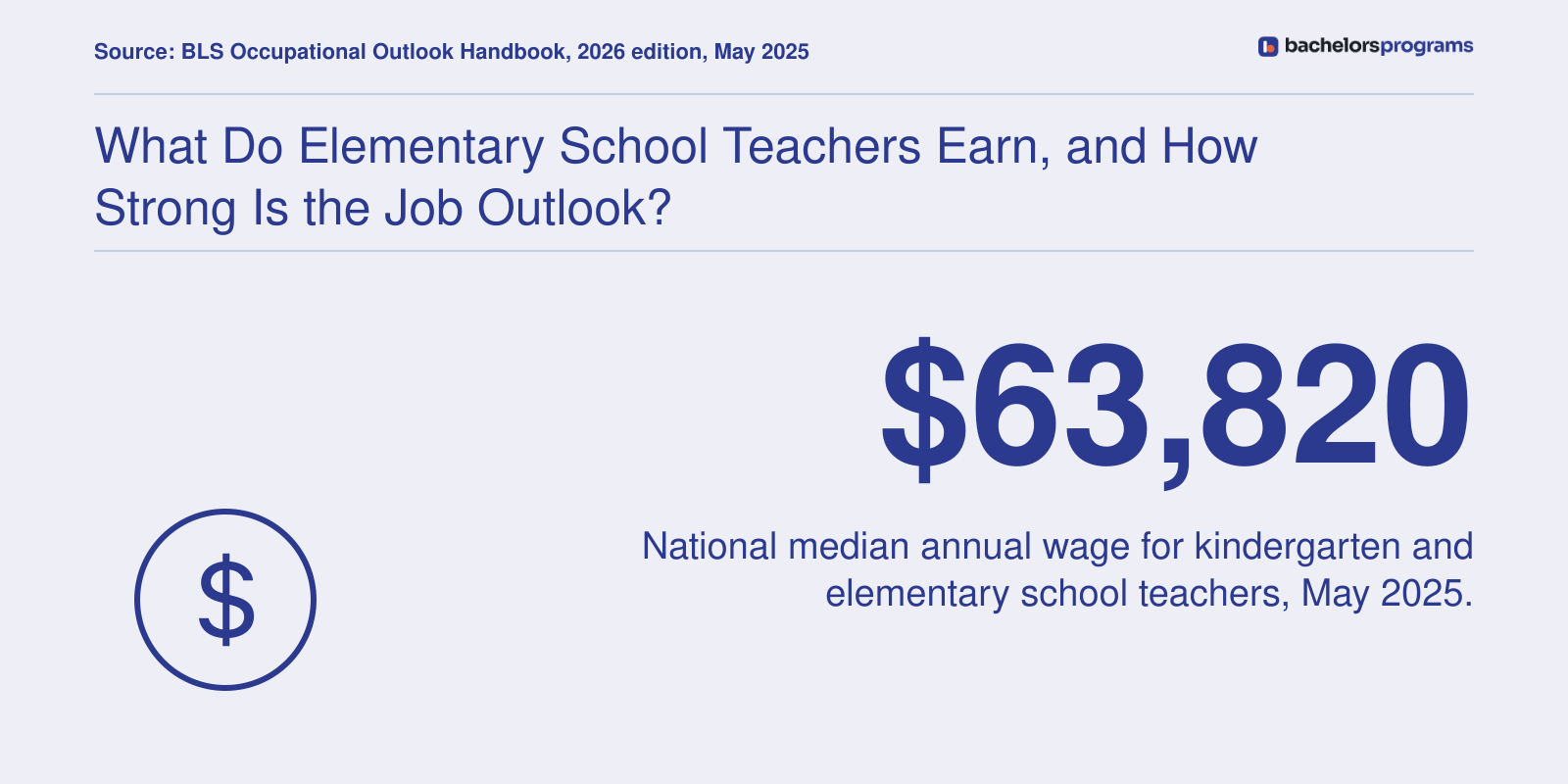
The Bureau of Labor Statistics reports a May 2025 median annual wage of $63,820 for kindergarten and elementary school teachers. BLS projects little or no change in employment from 2025 to 2035 (0%). Even so, it expects about 99,400 openings per year on average, many created as teachers retire or leave the field.
Licensure Is State-Specific: Exams, Reciprocity and What to Check First
A bachelor's degree alone does not make you a licensed teacher.1 Each state sets its own requirements, usually including an approved preparation program, supervised clinical experience, a background check, and content and pedagogy assessments.1 Praxis is common but not universal, so confirm which exam your target state actually accepts before you buy a prep book.2
What Reciprocity Actually Gets You
The NASDTEC Interstate Agreement is a set of individual state agreements, not a national license. All 50 states, DC, Guam, DoDEA and Ontario have signed, but signing does not mean every license transfers without conditions.3 The receiving state controls the credential type, duration and any extra coursework or testing it wants. Arkansas, for example, requires its Foundations of Reading exam for K-6 elementary licenses even for out-of-state applicants.4 Provisional, temporary or emergency licenses are often excluded from recognition.5
Before You Enroll
- Confirm in-state approval: Ask the program, in writing, which state licenses its graduates qualify for.
- Check alternative routes: Many states offer provisional or career-changer pathways, useful if you already hold a degree.
- Plan for the move: If you may relocate, expect testing, reading or special-education coursework, and fees.
Related Articles
Accreditation and Student Teaching Requirements for Fast-Track Programs
Program websites often blur two separate checks: CAEP accreditation and state approval. CAEP grants its own accreditation, while the state decides whether a program can recommend you for a license, so state approval matters most.1 Phrases like "CAEP-aligned" or "seeking accreditation" are not the real thing. South Carolina requires national accreditation for public institutions2, and Tennessee's State Board of Education approves programs, with a CAEP-managed review as one route to full approval.3
How to Verify
Look the school up on CAEP's accredited-provider list and note the status (accredited, initial accreditation, probation, or another limitation).1 Then find the exact program on your state education department's approved-program list, matching the license area and delivery format.
Student Teaching
Accelerated programs still require student teaching, and the totals vary by state. Delaware requires at least 10 consecutive weeks and 200 hours.4 Tennessee requires at least 15 weeks of full-time student teaching.3 Texas clinical teaching requires at least 280 hours.5
Working adults and paraprofessionals may have options. Tennessee offers a job-embedded clinical year, for example.3 Ask the program whether your job counts as approved clinical practice in your state before you enroll.
Is a Fast-Track Elementary Education Degree Right for You?
Speed saves time and tuition, but it demands more of your calendar. Compressed 8-week courses move quickly, and student teaching is typically unpaid, so plan your income before you enroll.
- Paraprofessionals: Online or hybrid formats let you keep working in the classroom while you study.
- Career changers with credits: Hybrid programs balance flexibility with in-person mentoring.
- Transfer students: Campus programs suit those who want a traditional cohort and local placements.
The programs ranked here mix online and campus options, so you can match format to your life. Your next step: request a transcript evaluation, then confirm the program fits your state's licensure rules.
Elementary Education programs by state
Compare Elementary Education programs on the data that matters
Explore more Education & Teaching majors or browse every field of study.
All Education & Teaching programs Browse every field of study