Best Forensic Science Schools in Arkansas
Compare 3 accredited Forensic Science programs in Arkansas, with net price after aid, graduation rates, earnings and debt from IPEDS and the U.S. College Scorecard.

Forensic science in Arkansas is a laboratory job before it is a badge job. Hiring labs want chemistry and biology credit hours, and as of 2026 the state issues no license for forensic scientists or forensic science technicians. Schools here either title the degree a Bachelor of Science in Forensic Science or fold the forensic coursework into a chemistry or biology major, and that science core is what separates it from a criminal justice major.
Only a handful of Arkansas colleges award the degree, which keeps the list short and makes program-level detail matter more than breadth. Typical earnings at the higher-paying programs here sit near $52,000, against median debt of $18,750 to $26,500, so the debt load you accept is not automatically repaid by the salary that follows.
Key Points
- Annual in-state tuition and fees: $9,960 at Southern Arkansas, $26,262 at Harding.
- Ouachita Baptist graduates typically earn $51,673 against $21,050 in debt.
- Arkansas requires no state license for forensic scientists in 2027.
Best Forensic Science Schools in Arkansas: Our Ranked List
Three Arkansas institutions meet the criteria for this ranked list, and each one awards a bachelor's degree in forensic science or a closely named equivalent. All three deliver their programs on campus, in Searcy, Arkadelphia and Magnolia, so readers who need a fully online route should look at the delivery section further down. Each entry below notes what the curriculum covers, what the school costs after aid and which students it fits.
Harding University
#1Searcy, AR · ~$22,000/yr (est.)
Best for: Students wanting a dedicated forensic science major
Harding University is a private Christian institution in Searcy, north of Little Rock, and the only entry here where forensic science is the degree name itself rather than a concentration. The 125-credit program pairs a chemistry and biology foundation with a heavy load of criminal justice coursework, and students can add summer undergraduate research in Florence, Italy. The university reports a 69% graduation rate and admits roughly 70% of applicants, and the average net price after aid comes to about $22,130. Graduates who borrowed leave with median debt of $26,500.
- 125 credit hours, about four years of full-time study
- Chemistry and biology foundation with substantial criminal justice coursework
- Summer undergraduate research option in Florence, Italy
- Student Affiliates of the American Chemical Society chapter on campus
- Prepares graduates for forensic scientist and laboratory scientist roles
- Taught on campus by the Department of Chemistry and Biochemistry
Ouachita Baptist University
#2Arkadelphia, AR · $20,000 – $25,000/yr (est.)
Best for: Test-optional applicants wanting liberal arts science
Ouachita Baptist University, in Arkadelphia about an hour southwest of Little Rock, awards a Bachelor of Arts in Biology with a Forensics Emphasis that requires no minor. The 120-hour plan joins biology with chemistry, physics, sociology, psychology, criminal justice and philosophy, and standardized test scores are not required for admission. Tuition runs $17,500 a semester for 10 to 18 credit hours with no out-of-state charge, the average net price after aid is about $22,410, and the graduation rate is 61%. Median debt for graduates who borrowed is $21,050.
- 120 credit hours, no minor required
- Standardized test scores not required for admission
- Combines biology with chemistry, physics, sociology and criminal justice
- Forensics support courses in criminology, criminal law and evidence analysis
- Senior capstone in biology required
- No out-of-state tuition charge; merit awards up to $20,000 a year
Southern Arkansas University
#3Magnolia, AR · $10,000 – $15,000/yr (est.)
Best for: Budget-focused students staying close to home
Southern Arkansas University is the public option on this list, in Magnolia in the south-central part of the state, and it offers a bachelor's degree in chemistry with a forensic science concentration. The 120-credit program builds a chemistry foundation in the Department of Biochemistry and Chemistry and adds forensic science preparation for students aiming at crime laboratory work. In-state tuition is $9,960 a year, the average net price after aid is about $14,030, and roughly 75% of applicants are admitted. The graduation rate is 49%, and graduates who borrowed carry median debt of $18,750.
- 120 credit hours, taught on campus
- Chemistry foundation with focused forensic science preparation
- Housed in the Department of Biochemistry and Chemistry
- Built for students targeting forensic science careers
Cost & outcomes by school
Federal data for the highest-earning Forensic Science programs, independent of the ranking above. Earnings are this field's bachelor's graduates four years after completing where the Scorecard reports them, else the school's undergraduate median.
| School | Net price / yr | Grad rate | Earnings | Debt | Grads/yr | Format |
|---|---|---|---|---|---|---|
| Harding University AR | $22,130 | 69% | $52,876 | $26,500 | 1 | Campus |
| Ouachita Baptist University AR | $22,409 | 61% | $51,673 | $21,050 | — | Campus |
| Southern Arkansas University AR | $14,027 | 49% | $42,386 | $18,750 | — | Campus |
Sources: U.S. Department of Education. Net price, graduation rate, earnings and debt: College Scorecard (earnings and debt for this field's bachelor's graduates where reported, else school-wide); graduates: IPEDS. A dash means no figure is reported.
Cost, debt & payoff
Median earnings of this field's bachelor's graduates (4 yrs after completing, else the school's undergraduate median) vs. their median federal loan debt · U.S. College Scorecard
Across these programs the median graduate earns about $51,673 and finishes with roughly $21,050 in debt — a ratio that clears a common rule of thumb (keep debt below first-year salary). Net price and debt vary widely school to school, so check the per-school figures in the table above before you shortlist.
Bachelor's Degree in Forensic Science vs. Criminal Justice and Crime-Scene Programs in Arkansas
A degree with "forensic" in its name is not always a science degree, and that gap decides whether you end up in a lab or in a law-and-policy classroom. Arkansas does have a bachelor's degree in forensic science: Harding University in Searcy offers a Forensic Science program. Southern Arkansas University in Magnolia takes a chemistry route with a Chemistry (Forensic Science) program. Ouachita Baptist University in Arkadelphia lists a Biology program, so ask the department how much forensic coursework it includes.
What We Left Out
The ranked schools are lab-science routes. Several other credentials carry a forensic label but were left out:
- Criminal justice degrees: These focus on policing, courts and corrections. A mention that graduates "may work in forensics" does not make the major a forensic science degree.
- Forensic concentrations inside criminal justice: A computer forensics track, for example, sits in a criminal justice degree and is not a natural-science curriculum.
- Crime-scene certificates and associate credentials: These are short, practical credentials for evidence collection. They are useful for some jobs, but they are not bachelor's degrees.
Accreditation in Plain Terms
FEPAC is the main accreditor for forensic science programs, covering bachelor's and master's levels. No Arkansas program is confirmed as FEPAC-accredited, and a 2024 review of the state reported none. That does not make a program worthless. It does mean checking the curriculum yourself, asking about lab hours, and asking how graduates have fared in hiring and in graduate applications.
A Quick Test
Open the degree plan and count courses. A true forensic science path is heavy on general and organic chemistry, biology, physics, statistics and lab sections, often with instrumental analysis or toxicology. A criminal justice path fills the same space with criminology, constitutional law, policy and administration electives. If most of the required credits are lab-based sciences, you are looking at a forensic science degree. If most are law and policy, it is criminal justice with a forensic label.
How We Ranked Arkansas Forensic Science Schools
How were these Arkansas forensic science schools ranked, and how much weight should the order carry? The ranking draws on five College Scorecard measures: net price, graduation rate, selectivity, program earnings and program debt. No single measure decides a school's position. Each one feeds a combined view, so a school with a low net price but weak completion results does not automatically rise to the top.
What the Measures Tell You
- Net price: What students pay on average after grants and scholarships, a more realistic figure than the published tuition rate.
- Graduation rate: The share of students who finish, a rough signal of how well a school keeps students on track.
- Selectivity: How competitive admission is, used as context rather than as a sign of quality.
- Program earnings and debt: What graduates of the field of study earn and borrow, the measures closest to the degree itself.
Limits to Keep in Mind
Both are campus-wide averages rather than program-level figures. They describe the whole university, not the forensic science track. Harding University offers a Forensic Science program, while Ouachita Baptist University (Biology) and Southern Arkansas University (Chemistry with a Forensic Science focus) route students into the field through related majors. Their campus-wide figures may not match what a forensic science student experiences. Earnings and debt data can also be thin for small programs, so treat those figures as directional.
What Was Included
Only bachelor's programs at Arkansas schools were considered, whether delivered on campus or online. The list is ranked-only. No school paid for placement, and no school can buy a higher position.
Online and Hybrid Forensic Science Bachelor's Options at Arkansas Schools
Online study buys flexibility; campus study buys the lab hours forensic work depends on. At Arkansas schools, the campus path is currently the only one.
Can You Earn This Degree Online in Arkansas?
Not fully, based on the schools ranked here. Harding University in Searcy, Ouachita Baptist University in Arkadelphia and Southern Arkansas University in Magnolia each list their forensic science bachelor's as a campus program. Southern Arkansas offers its Chemistry (Forensic Science) major as a 120-credit on-campus degree and does not describe it as online or hybrid. Harding's 125-credit program sits in its Chemistry and Biochemistry Department. Ouachita's Biology degree with a forensics emphasis requires chemistry, physics and a capstone. An individual lecture or general education course may occasionally run online, so check each catalog, but treat the major itself as an in-person commitment.
Which Parts Happen in Person
The schools do not publish a course-by-course list of in-person requirements. Still, the structure of these degrees points to the components that typically require a physical lab:
- Chemistry labs: General, organic and analytical chemistry sequences built around bench work.
- Biology labs: Hands-on coursework that underpins evidence and DNA-related study.
- Capstone and research: Ouachita requires a capstone, and Harding highlights summer research in Florence, Italy.
Out-of-State Online Programs
Some schools outside Arkansas market online forensic science bachelor's degrees. Before you enroll in one, ask how it handles lab credit (at-home kits or on-site intensives) and whether those credits would transfer if you later move to a campus program.1
Trade-Offs to Weigh
- Flexibility: Campus schedules are harder to fit around a full-time job, though they keep you on a standard four-year track.
- Lab access: In-person programs give you supervised time on instruments that you cannot replicate at home, which matters when you apply for lab roles.
- Commuting: Searcy, Arkadelphia and Magnolia are far apart, so living near campus or budgeting for housing is part of the real cost of this degree.
Admission Requirements for Arkansas Forensic Science Bachelor's Programs
All three schools admit most applicants, so a solid science transcript usually matters more than selectivity. Confirm GPA, testing and transfer rules on each admissions page before you apply, because the sources we reviewed did not list every policy.
- Harding UniversityAdmits roughly 71% of applicants. The forensic science major is built on chemistry and biology and runs 125 credit hours. We did not find a published minimum GPA or test policy, so check with Harding admissions.
- Ouachita Baptist UniversityAdmits roughly 68% of applicants and is test optional, so ACT or SAT scores are not required. Forensics is an emphasis within the biology degree (120 credit hours) and requires chemistry, physics and sociology coursework. We did not find a published minimum GPA.
- Southern Arkansas UniversityAdmits roughly 75% of applicants. Forensic science is a concentration within the chemistry degree (120 credit hours). We did not find published GPA or test-score requirements, so confirm them with SAU.
- Math and science preparationAll three programs are lab-science degrees. High school chemistry, biology and algebra-level math will prepare you for first-year coursework, even where a school lists no formal prerequisite.
- Transfer creditNone of the three published a forensic-specific transfer policy in our research. Ask each registrar how chemistry, biology and general education credits will apply before you transfer.
- Community college pathwaysAssociate degrees in criminal justice or crime scene investigation can be a starting point. Some Arkansas community college forensic certificates are labeled non-transferable to four-year schools, though. To keep credits moving toward a bachelor's, prioritize transferable general chemistry, biology and math.
Cost of a Forensic Science Bachelor's Degree in Arkansas
Tuition, net price and debt
How much does a forensic science degree cost in Arkansas? Published in-state tuition and fees run from $9,960 a year at Southern Arkansas University, the public option here, to $34,500 at Ouachita Baptist University, with Harding University in between at $26,262. Average net price after grants and scholarships is an estimate that also includes living costs. It narrows that spread considerably:
- Southern Arkansas University: $9,960 tuition and fees; about $14,027 net price; $18,750 median debt at graduation
- Harding University: $26,262 tuition and fees; about $22,130 net price; $26,500 median debt
- Ouachita Baptist University: $34,500 tuition and fees; about $22,409 net price; $21,050 median debt
The debt figures are school-wide medians for graduates, not for the forensic program alone. Southern Arkansas's net price sits above its tuition because net price includes housing, food and books.
Arkansas Academic Challenge Scholarship
This lottery-funded scholarship is the state's main award for bachelor's students.1 The Arkansas Division of Higher Education (ADHE) puts the 2026 freshman award at $2,000.2 ADHE says the award rises $1,000 each year, reaching a maximum of $5,000 by the fourth year.3
To qualify, you must meet these conditions:
- Be a U.S. citizen or permanent resident.4
- Have lived in Arkansas for the 12 months immediately before enrolling.4 If you are under 21, a parent or guardian can meet this requirement.
- Be accepted and enrolled full- or part-time in a bachelor's program at an approved institution.
- Not be in default on a student loan and not owe a grant refund.
State sources have listed the award schedule in different forms. Confirm current amounts and academic requirements with ADHE before you count on them.
Arkansas Future Grant
The Future Grant targets certificate and associate programs in high-demand fields such as science, technology, engineering and math. ADHE lists it as covering tuition and fees at two-year colleges or providing $3,800 at four-year institutions.5 The grant has a 75-credit-hour cap and requires the FAFSA.5 It is not designed to fund a bachelor's degree in forensic science.
What this means for your budget
Sticker price overstates what most families pay at the private schools here. Ouachita Baptist's listed price drops by roughly $12,000 at average net price, and the university reports merit awards of up to $20,000 a year. To keep your costs down:
- File the FAFSA early.
- Add the Academic Challenge Scholarship on top of any institutional aid.
- Compare each school's offer by net cost, not tuition.
What Arkansas Forensic Science Graduates Earn vs. What They Borrow
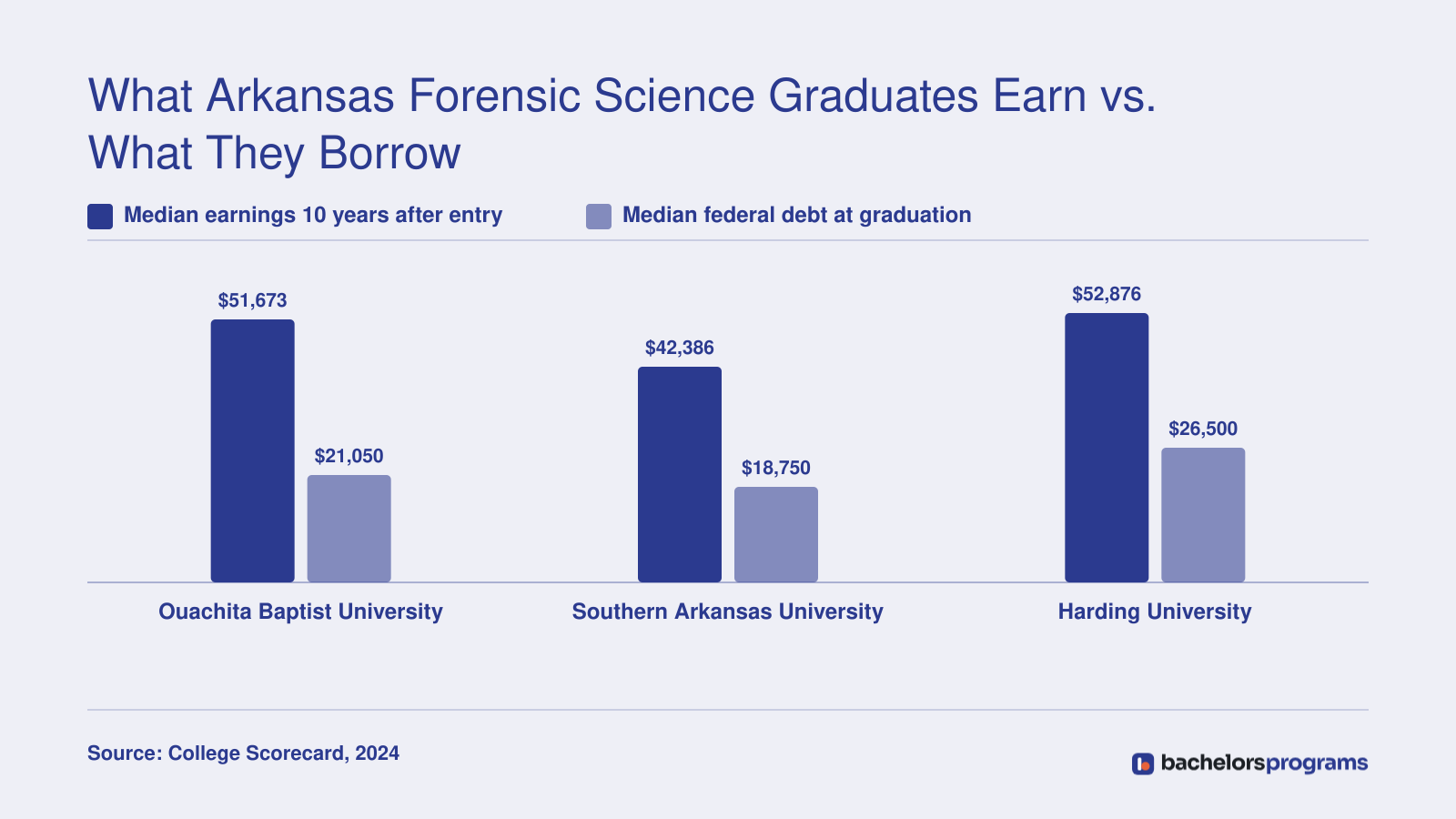
At each school here, typical earnings run about two to two and a half times typical debt. Ouachita Baptist University shows the strongest balance at $51,673 earned against $21,050 owed. Harding University posts the highest earnings ($52,876) and the highest debt ($26,500), while Southern Arkansas University keeps median debt lowest at $18,750. Earnings for forensic science graduates specifically are not reported, so these are school-wide figures: median earnings 10 years after first enrolling and median federal loan debt at graduation.
Related Articles
Do You Need a License to Work in Forensic Science in Arkansas?
Questions to Ask Yourself
Is your goal a lab analyst job or crime-scene and investigative work?
Can you relocate or pay out-of-state tuition, or do you need to stay in Arkansas?
Does the program place students in a working crime lab?
Forensic Science Schools in Arkansas: Common Questions
Does Arkansas have a bachelor's degree in forensic science?
Can you get a forensic science degree online in Arkansas?
How much does a forensic science degree cost in Arkansas?
What is the best college in Arkansas for forensic science?
Do you need a license to work in forensic science in Arkansas?
Compare Forensic Science programs on the data that matters
Explore more Criminal Justice & Law majors or browse every field of study.
All Criminal Justice & Law programs Browse every field of study