Best Criminology Schools in Arkansas
Compare 6 accredited Criminology programs in Arkansas, with net price after aid, graduation rates, earnings and debt from IPEDS and the U.S. College Scorecard.

The decision most Arkansas students face is not whether to study criminology but where: a flagship campus in Fayetteville, a regional university in Jonesboro, Conway or Russellville, or a program completed online. Schools title the degree Bachelor of Science (B.S.) or Bachelor of Arts (B.A.) in Criminology, and some file closely related coursework under criminal justice.
The ranked schools here are the University of Arkansas, Arkansas State University, the University of Central Arkansas, Arkansas Tech University, the University of Arkansas at Little Rock and Strayer University-Arkansas. In-state tuition is fairly close across them, so format, admissions rules and local career pathways tend to matter more than sticker price.
Key Points
- Arkansas State's B.A. in Criminology can be completed entirely online.
- At $8,090 a year, Arkansas State has the lowest in-state tuition here.
- Arkansas officers generally must be 21 to earn CLEST certification.
Best Bachelor's in Criminology Schools in Arkansas
The six schools below offer a bachelor's degree in criminology or a closely related criminal justice degree, and they range from a fully online program at Arkansas State to campus programs with internships and honors research. Tuition and net prices vary by thousands of dollars across the group. Each entry gives the in-state price, the average net price after aid where the university reports it, and the university's overall graduation rate.
Arkansas State University
#1Jonesboro, AR · $8,000 – $15,000/yr (est.)
Best for: Working adults needing fully online study
Arkansas State University in Jonesboro runs its Bachelor of Arts in Criminology entirely online, with seven-week courses and a 120-credit structure split among general education, the major and electives. In-state tuition is $8,090, the average net price after aid is $12,366, and the university's overall graduation rate is 55%. The program accepts up to 90 transfer credits and charges the same $302 per credit to all U.S. residents. It fits working adults who need to study around a job.
- 120 credit hours: 38 general education, 48 major, 34 electives
- Up to 12 hours of foreign language can count toward electives
- 100% online with seven-week courses and multiple start dates
- $302 per credit, the same rate for all U.S. residents
- CRIM 44303 Applied Research serves as the capstone
- Transfer students with 13 or more credits need a 2.0 GPA
- Up to 90 transfer credit hours may apply
- $30 non-refundable application fee
University of Central Arkansas
#2Conway, AR · $15,000 – $20,000/yr (est.)
Best for: Campus students wanting police internships
The University of Central Arkansas in Conway offers a Bachelor of Science in Criminology with a required 150-hour internship, coursework in theory, research and social policy, and a student chapter of Alpha Phi Sigma. In-state tuition is $10,523, the average net price after aid is $16,511, and the university's overall graduation rate is 53%. The 120-credit degree requires a 2.0 GPA overall and in the major, and majors must earn a C or better in CRIM 2300. It suits campus-based students who want field experience with police and sheriff departments before they graduate.
- 120 credit hours, including a minor and 40 upper-division hours
- 2.0 GPA required overall and in the major and minor
- Majors must earn a C or better in CRIM 2300
- 150-hour internship with police and sheriff departments
- Coursework emphasizes theory, research and social policy
- Student organizations include Alpha Phi Sigma and the Society of Criminology Students
- Juniors and seniors may take CRIM 4370 for the internship
University of Arkansas
#3Fayetteville, AR · ~$18,000/yr (est.)
Best for: Research-minded students pursuing honors thesis
The University of Arkansas in Fayetteville awards a Bachelor of Arts in Criminology through its Department of Sociology and Criminology, with 37 credit hours in criminology and sociology and options for an honors thesis and a double major. In-state tuition is $10,104, the average net price after aid is $18,209, and the university's overall graduation rate is 70%, the highest in this group. The 120-credit program includes internships and a fully online minor in criminal justice. It fits students who want a research-heavy degree and the resources of the state's largest flagship campus.
- 120 total credit hours, with 37 in criminology and sociology
- Eight-semester degree plan available
- Undergraduate honors thesis option
- Internship opportunities available
- Double major in criminology and sociology available
- Fully online minor in criminal justice
Arkansas Tech University
#4Russellville, AR · $10,000 – $15,000/yr (est.)
Arkansas Tech University in Russellville lists a Bachelor of Arts in Criminal Justice and Criminology on its bachelor's degree list, and the same department also offers an Associate of Science in Criminal Justice. In-state tuition is $8,674, the average net price after aid is $12,970, and the university's overall graduation rate is 49%. It suits budget-conscious students who want a smaller-campus setting in the Arkansas River Valley.
- Listed on the university's bachelor's degree list
- Same department offers an Associate of Science in Criminal Justice
University of Arkansas at Little Rock
#5Little Rock, AR · $17,000/yr (est. net price)
The University of Arkansas at Little Rock awards a Bachelor of Arts in Criminal Justice through its School of Criminal Justice and Criminology, with a 36-credit major and the option to take every course online or in person. In-state tuition is $9,748, the average net price after aid is $17,248, and the university's overall graduation rate is 42%. A 2.25 GPA and completion of freshman composition are recommended for admission to the major, and employees of participating Corporate Partnership Program employers receive a 10% tuition scholarship. It suits working students in central Arkansas who want an urban campus and a strong online pathway.
- 36 credit hours in the major
- At least 15 hours must be completed at UA Little Rock
- ENGL 10103 and 10203 plus a 2.25 GPA recommended for admission
- All criminal justice courses offered online and in person
- 18-credit criminal justice minor available
- Associate of Science in Law Enforcement also offered
- Certificates for sworn law enforcement officers available
Strayer University-Arkansas
#6Little Rock, AR · $10,000 – $15,000/yr (est.)
Strayer University's Arkansas campus in Little Rock serves students through a fully online Bachelor of Science in Criminal Justice with a concentration in Crime and Criminal Behavior. The degree runs 40 courses of 11 weeks each at $1,555 per course, and students may transfer up to 28 classes. Coursework covers criminological theory, crime prevention, forensic psychology, and drugs, gangs and organized crime. It suits adults who want a private, career-focused online program with frequent start dates and one-on-one academic coaching.
- 40 courses, each 11 weeks long
- $1,555 per course
- Concentration in Crime and Criminal Behavior
- Transfer up to 28 classes
- Accredited by the Middle States Commission on Higher Education
- Winter classes start January 4
- $65 per term technology fee and $100 resource kit per course
- One free course for every three passed through Learn and Earn
Cost & outcomes by school
Federal data for the highest-earning Criminology programs, independent of the ranking above. Earnings are this field's bachelor's graduates four years after completing where the Scorecard reports them, else the school's undergraduate median.
| School | Net price / yr | Grad rate | Earnings | Debt | Grads/yr | Format |
|---|---|---|---|---|---|---|
| University of Arkansas AR | $18,209 | 71% | $58,191 | $21,500 | — | Campus |
| University of Central Arkansas AR | $16,511 | 54% | $47,387 | $19,414 | 35 | Campus |
| Arkansas State University AR | $12,366 | 55% | $46,293 | $23,250 | 51 | Online |
| University of Arkansas at Little Rock AR | $17,248 | 42% | $45,265 | $22,000 | — | Online or campus |
| Arkansas Tech University AR | $12,970 | 49% | $41,766 | $21,000 | — | Online or campus |
| Strayer University-Arkansas AR | — | — | $40,092 | $40,621 | — | Online |
Sources: U.S. Department of Education. Net price, graduation rate, earnings and debt: College Scorecard (earnings and debt for this field's bachelor's graduates where reported, else school-wide); graduates: IPEDS. A dash means no figure is reported.
Cost, debt & payoff
Median earnings of this field's bachelor's graduates (4 yrs after completing, else the school's undergraduate median) vs. their median federal loan debt · U.S. College Scorecard
Across these programs the median graduate earns about $45,779 and finishes with roughly $21,750 in debt — a ratio that clears a common rule of thumb (keep debt below first-year salary). Net price and debt vary widely school to school, so check the per-school figures in the table above before you shortlist.
How We Ranked Arkansas Criminology Schools
The ranking starts with federal College Scorecard data, the U.S. Department of Education's public record of how graduates of individual programs fare after they leave. For the Arkansas schools here, that means four measures: what graduates earn four years after finishing, the debt they carry, how many students complete the program, and what students actually pay once grants and scholarships are applied.
Where the Numbers Are Approximate
Net price and graduation rates are reported for the whole institution rather than a single major. A criminology major at a midsize public university shares a campus with nursing and business students, so those two figures describe the school's average undergraduate rather than a criminology major. Treat them as a signal of affordability and completion, not a forecast.
What the List Covers
The list covers bachelor's programs in Arkansas, campus and online, limited to schools that publish program-level data. Programs appear under different labels, from a B.A. in Criminology to a criminal justice degree with a criminology concentration, so we compare what they actually require: research methods, criminological theory, and coursework on the Arkansas court and corrections systems.
Beyond the Numbers
The deciding detail is often practical: whether a program arranges internships with local agencies, whether upper-level courses run online, and whether transfer credit from a two-year school counts toward the major. Those factors never show up in a dataset, but they shape how quickly a student finishes and what they can do with the degree.
Bachelor's Degree in Criminology vs. Criminal Justice in Arkansas
Arkansas State University, the University of Central Arkansas and the University of Arkansas each offer a bachelor's degree in criminology under that name. Arkansas State awards it as a Bachelor of Arts in Criminology, and its program can be completed online. UCA and the University of Arkansas list the major as Criminology and teach it on campus.
Schools With Criminal Justice Titles
The other schools use criminal justice wording:
- Arkansas Tech University: Bachelor of Arts in Criminal Justice & Criminology, a combined title.
- University of Arkansas at Little Rock: Criminal Justice, with a fully online option.
- Strayer University-Arkansas: Bachelor of Science in Criminal Justice, with a Crime and Criminal Behavior concentration, delivered online.
Strayer's concentration and Arkansas Tech's combined title put criminological content inside a criminal justice framework. That makes them a middle path between the two labels.
What Separates the Two
Criminology studies why crime happens: its causes, patterns and social context, usually through sociology, theory and research methods. Criminal justice studies how the system responds, covering policing, courts and corrections, including procedure and policy.
Why It Matters for Your Next Step
In most entry-level law enforcement, corrections, probation and victim-services jobs, employers treat the two degrees similarly. They tend to weigh your record, your internships and your interview more heavily than the exact major name. The label matters more if you want to continue to graduate school or work in research and policy. A criminology degree with heavy theory and statistics signals research preparation. A criminal justice degree may suit you better if you want to understand agency operations and administration.
Before you apply, confirm the exact degree title on the school's program page and read the required course list. Titles can hide very different mixes of theory, methods, law and procedure, and the courses you will actually take should match your goals.
Online and Hybrid Bachelor's in Criminology Options at Arkansas Schools
Delivery format now separates Arkansas criminology programs: the same degree title reaches students in Jonesboro, in Little Rock and out of state entirely online. Arkansas State University's B.A. in Criminology is the clearest case: the online program page describes it as 100% online, and the degree requires 120 credit hours, 48 of them inside the major.
Fully Online Options
Arkansas State accepts up to 90 transfer credits, charges $302 per credit, and applies one tuition rate to every U.S. resident, which erases the usual in-state versus out-of-state gap. Neither of the university's program pages states a required campus residency or on-campus component, so ask an advisor to confirm that in writing before you enroll. Strayer University-Arkansas delivers its B.S. in Criminal Justice with a concentration in crime and criminal behavior entirely online, across 40 courses at $1,555 per course, and accepts up to 28 transfer classes.
Campus and Mixed Formats
University of Central Arkansas runs its criminology bachelor's from Conway, and the University of Arkansas in Fayetteville lists a campus criminology degree plus an online criminal justice minor rather than an online major. Arkansas Tech University lists both formats for its Criminal Justice & Criminology degree. UA Little Rock describes a fully online option alongside campus study, with at least 15 credit hours completed through the university.
Who Online Suits, and What to Ask
Online study suits working adults already in law enforcement, corrections or probation, transfer students with credits already earned, and anyone beyond commuting range of Jonesboro, Conway, Fayetteville, Russellville or Little Rock. Ask three questions before committing: whether online students pay the in-state rate or a flat rate, how exams are proctored, and how many transfer credits the major will actually apply. A flat online rate can be worth more than a lower sticker price, especially where in-state and out-of-state tuition diverge sharply.
Admission Requirements for Arkansas Criminology Programs: GPA, Test Policy and Transfer Credit
Arkansas State University and the University of Central Arkansas both expect ACT, SAT or equivalent scores from first-year applicants, so neither is test-optional, and both set a 2.0 cumulative college GPA for transfer students. Arkansas State offers more routes to automatic admission (a 3.00 GPA, an ACT superscore of 19, an SAT superscore of 990 or a top 20% class rank), while UCA sets a lower 2.5 GPA floor but also requires minimum test scores. These figures come from Arkansas State's Undergraduate Admission Requirements page and UCA's Undergraduate Transfer Student Guidelines and Undergraduate Bulletin. They apply university-wide rather than to criminology alone, so confirm current rules for the University of Arkansas, Arkansas Tech University, UA Little Rock and Strayer University-Arkansas with each admissions office.
| School | Minimum GPA / Admission Standard | ACT/SAT Policy | Transfer Credit Policy |
|---|---|---|---|
| Arkansas State University (first-year applicants) | 3.00 cumulative high school GPA (or GED equivalent) for automatic admission; ranking in the top 20% of the graduating class is another automatic-admission route | Required: ACT superscore of 19 or SAT combined superscore of 990 for automatic admission; minimum test scores are still required | N/A |
| Arkansas State University (transfer applicants) | 2.0 cumulative GPA from previous college work | N/A | Apply the semester before intended enrollment and submit official college transcripts; no credit-equivalency or maximum-credit policy published on the admissions page |
| University of Central Arkansas (first-year applicants) | 2.5 minimum cumulative high school GPA on a 4.0 scale | Required: ACT composite of 17, SAT of 930 or CLT of 51, plus minimum section scores | N/A |
| University of Central Arkansas (transfer applicants) | 2.0 cumulative GPA | ACT, SAT, COMPASS or ASSET scores required for placement in freshman writing and math courses | Applicants with fewer than 24 earned credit hours must also meet freshman admission requirements; no credit-equivalency or maximum-credit policy published |
Related Articles
Cost of a Criminology Degree in Arkansas
Tuition and Net Price
In-state tuition varies only modestly across these schools. Arkansas State University is the lowest at $8,090 a year, followed by Arkansas Tech University at $8,674, the University of Arkansas at Little Rock at $9,748, the University of Arkansas at $10,104 and the University of Central Arkansas at $10,523.1 Out-of-state rates spread much wider, from $14,522 at Arkansas State to $29,966 at the University of Arkansas, so residency matters a great deal.
Average net price after aid runs from $12,366 at Arkansas State and $12,970 at Arkansas Tech to $16,511 at Central Arkansas, $17,248 at UA Little Rock and $18,209 at the University of Arkansas.
Pell Share and Debt
These figures describe each school overall, not the criminology program. Pell Grant recipients make up about 72% of students at Arkansas State, 75% at Arkansas Tech, 69% at Central Arkansas, 74% at UA Little Rock and 47% at the University of Arkansas. Median debt for graduates falls in a narrow band: $20,346 at Central Arkansas, $20,500 at Arkansas State, $21,000 at Arkansas Tech, $21,500 at the University of Arkansas and $22,000 at UA Little Rock.
Arkansas Aid Programs
- Arkansas Academic Challenge Scholarship: open to Arkansas residents, with a freshman award of $2,000 for the school year.2 Amounts vary by college and class level, so confirm the current figure for sophomore through senior years with the Arkansas Division of Higher Education.
- Arkansas Future Grant: covers tuition and fees for eligible students, first-come, first-served4, with a 75 credit hour limit and a $3,800 figure cited for four-year institutions.2 Eligibility requires an Arkansas high school or homeschool background, or three years of Arkansas residency.3 It is built for certificate and associate programs in STEM and high-demand fields, so it may help with a two-year start but is not a general grant for a bachelor's degree in criminology. Check the eligible program list before counting on it.
A Practical Tip
File the FAFSA and the state scholarship application as early as each opens. Several Arkansas awards are limited or awarded first-come, first-served, and a late application can cost you money. Treat net price as an average across all aided students, not a quote. Your own figure depends on income, enrollment and residency, so run each school's net price calculator before you compare.
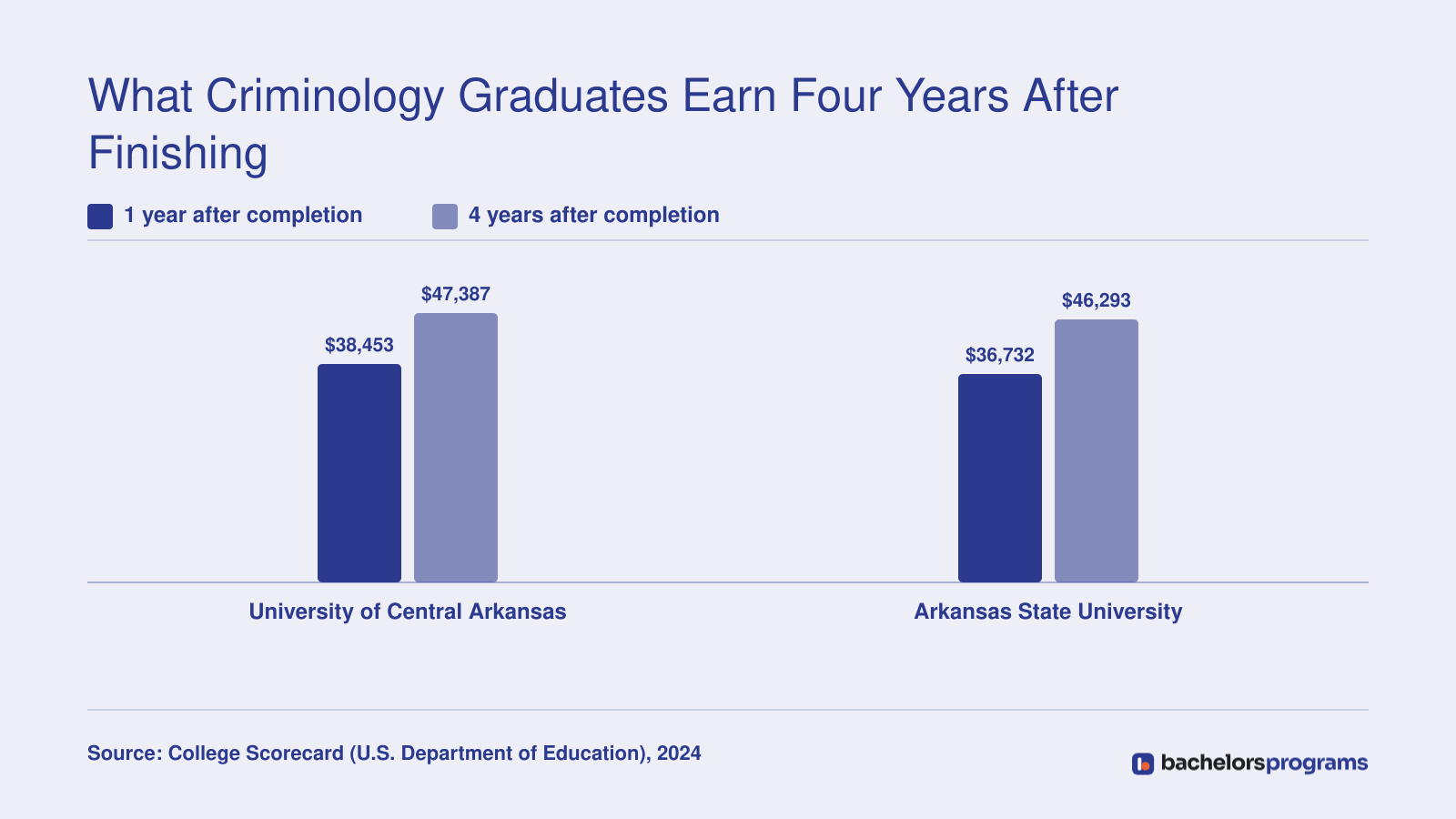
What Criminology Graduates Earn Four Years After Finishing
University of Central Arkansas and Arkansas State University both publish federal earnings data for their criminology bachelor's graduates. At both schools, median pay rises by about $8,900-$9,600 between the first and fourth year after graduation. These figures are College Scorecard medians for program completers, not statewide wages, and program-level figures for the other schools are not reported.
Arkansas Law Enforcement Certification at a Glance
Questions to Ask Yourself
Do you want a criminology degree built for research and graduate study, or a criminal justice route toward a certified officer job?
Can you relocate to a campus, or do you need to keep working while you study?
Will the Arkansas aid you qualify for cover most of the bill, or do you need the lowest net price up front?
Does the program's internship or field placement feed into the Arkansas agencies you want to work for?
Arkansas Criminology Degree FAQs
These answers cover the questions Arkansas students ask most often about a bachelor's degree in criminology, from school choice and format to cost and career paths.
Which Arkansas college has the best criminology program?
Which Arkansas schools offer a true criminology major versus criminal justice?
Can you get a bachelor's degree in criminology online in Arkansas?
How much does a criminology degree cost in Arkansas?
What jobs can you get with a criminology degree in Arkansas?
Compare Criminology programs on the data that matters
Explore more Criminal Justice & Law majors or browse every field of study.
All Criminal Justice & Law programs Browse every field of study