Best Information Technology Schools in Missouri
Compare 17 accredited Information Technology programs in Missouri at 14 colleges, with net price after aid, graduation rates, earnings and debt from IPEDS and the U.S. College Scorecard.

A bachelor's degree in information technology prepares you to run the systems a business depends on: networks, servers, cloud infrastructure, security. In Missouri the usual degree is the Bachelor of Science in Information Technology: 120 credits blending programming, networking and business courses.
Median earnings five years after completion run from about $52,943 to $101,982 for graduates of the programs ranked here, a gap wide enough that school choice rivals major choice.
Names vary too: the same core curriculum shows up as information technology, computer information systems or information science. The ranking below weighs format, net price, graduation rate and graduate earnings, and several programs run fully online.
Key Points
- Harris-Stowe State University posts the lowest net price: $9,922 per year.
- Missouri University of Science and Technology grads top earnings: $101,982 median.
- Missouri doesn't license IT workers, so certifications fill that gap.
Best Bachelor's in Information Technology Schools in Missouri: Ranked
Ten Missouri schools appear below, from a private university in St. Louis and the state's flagship and technical campuses to regional publics that deliver the degree fully online or in hybrid form. Formats range from accelerated eight-week terms to lab-based programs built around enterprise networking hardware. Each entry notes delivery mode, available concentrations, an approximate average net price after aid, and the institution's graduation rate.
Saint Louis University
#1Saint Louis, MO · $24,000/yr (est. net price)
Best for: Working adults needing flexible online terms
Saint Louis University is a private Jesuit university in St. Louis, and its information technology offering runs through the School for Professional Studies as a Bachelor of Science in Computer Information Systems. Six accelerated eight-week terms a year let students begin at any point, and the program can be completed entirely online. Students can add a data analytics or cybersecurity certificate with two extra courses. The institution as a whole graduates about 80% of students, and the average net price after aid is roughly $24,400.
- 120 credits, including 39 major credits and a capstone
- Six accelerated eight-week terms a year; start at any term
- Standard tuition $660 per credit; $300 for military and first responders
- Two concentration options, plus a certificate in two extra courses
- 2.5 transfer GPA minimum; high school diploma or GED required
- Fully online through the School for Professional Studies
University of Missouri
#2Columbia, MO · ~$20,000/yr (est.)
Best for: Full-time students wanting a research campus
The University of Missouri is the state's flagship campus, where the BS in Information Technology sits in the College of Engineering with 36 hours of core INFOTC coursework and 30 hours of technical electives reaching into virtual reality, game development, and mobile app work. The university has been expanding AI and quantum computing resources for students, including a collaboration with Google Public Sector on AI tools, cloud capacity, and certification opportunities. The degree runs on campus in Columbia. Institution-wide, about 75% of students graduate, and the average net price after aid is roughly $20,300.
- 120 credits: 36 in the INFOTC core and 30 in technical electives
- At least 15 of the 30 elective hours at the 3000 level
- Two-course, writing-intensive senior capstone sequence
- 2.0 GPA required overall and in all INFOTC and CMP_SC courses
- Electives in virtual reality, game development, and mobile apps
- Core covers networking, cybersecurity, databases, and UNIX
Missouri University of Science and Technology
#3Rolla, MO · ~$16,000/yr (est.)
Best for: Business-minded students seeking a technical core
Missouri University of Science and Technology in Rolla awards its Information Science and Technology degree through the Jaggi School of Business, pairing a technical core of networks, cybersecurity, and database management with business coursework. Summer internships and co-ops are strongly encouraged before graduation, and the campus carries a long engineering and applied science identity. About 64% of students graduate institution-wide, and the average net price after aid is roughly $16,300.
- 120 credits, awarded through the Jaggi School of Business
- Common core in database management, networks, and cybersecurity
- 11 credit hours of free electives
- Grade of C or better required in designated courses
- Summer internships and co-ops strongly encouraged
Northwest Missouri State University
#4Maryville, MO · $15,000 – $20,000/yr (est.)
Northwest Missouri State University in Maryville offers a Bachelor of Applied Science in Information Technology built for transfer students who arrive with an associate degree, so vocational and technical credits carry over and fewer general education courses are required. Three tracks are available, General, Cybersecurity, and Data Analytics, and each has an online option. About 54% of students graduate institution-wide, and the average net price after aid is roughly $16,200.
- Bachelor of Applied Science track for transfer students with an associate degree
- Maximizes transfer of vocational and technical credits
- Coursework in web development, big data visualization, and digital forensics
- Fewer general education courses than a traditional four-year degree
University of Missouri-Kansas City
#5Kansas City, MO · $13,000 – $30,000/yr (est.)
The University of Missouri-Kansas City offers an ABET-accredited Bachelor of Information Technology that blends computer science, IT, and business courses, with a required internship and a software engineering capstone. The 120-credit degree prepares students for software development, network specialist, and database administration roles. About 55% of students graduate institution-wide, and the average net price after aid is roughly $13,300.
- ABET-accredited, 120 credits, four-year program
- Blends computer science, IT, and business coursework
- One-credit internship required; software engineering capstone
- Automatic admission with a 3.0 high school GPA and ACT benchmarks
- Transfers need 24 college credits and a 2.0 GPA
- Coursework in networking, operating systems, databases, and data analytics
University of Missouri-St Louis
#6Saint Louis, MO · $15,000 – $20,000/yr (est.)
The University of Missouri-St. Louis places its Bachelor of Science in Business Information Technology in the AACSB-accredited Ed G. Smith College of Business, with concentrations in application development, business intelligence, and cybersecurity. The degree runs on campus, fully online, or hybrid, with course lengths from four to sixteen weeks, and an accelerated path lets students finish a master's in information systems and technology in five years. Regional employer ties include World Wide Technology and a tuition discount arrangement with Nidec Motor Corporation. About 57% of students graduate institution-wide, and the average net price after aid is roughly $15,100.
- AACSB-accredited business school, in business and accounting
- Three concentration options: application development, business intelligence, cybersecurity
- On campus, 100% online, or hybrid delivery
- Accelerated master's in information systems and technology in five years
- Courses run in 4-, 8-, 12-, and 16-week formats
- Advanced Information Systems Lab and Cybersecurity and IT Innovation Lab
Missouri Southern State University
#7Joplin, MO · $12,000/yr (est. net price)
Missouri Southern State University in Joplin offers a CIS major with an Information Technology option built on a 30-credit CIS core plus professional electives and supporting work in Python, Power BI, project management, and statistics. The 120-credit degree is taught on campus and is Fast Track eligible. About 42% of students graduate institution-wide, and the average net price after aid is roughly $12,000.
- 120 credits including a 39-credit general education core
- 30-credit CIS core plus 12 credits of professional electives
- Coursework in programming, database systems, networks, and data structures
- Supporting work in Python, Power BI, project management, and statistics
- 39 upper-division credit hours required
- Fast Track eligible
Missouri State University
#8Springfield, MO · $18,000/yr (est. net price)
Missouri State University in Springfield delivers its Bachelor of Science in Information Technology 100% online, with the same curriculum taught by full-time faculty and industry professionals. Students choose an app development with AI track, an IT infrastructure track, or a cybersecurity track, and the degree qualifies for a Fast Track Grant. About 58% of students graduate institution-wide, and the average net price after aid is roughly $17,600.
- 100% online, taught by full-time faculty and industry professionals
- Three tracks: app development with AI, IT infrastructure, cybersecurity
- Curriculum co-developed with IT industry leaders
- Qualifies for the Fast Track Grant
- App development track builds full-stack developer skills
- Student chapter of A-BITS
Hannibal-LaGrange University
#9Hannibal, MO · ~$23,000/yr (est.)
Hannibal-LaGrange University is a small private Christian campus in Hannibal offering a Bachelor of Science in Computer Sciences with four technology areas, including an information technology track and a cybersecurity track. Students complete an internship and an individualized project, and the program reports a 93% placement rate for tech graduates. About 50% of students graduate institution-wide, and the average net price after aid is roughly $22,800.
- Four technology areas: cybersecurity, computer science, IT, and computer information systems
- Coursework in networking, security, databases, web development, and operating systems
- Internship plus an individualized project required
- 93% placement rate reported for tech graduates
- Biblical worldview applied to ethical issues in the field
University of Central Missouri
#10Warrensburg, MO · ~$14,000/yr (est.)
The University of Central Missouri in Warrensburg offers a Bachelor of Science in Information Technology with concentrations in network and systems administration and in web and cloud applications development. Classes meet in Warrensburg or Lee's Summit, in person or hybrid, with select courses fully online, and UCM is a designated Cisco Networking Academy Support Center with enterprise routers, switches, and Azure servers on hand. Internships have run with AT&T, CenturyLink, and the Air Force Civil Service. About 54% of students graduate institution-wide, and the average net price after aid is roughly $14,500.
- Two concentrations: network and systems administration; web and cloud applications development
- Classes in Warrensburg or Lee's Summit; hybrid format with select online courses
- Designated Cisco Networking Academy Support Center
- Hands-on training on enterprise routers, switches, and Azure servers
- Internships with AT&T, CenturyLink, and Air Force Civil Service
- Curriculum aligns with professional certification preparation
Cost & outcomes by school
Federal data for the highest-earning Information Technology programs, independent of the ranking above. Earnings are this field's bachelor's graduates four years after completing where the Scorecard reports them, else the school's undergraduate median.
| School | Net price / yr | Grad rate | Earnings | Debt | Grads/yr | Format |
|---|---|---|---|---|---|---|
| Missouri University of Science and Technology MO | $16,298 | 64% | $107,195 | $23,338 | 151 | Campus |
| University of Missouri MO | $20,268 | 75% | $100,234 | $20,906 | 218 | Campus |
| Saint Louis University MO | $24,398 | 80% | $90,660 | $25,000 | 17 | Online |
| Lindenwood University MO | $19,638 | 49% | $86,526 | $23,343 | 44 | Online |
| University of Central Missouri MO | $14,462 | 54% | $81,657 | $21,000 | 3 | Hybrid |
| Northwest Missouri State University MO | $16,244 | 54% | $80,690 | $21,975 | 31 | Online or campus |
| University of Missouri-Kansas City MO | $13,310 | 56% | $76,216 | $21,138 | 13 | Campus |
| Missouri Southern State University MO | $12,007 | 42% | $75,295 | $19,174 | 18 | Campus |
| Missouri Western State University MO | $13,251 | 39% | $68,405 | $18,350 | — | Online |
| William Jewell College MO | $17,562 | 68% | $59,268 | $24,498 | — | Online or campus |
| University of Missouri-St Louis MO | $15,071 | 57% | $53,037 | $20,000 | 29 | Online or campus |
| Missouri State University MO | $17,613 | 58% | $49,827 | $25,750 | 79 | Online |
Sources: U.S. Department of Education. Net price, graduation rate, earnings and debt: College Scorecard (earnings and debt for this field's bachelor's graduates where reported, else school-wide); graduates: IPEDS. A dash means no figure is reported.
Cost, debt & payoff
Median earnings of this field's bachelor's graduates (4 yrs after completing, else the school's undergraduate median) vs. their median federal loan debt · U.S. College Scorecard
Across these programs the median graduate earns about $80,690 and finishes with roughly $21,975 in debt — a ratio that clears a common rule of thumb (keep debt below first-year salary). Net price and debt vary widely school to school, so check the per-school figures in the table above before you shortlist.
Most Affordable Bachelor's in Information Technology Programs in Missouri
Sorted by average net price after grants and scholarships (2024 U.S. Department of Education IPEDS and College Scorecard data), Harris-Stowe State University in St. Louis, a school in our directory, has the lowest figure at $9,922 per year. Among the ranked schools, Missouri Southern State University in Joplin is the least expensive at $12,007, followed by the University of Missouri-Kansas City at $13,310. Missouri Western State University, also in our directory, is the only fully online option in this group.
| School | City | Program | Format | In-State Tuition and Fees | Out-of-State Tuition and Fees | Average Net Price | Median Graduate Debt | Graduation Rate |
|---|---|---|---|---|---|---|---|---|
| Harris-Stowe State University | St. Louis | Information Sciences and Computer Technology | Campus | $7,008 | $11,640 | $9,922 | $25,930 | 27.6% |
| Missouri Southern State University | Joplin | CIS Major, Information Technology Option | Campus | $8,960 | $17,080 | $12,007 | $19,174 | 41.6% |
| Missouri Western State University | St. Joseph | Bachelor of Science in Technology | Online | $10,306 | $20,866 | $13,251 | $19,968 | 38.5% |
| University of Missouri-Kansas City | Kansas City | Bachelor of Information Technology | Campus | $12,587 | $30,227 | $13,310 | $18,750 | 55.5% |
| University of Central Missouri | Warrensburg | Information Technology | Campus and online | $10,050 | $18,600 | $14,462 | $21,000 | 54.1% |
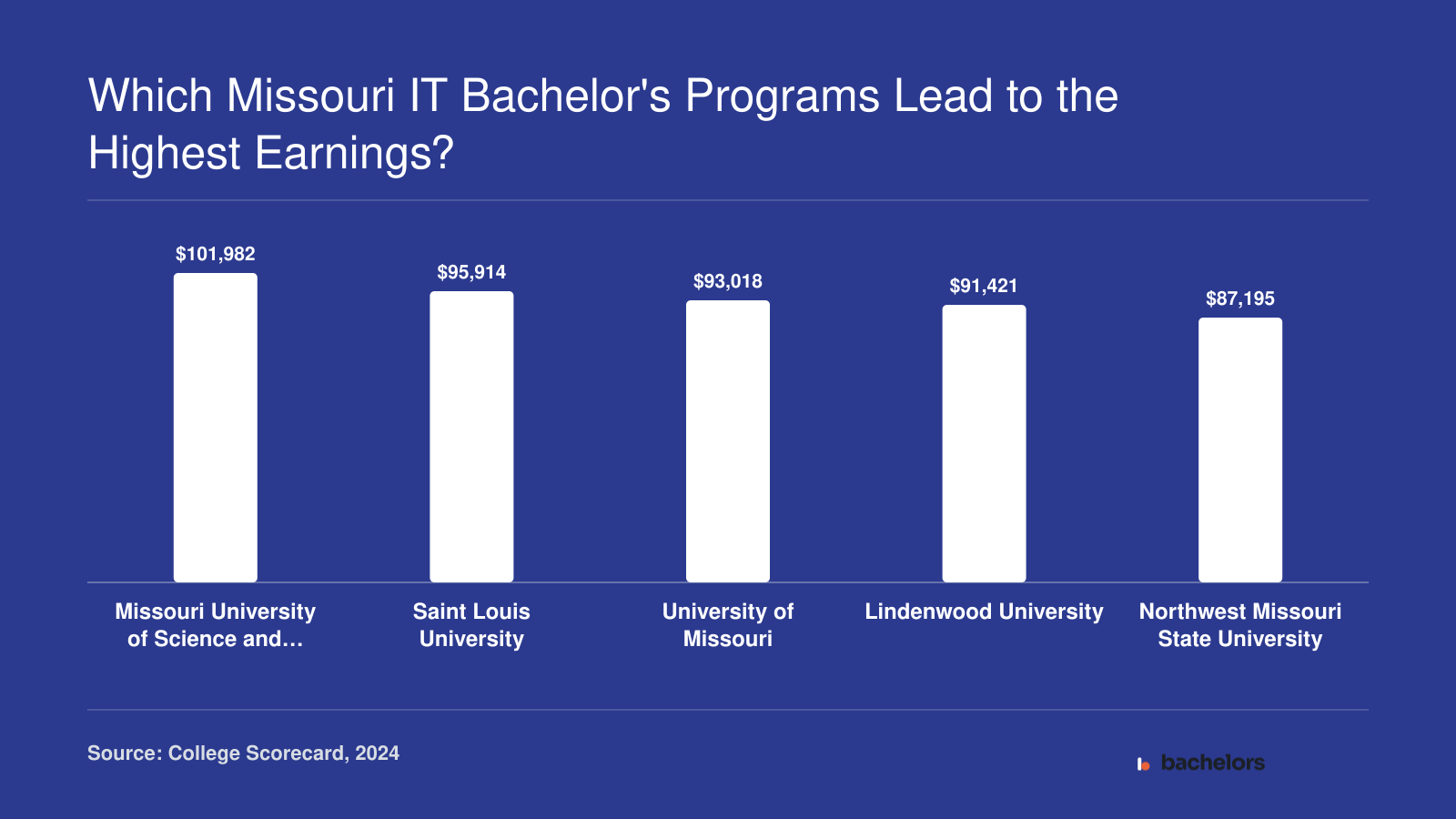
Which Missouri IT Bachelor's Programs Lead to the Highest Earnings?
Missouri University of Science and Technology information technology graduates earned a median $101,982 five years after completion, the highest among the ranked schools shown, followed by Saint Louis University at $95,914 and the University of Missouri at $93,018. Lindenwood University ($91,421) and Northwest Missouri State University ($87,195) are also included, with all figures measured five years after completion. Weigh these earnings against the net prices in the cost table above. Northwest's $16,244 average net price is paired with earnings close to the top of this group, while Saint Louis University's result comes from a very small graduating class.
Online and Hybrid Bachelor's Degree Options at Missouri Schools
The University of Missouri-St. Louis offers its information systems and technology bachelor's in all three delivery modes: on campus, 100% online and hybrid, with 120 credits required. That flexibility is worth understanding, because "online" can mean different things at different Missouri schools.
Fully Online, Hybrid, and Campus With Online Courses
A fully online degree can be completed without visiting campus at all. Hybrid means some required work happens in person, even if most courses are online. A campus program with some online courses is a third category: the degree is built around in-person classes, and online sections are an option or a supplement.
Which Schools Use Which Format
- University of Missouri-St. Louis: on-campus, 100% online and hybrid completion are all available.
- Northwest Missouri State University: program data lists both campus and online options for its IT bachelor's. It also offers a B.A.S. for transfer students; that is a completion pathway for technical credit, not the same thing as a fully online four-year IT degree.
- University of Central Missouri: listed with both campus and online formats; classes run at Warrensburg and Lee's Summit.
- Missouri State University: its IT bachelor's is offered online, with the same curriculum as the on-campus version, according to the program page.
- Saint Louis University: its Computer Information Systems B.S. is offered online.
Several other schools on the list are campus-based, including the University of Missouri, Missouri S&T, UMKC, Missouri Southern and Hannibal-LaGrange. A campus program can still include online sections, but do not assume the whole degree can be finished remotely.
Check the Residency Rate Before You Enroll
Missouri's public universities publish in-state and out-of-state tuition rates, and the program pages do not show a separate online rate. If you live outside Missouri, ask whether the online format charges the in-state rate or the out-of-state rate before you apply.
Admission Requirements for a Bachelor's Degree in Information Technology in Missouri
Freshman Entry
Missouri's IT schools range from moderately selective to nearly open. Federal admission rates show the spread: University of Missouri-St Louis admits about 63% of applicants and University of Central Missouri about 64%. Missouri University of Science and Technology (73%), University of Missouri-Kansas City (72%), Hannibal-LaGrange University (73%), Saint Louis University (75%) and University of Missouri (78%) sit in the middle. Northwest Missouri State University (86%), Missouri State University (91%) and Missouri Southern State University (97%) admit most applicants.
University of Missouri publishes no single minimum GPA for freshmen. Review centers on your high-school curriculum, with at least 17 college-preparatory units: 4 English, 4 math (Algebra 1 or higher) and 3 science, not counting General Science. Fall 2026 freshmen can apply test-optional, and a committee judges admissibility holistically. Its published materials do not give score cutoffs for students who submit tests. University of Missouri-Kansas City lists automatic admission with a 3.0 high-school GPA and names the ACT as its exam.
For the other schools, we could not confirm a minimum GPA or test requirement, so check each admissions page rather than assuming one. The same goes for application deadlines, which vary by term and by campus.
Transfer Entry
Transfer rules are where policies differ most.
- University of Missouri: A 2.5 GPA on college-level credits, plus a C- or better in transferable math (intermediate algebra or higher, or statistics) or in English Composition I or higher. Students with fewer than 24 college-level credits must also meet freshman requirements.
- Community-college route: An associate of arts degree or Missouri CORE 42 with a 2.0 GPA from an accepted two-year college generally counts as completed general education. Students arriving with 60 or more credits skip ENGINR 1050 in the IT degree.
- University of Missouri-Kansas City: Transfers need 24 credits and a 2.0 GPA.
- Northwest Missouri State University: A Bachelor of Applied Science pathway is built to maximize vocational and technical transfer credits.
We could not confirm credit caps for most schools, so ask each registrar for a written transfer evaluation before you commit.
What to Prepare First
Start with official transcripts from every school you have attended, since they drive both admission and credit evaluation. Order test scores only if a school asks for them or you want them considered. File the FAFSA as soon as it opens, because aid and scholarship consideration can be tied to early filing even when admission deadlines are later.
Related Articles
IT vs. Information Systems vs. Cybersecurity Degrees, and Why ABET Matters
ABET accredits individual computing programs, not whole institutions, and it publishes separate criteria for information technology, information systems and cybersecurity. AACSB is a different accreditor: it reviews business schools, so it matters mainly when an information systems degree sits inside a business college. Among the Missouri schools ranked here, the University of Central Missouri appears in ABET's accredited program search, but the result does not identify the program title or the accrediting commission. ABET status for the other schools is not verified, so check ABET's program search before you apply.
| Comparison point | Information Technology | Information Systems | Cybersecurity |
|---|---|---|---|
| Main focus | Installing, configuring and supporting networks, systems and software for organizations | Using technology to solve business problems, linking data and systems to how a company operates | Protecting systems, networks and data from attack, and responding when security fails |
| Typical coursework | Networking, databases, systems administration, web and application development | Systems analysis and design, databases, project management, business process courses | Network defense, cryptography, secure coding, risk management, digital forensics |
| Common first jobs | Help desk or IT support specialist, network administrator, systems administrator | Business or systems analyst, database analyst, IT project coordinator | Security analyst, SOC analyst, junior penetration tester |
| Typical accreditation | ABET computing accreditation, which has program-specific IT criteria | ABET computing accreditation with information systems criteria, or AACSB when housed in a business school | ABET computing accreditation, which has program-specific criteria for undergraduate cybersecurity |
| Missouri examples and ABET status | University of Missouri, Northwest Missouri State University, Missouri State University, University of Central Missouri and Lindenwood University offer IT degrees. Central Missouri is in ABET's search, but program title is unconfirmed. Others: not verified | Saint Louis University (Computer Information Systems), University of Missouri-St Louis (Business Information Technology) and Missouri Southern State University (CIS, IT Option). ABET status: not verified | Review each school's catalog for security coursework or emphasis areas. ABET status for cybersecurity at the schools here: not verified |
| Best fit for | Networking and hands-on infrastructure work, such as Lindenwood's Networking Emphasis | Business-facing systems work, where you translate between managers and technical teams | Security careers, or an IT degree with security electives if a dedicated major is not offered |
Questions to Ask Yourself
Do you want to build and maintain systems, or connect technology to business strategy?
Is a security specialization your goal, and does your target employer ask for an ABET-accredited degree?
Do you need a fully online program, or can you attend campus at least part of the time?
Frequently Asked Questions
These answers draw on the school profiles and cost figures earlier on this page. Confirm current details with each school's admissions and financial aid offices before you apply.
What is the best school for information technology in Missouri?
How much does an information technology degree cost in Missouri?
Do you need a license to work in IT in Missouri?
Can community college credits transfer into a Missouri bachelor's in information technology?
Compare Information Technology programs on the data that matters
Explore more Computers & IT majors or browse every field of study.
All Computers & IT programs Browse every field of study