Best Early Childhood Education Schools in Missouri
Compare 29 accredited Early Childhood Education programs in Missouri at 23 colleges, with net price after aid, graduation rates, earnings and debt from IPEDS and the U.S. College Scorecard.
A bachelor's degree in early childhood education, usually a Bachelor of Science (B.S.), prepares students to teach children from birth through grade 3. In Missouri, the right program depends on two things: whether it leads to state teacher certification, and what it costs after aid.
College of the Ozarks ranks first, with an average net price of $6,100 a year, the lowest among the schools here. Cost, online delivery, admissions standards and licensure rules all differ from campus to campus.
The label on the diploma matters as much as the price. Some child development degrees, such as Cottey College's, carry no teacher certification.
Key Points
- College of the Ozarks posts the lowest 2024 net price: $6,100.
- The University of Missouri's online B.S.Ed. costs $74,580 for 120 credits.
- Child development degrees don't lead to Missouri's birth through grade 3 certificate.
Best Early Childhood Education Schools in Missouri: Our Top 10
Ten Missouri colleges and universities offer a bachelor's degree in early childhood education or a closely related child development path, and they differ sharply in delivery, cost and how much time students spend in real classrooms. The list covers campus programs, fully online options and blended formats, from a work college in the Ozarks to research universities in Columbia, Kansas City and St. Louis. Each entry notes the credential, the ages the program prepares you to teach, and the field experiences that come with it.
College of the Ozarks
#1Point Lookout, MO · $5,000 – $10,000/yr (est.)
Best for: Hands-on learners at a work college
College of the Ozarks sits in Point Lookout, near Branson, and pairs teacher preparation with a work college model in which students hold campus jobs. Its early childhood pathway runs through a Bachelor of Science in Elementary Education with an early childhood concentration, and the teacher education program is accredited by the Missouri Department of Elementary and Secondary Education. Education majors can join a Student Missouri State Teachers Association chapter or Kappa Delta Pi, the education honor society. A new child development center planned with eight classrooms broke ground in May 2026 and is designed to give students hands-on time with young children.
- Early childhood concentration inside the Elementary Education B.S.
- Teacher education accredited by the Missouri Department of Elementary and Secondary Education
- An approved program of study qualifies graduates for Missouri teacher certification
- Kappa Delta Pi honor society invites education majors with a 3.00 GPA
- Student Missouri State Teachers Association chapter meets about once a month
- Middle school add-ons available for education majors
University of Missouri
#2Columbia, MO · ~$20,000/yr (est.)
Best for: Working adults needing a fully online path
The University of Missouri in Columbia runs a 120-credit Bachelor of Science in Education in Early Childhood Education that students can complete entirely online, with coursework offered in synchronous and asynchronous formats. Fieldwork stays local: students complete several practicums and a 16-week student teaching internship in schools near them, so no campus visits are required for classes. The degree leads to initial Missouri certification for birth through grade 3 and prepares students for the Praxis exam. The program is approved by the Missouri Department of Elementary and Secondary Education.
- 120 credit hours over about four years on a semester calendar
- 100% online, with synchronous and asynchronous course options
- No campus visits for coursework; practicums and a 16-week internship are local
- Leads to initial Missouri certification for birth through grade 3
- Prepares students for the Praxis certification exam
- Accredited by the Missouri Department of Elementary and Secondary Education
- Students take four to six classes per semester
Cottey College
#3Nevada, MO · ~$14,000/yr (est.)
Best for: Women seeking child care careers, not licensure
Cottey College, a women's college in Nevada, Missouri, offers an online Bachelor of Arts in Child Development built for community, commercial and nonprofit child care settings. Classes run in 8- or 16-week terms, and students can steer 8 credits toward work with school-aged children, including reading and writing with young children. The degree does not lead to certification or licensure, so it suits readers aiming at child care leadership, advocacy or social support work rather than a teaching license. Projects, a capstone and internships round out the curriculum.
- Online bachelor's for women, with 8- or 16-week classes
- Prepares students for community, commercial and nonprofit child care settings
- 8 credits of school-aged child emphasis coursework available
- Curriculum includes early childhood methods and family and community resources
- Program does not lead to certification or licensure
- Projects, capstone and internships built into the degree
University of Missouri-Kansas City
#4Kansas City, MO · $13,000 – $30,000/yr (est.)
The University of Missouri-Kansas City awards a Bachelor of Arts in Early Childhood Education through its School of Education, Social Work and Psychological Sciences, with courses and field placements delivered in person. The program holds CAEP accreditation and DESE approval, and graduates can be recommended for Missouri certification after passing state assessments. Admission to the professional program is selective: a 2.75 overall GPA, a 3.0 GPA in education courses, a faculty interview and Missouri Substitute Teacher Certification. Students practice in one of nine partner districts and finish with a semester-long student teaching placement.
- 120 credit hours over four years, with courses and field placements in person
- CAEP accredited and DESE approved; graduates may be recommended for certification
- Admission requires a 2.75 overall GPA and a 3.0 GPA in education courses
- Faculty interview, Missouri Substitute Teacher Certification and TB test required
- Practicums in one of nine partner districts plus semester-long student teaching
- Spring application only, for a fall start
- Graduation requires a 3.0 cumulative and professional education GPA
Maryville University
#5Saint Louis, MO · ~$22,000/yr (est.)
Maryville University in St. Louis awards a bachelor's degree in elementary and early childhood education that leads to dual certification: elementary grades 1 through 6 plus early childhood birth through grade 3. Fieldwork starts early, with sophomores spending eight hours a week in an assigned classroom, and students complete placements in at least three school settings with partners including Parkway, Ritenour, Lindbergh, Hazelwood and Kirkwood. Classes average 14 students, and there is no application fee. Maryville reports a 98% career outcomes rate, and graduates work as early childhood, preschool, kindergarten and elementary teachers or early learning program coordinators.
- Dual certification: elementary grades 1-6 and early childhood birth through grade 3
- Sophomores spend eight hours a week in an assigned classroom
- Placements in at least three school settings across five partner districts
- Average class size of 14
- No application fee; scholarships, need-based aid and GI Bill benefits available
- Graduates work as early childhood, preschool and kindergarten teachers
Missouri State University
#6Springfield, MO · $18,000/yr (est. net price)
Missouri State University in Springfield runs one of the largest early childhood programs in the state, with an early childhood education major housed alongside family development in the College of Education. The program is accredited by the Missouri Department of Elementary and Secondary Education, NAEYC and the National Council for Accreditation of Teacher Education, and students get into classrooms before student teaching. A separate Child and Family Development degree adds child development, child life, family studies and youth development tracks. A published four-year plan and transfer resources make it easy to map the route to graduation.
- Accredited by DESE, NAEYC and the National Council for Accreditation of Teacher Education
- Field placement and classroom experience before student teaching
- Internship Academy option places students with a master teacher for a full year
- Sample four-year degree plan and transfer resources published
- Housed in a department that also includes family development
- Financial aid and scholarships available
Southeast Missouri State University
#7Cape Girardeau, MO · $16,000/yr (est. net price)
Southeast Missouri State University delivers its early childhood education bachelor's on the Cape Girardeau campus and at its Kennett and Sikeston regional sites, with a separate online child development option for readers who need distance learning. The campus program is a Bachelor of Science in Education with a semester-long co-teaching capstone in a prekindergarten through third grade classroom, and field experiences start with infants and toddlers. Graduates are certified for birth through grade 3 and can add elementary certification for grades 1 through 6. The online child and family studies track has no set class times and accepts credit for prior learning.
- Taught on the Cape Girardeau campus and at Kennett and Sikeston
- At least 120 credit hours, including 39 senior division hours
- Semester-long co-teaching placement in a prekindergarten through grade 3 classroom
- Educator Preparation Program admission needs 42 credits plus ACT, SAT or MoGEA
- Graduates need a 3.0 professional education GPA and passing state content assessments
- Certifies teachers for birth through grade 3; elementary grades 1-6 certification can be added
- Field experiences begin with infants, toddlers and preschoolers
University of Missouri-St Louis
#8Saint Louis, MO · $15,000 – $20,000/yr (est.)
The University of Missouri-St. Louis offers a Bachelor of Science in Education in Early Childhood with an emphasis in early childhood special education, and the degree leads to Missouri certification for birth through grade 3. Students can add special education certification by passing one more state assessment, which makes the program stand out for readers who want to work with young children with disabilities. A year-long practicum places students in a local school or one of the region's Studio Schools, supported by on-campus seminars. The College of Education works with more than 36 public, private and charter schools and sponsors eight charter schools.
- Emphasis in early childhood special education
- Leads to Missouri certification in early childhood, birth through grade 3
- Add early childhood special education certification with one more state assessment
- Year-long practicum in a local school or a regional Studio School
- College of Education partners with more than 36 public, private and charter schools
- Coursework covers child development theory and developmentally appropriate practice
- On-campus seminars run alongside the practicum
University of Central Missouri
#9Warrensburg, MO · ~$14,000/yr (est.)
The University of Central Missouri delivers an elementary education degree with an early childhood birth through grade 3 option at its Warrensburg and Lee's Summit sites, in online, face-to-face and hybrid formats with full-time and part-time plans. Teacher education has held CAEP accreditation since 1954 and is also approved by the Missouri Department of Elementary and Secondary Education. Clinical teaching in real classrooms comes before graduation, and the university lists transfer agreements such as an AA Teaching pathway from Moberly Area Community College plus a T.E.A.C.H. Early Childhood Missouri Scholarship arrangement. A paraprofessional degree completion route suits working classroom staff.
- 120 credit hours with full-time and part-time degree plans
- Warrensburg and Lee's Summit sites; online, face-to-face and hybrid options
- CAEP accredited since 1954 and approved by the Missouri Department of Elementary and Secondary Education
- DESE certification for ages birth through grade 3
- Clinical teaching in real classrooms before graduation
- AA Teaching transfer agreement with Moberly Area Community College
- T.E.A.C.H. Early Childhood Missouri Scholarship arrangement listed
- Paraprofessional degree completion program available
Evangel University
#10Springfield, MO · ~$19,000/yr (est.)
Evangel University in Springfield prepares students for dual certification in early childhood, birth through grade 3, and elementary grades 1 through 6, with field experience starting as early as freshman year. Placements cover infants and toddlers, preschoolers, early childhood special education students and elementary classrooms, and the program ends with a year-long student teaching internship. Coursework includes early literacy, language development and perceptual motor development. The program is Missouri Fast Track eligible, and the university highlights the T.E.A.C.H. Missouri Scholarship and loan forgiveness programs for early childhood educators.
- Dual certification: birth through grade 3 and elementary grades 1-6
- Field experiences begin as early as freshman year
- Year-long student teaching internship
- Coursework in early literacy, language development and perceptual motor development
- Placements include infants, toddlers and early childhood special education students
- Missouri Fast Track eligible
- Scholarships available for education majors
Cost & outcomes by school
Federal data for the highest-earning Early Childhood Education programs, independent of the ranking above. Earnings are this field's bachelor's graduates four years after completing where the Scorecard reports them, else the school's undergraduate median.
| School | Net price / yr | Grad rate | Earnings | Debt | Grads/yr | Format |
|---|---|---|---|---|---|---|
| Westminster College MO | $24,314 | 56% | $52,199 | $27,000 | 13 | Campus |
| Park University MO | $21,032 | 38% | $45,525 | $23,944 | 24 | Online or campus |
| Columbia College MO | $22,715 | 42% | $45,378 | $23,879 | — | Online or campus |
| University of Missouri MO | $20,268 | 75% | $44,681 | $20,475 | 200 | Online |
| Missouri Valley College MO | $18,086 | 22% | $43,221 | $25,950 | 11 | Campus |
| Northwest Missouri State University MO | $16,244 | 54% | $42,508 | $23,350 | 97 | Campus |
| Lindenwood University MO | $19,638 | 49% | $41,633 | $25,250 | 5 | Hybrid |
| College of the Ozarks MO | $6,100 | 64% | $41,592 | — | 15 | Campus |
| University of Missouri-Kansas City MO | $13,310 | 56% | $41,228 | $21,566 | 37 | Campus |
| Maryville University MO | $22,066 | 66% | $39,331 | $22,862 | 15 | Campus |
| Missouri Western State University MO | $13,251 | 39% | $39,163 | $19,493 | 30 | Campus |
| University of Missouri-St Louis MO | $15,071 | 57% | $38,980 | $20,500 | 89 | Campus |
Sources: U.S. Department of Education. Net price, graduation rate, earnings and debt: College Scorecard (earnings and debt for this field's bachelor's graduates where reported, else school-wide); graduates: IPEDS. A dash means no figure is reported.
Cost, debt & payoff
Median earnings of this field's bachelor's graduates (4 yrs after completing, else the school's undergraduate median) vs. their median federal loan debt · U.S. College Scorecard
Across these programs the median graduate earns about $38,641 and finishes with roughly $22,494 in debt — a ratio that clears a common rule of thumb (keep debt below first-year salary). Net price and debt vary widely school to school, so check the per-school figures in the table above before you shortlist.
How We Ranked Bachelor's in Early Childhood Education Programs
This ranking rests on federal data and public program records, not on reputation. We limited the field to Missouri bachelor's programs, whether taught on campus or online.
What the Figures Do and Don't Measure
Two of these measures come with a caveat. Both the graduation rate and net price are institution-wide averages. They describe an entire university, not the early childhood education program inside it, so your experience as an education major may differ from the number shown. Earnings and debt are tied to the specific program where federal data allows. Small programs can produce thin or unreported numbers, and we left those points out rather than guess.
What the Ranking Cannot See
Data cannot tell you how strong a curriculum is, how much classroom time you get, or how well graduates do on licensure exams. Check those yourself before you apply:
- Certification: Confirm the program leads to Missouri certification for birth through grade 3.
- Exam results: Ask the school for recent licensure exam pass rates.
- Field experience: Look at the length and quality of student teaching placements.
- Accreditation: Verify the program's CAEP status.
Use the rankings to build a shortlist, then confirm these details with each school's education department.
Cheapest Missouri Schools for a Bachelor's in Early Childhood Education
These schools are sorted by average net price, the yearly cost after grants and scholarships, using 2024 federal data from IPEDS and the College Scorecard. College of the Ozarks has the lowest net price at $6,100. Harris-Stowe State University and Missouri Western State University, both in our directory, have the lowest published in-state tuition. Cottey College's online Child Development degree does not lead to teacher certification, so students aiming for a Missouri classroom license should weigh that before choosing on price.
| School | City | Type | Program | Format | In-State Tuition and Fees | Average Net Price | Median Debt at Graduation |
|---|---|---|---|---|---|---|---|
| College of the Ozarks | Point Lookout | Private nonprofit | Elementary Education Major, Early Childhood Concentration | Campus | $22,320 | $6,100 | N/A |
| Harris-Stowe State University | Saint Louis | Public | Early Childhood Education | Campus | $7,008 | $9,922 | $25,930 |
| Missouri Western State University | Saint Joseph | Public | Early Childhood Education | Campus | $10,306 | $13,251 | $19,968 |
| University of Missouri-Kansas City | Kansas City | Public | Bachelor of Arts: Early Childhood Education | Campus | $12,587 | $13,310 | $18,750 |
| Cottey College | Nevada | Private nonprofit | Child Development | Online | $27,562 | $13,805 | $19,043 |
Online and Hybrid Bachelor's Degree Options at Missouri Schools
The University of Missouri's fully online Bachelor of Science in Education in Early Childhood Education spans 120 credit hours with a published total program tuition of $74,580, delivered synchronously or asynchronously with no campus visits for coursework.
Fully Online Options
- University of Missouri: Four to six courses a semester, multiple practicum placements and fieldwork arranged in your local area. The program leads to initial Missouri certification for birth through grade three.
- Cottey College: The Child Development bachelor's is available fully online with 8- or 16-week classes. Cottey states plainly that the program carries no certification or licensure, so it suits students aiming at childcare, advocacy or social services rather than a teaching license.
Hybrid and Campus Delivery
University of Central Missouri publishes both formats, pairing a fully online route with part-time and full-time study and a paraprofessional degree completion track. College of the Ozarks, UMKC, Maryville University, Missouri State University, Southeast Missouri State University, University of Missouri-St Louis and Evangel University publish campus delivery only.
Questions for Working Adults and Transfers
Ask how often your cohort meets, how many courses run per term, and whether practicum hours can be placed near your job. Online students still complete in-person student teaching: Mizzou's internship is a 16-week unpaid placement, UMKC's runs a semester, and UMSL pairs a year-long practicum with on-campus seminars. Transfers should confirm which community college credits count toward the 120-hour total.
Admissions Requirements: GPA, Test Policy, and Transfer Credit
Policies vary widely across Missouri schools, and several publish little. Here is what the admissions and program pages state.
GPA and test policy
- University of Missouri: Online transfer applicants need a 2.5 cumulative college GPA.1 Freshmen must meet an ACT/SAT minimum but can request test-optional review.1 Exact score cutoffs are not stated.
- Southeast Missouri State University: No program admission GPA is published. Educator Preparation Program entry requires ACT 20, SAT 1040, passing all MoGEA sections, or a four-year degree.
- Missouri State University: No minimum GPA, test policy or transfer rules are published. A 3.0 Professional Education GPA applies to certification recommendation, not admission.
- University of Missouri-Kansas City: The program lists a 3.0 GPA minimum, a faculty interview, and spring application for fall admission only.
- Missouri Western State University (in our directory): It lists a 2.50 overall GPA, 3.0 professional and content GPAs, and an ACT composite of 17.3 It does not state a test-optional or SAT policy.
For the other schools here, we did not confirm a published policy, so check each admissions page directly.
Selectivity context
Scorecard admissions rates show how competitive entry is: about 91% at Missouri State, 78% at Mizzou, 74% at Southeast Missouri State and 72% at UMKC. A high rate does not mean easy program entry, since teacher education gates often come later.
Program-entry gates
Many programs admit you to the university first and to teacher education second. Southeast Missouri State expects 42 credit hours before program admission. Missouri Western requires EDU 202 with a C or higher and credit in EDU 203.3 Mizzou's Human Development program asks transfers for 24 applicable hours, including MATH 1100 or ENGLSH 1000 equivalents with a C- or better.2
Community-college transfers
Mizzou says requirements differ for University of Missouri System transfers and associate degree holders from regionally accredited Missouri community colleges, but it does not spell out the credit rules. It requires 24 applicable hours; applicants with fewer apply as freshmen.1 Southeast Missouri State and Missouri Western publish no transfer-credit policy in what we reviewed. Credit caps are rarely stated, so get a written credit evaluation before you enroll.
How Does Sticker Price Compare With Net Price at Missouri's Top Early Childhood Education Schools?
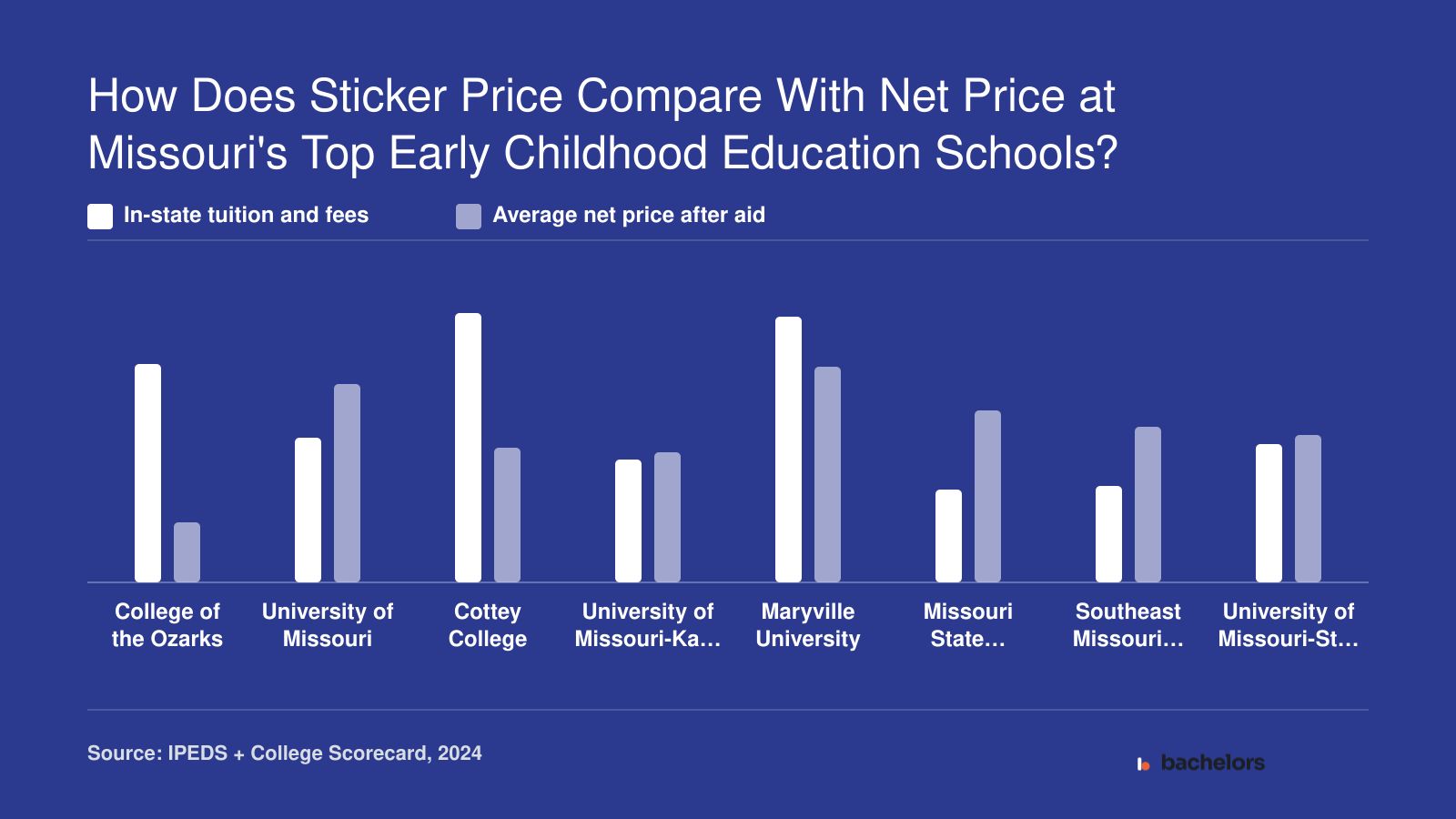
Published in-state tuition and fees tell only part of the story. Net price is the average a full-time student actually pays per year after grants and scholarships, and it covers housing, food and books as well as tuition. That is why a public university's net price can sit above its tuition, while a wide gap in the other direction, as at College of the Ozarks, Cottey College and Maryville University, shows how much aid can matter. Net price is a schoolwide average, not a program figure, so your own cost will depend on your aid package.
Cost of a Bachelor's Degree in Early Childhood Education in Missouri
Missouri's public universities make a bachelor's degree in early childhood education affordable, but the price gap between schools is wide. Among the ranked schools with data here, in-state tuition runs from $9,903 at Southeast Missouri State University to $27,562 at Cottey College. Net price after aid runs from $6,100 at College of the Ozarks to $15,882 at Southeast Missouri State. Residency matters at the large publics: University of Missouri-St Louis charges $14,112 in-state against $35,112 out-of-state, a gap of $21,000 a year.
Missouri Aid Programs
- Access Missouri: Awards $500 to $1,700 a year in 2026-27.1 You must be a Missouri resident, enroll full-time, and have a Student Aid Index of $12,000 or less. There is no separate award for education majors.1
- A+ Scholarship: Covers unpaid tuition and fees at community colleges and technical schools, up to $240 per credit hour, after federal grants.2 It requires an A+ high school agreement and a 2.5 GPA.3 It does not pay for a four-year bachelor's program.2
- Fast Track: One Missouri institution describes up to $500 for other education expenses when other aid covers tuition.4 That is not a statewide maximum. Southeast Missouri State lists its program as Fast Track eligible.
- TEACH Grant (federal): Up to $4,000 per year if you commit to four years teaching a high-need subject at a low-income school.5 Miss the commitment and it becomes an unsubsidized loan.5 No Missouri state scholarship limited to early childhood majors was identified.4
What Graduates Borrow
Program-level median debt is about $20,500 at University of Missouri-St Louis, $21,500 at the University of Central Missouri, and $22,000 at Southeast Missouri State. That works out to roughly $217 to $233 a month on a 10-year plan.
Three Ways to Spend Less
- Start at a community college: Use A+ to cover the first two years, then transfer into a bachelor's program.
- File the FAFSA early: Access Missouri has FAFSA deadlines, so confirm the current date with the state.1
- Pair aid with service: Teacher scholarships tied to service, like the TEACH Grant, can cut costs if you will teach in a high-need school.
Related Articles
Missouri Teacher Licensure and CAEP Accreditation for Birth Through Grade 3
A child development degree and a teaching degree can look alike in a course catalog, but only one of them puts you in a Missouri classroom. The difference is whether the program leads to state certification.
The DESE Path to Birth Through Grade 3 Certification
The Missouri Department of Elementary and Secondary Education (DESE) issues the Early Childhood Education, Birth-Grade 3 certificate. For a traditional candidate, the steps run in this order:
- Approved program: Complete a DESE-approved educator preparation program. Eligibility rests on this.
- MoCA exams: Pass the Missouri Content Assessments required for the birth-grade 3 area. DESE's current Early Childhood Education, Birth-Grade 3 Matrix (revised 08-25) lists them, so check it rather than rely on a school's summary.
- Student teaching: Finish the clinical practice your program requires.
- Application: Apply through DESE's online Certification Account Portal, where you can also track transcripts, fingerprint status and scores.
DESE does not issue temporary authorization certificates in birth-grade 3, so do not plan on teaching before finishing the program. Questions go to DESE Educator Certification at 573-751-0051 or [email protected].
Certification-Track vs. Non-Certification Degrees
A B.S.Ed. or similar education degree built around the DESE-approved program is the classroom route. Degrees in child development or educational studies can lead to child care, family services or advocacy work, but they may not lead to certification. Cottey College's child development program, for example, states that it carries no certification or licensure. Before you enroll, ask whether the exact major, not just the school, is DESE-approved.
Student Teaching and CAEP Accreditation
Expectations vary. Southeast Missouri State University and the University of Missouri-Kansas City describe semester-long student teaching. The University of Missouri lists a 16-week unpaid internship. Evangel University and the University of Missouri-St Louis describe year-long internship or practicum models. Ask any program for its exact hours and placement rules.
The Council for the Accreditation of Educator Preparation (CAEP) is the national accreditor of educator preparation programs. It is separate from DESE approval. The University of Missouri-Kansas City and the University of Central Missouri both state CAEP accreditation. Missouri State University cites accreditation from NCATE, an earlier accreditor, and the National Association for the Education of Young Children. For the other schools here, CAEP status could not be verified, so confirm it directly with the program.
Early Childhood Careers in Missouri: Settings, Pay and Demand
A bachelor's degree in early childhood education leads to four main work settings in Missouri, and each one expects a different credential.
Public school pre-K through grade 3
Certified teaching positions in a district. Requires the degree plus Missouri certification for birth through grade 3, including supervised student teaching and the state's required assessments. This is the highest-paying track in the field, and the one where the bachelor's degree is non-negotiable.
Preschool, Head Start and child care centers
- Private preschools: Lead teachers are often hired with an associate's degree, but a bachelor's is preferred and increasingly expected.
- Head Start: Federally funded classrooms where lead teachers typically hold at least a bachelor's in early childhood education or a closely related field.
- Child care centers: Aides and assistants generally need a high school diploma and short-term on-the-job training; lead teachers need more.
What the pay looks like
Missouri-specific medians for these roles were not in the sources reviewed, so these are BLS national figures from May 2025: kindergarten and elementary school teachers $63,820 combined,2 preschool teachers $38,140 ($18.34 an hour)1, child care workers $34,980 ($16.82 an hour)3. Employment is large, at 583,200 preschool teachers and 1,010,300 child care workers nationwide. Earnings published for individual programs, measured a few years after students finish, are a separate signal: they cover only graduates who are working and reporting, so treat them as one clue rather than a salary promise.
Demand and a practical tip
For 2025-2035, BLS projects preschool teaching up 4% (26,200 jobs, 66,700 openings a year)1, kindergarten and elementary flat, and child care down 2% (19,900 jobs)3 while still generating 150,300 openings a year from turnover. For a local comparison: in St. Louis, all occupations average $31.89 an hour against $33.54 nationally, and preschool and daycare administrators there number 550 at a mean of $59,380.4
Pick the setting before the program. If you want a public classroom, prioritize a path that ends in certification. If you want to lead a private classroom or center, weigh cost and field hours instead.
Compare Early Childhood Education programs on the data that matters
Explore more Education & Teaching majors or browse every field of study.
All Education & Teaching programs Browse every field of study