Best Criminology Schools in Missouri
Compare 11 accredited Criminology programs in Missouri, with net price after aid, graduation rates, earnings and debt from IPEDS and the U.S. College Scorecard.

Criminology bachelor's degrees in Missouri usually take 120 credit hours, and schools award either a Bachelor of Science (B.S.) or a Bachelor of Arts (B.A.). Published in-state tuition for it runs from $9,502 at Missouri State University to $55,760 at Saint Louis University.
The schools ranked here span public and private campuses from Kansas City to Springfield to St. Louis. Some require you on campus, while several offer fully online or blended formats.
A program's name says little about where its graduates land, whether in policing, probation, research or social services.
Key Points
- University of Missouri-Kansas City ranks first, with the lowest average net price.
- Four years out, Maryville University criminology graduates earned a $66,612 median.
- Northwest Missouri State offers its B.S. in Criminology entirely online.
Best Bachelor's Degree in Criminology Programs in Missouri, Ranked
The best criminology school in Missouri for most students is the University of Missouri-Kansas City, which takes the top spot on the strength of a tightly structured 36-credit major, a required capstone and the lowest average net price after aid on this list. Its Kansas City location keeps students close to the agencies where many of them will eventually work, and the program pairs theory and research methods with real coursework in policing, courts and corrections. The nine schools that follow trade places on cost, delivery format and the depth of their connections to Missouri law enforcement.
University of Missouri-Kansas City
#1Kansas City, MO · $13,000 – $30,000/yr (est.)
Best for: Kansas City students wanting a research capstone
The University of Missouri-Kansas City is a public research university that awards its Bachelor of Arts in Criminal Justice and Criminology through the College of Arts and Sciences. The major runs 36 credits inside a 120-credit, four-year degree, moving from criminological theory and statistics into a capstone seminar. Net price after aid averages about $13,310 a year, the lowest of the Missouri schools here, and schools offering this program report institution-wide graduation rates around 56%. Students take one course each in policing, courts and corrections, then build 12 credits of electives.
- 120-credit, four-year degree with a 36-credit major
- Foundation courses in criminological theory, research methods and statistics
- One course each in policing, courts and corrections
- 12 credits of criminal justice and criminology electives
- Capstone seminar (CJC 495WI) required to finish
- At least 21 of the 36 major hours must be taken at UMKC
- C- or better in five core courses; 2.0 GPA in major and overall
- Missouri civics exam required to graduate
Missouri State University
#2Springfield, MO · $18,000/yr (est. net price)
Best for: Working adults needing fully online coursework
Missouri State University in Springfield awards both a Bachelor of Science and a Bachelor of Arts in criminology and criminal justice, and students can attend seated, fully online, or in a mix of the two. The BS concentrates on the major while the BA layers in language, fine arts and humanities coursework, and neither version requires a minor. Net price after aid averages about $17,613 a year, and schools offering this program report institution-wide graduation rates around 58%. Missouri Department of Corrections employees receive a 10% tuition discount, and select electives can double-count toward departmental certificates.
- Bachelor of Science or Bachelor of Arts; no minor required
- Seated, fully online, or blended formats
- Electives double-count toward a criminal investigation certificate
- Certificates also in criminal courts and victim advocacy
- Academic credit possible for academy or professional training
- Dual credit or transfer credit accepted at admission
- Coursework includes forensic science, terrorism, serial killers
- Alumni work as FBI agents, U.S. Marshals and police detectives
University of Missouri-St Louis
#3Saint Louis, MO · $15,000 – $20,000/yr (est.)
Best for: Certified officers seeking credit for academy training
The University of Missouri-St. Louis offers an interdisciplinary Bachelor of Science in Criminology and Criminal Justice that pulls together criminology, law, public administration and corrections. Students can study on campus or 100% online, with 4-, 8-, 12- and 16-week terms that suit working adults, and certified Missouri and Illinois law enforcement officers may receive credit for their training. Net price after aid averages about $15,071 a year, with institution-wide graduation rates at schools in this group around 57%. A partnership with the St. Louis Metropolitan Police Department covers tuition for participating officers after reimbursement.
- Interdisciplinary BS in the College of Arts and Sciences
- On campus or 100% online; 4-, 8-, 12- and 16-week terms
- Core: theories of crime, criminal law, justice policy, research methods
- Credit may be allowed for Missouri and Illinois certified officers
- Accelerated BS to MS pathway with fewer total credit hours
- Honors College adds no extra classes
- St. Louis police partnership covers tuition after reimbursement
- Criminology and Criminal Justice Student Association
Maryville University
#4Saint Louis, MO · ~$22,000/yr (est.)
Maryville University is a private university in St. Louis that awards a Bachelor of Arts in Criminal Justice/Criminology, with a fully online criminology version for students who cannot come to campus. The degree treats crime as a social phenomenon and leans on data-driven approaches, a required senior-year practicum and a police cadet program that includes crime scene investigation and fingerprinting. Net price after aid averages about $22,066 a year, and schools offering this program report institution-wide graduation rates near 66%. Average class size is 14, and there is no application fee.
- Required senior-year practicum
- Fully online Bachelor of Arts in Criminology also available
- Police cadet program with crime scene investigation and fingerprinting
- Placements with municipal police, U.S. Marshals, FBI and law offices
- Average class size of 14
- No application fee
- Spring 2027 starts January 11; fall 2027 starts August 23
- Military benefits accepted
Drury University
#5Springfield, MO · ~$21,000/yr (est.)
Drury University in Springfield runs a criminology major that pairs psychology with sociology, so students look at criminal behavior through both lenses rather than one. The 44-45 credit major is heavier on research than most, requiring a two-course thesis sequence plus an internship and senior seminar, with recent placements at the Missouri Board of Probation and Parole and the U.S. Marshals Service. Net price after aid averages about $20,831 a year, and schools offering this program report institution-wide graduation rates near 62%. Seniors sit a nationally normed exit exam alongside a departmental final.
- 44-45 credit hours required in the major
- Combines psychology and sociology perspectives on crime
- Two-course advanced behavioral research thesis sequence
- Required internship and senior seminar
- Choose two criminal justice administration courses
- Recent interns placed with U.S. Marshals and Missouri Probation and Parole
- Nationally normed exit exam plus final comprehensive exam
- Nearly all applying graduates are accepted to graduate or law school
Northwest Missouri State University
#6Maryville, MO · $15,000 – $20,000/yr (est.)
Northwest Missouri State University in Maryville awards a Bachelor of Science in criminology that students can finish on campus on a four-year plan or fully online. The program studies crime and the justice system through sociological and psychological factors, and places interns with campus police, treatment centers, children and family centers, and law firms. Net price after aid averages about $16,244 a year, and schools offering this program report institution-wide graduation rates around 54%. A Bachelor of Applied Science in criminology exists as a transfer-only route, not a traditional four-year degree.
- Bachelor of Science in criminology, on campus or fully online
- Bachelor of Applied Science option for transfer students only
- Internships with campus police, treatment centers, family centers
- Criminal Justice Club and Northwest Mock Trial Team
- Four-year campus plan available
- Sociological and psychological factors that shape crime
- Scholarships and financial aid available
Webster University
#7Saint Louis, MO · ~$27,000/yr (est.)
Webster University, based in Webster Groves outside St. Louis, offers a Bachelor of Arts in Criminology and Criminal Justice on campus and asynchronously through Webster University Online. The degree takes an average of four years and adds training in several data-analysis methods criminologists actually use, on top of standard courts, corrections and policing material. Net price after aid averages about $27,047 a year, and schools offering this program report institution-wide graduation rates near 64%. Faculty are working professionals, and students can pair the major with coursework in cybersecurity, human rights or transnational crime.
- On the Webster Groves campus or asynchronous online
- Average of four years to complete
- Specialized courses in transnational crime, terrorism and homeland security
- Training in multiple data-analysis methods
- Faculty are working criminology and criminal justice professionals
- Students can collaborate with faculty on research projects
- Pair the major with cybersecurity, human rights or sociology coursework
Avila University
#8Kansas City, MO · ~$16,000/yr (est.)
Avila University in Kansas City awards a 120-credit bachelor's degree in Criminology and Justice Studies, available on campus or fully online through its adult undergraduate option. The curriculum covers crime prevention and the treatment of offenders while drawing on several academic disciplines, and internships range from police and corrections to victim assistance, shelters and mental health settings. Net price after aid averages about $16,053 a year, and schools offering this program report institution-wide graduation rates near 52%. Transfer students can earn Prior Learning Assessment credit for work history.
- 120 credit hours in criminology and justice studies
- On campus or fully online adult undergraduate option
- Covers crime prevention and treatment of offenders
- Internships with police, victim assistance, shelters and corrections
- Prior Learning Assessment credit for work history
- Prepares for law enforcement, social justice roles or graduate school
Lindenwood University
#9Saint Charles, MO · ~$20,000/yr (est.)
Lindenwood University in Saint Charles offers a Bachelor of Arts in Criminology and Criminal Justice on campus, in blended formats, or online, and it is the Missouri school here with the clearest route from the degree into police certification. The major runs 51 credit hours, 27 in the core and 24 in electives, and an accelerated arrangement lets students work toward the degree and Missouri peace officer certification at the same time through the St. Louis County and Municipal Police Academy. Net price after aid averages about $19,638 a year, and schools offering this program report institution-wide graduation rates near 49%. A law enforcement concentration adds the academy option.
- 51 credit hours: 27 core and 24 major electives
- Accelerated pathway with St. Louis County and Municipal Police Academy
- Law enforcement concentration with a police academy option
- On campus, blended, or online formats
- Internships in cybercrime units, juvenile facilities, victim assistance
- Field trips to correctional facilities, courthouses and forensic labs
- Guest speakers include FBI agents, judges and forensic scientists
Saint Louis University
#10Saint Louis, MO · $24,000/yr (est. net price)
Saint Louis University is a private Jesuit university whose Bachelor of Arts in Criminology and Criminal Justice requires 42 credit hours inside a 120-credit degree. Eleven required courses cover theory, ethics, policing, courts, corrections and justice research before a capstone, with electives in juvenile justice, white-collar crime, victimology and mental health and crime. Net price after aid averages about $24,398 a year, and schools offering this program report institution-wide graduation rates near 80%, the highest of any school on this list. Students can add a 3+3 B.A. to J.D. track, a senior-year graduate sequence or Honors credit, and internships run across more than 250 partner agencies in St. Louis City and County.
- 42 credit hours in the major within a 120-credit degree
- 11 required courses plus three electives
- Capstone required to finish the major
- Electives in juvenile justice, white-collar crime and victimology
- 3+3 B.A. to J.D. program available
- Internships across St. Louis City and County; 250+ agency partners
- Accelerated senior-year graduate sequence and Honors credit
Cost & outcomes by school
Federal data for the highest-earning Criminology programs, independent of the ranking above. Earnings are this field's bachelor's graduates four years after completing where the Scorecard reports them, else the school's undergraduate median.
| School | Net price / yr | Grad rate | Earnings | Debt | Grads/yr | Format |
|---|---|---|---|---|---|---|
| Saint Louis University MO | $24,398 | 80% | $70,783 | $25,000 | — | Campus |
| Maryville University MO | $22,066 | 66% | $66,612 | $22,000 | 15 | Online or campus |
| University of Missouri-Kansas City MO | $13,310 | 56% | $59,637 | $18,750 | 51 | Campus |
| Lindenwood University MO | $19,638 | 49% | $53,278 | $26,000 | — | Online or campus |
| Avila University MO | $16,053 | 52% | $52,773 | $25,000 | 11 | Online or campus |
| University of Missouri-St Louis MO | $15,071 | 57% | $52,331 | $18,504 | 54 | Online or campus |
| Webster University MO | $27,047 | 64% | $50,876 | $23,000 | 8 | Online or campus |
| University of Central Missouri MO | $14,462 | 54% | $49,560 | $21,000 | — | Online or campus |
| Missouri State University MO | $17,613 | 58% | $49,053 | $21,500 | 95 | Online or campus |
| Northwest Missouri State University MO | $16,244 | 54% | $47,885 | $27,000 | 19 | Online or campus |
| Drury University MO | $20,831 | 62% | $40,694 | $20,979 | 8 | Campus |
Sources: U.S. Department of Education. Net price, graduation rate, earnings and debt: College Scorecard (earnings and debt for this field's bachelor's graduates where reported, else school-wide); graduates: IPEDS. A dash means no figure is reported.
Cost, debt & payoff
Median earnings of this field's bachelor's graduates (4 yrs after completing, else the school's undergraduate median) vs. their median federal loan debt · U.S. College Scorecard
Across these programs the median graduate earns about $52,331 and finishes with roughly $22,000 in debt — a ratio that clears a common rule of thumb (keep debt below first-year salary). Net price and debt vary widely school to school, so check the per-school figures in the table above before you shortlist.
How We Ranked Missouri Criminology Schools
Picking a criminology program usually means trading one thing for another: the lowest tuition, the strongest graduation record, or the flexibility to keep working while you study. Rarely does one Missouri school lead on all three, so our ranking makes that tradeoff visible instead of hiding it behind a single score.
What We Weighed
Every program here is a bachelor's degree in criminology or criminal justice at a Missouri-based school, whether you attend on campus or online. We looked at cost, including tuition and net price after aid; completion, meaning how many students actually finish; outcomes, including earnings after graduation; and whether a school offers an online or hybrid format that fits a working schedule. The figures come from the federal College Scorecard, which reports institution-wide and program-level outcomes, and from each school's own program listings.
Where the Numbers Stop
Several limits apply to these numbers. Graduation rates and net prices are reported for the whole institution, not for the criminology major alone. Earnings data is narrower, and some programs do not publish it, so a school's absence from that comparison says little about its graduates. Treat the figures as starting points for a conversation with an admissions office.
Only Missouri schools and bachelor's programs appear here, campus and online.
Online and Hybrid Bachelor's in Criminology Options at Missouri Schools
At several Missouri schools you can finish a criminology bachelor's degree without ever setting foot on campus. Northwest Missouri State offers its B.S. in Criminology entirely online, and the University of Missouri-St. Louis lists its required criminology coursework online. Missouri State, the University of Central Missouri, Maryville, Avila, Lindenwood and Webster each run online or hybrid versions alongside seated classes.1 Drury, Saint Louis University and the University of Missouri-Kansas City keep their programs campus-based.
How Long a Criminology Degree Takes in Missouri
Plan on four years of full-time study, or eight semesters, which is the standard timeline at Missouri State and Webster. Most programs follow the 120-credit bachelor's model, as at Missouri State, Northwest Missouri State and Avila. Missouri State's B.A. plan spreads 120 credits across eight semesters, 40 of them upper-division; summer or intersession terms and transfer credit can shorten that. UCM runs classes in 8- or 16-week blocks and offers a five-year dual degree that adds a master's to the bachelor's.
B.S., B.A., or B.A.S.
Missouri State awards either a Bachelor of Science, which concentrates on the major, or a Bachelor of Arts. Northwest Missouri State lists a transfer-only B.A.S. option for students arriving with substantial credit and accepts up to 90 transfer credits. Avila grants credit for work history, and UMSL offers credit for certified law enforcement officers.
Which Format Fits You
- Working adults: fully online study at Northwest Missouri State and UMSL, plus UCM's shorter 8-week sessions.
- Community college transfers: Northwest's 90-credit transfer ceiling and B.A.S. route.
- Traditional students: campus programs at Drury, Saint Louis University and UMKC, where internships and practicum work are built in.
Admission Requirements for a Bachelor's in Criminology in Missouri
Admissions pages for Missouri criminology programs come in two kinds: one that posts a specific GPA and test score, and one that posts little beyond an application. Neither tells you whether you will thrive in the program, but both tell you how much margin you have if your transcript is uneven.
GPA and Test Policy, School by School
Missouri State lists a 2.00 GPA standard for General Education, overall coursework, Missouri State coursework, and criminology courses on its four-year plan, and its program pages publish no SAT or ACT requirement and no general test-optional statement. Northwest Missouri State asks for a 2.0 cumulative GPA; freshmen under 24 also need a 21 ACT or SAT equivalent, while applicants 24 and older may skip the test and submit scores only for placement or scholarship review. Transfers to Northwest with fewer than 24 hours follow the freshman rules. UMSL's criminology page does not publish a minimum GPA, a testing policy, or a transfer cap.
Transfer Credit and the 120-Credit Count
The degrees here generally land at or near 120 credits. Northwest's online B.S. accepts up to 90 transfer hours and offers a transfer-only B.A.S. for students who arrive with vocational, technical, or associate credit. Missouri State's 2026-2027 2+2 agreement for an associate in criminal justice into the B.S. lists 120 to 125 total hours and notes that electives may or may not be needed to reach 120 total and 40 upper-division hours.1 Expect general education, equivalent criminal justice core courses, and electives to count; UMKC asks that 21 of the 36 major hours be completed there.
What the Admission Rates Suggest
Published admission rates put several of these schools in reach for most applicants: Missouri State, Maryville, Avila, Webster, and Northwest admit 85 percent or more. Drury, Lindenwood, and UMSL sit in the high 50s to low 60s, so a stronger GPA and test score carry more weight there. Confirm the details on each school's admissions page, since a program page and a university page do not always match.
Related Articles
Most Affordable Bachelor's in Criminology Programs in Missouri: Tuition and Net Price
Published tuition is the sticker price, while average net price reflects what students actually paid after grants and scholarships, according to 2024 IPEDS and College Scorecard data from the U.S. Department of Education. Public universities such as the University of Missouri-Kansas City and Northwest Missouri State University charge Missouri residents far less than out-of-state students, and private Avila University lists $42,000 for everyone yet averages a $16,053 net price, close to the public options. Treat each net price as an average for aided students, not a quote for your own aid package, and run each school's net price calculator for a personal estimate.
| School | City | Sector | In-State Tuition and Fees | Out-of-State Tuition and Fees | Average Net Price After Aid |
|---|---|---|---|---|---|
| University of Missouri-Kansas City | Kansas City | Public | $12,587 | $30,227 | $13,310 |
| University of Central Missouri | Warrensburg | Public | $10,050 | $18,600 | $14,462 |
| University of Missouri-St Louis | Saint Louis | Public | $14,112 | $35,112 | $15,071 |
| Avila University | Kansas City | Private nonprofit | $42,000 | $42,000 | $16,053 |
| Northwest Missouri State University | Maryville | Public | $10,611 | $17,324 | $16,244 |
Paying for a Missouri Criminology Degree: Access Missouri, A+ Scholarship, and Bright Flight
Missouri's state aid rewards two distinct paths into a criminology degree: starting at a community college, or arriving with a top-tier ACT score. Knowing which route fits you shapes where you should enroll first.
Access Missouri and the A+ Route
Access Missouri supports undergraduates enrolled full time at a participating Missouri school.1 Award amounts and eligibility rules change, so confirm the 2026-27 schedule with your school's financial aid office.
The A+ Scholarship favors students who begin at a community college. It goes to graduates of A+ designated high schools who attend a participating public community college or vocational-technical school. To qualify in high school, you need:
- GPA: An unweighted 2.5 or higher.2
- Attendance: At least 95% across grades 9 through 12.
- Service: 50 unpaid tutoring or mentoring hours, with up to 25% allowed as job shadowing.
Some schools allow up to six months after graduation to finish these requirements. For 2026-27, A+ reimburses unpaid tuition and general fees at up to $240 per credit hour.2 Students then transfer. Missouri State accepts transfer credit, and Northwest Missouri State offers a transfer-only B.A.S. option.
Bright Flight for High Scorers
Bright Flight targets Missouri residents who are U.S. citizens or permanent residents and who score in the top 5% of Missouri ACT or SAT test takers.3 For 2026-27, an ACT of 32 or higher ties to a $3,000 award.3 A score of 31 ties to $1,000, though a state budget document notes that students in the 4th and 5th percentiles have never actually been funded.4 Renewal requires a 2.5 cumulative GPA and lasts up to 10 semesters.4
Debt and School Aid
Median federal debt for criminology graduates runs $18,504 at UMSL, $21,500 at Missouri State, and $27,000 at Northwest Missouri State. UMSL and Northwest both advertise scholarships on their program pages. File the FAFSA first, since state and school aid build on it.
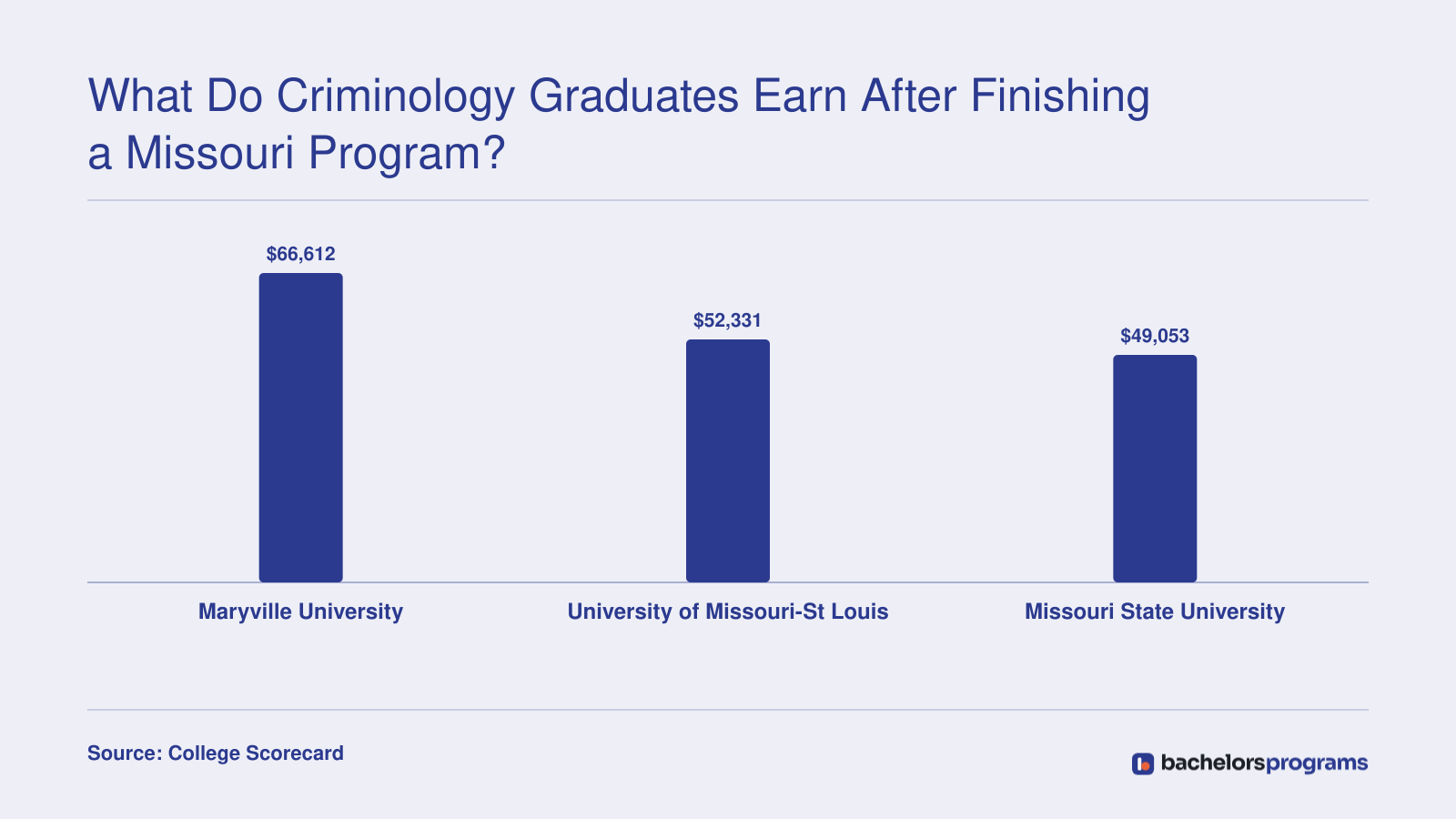
What Do Criminology Graduates Earn After Finishing a Missouri Program?
Four years after finishing, criminology bachelor's graduates from Maryville University earned a median $66,612, compared with $52,331 at the University of Missouri-St Louis and $49,053 at Missouri State University. Lindenwood University's program reports a five-year median of $49,164, so it sits outside this four-year comparison. These medians reflect who graduated, often in small classes, and where they took jobs, so read the gap as a signal about past outcomes, not a promise about your own pay.
Missouri Peace Officer Certification at a Glance
Questions to Ask Yourself
Are you aiming for law enforcement or for analysis and research?
Would you pay a private school's net price, or does a public school fit your budget better?
Does the concentration list match the career you want?
Frequently Asked Questions About Criminology Schools in Missouri
These answers cover the questions students ask most often when comparing bachelor's degree in criminology options in Missouri. Program names and requirements vary by school, so confirm details on each program page before you apply.
What is the best criminology school in Missouri?
How long does a criminology degree take in Missouri?
Are there online bachelor's in criminology programs in Missouri?
What is the difference between criminology and criminal justice?
Is criminology program accreditation required in Missouri?
Compare Criminology programs on the data that matters
Explore more Criminal Justice & Law majors or browse every field of study.
All Criminal Justice & Law programs Browse every field of study