Best Interior Design Degree Programs
Compare 180+ accredited Interior Design programs, with net price after aid, graduation rates, earnings and debt from IPEDS and the U.S. College Scorecard.

CIDA accreditation decides an interior design graduate's timeline, because it sets how much supervised work the NCIDQ requires before you can sit for the exam. Price comes second: in-state tuition at the public universities compared here runs as low as $6,381 a year, while Cornell charges $69,314, or $28,690 after aid.
Admission is its own barrier: several programs require a portfolio review or a secondary application after the first year, not at initial entry.
Federal cost, earnings, and debt figures sit alongside program format. Prestige matters less here than whether the credential and the price hold up across four years of studio work.
Key Points
- The NCIDQ now tests IDFX, IDIX, and IDPX; IDIX replaced Practicum.
- The most affordable public options charge about $6,381 to $7,374 in-state.
- CIDA-accredited degrees mean less to prove when qualifying for the NCIDQ.
Top 10 Interior Design Schools Ranked for 2027
The strongest interior design programs on this list share three traits: they hold CIDA accreditation, they keep the average price after aid within reach, and they report solid completion rates. Cost and graduation rates separate the top of the list, while format and location shape the rest. Each entry below shows tuition, average net price, admission rate, and, where the federal data publishes it, program-level earnings and debt for interior design graduates.
University of Florida
#1Gainesville, FL · ~$7,000/yr (est.)
Best for: Florida residents seeking low net price
The University of Florida is a large public research university in Gainesville with a design college that puts interior design students alongside architecture, landscape architecture, and urban planning majors. Its interior design bachelor's is a CIDA-accredited first professional degree, and undergraduates mentor lower-division peers while working on projects across Florida and abroad. The school graduates 91 percent of its students, and the average price after aid is among the lowest on this list.
- CIDA-accredited first professional degree in interior design
- 120-credit, four-year curriculum
- Upper-division students mentor lower-division peers
- Design projects sited across Florida and internationally
- Housed with architecture, landscape architecture, and planning
- Coursework spans codes, lighting, materials, and environmental psychology
Cornell University
#2Ithaca, NY · $29,000/yr (est. net price)
Best for: Research-minded design students
Cornell University is a private Ivy League institution in Ithaca, New York, where interior design sits inside the Design + Environmental Analysis program in the College of Human Ecology. The curriculum is research-driven, teaching students to apply evidence-based methods to human-centered environments, with fabrication labs and internships at major design firms. Admission is highly selective at 8.8 percent, and the school graduates 95 percent of its students.
- CIDA-accredited interior design pathway within Design + Environmental Analysis
- Evidence-based design curriculum built on research methods
- Access to fabrication labs with 3D printing and laser cutters
- Internships with firms such as Gensler and HOK
- Meets educational requirements for the NCIDQ exam
- Honors program and international exchange available
University of Georgia
#3Athens, GA · ~$14,000/yr (est.)
Best for: Studio-focused BFA students in the South
The University of Georgia is a large public flagship in Athens with a studio-based art school that houses its CIDA-accredited interior design BFA. Students move from residential work to large commercial projects and can study abroad in Cortona, Italy, with the program reporting strong job placement at design firms. The school graduates 90 percent of its students, and in-state applicants pay among the lower tuition rates here.
- CIDA- and NASAD-accredited BFA in interior design
- Studio sequence from residential to large-scale commercial work
- Study abroad in Cortona, Italy, with scholarships available
- Portfolio review required for upper-division admission
- Prepares students for the NCIDQ exam
- Dedicated studio facilities and design media coursework
Fashion Institute of Technology
#4New York, NY · $6,000 – $17,000/yr (est.)
The Fashion Institute of Technology is a public college in Manhattan devoted to art, design, business, and technology, and its interior design BFA emphasizes complex building types such as townhouses, retail stores, and government facilities. Students finish a two-semester senior thesis reviewed by practicing professionals, and faculty bring industry experience into the studio. The school graduates 81 percent of its students.
- CIDA-accredited BFA in interior design
- Two-semester senior thesis juried by practicing professionals
- Design work on townhouses, retail, and government facilities
- Meets the educational requirement for the NCIDQ exam
- Portfolio required for admission
- New York City location with specialized computer labs
Florida State University
#5Tallahassee, FL · ~$11,000/yr (est.)
Florida State University is a large public university in Tallahassee whose interior design bachelor's is accredited by both CIDA and NASAD and blends design theory with studio work in residential, healthcare, office, retail, and hospitality settings. Internships are required, students can study abroad in London, and admission to the major is capacity-constrained with a first-year review. The school graduates 86 percent of its students.
- CIDA- and NASAD-accredited BS in interior design
- Sequential 120-credit program with a capstone
- Capacity-constrained major admission after foundation review
- Required internships, with school help identifying firms
- Study abroad in London and summer intensive at the Ringling Museum
- No portfolio or recommendation letters required to apply
The University of Texas at Austin
#6Austin, TX · ~$20,000/yr (est.)
The University of Texas at Austin is a large public flagship whose interior design bachelor's sits in the School of Architecture, pairing studio work with aesthetic, technological, and behavioral approaches to design. Students present proposals to classmates, faculty, visiting professionals, and the public, with intensive one-on-one instruction in studio. The school graduates 89 percent of its students.
- CIDA-accredited BS in interior design in the School of Architecture
- 126 credit hours, including the University Core Curriculum
- Design studio model built on dialogue and collaboration
- Intensive one-on-one faculty instruction in studio
- Projects discussed with visiting professionals and the public
- Coursework blends aesthetic, technological, and behavioral design
Indiana University-Bloomington
#7Bloomington, IN · $12,000 – $42,000/yr (est.)
Indiana University Bloomington is a large public university whose interior design bachelor's integrates arts, physical and social sciences, and business principles, with attention to textiles, apparel, and furniture as well as interiors. The program is CIDA-accredited and prepares graduates for commercial and residential firms, facilities management, and government agencies. The school graduates 80 percent of its students, and admission is comparatively open at 78 percent.
- CIDA-accredited BS in interior design
- Blends arts, physical and social sciences, and business
- Studies in textiles, apparel, furniture, and interiors
- Prepares graduates for commercial and residential design firms
- Pathway to advanced study in architecture or environmental design
- Coursework links aesthetic, behavioral, and technological concerns
Purdue University
#8West Lafayette, IN · ~$15,000/yr (est.)
Purdue University is a large public university in West Lafayette whose interior (space planning) design major is a BFA dual-accredited by CIDA and NASAD. Studio work covers lighting, color theory, materials, and spatial planning with attention to code compliance and accessibility, and every student completes a required internship. The school graduates 83 percent of its students.
- CIDA- and NASAD-accredited BFA in interior (space planning) design
- Required internship for all interior design students
- Studio coursework in lighting, color theory, and materials
- Emphasis on code compliance and accessibility
- Graduates hired by firms including Gensler, HOK, and Perkins & Will
- Transfer applicants need a 2.5 GPA and four years at Purdue
University of Wisconsin-Madison
#9Madison, WI · ~$17,000/yr (est.)
The University of Wisconsin-Madison is a large public university whose interior architecture bachelor's is a CIDA-accredited professional program combining design theory and history with materials, lighting, and building systems. Studio courses bridge social and physical sciences, a portfolio is required before graduation, and internships extend the learning. The school graduates 90 percent of its students.
- CIDA-accredited BS in interior architecture
- Four-year professional program in two phases
- Required portfolio before graduation
- Coursework in design theory, materials, lighting, and building systems
- Sketching, rendering, CAD, and 3D modeling instruction
- Internships and a fabrication lab with computer labs on site
Ohio State University
#10Columbus, OH · $17,000/yr (est. net price)
Ohio State University is a large public university in Columbus whose interior design bachelor's focuses on commercial, workplace, hospitality, educational, and healthcare spaces, blending studio practice with research-driven coursework. Students begin in a collaborative design foundations year, complete a capstone, and add a history of art minor, with the program reporting 97 percent retention. The school graduates 88 percent of its students.
- CIDA-accredited BSD in interior design
- Collaborative 18-credit Design Foundations first year
- Required History of Art minor
- Capstone project showcasing independent design thinking
- Focus on commercial, workplace, hospitality, and healthcare spaces
- Prepares graduates for the NCIDQ exam and entry-level practice
Cost & outcomes by school
Federal data for the highest-earning Interior Design programs, independent of the ranking above. Earnings are this field's bachelor's graduates four years after completing where the Scorecard reports them, else the school's undergraduate median.
| School | Net price / yr | Grad rate | Earnings | Debt | Grads/yr | Format |
|---|---|---|---|---|---|---|
| Cornell University NY | $28,690 | 95% | $104,043 | $14,000 | — | Campus |
| Lawrence Technological University MI | $32,918 | 61% | $99,444 | $27,000 | 36 | Campus |
| George Washington University DC | $36,586 | 84% | $90,873 | $20,449 | 33 | Campus |
| San Jose State University CA | $13,760 | 69% | $78,988 | $15,000 | 229 | Campus |
| University of Redlands CA | $30,031 | 67% | $75,374 | $26,000 | 5 | Campus |
| Florida State University FL | $11,297 | 86% | $73,888 | $22,625 | 28 | Campus |
| Virginia Polytechnic Institute and State University VA | $24,953 | 86% | $72,213 | $23,900 | 74 | Campus |
| University of Cincinnati OH | $25,648 | 75% | $71,605 | $25,500 | 142 | Campus |
| Syracuse University NY | $38,793 | 84% | $71,527 | $27,000 | 114 | Campus |
| The University of Texas at Austin TX | $19,857 | 89% | $69,846 | $18,000 | 67 | Campus |
| Washington State University WA | $14,971 | 61% | $69,224 | $24,604 | 29 | Campus |
| University of Georgia GA | $13,936 | 90% | $68,726 | $18,500 | — | Campus |
Sources: U.S. Department of Education. Net price, graduation rate, earnings and debt: College Scorecard (earnings and debt for this field's bachelor's graduates where reported, else school-wide); graduates: IPEDS. A dash means no figure is reported.
Cost, debt & payoff
Median earnings of this field's bachelor's graduates (4 yrs after completing, else the school's undergraduate median) vs. their median federal loan debt · U.S. College Scorecard
Across these programs the median graduate earns about $55,383 and finishes with roughly $24,438 in debt — a ratio that clears a common rule of thumb (keep debt below first-year salary). Net price and debt vary widely school to school, so check the per-school figures in the table above before you shortlist.
How We Ranked These Interior Design Programs
We rank on federal outcome data you can look up yourself, not on a poll of opinions. Each program was weighed on the same inputs:
- Net price after aid: what the average student is left paying after grant aid.
- Published tuition: the sticker price, shown alongside net price.
- Earnings and debt: program-level figures from the U.S. Department of Education's College Scorecard.
- Completion and retention: institution-wide rates, since program-level figures are not available.
- Delivery format: fully on campus, hybrid, or online.
Why Federal Data Instead of Reputation
Federal figures are reported the same way for every school, and you can check each number on College Scorecard. Reputation surveys cannot offer that. They tell you what respondents believe, not what graduates earn or borrow.
How DesignIntelligence Differs
DesignIntelligence publishes the best-known reputation rankings in design education. Its current method draws on three groups.1 Hiring professionals say which programs best prepared students based on their last five years of hiring. Deans and program chairs name the programs they most admire. Students and recent graduates rate their satisfaction.2 Hiring professionals also rate how well schools teach communication, computer applications, and sustainable design.2
The most recent complete undergraduate interior design ranking we could confirm is the 2015 edition, published in November 2014.3 It placed Savannah College of Art and Design first, followed by Pratt Institute, New York School of Interior Design, Rhode Island School of Design, and Parsons School of Design.3 Many schools cite DesignIntelligence in their marketing, so check which year and which program a claim refers to.
Confirm Accreditation Separately
CIDA accreditation is not part of the federal dataset. Verify each program's status directly with CIDA before you apply.
CIDA Accreditation and NCIDQ Eligibility: Why It Matters
A CIDA-accredited bachelor's degree and an unaccredited one can both lead to NCIDQ certification, but the two paths demand different amounts of documentation and supervised work. The gap shows up in your transcript review and your supervised work hours.
What CIDA Does
The Council for Interior Design Accreditation (CIDA) is the accrediting body for professional-level interior design programs in the United States and abroad. Accreditation signals that a program's curriculum has been reviewed against established professional standards. Check CIDA's current directory for the latest list of accredited programs before you apply.
NCIDQ Eligibility by Education Level
The Council for Interior Design Qualification (CIDQ) ties required supervised work hours to your education pathway. Every route requires at least 60 semester or 90 quarter hours of interior design coursework.1
- CIDA-accredited bachelor's or master's: 3,520 hours (about two years).
- Non-CIDA interior design bachelor's or master's: 3,520 hours, but only if your transcript shows the 60/90 interior design credit minimum.
- Associate degree, certificate, or diploma in interior design: 5,280 hours (about three years).
- Non-design bachelor's or master's plus an interior design credential: 5,280 hours.
- NAAB- or CACB-accredited architecture degree: 3,520 hours. Non-accredited architecture degrees plus an interior design credential require 5,280.
Up to 1,760 hours earned before graduation can count, and a supervisor or sponsor must verify your experience.1 Students in the final year of an interior design degree can sit for the first exam section early under Route 2.2
Licensure and Registration
Some states regulate the interior design title or the practice itself, and many tie registration or licensure to NCIDQ certification. Rules vary by jurisdiction, so check your state board before choosing a program.
Is a CIDA Degree Worth It?
For most students aiming at commercial work, yes. A CIDA-accredited degree is the most direct route to NCIDQ certification, with no credit-count questions to resolve and the shortest work-experience requirement.1 Commercial, healthcare, and hospitality firms often expect it. Residential decorators and designers who don't need a license can succeed without it, though a non-accredited degree works best when it still delivers the full 60/90 credits of interior design coursework.
What Does the NCIDQ Exam Cost, and How Many Candidates Pass?
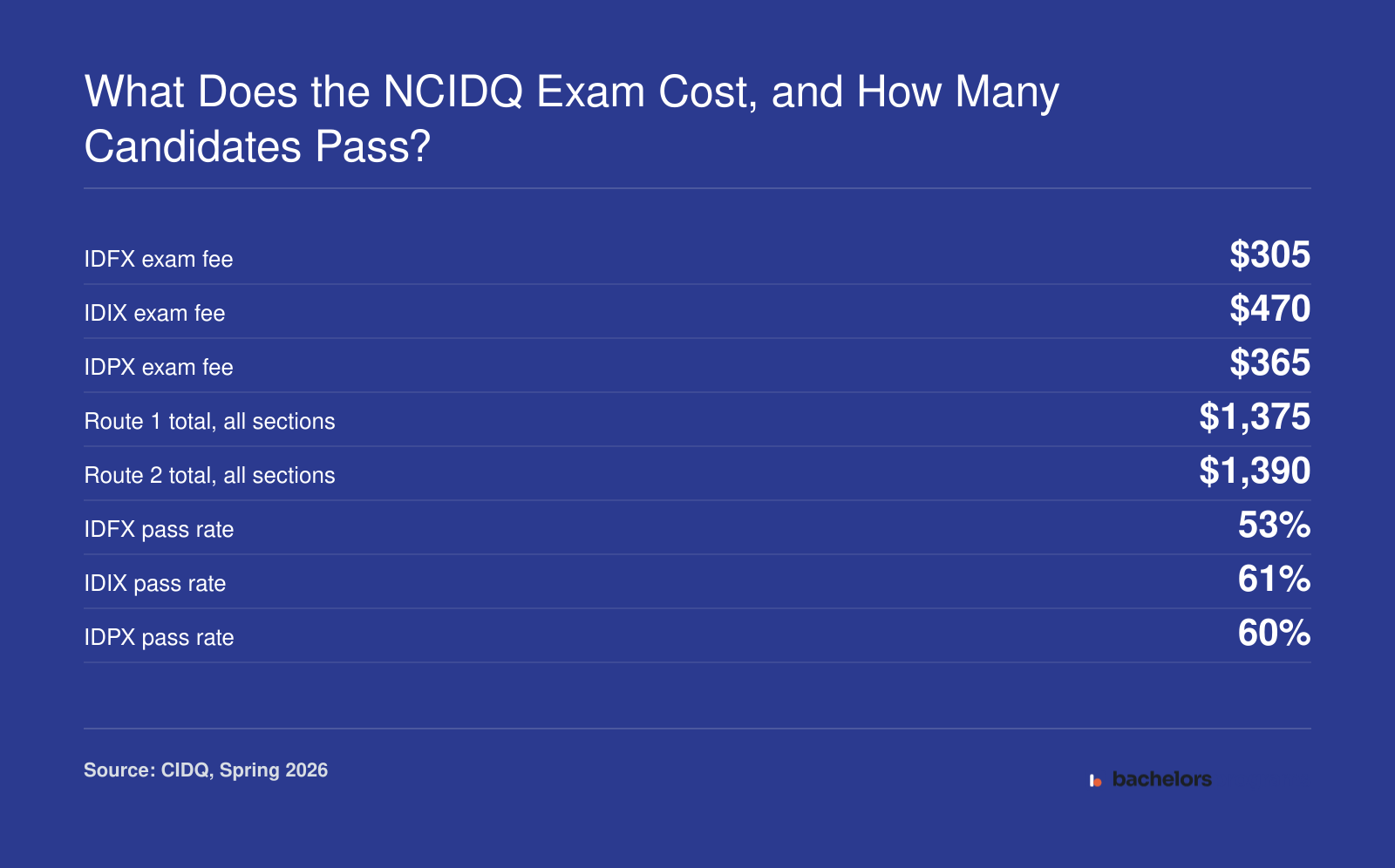
The 2026 NCIDQ has three sections: IDFX (fundamentals), IDIX (implementation, which replaced the former Practicum starting with the 2026 administration), and IDPX (professional). Candidates who have not yet met the work-experience requirement can apply through Route 2 and sit for the IDFX first, so you can start the exam before finishing your work hours. Pass rates below are CIDQ's most recent published figures, from Spring 2026.
Interior Design Degree Cost: Tuition, Net Price, and Hidden Expenses
The schools below post the lowest average annual net price after aid among the bachelor's interior design programs in our dataset. All are public universities where in-state tuition runs about $6,381 to $7,374 a year, compared with roughly $19,974 to $28,659 for out-of-state students, and the net price shown is an approximate federal average that will differ from your own aid package. Net price also leaves out studio costs: Mississippi State puts a capable Windows laptop (16 GB of RAM, 8 GB of graphics memory, 500 GB of storage) at $2,500 to $3,000, Thomas Jefferson asks for 32 GB of RAM, and supplies add up quickly, with Belmont estimating $740 to $880 per semester in total out-of-pocket costs, Samford $100 to $150 per semester for supplies, and RIT $40 to $100 per semester for board printing plus $10 to $50 per model. Software can cost less than you expect, since Autodesk gives eligible students free, renewable one-year access to AutoCAD and Revit, SketchUp runs about $55 a year at Marymount, and Marymount and Thomas Jefferson include Adobe tools for enrolled students, so check your program's laptop specifications and whether studio or software fees are already bundled before you enroll.
| School | Location | Accreditation | In-State Tuition (per year) | Out-of-State Tuition (per year) | Average Net Price After Aid (per year) |
|---|---|---|---|---|---|
| University of Florida | Gainesville, FL | CIDA | $6,381 | $28,659 | $6,541 |
| California State University-Long Beach | Long Beach, CA | NASAD | $7,374 | $19,974 | $10,440 |
| Florida State University | Tallahassee, FL | CIDA, NASAD | $6,517 | $21,683 | $11,297 |
Related Articles
What Interior Designers Earn Nationally
Before weighing tuition against a degree's payoff, start with what the occupation pays across the United States.
Interior Design Degree Salary and Graduate Outcomes
Program-level earnings show what graduates of a specific interior design bachelor's degree made, measured at a fixed point after finishing. They say more than occupation-wide averages, though the window differs by school, so read each figure with its window attached.
Highest Program-Level Earnings
San Jose State University posts the top figure here: $93,917 median earnings five years after completion. The University of Texas at Austin follows at $88,050 (five years), then the University of Florida at $73,474 (five years) and Ohio State at $69,416 (five years). Virginia Tech reports $72,213 four years out, and NJIT, Arkansas and Oklahoma land between roughly $65,600 and $66,500 at four years.
First-year numbers are lower. One year after completion, graduates at Miami University (Ohio) report $47,295, Virginia Tech $46,761, and UT Austin $44,506.
Pairing Pay With Debt
Earnings only mean something next to what you borrowed. UT Austin graduates carry $18,000 in median program debt, or about $191 a month on a 10-year plan, against $88,050 at five years. Florida graduates owe $19,839 ($210 a month). Miami University and Oklahoma sit higher, at $26,000 ($276 a month) and $26,250 ($278 a month). San Jose State does not report program debt, so its ROI can't be calculated the same way.
Where the Work Pays Most
BLS wage data (May 2023) shows annual mean wages for interior designers of $81,570 in California, $75,310 in New York, $67,650 in Texas and $64,880 in Florida. Among metro areas, Los Angeles-Long Beach-Anaheim ($81,060) and Washington-Arlington-Alexandria ($80,740) lead the areas listed, followed by New York-Newark-Jersey City ($75,730) and Denver-Aurora-Lakewood ($70,290). These lists are not a complete ranking.
BLS projects 3% employment growth from 2025 to 2035, from 97,100 to 99,700 jobs, with about 7,700 openings a year as people retire or change fields.1 Growth is slow, so openings come mostly from replacement hiring.
Why Early Pay Trails the National Median
The 2025 BLS median for interior designers is $67,190.1 First-year graduate earnings sit well below that because the median reflects experienced professionals. Pay typically climbs as designers log supervised experience, pass the NCIDQ exam and build a specialty. Commercial work such as offices, healthcare and hospitality tends to reward that credentialing most, which is why the five-year figures at several schools move toward or past the national median.
Online vs. Campus Interior Design Degrees
Campus programs put you in a physical studio with a materials library, while online programs trade that access for flexibility. Neither is automatically better, but the accreditation gap between them can change your timeline to the NCIDQ.
How the Two Formats Compare
- Studio and materials access: Campus programs offer shared studios, fabrication space, and hands-on sample libraries. Online students usually source materials themselves and rely on digital critiques.
- CIDA accreditation: Far more campus programs hold it. Online and hybrid options with CIDA accreditation are limited.
- Cost and flexibility: Online study can cut housing and relocation costs and suits working adults, though tuition varies, so compare net price rather than sticker price.
- Networking and internships: Campus students find local firms, faculty contacts, and internships more easily. Online students need to build those connections deliberately.
Online and Hybrid Programs With CIDA Accreditation
Academy of Art University has held CIDA accreditation for online delivery since 2008.1 Rocky Mountain College of Art and Design Online is also listed by CIDA, and Interior Designers Institute reports a CIDA-accredited bachelor's approved in hybrid form for California residents.2 Sources do not show whether any of these require on-campus residencies, so ask each school directly. Check the delivery format listed with each school in the ranking table to see which programs offer online or hybrid options.
CIDA's directory also lists bachelor's programs at Arizona State University, Design Institute of San Diego, Colorado State University, and Bellevue College. Confirm each school's delivery format before assuming anything about online access.
The Catch With Non-Accredited Online Degrees
Many online interior design certificates and degrees are not CIDA-accredited. MICA's fully asynchronous, 120-credit online Bachelor of Design in Interior Design, for example, is not currently accredited and is structured for a future CIDA application.3
A non-CIDA bachelor's can still satisfy the NCIDQ education pathway if it comes from an accredited institution and includes at least 60 semester interior-design credits.4 The work requirement grows, though, when the degree falls short of that 60-credit minimum: 5,280 hours (about three years), against 3,520 hours (about two years) for a CIDA-accredited degree.5 Up to 1,760 hours earned before graduation may count.6 NCIDQ eligibility also does not guarantee state licensure, so check your state's rules.7
How to Choose the Right Interior Design Program
What should you verify before you commit to an interior design program? The answer is rarely the campus tour. It is the admission portfolio, the transfer policy, the internship pipeline, and the accreditation status.
Portfolio and Admission Requirements
Many BFA programs require a portfolio or a design exercise before admission. Others admit first-year students and hold a portfolio review after year one, and you must pass it to continue in the major. The timing changes your risk. If the review comes later, ask what support the school gives students who do not advance on the first attempt, and whether they can repeat the review or must change majors. Confirm the format too: some schools want drawing and observation work, others accept digital and spatial projects. Ask whether the school awards a BFA or a BS, because the admission and portfolio requirements can differ.
Credits, Studios, and Transfer Students
Community college students should get a written transfer evaluation before enrolling. Studio courses are the sticking point. Many programs restart the studio sequence because they want to control the order and assess your work themselves, so a two-year studio sequence may not shorten your bachelor's degree. General education credits usually transfer more cleanly. Ask specifically which studio courses count, which ones satisfy elective credit only, and how many semesters you will need after transfer.
Specializations and Internships
Look for tracks in commercial, healthcare, hospitality, or sustainable design if you already know the sector you want. Required internships matter because supervised work experience can count toward the professional hours NCIDQ requires. Ask who places interns, whether the school has employer relationships in those sectors, and whether internship credit is required or optional. A program with a formal internship office will save you months of cold outreach.
Location and Decision Order
Schools near active design markets give you more internship options, and the salary section identifies the metros where interior designers earn the most. If two programs still feel close, decide in this order: CIDA accreditation first, net price second, graduate outcomes third, format and fit last. Accreditation protects your NCIDQ path. Net price tells you what you will actually pay after grants. Outcomes show whether graduates get hired, and format and fit are worth weighing only after those three checks.
Interior Design programs by state
Compare Interior Design programs on the data that matters
Explore more Arts & Design majors or browse every field of study.
All Arts & Design programs Browse every field of study