Best Psychology Schools in Vermont
Compare 4 accredited General Psychology programs in Vermont, with net price after aid, graduation rates, earnings and debt from IPEDS and the U.S. College Scorecard.

Psychology bachelor's degrees in Vermont come in two credential shapes: a Bachelor of Science (B.S.) or a Bachelor of Arts (B.A.) in Psychology. The choice between them usually comes down to how much statistics and natural science you want in the major. The University of Vermont, Saint Michael's College, Vermont State University, and Norwich University all award one, with published in-state tuition at the publics starting near $11,952.
Cost is where the four diverge fastest. Vermonters and nonresidents pay very different rates at the public options, while the private colleges charge one price. Below that sits the harder constraint: a bachelor's alone licenses you for nothing in this state.
Key Points
- Vermont State University offers the psychology bachelor's online and hybrid.
- In-state students pay $26,444 less than nonresidents at University of Vermont.
- A bachelor's alone won't qualify you for Vermont psychologist licensure.
Best Psychology Schools in Vermont at a Glance
Vermont awards the bachelor's degree in psychology at four institutions, and they divide cleanly between a large public research university, two small private colleges, and a statewide public system with a fully online option. The four programs below are ordered for how well they serve undergraduates who want a psychology credential in Vermont, whether they study on campus or online.
University of Vermont
#1Burlington, VT · $19,000 – $46,000/yr (est.)
Best for: Research-minded science-track psychology majors
The University of Vermont anchors the state's public psychology offerings from its Burlington campus, and its B.S. in Psychological Science is the more science-heavy of the tracks the department awards. The major runs 32 credits with extra coursework in math, lab science, and research methods, and no minor is required. Students get the resources of a large research university, a strong four-year completion record, and a clear route into graduate study, including an accelerated path into UVM's own psychology graduate programs.
- 32-credit major housed in the College of Arts and Sciences
- More psychology coursework than the B.A. track requires
- Stronger emphasis on math, science, and lab science
- No minor required
- Core concepts, research methods, and critical reading of literature
- Alumni placements include Boston Children's Hospital
- Built to prepare students for graduate study in psychology
Saint Michael's College
#2Colchester, VT · $25,000 – $30,000/yr (est.)
Best for: Hands-on practicum seekers in human services
Saint Michael's College is a small Catholic liberal arts college in Colchester where psychology ranks among the larger majors and the emphasis falls on applied experience. A two-semester practicum places students 8 to 10 hours a week inside Vermont agencies such as the Howard Center and Winooski Schools, and three dedicated labs support student research. Classes are small, the graduation rate is strong, and the college runs its own clinical-counseling master's program for students who want to stay in state.
- Two-semester practicum, 8 to 10 hours weekly at a local agency
- Three labs: Observational, Animal, and Psychophysiology/VR
- Faculty-mentored research from virtual reality learning to stress and health
- Partnership sites include Howard Center and Winooski Schools
- Psi Chi honor society and an active Psychology Club
- Coursework spans neuroscience, cognitive psychology, and clinical practice
- Grant-funded research options for undergraduates
Vermont State University
#3Randolph, VT · $15,000 – $20,000/yr (est.)
Best for: Working Vermonters needing online flexibility
Vermont State University is the state's public system, and it delivers psychological science at its Castleton and Johnson campuses and fully online. The B.A. requires an internship before graduation, and most students are offered jobs at the sites where they train. An accelerated track can finish the degree in three or three and a half years, and tuition is charged per credit, which makes the online route unusually transparent for working adults.
- Offered at Castleton and Johnson campuses, plus fully online
- Required internship before graduation; many placements are paid
- Most students receive job offers from their internship sites
- Accelerated track finishes in three or three and a half years
- Start dates include August 2026, October 2026, January 2027, May 2027
- Up to nine credits may count toward Vermont State counseling master's
- Per-credit tuition with financial aid for most students
- Not open to F-1 visa students
Norwich University
#4Northfield, VT · $22,000/yr (est. net price)
Norwich University is a private military and civilian university in Northfield with a psychology department built around hands-on research. Undergraduates choose a B.A. or B.S. track and can concentrate in neuroscience or criminology, then design and run an original thesis project as seniors. Labs equipped with EEG, eye-tracking, and flight simulation give the program a rare technical bent for a bachelor's degree, and an accelerated pathway lets graduates finish a master's online in roughly a year.
- Choose between a B.A. and a B.S. track
- Concentrations in neuroscience or criminology
- Senior thesis: original research designed and conducted by the student
- Labs use EEG, eye-tracking, and flight simulation
- Minors in forensic, cross-cultural, and political psychology
- Accelerated Master's Pathway completes a graduate degree online in 12 to 18 months
- Small, collaborative classes with faculty who are active researchers
Cost & outcomes by school
Federal data for the highest-earning General Psychology programs, independent of the ranking above. Earnings are this field's bachelor's graduates four years after completing where the Scorecard reports them, else the school's undergraduate median.
| School | Net price / yr | Grad rate | Earnings | Debt | Grads/yr | Format |
|---|---|---|---|---|---|---|
| Norwich University VT | $22,257 | 60% | $53,775 | $26,877 | 26 | Campus |
| University of Vermont VT | $19,343 | 79% | $52,805 | $20,500 | 212 | Campus |
| Saint Michael's College VT | $25,239 | 73% | $52,589 | $27,000 | 37 | Campus |
| Vermont State University VT | $18,212 | 47% | $50,782 | $15,000 | 44 | Hybrid |
Sources: U.S. Department of Education. Net price, graduation rate, earnings and debt: College Scorecard (earnings and debt for this field's bachelor's graduates where reported, else school-wide); graduates: IPEDS. A dash means no figure is reported.
Cost, debt & payoff
Median earnings of this field's bachelor's graduates (4 yrs after completing, else the school's undergraduate median) vs. their median federal loan debt · U.S. College Scorecard
Across these programs the median graduate earns about $52,697 and finishes with roughly $23,689 in debt — a ratio that clears a common rule of thumb (keep debt below first-year salary). Net price and debt vary widely school to school, so check the per-school figures in the table above before you shortlist.
How We Ranked Vermont Bachelor's Psychology Schools
Every list of the best psychology schools in Vermont seems to name a different winner. Here is what decides the order.
What We Looked At
The ranking weighs several factors, each in plain terms:
- Cost and net price: the bill after grants and scholarships, not the sticker price.
- Completion: how many students finish their degree.
- Earnings and debt: what graduates tend to earn and what they owe.
- Program outcomes: what the psychology major itself offers, such as research, internships and accreditation.
- Format: campus, hybrid or online study.
Limits of the Numbers
The graduation rate and the net price are institution-wide averages covering the University of Vermont, Saint Michael's College, Vermont State University and Norwich University. They are not psychology-specific figures. Net price is also approximate, because it shifts with family income and the aid a student receives. Treat both as a starting point, then ask each psychology department for its own numbers.
Why Other Lists Disagree
Niche, PsychologyUSA and similar lists often split on the top school. General college lists tend to reward institution-wide reputation, campus life and overall student experience. Psychology-focused lists look harder at the program itself: faculty, research opportunities and curriculum. Each also weights its factors differently, so a small change in emphasis can reorder the schools.
How to Read Any Ranking
Check what a list is measuring before you trust its order, and that includes this one. Then decide which factor matters most to you, whether that is cost, research access or online flexibility, and let it break ties. Confirm the details on each school's own psychology program page before you apply.
What You Can Study: Bachelor's Psychology Concentrations, Internships, and Accreditation
A brochure says less about a psychology department than its course catalog does. What a program advertises and what it requires are often different, and that gap can shape four years of your education. Confirm, school by school, what a psychology bachelor's degree really contains before you pay an application fee.
Read the Catalog, Not the Landing Page
Start with the University of Vermont psychology major page, then repeat the exercise for Saint Michael's College, Vermont State University, and Norwich University. Open each department's undergraduate page alongside the current course catalog and search the text for a handful of words: "concentrations," "tracks," "practicum," "internship," "fieldwork," and "undergraduate research." A program that organizes upper-level work into named tracks structures its electives differently from one offering a single general major, and a required practicum or fieldwork placement changes your weekly schedule in junior or senior year. Catalogs also show which courses are offered every term and which rotate, a detail that decides whether you can finish in four years.
Confirm Accreditation From the Source
Accreditation should never be taken on faith from a list or a marketing page. Search the New England Commission of Higher Education (NECHE) directory for each institution, then cross-check what you find against the school's own accreditation or consumer-information page, which typically names its regional accreditor and the date of its most recent review. If the two sources disagree or one is unclear, ask the admissions office in writing before you apply.
Where to Look for Research and Fieldwork
Department overviews skim over experiential learning. Faculty lab pages name current projects and often note whether undergraduates assist, and career-services pages list internship partners and fieldwork requirements. For broader context, use the American Psychological Association and the Association for Psychological Science on career paths and program expectations, the Vermont Psychological Association for regional professional perspective, and the Occupational Outlook Handbook at BLS.gov for how psychology occupations describe their typical entry-level education and duties.
A Checklist Before You Apply
- Search "site:school.edu psychology major" to surface department pages that the main site does not link prominently.
- Scan each catalog for the six keywords above and note which appear as requirements rather than options.
- Email the department or academic advising office with targeted questions: Is fieldwork required, how are placements arranged, and how many undergraduates join a lab each year?
- Verify NECHE accreditation independently before you enroll, not after.
Online and Hybrid Bachelor's in Psychology Options at Vermont Schools
Among the schools ranked here, Vermont State University is the one that offers its bachelor's in psychology online and in hybrid formats. The other schools deliver the major on campus. Vermont State uses "In-Person Plus" to mean a mix of in-person and remote classes, not a fully online program. Its program pages and its 2026 academic listing do not always agree on which campus uses which format, and the university notes that some online programs may still require in-person meetings, residencies, or fieldwork, so confirm the format with admissions before you apply.
| School | Program | Campus | Delivery Format | Notes |
|---|---|---|---|---|
| Vermont State University | Psychological Science, B.A. | Castleton, VT | Online and In-Person | Listed with both online and campus delivery |
| Vermont State University | Psychological Science, B.A. | Johnson, VT | Online and In-Person | Listed with both online and campus delivery |
| Vermont State University | Psychological Science, B.A. | Online | Online | Fully online option listed; required internship before graduation |
| Vermont State University | Psychological Science, B.S. | Castleton, VT | In-Person | Listed as in-person on the program page |
| Vermont State University | Psychological Science, B.S. | Johnson, VT | In-Person | Listed as in-person on the program page |
| Vermont State University | Psychological Science, B.S. | Williston, VT | In-Person Plus | Shown in the 2026 academic program listing |
| Vermont State University | Psychological Science, B.S. | Lyndon, VT | In-Person Plus | Shown in the 2026 academic program listing |
| Vermont State University | Psychological Science, B.S. | Online | Online | Shown as available online in the 2026 listing |
| Vermont State University | Applied Psychology & Human Services, B.S. | Lyndon, VT | In-Person, In-Person Plus | Program page explains the combined format |
| Vermont State University | Applied Psychology & Human Services, B.S. | Randolph, VT | In-Person Plus | Mix of in-person and remote classes |
| Vermont State University | Applied Psychology & Human Services, B.S. | Johnson, VT | In-Person Plus | Mix of in-person and remote classes |
| Vermont State University | Applied Psychology & Human Services, B.S. | Online | Online | Listed as available online |
| University of Vermont | B.S. in Psychological Science | Burlington, VT | On campus | College of Arts and Sciences program |
| Saint Michael's College | Psychology | Colchester, VT | On campus | Two-semester practicum internship |
| Norwich University | Psychology | Northfield, VT | On campus | B.A. or B.S. options; neuroscience or criminology concentrations |
Related Articles
How Much Does Residency Change Tuition at Vermont Psychology Schools?
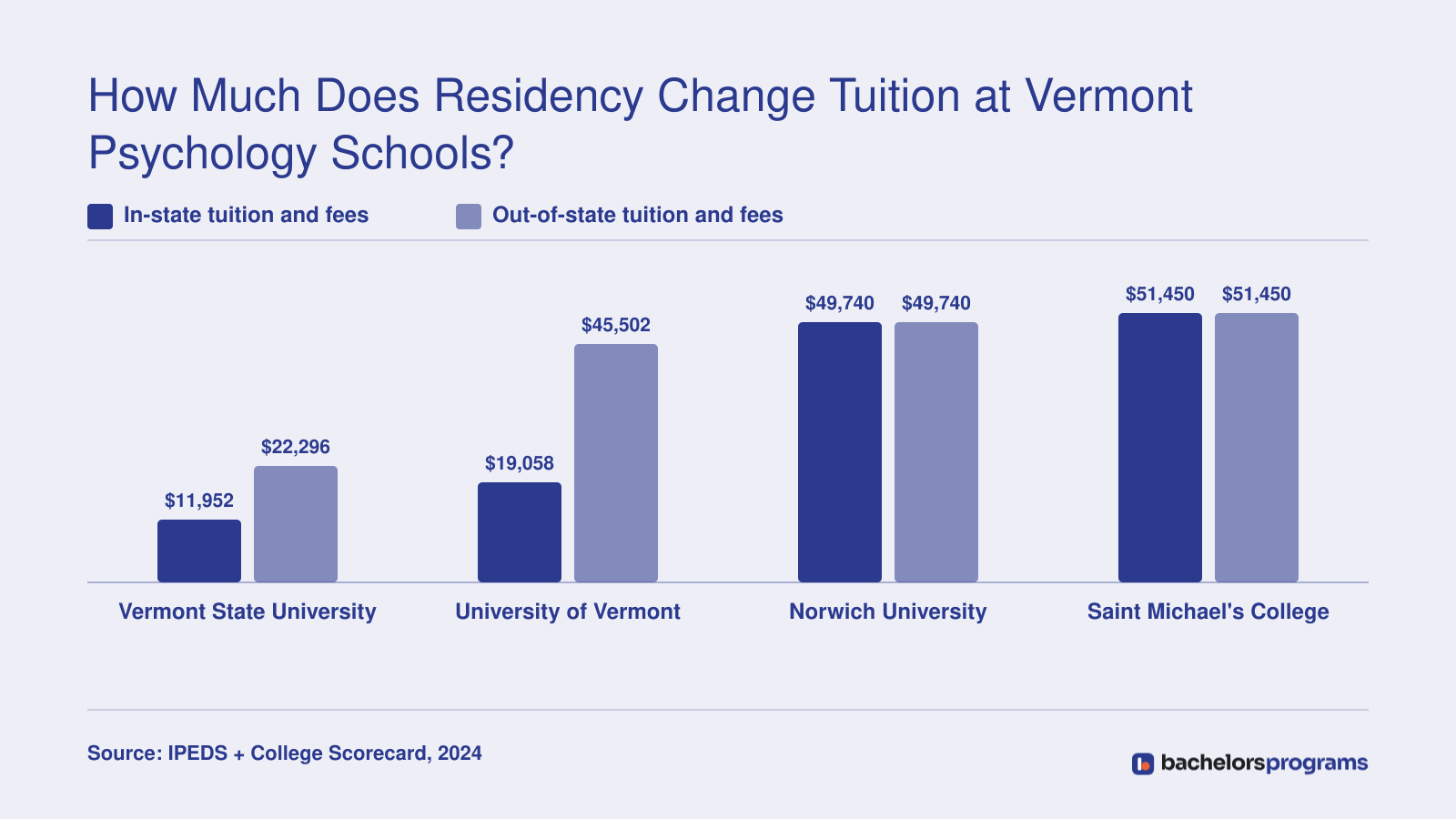
Residency matters only at the public schools. Vermonters pay $26,444 less than nonresidents at the University of Vermont and $10,344 less at Vermont State University, while Saint Michael's College and Norwich University charge one rate to everyone. These are sticker prices before grants and scholarships, and most students pay less once aid is applied.
Cost of a Psychology Bachelor's in Vermont: Net Price, Debt, and State Aid
What you pay for a psychology bachelor's in Vermont depends on the gap between sticker tuition and what students actually pay. Published in-state tuition runs from about $11,952 at Vermont State University to $19,058 at the University of Vermont. Norwich University and Saint Michael's College list about $49,740 and $51,450. After aid, the average net price is much closer together: $18,212 at Vermont State, $19,343 at UVM, $22,257 at Norwich and $25,239 at Saint Michael's. Net price is an institution-wide approximation, not a psychology-specific figure.
What Students Actually Borrow and Receive
Pell Grant share shows how many students need federal need-based aid. About 55% of Vermont State students receive Pell, compared with 46% at Norwich, 31% at UVM and 25% at Saint Michael's.
Institution-wide median debt among graduates is $15,000 at Vermont State, $20,951 at UVM, $25,000 at Norwich and $26,922 at Saint Michael's. Program-level debt for psychology graduates is available for three schools: about $20,500 at UVM, $26,877 at Norwich and $27,000 at Saint Michael's. No program-level figure is reported for Vermont State, so its institution-wide number is the better guide.
VSAC Grants and Scholarships
The Vermont Student Assistance Corporation (VSAC) runs the main state programs.
- Vermont Grant: For Vermont residents with demonstrated financial need who make satisfactory academic progress. Full-time status means at least 12 credits a semester. Awards ranged from $1,000 to $15,350 in 2025-2026, vary by need and funding, and are first come, first served.1 Apply through MyVSAC and the FAFSA.
- VSAC scholarships: More than 150 programs for Vermont residents who are U.S. citizens or eligible non-citizens.2 Typical awards run $1,000 to $3,000, and some add requirements such as essays or recommendations.3
- Unified Scholarship Application: The 2027-2028 application opened October 1, 2026.2 Documents are due by February 10, 2027.
Aid at Vermont State University
Vermont State offers scholarships, federal grants and institutional grants. Institutional grants require full-time registration. Its Freedom & Unity benefit offers tuition-free study to students with family income of $85,000 or less. Check the university's financial aid page for current eligibility, award limits and deadlines before counting on it. The psychological science program also advertises a Free Tuition Guarantee for Vermonters, so confirm the terms with the school.
How to Estimate Your Own Cost
Begin with the net price calculator at each school, which uses your family's finances rather than a campus average. File the FAFSA, then complete the MyVSAC Vermont Grant application and the Unified Scholarship Application. Because Vermont Grant awards are first come, first served, filing early matters. Compare the net price figures you get side by side, not the sticker prices.
Vermont Licensure: What a Bachelor's in Psychology Does and Doesn't Qualify You For
Compare General Psychology programs on the data that matters
Explore more Psychology majors or browse every field of study.
All Psychology programs Browse every field of study