Best Computer Science Schools in Vermont
Compare 7 accredited Computer Science programs in Vermont at 5 colleges, with net price after aid, graduation rates, earnings and debt from IPEDS and the U.S. College Scorecard.

Vermont splits its bachelor's degree in computer science options between one public flagship and a few private colleges, and the gap between $16,280 in-state tuition at the University of Vermont and what the private schools charge is the first decision families face.
Students take the credential as a Bachelor of Science (B.S.) or a Bachelor of Arts (B.A.) in Computer Science, and the difference surfaces in math requirements and free electives rather than in the title an employer reads. Campus and online routes lead to the same degree.
Median earnings one year after graduation run from $54,036 to $80,158 across the schools on the ranked list, measured from federal College Scorecard data. That spread, not the degree name, is what separates these programs.
Key Points
- Middlebury College computer science graduates earn a median $128,471 four years out.
- In-state tuition and fees at UVM total $19,058, the lowest here.
- Champlain College offers a 120-credit computer science B.S. fully online.
Best Computer Science Schools in Vermont: Ranked List
Middlebury College is the best college for computer science in Vermont on this list, and the University of Vermont is the strongest public option, running a full Bachelor of Science in Computer Science through its engineering college alongside a business-linked Computer Science and Information Systems major. Institution-wide, the schools offering this program have graduation rates of 43.0% to 91.4%, and those are whole-college figures rather than program completion rates. Median earnings for computer science graduates four years after finishing range from $81,160 to $128,471 across the Vermont programs that report them.
Middlebury College
#1Middlebury, VT · $30,000 – $35,000/yr (est.)
Best for: Liberal arts students wanting small CS cohorts
Middlebury is a private liberal arts college with an 8-to-1 student-faculty ratio, an institution-wide graduation rate of 91%, and a computer science department of 12 faculty members. Students can take computer science as a major or a minor and work across algorithmic reasoning, programming and the social impact of AI, with the Responsible Computing program supporting that focus. MiddDev, a student-run software development organization, and WiCS++ give students team experience outside the classroom, and the department funds research and advanced projects. Middlebury has also announced a 2026 affordability initiative making the college tuition-free for families earning up to $175,000, subject to the program's terms.
- Major and minor both offered
- 12 faculty members plus one assistant in instruction
- Algorithmic reasoning, problem solving and programming
- AI tools and their societal impact studied in coursework
- Responsible Computing program on technology's social effects
- Student-run MiddDev software development organization
- WiCS++ group for women and nonbinary CS students
- Research and advanced project opportunities
University of Vermont
#2Burlington, VT · $19,000 – $46,000/yr (est.)
Best for: In-state students seeking a public research university
The University of Vermont is the state's public flagship in Burlington and carries the widest computer science footprint in Vermont, with a Bachelor of Science in Computer Science through the College of Engineering and Mathematical Sciences and a second major in Computer Science and Information Systems run with the Grossman School of Business. The B.S. spans 120 credits with a required capstone, 15 credits of CS electives, paid summer internships, paid software work through CAT Coders and undergraduate research with faculty. Institution-wide, UVM's graduation rate is 79%, and the campus hosted the 2026 UVM Hackathon, where teams from Middlebury and Champlain competed alongside UVM students.
- 120 total credit hours with a required capstone
- 15 credits of CS electives and about 30 free elective credits
- Covers algorithms, data structures, cybersecurity and software engineering
- Paid summer internships and CAT Coders paid software work
- Undergraduate faculty research and independent study for credit
- Minimum 2.0 GPA in CS courses required to graduate
- Accelerated master's option adds one year
- Interdisciplinary major with the Grossman School of Business
- Combines computing coursework with business principles
- Offered on campus through the College of Engineering and Mathematical Sciences
- Minimum 2.0 GPA in CS-prefix courses to graduate
- Hands-on experiential learning and paid internships
- Accelerated master's programs available to qualified students
Norwich University
#3Northfield, VT · $22,000/yr (est. net price)
Best for: Cadets and civilians drawn to cybersecurity
Norwich University is a private university in Northfield that blends a Corps of Cadets with a civilian student body, and it houses computer science in the School of Cyber and Advanced Computing within the College of Professional Schools. The B.S. builds from core courses and a math-and-engineering support sequence into 12 credits of technical electives, and it carries a five-year accelerated pathway to a Master of Science in Cybersecurity. Each student gets a faculty advisor from the first day on campus, and the institution-wide graduation rate is 60%.
- Core courses CS 100 and CS 140 require a minimum grade of C
- Support sequence through CS 431 plus EE 215, EE 321 and math through MA 380
- At least 12 credits of technical electives
- Five-year accelerated pathway to an M.S. in Cybersecurity
- Letter of intent and two faculty recommendations for the accelerated track
- Credit by exam accepted for CS 100
- Faculty advisor assigned from the first day on campus
Champlain College
#4Burlington, VT · ~$36,000/yr (est.)
Champlain College is a private college in Burlington whose computer science degree runs 100% online through Champlain College Online on 7-week terms, with 48 professional credits inside a 120-credit degree. Coursework covers Python and C++, data structures and algorithms, computer architecture, compilers and Linux administration, closing with a Senior Seminar Project; at two courses per term the estimated completion time is three years and six months, and up to 90 transfer credits are accepted. The institution-wide graduation rate is 65%, and the college has announced tuition discounts aimed at matching UVM's rate for a Vermont student's first year.
- 120 credits: 48 professional, 42 general education, 30 elective
- 100% online with 7-week course terms, 1 to 3 courses per term
- Estimated completion in 3 years, 6 months at two courses per term
- Coursework in Python, C++, data structures, compilers and Linux administration
- 3-credit Senior Seminar Project as the capstone
- Up to 90 transfer credits accepted, plus credit for prior learning
- Admission recommends a 2.5 GPA
- Standard rate $342 per credit; military rate $250 per credit
Landmark College
#5Putney, VT · $55,000 – $60,000/yr (est.)
Landmark College in Putney is a small private college designed for students who learn differently, including neurodiverse students, and its computer science B.S. requires 121 credits with a project-oriented curriculum in programming, software engineering, database design and theoretical computing. Students finish with a capstone or an internship, complete calculus and discrete math, and can add a concentration or minor alongside the major, with at least 15 upper-level elective credits required. The institution-wide graduation rate is 43%.
- 121 credits required for the Bachelor of Science
- Project-oriented curriculum with programming and software engineering
- Coursework in data structures, algorithms, database design and theory
- Capstone or internship option to finish
- Calculus or Calculus I plus Discrete Math required
- At least 15 upper-level elective credits; maximum 39 electives
- Concentrations and minors can be added alongside the major
Cost & outcomes by school
Federal data for the highest-earning Computer Science programs, independent of the ranking above. Earnings are this field's bachelor's graduates four years after completing where the Scorecard reports them, else the school's undergraduate median.
| School | Net price / yr | Grad rate | Earnings | Debt | Grads/yr | Format |
|---|---|---|---|---|---|---|
| Middlebury College VT | $31,483 | 91% | $128,471 | $13,500 | 72 | Campus |
| Champlain College VT | $35,860 | 65% | $97,753 | $27,000 | 28 | Online |
| University of Vermont VT | $19,343 | 79% | $81,160 | $20,734 | 116 | Campus |
| Norwich University VT | $22,257 | 60% | $65,575 | $25,000 | 14 | Campus |
| Landmark College VT | $56,954 | 43% | $29,813 | $17,500 | 4 | Campus |
Sources: U.S. Department of Education. Net price, graduation rate, earnings and debt: College Scorecard (earnings and debt for this field's bachelor's graduates where reported, else school-wide); graduates: IPEDS. A dash means no figure is reported.
Cost, debt & payoff
Median earnings of this field's bachelor's graduates (4 yrs after completing, else the school's undergraduate median) vs. their median federal loan debt · U.S. College Scorecard
Across these programs the median graduate earns about $81,160 and finishes with roughly $20,734 in debt — a ratio that clears a common rule of thumb (keep debt below first-year salary). Net price and debt vary widely school to school, so check the per-school figures in the table above before you shortlist.
How We Ranked Vermont Bachelor's Programs in Computer Science
Computer science rankings usually reward reputation, and reputation follows scale. The order here instead follows what a degree costs after aid and what graduates report earning, the two figures most families weigh when they choose where to enroll.
The Measures Behind the Order
Each school's placement reflects federal College Scorecard figures tied to its bachelor's programs in the field:
- Net price: average yearly cost after grants and scholarships, for students who receive federal aid.
- Graduation rate: the share of students who finish within the timeframe the school reports.
- Earnings: median pay for graduates of the computer science program, measured a few years after completion.
- Debt: typical federal borrowing among graduates of the program.
- Completions: how many students actually finish, a check that the major is a working pathway rather than a name in the catalog.
Where the Numbers Stop Short
Two of those measures, graduation rate and net price, describe the whole institution rather than the computer science department. A college with a strong overall completion rate can still run a small, thinly staffed major, and its net price averages every program it offers. Earnings and debt figures come only from graduates who received federal aid and are working, so they undercount people who move out of state, go on to graduate study, or are self-employed.
A Short List, by Necessity
Vermont's pool of bachelor's programs in computer science is small, so this list is short. Every school named here awards a bachelor's degree in computer science, as a Bachelor of Science or a Bachelor of Arts, and each entry reflects the federal data reported for that campus rather than an estimate.
Earning a Bachelor's Degree in Computer Science in Vermont: B.S. vs. B.A. Options
The choice between a B.S. and a B.A. in computer science comes down to technical depth versus room for other subjects. Both are bachelor's degrees, and employers read both as computer science degrees.
B.S. vs. B.A.: The Practical Difference
A Bachelor of Science typically packs in more math, science and advanced technical coursework, which suits students aiming at software engineering, systems or further technical specialization. A Bachelor of Arts usually trades some of that required depth for electives, which helps if you want to pair computing with a second field such as design, business or the humanities. The programs at UVM, Champlain College and Landmark College are labeled as B.S. degrees. Middlebury College and Norwich University list Computer Science, so check each program page for the exact credential.
Related Options at UVM
UVM offers a B.S. in Computer Science and a B.S. in Computer Science and Information Systems. The second leans toward applying technology to organizations and business problems, so it fits students who care more about systems in context than theory. Data science is a distinct computing discipline, and it suits students drawn to statistics and analysis. Confirm its current status in UVM's catalog.
What UVM's Requirements Look Like
UVM's three computer science bachelor's degrees each require 120 credits, so check the catalog for the full course list. A computer science B.S. generally includes programming, data structures, discrete math, calculus or statistics, algorithms, computer systems and a capstone or integrative project.
ABET Accreditation and Licensure
ABET's Computing Accreditation Commission accredits computing programs at the associate, bachelor's and master's levels.1 Under its 2025-2026 criteria, a computer science program needs at least 40 semester credit hours of computer science and at least 15 in mathematics and statistics.2 The University of Vermont appears in ABET's accredited-programs search, but the result does not show that its bachelor's computer science program is accredited.3 No bachelor's computer science program at the other schools here is listed either.3 Check ABET's search directly before you decide.
Computer science has no state licensure requirement in Vermont, so no exam stands between you and a job.
Related Articles
Online and Hybrid Computer Science Bachelor's Options at Vermont Schools
Champlain College in Burlington offers a 120-credit Bachelor of Science in Computer Science that you can complete entirely online, so the degree is available remotely from a Vermont-based school. Champlain is the clear online route among the schools here.
Fully Online at Champlain
Champlain's online computer science degree runs in 7-week course terms with full-time and part-time options, and its listing notes a 2026 application deadline of December 29. Tuition is listed at $342 per credit, with a military rate of $250. The college also offers online Bachelor of Science programs in Software Development and Information Technology, each at 120 credits.1 Champlain's program pages identify no on-campus requirement for these degrees. They also don't spell out whether sessions are asynchronous or scheduled, so ask admissions about live-meeting expectations before you enroll.
Campus-Only Programs
The University of Vermont's B.A. in Computer Science, B.S. in Computer Science, and B.S. in Computer Science and Information Systems are on-campus programs at 120 credits each, and UVM's materials state no online delivery. Middlebury College, Norwich University, and Landmark College (121 credits) describe campus-based computer science majors, and we found no online or hybrid version of them. Hybrid study is not a documented option at the schools ranked here.
Who Benefits Most
Champlain's format suits working adults who need to study around a job. Transfer students gain from its acceptance of up to 90 transfer credits and credit for prior learning. Rural Vermonters far from Burlington can also avoid a daily commute or relocation, since no campus attendance is listed as required.
Admissions for Vermont Computer Science Bachelor's Programs
Vermont's computer science bachelor's programs range from highly selective to broadly accessible, and the University of Vermont publishes the clearest admissions details of the schools here.
GPA, Test Policy and Selectivity
Admission rates run from about 10.8% at Middlebury College to 49.4% at Landmark College, 65.3% at the University of Vermont, 74.4% at Norwich University and 82.9% at Champlain College.
UVM is test-optional. Applicants may self-report SAT or ACT scores, but students who enroll must submit official results. Admitted students typically show a GPA of 3.5 to 3.8 on a 4.0 scale, with SAT math scores of 650 to 740 and ACT scores of 31 to 34. That is a profile of who gets in, not a stated minimum.
Middlebury, Norwich and Landmark do not state a GPA threshold or test policy in the admissions information reviewed for this page, so confirm both with each admissions office before you apply. Champlain's online bachelor's program lists a 2.5 GPA minimum.
Math Prerequisites
UVM expects three years of high school math: Algebra I, Algebra II and Geometry. It does not publish a separate math prerequisite for the computer science major itself. No other school here publishes a computer-science-specific math prerequisite in the sources reviewed1, though Landmark's curriculum includes calculus and discrete math once you enroll.
Transfer Credit and Community-College Pathways
UVM accepts credit from regionally accredited institutions, plus AP, IB and international exams, and courses must be comparable to UVM's. A grade of C or higher transfers. For computer science, transfer applicants need at least one semester of college calculus, and a computer science or lab-science course is preferred.
UVM also runs a 2+2 pathway with a Vermont community college, beginning in Fall 2021:
- Credits: At least 60 transferable credits, with 30 earned at the community college.
- GPA: A 3.20 or higher qualifies, and applicants between 2.80 and 3.19 are strongly considered.
- STEM grades: Individual STEM courses need a B or higher.
The published agreement covers that one community college, not every Vermont two-year school.
Champlain is the most flexible on credit, accepting up to 90 transfer credits and offering credit for prior learning. Norwich accepts credit by exam for its introductory computer science course. Middlebury and Landmark do not publish transfer terms in the material reviewed, so ask admissions directly.
Cost of a Computer Science Bachelor's Degree in Vermont: Tuition, Net Price and Aid
The University of Vermont is the only public school here, and its in-state tuition and fees of $19,058 and average net price of $19,343 make it the most affordable option for Vermont residents. The private colleges charge the same rate regardless of residency, though grants and scholarships lower what families actually pay. Vermont residents without a bachelor's degree can also apply through VSAC for the Vermont Grant, which ranged from $1,000 to $15,350 in 2025-26 and is awarded first-come, first-served, plus more than 150 VSAC scholarships that require the FAFSA.
| School | Sector | Tuition and Fees (In-State) | Tuition and Fees (Out-of-State) | Average Net Price After Aid | Median Debt at Graduation |
|---|---|---|---|---|---|
| University of Vermont | Public | $19,058 | $45,502 | $19,343 | $20,951 |
| Norwich University | Private nonprofit | $49,740 | $49,740 | $22,257 | $25,000 |
| Middlebury College | Private nonprofit | $67,600 | $67,600 | $31,483 | $13,857 |
| Champlain College | Private nonprofit | $47,850 | $47,850 | $35,860 | $26,814 |
| Landmark College | Private nonprofit | $66,540 | $66,540 | $56,954 | $17,500 |
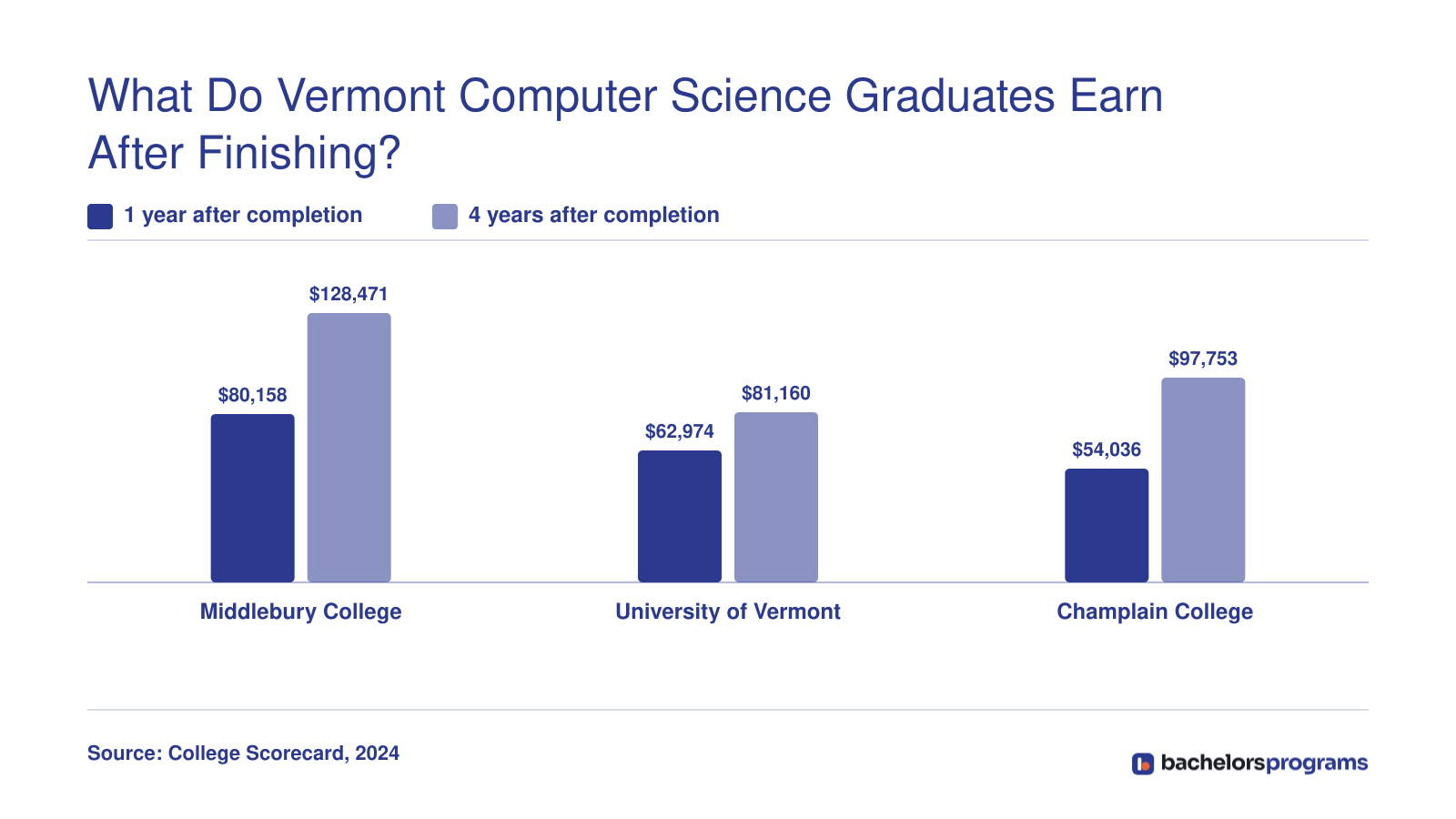
What Do Vermont Computer Science Graduates Earn After Finishing?
Middlebury College computer science graduates earn a median $80,158 one year after finishing and $128,471 four years out. University of Vermont graduates earn $62,974 at one year and $81,160 at four years, and Champlain College graduates earn $54,036 and $97,753 over the same windows. Median debt for these graduates is $13,500 at Middlebury, $20,734 at UVM and $27,000 at Champlain; program earnings are not reported for Norwich University or Landmark College, so they are not charted.
Computer Science Careers and Salaries in Vermont
A Vermont computer science graduate weighs a smaller local tech market against living costs and commutes well below Boston's or New York's. The answer is not a single salary figure but a repeatable method for checking pay where you intend to work. No state license is required to work as a software developer in Vermont, so hiring turns on demonstrable skills, internships and portfolio work rather than a credential.
Start With National Benchmarks
The Bureau of Labor Statistics puts the national median annual wage for computer and information technology occupations at $109,470 as of May 2025, against $50,980 for all occupations.1 Software developers, quality assurance analysts and testers combined show a national median of $134,040.1 Treat these as context only. They describe the country, not Vermont, and the combined software category does not isolate developers.
Pull Vermont's Own Numbers
Go to the BLS Occupational Employment and Wage Statistics page at bls.gov/oes, select Vermont, and filter for software developers (SOC 15-1252) and the broader computer occupations group (SOC 15-0000). State estimates are refreshed annually, so confirm you are reading the most recent May reference year. For employer names, postings and in-demand occupation lists, use the Vermont Department of Labor at labor.vermont.gov2, then cross-check with the Vermont Department of Economic Development and regional workforce development boards.
Compare Postings and Ask People
Match the wage data against real Vermont job postings and adjust for local cost of living. The Vermont Technology Alliance, IEEE Computer Society chapters and local tech meetups will tell you what employers actually pay. Finally, read career services pages and graduation and employment outcome reports on the websites of the University of Vermont, Champlain College, Norwich University, Middlebury College and Landmark College rather than relying on general claims. State-level data usually lags national hiring trends, so pair it with current postings.
Choosing the Right Vermont Computer Science School for You
A big public university and a small private college can both lead to a bachelor's degree in computer science, but they suit different priorities. Start with what matters most to you, then match it to the school type.
Match Your Priority to a School
- Lowest cost: The University of Vermont is the public option here, so in-state sticker price is the natural starting point. Private schools often discount heavily, so compare what you would actually pay.
- Research and breadth: The University of Vermont offers several computer science tracks, including a Computer Science and Information Systems degree. Middlebury College fits students who want computing inside a liberal arts setting.
- Flexibility for working adults: Champlain College and Norwich University are the places to look first. Ask each about evening, part-time or hybrid scheduling for the computer science major specifically.
- Online: Confirm that the computer science bachelor's itself can be completed online, not just other programs at the same school.
- Different learning needs: Landmark College builds its B.S. in Computer Science around students who learn differently.
Your Next Step
Pick two or three schools and do two things this week. First, check each program's ABET accreditation status on the school's computer science page or on ABET's website. Second, request a net price estimate, using the net price calculator on each school's financial aid page, so you compare real costs rather than published tuition.
Compare, Then Apply
Once you have those answers, line up your finalists side by side on cost, format and curriculum. Then start your applications and confirm deadlines on each admissions page. Use bachelorsprograms.com to keep comparing programs as you narrow your list.
Vermont Computer Science School Questions Answered
These answers cover the questions students ask most when comparing bachelor's degree options in computer science in Vermont. Figures reflect 2026 data.
Which Vermont colleges offer computer science degrees?
What is the cheapest computer science degree in Vermont?
Is the University of Vermont good for computer science?
Can out-of-state students get a good deal in Vermont?
Do I need a license to work as a software developer in Vermont?
Compare Computer Science programs on the data that matters
Explore more Computers & IT majors or browse every field of study.
All Computers & IT programs Browse every field of study