Best Finance Schools in Michigan
Compare 36 accredited Finance programs in Michigan at 32 colleges, with net price after aid, graduation rates, earnings and debt from IPEDS and the U.S. College Scorecard.

Michigan offers a bachelor's degree in finance at schools where the sticker price runs from roughly $15,000 a year in-state to nearly $40,000 at private colleges, and the earnings gap between programs can be just as wide. The common credential is the Bachelor of Science (B.S.) in Finance, though many schools award a BBA instead.
This page ranks Michigan bachelor's programs, campus and online, by net price, graduation rate and program earnings, then breaks out the cheapest and highest-earning options.
One caution: sticker price alone rarely predicts what a graduate nets.
Key Points
- University of Michigan-Dearborn sets a 2.50 minimum GPA for business admission.
- Oakland University lists in-state tuition near $15,262, before grants and scholarships.
- Detroit, Grand Rapids and Ann Arbor anchor Michigan's finance job market.
Best Finance Schools in Michigan for a Bachelor's Degree: Top 10 Ranked
Finance programs in Michigan differ widely: some lean on classical economics, others on trading labs, CFA-aligned coursework and student-managed portfolios. The ten schools below span the state, from Detroit and Dearborn to Houghton, Allendale and Berrien Springs, and represent the range of bachelor's credentials a finance student can earn here.
Hillsdale College
#1Hillsdale, MI · $30,000 – $35,000/yr (est.)
Best for: Students wanting a free-market finance curriculum
Hillsdale College houses finance inside its business and economics department, teaching the subject through a classical liberal arts core and an explicitly free-market lens. Students take courses such as Advanced Financial Management and Futures and Options Markets, and the Executive Speakers Program brings business leaders to campus. Sigma Beta Delta, the business honor society, gives strong students a departmental community to join.
- Offered as both a major and a minor in business and economics
- Rooted in a classical liberal arts curriculum and a free-market approach
- Courses include Advanced Financial Management and Futures and Options Markets
- Executive Speakers Program brings business and industry executives to campus
- Business honor society Sigma Beta Delta chapter on campus
Michigan State University
#2East Lansing, MI · $16,000 – $44,000/yr (est.)
Best for: Students drawn to Big Ten campus recruiting
Michigan State University's Broad College of Business awards a Bachelor of Science in Finance through two routes: a competitive direct admission from high school and a standard pathway for students who enroll first and apply later. Students help direct the Student Investment Fund and can apply to the Financial Markets Institute, and the program is a CFA Program Partner of CFA Institute. It is the largest finance program in this group, with a corporate finance track and alumni working as credit and financial analysts.
- CFA Program Partner of CFA Institute
- Students direct the Student Investment Fund
- Two admission pathways: competitive direct and standard admission
- Financial Markets Institute available by application
- Tracks: Corporate Finance
- Alumni work as credit analysts and financial analysts
Michigan Technological University
#3Houghton, MI · $10,000 – $15,000/yr (est.)
Best for: Tech-minded students eyeing fintech careers
Michigan Technological University pairs finance with technology in Houghton, tying the B.S. in Finance to the CFA body of knowledge and to a trading lab where students manage a real $2 million portfolio. A FinTech minor covering blockchain, algorithmic trading and robo-advising was the first of its kind in the Upper Midwest, and Bloomberg Terminals are available in the library. More than 400 employers recruit on campus, and an accelerated master's can be finished in two additional semesters.
- AACSB-accredited finance program
- CFA University Affiliate Program with about 70 percent CFA curriculum coverage
- Students manage a real $2 million portfolio in the campus trading lab
- Bloomberg Terminals available in the library
- First FinTech minor in the Upper Midwest, covering blockchain and robo-advising
- More than 400 employers recruit on campus
- Accelerated master's option completed in two semesters
Grand Valley State University
#4Allendale, MI · $15,000 – $20,000/yr (est.)
Grand Valley State University's AACSB-accredited BBA in Finance rests on a shared business core in accounting, economics and management, with an ethics course and a 19-credit finance major layered on top. The school reports that 80 to 90 percent of its finance graduates land jobs related to their major, among the strongest placement figures it tracks. Internship and independent research credit are available, and 12 accounting credits prepare students for credit analyst work.
- AACSB-accredited Bachelor of Business Administration in Finance
- 19-credit finance major built on a shared business core
- Financial aid available
- School reports 80 to 90 percent placement in finance careers
- Internship and independent research credit available
- 12 accounting credits support credit analyst roles
Andrews University
#5Berrien Springs, MI · $10,000 – $15,000/yr (est.)
Andrews University offers a 124-credit finance BBA through its School of Business Administration in Berrien Springs, combining a business core with investments, financial planning, futures and options, and portfolio theory. Students must hold a 2.33 GPA in major courses and earn at least a C in core accounting and finance classes before advancing. An internship elective adds hands-on experience, and the program is taught in a faith-based setting.
- 124-credit BBA with a finance emphasis
- Coursework in investments, financial planning, futures and options, and portfolio theory
- Minimum 2.33 GPA required in major courses
- C or better required in core accounting and finance courses
- Internship elective offers hands-on experience
University of Michigan-Dearborn
#6Dearborn, MI · ~$9,000/yr (est.)
The University of Michigan-Dearborn awards a BBA in Finance with Financial Management and Financial Services concentrations, plus finance and financial planning minors for students in other majors. The Bloomberg Finance Lab supplies real-time market data and a route to Bloomberg Market Concepts certification, and the Investment Fund Management course has students managing an actual fund. The Dearborn campus sits close to Detroit's finance and banking employers.
- Concentrations in Financial Management and Financial Services
- Bloomberg Finance Lab with real-time market data
- Bloomberg Market Concepts certification available
- Investment Fund Management course manages real money
- Finance and financial planning minors also offered
Wayne State University
#7Detroit, MI · ~$13,000/yr (est.)
Wayne State University's Mike Ilitch School of Business lets students choose between a B.A. and a B.S. in Business Administration with a major in finance, with the B.A. adding foreign language coursework for globally minded students. Classes run days and evenings, on campus or online, and the Detroit location puts internships with employers such as General Motors and Ally within reach. Honors work is open to students at a 3.5 GPA or above, and the AGRADE program allows a dual graduate degree.
- B.A. adds foreign language coursework to the finance major
- Daytime and evening classes on the Detroit campus
- Honors track for students with a 3.5 GPA or higher
- AGRADE dual graduate degree option
- Internships, mentorship and study abroad opportunities
University of Detroit Mercy
#8Detroit, MI · ~$15,000/yr (est.)
At the University of Detroit Mercy, finance is a concentration inside the B.S.B.A., and students may add a second concentration from the business school's other offerings. The Charlton Center for Responsible Investing runs a Financial Markets Lab where students manage the Majestic Fund, a real portfolio of stocks and bonds, and publish an investment newsletter. An Investment Advisory Council connects them with working professionals, and the program supports students pursuing the CFA designation.
- Finance concentration within the B.S.B.A.; students may select up to two concentrations
- Students manage the Majestic Fund, a real stock and bond portfolio
- Financial Markets Lab at the Charlton Center for Responsible Investing
- Students publish an investment newsletter
- Investment Advisory Council connects students with industry professionals
- Support for pursuing the CFA designation
Calvin University
#9Grand Rapids, MI · $23,000/yr (est. net price)
Calvin University awards a B.A. in Finance with two tracks, financial analyst and financial planning, each carrying its own set of electives. Coursework spans business finance and personal finance, covering cash flows, the time value of money and risk. Students need at least a C in four foundation courses, including accounting and business prerequisites, before moving into 300-level finance classes.
- B.A. in Finance with financial analyst and financial planning tracks
- Coursework blends business finance and personal finance
- Each track carries its own set of elective courses
- Minimum C in BUS 101, BUS 201, ACCT 203 and ACCT 204 to enter 300-level finance courses
Oakland University
#10Rochester Hills, MI · $9,000/yr (est. net price)
Oakland University's finance bachelor's is part of the CFA Institute University Affiliate Program, so coursework tracks the knowledge areas tested on CFA exams. Students in the Student Managed Investment Fund run a real $2 million portfolio, and a Wealth Management concentration covers estate planning, risk management and advising high-net-worth clients. Internships and hands-on research come through the OU Pledge, and graduates move into roles such as portfolio manager, credit analyst and financial planner.
- CFA Institute University Affiliate Program coursework
- Student Managed Investment Fund with a $2 million portfolio
- Wealth Management concentration covering estate planning and risk management
- Internships and hands-on research through the OU Pledge
- Graduates work as portfolio managers, credit analysts and financial planners
Cost & outcomes by school
Federal data for the highest-earning Finance programs, independent of the ranking above. Earnings are this field's bachelor's graduates four years after completing where the Scorecard reports them, else the school's undergraduate median.
| School | Net price / yr | Grad rate | Earnings | Debt | Grads/yr | Format |
|---|---|---|---|---|---|---|
| Michigan State University MI | $19,680 | 81% | $102,017 | $22,500 | 390 | Campus |
| Kettering University MI | $34,660 | 71% | $94,823 | $27,000 | — | Campus |
| University of Michigan-Dearborn MI | $9,492 | 58% | $85,068 | $18,875 | 54 | Campus |
| Albion College MI | $14,301 | 62% | $81,887 | $24,979 | 16 | Campus |
| Central Michigan University MI | $17,597 | 59% | $79,906 | $25,500 | 45 | Campus |
| Oakland University MI | $9,120 | 58% | $79,127 | $22,423 | 91 | Campus |
| Michigan Technological University MI | $14,182 | 68% | $78,198 | $24,990 | 23 | Campus |
| Walsh College MI | — | — | $76,597 | $13,284 | 31 | Hybrid |
| Ferris State University MI | $8,624 | 47% | $75,797 | $21,000 | 14 | Campus |
| Davenport University MI | $17,707 | 57% | $74,898 | $25,072 | 28 | Online |
| Wayne State University MI | $12,766 | 58% | $74,703 | $18,507 | 165 | Hybrid |
| Eastern Michigan University MI | $15,407 | 46% | $74,066 | $21,500 | 55 | Online |
Sources: U.S. Department of Education. Net price, graduation rate, earnings and debt: College Scorecard (earnings and debt for this field's bachelor's graduates where reported, else school-wide); graduates: IPEDS. A dash means no figure is reported.
Cost, debt & payoff
Median earnings of this field's bachelor's graduates (4 yrs after completing, else the school's undergraduate median) vs. their median federal loan debt · U.S. College Scorecard
Across these programs the median graduate earns about $71,348 and finishes with roughly $23,250 in debt — a ratio that clears a common rule of thumb (keep debt below first-year salary). Net price and debt vary widely school to school, so check the per-school figures in the table above before you shortlist.
How We Ranked Michigan Finance Schools (And Why AACSB Accreditation Matters)
What Drives the Ranking
The order rests on net price, graduation rate, and College Scorecard figures for program-level earnings and debt. One limit applies: net price and graduation rate describe the whole institution, not the finance program. A school's overall numbers can differ from what finance majors experience.
AACSB Versus ACBSP
AACSB and ACBSP are separate business-accrediting bodies.1 AACSB reviews a school against its Global Standards through self-assessment and peer review, looking at strategic management, learner success, thought leadership, societal impact, and continuous improvement. ACBSP is a different accreditor, and the sources checked here did not support a more specific side-by-side comparison, so we do not offer one.
For you, accreditation is a quality signal. Some employers and graduate admissions committees pay attention to it, especially for competitive roles. The CFA Program does not require an accredited degree, but a recognized business school can make your credentials easier to read.
Which Ranked Schools Are Verified
AACSB's own directory lists these ranked schools as accredited:
- Michigan State University: Bachelor of Arts in Finance, including Banking.2
- University of Michigan-Dearborn: Bachelor of Business Administration in Finance, including Banking.3
- University of Michigan-Flint: Bachelor of Business Administration in Finance, including Banking.4
- Western Michigan University: Bachelor of Business Administration in Finance, including Banking.5
- Eastern Michigan University: Bachelor of Business Administration in Finance, including Banking.6
The directory results we reviewed did not settle AACSB or ACBSP status for Wayne State University, Grand Valley State University, Oakland University, or Central Michigan University. That is not evidence either way. No ACBSP listing was confirmed for any school named here, so check both directories and each school's business college page before you apply.
Cheapest Bachelor's in Finance Programs in Michigan
Published tuition is the sticker price before any aid. Average net price is what students actually paid after grants and scholarships, averaged across aided students, so your own cost can land higher or lower. The schools below show the lowest average net prices for a finance bachelor's in our Michigan data, drawn from federal IPEDS and College Scorecard figures. Saginaw Valley State University has the lowest sticker price in this group, but University of Michigan-Flint costs the least once aid is counted, which is why net price is the better yardstick.
| School | City | Program | Format | Published In-State Tuition and Fees | Average Net Price After Aid |
|---|---|---|---|---|---|
| University of Michigan-Flint | Flint | Bachelor of Business Administration in Finance | In person, online, hybrid | $14,704 | $7,007 |
| Ferris State University | Big Rapids | Finance | Campus | $14,778 | $8,624 |
| Oakland University | Rochester Hills | Finance | Campus | $15,262 | $9,120 |
| University of Michigan-Dearborn | Dearborn | BBA Finance major | Campus | $15,640 | $9,492 |
| Saginaw Valley State University | University Center | Finance | Campus | $12,930 | $10,775 |
Related Articles
Online and Hybrid Bachelor's in Finance Options at Michigan Schools
Michigan's online finance options vary widely, and the label on a program page matters more than the school's name. Confirm each format with the school before you apply, because delivery details can change.
Schools With Online or Hybrid Delivery
- University of Michigan-Flint: A Bachelor of Business Administration with a Finance concentration, offered as an accelerated online degree-completion track built on 7-week courses. It is designed for students who already hold college credit.
- Cornerstone University: Lists a Business Finance (B.S.) with 100% online and on-campus delivery.
- Baker College and Ferris State University: Both offer a Bachelor of Business Administration online and on campus. Check whether the online version includes a finance emphasis.
- Eastern Michigan University and Northwood University: Online and hybrid or blended formats are listed. Confirm the exact finance title.
- Western Michigan University: Offers a Bachelor of Business Administration in Finance and prices fully online undergraduate tuition as its own category.
Wayne State University pairs its Detroit campus with some online courses, which makes it a flexible mix rather than a fully online path.
Online Versus Campus
Online pacing is usually faster and more flexible. UM-Flint describes its online rates as comparable to on-campus, and eligible fully online out-of-state students pay about 10% above in-state tuition. Western Michigan's online rate is separate from resident and nonresident rates, so check its current schedule rather than assuming savings.
Internships are the real tradeoff. Campus students get easier access to student-managed investment funds, trading labs and on-site recruiting. Online students usually need to line up internships near home.
Who Benefits Most
Working adults, transfer students and anyone finishing a degree after a break gain the most from online or hybrid delivery. Traditional first-year students usually do better on campus.
Admission Requirements for Michigan Finance Bachelor's Programs
At the University of Michigan-Dearborn, the College of Business sets a 2.50 minimum GPA for admission, and students must also earn at least a C in each of ten foundation courses before moving into upper-level finance work. That pairing, an overall GPA plus specific course grades, is the pattern to look for at other schools.
Direct Admission vs. Admission After Sophomore Year
Michigan finance programs generally take one of two shapes. Some admit first-year students straight into the major, so your high school record and application decide the path. Others admit you to the university first and require a separate application to the business school after you finish prerequisites such as accounting, microeconomics, statistics, and calculus. Ask which model a program uses before you apply: a secondary admission threshold affects your timeline as much as your first acceptance letter does.
GPA and Test Scores
For most other schools ranked here, Hillsdale, Calvin, Alma, Spring Arbor, Northwood, Andrews, Wayne State, Grand Valley and Oakland, no published minimum GPA or SAT/ACT requirement specific to the finance major appeared in the admission information reviewed. Several Michigan schools now treat test scores as optional, which places more weight on GPA and course rigor, but these policies shift from year to year, so confirm the current first-year requirements directly with each admissions office.
Transfer Credit
UM-Dearborn reviews transfer applicants on the grades and credits earned at every institution previously attended, which means submitting transcripts from all of them. Where a school publishes no transfer policy for the major, request a written credit evaluation before you enroll so you know which business courses will count.
What a Bachelor's Degree in Finance Costs in Michigan
At Michigan's public universities, in-state tuition looks intimidating next to the average net price students pay after grants and scholarships, and that gap is the number worth watching. At Oakland University, in-state tuition runs about $15,262 while the average net price lands near $9,120. At University of Michigan-Dearborn the pair is roughly $15,640 and $9,492; at Wayne State, about $15,190 and $12,766. Andrews University, a private institution, lists tuition near $35,056 but reports an average net price around $12,547. Median federal debt for graduates of these schools falls between $18,507 and $26,000.
Why Net Price Runs Below Sticker
Pell Grant participation explains much of the discount. Roughly 56 percent of Oakland undergraduates and 74 percent at UM-Dearborn receive Pell, with Wayne State near 68 percent. At Michigan Technological University, where Pell participation is about 40 percent, in-state tuition of roughly $19,123 meets an average net price near $14,182.
Michigan Aid That Cuts the Bill
The Michigan Achievement Scholarship pays up to $5,500 a year, or $27,500 total, at a Michigan public university, private college, or baccalaureate program at a community college.1 It requires a Michigan high-school credential earned in 2023 or later, a current-year FAFSA with a Student Aid Index of $30,000 or less, Michigan residency since July 1 of the prior calendar year, full-time enrollment, and satisfactory academic progress.1 The Tuition Incentive Program serves students who were Medicaid-eligible for 24 months within a 36-month window between age 9 and high-school graduation; Phase I covers a certificate or associate program at six or more credits, and Phase II adds up to $500 per semester, capped at $2,000, after 56 transferable credits and bachelor's enrollment.2
Three Ways to Pay Less
- Claim in-state status: out-of-state rates at these publics can run close to double the resident price.
- Transfer strategically: a community college start can lower total cost, and 56 transferable credits qualify you for TIP Phase II.
- File the FAFSA early: both state programs require a current-year FAFSA, and the Achievement Scholarship is strictly need-based.
Finance Careers and Salaries in Michigan After a Bachelor's Degree
Where Finance Jobs Are in Michigan
Michigan's finance employment clusters around Detroit, Grand Rapids and Ann Arbor. Detroit is home to Rocket Companies, a financial-services firm, and supports corporate finance, lending and mortgage work.3 West Michigan, including Grand Rapids, has a base of community and regional banks; United Bank of Michigan is one example. Ann Arbor adds Bank of Ann Arbor and a concentration of university-linked and technology companies that need analysts and finance staff. These are examples rather than a complete list, but they show the range: corporate finance, banking, mortgage and wealth management.
What Finance Pay Looks Like in Michigan
Michigan's 2025 regional wage data give a useful, if broad, picture. Median annual pay for financial and investment analysts was $101,462 in West Michigan and $90,262 in East Central Michigan.1 Personal financial advisors earned a median of $119,333 in West Michigan, $112,084 in Southwest Michigan and $144,829 in Southeast Michigan.1 For context, BLS national medians were $102,740 for financial and investment analysts and $105,070 for personal financial advisors in the same period.2 Regional medians are not a starting salary: they blend entry-level and experienced workers across many employers.
Wages vs. Graduate Earnings
Do not read an occupational median as a prediction of what a specific bachelor's program produces. Occupational wages cover everyone in the role, including people with years of experience and advanced credentials. Graduate earnings figures reported for individual schools describe alumni of that school, often at a fixed point after graduation. The two measures answer different questions, and a program's alumni earnings can sit above or below a state or regional median.
Licenses and Credentials
Michigan does not require a general license to work in corporate finance, banking operations or financial analysis. Licensing appears in specific roles: Series 7 and Series 66 registrations may be required or expected for broker-dealer and investment advisory work, while the CFP designation is common in financial planning but optional. Employers set these requirements by role, so check job postings rather than assume one path.
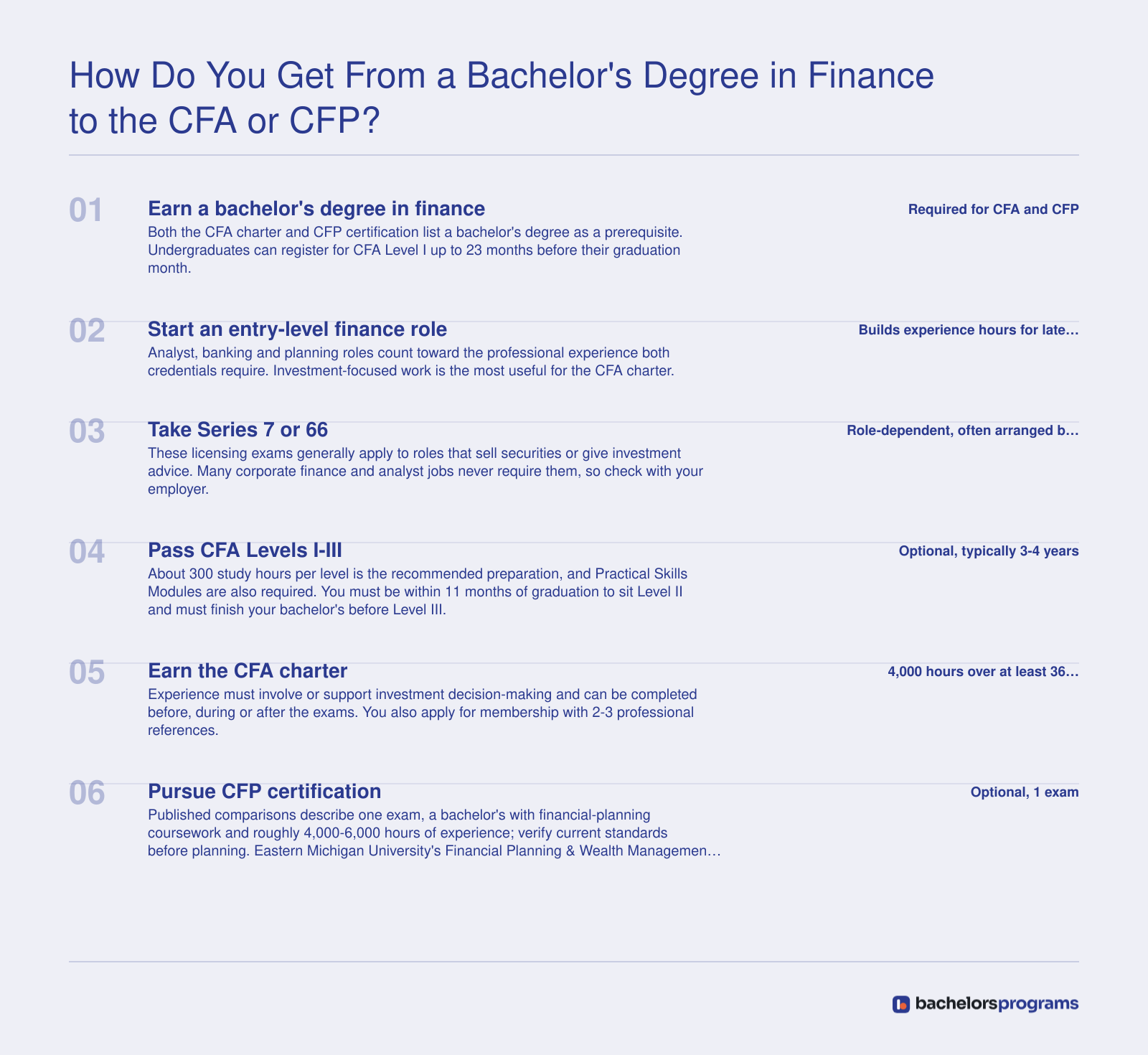
How Do You Get From a Bachelor's Degree in Finance to the CFA or CFP?
A bachelor's degree in finance opens the door to entry-level work and to the two best-known finance credentials. Licensing exams and professional designations are optional or depend on the role, so treat this as a map rather than a checklist. Confirm current requirements with each credentialing body before you plan around a date.
Common Questions About Finance Bachelor's Programs in Michigan
These answers draw on the program details covered earlier on this page. Check each school's own finance page for current requirements and delivery options before you apply.
Which Michigan colleges are the best for a bachelor's degree in finance?
Which Michigan finance programs are AACSB accredited?
Can you get a bachelor's degree in finance online from a Michigan school?
How much do finance graduates earn in Michigan?
Compare Finance programs on the data that matters
Explore more Business & Management majors or browse every field of study.
All Business & Management programs Browse every field of study