Best Computer Science Schools in Michigan
Compare 47 accredited Computer Science programs in Michigan at 32 colleges, with net price after aid, graduation rates, earnings and debt from IPEDS and the U.S. College Scorecard.
Michigan's computer science bachelor's degrees come in two shapes: a large public research university with graduate labs and a capacity-limited admission process, or a smaller regional or private campus that admits students straight into the major. Schools award it as a Bachelor of Science (B.S.) or Bachelor of Arts (B.A.) in Computer Science.
The difference shows up in price. Software developers in Michigan earned a median $125,570 in 2025, but net price after aid swings widely between public and private campuses, so that salary buys a very different four years depending on where you enroll.
Key Points
- Michigan Technological University ranks first, offering an ABET-accredited computer science B.S.
- Michigan software developers earned a median $125,570 in 2025, per BLS.
- In 2027, Davenport University and Baker College offer online computer science bachelor's routes.
Best Schools for a Bachelor's Degree in Computer Science in Michigan
Michigan Technological University takes the top spot among the best computer science schools in Michigan, pairing an ABET-accredited Bachelor of Science in Computer Science with strong completion outcomes and a comparatively low average net price after aid. The ten schools below run from large public universities to small private colleges, and each one awards a bachelor's degree in computer science. Admission rates across the group stretch from the low 60s to the low 90s, so there is a realistic option for most applicants.
Michigan Technological University
#1Houghton, MI · $10,000 – $15,000/yr (est.)
Best for: Hands-on learners wanting lab-based CS
Michigan Technological University leads this list on the strength of a hands-on Bachelor of Science in Computer Science that carries ABET accreditation and offers tracks in application development, computer systems and game development. Students work in labs, join enterprise teams and collaborate on faculty research in Houghton. The university admits about 92% of applicants, and schools offering this program have graduation rates of roughly 68%.
- ABET-accredited Bachelor of Science in Computer Science
- Tracks: Application, Computer Systems, Game Development
- Lab work plus undergraduate research with faculty
- Enterprise program teams, including Husky Game Development
- Minors in computer science, cybersecurity and data acquisition
- Housed in the College of Computing at Rekhi Hall
Andrews University
#2Berrien Springs, MI · $10,000 – $15,000/yr (est.)
Best for: Faith-driven students drawn to AI and robotics
Andrews University is a private school in Berrien Springs where computer science leans hard into applied work: artificial intelligence, machine learning, robotics, full-stack development and data science. Classes are small, internships and industry networking are built in, and the program asks students to weigh the ethics and social impact of what they build. It admits about 82% of applicants, and schools offering this program have graduation rates of roughly 72%.
- Coursework in AI, machine learning, robotics and data science
- Full-stack web and mobile development projects
- Internships and industry networking built into the program
- Ethics and societal impact threaded through the curriculum
- Real-world projects from the first year
University of Detroit Mercy
#3Detroit, MI · ~$15,000/yr (est.)
Best for: Detroit-area students seeking paid co-ops
The University of Detroit Mercy pairs a Bachelor of Science in Computer Science with paid co-op placements, often at Fortune 500 companies, so students graduate with professional experience on the resume. Specialties run from cybersecurity and gaming to bioinformatics and robotics, and a five-year B.S./M.S. option lets strong students double count courses. Roughly 75% of applicants are admitted, and schools offering this program have graduation rates of about 67%.
- Paid co-op assignments, often with Fortune 500 companies
- Specialties include cybersecurity, gaming, bioinformatics and robotics
- Five-year B.S./M.S. option with graduate courses at undergraduate rates
- Low student-to-faculty ratio with project-based team work
- State-of-the-art labs; ACM and Software Engineering Club chapters
Calvin University
#4Grand Rapids, MI · $23,000/yr (est. net price)
Calvin University awards a Bachelor of Computer Science, a credential built for students who want their degree centered squarely on computing rather than a broader science major. The program carries Computing Accreditation Commission of ABET approval and gives students room to stack advanced electives, with different sections of the same course counting separately when the topics differ. About 71% of applicants are admitted, and schools offering this program have graduation rates of roughly 74%, the highest figure on this list.
- Computing Accreditation Commission of ABET accredited
- Ten credit hours of advanced computer science electives
- Multiple CS 300 sections count as separate advanced electives
- Built for students who want computing as their primary focus
Western Michigan University
#5Kalamazoo, MI · $15,000 – $20,000/yr (est.)
Western Michigan University offers an ABET-accredited Bachelor of Science in Computer Science built on a 122-credit curriculum that runs from programming and data structures through operating systems, database management and web technologies. Students need at least a 2.0 GPA across computer science, engineering, math and statistics courses, and the department publishes an eight-semester plan to keep them on pace. About 85% of applicants are admitted, and schools offering this program have graduation rates of roughly 58%.
- ABET-accredited program requiring 122 credit hours
- Minimum 2.0 GPA in CS, ECE, MATH and STAT courses
- Coursework spans data structures, operating systems, databases and web tech
- Laptop required; an eight-semester sample schedule is published
- Team projects with emphasis on ethics and communication
Madonna University
#6Livonia, MI · $15,000 – $20,000/yr (est.)
Madonna University is a small private university in Livonia where computer science students get small classes, faculty with industry experience and cooperative employment placements. The Bachelor of Science in Computer Science offers concentrations in cybersecurity and software development, plus electives in mobile app development through a partnership with RIZE Education. Roughly 63% of applicants are admitted, and schools offering this program have graduation rates of about 60%.
- Tracks: Cyber Security, Software Development
- Small class sizes with direct faculty interaction
- Cooperative employment opportunities
- Partnership with RIZE Education for national network building
- Mobile application development electives
- Faculty advisor meetings required
Kettering University
#7Flint, MI · ~$35,000/yr (est.)
Kettering University in Flint runs on a co-op model, so computer science majors alternate classroom terms with paid work assignments and leave with substantial professional experience. The Bachelor of Science in Computer Science offers concentrations in computer gaming and cybersecurity, backed by dedicated networking, security and microcomputer labs. Roughly 79% of applicants are admitted, and schools offering this program have graduation rates of about 71%.
- Tracks: Computer Gaming, Cybersecurity
- Co-op terms alternate classroom study with paid work experience
- Labs include Computer Networks, Network Security and Microcomputers
- Research with faculty and national competition participation
- Bachelor's/Master's pathway and a computer science minor
Northwood University
#8Midland, MI · $27,000/yr (est. net price)
Northwood University frames computer science as a business discipline, pairing programming coursework with the communication and management skills employers say they want. Students in the Bachelor of Science in Computer Science work in Java, Python, C and C++, cover agile development and finish with a senior project. About 65% of applicants are admitted, and schools offering this program have graduation rates of roughly 63%.
- Business-focused computer science curriculum
- Languages include Java, Python, C/C++ and MySQL
- Agile development, data structures and algorithm design courses
- Senior project required
- B.S./MBA option available
Cornerstone University
#9Grand Rapids, MI · $20,000 – $25,000/yr (est.)
Cornerstone University is a private Christian school in Grand Rapids whose Bachelor of Science in Computer Science covers programming, algorithms, data structures, networking and web development, with agile team projects along the way. Students may transfer up to 75% of their credits, and the 33-credit Cornerstone Core adds a faith and career preparation thread. Roughly 78% of applicants are admitted, and schools offering this program have graduation rates of about 62%.
- Coursework in algorithms, data structures, networking and web development
- Agile teamwork and software engineering lifecycle management
- Transfer up to 75% of credits
- $0 application fee with spring and fall start dates
- 33-credit Christian worldview core
Central Michigan University
#10Mount Pleasant, MI · $18,000/yr (est. net price)
Central Michigan University offers a Bachelor of Science in Computer Science with hands-on coursework in programming, database management, artificial intelligence and network security, plus lab access to UNIX and LINUX workstations. Students can join faculty research and student organizations, and applications are reviewed on a rolling basis with priority scholarship consideration by December 1. About 90% of applicants are admitted, and schools offering this program have graduation rates of roughly 59%.
- 23 to 67 credit hours of computer science coursework
- Lab access to UNIX and LINUX workstations
- Coursework in AI, network security, software engineering and graphics
- Faculty research opportunities and student organizations
- Rolling fall admissions; priority scholarship review by December 1
Cost & outcomes by school
Federal data for the highest-earning Computer Science programs, independent of the ranking above. Earnings are this field's bachelor's graduates four years after completing where the Scorecard reports them, else the school's undergraduate median.
| School | Net price / yr | Grad rate | Earnings | Debt | Grads/yr | Format |
|---|---|---|---|---|---|---|
| Kettering University MI | $34,660 | 71% | $106,638 | $27,500 | 45 | Campus |
| Michigan Technological University MI | $14,182 | 68% | $105,428 | $23,250 | 81 | Campus |
| Calvin University MI | $22,992 | 74% | $95,410 | $18,250 | 37 | Campus |
| University of Michigan-Flint MI | $7,007 | 40% | $95,183 | $28,651 | 28 | Campus |
| Western Michigan University MI | $15,273 | 58% | $90,876 | $27,000 | 45 | Campus |
| Central Michigan University MI | $17,597 | 59% | $89,216 | $26,000 | 49 | Online |
| University of Michigan MI | $13,138 | 93% | $83,648 | $19,500 | — | Campus |
| Lawrence Technological University MI | $32,918 | 61% | $82,464 | $27,000 | 26 | Campus |
| Baker College MI | $13,157 | 36% | $80,179 | $34,750 | 25 | Hybrid |
| Davenport University MI | $17,707 | 57% | $76,469 | $29,073 | 43 | Hybrid |
| Concordia University Ann Arbor MI | $32,811 | 48% | $75,487 | $25,750 | — | Online |
| Eastern Michigan University MI | $15,407 | 46% | $74,818 | $25,000 | 92 | Hybrid |
Sources: U.S. Department of Education. Net price, graduation rate, earnings and debt: College Scorecard (earnings and debt for this field's bachelor's graduates where reported, else school-wide); graduates: IPEDS. A dash means no figure is reported.
Cost, debt & payoff
Median earnings of this field's bachelor's graduates (4 yrs after completing, else the school's undergraduate median) vs. their median federal loan debt · U.S. College Scorecard
Across these programs the median graduate earns about $63,075 and finishes with roughly $25,000 in debt — a ratio that clears a common rule of thumb (keep debt below first-year salary). Net price and debt vary widely school to school, so check the per-school figures in the table above before you shortlist.
Most Affordable Bachelor's in Computer Science Programs in Michigan
The schools below have the lowest average net price after grants and scholarships for a computer science bachelor's, based on 2024 IPEDS and College Scorecard data from the U.S. Department of Education. Net price is an average that depends on sector: public figures reflect in-state students who receive federal aid, and the private figure reflects all aided students, so your own cost will shift with family income and the awards you receive. Public universities such as the University of Michigan-Flint, Oakland University, the University of Michigan-Dearborn and Saginaw Valley State University average roughly $7,000 to $10,800 a year, while private Andrews University averages $12,547 after aid against a $35,056 sticker price. That makes Andrews a reasonable private option for students who qualify for substantial aid.
| School | Location | Sector | Format | Average Net Price After Aid | In-State Tuition and Fees |
|---|---|---|---|---|---|
| University of Michigan-Flint | Flint, MI | Public | Campus | $7,007 | $14,704 |
| Oakland University | Rochester Hills, MI | Public | Campus | $9,120 | $15,262 |
| University of Michigan-Dearborn | Dearborn, MI | Public | Campus | $9,492 | $15,640 |
| Saginaw Valley State University | University Center, MI | Public | Campus | $10,775 | $12,930 |
| Andrews University | Berrien Springs, MI | Private | Campus | $12,547 | $35,056 |
Related Articles
ABET-Accredited Computer Science Bachelor's Programs in Michigan
The schools below hold ABET accreditation for their bachelor's programs in computer science, each through ABET's Computing Accreditation Commission (CAC), according to ABET's accredited program search as of 2026. ABET accreditation is voluntary, so a program without it is not automatically weaker, but the credential signals that the curriculum meets an outside quality standard recognized by employers, graduate schools, and some federal and defense-sector employers. Confirm current status in the ABET database before you apply, because accreditation is reviewed on a cycle.
| School | Program Name | ABET Commission | Accreditation Status |
|---|---|---|---|
| University of Michigan | Computer Science | Computing Accreditation Commission (CAC) | ABET-accredited |
| Michigan Technological University | Computer Science | Computing Accreditation Commission (CAC) | ABET-accredited |
| Wayne State University | Computer Science | Computing Accreditation Commission (CAC) | ABET-accredited |
| Western Michigan University | Computer Science | Computing Accreditation Commission (CAC) | ABET-accredited |
| Oakland University | Computer Science | Computing Accreditation Commission (CAC) | ABET-accredited |
| Lawrence Technological University | Computer Science | Computing Accreditation Commission (CAC) | ABET-accredited |
Online and Hybrid Bachelor's in Computer Science Options at Michigan Schools
Yes, but the choices are narrow. Davenport University and Baker College are the two Michigan-based schools clearly supported for a 2026 Bachelor of Science in Computer Science with an online route. Each requires 120 credits. Davenport lists online and campus delivery, and Baker lists online. Neither school spells out whether proctored exams, labs or internships require a campus visit, so ask admissions before enrolling.
Formats at the Ranked Schools
Most of the ranked schools teach on campus. That includes Michigan Technological University, Andrews University, University of Detroit Mercy, Calvin University, Kettering University and Cornerstone University. Northwood University's program is listed as hybrid. Madonna University's program page mentions a hybrid delivery format.
Western Michigan University reported 116 distance-education computer science bachelor's completions in 2023, and Madonna reported 3. Even so, Western Michigan's program page describes on-campus delivery. Central Michigan University's program carries an online tag in our data, but its page also describes an on-campus format. Confirm the actual format with each department before you plan around it.
Flexibility Versus Campus Access
Online study suits working adults and students who already have credits. For transfer requirements, check each school's policy directly, since the research does not state them. The trade-off is access. Labs, faculty research, co-ops and campus recruiting events are easiest to reach in person, and Detroit Mercy and Kettering build paid co-op experience into their campus programs. If you go online, plan to find internships on your own.
Admission Requirements for Michigan Computer Science Bachelor's Programs
Admission to a Michigan computer science bachelor's program ranges from open-door regional campuses to a split, capacity-limited process at the University of Michigan. Where you apply decides how much your GPA and course record matter.
University of Michigan: LSA vs. Engineering
The University of Michigan offers computer science through two colleges, and you apply directly to one of them. The College of Engineering awards the Computer Science major in its own program. The College of Literature, Science, and the Arts (LSA) offers a separate CS degree. LSA is SAT/ACT optional for 2026, allows self-reported scores, and states no minimum GPA.1 It lists expected coursework: four years of English, three each of math, science, and history/social science, and two of one foreign language.1 Because of capacity limits, LSA students must be selected for the CS major before declaring it.1 Our research did not confirm Engineering's 2026 first-year test policy or GPA expectations, so check its admissions page directly and do not assume LSA's policy applies.
The University of Michigan does not appear to publish a CS-specific acceptance rate. Only the university-wide rate is, and it overstates your odds in a competitive major.
Transfers
LSA accepts up to 60 outside credits toward its 120-credit degree, usually with a C or better.2 Outside grades generally do not enter the U-M GPA.2 Engineering transfer applicants need prerequisite courses at C or better and a cumulative GPA of at least 3.0.3 Departmental credit often counts only as elective credit.
Regional Schools
Most other schools here are far more accessible. Admit rates run from about 92% at Michigan Technological University and 90% at Central Michigan University to roughly 85% at Western Michigan University, 79% at Kettering University, 78% at Cornerstone University, and 75% at the University of Detroit Mercy. Calvin University (71%), Northwood University (65%), and Madonna University (63%) are somewhat more selective. Central Michigan uses rolling fall admission with a December 1 priority date for scholarships. Cornerstone starts students in fall or spring and lets them transfer up to 75% of credits.
Our research did not clearly establish GPA expectations, test policies, or transfer-credit rules at most of these schools, including Wayne State University and Oakland University. Confirm them on each school's admissions page. Some programs also review applicants again before the upper-level CS sequence, so ask when the program's own requirements begin.
Community College Pathways
The Michigan Transfer Agreement lets a community college student complete a block of general education credit that participating Michigan schools accept. CS majors should also finish calculus and programming prerequisites before transferring.
Cost of a Computer Science Bachelor's Degree in Michigan
The Michigan Achievement Scholarship, which covers high school graduates from the class of 2023 onward, has changed how Michigan students pay for college.1 Sticker prices still tell only part of the story.
Public vs. Private: Tuition and Net Price
Among the public schools here, in-state tuition and fees run about $14,760 at Central Michigan University, $15,252 at Western Michigan University and $19,123 at Michigan Technological University. Net price after aid, which also reflects living costs, is $14,182 at Michigan Tech, $15,273 at Western Michigan and $17,597 at Central Michigan.
Private sticker prices are higher: Cornerstone University at $23,000, Madonna University at $28,440, University of Detroit Mercy at $32,946, Andrews University at $35,056, Calvin University at $39,350 and Kettering University at $48,470. Aid narrows the gap. Andrews' net price is $12,547 and Detroit Mercy's is $15,232, while Kettering's remains $34,660.
Affordability Context (School-Wide)
These figures cover each school's whole undergraduate body, not computer science majors alone. The Pell share is 65% at Madonna, 59% at Northwood University and 34% at Kettering. Median debt at completion ranges from $20,842 at Northwood to $27,000 at Kettering and Central Michigan.
Michigan State Aid
The Michigan Achievement Scholarship offers up to $5,500 a year for up to five years at Michigan public and private universities, and for four-year programs at community colleges.2 The 2026-27 materials list a $2,500 minimum award and a $3,000 last-dollar award.3 Your actual amount depends on award type, cost of attendance and other aid. Pell-eligible students may receive a $1,000 bonus.2
To qualify, you must:
- Be a Michigan high school graduate from the class of 2023 or later.
- Have a FAFSA student aid index of $30,000 or less.1
- Be a Michigan resident, a citizen, permanent resident or refugee, and not in loan default.1
- Enroll full-time within 15 months of graduating.1
The Michigan Student Aid materials reviewed here do not describe a current program called Michigan Competes. The closest listed program is the Michigan Competitive Scholarship, which for 2026-27 requires a 2.0 GPA, at least half-time undergraduate enrollment and a current-year FAFSA.4 Confirm award amounts with Michigan Student Aid.5
One Practical Tip
File the FAFSA as early as you can each year. Both state programs require a current-year FAFSA, and a missed filing can cost you the award.
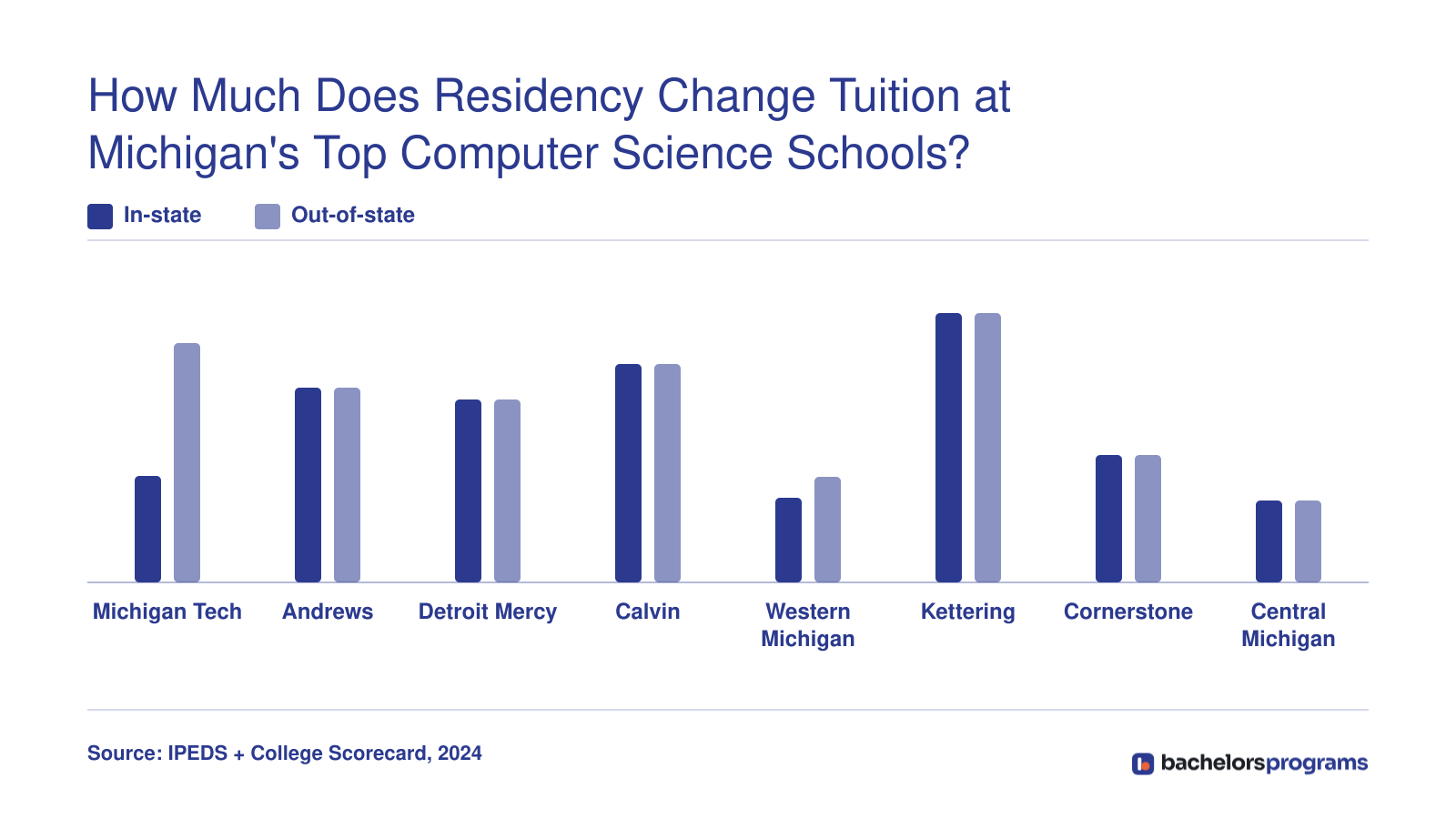
How Much Does Residency Change Tuition at Michigan's Top Computer Science Schools?
Residency matters most at Michigan Technological University, where out-of-state students pay $42,988 in tuition and fees versus $19,123 for Michigan residents. That $23,865 gap is the widest among the schools ranked here. Western Michigan University's gap is far smaller at $3,782, and Central Michigan University charges $14,760 regardless of residency. Private schools such as Andrews, Detroit Mercy, Calvin, Kettering and Cornerstone charge one rate to everyone, so out-of-state students give up nothing on sticker price there. These are published tuition and fees before aid. Your net price after grants and scholarships will usually be lower.
Computer Science Careers and Salaries in Michigan (No Michigan License Required)
Michigan had 43,460 software developers in 2025, with a median annual wage of $125,570 ($60.37 an hour), according to BLS data.1 That ranks the state 14th nationally for employment.2 The wage is about 92 percent of the national median of $135,980.1 Nationally, BLS projects 10 percent job growth from 2025 to 2035, with about 106,100 openings a year.3 A bachelor's degree is the typical entry credential.1
Where Michigan Developers Work
The state's demand is tied to its established industries: automotive and mobility, finance, healthcare, and defense. Ann Arbor and Detroit also have growing tech scenes. Treat these clusters as places to research, not as confirmed openings. Check current postings before you plan around any one employer.
Co-op and Internship Pipelines
Some Michigan schools build work experience into the degree. Kettering University's program includes co-op work terms, which alternate paid employer placements with study rather than relying on summer internships alone. Baker College's computer science program lists internship or co-op placements among its features. Ask any school you are considering about its employer relationships, how placements are arranged, and what students typically earn.
Scorecard Earnings vs. State Wages
The two figures cover different groups and time windows, so compare them carefully. The state wage covers all employed software developers in 2025, including experienced workers.1 Federal Scorecard earnings measure graduates of a specific program about one year after completion:
- Kettering University: $83,751
- Central Michigan University: $74,135
- Calvin University: $73,145
- Michigan Technological University: $69,910
All of these sit below the $125,570 statewide median, what you would expect from entry-level pay. First-year pay is an entry-level figure. Kettering's graduates show a four-year median of $106,638, which narrows the gap as experience builds.
Licensing
Software development is not a licensed profession, so Michigan requires no state license to work as a developer. Employers typically look at your degree, projects, internships, and technical skills instead.
How to Choose a Michigan Computer Science School
Computer science degrees now differ more by specialty than by title, so two programs with the same name can lead to very different careers. A short checklist keeps the comparison manageable.
Start With Accreditation and Specialization
ABET accreditation comes first. Michigan Technological University, Calvin University and Western Michigan University each describe their program as ABET accredited. For any other school, confirm the status on ABET's own site before you apply.
Next, match the concentrations to your goal:
- Game development: Michigan Tech offers a concentration, and the University of Detroit Mercy lists gaming among its specialties.
- AI and machine learning: Andrews University emphasizes AI and robotics, and Baker College's program carries an Artificial Intelligence concentration.
- Cybersecurity: Detroit Mercy lists it as a specialty, Michigan Tech offers a cybersecurity minor, and Cornerstone University points to network security careers.
- Data science and business software: Andrews covers data science, and Lawrence Technological University's program has a Business Software Development concentration.
Weigh Size, Location and Format
A small campus like Madonna University means smaller classes and hybrid delivery. A larger school like Western Michigan has more electives. Houghton is remote, while Detroit and Grand Rapids put you near employers. Northwood University lists a hybrid format, and Central Michigan University lists an online option.
Look Past Graduate Rankings
U.S. News graduate rankings mostly reflect research reputation, not how well a school teaches first-year programmers. For a bachelor's degree, check what graduates experience instead:
- Retention: Kettering University retains about 94 percent of first-year students, and Michigan Tech about 89 percent.
- Graduation rate: Calvin graduates about 74 percent of its students, and Kettering about 71 percent.
- Program earnings: Compare earnings for computer science graduates, not school-wide averages.
- Internship access: Kettering and Detroit Mercy build co-op work into their programs.
What About Reddit?
Reddit threads about the best computer science schools in Michigan carry strong opinions, but they vary by poster, major and graduation year. Use those threads to find questions worth asking, then test each claim against retention, graduation and earnings data.
Compare Computer Science programs on the data that matters
Explore more Computers & IT majors or browse every field of study.
All Computers & IT programs Browse every field of study