Best Finance Schools in North Carolina
Compare 30 accredited Finance programs in North Carolina at 27 colleges, with net price after aid, graduation rates, earnings and debt from IPEDS and the U.S. College Scorecard.

Finance hiring in North Carolina clusters around two poles: Charlotte, one of the country's largest banking centers, and the Raleigh-Durham fintech and research corridor. Employers in both places typically expect a bachelor's degree in finance as the entry credential, most often a Bachelor of Science (B.S.) in Finance, though some schools award a BSBA or B.A. instead.
The tension is practical. Cost runs from affordable in-state public tuition to private sticker prices far higher, and graduation rates, post-graduation earnings, online availability, and admissions rules vary just as widely. A school's address also shapes how easily you reach those employers.
Key Points
- UNC Pembroke's average net price is $10,260 per year after aid.
- Wake Forest's $67,642 tuition drops to a $28,719 average net price.
- Charlotte-area financial and investment analysts averaged $109,820 in May 2023.
Best Finance Schools in North Carolina: Our Top 10 Ranked
North Carolina's finance programs run from large public business schools in Raleigh and Charlotte to small private campuses with their own student-managed investment funds. Every school below is based in the state and awards an undergraduate credential, so the list works whether you plan to sit in a classroom or study online. Each card shows in-state tuition, average net price and the school's overall graduation rate so you can compare cost and completion side by side.
North Carolina State University at Raleigh
#1Raleigh, NC · $9,000 – $33,000/yr (est.)
Best for: Students planning corporate finance careers
NC State anchors the Research Triangle with a finance concentration inside a 120-credit business administration degree at the Poole College of Management. The coursework blends accounting, economics and statistics with valuation, portfolio management and risk management. Graduates move into analyst, credit and financial management roles across Raleigh, Durham and Charlotte.
- 120 total credit hours
- 2.0 GPA minimum for the major
- Investment analysis and portfolio management coursework
- Covers business valuation and risk management
- Taught at the Poole College of Management
University of North Carolina at Charlotte
#2Charlotte, NC · $15,000 – $20,000/yr (est.)
Best for: Charlotte-area students seeking bank internships
UNC Charlotte puts its finance degree in the middle of the state's banking industry, and the school leans on Fortune 500 partnerships and internships built around the Charlotte market. Students enter as pre-business majors and declare finance after completing progression courses. The Business Honors Program adds a more demanding track for strong students.
- Freshmen enter as Pre-Business majors
- 2.7 overall GPA required for transfer applicants
- Junior standing at 60 credit hours before declaring
- 9 credit hours of restricted electives
- Minimum grade of C in progression and core courses
- Business Honors Program available
Appalachian State University
#3Boone, NC · $8,000 – $25,000/yr (est.)
Best for: Hands-on learners drawn to student investment funds
Appalachian State groups finance and banking into a single major inside the Department of Finance, Banking and Insurance, a structure that suits students aiming at lending and bank management. The Boone campus supports the Bowden Investment Group and the Finance Student Association, and the department encourages off-campus internships. Graduates move into banking, corporate finance, investment management and risk analysis.
- One of two majors in the Department of Finance, Banking and Insurance
- Leads to a Bachelor of Science in Business Administration
- Bowden Investment Group manages a student portfolio
- Finance Student Association among four student organizations
- Off-campus internships encouraged for real-world experience
Wake Forest University
#4Winston-Salem, NC · $25,000 – $30,000/yr (est.)
Wake Forest is the most selective campus on this list, and its School of Business builds the finance degree on financial economics, accounting and applied statistics. Students are pushed toward the CFA designation and a summer internship between junior and senior year. The program also feeds a one-year Master of Science in Accountancy for graduates who want a fifth year.
- Coursework in financial economics, accounting and applied statistics
- CFA designation encouraged for finance students
- Summer internship recommended between junior and senior year
- Pathway to a one-year Master of Science in Accountancy
East Carolina University
#5Greenville, NC · ~$16,000/yr (est.)
East Carolina's College of Business has held AACSB International accreditation since 1967 and offers a BSBA in finance with a choice of finance or risk management and insurance concentrations. The Greenville program adds a leadership capstone, a required professional development portfolio and a renewable four-year merit award for incoming business students. Career outcomes cluster in banking, financial services and real estate.
- At least 120 semester hours required
- 18-credit concentration in finance or risk management and insurance
- AACSB International accreditation held since 1967
- Business Scholars Award is a renewable four-year merit scholarship
- Leadership capstone and professional development portfolio required
- 36-credit business core and 40-credit general education core
Elon University
#6Elon, NC · ~$42,000/yr (est.)
Elon's Love School of Business pairs a finance major with a separate financial technology track and a finance center holding 12 Bloomberg Terminals plus FactSet and Wharton Research Data Services. The school sits in the CFA Institute University Affiliation Program, and its accelerated 3+1 option awards a BSBA and a Master of Science in Business Analytics in four years. Internships have placed students at JPMorgan Chase, Bank of America and Wells Fargo.
- 12 Bloomberg Terminals plus FactSet and Wharton Research Data Services
- CFA Institute University Affiliation Program member
- Accelerated 3+1 route to a BSBA and an M.S. in Business Analytics
- Separate Financial Technology major as an alternate pathway
- Internships at JPMorgan Chase, Bank of America and Wells Fargo
- Wall Street Prep boot camps and CFA Research Challenge team
Western Carolina University
#7Cullowhee, NC · ~$13,000/yr (est.)
Western Carolina runs its finance degree on the Cullowhee campus with three concentration options and full- or part-time schedules, which helps working students in the western part of the state. Every student completes a required internship, often with regional banks recruited through the annual Financial Services Career Fair. The Finance Club manages a real $400,000 equity portfolio, and members travel to the New York Stock Exchange each fall.
- Required internship with regional banks and financial institutions
- Annual Financial Services Career Fair on campus
- Coursework in bank operations and credit union management
- Finance Club travels to the New York Stock Exchange
- Customizable curriculum for finance careers
- Skills in asset management and investing
- Study abroad opportunities available
- Dual degree with Accounting available
- Eligible for CFP certification
- Internships at Macon Bank and Home Trust Bank
- 120 total credit hours with part-time options
- Emphasizes ethical practice and financial analysis
University of North Carolina at Greensboro
#8Greensboro, NC · $11,000/yr (est. net price)
UNC Greensboro's Bryan School holds AACSB accreditation and delivers its finance degree both on campus and online, which makes it one of the few North Carolina options that does not require relocating to Greensboro. The Spartan Investment Club adds CFA exam preparation and company networking sessions. An accelerated master's path finishes in one additional year with no GRE or GMAT required.
- AACSB-accredited Bryan School
- On-campus and online options available
- CFA exam preparation through the Spartan Investment Club
- Accelerated master's degree in one additional year
- No GRE or GMAT required for the accelerated path
North Carolina A & T State University
#9Greensboro, NC · ~$11,000/yr (est.)
North Carolina A&T, a historically Black university in Greensboro, houses its finance degree in the Willie A. Deese College of Business and Economics alongside accounting. The department offers just two undergraduate degrees, and the finance program is built around preparation for professional certification and entry into the field. Students get a compact, focused curriculum rather than a wide menu of tracks.
- One of two undergraduate degrees in Accounting and Finance
- Housed in the Willie A. Deese College of Business and Economics
- Prepares students for professional certification
- Campus-based program in Greensboro
Campbell University
#10Buies Creek, NC · $25,000/yr (est. net price)
Campbell keeps finance classes small on its Buies Creek campus and gives students the First Citizens Wealth Management Center plus a real student-managed investment fund to work in. A national stock market competition, Excel workshop series and financial literacy center round out the practical side. A 4+1 pathway lets students add an MBA, and popular minors include accounting, economics and math.
- First Citizens Wealth Management Center for financial analysis
- Students manage a real investment portfolio
- Prepares for CFP and CFA designations
- 4+1 pathway to an MBA
- Annual national stock market competition
- Extensive Excel workshop series
Cost & outcomes by school
Federal data for the highest-earning Finance programs, independent of the ranking above. Earnings are this field's bachelor's graduates four years after completing where the Scorecard reports them, else the school's undergraduate median.
| School | Net price / yr | Grad rate | Earnings | Debt | Grads/yr | Format |
|---|---|---|---|---|---|---|
| Wake Forest University NC | $28,719 | 89% | $145,996 | $19,500 | 143 | Campus |
| Elon University NC | $41,555 | 84% | $103,426 | $19,500 | 152 | Campus |
| Duke University NC | $29,612 | 97% | $97,800 | $13,000 | — | Campus |
| Queens University of Charlotte NC | $30,857 | 61% | $94,719 | $25,000 | 13 | Campus |
| East Carolina University NC | $15,739 | 63% | $78,324 | $22,500 | 128 | Campus |
| Campbell University NC | $24,516 | 61% | $78,021 | $25,500 | 37 | Campus |
| Appalachian State University NC | $16,836 | 75% | $75,396 | $20,500 | 136 | Campus |
| University of North Carolina at Charlotte NC | $15,435 | 69% | $74,965 | $21,500 | 403 | Campus |
| North Carolina State University at Raleigh NC | $17,303 | 85% | $68,758 | $20,121 | — | Campus |
| Wingate University NC | $20,748 | 46% | $67,315 | $20,500 | 21 | Campus |
| University of North Carolina at Greensboro NC | $10,965 | 56% | $64,077 | $22,520 | 92 | Online |
| High Point University NC | $38,707 | 74% | $61,389 | $24,575 | 88 | Campus |
Sources: U.S. Department of Education. Net price, graduation rate, earnings and debt: College Scorecard (earnings and debt for this field's bachelor's graduates where reported, else school-wide); graduates: IPEDS. A dash means no figure is reported.
Cost, debt & payoff
Median earnings of this field's bachelor's graduates (4 yrs after completing, else the school's undergraduate median) vs. their median federal loan debt · U.S. College Scorecard
Across these programs the median graduate earns about $56,522 and finishes with roughly $23,371 in debt — a ratio that clears a common rule of thumb (keep debt below first-year salary). Net price and debt vary widely school to school, so check the per-school figures in the table above before you shortlist.
Most Affordable Bachelor's in Finance Programs in North Carolina
UNC Pembroke has the lowest average net price in our directory at $10,260 per year, while North Carolina A&T State University has the lowest net price of the schools ranked here at $10,846, and Western Carolina University has the lowest in-state tuition among them at $4,630. Net price is the school-wide average cost after grants and scholarships for aided undergraduates, so use it as a benchmark rather than an exact quote for the finance major. Every school below is a public university, and each enrolls a large share of Pell Grant recipients, from about 60 percent at Western Carolina to about 79 percent at Winston-Salem State, according to 2024 IPEDS and College Scorecard data from the U.S. Department of Education.
| School | Location | Finance Program | Format | In-State Tuition & Fees | Average Net Price After Aid | Pell Grant Recipients |
|---|---|---|---|---|---|---|
| University of North Carolina at Pembroke | Pembroke | B.S. in Business Administration (Finance concentration) | Campus | $3,648 | $10,260 | 75.7% |
| North Carolina A & T State University | Greensboro | Bachelor of Science in Finance | Campus | $6,813 | $10,846 | 73.5% |
| University of North Carolina at Greensboro | Greensboro | Finance, B.S. | Online and campus | $7,661 | $10,965 | 67.7% |
| Western Carolina University | Cullowhee | Finance (BSBA) | Campus | $4,630 | $13,315 | 59.8% |
| Winston-Salem State University | Winston-Salem | Finance | Campus | $6,126 | $13,479 | 79.1% |
Online and Hybrid Bachelor's in Finance Options at North Carolina Schools
An online bachelor's degree in finance covers the same coursework, credits, and B.S. credential as a campus program, but lectures, problem sets, and exams reach you through a learning platform instead of a classroom. A hybrid program pairs remote coursework with required campus sessions, proctored exams, or weekend residencies. Across North Carolina, few finance programs offer a remote route, and the details differ by school.
Which schools here list an online route
UNC Greensboro is the one school here that lists its finance B.S. as an asynchronous online program. Confirm with an advisor that every required course can be finished remotely before you enroll. Western Carolina publishes a finance concentration inside its B.S.B.A. and describes an online path for it, with an in-state figure of about $42 per credit; that page does not show a nonresident rate.
NC State, Appalachian State, Wake Forest, Elon, NC A&T, and Campbell list their finance programs as campus-based. East Carolina turns up in one online-affordability listing, but its own program page does not confirm the format. UNC Charlotte's online B.S.B.A. is a degree-completion route, and its page does not confirm a finance concentration, so treat it as a business degree unless an advisor says otherwise.
What changes off campus
- Tuition rules: Distance rates do not always follow campus residency rules. Ask whether an out-of-state online student pays the resident rate.
- Internships: Online students typically line up internships near home. Campus students at UNC Charlotte and Wake Forest can draw on Charlotte and Winston-Salem employers.
- Networking: Charlotte's banking and asset-management firms are easiest to reach from a Charlotte-based program, not a remote one.
Admissions for a Bachelor's Degree in Finance in North Carolina: GPA, Test Policy, and Transfer Credit
Admission to the university and admission to the finance major are two separate steps. Admission rates vary widely across North Carolina, and some business schools apply their own requirements after you enroll.
Selectivity and Test Policy
Wake Forest admits about 22 percent of applicants and NC State about 42 percent. North Carolina A & T is near 50 percent and Elon near 66 percent. UNC Charlotte admits about 80 percent, Western Carolina about 82 percent, and Campbell about 87 percent. UNC Greensboro (89 percent), East Carolina (89 percent) and Appalachian State (90 percent) are the most open.
We could not confirm current SAT/ACT policies or freshman GPA expectations for these schools from published pages, so check each admissions office directly before you apply. Treat any school's test policy as unconfirmed until you see it in writing.
Finance Major Entry and GPA
UNC Charlotte does not admit freshmen directly to finance. Students enter Pre-Business, and the program page lists a 2.7 GPA minimum, prerequisite courses, a minimum C in progression courses, and junior standing at 60 credit hours. NC State's program page lists a 2.0 GPA minimum within a 120-credit degree. For the other schools, we found no published finance-specific GPA threshold or direct-admit rule, so ask the business school whether you declare finance at enrollment or after a first- or second-year review.
Transfer Credit and the Community College Route
UNC Charlotte's transfer rules are the clearest in our data:
- Credits: At least 24 transferable credit hours from a regionally accredited institution.1
- GPA: A minimum 2.0 cumulative college GPA.1
- Course grades: Nothing below a C transfers, and grades do not enter your UNC Charlotte GPA.2
- Cap: Up to 64 credit hours from two-year institutions.2
For the other schools here, we found no published transfer policy to compare.
The revised Comprehensive Articulation Agreement, effective Spring 2026, can cut cost for community college students headed to a public university.3 It covers Associate in Arts and Associate in Science graduates moving to the 16 UNC universities. It offers a general education waiver, junior-level transfer and Transfer Assured Admissions for qualifying students. Expect 60 semester hours and a 2.0 GPA.4 The agreement lists C- as the minimum course grade, while the community college catalog says C, so confirm with an advisor.3
The agreement does not cover private schools such as Wake Forest, Elon or Campbell. It also guarantees general transfer credit, not that every course will count toward a finance major. Confirm the finance prerequisites before you register for classes.
Cost of a Finance Degree in North Carolina: Tuition, Net Price, and State Aid
How much does a bachelor's in finance actually cost in North Carolina once aid is counted? At the state's public universities, less than many families expect.
Public Tuition and Net Price
In-state tuition and fees at the public schools ranked here run from $4,630 a year at Western Carolina University to $8,799 at North Carolina State University at Raleigh. Over four years, that is roughly $18,500 to $35,200 in tuition alone. University of North Carolina at Pembroke, in our directory, lists $3,648.
Average net price is usually higher than tuition because it covers the full cost of attendance (housing, food, books) minus grants. Among the ranked public schools it runs from $10,846 a year at North Carolina A & T State University to $17,303 at NC State. Four years at those rates comes to about $43,400 to $69,200, before any extra aid you qualify for.
Private Schools and Average Net Price
Wake Forest University, Elon University and Campbell University post higher sticker prices than the public campuses. Net price is an average after grants and scholarships, so it typically sits below the published rate. Compare each school's net price calculator, not its tuition line.
North Carolina State Aid
- NC Education Lottery Scholarship: For North Carolina-resident undergraduates taking at least 6 credit hours per semester who meet Pell criteria. You are considered automatically when you file the FAFSA, according to CFNC.
- Next NC Scholarship: For in-state students at the 16 UNC System universities with household income of $80,000 or less and a Student Aid Index of 7,500 or less. It combines Pell and state aid for at least $5,000 a year, can cover more than half (if not all) of tuition and fees1, applies to books, food and housing, and is not repaid.
- NC Need-Based Scholarship: For residents at qualifying private North Carolina colleges with a Student Aid Index of 15,000 or less, at least 6 credit hours and no prior bachelor's degree.
File the FAFSA Early
Every program above runs through the FAFSA. The Next NC Scholarship deadline is June 12, and filing well before then improves your shot at limited state and campus funds. Check each school's own scholarship deadlines too, since many fall earlier in the spring.
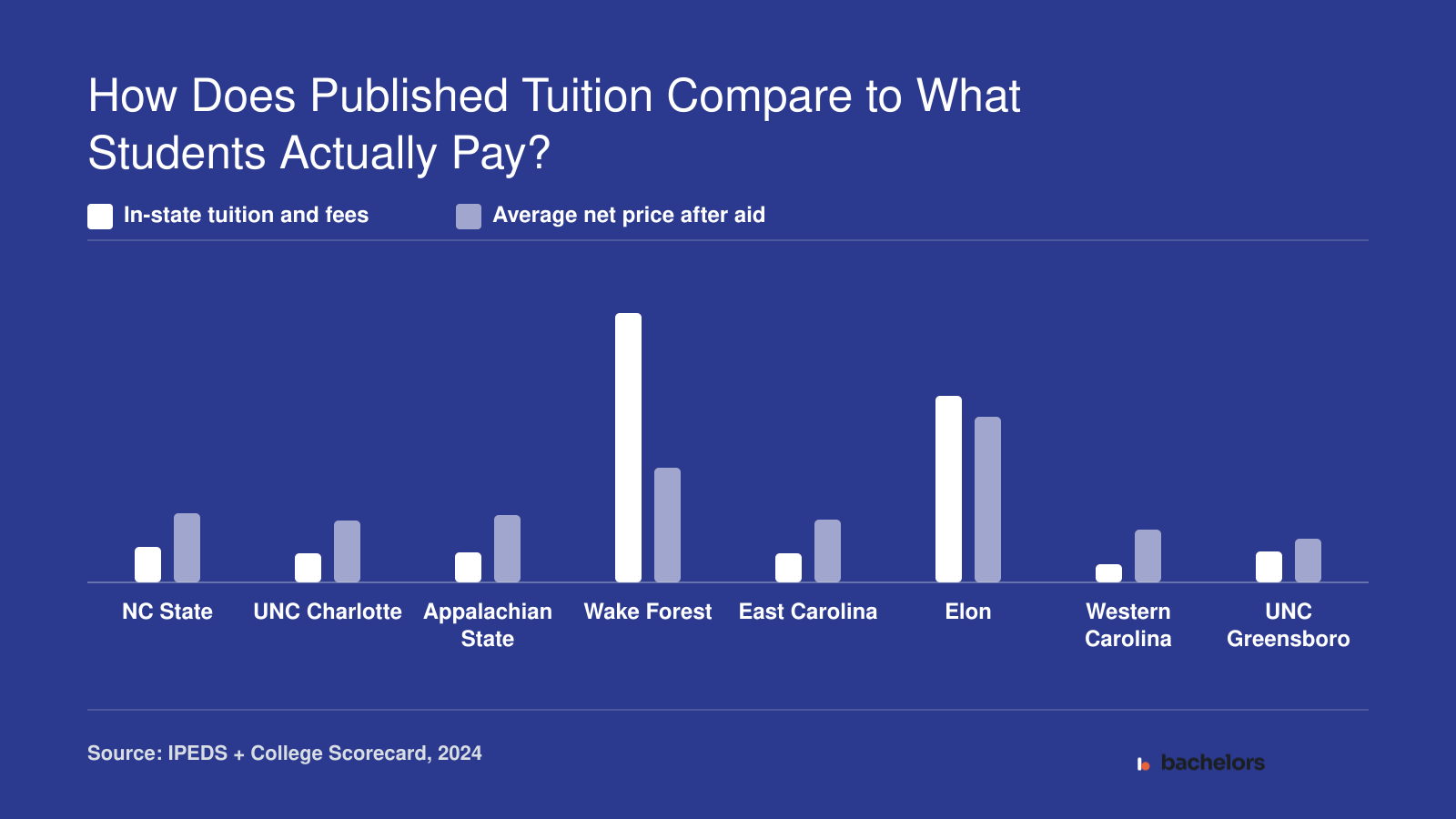
How Does Published Tuition Compare to What Students Actually Pay?
Sticker price and actual cost can differ widely. Wake Forest has the widest gap: published tuition of $67,642 against an average net price of $28,719 after aid, a difference of $38,923. At the public universities, net price is higher than tuition because it also covers housing, food, and books, so treat each net price as an approximate average for students receiving aid, not a personal quote.
Related Articles
Finance Careers and Salaries in North Carolina
A high average wage can mislead you about what a typical new graduate earns, and finance pay is especially skewed by senior producers. In the Charlotte-Concord-Gastonia area, the May 2023 mean annual wage was $109,820 for financial and investment analysts (about 5,670 jobs)1, $137,320 for personal financial advisors (about 6,530 jobs)2, and $88,640 for loan officers (about 5,840 jobs)3. In the Raleigh area, May 2022 means were $142,580 for advisors and $82,630 for loan officers4. These are means, not medians, so pull current numbers yourself.
How to Look Up Current BLS Wages
- Go to the Occupational Employment and Wage Statistics (OEWS) pages on BLS.gov and open the state and metro area data.
- Search by occupation code: 13-2051 (financial and investment analysts), 13-2052 (personal financial advisors), 13-2072 (loan officers).
- Set the area filter to North Carolina, then repeat for Charlotte-Concord-Gastonia, NC-SC and Raleigh-Cary, NC.
- Use the latest release, and download the spreadsheet if the web table omits percentile columns.
Checklist for Reading the Numbers
- Median first: The median shows the middle worker. Treat the mean as a ceiling for planning.
- 10th percentile: This approximates entry-level pay, so use it for your first-job budget.
- 90th percentile: This shows long-run potential, especially in advising, where commissions and client fees matter.
- Metro match: Confirm the area name and release year before comparing Charlotte with Raleigh.
- Employment size: Larger job counts, like Charlotte's, usually mean more openings to apply for.
Local and Professional Sources
The NC Department of Commerce publishes labor market information for the state's regions. Next, check the career outcome and employment reports from UNC Charlotte and NC State, which show where graduates land and what they are offered. Finally, associations for financial planners, bankers, and mortgage lenders publish compensation studies and outlook pieces that add context BLS cannot. Compare at least two sources before you decide a degree pays off.
Finance Credentials and Licensing in North Carolina at a Glance
Internships, Investment Labs, and Charlotte Employer Access
A school inside Charlotte gives you banks within commuting distance, while a school elsewhere has to bring the banks to you. Either arrangement can work, provided the program page explains how.
Verified Hands-On Features
- NC State: Bell Tower Capital Management is a student-run fund investing about $240,000 of university endowment money using fundamental value investing. The college also has a Bloomberg lab with 9 terminals in a 30-seat classroom.
- UNC Charlotte: Its student-managed investment fund dates to 1997. The finance page calls Charlotte the nation's second-largest banking hub, and about 50 Risk Management and Insurance concentrators complete an internship each year.
- Campbell and Western Carolina: Campbell students manage a real investment portfolio. Western Carolina's Finance Club manages a $400,000 portfolio, and every student completes an internship.
Why Charlotte Proximity Matters
A Charlotte listing for a Summer 2027 Commercial Credit/Banking Intern covers credit analysis and underwriting, with an application deadline of November 30, 2026. Students nearby can interview in person and intern during the semester. Farther-away schools build employer access differently. Western Carolina runs an annual Financial Services Career Fair and works with local banks, and UNC Greensboro lists Truist, Wells Fargo and Bank of America among employers.
Checklist for Any Program Page
- Does the fund manage real money, and how much?
- How many Bloomberg terminals are there, and can undergraduates use them?
- Is an internship required or only encouraged?
- Are named employers listed, not just "industry connections"?
- Does the school mention CFA exam support?
Questions to Ask Yourself
Do you want to work in Charlotte banking after graduation?
Will your budget point to an in-state public school, or can a private aid package close the gap?
Do you need online or hybrid flexibility, or transfer credit from a North Carolina community college?
Compare Finance programs on the data that matters
Explore more Business & Management majors or browse every field of study.
All Business & Management programs Browse every field of study