Best Finance Schools in South Carolina
Compare 28 accredited Finance programs in South Carolina at 24 colleges, with net price after aid, graduation rates, earnings and debt from IPEDS and the U.S. College Scorecard.

South Carolina offers two routes to a finance degree: a B.S. in Finance inside an AACSB-accredited business school, or a finance concentration folded into a B.B.A. or liberal arts major. The Bachelor of Science (B.S.) in Finance is the credential employers recognize, but what sits behind it varies more than the title suggests.
Price splits the field just as sharply. In-state tuition at a public university and sticker price at a private college can differ by tens of thousands before South Carolina's lottery scholarships narrow the gap. Add campus versus online delivery, and the choice narrows fast.
Key Points
- Clemson, College of Charleston and Coastal Carolina all hold AACSB accreditation.
- The Citadel offers residents the widest in-state discount: $25,938 yearly.
- Online options are business administration degrees with a finance concentration.
Best Bachelor's Degree in Finance Schools in South Carolina
South Carolina's finance bachelor's programs run from a large public business school in Columbia to small private colleges where finance sits inside a liberal arts core. The ten schools below award a bachelor's degree in finance or a closely related business degree, and several run trading rooms, student investment funds or professional exam preparation that put practice ahead of theory.
Clemson University
#1Clemson, SC · $20,000 – $25,000/yr (est.)
Best for: Trading-simulator learners pursuing corporate finance
Clemson University's finance program sits inside a large public research university with a dedicated finance trading room, Bloomberg terminals and a student-run simulated investing program. The B.S. in Financial Management splits into four emphasis areas, and the corporate finance track draws students headed toward banking, brokerage and corporate treasury work. Faculty research in corporate governance, mergers and acquisitions, and housing markets feeds current industry practice into the classroom, and the school is among the most selective on this list.
- Dedicated corporate finance track among four emphasis areas
- Bloomberg terminals in the finance trading room
- Wall Street South simulated investing program
- Financial modeling workshops offered
- CFA exam scholarships available to students
- Faculty research in corporate governance and M&A
- Student Management Investment Fund run by finance majors
- Annual Finance Recruiting Night with employers
- Prepares students for banking and brokerage roles
- Bloomberg terminal and trading room access
- CFP exam preparation available
- CFP exam preparation built into the emphasis
- CFA Level I exam scholarships
- Access to the finance trading room
- Creative Inquiry on AI and machine learning in real estate
- CFA Global Research Challenge participation
University of South Carolina
#2Columbia, SC · ~$23,000/yr (est.)
Best for: Students pairing finance with business analytics
The University of South Carolina's Darla Moore School of Business anchors finance education in the state capital, and its B.S.B.A. in finance is the largest single program on this list. The 122-credit curriculum builds a broad business core before advanced work in corporate financial analysis, investment analysis and portfolio management. Optional concentrations in business analytics and sustainability let students pair finance with a second specialty, and admission is fall-term only with a calculus prerequisite.
- 122 total credit hours
- Fall-only admission with a calculus prerequisite
- Optional concentrations in business analytics or sustainability
- Investment analysis and portfolio management coursework
- Electives in derivatives, fixed income and international finance
- Focus on company valuation and financial statement analysis
Wofford College
#3Spartanburg, SC · ~$19,000/yr (est.)
Best for: Liberal arts students heading to Wall Street
Wofford College is a small private liberal arts college in Spartanburg where finance sits inside the accounting, business and finance department. Classes are small, faculty bring business and nonprofit experience, and the liberal arts core adds writing, ethics and critical thinking to the finance major. An information management emphasis lets students combine finance with data skills, and the department recognizes its top senior with an annual finance academic award.
- Emphasis in information management pairs finance with data
- Liberal arts core in ethics, writing and critical thinking
- Annual finance academic award for a top senior
- Faculty drawn from business, nonprofit and academic roles
- Real Estate Club and internship opportunities
Citadel Military College of South Carolina
#4Charleston, SC · $13,000 – $39,000/yr (est.)
The Citadel pairs a finance concentration inside its B.S. in Business Administration with a Financial Leadership Lab built to resemble a trading floor. Students work with Morningstar Direct and Oracle Crystal Ball across dozens of dual-monitor terminals and a full-color ticker display. A student-run Financial Management Association chapter and internship connections feed the program's leadership focus, and it ranks among the most selective and lowest-priced options here for South Carolina residents.
- Financial Leadership Lab with a simulated trading floor
- 29 dual-monitor trading terminals and a 22-foot ticker display
- Morningstar Direct, WONDA and fi360 tools
- Student-run Financial Management Association chapter
- FMA National Honor Society recognition available
College of Charleston
#5Charleston, SC · $13,000 – $38,000/yr (est.)
The College of Charleston's B.S. in Finance is housed in an AACSB-accredited School of Business in downtown Charleston. The major requires more than 60 credit hours with at least nine hours of advanced finance electives, so students can shape the degree toward real estate, risk management, international finance or applied portfolio management. Faculty advising is emphasized, foundational math courses are recommended early, and the coursework is sequenced to prepare graduates for corporate finance, banking and investment management roles.
- 60+ credit hours in the major
- At least nine credit hours of advanced finance electives
- Electives in real estate, risk management and applied portfolio management
- School of Business holds AACSB accreditation
- Cannot be combined with a business administration double major
- MATH 120 and 250 strongly recommended early
Anderson University
#6Anderson, SC · ~$24,000/yr (est.)
Anderson University is a private Christian university in the Upstate where finance is a concentration inside the Bachelor of Science in Business. The 128-credit program covers financial markets, investment strategy, corporate finance and analysis, with seated classes on the main campus and a low student-to-faculty ratio. Rolling admissions and fall or spring starts make it a flexible entry point for first-year students and transfers alike, and the curriculum blends technical finance skills with faith-informed business coursework.
- 128 total credit hours, typically four years
- Rolling admissions with fall and spring starts
- Finance concentration inside a broader business degree
- Seated classes on the Anderson campus
- Common App accepted
Coastal Carolina University
#7Conway, SC · $10,000 – $15,000/yr (est.)
Coastal Carolina University offers a B.S.B.A. in Finance with a corporate finance concentration inside a 120-credit degree. Coursework runs from capital budgeting and capital structure to equity, fixed income and derivative securities, supported by study of financial institutions, markets and regulation. The university has held in-state undergraduate tuition flat for several consecutive years, which keeps the Conway campus among the more affordable public routes to a finance degree.
- 120 total credit hours
- Coursework in capital budgeting and capital structure
- Equity, fixed income and derivative securities coverage
- Financial institutions, markets and regulation coursework
- Placement into MATH 132 required for admission
Francis Marion University
#8Florence, SC · $11,000 – $22,000/yr (est.)
Francis Marion University in Florence runs a B.B.A. with a major in finance built around small classes and faculty with industry, government and consulting experience. Eighteen hours of upper-level finance work includes principles of investments and advanced corporate finance, plus options in real estate, financial markets and security analysis. It posts the lowest published net price on this list, and the university reports that many graduates continue on to M.B.A. and doctoral study.
- 18 hours of upper-level finance courses
- Principles of Investments and Advanced Corporate Finance required
- Options in real estate, financial markets and security analysis
- Small classes with faculty who have industry experience
- Graduates also continue to M.B.A. and Ph.D. study
Charleston Southern University
#9Charleston, SC · ~$22,000/yr (est.)
Charleston Southern University is a private Christian university in North Charleston with two distinct finance routes inside its business college. Coursework across both spans money and banking, investments and securities analysis, risk management and insurance, financial statement analysis and entrepreneurial finance. The Nielsen College of Business integrates Christian principles with current business theory, and the personal financial management track adds CFP exam preparation and a required internship or practicum.
- Coursework in money and banking and securities analysis
- Risk management and insurance plus financial planning
- Entrepreneurial finance and financial statement analysis
- IACBE-accredited Nielsen College of Business
- Internships and community networking built in
- Prepares students for the CFP exam
- Required internship or practicum
- Student-led investment fund
- Peer-to-peer financial coaching experience
- Partnerships with financial advisory firms
Benedict College
#10Columbia, SC · ~$18,000/yr (est.)
Benedict College is a historically Black college in Columbia whose B.S. in Finance sits in the Tyrone Adam Burroughs School of Business and Entrepreneurship. Students cover principles of finance, personal finance, investment management and real estate practice, and every graduate completes a business plan, research paper or case study with an oral defense. Signature events like Business Week and a supportive alumni network give students networking practice alongside the coursework.
- Coursework in personal finance, investments and real estate
- Investment management course offered
- Capstone business plan, paper or case study with oral defense
- Signature Business Week networking event
- HBCU in Columbia with a supportive alumni network
Cost & outcomes by school
Federal data for the highest-earning Finance programs, independent of the ranking above. Earnings are this field's bachelor's graduates four years after completing where the Scorecard reports them, else the school's undergraduate median.
| School | Net price / yr | Grad rate | Earnings | Debt | Grads/yr | Format |
|---|---|---|---|---|---|---|
| University of South Carolina SC | $22,811 | 79% | $92,578 | $23,250 | 653 | Campus |
| Clemson University SC | $22,253 | 87% | $91,269 | $19,312 | 382 | Campus |
| College of Charleston SC | $18,960 | 66% | $84,187 | $20,500 | 116 | Campus |
| Wofford College SC | $18,732 | 84% | $79,643 | $27,000 | 82 | Campus |
| Citadel Military College of South Carolina SC | $20,723 | 75% | $72,085 | $21,096 | 29 | Campus |
| Coastal Carolina University SC | $13,966 | 49% | $70,181 | $25,683 | 85 | Campus |
| Furman University SC | $30,308 | 79% | $68,635 | $23,250 | — | Campus |
| University of South Carolina-Upstate SC | $13,557 | 43% | $48,587 | $22,310 | — | Campus |
| Newberry College SC | $21,656 | 45% | $48,040 | $26,805 | — | Campus |
| Southern Wesleyan University SC | $15,464 | 52% | $47,756 | $26,000 | — | Online or campus |
| Winthrop University SC | $15,343 | 57% | $47,185 | $26,975 | — | Campus |
| Charleston Southern University SC | $21,666 | 47% | $45,898 | $26,471 | 12 | Campus |
Sources: U.S. Department of Education. Net price, graduation rate, earnings and debt: College Scorecard (earnings and debt for this field's bachelor's graduates where reported, else school-wide); graduates: IPEDS. A dash means no figure is reported.
Cost, debt & payoff
Median earnings of this field's bachelor's graduates (4 yrs after completing, else the school's undergraduate median) vs. their median federal loan debt · U.S. College Scorecard
Across these programs the median graduate earns about $46,542 and finishes with roughly $26,236 in debt — a ratio that clears a common rule of thumb (keep debt below first-year salary). Net price and debt vary widely school to school, so check the per-school figures in the table above before you shortlist.
Cheapest Finance Bachelor's Programs in South Carolina
Average net price comes from 2024 U.S. Department of Education data (IPEDS and College Scorecard): it is an institution-wide average of what undergraduates paid after grants and scholarships, not a finance-specific figure, so treat it as an estimate of your own cost. The spread among these lower-cost options is narrow, from $11,386 at Francis Marion University to $13,557 at the University of South Carolina-Upstate, a gap of about $2,200 per year. Private schools such as Clinton College and Voorhees University charge the same tuition to every student, while out-of-state tuition at the public universities runs roughly double the in-state rate.
| School | City | Finance Program | In-State Tuition and Fees | Out-of-State Tuition and Fees | Average Net Price (After Aid) |
|---|---|---|---|---|---|
| Francis Marion University | Florence | B.B.A. with Major in Finance | $11,160 | $21,544 | $11,386 |
| Clinton College | Rock Hill | Business Administration (Finance concentration) | $11,136 | $11,136 | $11,458 |
| University of South Carolina Aiken | Aiken | Finance | $10,760 | $21,218 | $11,641 |
| Voorhees University | Denmark | Business Administration, Concentration in Finance | $12,630 | $12,630 | $13,335 |
| University of South Carolina-Upstate | Spartanburg | Economics and Finance (BSBA) | $11,588 | $23,090 | $13,557 |
Which South Carolina Finance Programs Are AACSB-Accredited?
AACSB accreditation is the clearest quality signal a South Carolina finance student can verify. According to AACSB International's accredited institutions directory, the University of South Carolina, Clemson University, College of Charleston, Coastal Carolina University, Winthrop University and Francis Marion University all hold it.1
What AACSB Does and Does Not Cover
AACSB reviews the business school as a whole, not the finance major on its own.1 The directory sometimes lists individual bachelor's degrees, such as College of Charleston's B.S. in Finance or Francis Marion's B.B.A. with a finance major.2 That listing means the degree sits inside an accredited business school. It does not mean the finance curriculum earned a separate stamp of approval.
Directory labels also differ from school to school. Clemson appears under "Business & Accounting," while Coastal Carolina appears under "Business." Read each school's entry so you know exactly what its accreditation covers.
Schools Not Listed With AACSB
Charleston Southern University and Furman University do not appear in AACSB's directory.1 That alone does not tell you their business programs lack outside review, since some schools hold business accreditation from other bodies such as ACBSP. Ask each admissions office which accreditor, if any, reviews its business program. For any other school on this page, search the AACSB directory yourself before you apply.
Why It Matters After Graduation
Treat AACSB status as a tiebreaker when two programs look similar on cost and fit. Finance employers and graduate business school admissions committees both recognize it as a benchmark. If you plan to pursue the CFA charter, AACSB will not replace exam preparation. Still, a degree from an accredited business school gives employers and graduate programs one less thing to question about your preparation.
Online and Hybrid Bachelor's Options in Finance at South Carolina Schools
Yes, South Carolina schools offer an online finance path, but it leads to a business administration degree with a finance concentration, not a standalone finance major. Know that difference before you apply, because it shapes your coursework and what appears on your diploma.
The Online Pathway
The School of Business at University of South Carolina Aiken issues an online Bachelor of Science in Business Administration with a Finance concentration. It is built as a degree-completion route. Applicants generally need 45 to 60 credits from a regionally accredited institution and a minimum 2.0 cumulative GPA. That makes it a fit for transfer students and working adults who already have college credit and need a flexible way to finish.
Campus-Based Programs
Every school in the ranking data delivers its program on campus. Anderson University's program page specifies seated classes on its main campus. We could not confirm a current online or hybrid finance option at any of the others, so check each school's program page or ask admissions directly.
- Standalone finance majors: University of South Carolina (B.S.B.A.), Wofford College, College of Charleston (B.S.), and Benedict College.
- Finance inside a business degree: Citadel Military College of South Carolina (Business Administration, Finance), Anderson University (Bachelor of Science in Business, Finance), and Francis Marion University (B.B.A. with a major in finance).
- Finance concentration or related track: Coastal Carolina University (Corporate Finance concentration in the B.S.B.A.), Clemson University (Financial Management), and Charleston Southern University (Financial Management).
What to Ask Before Enrolling
If you need flexibility, ask whether required finance courses are offered online or in the evening, how many credits transfer, and whether the degree's accreditation matters for your goals. A concentration can serve you well in banking, financial analysis, or corporate roles, so judge it on the curriculum rather than the label.
Related Articles
Admission Requirements for South Carolina Finance Bachelor's Programs
Getting into a South Carolina finance program depends far more on the school you choose than on the major. The University of South Carolina shows the two-step path most clearly.
How Selective Are These Schools?
Admission rates at these schools range from open to highly selective. The Citadel admits about 23 percent of applicants and Clemson about 38 percent. Wofford (52 percent), Anderson University (55 percent), the College of Charleston (60 percent) and the University of South Carolina (60 percent) sit in the middle. Coastal Carolina (75 percent) and Francis Marion (86 percent) are less selective. Benedict College (96 percent) and Charleston Southern (96 percent) admit nearly everyone who applies.
Direct Admit or Pre-Business?
USC Columbia does not admit students straight into finance. Freshmen enter the Moore School's Pre-Business division, and moving into the Finance, B.S.B.A. is a separate, competitive step.1 Meeting the minimums does not guarantee a seat, because qualified applicants are ranked on academic credentials until the seats fill.
- GPA to progress: A 3.00 cumulative GPA at USC on at least 24 hours, including a C or better in each required course (English 101 and 102, calculus, MGSC 290, economics, statistics and ACCT 225).1
- Entry GPA and tests: USC's official pages list campus admission requirements but give no specific high-school GPA cutoff or 2026 SAT/ACT policy. Confirm the current test policy on the Moore School's undergraduate programs page before you apply.
For the other schools, we did not find a published finance-specific GPA, test or progression policy to summarize. Check each admissions page before you apply.
Transfer Credit Rules
USC's published transfer rules are detailed:
- General transfer: The university minimum is a 2.25 GPA, though individual colleges can require more.
- Credit acceptance: Nonremedial coursework from regionally accredited institutions generally transfers with a C- or better.
- External finance transfers: A 3.25 cumulative GPA on all college work and calculus with a C or better, for fall entry only.1 Students with fewer than 30 semester hours must also meet freshman requirements.
- Internal transfers: A 3.25 GPA at USC, at least 15 USC credit hours and calculus with a C or better.1
The finance bulletin and transfer page were updated in October 2026. Confirm which terms each rule applies to.
Cost of a Bachelor's Degree in Finance in South Carolina
For South Carolina residents, state lottery scholarships do as much to set the real price of a finance degree as published tuition does.
In-State vs. Out-of-State Tuition
Public schools charge residents far less. Clemson University lists $15,554 in annual in-state tuition and fees against $40,866 for nonresidents. College of Charleston lists $12,978 versus $38,296, and Coastal Carolina University lists $11,640 versus $29,628. Francis Marion University has a narrower gap: $11,160 in-state and $21,544 out-of-state.
Net price tells a different story. Clemson's average net price is $22,253, and Coastal Carolina's is $13,966. These are averages after grants. They also include costs beyond tuition, such as housing and books, so your own figure may land higher or lower. Wofford College, a private school, shows how far aid can move the number: $56,005 in tuition and fees, but an average net price of $18,732.
South Carolina State Scholarships and Grants for 2026-27
- Palmetto Fellows: $6,700 the first year and up to $7,500 in later years. Eligible upperclassmen can reach $10,000 with the enhancement. The standard path requires a 3.5 GPA, a 1200 SAT or 25 ACT, and top 6% class rank. The early deadline is May 1.
- LIFE Scholarship: Up to $5,000 a year, plus up to $2,500 more from sophomore year for students who meet math and science requirements. Four-year students need two of three: a 3.0 GPA, a 1100 SAT or 22 ACT, or top 30% rank. Renewal requires a 3.0 LIFE GPA and an average of 30 earned hours per year.
- HOPE Scholarship: Up to $2,800 for freshman year for students with a 3.0 GPA who miss LIFE and Palmetto Fellows. Recipients can move to LIFE if they meet its renewal rules.
- Need-based Grant: Up to $3,500 a year full-time ($1,750 part-time) at eligible public schools. You need a FAFSA each year, a 2.0 GPA and 24 earned hours. Awards depend on available funding.
Putting the Numbers Together
A LIFE recipient at Coastal Carolina would see $11,640 in tuition and fees drop to about $6,640 before any federal or institutional aid. Awards are capped at your cost of attendance.
These programs serve South Carolina residents, so out-of-state students generally cannot use them. If you are coming from another state, compare each school's own merit scholarships before you commit.
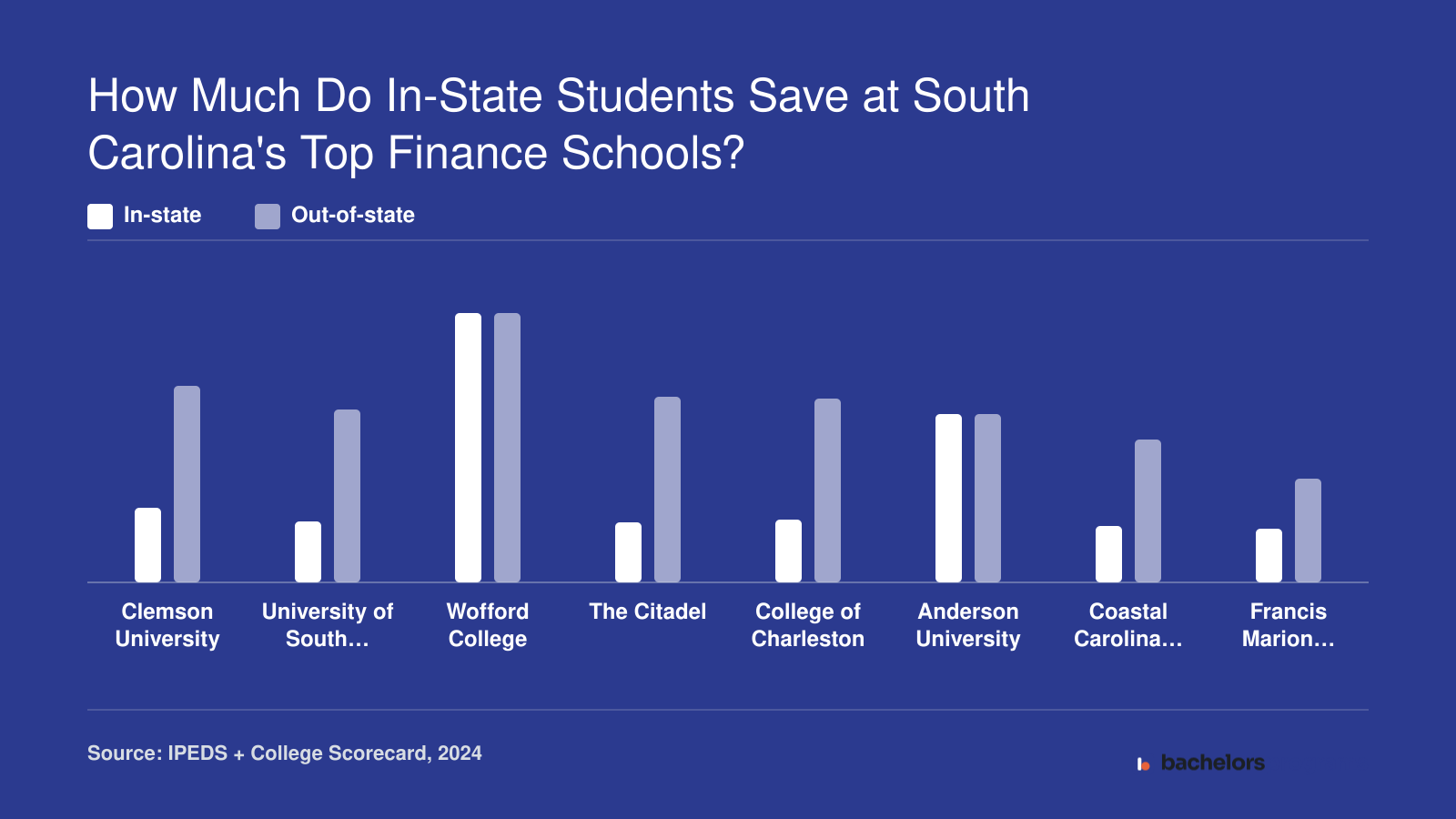
How Much Do In-State Students Save at South Carolina's Top Finance Schools?
South Carolina residents pay far less at the state's public universities. The Citadel has the widest in-state discount, $25,938 a year, followed closely by College of Charleston ($25,318) and Clemson ($25,312). Wofford and Anderson are private and charge every student the same rate.
Finance Careers in South Carolina After a Bachelor's Degree
Where do South Carolina finance graduates actually go to work, and what do those jobs pay? Three metro areas absorb most of the state's finance hiring1, and the licensing picture for a new graduate is simpler than many students expect.
Where the jobs are
- Charleston: Banking, wealth management, insurance, and a growing fintech presence. Graduates of College of Charleston, The Citadel, and Charleston Southern are already in the market here.
- Greenville: Banking, insurance, and corporate finance roles at companies headquartered in the Upstate. Furman, Bob Jones, USC Upstate, and Wofford all feed this hiring pool.
- Columbia: State-government finance, banking, insurance, and healthcare finance, with the University of South Carolina and Benedict College nearby.
Upstate graduates also commute or relocate toward the Charlotte regional banking market, which sits just across the state line from Rock Hill, where Winthrop and Clinton College are located.
What the pay looks like
The Bureau of Labor Statistics reports a national median annual wage of $102,740 for financial and investment analysts and $105,070 for personal financial advisors as of May 2025. Those are mid-career figures, not starting salaries. For advisors specifically, the South Carolina Department of Employment and Workforce publishes a reported annual wage of $118,961 with a typical range of $57,640 to $149,010, which gives a reasonable picture of the spread between a new advisor and an established one.1
Licensing: optional, and mostly employer-driven
Most entry-level finance work in South Carolina (analyst, credit analyst, treasury or corporate finance associate) requires no state license at all. Your degree and your spreadsheet skills are the hiring test. Credentials come later, and usually because an employer needs them:
- FINRA exams: The Securities Industry Essentials exam can be taken without firm sponsorship, so some students sit for it before graduating. The Series 7 requires sponsorship by a FINRA member firm. Investment adviser representatives typically need the Series 65, or the Series 66 paired with the Series 7.2
- CFP: Requires a bachelor's degree, coursework, a proctored exam, 6,000 hours of professional experience (or 4,000 through an apprenticeship), and 30 continuing education hours every two years.2
- CFA: Requires a bachelor's degree or equivalent, three proctored exams, and 4,000 hours of qualifying investment experience, with no continuing education requirement attached.3
How to Choose a South Carolina Finance School
Picking by degree title and picking by curriculum can lead to different schools. The second approach is the one that pays off.
Match the Program to Your Goal
Start with the career you want, then check what the program offers. AACSB accreditation matters most for corporate finance and investment recruiting. Specialization names hint at focus: Coastal Carolina's corporate finance concentration, Lander's Financial Services major, and Charleston Southern's Personal Financial Management option point to different paths. If you want financial planning or CFA Investment Foundations preparation, ask each department whether its courses align with CFP-registered coursework or that exam content.
Titles Matter Less Than Content
Clemson calls its major Financial Management, while the University of South Carolina offers Finance (B.S.B.A.). Both lead to similar finance careers. Compare required courses, available electives, internship pipelines, and which employers recruit on campus. Those factors shape your first job far more than the name on the diploma.
A Quick Decision Rule
- Cost-sensitive: Start with the most affordable in-state options in the cost table, then compare net price after aid rather than sticker tuition.
- Career-switcher or online learner: Prioritize schedule flexibility and transfer-credit policies, and review the online and hybrid options above.
- Top-employer seeker: Favor AACSB-accredited programs with strong recruiting access, such as those at Clemson and the University of South Carolina, and ask for internship placement details.
Check the Numbers Before You Decide
Before committing, revisit the graduation rate, net price, and program-level earnings for each finalist. A program that looks perfect on paper but graduates few students, or leaves you with heavy debt relative to early earnings, deserves a second look.
Compare Finance programs on the data that matters
Explore more Business & Management majors or browse every field of study.
All Business & Management programs Browse every field of study