Best Computer Science Schools in South Carolina
Compare 30 accredited Computer Science programs in South Carolina at 22 colleges, with net price after aid, graduation rates, earnings and debt from IPEDS and the U.S. College Scorecard.
Public universities in South Carolina award the computer science bachelor's as a Bachelor of Science (B.S.), while private colleges may confer a Bachelor of Arts (B.A.); ABET accreditation is the credential employers screen for. Cost splits these programs more than coursework does: average net price after aid at the cheapest options spans about $2,600, and non-residents at some public campuses pay double or more.
The ranking comes first, followed by online and campus formats, earnings, cost, admissions and state aid; a regional directory closes the list. Residency decides: Palmetto Fellows and SC LIFE fund in-state study, and transfer rules set how fast a two-year start becomes a four-year degree.
Key Points
- The University of South Carolina ranks first, with ABET-accredited computer science.
- Francis Marion University has the lowest average net price: $11,386 yearly.
- University of South Carolina Aiken offers the clearest online computer science option.
Best Computer Science Schools in South Carolina: Top 10 Ranked
The University of South Carolina in Columbia is the strongest overall choice for most students, pairing an ABET-accredited Bachelor of Science in Computer Science with the state's widest set of transfer pathways and a full engineering college behind it. The nine schools that follow range from a military college in Charleston to small private liberal arts campuses, and they differ sharply in price, class size, and how much of the degree is hands-on.
University of South Carolina
#1Columbia, SC · ~$23,000/yr (est.)
Best for: In-state students wanting a large research campus
The flagship public university in Columbia, where the B.S.C.S. is delivered through the Molinaroli College of Engineering and Computing and holds both ABET and SACS accreditation. About 79% of students graduate, and formal computing articulation agreements with several South Carolina technical colleges give transfer students a defined route in, including a guaranteed Midlands Technical College pathway for eligible students at a 2.75 GPA. A 2026 scholarship partnership with the South Carolina Governor's School for Science and Mathematics adds another in-state affordability option.
- ABET and SACS accredited B.S.C.S. in the Molinaroli College of Engineering and Computing
- Concentrations in artificial intelligence and cybersecurity
- Two-semester capstone: design, build, and deploy a software application
- Elective clusters in game design, data science, and bioinformatics
- Coursework spans software engineering, programming, and problem solving
Citadel Military College of South Carolina
#2Charleston, SC · $13,000 – $39,000/yr (est.)
Best for: Cadets seeking a military computing environment
A public military college in Charleston where cadets and non-cadet students earn an ABET-accredited B.S. in Computer Science that folds leadership training and ROTC requirements into the degree. Its Department of Cyber and Computer Sciences is linked to the DoD Cyber Institute and runs K-12 cyber outreach through student ambassadors. About 75% of students graduate.
- ABET-accredited B.S. of 123 credit hours, including 40 in computer science
- 17 hours of mathematics and statistics plus 18 hours of electives
- Leadership courses and ROTC requirements built into the program
- Tracks: Computer Information Systems concentration
- Hardware foundation through required electrical engineering courses
Wofford College
#3Spartanburg, SC · ~$19,000/yr (est.)
Best for: Liberal arts students wanting small classes
A private liberal arts college in Spartanburg where computer science is taught through small classes and close faculty mentorship. About 84% of students graduate, the highest rate among the schools ranked here, and alumni have gone on to Bank of America, Boeing, Facebook, and Microsoft or to graduate study at Carnegie Mellon. The core leans on algorithms, computer architecture, and software engineering, with room for interdisciplinary work in the sciences.
- Core coursework in algorithms, computer architecture, and software engineering
- Graduates have been hired at Bank of America, Boeing, and Facebook
- Alumni have entered graduate study at Carnegie Mellon
- Interdisciplinary applications in the physical and life sciences
- Double major options available
- 45-credit major: 24 hours computer science, 6 hours math, 9 hours electives
- 3-credit ethics course required, plus a 3-credit math elective
- Emphasis requires an internship and spans multiple majors
- COSC 235 and 350 require a grade of C or higher
- Honors courses offered by the department
Bob Jones University
#4Greenville, SC · ~$17,000/yr (est.)
A private Christian university in Greenville whose computer science curriculum follows the ACM's 2013 guidelines and runs from C# and C++ in the freshman year to compiler construction and assembly programming. Seniors focus on computer security, and internships have placed students at Oak Ridge National Laboratory. About 65% of students graduate.
- Freshman coursework in C# and C++ with object-oriented programming
- Students build a working compiler and interpreter
- Senior year focuses on computer security
- Follows ACM 2013 computer science curriculum guidelines
- Covers microprocessor architecture, operating systems, and assembly
- Internships available, including at Oak Ridge National Laboratory
- First place in the 2016 ACM Southeast competition
College of Charleston
#5Charleston, SC · $13,000 – $38,000/yr (est.)
A public liberal arts university in Charleston that awards both a B.S. and a B.A. in Computer Science, with the B.S. as the ABET-accredited flagship major and the B.A. leaving more room for electives outside the discipline. About 66% of students graduate. A partnership with Spartanburg Community College gives associate-degree holders in software development and networking a streamlined route into the college's Bachelor of Professional Studies.
- B.S. is the flagship major; a B.A. shares the same core
- B.S. is accredited by ABET's Computing Accreditation Commission
- B.A. allows more elective coursework outside the discipline
- 2026-27 program planners published for both degrees
- Outcomes cover problem analysis, design, ethics, and teamwork
Furman University
#6Greenville, SC · ~$30,000/yr (est.)
A private liberal arts university in Greenville where computer science leads to either a B.A. or a B.S. and students work in three main laboratories with private research workstations and 3D scanning and printing. Around 79% of students graduate. Undergraduates have joined research projects supported by NASA and Apple and interned with BMW, Michelin, and Hitachi Solutions.
- Leads to either a Bachelor of Arts or a Bachelor of Science
- Three main labs, private research workstations, and 3D printing
- Research projects supported by NASA and Apple
- Internships with BMW, Michelin, and Hitachi Solutions
- Coursework in data analytics, information security, and hardware
- Alumni employed at Apple, Microsoft, IBM, and Cisco
Coastal Carolina University
#7Conway, SC · $10,000 – $15,000/yr (est.)
A public university in Conway whose ABET-accredited B.S. in Computer Science blends a theoretical foundation with applied software development. Students must complete at least 27 upper-level major credits at CCU, and upper-level transfer work is accepted only from ABET-accredited programs. About 48% of students graduate, and internships and cooperative education placements carry academic credit.
- ABET-accredited B.S. in the College of Science and Engineering
- At least 27 upper-level major credits must be completed at CCU
- Upper-level transfer credit only from ABET-accredited programs
- Internships and cooperative education carry academic credit
- Upper-level work in computer architecture, operating systems, and algorithms
Converse University
#8Spartanburg, SC · ~$23,000/yr (est.)
A private university in Spartanburg with a small undergraduate computer science major built around engineering fundamentals, quantitative reasoning, and team-based projects. About 62% of students graduate. The curriculum pairs technical coursework with communication and problem-solving skills, and the 2025-2026 catalog sets current requirements.
- Bachelor of Science in Computer Science major
- EGR 101 Engineering Fundamentals requires MTH 110 and ENG 101
- Emphasis on quantitative reasoning and team-based projects
- Technical communication and problem-solving coursework included
- 2025-2026 undergraduate catalog sets current requirements
Claflin University
#9Orangeburg, SC · ~$18,000/yr (est.)
A private historically Black university in Orangeburg where computer science is a Bachelor of Science in the School of Natural Sciences & Mathematics, one of 44 undergraduate programs listed in the 2026-2027 catalog. About 52% of students graduate. The university enrolls a high share of Pell Grant recipients, and the catalog is the authoritative source for credit hours, learning outcomes, and course descriptions.
- Bachelor of Science in the School of Natural Sciences & Mathematics
- One of 44 undergraduate programs in the 2026-2027 catalog
- Catalog is the authoritative source for credit hours and outcomes
Presbyterian College
#10Clinton, SC · $20,000 – $25,000/yr (est.)
A small private college in Clinton with a 12:1 student-to-faculty ratio, where every computer science major finishes with a team capstone that designs, builds, and presents a working application. About 51% of students graduate. Coursework reaches into artificial intelligence, machine learning, cybersecurity, and databases, and the major pairs easily with data analytics, mathematics, or business.
- Team capstone: design, build, and present a working software application
- Coursework in artificial intelligence, machine learning, databases, cybersecurity
- 12:1 student-to-faculty ratio
- Pair the major with data analytics, mathematics, or business
- Computer Science Club, research fellows programs, faculty-led study abroad
Cost & outcomes by school
Federal data for the highest-earning Computer Science programs, independent of the ranking above. Earnings are this field's bachelor's graduates four years after completing where the Scorecard reports them, else the school's undergraduate median.
| School | Net price / yr | Grad rate | Earnings | Debt | Grads/yr | Format |
|---|---|---|---|---|---|---|
| Charleston Southern University SC | $21,666 | 47% | $97,290 | $26,471 | 10 | Campus |
| Wofford College SC | $18,732 | 84% | $86,520 | $25,732 | 18 | Campus |
| Citadel Military College of South Carolina SC | $20,723 | 75% | $72,085 | $21,096 | — | Campus |
| Clemson University SC | $22,253 | 87% | $71,513 | $21,500 | — | Campus |
| Furman University SC | $30,308 | 79% | $68,635 | $23,250 | 15 | Campus |
| University of South Carolina SC | $22,811 | 79% | $62,177 | $21,500 | — | Campus |
| Presbyterian College SC | $20,528 | 52% | $60,194 | $26,000 | 2 | Campus |
| College of Charleston SC | $18,960 | 66% | $56,416 | $23,250 | — | Campus |
| University of South Carolina-Upstate SC | $13,557 | 43% | $48,587 | $22,310 | — | Campus |
| University of South Carolina Beaufort SC | $14,656 | 34% | $48,088 | $24,000 | — | Campus |
| Newberry College SC | $21,656 | 45% | $48,040 | $26,805 | — | Hybrid |
| Coastal Carolina University SC | $13,966 | 49% | $47,258 | $23,750 | 16 | Campus |
Sources: U.S. Department of Education. Net price, graduation rate, earnings and debt: College Scorecard (earnings and debt for this field's bachelor's graduates where reported, else school-wide); graduates: IPEDS. A dash means no figure is reported.
Cost, debt & payoff
Median earnings of this field's bachelor's graduates (4 yrs after completing, else the school's undergraduate median) vs. their median federal loan debt · U.S. College Scorecard
Across these programs the median graduate earns about $47,222 and finishes with roughly $25,866 in debt — a ratio that clears a common rule of thumb (keep debt below first-year salary). Net price and debt vary widely school to school, so check the per-school figures in the table above before you shortlist.
Most Affordable Bachelor's in Computer Science Programs in South Carolina
Average net price after aid runs from $11,386 a year at Francis Marion University to $13,966 at Coastal Carolina University, a spread of about $2,600 among the lowest-cost options here. Net price is an average for students who receive aid, calculated for in-state students at public schools and for all aided students at private schools, so your own cost will depend on your residency and aid package. Figures come from U.S. Department of Education IPEDS and College Scorecard data (2024).
| School | City | Program | Format | Sector | In-State Tuition and Fees | Average Net Price After Aid |
|---|---|---|---|---|---|---|
| Francis Marion University | Florence | Computer Science (B.S.) | On campus | Public | $11,160 | $11,386 |
| University of South Carolina Aiken | Aiken | Applied Computer Science | Hybrid (in-person or fully online) | Public | $10,760 | $11,641 |
| Voorhees University | Denmark | Computer Science/Cyber Security | Online | Private nonprofit | $12,630 | $13,335 |
| University of South Carolina-Upstate | Spartanburg | Bachelor of Science in Computer Science | On campus | Public | $11,588 | $13,557 |
| Coastal Carolina University | Conway | Computer Science, B.S. | On campus | Public | $11,640 | $13,966 |
Related Articles
Online and Hybrid Bachelor's in Computer Science Options at South Carolina Schools
An online bachelor's in computer science is a degree you complete mostly or entirely through remote coursework, usually as a Bachelor of Science (B.S.) or Bachelor of Arts (B.A.). Among South Carolina schools, the clearest option is USC Aiken's B.S. in Applied Computer Science with a Cybersecurity concentration, delivered online as a degree-completion program. It is built for transfer students, not first-year freshmen. You need roughly 45 to 60 credits from a regionally accredited institution and a 2.0 cumulative GPA, and a full-time student should finish in about two years. Coursework covers data structures, algorithmic design, information security, software engineering, discrete mathematics and a survey of calculus.
Online, hybrid and in-person compared
- Online: USC Aiken's degree-completion route is the one online computer science pathway confirmed here. A separate USC online degree, the Integrated Information Technology B.S., is an IT major, not a computer science degree.
- Hybrid: A 2025 USC proposal described a hybrid B.S. in Cybersecurity planned for spring 2026. Ask the school whether it has launched before counting on it.
- In-person: The other schools here, including Citadel, Wofford, Bob Jones, College of Charleston, Furman, Coastal Carolina, Converse, Claflin and Presbyterian, list campus-based programs.
Which concentrations can you take online?
Cybersecurity is the only concentration confirmed online, through USC Aiken. The University of South Carolina's Columbia B.S.C.S. offers AI and cybersecurity concentrations, plus clusters in game design, data science and bioinformatics, as a campus program. Its pages do not confirm online completion. If you want AI, data science or game development, plan on attending in person.
A practical check before you apply
Before enrolling in any online program, ask the admissions office two questions. First, is the school authorized to enroll students in your home state? Second, are any in-person pieces required, such as proctored exams, labs or campus visits? Get both answers in writing.
Cost of a Bachelor's Degree in Computer Science in South Carolina
Two prices sit behind every computer science degree in South Carolina: the sticker rate a university publishes, and the average net price students pay after grants and scholarships. Knowing both, and knowing which one applies to your family, separates a four-year budget that holds from one that surprises you.
Sticker Tuition at Public and Private Schools
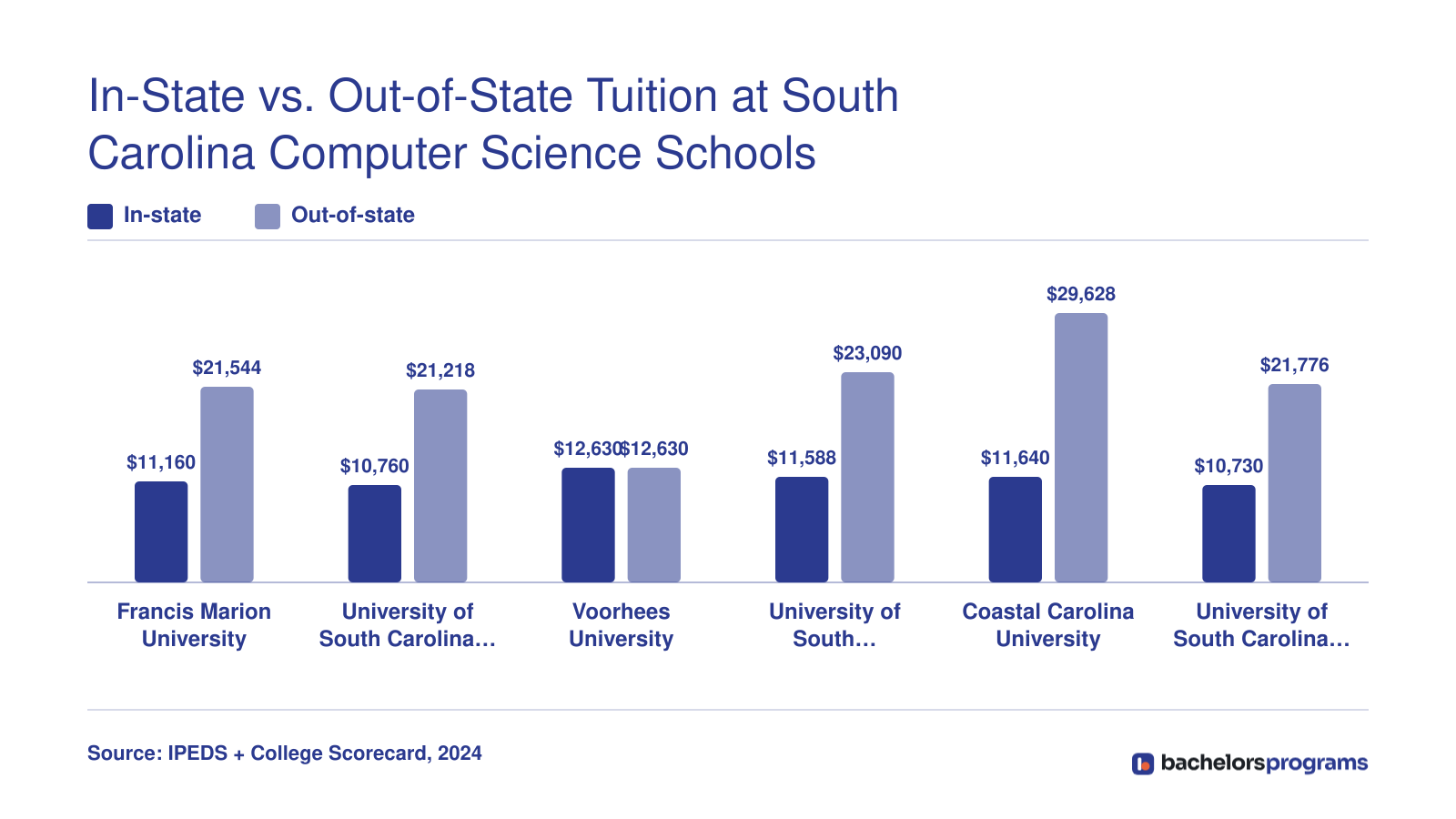
At the state's public universities, resident undergraduate tuition and fees for 2026-2027 fall between $10,730 and $14,678 on the figures we compared, while nonresident rates run from $21,218 to $29,628. USC Columbia publishes $12,288 a year for residents and $38,100 for nonresidents, plus a $200 per semester technology fee, a $150 per semester athletics fee and a one-time $80 matriculation fee. Private colleges quote one rate to everyone: Claflin lists $18,282 and Bob Jones $24,470.
Sticker Price Versus Net Price
Average net price is not a discount code. It is an approximate figure for the whole undergraduate body, blending students with large Pell awards and students paying close to full price. Across the schools we compared, net prices land between roughly $11,400 and $18,100, and the gap between sticker and net tends to widen where need is concentrated: Pell Grants reach about 86 percent of undergraduates at Francis Marion and about 75 percent at Coastal Carolina, so published net prices there reflect a heavily aided student body rather than a typical paying family.
The Takeaway
Among the schools compared, USC Beaufort carries the lowest resident tuition and fees at $10,730, and USC Aiken the lowest nonresident rate at $21,218. Run your own numbers through each university's net price calculator before you commit.
In-State vs. Out-of-State Tuition at South Carolina Computer Science Schools
At the lowest-cost public schools offering a bachelor's in computer science, non-residents pay about double the in-state rate or more. The widest gap is at Coastal Carolina University, where published tuition and fees are $11,640 for South Carolina residents and $29,628 for out-of-state students. That is a difference of $17,988 a year, or close to $72,000 over four years. Voorhees University, a private HBCU offering an online Computer Science/Cyber Security program, charges the same $12,630 regardless of residency. Non-resident applicants should compare flat-priced private options like Voorhees against public sticker prices before assuming a state school is cheaper.
SC LIFE, Palmetto Fellows, and Other State Aid for Computer Science Majors
Which South Carolina scholarships can a computer science major actually use? Four state programs matter for 2026-27, and all require South Carolina residency, attendance at an eligible in-state institution, and no federal default or unpaid refunds.1 Figures below come from the SC Commission on Higher Education (CHE).
The Four Programs
- Palmetto Fellows: Up to $6,700 for freshmen, with later years capped higher.2 A separate enhancement exists for approved math, science, and education programs, so ask each school whether your major qualifies.
- LIFE Scholarship: Up to $5,000 per year, covering a maximum of eight terms.4
- SC HOPE: $2,800 for freshmen who miss LIFE and Palmetto Fellows, covering two terms at an eligible four-year school.3
- SC Need-based Grant: Up to $3,500 for students with FAFSA-demonstrated need at eligible public institutions.4
GPA and Test Score Thresholds
LIFE and HOPE both start at a 3.0 GPA, and the Need-based Grant asks for a 2.0 after the first year.3 Palmetto Fellows is the most selective, with several routes that combine GPA, class rank, SAT or ACT scores, or National Merit status. CHE's published excerpts do not spell out every 2026 cutoff, so check its current scholarship sheet for the exact scores.
What a Strong Student Could Stack
A top in-state student who earns Palmetto Fellows could receive up to $6,700 as a freshman. If the school also awards the Need-based Grant, that could add up to $3,500, for a possible $10,200. HOPE cannot be combined with LIFE or Palmetto Fellows, though a HOPE recipient can move up to LIFE by earning a 3.0 and averaging 30 credit hours by the end of year one.5
Renewal Rules
LIFE and Palmetto Fellows must be renewed. LIFE requires staying on pace with credit hours and GPA within the eight-term cap, and Palmetto Fellows carries its own renewal standards. South Carolina does not license computer science, so licensure plays no part in aid eligibility.
Compare Computer Science programs on the data that matters
Explore more Computers & IT majors or browse every field of study.
All Computers & IT programs Browse every field of study