Best Finance Schools in Texas
Compare 80 accredited Finance programs in Texas at 61 colleges, with net price after aid, graduation rates, earnings and debt from IPEDS and the U.S. College Scorecard.
A bachelor's degree in finance, usually a Bachelor of Science in Finance, maps onto the Texas economy with unusual directness: Dallas-Fort Worth, Houston and Austin carry the corporate banking, energy trading and treasury operations that hire graduates in cohorts rather than one at a time.
The programs ranked below are for students studying in Texas, or online through a Texas-based school. On paper the credential reads the same everywhere; what separates the schools is net price after aid, AACSB accreditation at the business school, and proximity to an internship desk. Cost and access decide more than the degree name.
Key Points
- The most affordable programs here cost $4,831 to $10,836 a year after aid.
- Texas residents pay about $9,300 to $14,600 at ranked public schools.
- LeTourneau University offers an online BBA with a finance concentration.
Best Bachelor's in Finance Programs in Texas: Our Top 10 Ranked
These ten Texas schools all award a bachelor's degree in finance, and each entry below carries the numbers that matter most: the average net price after aid, the share of students the school graduates, how selective it is, and whether you can study on campus or online. Every program here is built for undergraduates, and several give students real money to manage before they graduate.
Texas A&M University-College Station
#1College Station, TX · ~$21,000/yr (est.)
Best for: Future investment bankers seeking live fund work
Texas A&M pairs a large public-university network with unusually hands-on finance training: students can manage real money through the Tanner Hedge Fund and the Reveille Fund, build Excel-based valuation and merger models, and add commercial real estate analysis. The Bachelor of Business Administration in Finance runs 120 credit hours with five fields of study, including a corporate finance track and the Aggies on Wall Street program. The school graduates about 84% of its students, admits roughly 57% of applicants, and the average net price after aid is around $21,300. All instruction is on campus in College Station.
- 120 credit hours with five fields of study
- Students manage real money in the Tanner Hedge Fund
- Reveille Fund gives another live portfolio to run
- Excel-based modeling for valuations and mergers
- Commercial real estate analysis coursework offered
- Tracks: Aggies on Wall Street, Trading, Risk and Investments Certificate
- Upper-level major admission requires specific coursework
The University of Texas at Dallas
#2Richardson, TX · $18,000/yr (est. net price)
Best for: Dallas-area students eyeing FinTech careers
UT Dallas runs its Bachelor of Science in Finance through the Naveen Jindal School of Management, with six 24-credit concentrations that include FinTech, corporate finance, investment, real estate finance, and risk management and insurance technology. A capstone and a practicum of at least 160 working hours are built into the 120-credit degree, and the investment track is structured around CFA Level 1 preparation. The school graduates about 76% of its students, admits roughly 65% of applicants, and the average net price after aid is about $18,300. Classes meet on the Richardson campus.
- Six 24-credit concentrations, including FinTech and investment
- 120 total credit hours with a required capstone
- Practicum of at least 160 working hours
- Investment track prepares for the CFA Level 1 exam
- 100 hours of community engagement required
- Employer project can substitute for the internship
- 74 credits of major coursework
- 45 upper-division credit hours required
Trinity University
#3San Antonio, TX · $20,000 – $25,000/yr (est.)
Best for: High-achievers wanting small finance cohorts
Trinity is the smallest and most selective campus on this list, and its Bachelor of Science in Finance sits in the Michael Neidorff School of Business. Students in the Student Managed Fund trade a real portfolio and compete in the CFA Institute Research Challenge, giving undergraduates portfolio and modeling work usually reserved for graduate study. The school graduates about 84% of its students, admits roughly 26% of applicants, and the average net price after aid is about $23,500. All coursework is on campus in San Antonio.
- Student Managed Fund trades a real portfolio
- Team competes in the CFA Institute Research Challenge
- Coursework in economics, accounting, math, and business
- Housed in the Michael Neidorff School of Business
- Emphasis on ethical, data-driven decision-making
- Pathways to MBA and finance master's study
Texas Christian University
#4Fort Worth, TX · $35,000 – $40,000/yr (est.)
TCU's Neeley School of Business recently moved to direct admission, and its finance major centers on the Educational Investment Fund, where undergraduates manage a real $1.5 million portfolio and execute trades. The Bachelor of Business Administration in Finance covers investments, modeling, money and banking, and international finance with CFA preparation built in, while the real estate concentration adds property valuation and development work. The LKCM Center for Financial Studies supplies industry mentors and internship connections. The school graduates about 86% of its students, admits roughly 44% of applicants, and the average net price after aid is about $36,700. Instruction is on campus in Fort Worth.
- Manage a real $1.5 million portfolio in the Educational Investment Fund
- Coursework in investments, modeling, and international finance
- CFA exam preparation built into the curriculum
- Direct admission to the Neeley School of Business
- LKCM Center for Financial Studies industry network
- Annual investment strategies conference
- Real estate concentration inside the finance major
- Faculty expertise in property valuation
- Internships and consulting projects with industry leaders
- Network through the Real Estate Club
- Prepares students for real estate developer roles
- Career fairs and panel discussions
The University of Texas at Arlington
#5Arlington, TX · ~$14,000/yr (est.)
UT Arlington's AACSB-accredited College of Business offers a Bachelor of Business Administration in Finance covering investments, capital budgeting, portfolio management, and financial institutions and markets across 120 credit hours. Students can join a student-managed investment fund, work in the Financial Markets Lab, add a double major in accounting or economics, or stack a banking certificate supported by a TexasBank endowment. The school graduates about 54% of its students, admits roughly 80% of applicants, and the average net price after aid is about $14,000. Classes are on the main campus in Arlington.
- AACSB-accredited College of Business curriculum
- 120 total credit hours
- Student-managed investment fund
- Financial Markets Lab and tutoring support
- Double major in accounting or economics available
- Banking certificate program backed by a TexasBank endowment
- 24 Fortune 500 companies headquartered nearby
The University of Texas Rio Grande Valley
#6Edinburg, TX · under $5,000/yr (est.)
UTRGV's Robert C. Vackar College of Business and Entrepreneurship delivers an AACSB-accredited Bachelor of Business Administration in Finance aimed at investment and commercial banking, financial planning, insurance, and real estate. The degree builds the analytical and communication skills behind roles such as financial analyst, credit analyst, budget analyst, and controller. Through the university's Tuition Advantage program, tuition and mandatory fees are covered for families earning $125,000 or less, and the average net price after aid is about $4,800, the lowest on this list. The school graduates about 51% of its students and admits roughly 94% of applicants, with classes on campus in Edinburg.
- AACSB-accredited Robert C. Vackar College of Business
- Tuition and mandatory fees covered for families under $125,000
- Prepares students for investment and commercial banking roles
- Paths into financial planning, insurance, and real estate
- Builds analytical, critical thinking, and communication skills
- Scholarships and financial aid available
Southern Methodist University
#7Dallas, TX · ~$41,000/yr (est.)
SMU's Cox School of Business awards a Bachelor of Business Administration in Finance across 120 credit hours with six subplans, including energy management, real estate, entrepreneurship, and management consulting. A new SMU Cox FinTech Coalition, developed with North Texas financial institutions, is planned to give students access to mentors, investors, pilot projects, and commercial partnerships, which matters for Dallas-Fort Worth fintech roles. The school graduates about 84% of its students, admits roughly 63% of applicants, and the average net price after aid is about $40,900. Classes are on campus in Dallas.
- 120 credit hours in the Cox School of Business
- Six subplans, including energy management and real estate
- New SMU Cox FinTech Coalition with North Texas institutions
- Entrepreneurship and management consulting subplans offered
- Artificial intelligence in business subplan available
University of St Thomas
#8Houston, TX · ~$19,000/yr (est.)
The University of St. Thomas is a private Catholic university in Houston, and its Bachelor of Business Administration in Finance covers corporate finance, risk management, investments, portfolio management, and financial forecasting on top of accounting, economics, and statistics foundations. A senior capstone ties the coursework together, and electives in real estate, capital budgeting, and internships let students shape the degree, which requires 120 credit hours and a cumulative GPA above 2.0. The school graduates about 69% of its students, admits roughly 90% of applicants, and the average net price after aid is about $19,400. Instruction is on campus.
- 120 total credit hours
- Cumulative GPA above 2.0 required
- Senior capstone seminar integrates the coursework
- Covers corporate finance, risk management, and portfolio management
- Electives in real estate and capital budgeting
- Internship elective available
The University of Texas at San Antonio
#9San Antonio, TX · $9,000 – $22,000/yr (est.)
UTSA's Bachelor of Business Administration in Finance pairs a business core with advanced work in corporate finance, investments, insurance, real estate, and financial institutions and markets. Students choose a track in corporate finance and investment banking, investment management, financial institutions, or FinTech, complete a required Career Compass professional development sequence, and can earn credit through a 160-hour finance internship. The school graduates about 53% of its students, admits roughly 87% of applicants, and the average net price after aid is about $10,800. Classes are on campus in San Antonio.
- Tracks: Corporate Finance and Investment Banking, Investment Management, Financial Institutions, FinTech
- 120 total credit hours on a four-year plan
- FACT exam required before upper-division finance courses
- Career Compass professional development sequence required
- 160-hour finance internship for credit
- Accelerated M.S. in Finance pathway for qualified students
- National finance case competitions
- Track designation appears on the transcript
Baylor University
#10Waco, TX · ~$41,000/yr (est.)
Baylor offers finance as a major inside its Bachelor of Business Administration, layering 18 hours of finance coursework on top of the BBA core, including advanced corporate finance, investment analysis, financial modeling, and intermediate accounting. Declaring the major requires at least a C in Introduction to Corporate Finance and in Calculus I, and finance and accounting double majors can waive Intermediate Accounting I. The school graduates about 80% of its students, admits roughly 51% of applicants, and the average net price after aid is about $41,100. Instruction is on campus in Waco.
- Finance major inside the BBA degree
- 18 hours of finance coursework beyond the BBA core
- Required courses include Advanced Corporate Finance and Investment Analysis
- Minimum grade of C in Introduction to Corporate Finance
- Minimum grade of C in Calculus I to declare
- Finance and accounting double majors may waive Intermediate Accounting I
- Only one practicum counts toward the six elective hours
Cost & outcomes by school
Federal data for the highest-earning Finance programs, independent of the ranking above. Earnings are this field's bachelor's graduates four years after completing where the Scorecard reports them, else the school's undergraduate median.
| School | Net price / yr | Grad rate | Earnings | Debt | Grads/yr | Format |
|---|---|---|---|---|---|---|
| Southern Methodist University TX | $40,892 | 84% | $133,852 | $19,439 | 261 | Campus |
| The University of Texas at Austin TX | $19,857 | 89% | $132,075 | $20,500 | 433 | Campus |
| Texas A&M University-College Station TX | $21,315 | 84% | $112,319 | $16,671 | 375 | Campus |
| Texas Christian University TX | $36,660 | 86% | $111,304 | $19,000 | 335 | Campus |
| Baylor University TX | $41,104 | 80% | $102,812 | $21,500 | 316 | Campus |
| Saint Edward's University TX | $25,578 | 63% | $90,286 | $21,875 | 34 | Campus |
| Rice University TX | $13,370 | 95% | $89,718 | $11,000 | — | Campus |
| Texas Tech University TX | $19,070 | 69% | $86,795 | $21,000 | 364 | Campus |
| The University of Texas at Dallas TX | $18,267 | 76% | $86,484 | $18,400 | 275 | Campus |
| Midwestern State University TX | $11,656 | 43% | $84,547 | $23,661 | 15 | Campus |
| Abilene Christian University TX | $26,182 | 59% | $83,525 | $22,375 | 26 | Campus |
| St. Mary's University TX | $21,145 | 59% | $82,753 | $25,389 | 26 | Campus |
Sources: U.S. Department of Education. Net price, graduation rate, earnings and debt: College Scorecard (earnings and debt for this field's bachelor's graduates where reported, else school-wide); graduates: IPEDS. A dash means no figure is reported.
Cost, debt & payoff
Median earnings of this field's bachelor's graduates (4 yrs after completing, else the school's undergraduate median) vs. their median federal loan debt · U.S. College Scorecard
Across these programs the median graduate earns about $71,835 and finishes with roughly $20,500 in debt — a ratio that clears a common rule of thumb (keep debt below first-year salary). Net price and debt vary widely school to school, so check the per-school figures in the table above before you shortlist.
Most Affordable Bachelor's in Finance Programs in Texas
How much does a finance degree cost in Texas? At the five lowest-cost programs, the average net price after aid runs from $4,831 to $10,836 a year, based on 2024 U.S. Department of Education data from IPEDS and the College Scorecard. Net price is an average for each school's sector (all five are public universities), so your own bill will move with family income. The University of Texas Rio Grande Valley stands out at less than half the net price of the others and advertises tuition coverage for families earning under $125,000, while Lamar University and University of Houston-Downtown give budget-minded students a fully online route.
| School | City | Average Net Price After Aid | In-State Tuition and Fees | Format |
|---|---|---|---|---|
| The University of Texas Rio Grande Valley | Edinburg | $4,831 | $9,987 | Campus |
| Lamar University | Beaumont | $9,366 | $8,905 | Online |
| The University of Texas at El Paso | El Paso | $9,403 | $9,744 | Campus |
| University of Houston-Downtown | Houston | $10,542 | $7,708 | Online |
| The University of Texas at San Antonio | San Antonio | $10,836 | $9,011 | Campus |
Online and Hybrid Bachelor's in Finance Options at Texas Schools
On-campus and online routes lead to the same bachelor's degree in finance, but Texas schools differ in which formats they offer. Texas A&M University-College Station, The University of Texas at Dallas, Trinity University, Texas Christian University, The University of Texas at Arlington, The University of Texas Rio Grande Valley, Southern Methodist University, University of St Thomas, The University of Texas at San Antonio and Baylor University all deliver their finance programs on campus. If one of those schools is your goal, plan to live within reach of its campus.
Online and Hybrid Routes
Several Texas schools award a Bachelor of Business Administration (B.B.A.) with a finance major rather than a B.S. Either credential prepares you for the same entry-level finance roles.
- LeTourneau University: Offers its B.B.A. with a finance concentration online.
- Texas Woman's University: The B.B.A. in Finance requires 120 credit hours, 66 of them in the major, with courses offered face-to-face, online and hybrid through the Denton campus.1 Ask an advisor whether the full degree can be completed online or whether some courses must be taken in person.
- Sam Houston State University: The B.B.A. in Finance is listed in both online and face-to-face formats.2 Confirm current delivery with the university before applying.
Who Online and Hybrid Suit
Online and hybrid formats work best for working adults who need evening or self-paced coursework, transfer students finishing a degree started elsewhere, and Texans who live far from a business school. Hybrid study also fits students who want some in-person contact with faculty without relocating.
Tuition for Online Students
Ask each school's bursar whether online students pay the same in-state rate as campus students and whether distance-education fees apply.
Can You Earn a Finance Bachelor's Online From a Texas School?
Yes. LeTourneau University and Sam Houston State University list online finance options, and Texas Woman's University offers online and hybrid finance courses.
Admissions for a Bachelor's Degree in Finance in Texas: GPA, Test Policy and Transfer Credit
Admission to a finance program in Texas is really two decisions: whether the university admits you, and whether you can then declare finance inside its business school. The paperwork is familiar, transcript, test scores where required, transfer coursework, but the rules differ by campus, and several schools say little about the second decision.
What UT Austin and Texas A&M publish
At The University of Texas at Austin, freshman applicants are admitted to the McCombs School of Business as "unspecified business," not directly to finance; students pick the specific major after enrolling.1 Transfer applicants are admitted for the fall term only and must show completed or in-progress work in Calculus I, Calculus II, microeconomics and macroeconomics by the deadline. The admissions pages do not publish a freshman GPA or class-rank expectation, and the 2026 SAT/ACT policy is not stated in the material reviewed here.
Texas A&M University uses a similar entry model. Freshmen choose business as a first-choice major and enter as Business Administration (BUAD), completing lower-division business courses before reaching upper-division status and declaring a major.3 Its 2026-2027 B.S. Business Administration transfer course sheet asks for a minimum 3.80 GPA, 24 transferable hours and a 3.25 GPA in required coursework, with applications from August 1 to October 15, 2027 and no spring entry.2 Mays generally accepts business transfer credit at the freshman and sophomore level only; upper-level business credit requires the dean's pre-approval.4 The 2.0 GPA finance majors must hold is a continuing-enrollment rule, not an admissions bar.5
Where nothing is published
Southern Methodist University, Texas Christian University, The University of Texas at Dallas, Trinity University, University of St Thomas, Baylor University, The University of Texas at Arlington, The University of Texas Rio Grande Valley and The University of Texas at San Antonio publish no finance-specific GPA, test or transfer-credit policy in the pages reviewed. That silence does not make admission automatic: general university admission still governs, and the business school is the only reliable source.
General admission versus the business school gate
Only some campuses spell out the split. TCU lists direct admission to the Neeley School of Business for incoming students, while UT Austin and Texas A&M route freshmen through a general business entry point first.
A tip before you send transcripts
If you start at a Texas community college, pull the transfer-credit guide and course-equivalency tables before your second semester, not after. Confirm that Calculus I, Calculus II, microeconomics and macroeconomics transfer as direct equivalents, and get written answers on whether upper-level business courses count, since schools such as Mays cap or pre-approve them. A missed rule here can cost a semester.
Related Articles
What a Finance Degree Costs in Texas: Tuition, Net Price and State Aid
In Texas, the published sticker price and the price a student actually pays are two different numbers, and the gap runs widest at the public universities that anchor the state's finance offerings.
In-State, Out-of-State and Net Price
At The University of Texas at Arlington, in-state tuition and fees run $11,950 against $29,582 for out-of-state students, while average net price after grant and scholarship aid lands at $13,951. UT San Antonio lists $9,011 in-state, $22,051 out-of-state and a net price of $10,836; UT Rio Grande Valley lists $9,987, $19,827 and $4,831. Net price is an average across all aided students, not a quote for your family, and an out-of-state student should expect the higher figure unless the school's aid package closes the gap.
Texas Aid: The TEXAS Grant and Its Neighbors
The TEXAS Grant is the state's main need-based award at public universities. Eligibility generally requires financial need, Texas residency for tuition purposes, enrollment in an eligible program, no prior bachelor's degree and Selective Service compliance. For 2026 the maximum semester award is $5,429, the semester target is $2,500 and the annual target is $7,5001; the $16,287 annual ceiling applies only when the semester maximum is paid across all three terms, and institutions may award less.2 Renewal guidance calls for a 2.50 cumulative GPA and 24 credit hours per academic year after year two.2
Other programs fill narrower gaps: the Texas Educational Opportunity Grant for public two-year students ($2,134 per semester at community colleges, $4,493 at technical institutes, $1,833 at state colleges), the Texas Transfer Grant ($2,500 semester target)1, and the Tuition Equalization Grant at eligible private colleges, capped at $4,270 a year or $6,405 for students with exceptional need.3
File the FAFSA, Then Run the Calculator
Submit the FAFSA, or the TASFA if you are a Texas resident who cannot file the federal form, by each school's priority deadline, then run the net price calculator with your own numbers before comparing packages. Median debt among federal-aid recipients who finished runs $12,950 at UT Rio Grande Valley, $17,527 at UT Arlington and $20,500 at UT San Antonio, context rather than a promise about your own borrowing.
How Much Does Texas Residency Save on a Bachelor's in Finance?
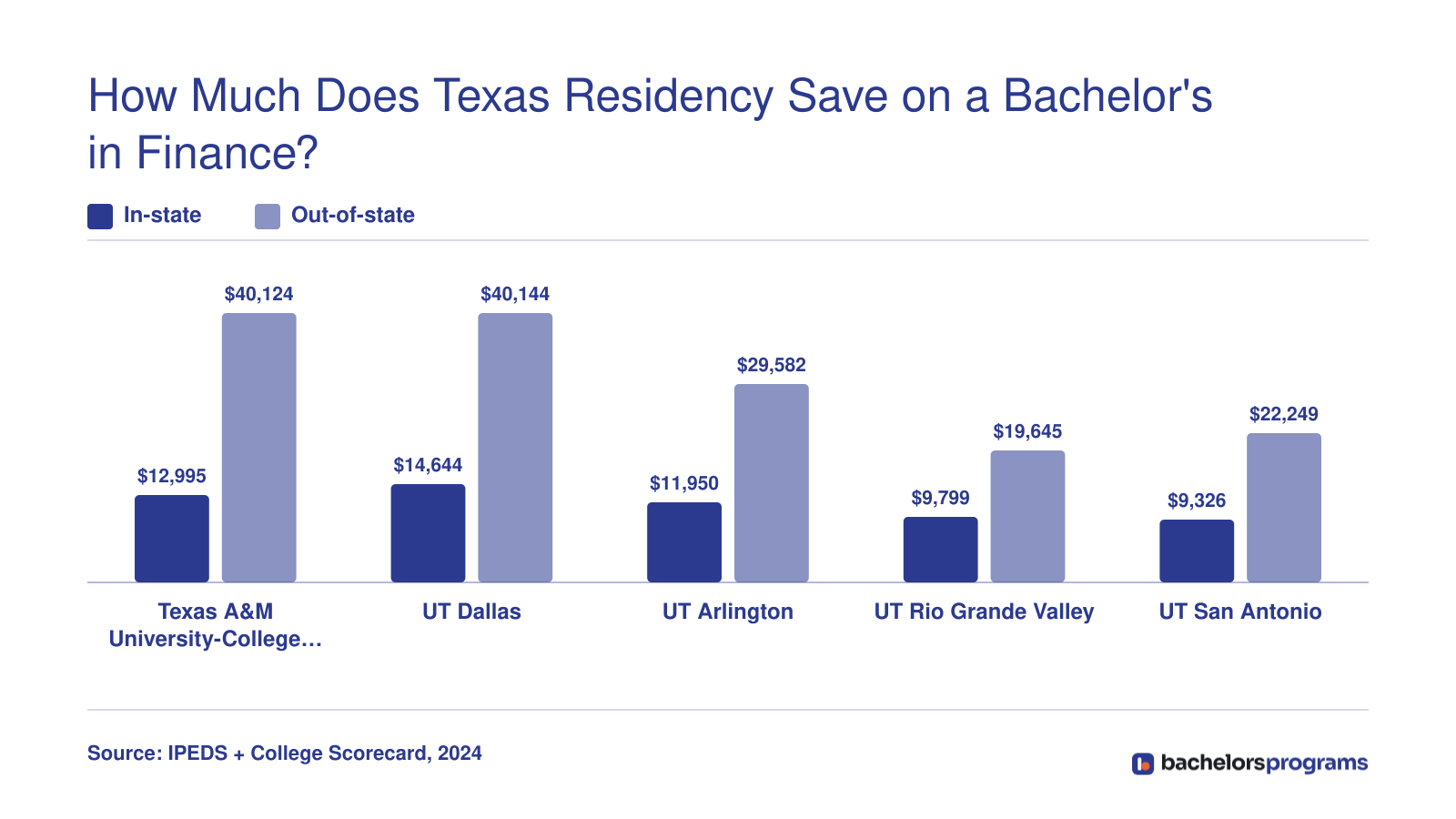
At Texas public universities, residency is the biggest tuition lever. At the public schools in our ranking, Texas residents pay about $9,300 to $14,600 a year in tuition and fees, while out-of-state students pay about $19,600 to $40,100. Texas A&M University-College Station shows the widest gap: in-state students save more than $27,000 a year. Private schools such as Trinity University, Texas Christian University, Southern Methodist University and Baylor University charge every student the same rate, so residency brings no discount there.
Texas Finance Degree FAQs
Quick answers to common questions about studying finance in Texas. Figures are published tuition and program details, so confirm current numbers with each school before you apply.
What are the best finance schools in Texas?
How much does a finance degree cost in Texas?
Which Texas colleges offer AACSB-accredited finance programs?
Can you get a bachelor's degree in finance online from a Texas school?
What can you do with a bachelor's degree in finance in Texas?
Compare Finance programs on the data that matters
Explore more Business & Management majors or browse every field of study.
All Business & Management programs Browse every field of study