Best Computer Science Schools in Texas
Compare 99 accredited Computer Science programs in Texas at 60 colleges, with net price after aid, graduation rates, earnings and debt from IPEDS and the U.S. College Scorecard.

Which Texas school offers the best bachelor's degree in computer science for the money? The programs ranked here award a Bachelor of Science (B.S.) or Bachelor of Arts (B.A.) in Computer Science, on campus or online, at Texas-based schools. Undergraduate study only.
Price is the main tension. Public in-state tuition and fees sit near $10,000 to $12,000 a year, while Southern Methodist University publishes $67,040. The top 10, cheapest and highest-earning picks, ABET status, admissions rules and Texas job markets all shape the choice.
ABET accreditation varies by school, so check it first.
Key Points
- The University of Texas Rio Grande Valley is the most affordable ranked school.
- Southern Methodist University's $67,040 sticker price averages $40,892 after aid.
- Texas A&M-College Station transfers need a 2.5 GPA on 24-plus hours.
Best Bachelor's Degree in Computer Science Schools in Texas
The best computer science schools in Texas fall into three rough groups: large public engineering programs with deep course catalogs and industry pipelines, private universities with smaller cohorts and higher sticker prices, and regional campuses where a bachelor's degree in computer science costs far less. Most of the schools below award a Bachelor of Science in Computer Science, and Texas State also offers a Bachelor of Arts route. Each entry covers what the degree requires, where it is taught, and what graduates of the program earn after finishing.
Texas A&M University-College Station
#1College Station, TX · ~$21,000/yr (est.)
Best for: Engineering-minded students wanting a deep alumni network
Texas A&M's computer science degree runs through the College of Engineering at College Station and at the Galveston campus, and the first year is shared with most other engineering majors before students enter a major through the Entry to a Major process. Students pair the core curriculum with a 12-hour concentration in another department and electives in algorithms, software systems, networking, artificial intelligence, graphics and robotics. Advanced undergraduates can take graduate-level courses in those areas before they finish. The university's institution-wide graduation rate is about 84 percent.
- ABET accredited; curriculum follows IEEE and ACM recommendations
- 126 credit hours including a senior capstone design project
- Concentrations in algorithms and theory, computer systems, and software
- 12-hour area of concentration in another department required
- Offered at College Station and at the Galveston campus
- Common first-year engineering curriculum with Entry to a Major process
- Median earnings $124,283 four years after finishing (federal data)
- Median debt $20,395 for program graduates
The University of Texas Rio Grande Valley
#2Edinburg, TX · under $5,000/yr (est.)
Best for: Rio Grande Valley students staying close to home
UTRGV's computer science department teaches programming languages, system design, data handling, network building and web development, and folds computer animation and robotics into the curriculum. The bachelor's program is accredited by the Computing Accreditation Commission and leans on hands-on lab work with faculty who teach and advise students directly. It is a campus-based degree in Edinburg, in the Rio Grande Valley, where the institution-wide graduation rate is about 51 percent.
- Accredited by the Computing Accreditation Commission
- Covers programming languages, system design, data handling, networks and web work
- Computer animation and robotics included in the coursework
- Campus-based program taught in Edinburg
- Median earnings $71,629 five years after finishing (federal data)
University of St Thomas
#3Houston, TX · ~$19,000/yr (est.)
Best for: Houston students wanting a small private campus
St. Thomas is a private Catholic university in Houston, and its computer science degree devotes 32 credit hours to the major inside a 120-credit bachelor's. Students take programming, data structures, computer organization, databases, operating systems and networks, then close with a capstone System Development Project built around a real application. Concentrations let students aim the degree at a specialty, and the mathematics sequence runs through calculus, linear algebra and discrete mathematics. The institution-wide graduation rate is about 69 percent.
- 32 credit hours in the major within a 120-credit degree
- Capstone System Development Project required
- Tracks in data analytics, information systems, algorithms and theory, and database systems
- Coursework spans programming, data structures, databases, operating systems and networks
- Mathematics sequence includes calculus, linear algebra and discrete mathematics
- 2.0 minimum GPA, with 36 upper-division hours and 36 hours in residence
Southern Methodist University
#4Dallas, TX · ~$41,000/yr (est.)
SMU's Lyle School of Engineering awards a Bachelor of Science in Computer Science built on 120 credit hours, with senior design courses and an engineering leadership component sitting alongside the technical core. Students choose from tracks that include artificial intelligence, data engineering, security, software engineering, game development and a research path. It is a private campus in Dallas where the institution-wide graduation rate is about 84 percent, and the program's federal earnings figures are among the highest in the state.
- 120 credit hours with a computer science core and senior design courses
- Tracks include artificial intelligence, data engineering, security and game development
- Game development track adds team game production and a gaming design project
- Engineering leadership component and a technical entrepreneurship elective
- C- or better required in major courses, with 95 to 100 major credit hours
- Median earnings $126,590 four years after finishing (federal data)
- Median debt $25,625 for program graduates
The University of Texas at Arlington
#5Arlington, TX · ~$14,000/yr (est.)
UT Arlington's computer science degree is a 123-credit program in the College of Engineering, capped by a two-course design sequence and 18 hours of technical electives. The program has held Computing Accreditation Commission accreditation since 2002, and admission to the professional program is separate from university admission, requiring a 2.5 GPA and no more than four unsuccessful engineering course attempts. Internships and cooperative education place students with employers across the Dallas Fort Worth area. The institution-wide graduation rate is about 54 percent.
- 123 credit hours with a two-course capstone design sequence
- Accredited by the Computing Accreditation Commission since 2002
- 18 hours of technical electives across six courses
- Professional program admission needs a 2.5 GPA and four or fewer failed engineering courses
- Entering students should have precalculus, chemistry and programming experience
- Internships and cooperative education available
- Median earnings $109,197 four years after finishing (federal data)
- Median debt $17,899 for program graduates
Texas State University
#6San Marcos, TX · ~$17,000/yr (est.)
Texas State offers two routes to the major: a Bachelor of Arts that requires modern language coursework and a Bachelor of Science that adds mathematics and physics, with an optional computer engineering concentration. Coursework covers software engineering, computer graphics, machine learning, artificial intelligence and several programming languages, and the final years include a capstone tied to the major. Students can also take independent study, internships, cooperative education, and study abroad or study in America programs. The institution-wide graduation rate is about 55 percent.
- Two routes: a B.A. with modern languages and a B.S. with more math and physics
- Optional computer engineering concentration within the B.S. route
- Coursework in software engineering, graphics, machine learning and artificial intelligence
- Capstone project required in the final years of the major
- Internships, cooperative education, independent study and study abroad available
- Median earnings $104,127 four years after finishing (federal data)
- Median debt $22,842 for program graduates
University of Houston-Clear Lake
#7Houston, TX · $15,000 – $20,000/yr (est.)
UHCL's computer science bachelor's degree is accredited by the Computing Accreditation Commission and taught in small classes by faculty who hold NSF grants and research data mining and artificial intelligence. Partnerships with NASA and nearby employers in the Clear Lake corridor feed internships and job leads for students. Undergraduates enter either as new freshmen or as transfer students. The institution-wide graduation rate is about 52 percent.
- Accredited bachelor's program taught in small classes
- Faculty hold NSF grants and research data mining and artificial intelligence
- NASA and local industry partnerships support internships
- Applicants enter as freshmen or as transfer students
- Median earnings $77,073 four years after finishing (federal data)
- Median debt $16,915 for program graduates
Austin College
#8Sherman, TX · $21,000/yr (est. net price)
Austin College is a small private liberal arts college in Sherman, and its computer science major deliberately mixes mathematics, design, logic, engineering and communication rather than teaching coding alone. Students design apps for real users, deploy cloud-based solutions and work on software development teams, with coursework in artificial intelligence, machine learning, data structures and software engineering. A Finish in Four pathway lays out the sequence for finishing on time. The institution-wide graduation rate is about 67 percent.
- Finish in Four pathway published for the major
- Blends mathematics, design, logic, engineering and communication
- Students design apps for real users, deploy cloud solutions and work on software teams
- Coursework in artificial intelligence, machine learning, data structures and software engineering
- Median earnings $76,196 four years after finishing (federal data)
St. Mary's University
#9San Antonio, TX · $20,000 – $25,000/yr (est.)
St. Mary's in San Antonio builds a 120-credit computer science degree around a shared core and an integrated mathematics minor, so every student graduates with a quantitative second credential on the transcript. Students follow a general path or a track in cybersecurity, data science or game development, working in C, C++, Java, Python and C# across databases, operating systems, networks and software engineering. A combined bachelor's and master's option is available for students who want to keep going. The institution-wide graduation rate is about 59 percent.
- 120 credit hours with an integrated mathematics minor built into the degree
- Tracks in cybersecurity, data science and game development, plus a general path
- Programming in C, C++, Java, Python and C#, with AI and machine learning
- Combined bachelor's and master's option available
- IEEE and Buffer Overflow student organizations, plus a science living community
Texas A&M University-San Antonio
#10San Antonio, TX · $10,000 – $23,000/yr (est.)
Texas A&M University-San Antonio divides its computer science degree into 42 credits of core curriculum, 53 credits of major coursework and 15 credits of electives, ending with a senior project. Courses run from programming fundamentals and algorithms through database systems, software engineering, cybersecurity, computer architecture and operating systems. Students must earn a C or better in mathematics and computing courses and hold a 2.25 GPA in the major, with 40 major hours completed at A&M-San Antonio. The institution-wide graduation rate is about 40 percent.
- 120 credits: 42 core, 53 major courses and 15 electives
- Senior project required, with a C or better in all math and computing courses
- 2.25 GPA minimum in computing courses, with 40 major hours taken at A&M-San Antonio
- Coursework in algorithms, databases, software engineering and cybersecurity
- Ethics in computing course and a first-year seminar required
Cost & outcomes by school
Federal data for the highest-earning Computer Science programs, independent of the ranking above. Earnings are this field's bachelor's graduates four years after completing where the Scorecard reports them, else the school's undergraduate median.
| School | Net price / yr | Grad rate | Earnings | Debt | Grads/yr | Format |
|---|---|---|---|---|---|---|
| Baylor University TX | $41,104 | 80% | $128,411 | $27,000 | 39 | Campus |
| Southern Methodist University TX | $40,892 | 84% | $126,590 | $25,625 | 91 | Campus |
| Texas A&M University-College Station TX | $21,315 | 84% | $124,283 | $20,395 | 440 | Campus |
| The University of Texas at Arlington TX | $13,951 | 54% | $109,197 | $17,899 | 205 | Campus |
| Texas State University TX | $16,805 | 55% | $104,127 | $22,842 | 287 | Campus |
| Tarleton State University TX | $20,783 | 48% | $102,423 | $19,606 | 20 | Campus |
| Abilene Christian University TX | $26,182 | 59% | $91,894 | $24,250 | 16 | Campus |
| Rice University TX | $13,370 | 95% | $89,718 | $11,000 | — | Campus |
| Saint Edward's University TX | $25,578 | 63% | $87,890 | $26,000 | 27 | Campus |
| University of Houston-Clear Lake TX | $15,563 | 52% | $77,073 | $16,915 | 65 | Campus |
| Austin College TX | $21,107 | 67% | $76,196 | $24,500 | 17 | Campus |
| The University of Texas at Austin TX | $19,857 | 89% | $75,121 | $20,500 | — | Campus |
Sources: U.S. Department of Education. Net price, graduation rate, earnings and debt: College Scorecard (earnings and debt for this field's bachelor's graduates where reported, else school-wide); graduates: IPEDS. A dash means no figure is reported.
Cost, debt & payoff
Median earnings of this field's bachelor's graduates (4 yrs after completing, else the school's undergraduate median) vs. their median federal loan debt · U.S. College Scorecard
Across these programs the median graduate earns about $55,933 and finishes with roughly $21,030 in debt — a ratio that clears a common rule of thumb (keep debt below first-year salary). Net price and debt vary widely school to school, so check the per-school figures in the table above before you shortlist.
How We Ranked Texas Computer Science Schools
Most of the numbers behind this ranking come from the College Scorecard, the U.S. Department of Education's public database.
An Undergraduate Ranking, Not a Graduate One
Most national computer science lists focus on doctoral programs and research output. This one stays on the bachelor's degree: what a program costs, how many students finish, and what graduates earn afterward. Every entry is a bachelor's degree in computer science, whether a school awards it as a Bachelor of Science or a Bachelor of Arts.
What Goes Into the Ranking
- Program records: the College Scorecard's program-level data for computer science, matched to institution-level records
- Net price: what students pay after federal, state, and institutional aid
- Graduation rate: the share of students who finish at the institution
- Earnings and debt: what a program's graduates earn and how much they typically borrow
Campus and online formats both count, provided the school itself is based in Texas. Only programs that were ranked appear on the list.
What the Numbers Do Not Tell You
Net price is a sector average, so your own bill will differ with aid, residency, and housing choices. Graduation rate and 10-year earnings describe the whole institution, not the computer science department alone. Treat them as context for comparison rather than a forecast of your outcome.
Most Affordable Bachelor's in Computer Science Programs in Texas
These Texas schools are ordered by average net price, the institution-wide cost after grants and scholarships, based on 2024 IPEDS and College Scorecard data. The University of Texas Rio Grande Valley is the most affordable school in our main ranking at $4,831 a year, and its B.S. carries ABET-CAC accreditation. South Texas College and Lamar University (both online, from our directory) also appear, along with Texas A&M International University and Texas College, two schools outside our main ranking.
| School | City | Program | Format | In-State Tuition & Fees | Out-of-State Tuition & Fees | Average Net Price | Graduation Rate | Median Debt at Graduation |
|---|---|---|---|---|---|---|---|---|
| South Texas College | McAllen | Computer and Information Technologies (Bachelor's) | Online | $4,920 | $7,620 | $1,751 | 27% | N/A |
| Texas A & M International University | Laredo | Computer Science (B.S.) | Campus | $7,894 | $19,454 | $3,637 | 46% | $15,000 |
| The University of Texas Rio Grande Valley | Edinburg | Bachelor of Science in Computer Science | Campus | $9,987 | $19,827 | $4,831 | 51% | $12,950 |
| Lamar University | Beaumont | Computer Science (B.S.) | Online | $8,905 | $18,745 | $9,366 | 37% | $21,250 |
| Texas College | Tyler | Computer Science | Campus | $10,008 | $10,008 | $10,958 | 14% | $31,000 |
Related Articles
Texas A&M vs. UT Arlington for a Computer Science Bachelor's Degree
Texas A&M University-College Station and The University of Texas at Arlington are two large public universities ranked here, and both award an ABET-accredited Bachelor of Science in Computer Science. Texas A&M is the more selective school and posts the stronger completion and long-run earnings figures. UT Arlington costs less after aid, admits a larger share of applicants and enrolls more Pell Grant recipients. In the table, cost and selectivity figures cover each university as a whole. Earnings, debt and employment figures are for computer science bachelor's graduates specifically.
| Measure | Texas A&M University-College Station | The University of Texas at Arlington |
|---|---|---|
| Average net price after aid | $21,315 | $13,951 |
| In-state tuition and fees | $13,154 | $11,950 |
| Admission rate | 57.4% | 79.9% |
| Share of undergraduates receiving Pell Grants | 51.5% | 61.6% |
| Graduation rate | 83.9% | 54.0% |
| First-year retention rate | 94% | 73% |
| Median earnings of CS graduates, 1 year after graduation | $86,084 | $84,759 |
| Median earnings of CS graduates, 4 years after graduation | $124,283 | $109,197 |
| Median debt of CS graduates | $20,395 | $17,899 |
| Share of CS graduates employed 1 year out | 98.6% | 94.8% |
| Program notes | ABET accredited; common first-year engineering curriculum with an Entry to a Major process; offered at College Station and Galveston | ABET accredited since 2002; 2.5 GPA minimum; separate admission to the professional program; internships and co-op education |
| Best fit | Students who want a selective flagship campus with high completion rates and the strongest earnings growth | Cost-conscious students, including Pell recipients, who want a lower net price and a large Dallas-Fort Worth campus with co-op options |
Online and Hybrid Bachelor's in Computer Science Options at Texas Schools
Online study is a genuine route to a bachelor's degree in computer science at a Texas school, but the online credential often carries a different name than the campus version, so read the degree title closely before you apply.
Where the Online Routes Run
Lamar University delivers its program fully online, but the degree is a Bachelor of Science in Computer Information Sciences rather than a B.S. in Computer Science. The university states no on-campus requirement, requires students to complete COSC 4272 in their final semester, and expressly notes that the program is not ABET-accredited.
Concordia University Texas lists computer science as available on campus or online. Online students earn a Bachelor of Arts in Computer Science, while campus students may choose a B.S. or a B.A. The university states no on-campus requirement for the online path and cites SACSCOC institutional accreditation rather than ABET accreditation for the degree.
At most ranked schools on this page, including Texas A&M University-College Station, UT Arlington, Texas State University and Texas A&M University-San Antonio, computer science is presented as a campus program, so online students usually look to Lamar or Concordia above, or pair a campus degree with online coursework.
Three Checks Before You Enroll
- Accreditation: ask whether the specific online program holds Computing Accreditation Commission of ABET status. Regional accreditation alone is a different stamp.
- Tuition rate: confirm whether online students pay the in-state rate, and whether online fees differ from campus fees.
- Logistics: settle transfer credit limits, proctored exams, and any final-semester residency course in writing before you commit.
Admissions for Texas Computer Science Bachelor's Programs: GPA, Test Policy, and Transfer Credit
Texas A&M University-College Station asks transfer applicants for at least a 2.5 GPA on 24 or more graded transferable semester hours, with coursework at C or better.1 Credit is evaluated once an official transcript arrives. Rice University's transfer page sets a lower hour threshold, at least 12 semester hours.2 Policies change by cycle, so confirm every figure on the school's own admissions page before you apply.
Texas Automatic Admission
Texas law gives students who graduate near the top of their high school class a path to automatic admission at public universities. Each school sets its own conditions, such as the rank cutoff, the required high school curriculum, and the application deadline. Texas A&M publishes freshman requirements through its admissions office3, but the current rank cutoff is not confirmed here. Check whether automatic admission also guarantees a place in computer science. Do not assume it does, because that detail is not established.
GPA and Test Policy
Texas A&M states no minimum GPA for freshmen. Its freshman page does not settle the SAT/ACT question, so check the current cycle's page directly. Rice's current freshman GPA expectations and test policy are not established either, so verify both directly with Rice.
Transfer Credit
Transfer is often the cheaper route into a bachelor's degree in computer science. Many students finish core coursework at South Texas College first, then transfer. Confirm in writing which courses count toward the major, since math and programming sequences are the ones most likely to be reviewed closely.
Computer Science as a Competitive Major
Computer science is often a high-demand major at Texas universities, and some schools apply separate admission criteria, prerequisite courses, or capacity limits. Neither Texas A&M nor Rice sets out CS-specific admission rules in the sources reviewed, so ask each admissions office whether the major has its own GPA bar or application step.
Cost of a Computer Science Bachelor's Degree in Texas
Sticker Price vs. What Families Pay
Published in-state tuition and fees at Texas public universities sit near $10,000 to $12,000 a year. The University of Texas Rio Grande Valley lists $9,987, Texas A&M University-San Antonio $9,654, and The University of Texas at Arlington $11,950. Average net price after grants looks different: about $4,831 at UTRGV, $11,196 at A&M-San Antonio and $13,951 at UT Arlington. Net price includes housing, books and living costs, so it can run higher than tuition. Treat these figures as approximate averages across aided students, not a quote for your family.
Private schools show the widest gap. Rice University publishes $64,144 in tuition and fees, yet its average net price is $13,370, close to UT Arlington's. Institutional aid can make a private bachelor's degree competitive, so compare net price, not the sticker.
Texas State Aid in Plain Terms
The TEXAS Grant is the state's main need-based award for residents attending public universities. Eligibility rests on Texas residency and demonstrated financial need. Award amounts change by year, so confirm the current figure with your school's aid office. Many public universities also run their own tuition-promise programs that cover tuition for Texas families under an income cutoff, and each school sets its own threshold.
Under the Texas Teaching and Research Assistant Tuition Waiver, someone employed at least half time in a degree-related teaching or research position at a public Texas institution can pay resident tuition at any public Texas institution. A spouse and children qualify too. Proof of eligibility is due before or at enrollment.
Three Ways to Lower Your Cost
- File aid forms early: Submit the FAFSA, or the TASFA if you cannot file the FAFSA, as soon as it opens. State grants depend on these forms.
- Use in-state residency: Out-of-state tuition at UT Arlington is $29,582, more than double the in-state rate.
- Start at a lower-cost school: South Texas College offers a bachelor's in computer and information technologies with an average net price of $1,751, and core courses from a community college often transfer into a four-year computer science program.
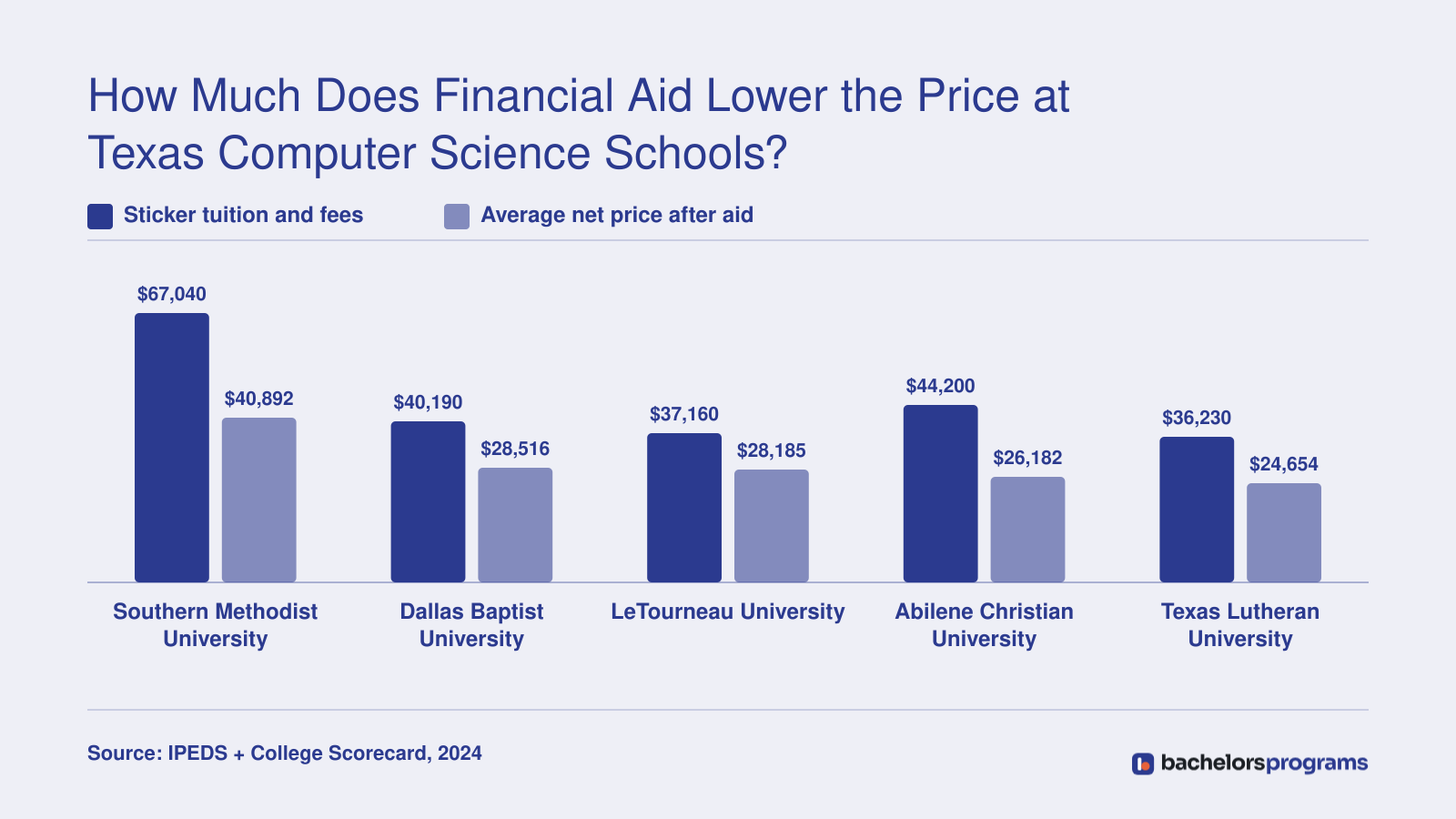
How Much Does Financial Aid Lower the Price at Texas Computer Science Schools?
Private Texas schools post the highest sticker prices, but grants and scholarships close much of the gap. At Southern Methodist University, published tuition and fees of $67,040 fall to an average net price of $40,892 after aid. Abilene Christian University drops from $44,200 to $26,182. Net price is an institution-wide average for students who receive aid, not a quote for any individual student, so run each school's net price calculator for your own estimate.
Software Developer Pay Across Texas Metro Areas
Texas employs software developers at a scale that rivals the traditional coastal tech centers, and the work is spread across several metros rather than concentrated in one.
Where the jobs sit
The U.S. Bureau of Labor Statistics counted 138,510 software developer jobs in Texas in its May 2023 Occupational Employment and Wage Statistics release.1 The Dallas-Fort Worth-Arlington metro area accounted for 59,570 of them, roughly 43 percent of the statewide total and by far the largest single concentration.1 Austin-Round Rock reported 26,850 developer jobs, a smaller absolute number but a heavy share relative to the metro's overall workforce.1 Houston and San Antonio also support substantial developer employment tied to energy, health systems, aerospace, and defense contracting. Median annual wage detail for these individual metros is not reproduced here, so treat the employment counts as the firmer anchor when comparing locations.
What geography means for your shortlist
Studying near a hiring cluster shortens the distance to internships, co-ops, and campus recruiting visits. In the Dallas-Fort Worth area that points toward Southern Methodist University, The University of Texas at Arlington, Texas Christian University, Dallas Baptist University, and Texas Wesleyan University. Austin-area students can look at Concordia University Texas and Huston-Tillotson University. Houston offers Rice University, University of St Thomas, University of Houston-Clear Lake, Houston Christian University, and Texas Southern University; San Antonio has St. Mary's University and Texas A&M University-San Antonio.
Read these as occupational figures
These counts describe everyone working as a software developer in each area, at every experience level and from every educational background. They are not the earnings or placement records of graduates from any single program, and no school in this ranking should be judged by them alone.
Compare Computer Science programs on the data that matters
Explore more Computers & IT majors or browse every field of study.
All Computers & IT programs Browse every field of study