Best Finance Schools in Wisconsin
Compare 33 accredited Finance programs in Wisconsin at 28 colleges, with net price after aid, graduation rates, earnings and debt from IPEDS and the U.S. College Scorecard.

A finance bachelor's in Wisconsin now competes on price as much as prestige: in-state tuition at a public campus starts near $9,000 a year, while sticker price at Marquette or Milwaukee School of Engineering passes $50,000. Both end in the same credential, usually a Bachelor of Science (B.S.) in Finance, though some schools award a B.B.A. or a comprehensive business finance major.
What changes a graduate's options is less the diploma than what surrounds it: a student-managed portfolio, a paid internship, a curriculum built toward the CFA exams. Fully online finance bachelor's programs exist in Wisconsin, but they remain the exception.
Key Points
- University of Wisconsin-Platteville offers the clearest fully online finance pathway.
- Median finance debt runs $20,181 (UW-Madison) to $23,750 (UW-Milwaukee).
- Wisconsin personal financial advisors earned a $140,940 median wage in May 2023.
Best Finance Schools in Wisconsin: Our Top 10 Ranked
Ten Wisconsin schools made this list, from the state's flagship business school in Madison to private colleges in Milwaukee and La Crosse that build internships directly into the finance major. Some lean on investment portfolios and trading simulations, others on banking partnerships, CFP-registered planning tracks or flexible online terms. Read each entry for what the school is actually good at, then compare cost and delivery format on the pages that follow.
University of Wisconsin-Madison
#1Madison, WI · ~$17,000/yr (est.)
Best for: Students aiming at investment banking and fintech
Wisconsin's flagship public university pairs a large, well-resourced business school with a finance major that stretches from security analysis to financial technology. Undergraduates can follow the general finance path or the Investment and Banking named option, both built on quantitative coursework and a capstone. Madison's scale brings recruiters, research access and a deep alumni network in banking and corporate finance.
- Covers security analysis, valuation, trading and financial markets
- Coursework in forecasting, capital structure and risk management
- International finance and fintech topics built into the major
- Prepares students for corporate finance, banking and investment roles
- Advising and faculty from the Wisconsin School of Business
- AACSB-accredited four-year Bachelor of Business Administration
- 120 total credit hours, starting in fall
- 3.0 GPA minimum plus prerequisite courses
- Capstone required, along with a Pre-Business 101 workshop
- Coursework in security analysis, valuation and financial risk
University of Wisconsin-La Crosse
#2La Crosse, WI · $15,000 – $20,000/yr (est.)
Best for: Hands-on learners who want to manage real money
UW-La Crosse runs a hands-on finance program where undergraduates help manage a real-money portfolio through the Spellman Fund. Students can keep the general finance track or add focused study in risk and insurance or in CFP-registered personal financial planning. The result is a compact, practice-oriented business school experience in western Wisconsin.
- 120 credits with a 2.0 GPA minimum
- Core in corporate finance, investments and financial institutions
- Spellman Fund lets undergraduates manage a real-money portfolio
- Electives in international finance, real estate, financial planning, insurance
- Capstone in applied business strategy
- Internships and independent study available
- One of few campuses offering this concentration
- Covers risk treatment and insurance methods
- Introduces the main components of financial planning
- Prepares for FRM, CLU, CPCU and CFP designations
- 120 credits with a capstone required
- CFP Board Registered Program
- Prepares students for the CFP exam
- Covers all major financial planning areas
- Capstone explores behavioral finance
- Application required for admission
- Teaches fiduciary responsibilities
Marquette University
#3Milwaukee, WI · ~$31,000/yr (est.)
Best for: Milwaukee-bound students seeking banking internships
Marquette's finance department sits in a Jesuit business school in Milwaukee, offering a four-year Bachelor of Science plus a commercial banking track that the university describes as unique in the Midwest. CFP coursework and two summer bank internships shape the banking path, while the broader major covers investment analysis, derivatives and fintech. Students can combine finance with up to two other business majors.
- 124 credits over four years, 2.0 GPA minimum
- Coursework in investment analysis, banking, derivatives and fintech
- Options in commercial banking, financial planning or insurance
- CFP exam track available
- International business elective required
- Up to three business majors allowed
- Described by the university as unique to the Midwest
- Eight courses in finance and banking
- Two summer bank internships required
- Apply in sophomore spring with a 3.0 GPA minimum
- B- or better required in program courses
University of Wisconsin-Eau Claire
#4Eau Claire, WI · ~$17,000/yr (est.)
UW-Eau Claire's comprehensive business finance major lets students choose among corporate finance and banking, financial markets and investments, or wealth management. Professional development workshops and a strategic management capstone keep the degree applied rather than purely theoretical. It is a strong fit for number-driven students who want CFA, CFP or FRM preparation without leaving the UW system.
- 120-credit comprehensive major with a 2.0 GPA minimum
- Concentrations in corporate finance and banking, markets and investments, or wealth management
- Coursework in derivatives, valuation and international finance
- Capstone in strategic management
- Professional development workshops required
- Prepares for CFA, CFP and FRM credentials
- Study abroad and student-faculty research options
Carroll University
#5Waukesha, WI · $15,000 – $20,000/yr (est.)
Carroll University, in Waukesha just west of Milwaukee, offers three finance specializations and requires an internship, with placements at firms such as Baird, UBS and Thrivent. Small classes and faculty mentorship define the experience, and an accelerated route lets students finish a Carroll MBA in four years total. It suits students who want a private-university setting close to Milwaukee's financial employers.
- Specializations in financial engineering, financial planning or business finance
- Required internship, with placements at Baird, UBS and Thrivent
- Case-based coursework in problem solving and communication
- Prepares for CFA, CFP and CPA credentials
- Accelerated pathway to a Carroll MBA in four years
- Small classes near Milwaukee's financial-services employers
University of Wisconsin-River Falls
#6River Falls, WI · $10,000 – $15,000/yr (est.)
UW-River Falls combines a finance major with a business economics setting, covering investments, capital planning and international finance. About three-quarters of students complete a high-impact practice such as an internship or research project. Class sizes are small and faculty advising is a stated strength, making it a lower-key option in western Wisconsin.
- Coursework in investments, capital planning and international finance
- Classes in managerial finance, real estate and risk management
- Prepares for financial advisor, analyst and bank management roles
- 76% of students complete a high-impact practice
- Housed in the College of Business and Economics
Milwaukee School of Engineering
#7Milwaukee, WI · ~$22,000/yr (est.)
The Milwaukee School of Engineering applies an engineering mindset to finance, emphasizing financial modeling, capital budgeting and portfolio management. Its Bachelor of Science in Finance is ACBSP accredited, and the program reports a 100% job placement rate for graduates. Electives in data analytics and IT let students tilt the degree toward technical finance roles.
- ACBSP-accredited Bachelor of Science in Finance
- Coursework in security markets, investment valuation and portfolio management
- Financial modeling and capital budgeting practice
- Electives in advanced accounting, data analytics and IT
- Reports a 100% job placement rate for graduates
University of Wisconsin-Parkside
#8Kenosha, WI · ~$12,000/yr (est.)
UW-Parkside offers a finance concentration inside its business administration degree, with the option to study on campus or online in seven-week accelerated terms. The business department is AACSB accredited, and students get practical exposure through stock investment projects, portfolio simulations and internships. The Ralph Jaeschke center adds consulting-style projects with regional employers.
- AACSB-accredited business department
- Seven-week accelerated online courses
- Student stock investment projects and portfolio simulations
- Internships and the Ralph Jaeschke Solutions for Economic Growth Center
- Prepares for commercial lending, bank management and investment banking
- Study on campus or online
University of Wisconsin-Platteville
#9Platteville, WI · $9,000 – $18,000/yr (est.)
UW-Platteville's BBA in finance mixes a broad business core with bank management, investments and international finance coursework. Electives reach into sports finance, treasury management and personal financial planning, and every student completes an internship or an applied professional capstone. The program is also offered online, with the world language requirement waived for online students.
- 2.50 GPA required in core and finance courses
- Internship or applied professional capstone required
- Electives include sports finance, treasury management and risk management
- 42 upper-level credits required
- World language requirement waived for online students
- Business core spans accounting, economics and supply chain
Viterbo University
#10La Crosse, WI · ~$21,000/yr (est.)
Viterbo University, in La Crosse, runs an ACBSP-accredited finance BBA with a guaranteed paid internship and a dedicated finance simulation lab. Embedded certificates in servant leadership and wealth management, plus a dual-advisor model, add structure beyond the standard coursework. Class sizes are small and graduates move into banking, corporate finance and analysis roles at regional employers.
- ACBSP-accredited BBA in finance
- Guaranteed paid internship for every student
- Charles D. Gelatt Finance Simulation Lab
- Embedded certificates in Servant Leadership and Wealth Management
- 17:1 student-to-faculty ratio
- Dual-advisor model for academic and career guidance
Cost & outcomes by school
Federal data for the highest-earning Finance programs, independent of the ranking above. Earnings are this field's bachelor's graduates four years after completing where the Scorecard reports them, else the school's undergraduate median.
| School | Net price / yr | Grad rate | Earnings | Debt | Grads/yr | Format |
|---|---|---|---|---|---|---|
| University of Wisconsin-Madison WI | $17,354 | 90% | $107,207 | $20,181 | 610 | Campus |
| Marquette University WI | $31,487 | 83% | $97,719 | $21,643 | 136 | Campus |
| Milwaukee School of Engineering WI | $22,453 | 67% | $89,070 | $27,000 | 4 | Campus |
| Carthage College WI | $26,565 | 64% | $86,952 | $25,709 | 36 | Campus |
| University of Wisconsin-Oshkosh WI | $14,305 | 46% | $79,927 | $22,250 | 69 | Campus |
| Carroll University WI | $15,193 | 71% | $79,884 | $27,000 | 10 | Campus |
| University of Wisconsin-La Crosse WI | $16,210 | 71% | $76,227 | $20,500 | 202 | Campus |
| University of Wisconsin-Eau Claire WI | $16,550 | 64% | $75,724 | $20,290 | 144 | Campus |
| Saint Norbert College WI | $26,172 | 71% | $72,464 | $27,000 | 44 | Campus |
| Rasmussen University-Wisconsin WI | — | 57% | $70,838 | $24,433 | — | Online |
| University of Wisconsin-Milwaukee WI | $15,014 | 49% | $69,673 | $23,750 | 168 | Campus |
| Concordia University-Wisconsin WI | $36,201 | 68% | $63,594 | $25,260 | 11 | Campus |
Sources: U.S. Department of Education. Net price, graduation rate, earnings and debt: College Scorecard (earnings and debt for this field's bachelor's graduates where reported, else school-wide); graduates: IPEDS. A dash means no figure is reported.
Cost, debt & payoff
Median earnings of this field's bachelor's graduates (4 yrs after completing, else the school's undergraduate median) vs. their median federal loan debt · U.S. College Scorecard
Across these programs the median graduate earns about $61,760 and finishes with roughly $21,643 in debt — a ratio that clears a common rule of thumb (keep debt below first-year salary). Net price and debt vary widely school to school, so check the per-school figures in the table above before you shortlist.
How We Ranked Wisconsin Bachelor's Programs in Finance
Two ways to choose a Wisconsin finance program: accept a published ranking at face value, or build your own shortlist from the numbers each school puts out. Building the shortlist yourself takes an afternoon and holds up better when you compare offers in April.
Start with the federal baseline
Use BLS.gov for the finance occupation family's outlook, salary ranges and typical entry-level education. Those figures are independent of any marketing page. When a program claims strong demand or high starting pay, set the claim next to the federal benchmark and ask what accounts for the gap.
Verify what each school publishes
Check the school's own site for degree requirements, total credits, tuition, net price after aid, and faculty credentials and teaching backgrounds. Ask specifically for graduation rates and placement outcomes for finance majors, and for how internship and career services operate: who secures the placement, when, and with which employers. If a number is not published, ask for it in writing.
Confirm accreditation and outside recognition
Institutional accreditation should be verifiable through the school or the accreditor, and business units may hold additional programmatic accreditation. Professional associations, including national finance and financial-planning bodies and the Wisconsin bankers' trade group, publish scholarship listings, exam pathways and networking channels. Their employer-facing material is a fair signal of which programs local hiring managers already recognize.
Cheapest Finance Schools in Wisconsin by Net Price
Net price is what students pay on average after grants and scholarships, so it is a more realistic cost measure than sticker tuition. Using 2024 federal figures from IPEDS and the College Scorecard, University of Wisconsin-Parkside, one of our ranked schools, has the lowest average net price in this comparison at $11,772 a year, and its finance program is offered online. University of Wisconsin-Superior, University of Wisconsin-Green Bay and University of Wisconsin-Oshkosh come from our directory, and every school below is a public University of Wisconsin campus with in-state tuition under $9,100.
| School | City | Format | In-State Tuition and Fees | Average Net Price | Graduation Rate |
|---|---|---|---|---|---|
| University of Wisconsin-Parkside | Kenosha | Online | $8,270 | $11,772 | 40.4% |
| University of Wisconsin-Superior | Superior | Campus and online | $8,812 | $12,220 | 41.9% |
| University of Wisconsin-Green Bay | Green Bay | Campus | $8,700 | $13,369 | 48.2% |
| University of Wisconsin-River Falls | River Falls | Campus | $9,008 | $14,054 | 57.0% |
| University of Wisconsin-Oshkosh | Oshkosh | Campus | $8,532 | $14,305 | 46.1% |
Related Articles
Online and Hybrid Bachelor's in Finance Options at Wisconsin Schools
Wisconsin schools do offer online finance bachelor's degrees, though fully remote options are fewer than in general business.
Where a fully online pathway exists
The University of Wisconsin-Platteville offers the clearest route. Its B.B.A. in Finance can be completed on campus or online, and the School of Business lists Finance as "On Campus, Online." The distance campus catalog carries the same degree among its distance programs, and the university waives the language requirement for online students. The University of Wisconsin-Parkside lists its Business Administration program, with a finance concentration, in an online format built on seven-week accelerated courses.
Most other finance programs on this list are campus degrees that include selected online courses rather than a full remote pathway. Hybrid study, as the UW-Platteville catalog defines it, means at least 24 credits taken online.
Who remote study fits
- Working adults: asynchronous coursework fits around a full-time job better than a daytime campus schedule.
- Transfer and degree-completion students: prior credits carry over, and the upper-level finance sequence can be finished without relocating. Platteville requires 42 upper-level credits.
- Place-bound students: those caring for family or living far from campus keep access to a Wisconsin degree.
Cost and requirements
For 2026-27, UW-Platteville lists online undergraduate B.B.A. tuition at $404.43 per credit, plus a $35 registration fee, a $45 one-time new transfer student fee, and a $75 degree assessment fee. The university describes those amounts as approximate and subject to change. Before you apply, ask each department about exam proctoring, residency requirements, and any in-person sessions.
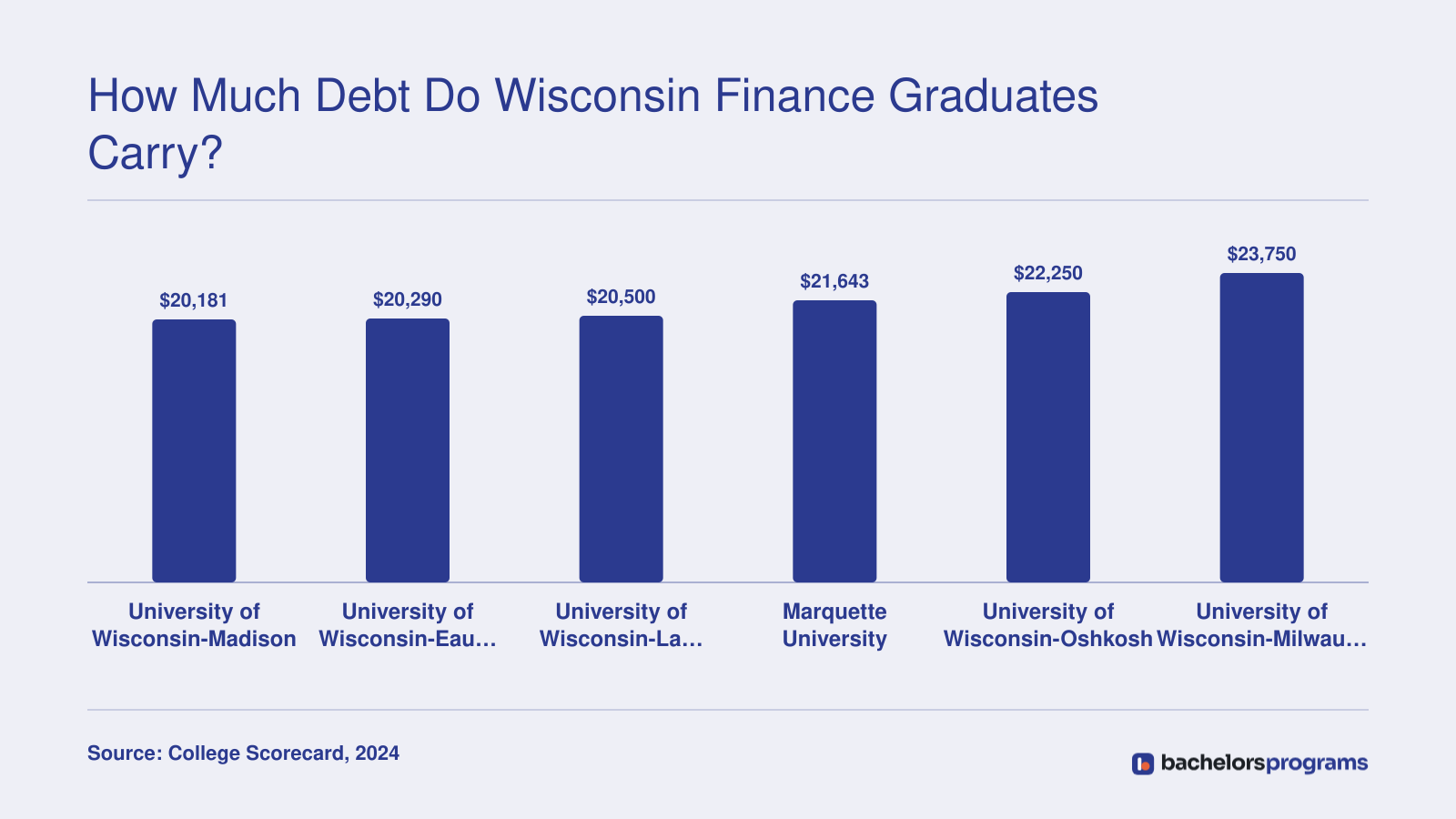
How Much Debt Do Wisconsin Finance Graduates Carry?
Median federal debt at program completion for a bachelor's degree in finance falls in a narrow band at these Wisconsin schools, from $20,181 at University of Wisconsin-Madison to $23,750 at University of Wisconsin-Milwaukee. The chart uses finance-program debt only and leaves out schools that do not report it. On a standard 10-year repayment plan, typical monthly payments run about $214 to $252, a manageable share of first-year median earnings that range from $52,744 to $68,681.
Finance Careers and Salaries in Wisconsin
U.S. Bureau of Labor Statistics wage estimates show that the roles most finance graduates pursue pay well in Wisconsin. Personal financial advisors posted a statewide median of $140,940 in May 2023, and financial and investment analysts came in at $102,090. The Milwaukee-Waukesha-West Allis rows use the earlier May 2022 metro survey, and these wage releases do not include a state growth projection, so read the table as a snapshot rather than a forecast.
| Occupation | Median Annual Wage (Wisconsin) | Wisconsin Employment | Projected Growth |
|---|---|---|---|
| Personal Financial Advisors (statewide, May 2023) | $140,940 | 4,680 | N/A |
| Financial and Investment Analysts (statewide, May 2023) | $102,090 | 4,490 | N/A |
| Loan Officers (statewide, May 2023) | $86,100 | 5,470 | N/A |
| Personal Financial Advisors (Milwaukee-Waukesha-West Allis metro, May 2022) | $145,020 | 2,610 | N/A |
| Financial and Investment Analysts (Milwaukee-Waukesha-West Allis metro, May 2022) | $99,260 | 2,040 | N/A |
| Loan Officers (Milwaukee-Waukesha-West Allis metro, May 2022) | $89,220 | 1,720 | N/A |
Wisconsin Finance Degree: Common Questions
What is the best finance school in Wisconsin?
Is UW-Madison's finance major hard to get into?
Do you need a finance degree to sit for the CFA exam or earn the CFP certification?
Do finance majors need a state license to work in Wisconsin?
How long does a bachelor's degree in finance take to finish?
Compare Finance programs on the data that matters
Explore more Business & Management majors or browse every field of study.
All Business & Management programs Browse every field of study