Best Psychology Schools in Wisconsin
Compare 34 accredited General Psychology programs in Wisconsin at 27 colleges, with net price after aid, graduation rates, earnings and debt from IPEDS and the U.S. College Scorecard.

The core tradeoff in a Wisconsin psychology degree is price against payoff. In-state tuition and fees at UW-Madison run $11,603, yet a bachelor's degree in psychology does not license anyone to practice. Schools award it as a Bachelor of Arts (B.A.) or Bachelor of Science (B.S.) in Psychology, on campus and online.
Rankings weigh net price after aid, graduation rate and earnings for psychology graduates specifically. The cheapest and highest-earning programs get separate lists, alongside admissions, state aid and careers.
Graduate pay varies widely by school. UW-Madison psychology graduates earn a median $61,607 five years out, and Wisconsin licenses psychologists only at the doctoral level.
Key Points
- University of Wisconsin-Madison psychology grads earn $61,607 median five years out.
- University of Wisconsin-Stout offers a fully online B.S. in Psychology.
- A psychology bachelor's alone won't make you a licensed Wisconsin psychologist.
Best Psychology Schools in Wisconsin: Our Top 10 Ranked
The best psychology school in Wisconsin for most students is the University of Wisconsin-Madison, which combines a top-20 national department ranking with a 89.5 percent institution-wide graduation rate and the second-strongest graduate earnings in this group. It is not the right answer for everyone, though: two-year costs, class size and the option to stay near home matter just as much. The ten bachelor's programs below are ordered by how well they balance completion, net price and outcomes for students who want to study psychology in Wisconsin.
University of Wisconsin-Madison
#1Madison, WI · ~$17,000/yr (est.)
Best for: Research-bound students aiming at graduate school
Wisconsin's flagship campus runs one of the largest psychology departments in the state, and its undergraduate program placed among the top 20 nationally in the 2025-26 U.S. News standings. The B.A. pairs a 30-credit core with honors research, a capstone seminar and study abroad in more than 80 countries. The institution-wide graduation rate is 89.5 percent and the average net price after aid is roughly $17,350, while graduates earn a median of about $58,900 four years after finishing.
- 30 credit hours in the major plus prerequisites
- Statistics and research methods foundation courses
- Capstone seminar tied to current research
- Honors research track for high-performing majors
- Study abroad options in 80+ countries
- Career advising through SuccessWorks
- Prepares students for graduate study, medicine, law and business
University of Wisconsin-La Crosse
#2La Crosse, WI · $15,000 – $20,000/yr (est.)
Best for: In-state students seeking a large psychology department
UW-La Crosse awards both a B.A. and a B.S. in psychology to roughly 750 majors, supported by 23 full-time instructors and dedicated experimental, testing and statistics laboratories. Fieldwork, internships and regional conference research are encouraged, and Psi Chi and the Psychology Club give students an easy foothold outside class. In-state tuition is about $10,070, the average net price after aid is about $16,200, the institution-wide graduation rate is 71.0 percent, and graduates earn a median of about $55,200 four years after finishing.
- B.A. and B.S. degree options
- About 750 declared majors and 400 minors
- 23 full-time instructors, more than 90 percent with doctorates
- Experimental lab, research and testing rooms, statistics computer lab
- Fieldwork, internships and independent research encouraged
- Students present projects at regional conferences
- Psi Chi honors association and Psychology Club
Marquette University
#3Milwaukee, WI · ~$31,000/yr (est.)
Best for: Milwaukee students wanting a Jesuit campus
Marquette's Jesuit campus in Milwaukee runs a tightly structured major of 38 psychology credits plus 15 cognate credits, with every student taking the same three core courses. An Honors in Psychology track plus research and internship credit give strong students room to go deeper. Tuition runs about $51,170, the average net price after aid is about $31,500, and the institution-wide graduation rate is 83.2 percent, while graduates earn a median of about $60,300 four years after finishing, the highest figure in this group.
- 38 psychology credits plus 15 cognate credits
- One shared core: general psychology, statistics, research methods
- Upper-division work required across five content areas
- Two upper-division psychology electives required
- Cognates include 6 social science, 3 math and 6 physical science credits
- Honors in Psychology for majors with a high psychology GPA
- Research and internship credit available
University of Wisconsin-Eau Claire
#4Eau Claire, WI · ~$17,000/yr (est.)
UW-Eau Claire awards the psychology major as a B.A. or a B.S., built on 36 credits that include research methods, statistics and at least 18 upper-division credits. Internships, research apprenticeships and a senior capstone give students applied experience, and the campus has invested in behavioral-health support programs in recent years. In-state tuition is about $9,640, the average net price after aid is about $16,550, the institution-wide graduation rate is 63.8 percent, and graduates earn a median of about $58,500 four years after finishing.
- 36 credit major with B.A. or B.S. options
- Research methods and statistics in the core
- Minimum 18 upper-division psychology credits
- Senior capstone course required
- Internship opportunities available
- Research apprenticeship options with faculty
- Coursework spans biological, developmental, learning, cognition and sociocultural areas
Carroll University
#5Waukesha, WI · $15,000 – $20,000/yr (est.)
Carroll University in Waukesha lets psychology majors choose a clinical and counseling, industrial and organizational, or research track within the same degree. Faculty-mentored projects often reach publication, internships place students with Wisconsin health organizations, and the major pairs easily with a second field without adding a fifth year. Tuition is about $38,890, the average net price after aid is roughly $15,200, and the institution-wide graduation rate is 70.7 percent, with graduates earning a median of about $55,400 four years after finishing.
- Three tracks: clinical and counseling, industrial and organizational, research
- Faculty-mentored research projects, often published
- Internships with leading Wisconsin health organizations
- Double major usually possible within four years
- Small classes and dedicated faculty advisors
- Psi Chi honor society chapter on campus
Lawrence University
#6Appleton, WI · ~$23,000/yr (est.)
Lawrence University is a small liberal arts campus in Appleton with a 7-to-1 student-faculty ratio and a required senior thesis completed in small seminars. Majors pursue original empirical research, clinical fieldwork practica and off-campus study within a flexible curriculum that covers clinical, cognitive, developmental, health, biological, industrial-organizational and social psychology. Tuition is about $56,980, the average net price after aid is roughly $23,400, and the institution-wide graduation rate is 76.8 percent, with graduates earning a median of about $46,000 four years after finishing.
- Thesis required, completed in small senior capstone seminars
- Original empirical research with faculty
- 7-to-1 student-faculty ratio
- Clinical fieldwork practica available
- Flexible major structure accommodates off-campus study
- Emphasis on critical thinking, quantitative reasoning and scientific communication
University of Wisconsin-Whitewater
#7Whitewater, WI · $10,000 – $15,000/yr (est.)
UW-Whitewater awards the psychology major as a B.A. or a B.S. and builds it around introductory psychology, research methods and behavioral neuroscience. Field placements and faculty-led undergraduate research are standard, and the department reports that 96 percent of graduates land a job or a graduate school seat. In-state tuition is about $8,620, the average net price after aid is about $14,160, the institution-wide graduation rate is 58.9 percent, and graduates earn a median of about $52,300 four years after finishing.
- B.A. and B.S. options with a published four-year plan
- Core includes introductory psychology, research methods and behavioral neuroscience
- Hands-on field placements and undergraduate research
- Faculty hold doctorates and no graduate assistants teach courses
- Department reports 96 percent job or graduate school placement
- Independent study and senior thesis projects available
University of Wisconsin-River Falls
#8River Falls, WI · $10,000 – $15,000/yr (est.)
UW-River Falls structures its 45-credit psychology major around 21 core credits and five options: psychological foundations, health, industrial and organizational, mental health, and social justice. A 24-credit psychology minor is also available, and the department states it prepares alumni for graduate study and professional careers. In-state tuition is about $9,010, the average net price after aid is about $14,050, the institution-wide graduation rate is 57.0 percent, and graduates earn a median of about $53,200 four years after finishing.
- 45-credit major with 21 core credits
- Five options: psychological foundations, health, I/O, mental health, social justice
- Core includes behavioral statistics, research methods and psychological measurement
- Senior seminar required
- Electives include health psychology, behavior modification and drugs and the nervous system
- 24-credit psychology minor available
University of Wisconsin-Platteville
#9Platteville, WI · $9,000 – $18,000/yr (est.)
UW-Platteville offers a B.S. in psychology grounded in American Psychological Association guidelines, with emphases in aging studies or substance use disorders counseling. The counseling emphasis can qualify graduates for state certification without a graduate degree, and a cooperative field experience, internships and a streamlined social work pathway add applied options. In-state tuition is about $8,640, the average net price after aid is about $16,030, the institution-wide graduation rate is 55.8 percent, and graduates earn a median of about $51,100 four years after finishing.
- B.S. in psychology built on APA guidelines
- Emphasis in substance use disorders counseling
- Emphasis in aging studies
- Cooperative field experience and internships available
- Substance use emphasis can lead to state counselor certification at the bachelor's level
- Social work training certificate and streamlined MSW pathway
- Can be paired with criminal justice or business
Saint Norbert College
#10De Pere, WI · $26,000/yr (est. net price)
Saint Norbert College in De Pere awards a B.S. in psychology that blends foundational theory with laboratory and experiential courses across biological, clinical, cognitive, developmental and social psychology. Internships, independent study and directed research are available, and about one third of graduates continue to graduate school. Tuition is about $44,620, the average net price after aid is roughly $26,200, and the institution-wide graduation rate is 71.3 percent, with graduates earning a median of about $44,600 four years after finishing.
- B.S. in psychology, with a minor also offered
- Labs and experiential courses across the major subdisciplines
- Internships, independent study and directed research
- About one third of graduates go on to graduate study
Cost & outcomes by school
Federal data for the highest-earning General Psychology programs, independent of the ranking above. Earnings are this field's bachelor's graduates four years after completing where the Scorecard reports them, else the school's undergraduate median.
| School | Net price / yr | Grad rate | Earnings | Debt | Grads/yr | Format |
|---|---|---|---|---|---|---|
| Marquette University WI | $31,487 | 83% | $60,338 | $24,187 | 118 | Campus |
| University of Wisconsin-Madison WI | $17,354 | 90% | $58,901 | $20,500 | 637 | Campus |
| University of Wisconsin-Eau Claire WI | $16,550 | 64% | $58,458 | $20,760 | 119 | Campus |
| Marian University WI | $21,937 | 44% | $56,434 | $25,000 | 20 | Campus |
| Concordia University-Wisconsin WI | $36,201 | 68% | $55,486 | $26,500 | 21 | Campus |
| Carroll University WI | $15,193 | 71% | $55,446 | $27,000 | 36 | Campus |
| University of Wisconsin-La Crosse WI | $16,210 | 71% | $55,173 | $21,282 | 212 | Campus |
| Carthage College WI | $26,565 | 64% | $54,636 | $23,250 | 27 | Campus |
| Lakeland University WI | $24,212 | 43% | $53,448 | $30,364 | 22 | Hybrid |
| University of Wisconsin-River Falls WI | $14,054 | 57% | $53,242 | $21,500 | 54 | Campus |
| University of Wisconsin-Stout WI | $17,490 | 55% | $52,366 | $19,750 | 53 | Online |
| University of Wisconsin-Milwaukee WI | $15,014 | 49% | $52,328 | $23,940 | — | Online |
Sources: U.S. Department of Education. Net price, graduation rate, earnings and debt: College Scorecard (earnings and debt for this field's bachelor's graduates where reported, else school-wide); graduates: IPEDS. A dash means no figure is reported.
Cost, debt & payoff
Median earnings of this field's bachelor's graduates (4 yrs after completing, else the school's undergraduate median) vs. their median federal loan debt · U.S. College Scorecard
Across these programs the median graduate earns about $51,402 and finishes with roughly $23,165 in debt — a ratio that clears a common rule of thumb (keep debt below first-year salary). Net price and debt vary widely school to school, so check the per-school figures in the table above before you shortlist.
The 5 Most Affordable Psychology Bachelor's Programs in Wisconsin
This table sorts Wisconsin psychology bachelor's programs by average net price, the yearly cost after grants and scholarships, rather than by sticker tuition, using 2024 IPEDS and College Scorecard data from the U.S. Department of Education. Every option here is a public University of Wisconsin campus, and only $2,386 separates the University of Wisconsin-Parkside ($11,772) from the fifth-lowest option, the University of Wisconsin-Whitewater ($14,158). Net price is an average across students who receive aid, so your own cost will depend on your family income and the aid package you are offered.
| School | City | Average Net Price (After Aid) | In-State Tuition and Fees | Graduation Rate | Median Debt at Graduation |
|---|---|---|---|---|---|
| University of Wisconsin-Parkside | Kenosha | $11,772 | $8,270 | 40% | $20,492 |
| University of Wisconsin-Superior | Superior | $12,220 | $8,812 | 42% | $22,500 |
| University of Wisconsin-Green Bay | Green Bay | $13,369 | $8,700 | 48% | $18,500 |
| University of Wisconsin-River Falls | River Falls | $14,054 | $9,008 | 57% | $20,500 |
| University of Wisconsin-Whitewater | Whitewater | $14,158 | $8,616 | 59% | $23,188 |
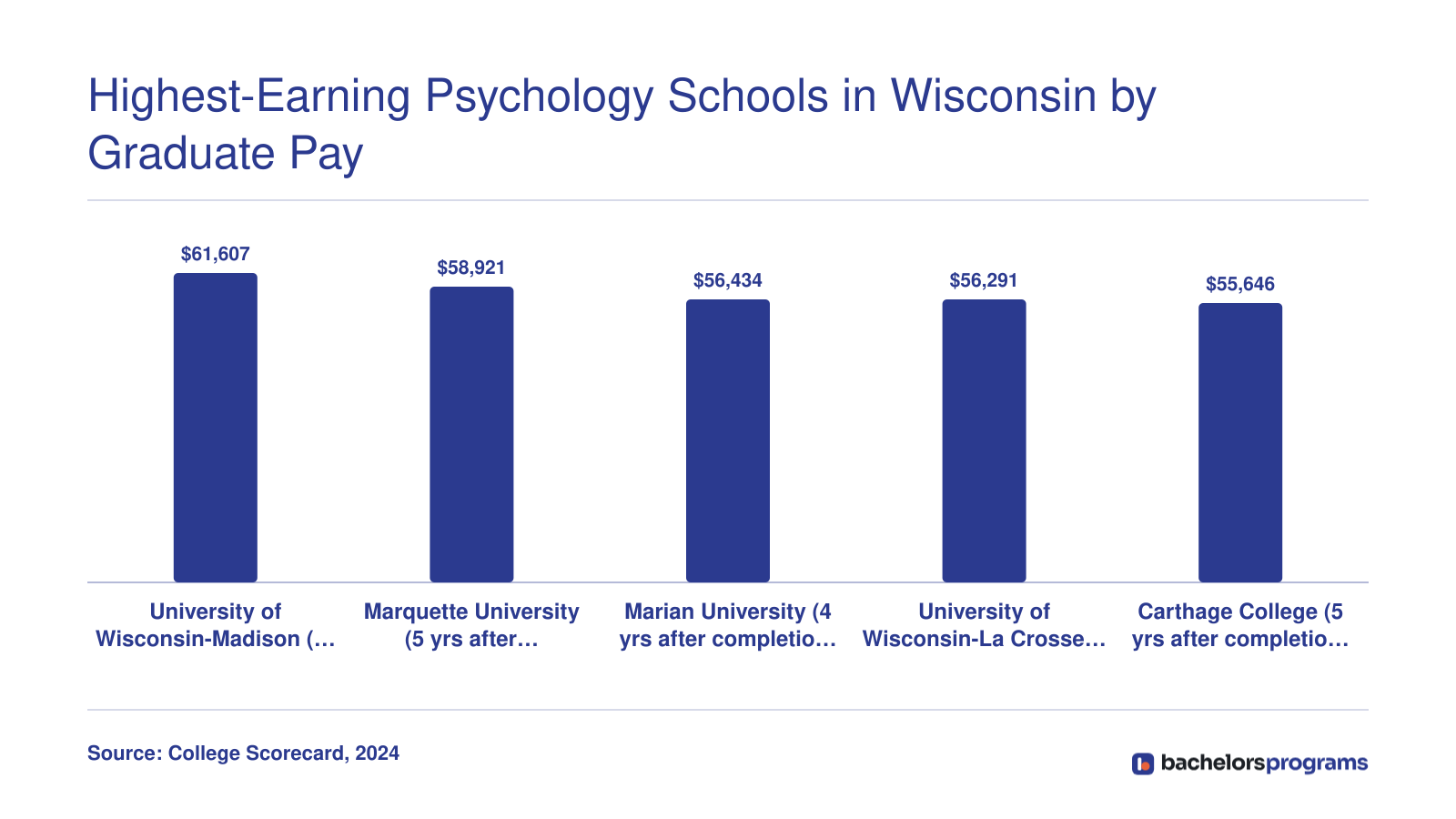
Highest-Earning Psychology Schools in Wisconsin by Graduate Pay
These bars show median earnings for graduates of each school's bachelor's degree in psychology, not campus-wide pay. The University of Wisconsin-Madison leads at $61,607 five years after completion, and Marian University's figure is measured four years out. Some Wisconsin psychology programs report no program-level earnings, so they cannot appear here.
What a Bachelor's Degree in Psychology Looks Like in Wisconsin (B.A. vs. B.S.)
In psychology, the B.A. versus B.S. choice now comes down less to prestige than to how much math, science and statistics you want on your schedule. Wisconsin schools award the bachelor's degree in psychology under both titles. The University of Wisconsin-Stout and Marian University list a Bachelor of Science in Psychology, and Ottawa University-Milwaukee offers a Bachelor of Arts in Psychology. Some campuses offer both, so confirm which version a catalog describes before you compare requirements.
How the Two Degrees Differ
- B.A. in Psychology: Typically broader, with more room for liberal arts electives and, at many schools, a foreign language requirement.
- B.S. in Psychology: Typically adds math, natural science and research methods coursework, often with extra statistics or lab work.
The psychology core (introductory psychology, statistics, research methods and upper-level electives) tends to look similar under either title. The real difference usually sits in the surrounding college requirements.
Credits and Coursework
Most bachelor's degrees require about 120 credits to graduate. The psychology major commonly accounts for 30 to 45 of those credits, though totals vary by school. Read each program's current catalog rather than assuming one number applies everywhere.
Specialized coursework varies too. At the University of Wisconsin-Madison, Behavioral Neuroscience (PSYCH 454) is listed at 3 to 4 credits through the university's neuroscience undergraduate program. Some departments group electives into areas such as neuroscience, research or human services. Ask whether a school treats these as formal concentrations or simply as suggested paths.
Is a B.A. or B.S. Better?
Neither is better across the board. Each fits a different goal.
- B.S. for research: Choose it if you plan to pursue research, neuroscience or a science-heavy graduate program, where extra statistics and methods give you a head start.
- B.A. for flexibility: Choose it if you lean toward human services or a double major and want room for courses in sociology, communication or a language.
For entry-level jobs, Wisconsin employers rarely distinguish between the two. Hiring managers in case management, social services and human resources tend to weigh internships and practical skills over the letters on your diploma. If you're unsure, pick the program you're most likely to finish strong.
Online and Hybrid Psychology Bachelor's Programs at Wisconsin Schools
Fully online psychology degrees in Wisconsin cluster at a handful of schools, and most of the strongest campus programs remain in-person only.
Three Formats, Sorted
- Fully online: University of Wisconsin-Stout offers a B.S. in Psychology online alongside its on-campus B.S. University of Wisconsin-Parkside lists an online degree-completion version of its Psychology major. Parkside's page does not make clear whether that completion degree is a B.A. or a B.S., so confirm with the school.
- Hybrid: None of the programs listed here is flagged as hybrid. Ask admissions directly if a mixed format matters to you.
- Campus-only: University of Wisconsin-Madison, UW-La Crosse, Marquette, UW-Eau Claire, Carroll, Lawrence, UW-Whitewater, UW-River Falls, UW-Platteville and Saint Norbert are all listed as campus-based. Eau Claire offers both B.A. and B.S. options, but only on campus.
The UW Online Pathway
UW Online Collaboratives programs are delivered 100% online, with no campus visits and no set class times.1 The online bachelor's completion fields listed there center on business, healthcare, management, sustainability and technology. Psychology does not appear in that listing,2 so Stout and Parkside are the better places to start. Credentials from UW schools are generally awarded by the participating campus. Tuition for online and campus versions can differ, so compare per-credit rates on each school's own page rather than assuming they match.
In-Person Requirements to Check
Even an online psychology major may include research methods, a capstone, or a field placement or internship. The schools' program pages are where to confirm whether any of these require on-site work, and whether you can complete them near home. Campus programs such as Whitewater and Platteville emphasize hands-on field placements, so expect a local component there.
Who Online Suits Best
Online study fits working adults who cannot attend daytime classes, transfer students carrying credits from a two-year college, and degree-completers who stopped short of a bachelor's. If you are a traditional-age student who wants research labs, faculty mentoring and a campus community, a campus program is usually the better match.
Transfer Credit Paths Into Wisconsin Psychology Programs
UW System guidance generally allows up to 72 credits from a non-baccalaureate institution, including WTCS colleges.1 That is a general framework, not a confirmed cap at every campus, so check the policy at the school you want. Published limits for UW-Madison and UW-Green Bay were not available, so ask their admissions offices directly.
Agreements and the Transfer Information System
The WTCS Universal Credit Transfer Agreement moves at least 30 credits from 11 core courses, including Psychology, Sociology and Algebra/Trigonometry, into UW four-year institutions.2 That is roughly one year of study. Not all 30 credits necessarily count toward a psychology major at every campus. The UW Transfer Information System and its Transfer Course Wizard show how individual courses transfer, but a match may land as elective credit only.1
The private-college agreement works differently. Specified technical-college credits count only with a C or better earned within the last ten years.2
Program-level pathways
A 2026 agreement between a Wisconsin technical college and UW-Stout links a 60-credit Associate of Arts to the 120-credit B.S. in Psychology.3 Students must finish the whole associate program and meet UW-Stout admission requirements. UW-Stout applies 56 credits, leaving 64 to complete.3 The agreement runs through Dec. 20, 2029, or five years, whichever comes first.
Residency rules at Marquette
Marquette requires at least 45 degree credits earned at Marquette, with up to 15 allowed through approved study abroad.4 Of your final 36 credits, 30 must come from Marquette or approved study abroad.5 At least half of the major must also be completed there.4 In the B.A. in Psychology, 24 of the 42 upper-division credits must be earned at Marquette.6 Major credit also requires a C or better, per the 2023 handbook.7
Tip before you enroll
General education credits transfer far more easily than major credits. Get written confirmation of psychology course equivalencies before you enroll, so a course counts toward the major rather than merely toward total credits.
Cost of a Psychology Bachelor's Degree in Wisconsin: Tuition, Aid and Debt
Sticker Price vs. Net Price
UW System four-year campuses average about $9,250 in tuition and fees for 2026-274, though flagship pricing runs higher. In-state tuition and fees at UW-Madison are $11,603 in the latest federal data. Lawrence University, a private school, lists $56,982. That is a gap of more than $45,000 on paper.
Net price, what remains after grants and scholarships, narrows that gap sharply. The federal figure is about $17,354 at UW-Madison and $23,401 at Lawrence. These are averages across all students, so your own number depends on family income and aid. A calculator on the school's own site gives a firmer number.
Debt Among Psychology Completers
Program-level figures describe students who completed that psychology degree, not everyone who enrolled. Median debt is $15,000 for Lawrence psychology completers and $20,500 for UW-Madison completers. The cheaper sticker price at the public flagship does not guarantee lower borrowing, so compare both numbers for any school you consider.
Wisconsin Grants to Know
- Wisconsin Grant (public): For Wisconsin residents with financial need at UW campuses. The 2026-27 maximum is $3,7001, and a second-tier award of $1,000 is possible only if funds remain. Technical college awards top out at $1,7521.
- Wisconsin Tuition Grant (private): For residents attending nonprofit private Wisconsin colleges such as Lawrence or Marquette. Awards are prorated by credits: 12 or more is full-time, 9 to 11 is three-quarter time, and 6 to 8 is half-time2. Current award amounts were not confirmed, so check the Higher Educational Aids Board and your school's aid office.
- Talent Incentive Program: For first-time freshmen with significant financial need and a nontraditional or educationally disadvantaged background. Your aid office or a counselor nominates you. Initial awards run $600 to $1,8002. Continuing students can receive up to $1,800 a year, with a $250 minimum, for up to 10 semesters3.
Apply Early
File the FAFSA as soon as it opens, because some state aid is limited by available funds. Then check each school's own scholarship page, since institutional awards often matter more than state grants at private colleges.
Related Articles
Careers in Wisconsin With a Bachelor's Degree in Psychology
Market research analysts and marketing specialists in Wisconsin earned a median annual wage of $65,000 in 2024, according to the Wisconsin Department of Workforce Development (DWD), and the state counted 18,157 of those jobs that year.1 It is one of several fields where a psychology bachelor's meets the typical entry requirement.
Common Bachelor's-Level Paths
Psychology graduates in Wisconsin tend to land in roles that use what the major teaches: understanding behavior, collecting data and working with people.
- Market research and marketing: $65,000 median wage (2024), with a bachelor's degree as the typical entry credential.
- Human resources specialists: $65,000 median wage in DWD's 2022 data, with a bachelor's as the usual entry point.2
- Social and human service assistants: $41,550 median wage (2020) across 9,345 Wisconsin jobs.3 Many of these roles accept a high school diploma, so a psychology degree can help you stand out and move toward case management.
- Case management and research assistant roles: Common first jobs in human services agencies, nonprofits and university labs, with pay that depends heavily on the employer and setting.
These DWD figures come from different reporting years, so treat them as a rough guide rather than a side-by-side comparison.
Be Realistic About Pay
A bachelor's in psychology is a general degree, not a professional license. The same diploma can lead to a service role in the low $40,000s or an analyst position near $65,000, depending on the skills you add. Coursework in statistics, research methods and business, plus at least one internship, tends to push graduates toward the higher end. The graduate pay chart earlier on this page shows how early-career earnings differ from one Wisconsin school to the next.
Working Now or Heading to Graduate School
Many psychology majors treat the bachelor's as a stepping stone. Becoming a licensed psychologist, professional counselor or clinical social worker in Wisconsin requires graduate education, so students aiming for therapy or clinical work should plan for that path from the start.
If you want to work right after graduation, favor a program with strong internship placement and applied coursework. If you plan to continue, look for undergraduate research opportunities, faculty mentorship and a solid statistics sequence, since graduate admissions committees weigh those heavily.
Wisconsin Licensure: What a Psychology Bachelor's Does and Doesn't Allow
A bachelor's degree in psychology prepares you for many careers, but on its own it does not make you a licensed psychologist in Wisconsin. Here is where the degree fits in the state's licensing system.
- Psychologist license: not available with a bachelor'sThe Psychology Examining Board, under the Wisconsin Department of Safety and Professional Services (DSPS), oversees this license. It requires a doctoral degree in psychology accredited by APA or CPA, or training the Board finds substantially equivalent. Applicants also need at least 3,000 hours of supervised experience, a passing score on EPPP Part 1 (Knowledge), the Wisconsin statutes-and-rules exam, and fingerprinting.
- Professional counselor (LPC): a separate pathA psychology bachelor's alone does not qualify you for the LPC. Even licensed counselors may not practice independently without approved clinical supervision.
- Social work: one opening for psychology graduatesSocial worker licensure generally requires a CSWE-accredited social work degree. However, DSPS offers a Social Worker Training Certificate to graduates with an accredited psychology bachelor's. That route still requires five courses and supervised experience. Independent and clinical social work licenses require a master's or doctorate in social work.
- Work that needs no licenseMany jobs in human services, research, business and education do not use a protected title such as psychologist, counselor or social worker. Those roles are open to bachelor's graduates without a state license.
How to Choose the Right Wisconsin Psychology School for Your Goals
The best Wisconsin psychology school for you is the one whose strengths match what you plan to do after graduation, not simply the one with the biggest name.
Match the School to Your Goal
- Research and graduate school prep: Research universities such as University of Wisconsin-Madison and Marquette University offer more faculty labs, which matters if you expect to apply to Ph.D. or Psy.D. programs later.
- Human services careers: Public campuses such as University of Wisconsin-Whitewater, University of Wisconsin-Eau Claire and University of Wisconsin-Green Bay are worth comparing for applied coursework and community placements.
- Pre-clinical paths: Smaller private colleges such as Lawrence University, Carroll University and Saint Norbert College can offer close advising for students headed toward counseling, social work or health professions.
- Online flexibility: University of Wisconsin-Stout offers a B.S. in Psychology online, and University of Wisconsin-Parkside offers an online degree-completion option for students who already have credits.
Confirm Accreditation First
The Higher Learning Commission (HLC) is the regional accreditor for Wisconsin colleges. HLC accreditation matters because it affects whether your credits transfer and whether you can use federal financial aid. Psychology bachelor's programs carry no separate programmatic accreditation. The American Psychological Association accredits doctoral programs and internships, not undergraduate majors, so a school's HLC status is the accreditation that counts at this level.
Run a Few Practical Checks
- Faculty research: Ask how undergraduates join labs and whether an honors thesis or independent study is available.
- Internships and practicum placements: Find out where students are placed and whether placements earn credit.
- Graduation rates: Compare how many students finish on time, since delays add tuition.
- Advising: Ask how the department helps students plan for graduate school or entry-level jobs.
A Quick Decision Shortcut
Start with the top-10 ranking above to see which schools perform best overall. If cost is the deciding factor, cross-check your shortlist against the most affordable programs table. If you work or live far from campus, go to the online and hybrid section. Then contact the psychology department at your final two or three choices and ask the questions above before you apply.
Compare General Psychology programs on the data that matters
Explore more Psychology majors or browse every field of study.
All Psychology programs Browse every field of study