Best Healthcare Administration Schools in Alabama
Compare 12 accredited Healthcare Administration programs in Alabama at 11 colleges, with net price after aid, graduation rates, earnings and debt from IPEDS and the U.S. College Scorecard.

Alabama's medical and health services managers earned an annual mean wage of $109,110 in a June 2026 state estimate, and a bachelor's degree in healthcare administration is the usual entry credential for that track. The degree is usually a Bachelor of Science (B.S.) in Healthcare Administration, though state schools also title it health services administration, health care management, or applied health science.
Annual tuition across these programs ranges from about $6,760 to $40,150, and median earnings five years after graduation span roughly $51,000 to $71,000. That gap is the real decision: the cheapest seat is not always the strongest return, and the best-known campus is not automatically the highest-paying one.
Key Points
- Auburn's health services administration graduates earn a $70,747 median five years out.
- Alabama's about 10,360 medical and health services managers average $109,110 yearly.
- Among healthcare administration roles, Alabama licenses only nursing home administrators.
Best Bachelor's Degree in Healthcare Administration Programs in Alabama, Ranked
Every school below offers a bachelor's degree in healthcare administration or a close equivalent, delivered on campus, fully online, or both. Each entry notes the format, in-state tuition, the approximate average net price after aid, and the earnings or debt figures the data publishes, so you can compare programs on the numbers that shape four years of cost and the first job after graduation.
Auburn University
#1Auburn, AL · $13,000 – $35,000/yr (est.)
Best for: Campus students targeting hospital leadership
Auburn has taught health services administration since 1971, and the campus program is certified by the Association of University Programs in Healthcare Administration. In-state tuition and fees are about $12,900 a year, and the average net price after aid is roughly $24,300. Program graduates report median earnings near $74,400 four years after finishing and median debt of about $25,800; the institution-wide graduation rate is about 82%.
- Certified by the Association of University Programs in Healthcare Administration
- Program founded in 1971, with more than 1,100 alumni nationwide
- Coursework spans patient-centered care, health IT, research, and management
- Reports high job placement and graduate school acceptance rates
- Prepares graduates for hospital administration, consulting, and health policy
- Scholarships available to enrolled students
University of Alabama at Birmingham
#2Birmingham, AL · $19,000/yr (est. net price)
Best for: Working clinicians moving into management
UAB has offered health care management since 1982, and the degree is built so credentialed health professionals can move into management without restarting their education; a fully online version is available. In-state tuition is about $9,100 a year, and the average net price after aid is roughly $18,700. Program graduates report median earnings near $53,000 four years out and median debt of about $28,500; the institution-wide graduation rate is about 64%.
- Clinical Manager track designed for credentialed health professionals
- General Manager track prepares for nursing home administrator licensure
- Fully online option available for the health care management major
- Health care management major offered at UAB since 1982
- Three concentration options
- Electives can include graduate program prerequisites
Samford University
#3Birmingham, AL · $30,000 – $35,000/yr (est.)
Best for: Birmingham locals prioritizing internship hours
Samford is a private Birmingham campus where the healthcare administration major pairs a business core with health policy, epidemiology, and two supervised internships totaling at least 240 hours. Tuition is about $40,150 a year before aid, and the average net price after aid is roughly $32,600. The institution-wide graduation rate is about 77%, and the program earned AUPHA certified undergraduate status in 2026.
- AUPHA certified undergraduate program as of June 2026
- Two internships totaling at least 240 hours at different organizations
- 128 total credit hours plus a senior capstone
- Health informatics and analytics minor available
- Accelerated bachelor's to Master of Healthcare Administration pathway
- Coursework in finance, health law, ethics, policy, epidemiology, and biostatistics
University of North Alabama
#4Florence, AL · $12,000 – $22,000/yr (est.)
UNA runs its health administration track entirely online in eight-week sessions, with a final internship completed in the student's own community rather than on a campus. In-state tuition is about $12,100 a year, and the average net price after aid, roughly $12,200, is the lowest on this list. The institution-wide graduation rate is about 55%.
- All courses delivered online in eight-week sessions
- Final-semester internship completed in your own community
- Admission requires a 2.0 GPA and a C or higher in each course
- No minor required
- Covers informatics, health policy, epidemiology, grant writing, and budgeting
University of Mobile
#5Mobile, AL · ~$22,000/yr (est.)
The University of Mobile combines business and clinical coursework, with faculty drawn from both the School of Business and the School of Nursing, and offers a five-year fast track to an MBA. Tuition is about $26,900 a year before aid, and the average net price after aid is roughly $22,400. The institution-wide graduation rate is about 57%.
- 13:1 student-faculty ratio
- Faculty from the School of Business and School of Nursing
- Optional five-year fast-track MBA
- Coursework in accounting, finance, marketing, HR, informatics, and health law
- Prepares students for entry-level and mid-management roles
Spring Hill College
#6Mobile, AL · $20,000/yr (est. net price)
Spring Hill is a small private college in Mobile where health care management is an 18-hour concentration inside the business administration degree, and it is also offered as a minor. Tuition is about $24,100 a year before aid, and the average net price after aid is roughly $20,400. The institution-wide graduation rate is about 52%.
- 18-hour Health Care Management concentration
- Also available as a minor
- Test-optional admission with a free application
- Average class size of 13
- Division of Business named a College of Distinction
Columbia Southern University
#7Orange Beach, AL · $15,000/yr (est. net price)
Columbia Southern is an online-first institution based in Orange Beach, and its health care administration degree can be finished entirely online with courses available around the clock. Published tuition and fees run about $6,800 a year, or $278 per credit, and the average net price after aid is roughly $14,600. Program graduates report median earnings near $61,800 four years out and median debt of about $38,200; the institution-wide graduation rate is near 33%.
- Fully online, with courses available 24/7
- $278 per credit hour; $250 for active-duty military
- 120 credits required; accepts up to 90 transfer credits
- Eleven start dates per year
- Textbooks included in tuition; weekly to monthly payment plans
- SACSCOC institutional accreditation and ACBSP business accreditation
Athens State University
#8Athens, AL
Athens State aims at adult learners and delivers health care management online, on campus, or at satellite sites, with coursework spanning accounting, finance, policy, and management. The average net price after aid is roughly $18,100, one of the lower figures among the schools listed here. The program is built around flexibility for students already working in or near healthcare.
- Online, on campus, or at satellite campuses
- Designed for working adults
- Coursework blends accounting, finance, policy, and management
- Careers in long-term care, pharmaceuticals, and medical equipment sales
Herzing University-Birmingham
#9Birmingham, AL · $15,000 – $20,000/yr (est.)
Herzing's Birmingham campus runs the healthcare administration degree fully online over about 32 months, with leadership or managed care concentrations and up to 90 transfer credits accepted. Tuition is about $13,450 a year, and the average net price after aid is roughly $19,700. Program graduates report median earnings near $51,100 four years out and median debt of about $47,400; the institution-wide graduation rate is around 13%.
- 32-month, 120-credit online program
- $530 per credit hour; military rate of $250
- Leadership or managed care concentration
- Capstone or internship required
- Transfer up to 90 approved credits
- Up to 12 graduate credits toward an MBA or MHA
- Rolling admissions with day or evening classes
The University of Alabama
#10Tuscaloosa, AL · ~$22,000/yr (est.)
The University of Alabama offers health care management as a concentration within the management major at the Culverhouse College of Business, with coursework in health systems, leadership, and analytics. In-state tuition is about $12,200 a year, and the average net price after aid is roughly $22,400. The institution-wide graduation rate is about 73%.
- Health Care Management and Analytics concentration in the management major
- HCAN 360 Introduction to Health Systems covers U.S. care delivery
- Management courses in leadership, innovation, and decision-making
- Prerequisites include accounting, economics, statistics, and MIS courses
- Offered through the Culverhouse College of Business
Cost & outcomes by school
Federal data for the highest-earning Healthcare Administration programs, independent of the ranking above. Earnings are this field's bachelor's graduates four years after completing where the Scorecard reports them, else the school's undergraduate median.
| School | Net price / yr | Grad rate | Earnings | Debt | Grads/yr | Format |
|---|---|---|---|---|---|---|
| Auburn University AL | $24,323 | 82% | $74,392 | $24,000 | 35 | Campus |
| Columbia Southern University AL | $14,580 | 33% | $61,821 | $23,621 | 153 | Online |
| The University of Alabama AL | $22,420 | 73% | $59,221 | $22,750 | — | Campus |
| Samford University AL | $32,622 | 77% | $58,469 | $19,500 | 13 | Campus |
| University of Alabama at Birmingham AL | $18,749 | 64% | $53,021 | $25,125 | 74 | Campus |
| Spring Hill College AL | $20,449 | 52% | $51,500 | $27,000 | 7 | Campus |
| Herzing University-Birmingham AL | $19,651 | 13% | $51,098 | $37,778 | 9 | Online |
| Athens State University AL | — | — | $50,273 | $18,051 | 6 | Online |
| South University-Montgomery AL | $27,807 | 9% | $46,885 | $39,675 | 9 | Hybrid |
| University of North Alabama AL | $12,170 | 55% | $45,415 | $22,077 | 16 | Online |
| University of Mobile AL | $22,382 | 57% | $43,611 | $26,500 | 3 | Campus |
Sources: U.S. Department of Education. Net price, graduation rate, earnings and debt: College Scorecard (earnings and debt for this field's bachelor's graduates where reported, else school-wide); graduates: IPEDS. A dash means no figure is reported.
Cost, debt & payoff
Median earnings of this field's bachelor's graduates (4 yrs after completing, else the school's undergraduate median) vs. their median federal loan debt · U.S. College Scorecard
Across these programs the median graduate earns about $52,261 and finishes with roughly $24,563 in debt — a ratio that clears a common rule of thumb (keep debt below first-year salary). Net price and debt vary widely school to school, so check the per-school figures in the table above before you shortlist.
Most Affordable Alabama Bachelor's Programs in Healthcare Administration
These are the lowest-cost paths to a healthcare administration bachelor's at the schools ranked here, ordered by average annual net price after grants and scholarships, using 2024 IPEDS and College Scorecard data from the U.S. Department of Education. The University of North Alabama comes in at $12,170 a year after aid, while Spring Hill College runs $20,449. That is a gap of about $8,300 a year, or roughly $33,000 across four years. Columbia Southern University carries the lowest sticker price at $6,760, so budget-minded students should compare net price, not tuition alone, before applying.
| School | City | Format | Program | In-State Tuition and Fees (per year) | Average Net Price After Aid (per year) | Median Debt at Completion (program) |
|---|---|---|---|---|---|---|
| University of North Alabama | Florence | Online (final internship in person) | B.S. in Applied Health Science, Health Administration Track | $12,120 | $12,170 | N/A |
| Columbia Southern University | Orange Beach | Online | B.S. Health Care Administration | $6,760 | $14,580 | $23,621 |
| University of Alabama at Birmingham | Birmingham | Campus | Health Care Management | $9,098 | $18,749 | $25,125 |
| Herzing University-Birmingham | Birmingham | Online | B.S. in Healthcare Administration | $13,450 | $19,651 | $37,778 |
| Spring Hill College | Mobile | Campus | BBA in Health Care Management | $24,054 | $20,449 | N/A |
Which Alabama Healthcare Administration Bachelor's Programs Lead on Earnings?
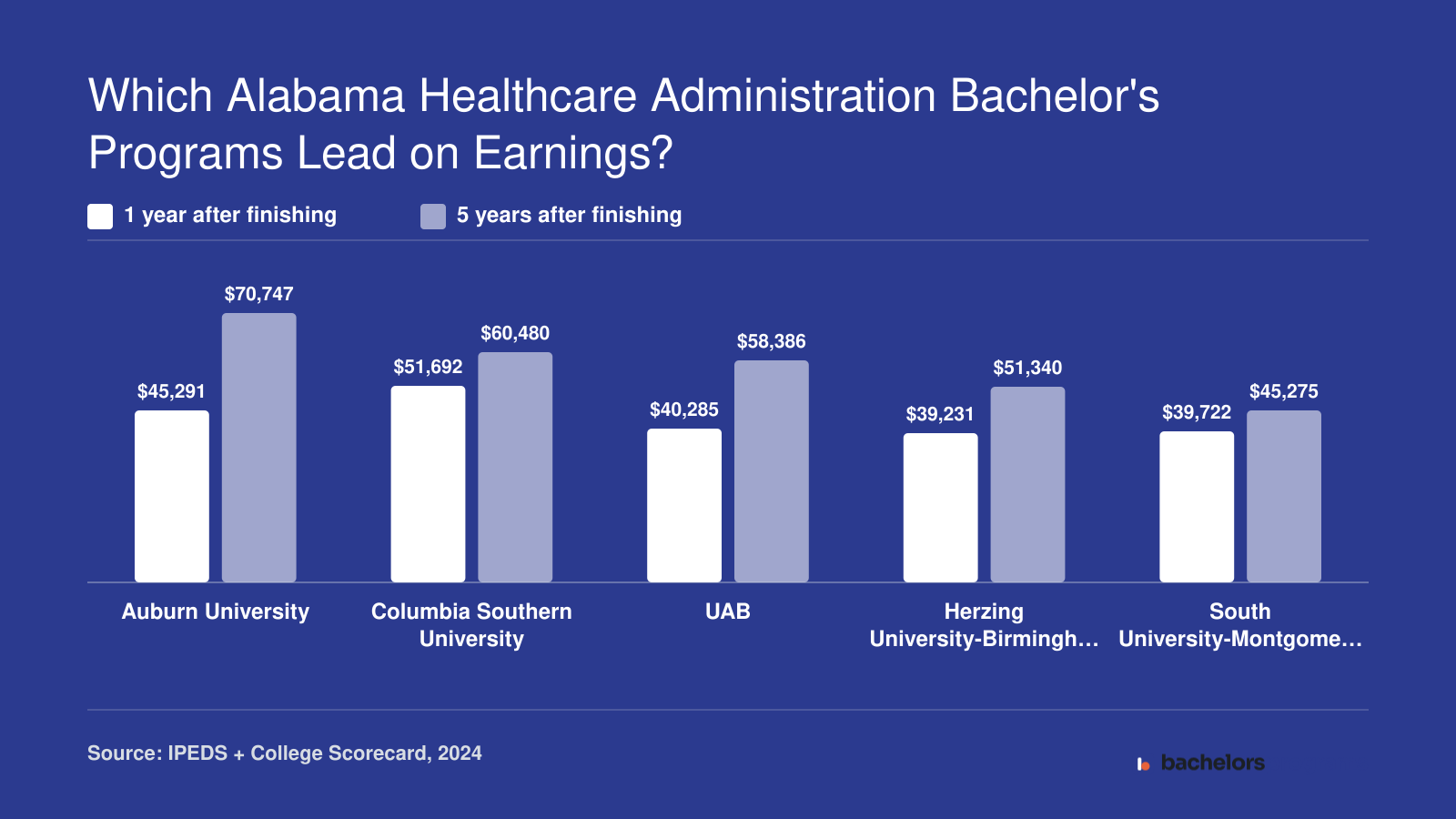
Auburn University's health services administration graduates post the highest program-level median earnings in this comparison: $45,291 one year after finishing and $70,747 five years after, against an average annual net price of $24,323. Columbia Southern University ($60,480 at five years) and UAB ($58,386) follow, and Herzing University-Birmingham ($51,340) and South University-Montgomery ($45,275), a school in our directory, round out the group, though Herzing's figure rests on a very small graduating class. The gap between programs widens over five years, while yearly net prices vary much less. Columbia Southern stands out for value, pairing a $14,580 net price with $60,480 in five-year median earnings.
Online and Hybrid Bachelor's Programs in Healthcare Administration at Alabama Schools
Delivery format is simply where and when you sit for class: fully online programs run entirely through a learning platform, campus programs meet in person in Florence, Birmingham, Mobile, Auburn or Tuscaloosa, and hybrid options mix the two. The format you choose usually matters more to your schedule than to your coursework, since the core subjects, accounting, health policy, management, look much the same either way.
Which Alabama schools teach online
Several of the programs here are built for distance students. The University of North Alabama's Applied Health Science degree with the Health Administration track delivers all coursework online. Columbia Southern University, based in Orange Beach, runs its B.S. Health Care Administration fully online with 11 start dates a year and accepts up to 90 transfer credits. Athens State University offers its Health Care Management degree across multiple modalities, including online and campus, and designs it around adult learners. Herzing University-Birmingham also lists its healthcare administration bachelor's online, with day or evening scheduling.
Campus-based options include Auburn University, Samford University, the University of Mobile, Spring Hill College, and The University of Alabama's management degree with a health care management and analytics concentration.
Term length, internships, and who each format suits
UNA runs its online courses in eight-week terms, which lets you focus on one or two classes at a time instead of juggling five across a full semester. That rhythm suits working adults and transfer students who need to stack credits around a job.
Hands-on hours are still required. UNA requires a 3-credit internship (AHS 427R) that students complete in their own community, so online learners are not required to relocate. UAB places its management internship in the final semester of the bachelor's: 3 credits and 120 contact hours for the Clinical Manager track, 6 credits and 240 hours for other tracks, with no more than 14 semester hours of clinical education counting toward the degree. Samford builds in two internships totaling 240 hours.
If graduate study appeals later, UAB's accelerated bachelor's/master's framework lets qualified students share up to 12 graduate credits, but that is a decision for your junior year, not now.
Rule of thumb: choose online when your job or family keeps you in place, and campus when you want faculty access and local internship connections handed to you.
Admission Requirements for Alabama Healthcare Administration Bachelor's Programs
First-year and transfer admission are two different processes with two different bars, and in healthcare administration the transfer route is the more common one. Knowing which set of rules applies to you decides what you need to assemble.
First-year admission
The University of Alabama at Birmingham publishes the most detailed requirements for its Bachelor of Science in Health Care Management. First-year applicants need graduation from an accredited high school and a minimum 2.5 GPA on a 4.0 scale. On testing, UAB's published policy for Summer and Fall 2027 applicants sets a weighted high school GPA of 3.5 as the dividing line: at or above it, an ACT or SAT score is optional and you may choose whether to send one; at 3.49 or below, a score is required. Because that threshold is tied to a specific application term, confirm the rule for the term you are entering before you skip the test.
Transfer admission and credit
UAB's health care management major asks transfer applicants for a 2.5 overall GPA, plus a 2.5 UAB institutional GPA if you have already attempted coursework there. University-level transfer admission is more forgiving: a 2.0 cumulative GPA after 24 semester hours of transferable college-level work. Bring fewer than 24 transferable hours and you must also meet the first-year requirements. UAB states no maximum on transferable credit; coursework is evaluated from official transcripts and may land as a direct course equivalent, a major or minor elective, a core requirement, or general elective credit.
Where no policy is published
For the other programs ranked here, including those at Auburn University, Samford University, the University of North Alabama, the University of Mobile, Spring Hill College, Columbia Southern University, Athens State University, Herzing University-Birmingham, The University of Alabama, and South University-Montgomery, no minimum GPA, test rule, or transfer credit cap is published on the program's own admissions materials. Treat that as "no policy published" rather than "no requirement," and ask an admissions counselor directly.
The community college pathway
Most Alabama students who land in these majors start at a two-year college, finish the general education core, then move across as a junior. Two habits make that work: request an official transcript evaluation in writing before you enroll, and verify course-by-course equivalency for your prerequisites rather than assuming a course title will match.
What a Bachelor's Degree in Healthcare Administration Costs in Alabama
The number that matters is not the sticker price but what your family actually pays after aid. A school with modest tuition can leave you with a bigger bill than a $40,000 private college that packages more grant money.
Sticker Price: In-State Versus Out-of-State
In-state tuition at the public universities here runs from roughly $9,100 at the University of Alabama at Birmingham to about $12,900 at Auburn University, with the University of North Alabama and The University of Alabama in the same band. Out-of-state rates climb sharply: Auburn and Alabama both sit above $34,000, while UAB and UNA charge out-of-state students in the low $22,000s. The private options publish a single rate for everyone, from about $24,000 at Spring Hill College to $40,150 at Samford University. Columbia Southern University prices its online B.S. in Health Care Administration at a flat rate near $6,800.
Net Price After Aid
Average net price, the figure that reflects grants and scholarships, spreads from about $12,200 at North Alabama to $32,600 at Samford. Treat that as a sector average, not a promise. Your own award depends on your FAFSA results, your residency and the package the school builds for you, so two students at the same college can pay very different amounts.
Alabama Aid and the FAFSA
The Alabama Student Grant Program awards up to $3,000 per academic year to Alabama residents who are U.S. citizens, enroll at least half time, make satisfactory academic progress and attend an eligible independent Alabama college. It is not need-based, and the maximum applies only when funds allow. For fall 2026, the application had to reach the participating school's financial aid office by September 15, 2026.1 Alabama Advantage is a separate state program; confirm current award amounts with the Alabama Commission on Higher Education before you budget around it.2
Federal aid is the other big lever. Pell receipt across these schools ranges from under a third of undergraduates to more than eight in ten, so file the FAFSA early and every year.
Start from the net price at the schools that admit you, then add fees, books, housing and travel, and compare four-year totals rather than a single year.
Related Articles
Accreditation for a Healthcare Administration Bachelor's: SACSCOC, AUPHA, and the CAHME Mix-up
Three names get used interchangeably in accreditation for healthcare administration degrees: SACSCOC, AUPHA, and CAHME. They do different jobs, and only two of them apply to a bachelor's degree.
Start With the Institutional Accreditor
SACSCOC, the Southern Association of Colleges and Schools Commission on Colleges, accredits whole institutions across Alabama and the Southeast. Most schools on this list answer to it, while a few online universities answer to a different institutional accreditor. This is the baseline that matters most: it is what makes federal student aid available and what lets credits and degrees travel to other colleges and into graduate school. Confirm a school appears in the accreditor's own directory before you apply.
Program-Level: AUPHA at the Bachelor's Level
The Association of University Programs in Health Administration recognizes programs rather than institutions. Samford's healthcare administration program received certified undergraduate status in June 2026 for seven years, described as the maximum under current AUPHA standards. UAB's bachelor's program is a certified AUPHA member. Read that status as evidence the curriculum was reviewed against the field's expectations, not as a license or a promise about outcomes.
Why CAHME Does Not Apply Here
CAHME accredits individual graduate programs offering a professional master's in healthcare management education. It does not accredit universities, and it does not accredit bachelor's programs. UAB's CAHME-recognized offering is its Graduate Program in Healthcare Quality & Safety. When a marketing page leans on CAHME for an undergraduate degree, it is borrowing a graduate credential.
How to Verify a Program's Status
- Check the institutional accreditor's directory for the school itself.
- Check AUPHA's program listing for the specific bachelor's program.
- Email admissions and ask which body accredits the bachelor's degree, and request the answer in writing.
Healthcare Administration Careers and Pay in Alabama
Alabama had about 10,360 medical and health services manager jobs in a June 2026 state estimate, with an annual mean wage of $109,110.1 The Alabama Department of Workforce's labor market division produced that estimate with the Bureau of Labor Statistics, using May 2025 survey data adjusted forward.
What Alabama Pays Health Services Managers
- Entry level: $72,677 per year, the figure the state labels as entry
- Average: $109,110 per year (mean)
- Experienced: $127,327 per year
For a national comparison, BLS puts the median for this occupation at $123,860 as of May 2025.2 That is a national benchmark, not an Alabama figure.
Where Bachelor's Graduates Work
Nationally, BLS counts hospitals as the largest employer of these managers (28 percent).2 Physician offices follow (13 percent), then nursing and residential care facilities (9 percent), outpatient care centers (7 percent), and government (7 percent). The state estimate does not split Alabama's jobs by setting. Still, hospital systems, clinics, long-term care facilities, and public health agencies are the settings most job seekers here will target.
New graduates with a bachelor's degree often start below the manager title. Common entry points include:
- Patient access or business office coordinator
- Practice manager at a small clinic
- Department administrative coordinator
- Billing or revenue cycle supervisor
A full department manager or administrator role usually comes after several years of experience.
Why These Figures Differ From Program Earnings
The program-level earnings shown earlier follow graduates of one specific degree in the first few years after they finish, in whatever job they hold. The occupational wage above covers everyone already working as a health services manager. That group includes long-tenured directors and many people with graduate degrees. Plan on a starting salary closer to the entry figure than to the mean.
Licensing
Most healthcare administration jobs in Alabama require no state license. The main exception is nursing home administration, which does require a state license. The next section covers that process.
Alabama Nursing Home Administrator Licensure at a Glance
How to Choose the Right Alabama School for a Bachelor's in Healthcare Administration
Pick your school by working through four decisions in order, because each one narrows the field for the next. Start with money, not prestige.
1. Set your budget
Compare net price after aid, not sticker tuition. The affordability table above shows which schools cost the least, and the cost section explains how state grants and scholarships can shift those numbers. Set a ceiling for total yearly cost and drop any school that clears it only with loans you would struggle to repay.
2. Decide on format
If you work full time, online availability matters more than campus amenities. Columbia Southern University, based in Orange Beach, offers its B.S. in Health Care Administration online. Several of the other schools here, including UAB, Athens State University, and Herzing University-Birmingham, also have options worth checking against your schedule. If you want in-person classes, Samford University, Spring Hill College, and the University of Mobile are campus-based paths.
3. Check your transfer status
If you hold community college credits or an associate degree, the admissions section is your filter. Look at how each school treats transfer credit and which credits apply to the major. Where a school publishes no clear policy, email admissions before you apply and ask for a written evaluation.
4. Match the school to your career goals
Use the earnings comparison as a guide, not a guarantee. If you want hospital management or a path toward nursing home administration, favor programs with a dedicated healthcare management or administration curriculum over general business or applied health science majors.
Our recommendation
- Budget first: Start with the school at the top of the affordability table, then compare its net price against your aid offer.
- Working adults: Start with Columbia Southern University for its online delivery, and compare it with the online options at other schools here.
- Career first: Start with the school leading the earnings comparison, and confirm it offers a healthcare-specific major.
Tuition, fees, and admissions rules change every year. Verify current figures on each school's own website before you apply.
Compare Healthcare Administration programs on the data that matters
Explore more Business & Management majors or browse every field of study.
All Business & Management programs Browse every field of study