Best Healthcare Administration Schools in New York
Compare 33 accredited Healthcare Administration programs in New York at 31 colleges, with net price after aid, graduation rates, earnings and debt from IPEDS and the U.S. College Scorecard.

A bachelor's in healthcare administration is usually a Bachelor of Science (B.S.), and it prepares graduates to manage the business side of hospitals, clinics, nursing facilities and physician practices. New York has one of the country's largest health-system job markets, and there are many ways in: public SUNY and CUNY campuses, private colleges from Brooklyn to Syracuse, and online programs from schools based in the state.
The tension is between price and fit. Public tuition is lower, but some programs are small and admit selectively, while private schools often discount heavily from sticker price. Most senior management roles still expect experience on top of the degree.
Key Points
- SUNY Brockport, Alfred State, and CUNY Lehman College all offer online options.
- Alfred State publishes a 2.00 minimum GPA for program admission.
- New York licenses nursing home administrators, not most other healthcare managers.
Best Healthcare Administration Schools in New York: Our Top 10 Bachelor's Programs
Each entry below is a bachelor's degree in healthcare administration or its close equivalent, ranked on how well the program combines on-time completion with a manageable net price after aid, with format flexibility and fieldwork as secondary factors; the scoring detail sits in the methodology note that follows the list. The net prices shown are averages after grant and scholarship aid, and graduation rates describe the whole institution rather than the program alone, so treat both as context rather than a promise.
CUNY Lehman College
#1Bronx, NY · $3,100/yr (est. net price)
Best for: Working adults seeking fully online study
CUNY Lehman College in the Bronx runs its health services administration bachelor's entirely online, which makes it one of the few City University of New York routes a working New Yorker can finish without a campus commute. The program pairs management coursework with an internship so students apply what they learn in a real health care setting, and the schedule is built around students who hold a job. Lehman sits in a borough with a dense network of hospitals and community clinics.
- Fully online option for the entire bachelor's
- Internship experience in real-world settings
- Coursework covers health services management
- Schedule supports students working full time
- Administrative leadership skills for health care settings
State University of New York at Cortland
#2Cortland, NY · $20,000 – $25,000/yr (est.)
Best for: Students wanting hospital fieldwork placements
SUNY Cortland built one of the first healthcare management majors in the SUNY system, and it treats the field as the business side of health care rather than a clinical track. Students take a full semester of fieldwork at hospitals or health systems, with placements near campus or elsewhere in New York, including through a clinical partnership with SUNY Upstate Medical University. Electives let students lean toward medicine or toward community nonprofit work.
- 120 total credit hours
- Semester-long full-time fieldwork placement
- Combines business economics and public health
- Coursework in epidemiology and biostatistics
- First program of its kind in the SUNY system
- Clinical partner: SUNY Upstate Medical University
- Electives in medicine or community nonprofit work
St. Joseph's University-New York
#3Brooklyn, NY · ~$19,000/yr (est.)
Best for: Planners eyeing a combined degree pathway
St. Joseph's University in Brooklyn offers a health administration major across its Brooklyn and Long Island campuses, and the same coursework is available online. The department builds a structured ladder, starting with the bachelor's in health administration and adding a combined five-year pathway in health care management for students who apply in the last semester of junior year. Required courses emphasize health care delivery, finance and economics, legal aspects and a capstone research course.
- Five-year combined B.S. pathway option
- Apply in the last semester of junior year
- Admission after 90 undergraduate credits
- 21 credits must be taken at St. Joseph's
- 3.0 overall and major GPA required
- Current health care work experience required
- Offered at Brooklyn and Long Island campuses
- Also available online
SUNY College of Technology at Alfred
#4Alfred, NY · ~$15,000/yr (est.)
Alfred State's online healthcare management bachelor's is built for people already working in health care who need a flexible route to a four-year credential. Courses run online with dedicated student support and quick start options, and students can adjust their credit load each term. The curriculum covers the management core, including finance, law, human resources and quality control, rather than clinical practice.
- Four-year online bachelor's program
- Covers finance, law, HR and quality control
- Customize course load each term
- Dedicated online student resources
- Quick start options available
- Learn from industry professionals
Roberts Wesleyan University
#5Rochester, NY · ~$23,000/yr (est.)
Roberts Wesleyan University in Rochester runs a fully online health administration bachelor's designed as a degree completion program for adults who already hold roughly 60 transferable college credits. The School of Business holds IACBE accreditation, and the program uses small cohorts, typically under 20 students, with five start dates a year and no entrance exam. An applied research project takes the place of a purely theoretical capstone.
- 37 credit hour online completion program
- $617 per credit for 2026-27
- Finish in 12 to 24 months
- Requires 60 transferable college credits to enter
- Five start dates per year
- Cohorts typically under 20 students
- Capstone applied research project
- 25% tuition discount for corporate partner employees
Siena University
#6Loudonville, NY · ~$34,000/yr (est.)
Siena University in Loudonville approaches health care through an interdisciplinary liberal arts lens, drawing courses from its business, liberal arts and science schools. The health administration track sits alongside a health science track, so students can shift toward management or toward clinical and research paths. A capstone course and project close out the senior year.
- Two tracks: health science or health administration
- Health administration track requires 21 to 22 credits
- Courses drawn from business, liberal arts and science
- Capstone course and project in senior spring
- Foundational coursework in biology and chemistry
- Health care policy and informatics coursework
SUNY Brockport
#7Brockport, NY · ~$16,000/yr (est.)
SUNY Brockport delivers its healthcare administration bachelor's entirely online, with a required internship that places students in hospitals, outpatient clinics or nursing homes. The curriculum covers health care ethics, financial management, medical terminology and organizational leadership, so graduates understand both the business and clinical sides of an organization. As a SUNY campus, it keeps in-state tuition low for New York residents.
- 100% online bachelor's degree
- Internship required for real-world experience
- Curriculum includes health care ethics
- Curriculum includes financial management
- Curriculum includes medical terminology
- Financial aid and scholarships available
St. John's University-New York
#8Queens, NY · ~$30,000/yr (est.)
St. John's University in Queens houses health services administration in the Lesley H. and William L. Collins College of Professional Studies, a professional school setting rather than a traditional liberal arts department. Students take classroom coursework and can add departmental internships that place them directly in their professional field. The division also organizes educational programming within the community and with related associations.
- B.S. in Health Services Administration
- Located in the Collins College of Professional Studies
- Departmental internships in the professional field
- Community and association programming alongside classes
Mount Saint Mary College
#9Newburgh, NY · ~$26,000/yr (est.)
Mount Saint Mary College in Newburgh sits in the Hudson Valley, about an hour from New York City, and leans on partnerships with regional clinical facilities for internships and fieldwork. Its healthcare management bachelor's blends business training in marketing, finance and leadership with health care specific coursework on payment structures and insurance. Students can add a concentration and finish with a capstone project.
- Concentrations in Finance, Marketing or Sports Management
- Capstone project required
- Blends business and health care coursework
- Clinical facility partnerships in the Hudson Valley
- Internship help through Career Services
- One hour from New York City
Manhattan University
#10Riverdale, NY · $27,000/yr (est. net price)
Manhattan University in Riverdale runs its healthcare administration bachelor's out of the Department of Kinesiology and Health, so the degree rests on a health sciences foundation. A public health minor is built into the 126-credit program, and a practicum gets students into a working public health setting. Graduates move into entry-level administrative, clinical coordination and health information roles, or continue to graduate study.
- 126 total credit hours over four years
- Public Health minor embedded in the degree
- Practicum in public health
- Coursework in health care financial management and law
- Epidemiology and health research methods
- Prepares for clinical coordinator and health information roles
Cost & outcomes by school
Federal data for the highest-earning Healthcare Administration programs, independent of the ranking above. Earnings are this field's bachelor's graduates four years after completing where the Scorecard reports them, else the school's undergraduate median.
| School | Net price / yr | Grad rate | Earnings | Debt | Grads/yr | Format |
|---|---|---|---|---|---|---|
| Manhattan University NY | $27,256 | 64% | $86,316 | $26,000 | 1 | Campus |
| Syracuse University NY | $38,793 | 84% | $79,164 | $26,000 | — | Online |
| CUNY New York City College of Technology NY | $5,127 | 22% | $76,730 | $13,800 | 157 | Online |
| St. Joseph's University-New York NY | $19,035 | 69% | $76,238 | $24,300 | 36 | Campus |
| Siena University NY | $33,733 | 75% | $76,079 | $26,561 | 8 | Campus |
| Adelphi University NY | $30,783 | 67% | $75,482 | $25,000 | — | Campus |
| St. John's University-New York NY | $29,999 | 66% | $69,571 | $25,000 | 2 | Campus |
| Mount Saint Mary College NY | $25,522 | 66% | $67,705 | $26,007 | 15 | Campus |
| Long Island University NY | $33,062 | 57% | $66,243 | $20,000 | 2 | Campus |
| University of Mount Saint Vincent NY | $21,696 | 57% | $65,756 | $25,000 | — | Campus |
| Ithaca College NY | $33,926 | 76% | $63,548 | $24,000 | — | Campus |
| Roberts Wesleyan University NY | $23,130 | 67% | $62,455 | $21,431 | 16 | Online |
Sources: U.S. Department of Education. Net price, graduation rate, earnings and debt: College Scorecard (earnings and debt for this field's bachelor's graduates where reported, else school-wide); graduates: IPEDS. A dash means no figure is reported.
Cost, debt & payoff
Median earnings of this field's bachelor's graduates (4 yrs after completing, else the school's undergraduate median) vs. their median federal loan debt · U.S. College Scorecard
Across these programs the median graduate earns about $59,400 and finishes with roughly $23,598 in debt — a ratio that clears a common rule of thumb (keep debt below first-year salary). Net price and debt vary widely school to school, so check the per-school figures in the table above before you shortlist.
Most Affordable Bachelor's in Healthcare Administration Programs in New York
Sticker tuition rarely matches what a family pays, so this table sorts by average annual net price, the cost after grants and scholarships, using 2024 U.S. Department of Education data from IPEDS and the College Scorecard. CUNY Lehman College, a ranked school, has the lowest net price at $3,148 a year, and CUNY New York City College of Technology, Bryant & Stratton College's Greece and Buffalo campuses, and Maria College of Albany round out the most affordable options in our directory. The two public CUNY colleges charge about $7,300 to $7,400 in in-state tuition and fees, while the private schools list $18,740 to $20,073, so their net prices of $11,503 to $14,135 come only after aid. Program median debt appears only where it is reported.
| School | City | Sector | Format | Average Net Price (per year) | In-State Tuition and Fees | Program Median Debt |
|---|---|---|---|---|---|---|
| CUNY Lehman College | Bronx | Public | Online option available | $3,148 | $7,410 | $11,216 |
| CUNY New York City College of Technology | Brooklyn | Public | Online | $5,127 | $7,332 | $13,800 |
| Bryant & Stratton College-Greece | Rochester | Private | Online or on campus | $11,503 | $20,073 | N/A |
| Maria College of Albany | Albany | Private | On campus | $13,082 | $18,740 | N/A |
| Bryant & Stratton College-Buffalo | Buffalo | Private | Online or on campus | $14,135 | $18,910 | N/A |
Online and Hybrid Bachelor's in Healthcare Administration at New York Schools
Online study is now a main route to a healthcare administration bachelor's degree in New York, and public SUNY and CUNY campuses carry much of it. SUNY Brockport, SUNY College of Technology at Alfred, and CUNY Lehman College all run online versions, and private Roberts Wesleyan University adds an online completion route.
Fully Online Programs
- SUNY Brockport: 100% online, with 120 total credits, 58 of them in the major.1 A management internship is required. Students must first meet prerequisites, including a 2.5 overall GPA.2
- CUNY Lehman College: Fully online classes plus internship experience.3 Lehman's page does not say whether the internship is mandatory or whether classes meet live.
- SUNY College of Technology at Alfred: Built for working students, who can set their course load each term. Quick-start options are available.
- Roberts Wesleyan University: A cohort-based completion program of 37 credit hours, with five start dates a year and full- or part-time study. Entry requires 60 transferable credits.
- Bryant & Stratton College-Online: 120 credits. Online classes have no set meeting times.5
Hybrid and Campus-Only Options
SUNY College of Technology at Canton offers health care management online, face-to-face, or in a mixed format. Its 12-credit final-semester internship is optional, and students can take courses in its place.4 SUNY Cortland, Siena University, St. John's University, Mount Saint Mary College, and Manhattan University list campus-based programs. St. Joseph's University is campus-based but notes that its program is also available online.
Who Each Format Suits
Working adults should start with Bryant & Stratton, where classes have no set times, or Alfred, where you choose your load each term. Transfer students with substantial credit fit Roberts Wesleyan's completion model. Most schools do not state outright whether lectures are asynchronous or live, so confirm this with admissions. None of the online program pages we reviewed lists an on-campus residency.
NYC Area vs. Upstate
In and near New York City, campus programs cluster at St. John's in Queens, St. Joseph's in Brooklyn, and Manhattan University in Riverdale. Upstate, SUNY campuses carry most online and hybrid options, while Siena and Mount Saint Mary anchor the Capital Region and the Hudson Valley.
Questions to Ask Yourself
Do you need asynchronous coursework to keep working full time?
Are you transferring from a SUNY or CUNY community college?
Do you plan to work in a nursing home or long-term care setting?
Do you want to train near New York City or upstate hospital systems?
Admissions: GPA, Test Policy, and Transfer Credit
Admissions standards vary more than the degree names suggest: some programs publish a hard GPA floor, while others leave the call to a program coordinator.
What the schools publish
- Alfred State: a 2.00 minimum GPA, with entry through a health-related associate degree or at least 60 transferable credits.1 An SAT/ACT rule and a maximum transfer limit are not published for this program.
- City Tech: a 2.5 minimum under its articulation, with three routes in: a health-science associate degree plus a relevant licensure or certification, an articulated associate degree, or any associate degree plus at least two years of healthcare or work experience as determined by the program coordinator.2 Test requirements are not published for this path.
- Roberts Wesleyan: a 2.0 minimum and 60 transferable credits to enter the health administration bachelor's, with no entrance exam required.
Transferring an associate degree
The clearest published pathway is City Tech's articulation, which grants 60 credits toward the 120-credit degree2; additional technical credits from an AAS go through CUNY's transfer review. If you hold a SUNY associate degree, ask the receiving campus in writing how each course maps. Credit that is accepted is not always credit that counts toward the major.
When nothing is published
Several schools on this list post no program-level GPA, test, or transfer ceiling. Treat that as a question to settle rather than permission: email the department and get the answer in writing before you apply.
What to prepare first
Order official transcripts from every college you have attended, and gather course descriptions or syllabi for your health science, business, and statistics courses. Those documents resolve most transfer disputes, and having them ready shortens the review.
Cost of a Bachelor's Degree in Healthcare Administration in New York
New York's biggest tuition-relief programs are tied to public campuses, and that shapes what a healthcare administration bachelor's degree costs across the state.
Public vs. Private Tuition
In-state tuition at the public schools here runs from about $7,400 to $8,900 a year. CUNY Lehman College charges $7,410, SUNY Brockport $8,752, and SUNY College of Technology at Alfred $8,892. Private options cost more up front: Maria College of Albany lists $18,740, Bryant & Stratton College-Greece $20,073, and The College of Westchester $25,191.
Net price after aid narrows that gap. Lehman's is $3,148, the lowest among these schools. Alfred's is $15,016 and Brockport's $16,353, so those two are closer to some private schools, such as Bryant & Stratton College-Greece at $11,503 or Maria College at $13,082. Always compare net price, not the sticker.
State Aid for 2026-27
- TAP: The Tuition Assistance Program pays up to $5,665.1 Net taxable income must be $125,000 or less for dependent undergraduates and independents with tax dependents, $60,000 or less for independent married students with no dependents, and $30,000 or less for independent single students with no dependents. You need 12 continuous months of New York residency and at least $200 in annual tuition charges.
- Excelsior Scholarship: It covers tuition at SUNY and CUNY up to the SUNY average of $7,070, reduced by any TAP award.2 Household federal AGI must be $125,000 or less.3 You must study full time (12 credits a term), complete 30 applicable credits a year, and stay on track to finish a bachelor's in four years.3 You must apply for TAP, though you need not receive it.
Aid rules and award amounts change yearly. Confirm current details with the Higher Education Services Corporation (HESC) and each school's financial aid office before you commit.
Routes That Lower Total Cost
A public campus paired with TAP or Excelsior is the most dependable way to cut costs. Articulated community college credits can shorten the years you pay for. Fully online programs, such as those at Lehman, Brockport, and Alfred, may also reduce housing and commuting expenses.
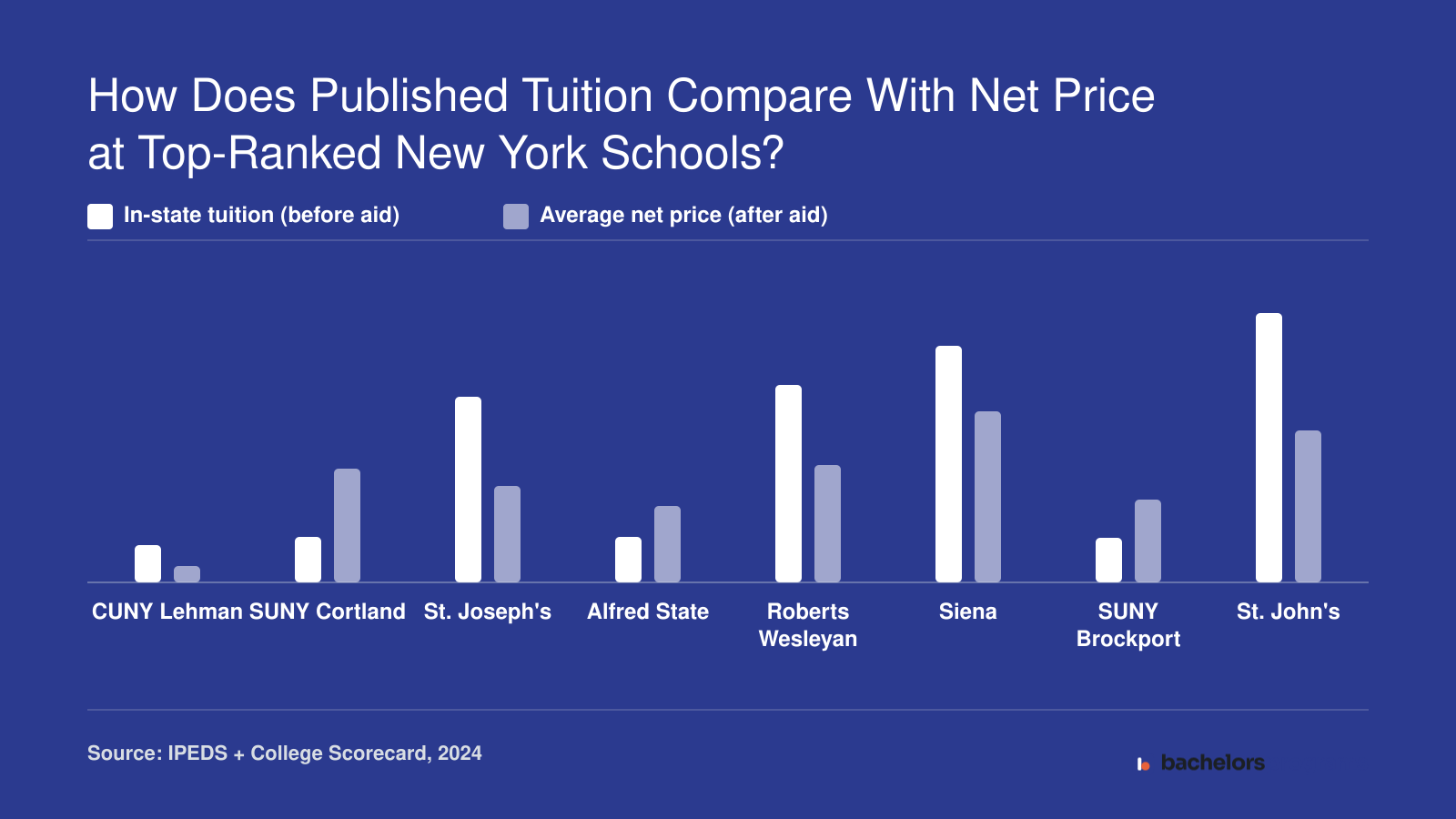
How Does Published Tuition Compare With Net Price at Top-Ranked New York Schools?
Each pair of bars sets a school's published in-state tuition and fees, before any aid, against its average net price after grants and scholarships. Net price is an institution-wide average for all undergraduates, not a figure for the healthcare administration major. It also counts living costs, which is why it can run higher than tuition at SUNY campuses. Private schools such as St. Joseph's and St. John's show the steepest drop from sticker price once aid is applied.
Related Articles
What Medical and Health Services Managers Earn in New York
New York ranks among the strongest-paying states for healthcare management careers that often begin with a bachelor's degree in healthcare administration.
Nursing Home Administrator License in New York: Steps for Bachelor's Graduates
New York requires a license only for nursing home administrators. Most other healthcare administration roles, such as hospital department, clinic and practice management, do not require one. The New York State Department of Health (NYSDOH) Board of Examiners of Nursing Home Administrators issues the credential.
- Meet basic eligibilityBe at least 21, show good moral character, and hold an accredited bachelor's degree or higher.
- Complete required courseworkEarn 15 credit hours across Nursing Home Administration, Health Care Financial Management, Legal Issues in Health Care, Gerontology and Personnel Management, plus a separate 3-credit Nursing Home Administration course. Most courses count for 10 years after completion. Nursing Home Administration courses count for 5 years.
- Finish an AIT or field experienceComplete a full-time Administrator-in-Training internship within the last 10 years, or document qualifying field experience instead. You find your own facility and preceptor. Confirm current hour requirements with NYSDOH.
- Apply to NYSDOHSubmit Form DOH-641 with the $40 fee and Addendum A (AIT) or Addendum B (field experience). NYSDOH approves the application and notifies you of exam eligibility.
- Pass the NAB examNew York approves only the NAB Nursing Home Administrator Licensing Examination. You schedule the 110-item CORE and the 55-item Line of Service exams together and need a scale score of 113 on each.
- Register to practiceFile Form DOH-642. Practicing in New York requires both a Board license and current NYSDOH registration.
Compare Healthcare Administration programs on the data that matters
Explore more Business & Management majors or browse every field of study.
All Business & Management programs Browse every field of study