Best Healthcare Administration Schools in North Carolina
Compare 19 accredited Healthcare Administration programs in North Carolina at 17 colleges, with net price after aid, graduation rates, earnings and debt from IPEDS and the U.S. College Scorecard.

What separates a healthcare administration bachelor's that leads to a hospital management job from one that stalls at the front desk? In North Carolina, the credential is typically a Bachelor of Science (B.S.) in Healthcare Administration, and it feeds department supervisor, practice manager and long-term care roles. Tuition varies sharply between public and private campuses, and nursing home administrators need a state license on top of the degree. The programs ranked here are campus and online options at North Carolina schools. Cost and that licensing step, more than the credential itself, decide who clears the bar.
Key Points
- Fayetteville State University carries the lowest net price among these schools.
- North Carolina Central University offers its health administration B.S. fully online.
- Nursing home administrators, unlike most graduates, need a North Carolina license.
Top 10 Bachelor's in Healthcare Administration Schools in North Carolina
The ten programs below are bachelor's degrees in healthcare administration and closely related fields at North Carolina schools, from a small health sciences college in Concord to large public research universities. Each entry covers the credential offered, how the program is delivered, and the details that matter most when comparing: internships, accreditation, admission thresholds, and cost.
Cabarrus College of Health Sciences
#1Concord, NC · $15,000 – $20,000/yr (est.)
Best for: Career changers seeking a small health sciences campus
Cabarrus College of Health Sciences is a small private health sciences college in Concord, just outside Charlotte, where nearly every program sits inside a clinical or health services setting. Its bachelor's in community health and wellness carries a healthcare administration concentration for students who want to manage programs rather than deliver bedside care. Classes are small, the student-to-faculty ratio is 11 to 1, and the college enrolls both traditional students and working adults.
- Non-clinical healthcare administration track
- 120 total credit hours with a capstone project
- Coursework in healthcare policy, informatics, and epidemiology
- Community health fieldwork or internship included
- Two specialization tracks offered
- Open to recent high school graduates and working adults
Appalachian State University
#2Boone, NC · $8,000 – $25,000/yr (est.)
Best for: Working adults needing asynchronous online classes
Appalachian State University in Boone runs one of the older health care management programs in the country and offers it both on campus and asynchronously online. Business fundamentals come first, followed by health services organization, human resources, and health information systems, plus a required internship in a health care setting. The program is AUPHA-certified and assigns each student a faculty mentor who builds the graduation plan.
- AUPHA-certified curriculum blending business and health care
- Required internship in a health care setting
- Individual faculty mentor and graduation plan
- Coursework in health information systems and HR management
- Prepares for roles in hospitals, long-term care, and insurance
- Asynchronous online classes in eight-week terms
- $424 per credit across 120 total credit hours
- Minimum 2.3 GPA and multiple start dates each year
- Transfer-friendly, with prior learning credit accepted
- Same faculty who teach the on-campus program
University of North Carolina at Charlotte
#3Charlotte, NC · $15,000 – $20,000/yr (est.)
Best for: Charlotte-area students wanting a large research campus
UNC Charlotte is the largest public university in the Charlotte region, and its health systems management major sits on a metropolitan campus with close ties to the area's hospital systems. The major is compact at 33 credit hours, leaving room for a minor or a heavy elective load, and strong students can apply to early-entry MPH or MHA pathways. Admission to the major is straightforward: a 2.0 GPA and 24 transferable credit hours.
- 33 credit hours in the major within a 120-credit degree
- Admission requires a 2.0 GPA and 24 transferable credits
- Earn a C or better in HSMT 2101, 2103, and 2104 within two attempts
- Early-entry MPH and MHA pathways available
- Curriculum aligned to health care executive skills
- Honors Program available for high achievers
East Carolina University
#4Greenville, NC · ~$16,000/yr (est.)
East Carolina University in Greenville delivers its health services management degree in a hybrid, cohort-based format that mixes online coursework with face-to-face classes. The program is AUPHA-certified, and the required internship places students with leading regional providers. ECU's health sciences campus and medical school give undergraduates regular exposure to clinical operations and academic medicine.
- AUPHA-certified, cohort-based structure
- Hybrid format blending online and face-to-face classes
- Internship with leading health care providers
- Coursework in population health, quality, and data management
- Faculty with practical health care management experience
- Prepares students for mid-level management roles
North Carolina A & T State University
#5Greensboro, NC · ~$11,000/yr (est.)
North Carolina A&T State University in Greensboro is the nation's largest historically Black university, and its health services management degree pairs a health leadership core with economics, technology, and data analysis. Students get one-to-one faculty mentoring and internships with industry partners. Graduates move into practice management, patient services, health operations, and medical office roles.
- Minimum 2.75 high school GPA for admission
- Transfer students need economics and statistics prerequisites
- Internships with industry partners
- Coursework in health systems, economics, and data analysis
- One-to-one faculty mentoring
Winston-Salem State University
#6Winston-Salem, NC · $10,000 – $15,000/yr (est.)
Winston-Salem State University is a historically Black university in Winston-Salem with an AUPHA-aligned healthcare management degree built around business skills and health care knowledge. Service learning and a practicum connect students with regional partners including Novant and Atrium Wake Forest. Academic success counselors and a close-knit campus support students who are starting college or changing careers.
- AUPHA-aligned curriculum in business and health care
- Service learning and practicum with Novant and Atrium Wake Forest
- Courses in health law and ethics and population health
- Close-knit HBCU setting with academic success counselors
- Merit- and need-based financial aid and scholarships available
Campbell University
#7Buies Creek, NC · $25,000/yr (est. net price)
Campbell University in Buies Creek offers healthcare management as a business degree, so students complete a full business core before specializing. A required internship, peer mentors, and an active Healthcare Management club give the program a professional feel, and a 4+1 MBA option lets students continue without leaving campus.
- Business-based curriculum applied to health care settings
- Required internship for hands-on experience
- 4+1 MBA pathway available
- Active Healthcare Management club and peer mentors
- Annual Health Solutions networking events
- In-house Career Center for internships and jobs
High Point University
#8High Point, NC · ~$39,000/yr (est.)
High Point University is a private university in High Point known for small classes and a business-focused undergraduate experience. Its healthcare management degree sits in the business school, pairs a 128-credit business core with health care coursework, and adds site visits to Cone Health. Students can also use a Go Global Grant for a tuition-free four-week Maymester in London.
- 128 credit hours combining business core and health care courses
- Site visits to Cone Health built into the program
- Tuition-free four-week Maymester in London via the Go Global Grant
- Courses in health care delivery, strategy, and HR management
- Faculty who began their careers in health care management
- Healthcare Management Club and executive Innovators-in-Residence
Fayetteville State University
#9Fayetteville, NC · $4,400 – $8,000/yr (est.)
Fayetteville State University is a public historically Black university in Fayetteville with a healthcare administration degree housed in its business college. The curriculum blends business administration, economics, and health care fundamentals with an emphasis on leadership and ethical decision making. Published tuition is among the lowest of any four-year option in the state, and the program includes a study abroad opportunity in London.
- Blends business administration, economics, and health care fundamentals
- Emphasis on leadership, ethics, and systems thinking
- Study abroad opportunity in London
- Prepares students for clinical director and practice administrator roles
Gardner-Webb University
#10Boiling Springs, NC · ~$18,000/yr (est.)
Gardner-Webb University in Boiling Springs is a private Christian university that offers its healthcare management degree online as well as on campus. The program layers 21 credit hours of health care management on top of a 36-credit business core and requires an internship or practicum. Multiple start dates and an ethics-centered curriculum make it a practical option for working adults.
- 36 credit hours of business core plus 21 in healthcare management
- Internship or practicum required
- Christian business ethics integrated into coursework
- Also offered on campus and online with multiple start dates
Cost & outcomes by school
Federal data for the highest-earning Healthcare Administration programs, independent of the ranking above. Earnings are this field's bachelor's graduates four years after completing where the Scorecard reports them, else the school's undergraduate median.
| School | Net price / yr | Grad rate | Earnings | Debt | Grads/yr | Format |
|---|---|---|---|---|---|---|
| East Carolina University NC | $15,739 | 63% | $67,732 | $22,825 | 65 | Hybrid |
| Appalachian State University NC | $16,836 | 75% | $66,227 | $21,500 | 45 | Campus |
| High Point University NC | $38,707 | 74% | $61,389 | $24,575 | — | Campus |
| Methodist University NC | $24,704 | 44% | $58,849 | $27,000 | 6 | Online |
| Cabarrus College of Health Sciences NC | $17,618 | 71% | $58,708 | $16,000 | 8 | Campus |
| Campbell University NC | $24,516 | 61% | $54,960 | $21,535 | 14 | Campus |
| University of North Carolina at Charlotte NC | $15,435 | 69% | $52,400 | $21,250 | 257 | Campus |
| Belmont Abbey College NC | $24,639 | 47% | $47,937 | $26,000 | 12 | Campus |
| Barton College NC | $23,626 | 46% | $47,913 | $25,877 | 6 | Campus |
| Gardner-Webb University NC | $17,674 | 55% | $47,089 | $24,289 | 10 | Online |
| North Carolina Wesleyan University NC | $17,432 | 42% | $45,873 | $25,000 | 26 | Campus |
| Winston-Salem State University NC | $13,479 | 47% | $45,182 | $28,515 | 74 | Campus |
Sources: U.S. Department of Education. Net price, graduation rate, earnings and debt: College Scorecard (earnings and debt for this field's bachelor's graduates where reported, else school-wide); graduates: IPEDS. A dash means no figure is reported.
Cost, debt & payoff
Median earnings of this field's bachelor's graduates (4 yrs after completing, else the school's undergraduate median) vs. their median federal loan debt · U.S. College Scorecard
Across these programs the median graduate earns about $47,937 and finishes with roughly $25,877 in debt — a ratio that clears a common rule of thumb (keep debt below first-year salary). Net price and debt vary widely school to school, so check the per-school figures in the table above before you shortlist.
Most Affordable Healthcare Administration Bachelor's Programs in NC
The schools below are ordered by average net price, the amount students typically pay after grants and scholarships, using 2024 federal data from IPEDS and the College Scorecard. Fayetteville State University has the lowest net price in this group at $7,892 per year, and its in-state tuition and fees come in under $4,500. North Carolina Central University, from our directory, is the online option here, offered through NCCU Online for working adults.
| School | City | Format | In-State Tuition and Fees | Out-of-State Tuition and Fees | Average Net Price | Graduation Rate |
|---|---|---|---|---|---|---|
| Fayetteville State University | Fayetteville | Campus | $4,353 | $8,353 | $7,892 | 38% |
| North Carolina A & T State University | Greensboro | Campus | $6,813 | $20,673 | $10,846 | 57% |
| Winston-Salem State University | Winston-Salem | Campus | $6,126 | $16,782 | $13,479 | 47% |
| North Carolina Central University | Durham | Online | $6,699 | $19,735 | $15,359 | 42% |
| University of North Carolina at Charlotte | Charlotte | Campus | $7,239 | $22,492 | $15,435 | 69% |
Online and Hybrid Healthcare Administration Bachelor's Options at North Carolina Schools
Several North Carolina schools offer formats beyond a traditional campus schedule. Program pages differ in how much detail they give, so each entry flags what is missing.
Fully Online
- North Carolina Central University: The B.S. in Health Administration is fully online, built for working adults, with multiple start dates and a capstone tailored to your work experience. The page does not specify live versus self-paced instruction or term length, and no campus requirements are identified.
- Appalachian State University: The B.S. in Health Care Management is fully online with no set class times, so it is effectively asynchronous.1 No campus visits are identified. An internship or applied-learning experience is required, and you can meet it through a traditional internship, applied learning at your current healthcare workplace, or a faculty-mentored capstone.1
- Gardner-Webb University: Healthcare Management is offered online with multiple start dates and an internship or practicum requirement. Delivery style and term length are not specified.
- Barton College: The B.S. in Healthcare Administration is online through Professional Studies. Delivery style, term length and internship requirements are not specified.
Hybrid and Mixed Formats
- East Carolina University: Health Services Management is a cohort-based hybrid that blends online and face-to-face classes and includes an internship. How often you would be on campus is not stated.
- North Carolina Wesleyan University: The B.S. for Adult Learners is described as 100% online and hybrid. The school promotes accelerated 8-week formats for adult degrees, but that is not confirmed for this program, and campus attendance and internship details are not published.
- Methodist University: Offered on campus and online. A senior-year internship under a preceptor at a healthcare organization is required, during the academic year or summer.2 Whether online students must come to campus is not specified.
Campus Programs
Cabarrus College of Health Sciences, UNC Charlotte, N.C. A&T, Winston-Salem State, Campbell, High Point and Fayetteville State list campus-based programs. Part-time schedules are not clearly published on the pages reviewed, so ask admissions directly if you work full time.
Questions to Ask Yourself
Can you commit to set class times, or do you need coursework you can finish around a job or shift schedule?
Does the program require an in-person internship near you, and can you get to it?
Are you transferring community college credits, and will the school count them toward the major?
What a Bachelor's Degree in Healthcare Administration Costs in North Carolina
The gap between a school's sticker price and what students actually pay has widened across North Carolina, and healthcare administration programs sit squarely inside that gap.
Published tuition and fees
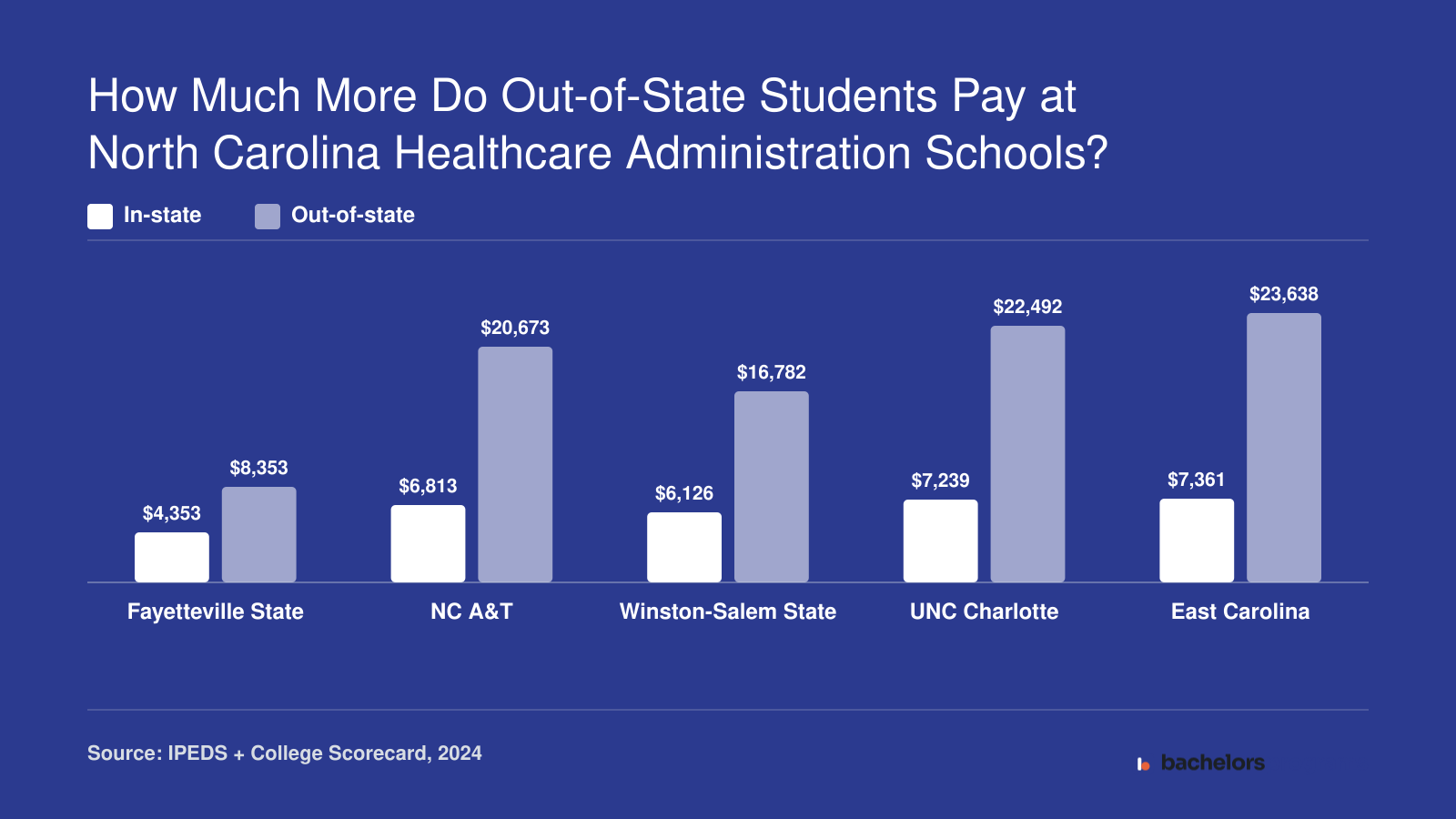
Sticker prices are the figures a school posts before any grant or scholarship is applied, and in the most recent federal reporting (2024 data) they vary sharply by sector. Among the public schools here, Fayetteville State University published roughly $4,353 in-state and $8,353 out-of-state for tuition and fees. Winston-Salem State University listed about $6,126 in-state against $16,782 out-of-state, North Carolina A&T State University about $6,813 against $20,673, UNC Charlotte $7,239 against $22,492, East Carolina University $7,361 against $23,638, and Appalachian State University $7,579 against $25,212. Private institutions list a single rate for every student: roughly $16,550 at Cabarrus College of Health Sciences and about $34,750 at Gardner-Webb University.
Net price after aid
Average net price estimates what a typical aided undergraduate pays once grants are subtracted. These are schoolwide averages, not program-specific figures, and your own number depends on family income. In the same 2024 federal data, averages ran from about $7,892 at Fayetteville State and $10,846 at North Carolina A&T up to roughly $15,435 at UNC Charlotte, $15,739 at East Carolina, $16,836 at Appalachian State, $17,618 at Cabarrus College, and $17,674 at Gardner-Webb.
North Carolina aid programs
According to the College Foundation of North Carolina (2026 figures), state aid falls into a few tracks:
- UNC Need-Based Grant: Up to $4,200 for residents enrolled in at least 6 credit hours at one of the UNC System's 16 institutions.1
- NC Need-Based Scholarship for Private College Students: Up to $7,640 for NC residents at qualifying private campuses, with a Student Aid Index of 15,000 or less and no prior bachelor's degree.2
- Next NC Scholarship: Guarantees at least $5,000 in combined federal and state aid for UNC students with household AGI of $80,000 or less and an SAI of 7,500 or less.3
- Golden LEAF Scholarship: $3,500 a year for up to three years for full-time transfers from rural counties with a 2.5 GPA.4
The NC Promise reduced-tuition program applies at select UNC campuses; confirm current rates with the campus directly.
Once average aid is counted, the published spread of more than $30,000 narrows to roughly $10,000.
How Much More Do Out-of-State Students Pay at North Carolina Healthcare Administration Schools?
Residency is one of the biggest cost factors at North Carolina's public universities. These are published annual undergraduate tuition and fees before any grants or scholarships, so most students will pay less after aid. Fayetteville State University has the smallest gap at $4,000, while East Carolina University has the largest at $16,277. Each school shown charges different in-state and out-of-state rates.
Accreditation: What to Look for in a Healthcare Administration Bachelor's Program
High Point University has held SACSCOC accreditation continuously since 1951, and that institutional seal covers its B.S.B.A. in Healthcare Management. That is the baseline every healthcare administration bachelor's program in North Carolina should clear first.
Start With Institutional Accreditation
SACSCOC (the Southern Association of Colleges and Schools Commission on Colleges) accredits the university, not the major. Without it, credits rarely transfer cleanly and federal financial aid does not follow you. High Point's long, unbroken record is the kind of status worth confirming on the accreditor's own site rather than on a brochure.
Then Check the Program Level
AUPHA, the Association of University Programs in Health Administration, is the undergraduate signal. AUPHA-certified bachelor's programs carry Full Certified Undergraduate Member status, while associate members have up to eight years to earn certification. Ask where a given program sits in AUPHA's directory instead of assuming the word "member" means certified.
The CAHME Question
CAHME accredits graduate healthcare management programs, so a bachelor's degree does not need it. When a school advertises CAHME, it is describing its master's, not the undergraduate major.
A Short Verification Checklist
- Confirm current SACSCOC accreditation directly with the accreditor.
- Look up the program in AUPHA's directory and note Full versus Associate status.
- Ask whether an internship or residency is required, how long it runs, and where students are placed.
Related Articles
Do You Need a License? North Carolina Nursing Home Administrator Requirements
Most jobs a bachelor's degree in healthcare administration leads to, such as roles in hospital departments, physician practices and clinics, require no state license. Nursing home administrators are the exception. They are licensed by the North Carolina Board of Examiners for Nursing Home Administrators under Chapter 90, Article 20 of state law. The requirements below come from state statute and NC Department of Health and Human Services sources reviewed in 2026. Confirm current details with the Board before you apply.
- EducationComplete at least two years of college-level study, defined as 60 semester hours or 96 quarter hours, or a combination of education and experience the Board approves.
- Administrator-in-Training (AIT)Finish a supervised AIT period of the length the Board prescribes. Ask the Board for the current required hours.
- ExaminationPass the examination administered by the Board.
- Fees and renewalState law caps the exam and processing fee at $500 plus the actual exam cost. It caps the license fee and the renewal fee at $1,000 each. The Board sets the actual amounts. Licenses renew every two years.
- Assisted living administratorsThese administrators are certified separately by the DHHS Adult Care Licensure Section. You must be at least 21 and pass a background check. You also need either a high school diploma plus two years of college coursework or 60 months of supervisory experience. Training is a 120-hour AIT (20 hours of coursework and 100 hours on the job). You must also pass a written exam ($50 fee). Certification renews every two years for $30.
Common Questions About Healthcare Administration Bachelor's Programs in North Carolina
These answers summarize the main points from the sections above. Always confirm current details with each school before you apply.
What is the best healthcare administration school in North Carolina?
Which North Carolina schools offer a bachelor's degree in healthcare administration online?
How much does a healthcare administration bachelor's degree cost in North Carolina?
What are the admission requirements for healthcare administration programs in North Carolina?
Do you need a license to work in healthcare administration in North Carolina?
Compare Healthcare Administration programs on the data that matters
Explore more Business & Management majors or browse every field of study.
All Business & Management programs Browse every field of study