Best Healthcare Administration Schools in Pennsylvania
Compare 45 accredited Healthcare Administration programs in Pennsylvania at 39 colleges, with net price after aid, graduation rates, earnings and debt from IPEDS and the U.S. College Scorecard.

Philadelphia and Pittsburgh anchor the state's hospital networks, and its long-term care base of nursing homes, assisted living campuses and home health agencies is deep, so administrative hiring runs statewide. Those roles usually require a bachelor's degree in healthcare administration, most often a Bachelor of Science (B.S.).
Cost separates the choices more than curriculum does. Published tuition among Pennsylvania schools with the major runs from $10,568 in-state to $68,686, before any aid, and net price after grants can fall far below that. For nursing home administration, the one licensed route in the field, the qualification pathway you choose matters as much as the degree.
Key Points
- The University of Pennsylvania tops the list with a Wharton-based concentration.
- Pennsylvania's medical and health services managers averaged $125,860 in May 2023.
- Nursing home administrators need a Pennsylvania license; most other roles don't.
Best Healthcare Administration Schools in Pennsylvania: Our Top 10 Picks
The strongest overall choice for a bachelor's degree in healthcare administration in Pennsylvania is the University of Pennsylvania, whose Wharton-based health care management and policy concentration draws on one of the country's most respected business faculties. Slippery Rock University offers the widest and most affordable path for most students, while Immaculata University is the most flexible online option for people already working.
University of Pennsylvania
#1Philadelphia, PA · $29,000/yr (est. net price)
Best for: Future consultants focused on health care finance
The University of Pennsylvania houses its health care management and policy concentration inside the Wharton School, so students study the financing and economics of health care alongside a full business curriculum. The concentration adds a capstone and electives in health care strategy, pharmaceutical economics, analytics and entrepreneurship, and graduates move into consulting, banking, health care IT and government. Penn graduates 97% of its students overall, among the highest rates in the state.
- Wharton concentration inside the Bachelor of Science
- HCMG 1010 Health Care Systems plus three full course units of electives
- Electives span health care strategy, data analytics and entrepreneurship
- Senior capstone course required
- Wharton BS totals 37 course units, 33 of them Wharton requirements
- Two semesters of a language other than English required
- Prepares for consulting, banking, health care IT and government roles
Immaculata University
#2Immaculata, PA · ~$24,000/yr (est.)
Best for: Working adults balancing full-time jobs
Immaculata University runs its Bachelor of Science in Health Care Management in a fully online, seven-week accelerated format built for working adults, with up to 72 credits accepted in transfer or through prior learning. Coursework covers health care information systems, financial accounting, human resources, legal and ethical issues and organizational leadership, capped by a capstone that ties theory to practice. The university graduates 71% of its students overall.
- Online, seven-week accelerated classes
- 120 total credit hours
- Transfer up to 72 credits, or earn credit for prior learning
- Two to four years, depending on credits transferred
- $465 per credit
- Capstone required
- Covers health care information systems, financial accounting and human resources
- Legal, regulatory and ethical issues coursework
Slippery Rock University of Pennsylvania
#3Slippery Rock, PA · ~$20,000/yr (est.)
Best for: Students weighing multiple health care concentrations
Slippery Rock University offers the widest menu in the state, with 15 concentration options inside its health care administration and management major, from financial management and information systems to long-term care, marketing and medical device sales, plus pre-professional tracks in physician assistant, physical therapy and occupational therapy. Internships reach Cleveland Clinic and UPMC, and a Future Healthcare Leaders club keeps students connected to employers. The university graduates 66% of its students overall.
- 15 concentration options
- Eight concentrations designed for non-clinical students
- Tracks include Financial Management and Leadership
- Pre-professional tracks in physician assistant, physical therapy and occupational therapy
- Internships at Cleveland Clinic and UPMC
- Curriculum covers financing, health law, quality improvement and leadership
- Student club: Future Healthcare Leaders
- Two career paths: administrative management or clinical preparation
University of Scranton
#4Scranton, PA · $33,000/yr (est. net price)
The University of Scranton pairs health administration with a built-in business administration minor and caps classes at 25 to 30 students, with a required 120-hour internship at sites such as Geisinger Health System and Memorial Sloan Kettering. The department holds full AUPHA undergraduate membership and its long-term care track is built around Pennsylvania nursing home administrator requirements. Scranton graduates 80% of its students overall.
- Full AUPHA undergraduate membership
- Class sizes capped at 25 to 30
- 120-hour internship plus 80 hours of community-based learning
- Includes a business administration minor
- Four-year program with two concentration options
- Active ACHE student association
- Meets Pennsylvania nursing home administrator licensure requirements
- 134 total credit hours
- 1,000 clinical hours
- 2.5 GPA minimum
- State licensure examination for long-term care administrators
- Careers in nursing homes and assisted living
Pennsylvania Western University
#5California, PA · $11,000 – $16,000/yr (est.)
Pennsylvania Western University delivers its B.S. in Allied Health Leadership entirely online as a degree completion program for credentialed allied health professionals, requiring 120 credits from students who already hold an associate degree, certificate or diploma in an allied health field. Coursework covers medical terminology, biomedical ethics, research methods, financial accounting, management principles and health care marketing, with no concentration required. The university graduates 52% of its students overall, and a partnership with Lake Erie College of Osteopathic Medicine gives qualified students an early-admission pathway into selected professional programs.
- 100% online degree completion program
- 120 total credit hours
- Requires an associate degree, certificate or diploma in an allied health field
- Coursework includes medical terminology and biomedical ethics
- Covers financial accounting, management principles and health care marketing
- No concentrations offered
- Prepares for health care manager and clinical team leader roles
Thomas Jefferson University
#6Philadelphia, PA · ~$29,000/yr (est.)
Thomas Jefferson University offers its Bachelor of Science in Health Services Management fully online and asynchronous, with accelerated eight-week courses and up to 90 transfer credits accepted, including community college articulation discounts. The curriculum covers health systems and policy, health care law and ethics, finance, public health and epidemiology, and quality improvement, taught by faculty who are scholar-practitioners. Jefferson graduates 69% of its students overall.
- Asynchronous online classes
- Accelerated eight-week courses
- 120 total credit hours
- Transfer up to 90 credits
- Community college articulation discounts
- Covers health policy, law and ethics, finance, epidemiology and quality improvement
- Faculty are scholar-practitioners
- Pathway to a graduate degree in organizational leadership
Drexel University
#7Philadelphia, PA · $39,000/yr (est. net price)
Drexel University blends business coursework with health systems, policy, finance and law in its health services administration bachelor's, adding analytics, AI applications and telemedicine topics. The signature feature is cooperative education: students can complete up to three co-ops and as much as 18 months of professional experience before graduation, with placements including Children's Hospital of Philadelphia. Drexel graduates 78% of its students overall.
- Up to three co-ops, as much as 18 months of professional experience
- Co-op placements include Children's Hospital of Philadelphia
- AUPHA Associate Bachelor's Program Member
- Offered on campus and online
- Curriculum covers healthcare analytics, AI applications and telemedicine
- Scholarships and financial aid available
York College of Pennsylvania
#8York, PA · $15,000 – $20,000/yr (est.)
York College of Pennsylvania runs a four-year, on-campus healthcare administration major that skips clinical training and focuses on policy, financial management, staffing, quality improvement and organizational leadership. A senior capstone and internships with local health care partners give students applied experience, and rolling admissions simplifies the application. York graduates 64% of its students overall.
- Four-year, on-campus program
- Rolling admissions
- Capstone required
- Internships with local healthcare organizations
- Faculty are active industry practitioners
- Small classes and a low student-to-faculty ratio
- 4+1 accelerated pathways available
- Prepares for nursing home administrator roles
Juniata College
#9Huntingdon, PA · ~$24,000/yr (est.)
Juniata College treats healthcare administration as an interdisciplinary program of emphasis that combines accounting, finance and organizational leadership with health-specific coursework and a strong ethics thread. Students take on faculty-guided research, internships (including at Penn Highlands Huntingdon, blocks from campus) and study abroad in England, Germany or France. Juniata graduates 74% of its students overall.
- IACBE-accredited business programs
- Coursework spans accounting, finance and organizational leadership
- Blocks from Penn Highlands Huntingdon hospital
- Internships at sites including the IRS, FBI and Northwestern Mutual
- Faculty-guided research and conference presentations
- Study abroad in England, Germany and France
- Emphasis on ethics in healthcare decisions
Seton Hill University
#10Greensburg, PA · ~$22,000/yr (est.)
Seton Hill University's online healthcare administration bachelor's uses eight-week accelerated courses and accepts up to 90 transfer credits, plus credit for life, work and military experience. Students work with a faculty advisor from application through graduation, and the curriculum spans leadership, information systems, health law, finance, marketing and regulatory issues. Seton Hill graduates 67% of its students overall.
- Accelerated eight-week online courses
- Transfer up to 90 college credits
- Credit for life, work and military experience
- $0 application fee
- Military benefits and employer tuition reimbursement accepted
- Curriculum covers leadership, information systems, law, finance and marketing
- Faculty advisor assigned from application through graduation
- Pathway to an MBA in Healthcare Administration
Cost & outcomes by school
Federal data for the highest-earning Healthcare Administration programs, independent of the ranking above. Earnings are this field's bachelor's graduates four years after completing where the Scorecard reports them, else the school's undergraduate median.
| School | Net price / yr | Grad rate | Earnings | Debt | Grads/yr | Format |
|---|---|---|---|---|---|---|
| University of Pennsylvania PA | $28,699 | 97% | $111,371 | $15,715 | 26 | Campus |
| Duquesne University PA | $37,730 | 78% | $95,128 | $26,244 | 5 | Campus |
| University of Pittsburgh-Johnstown PA | $18,202 | 56% | $83,516 | $22,662 | 3 | Campus |
| University of Pittsburgh-Greensburg PA | $17,945 | 40% | $83,516 | $22,662 | 4 | Campus |
| University of Scranton PA | $32,568 | 80% | $76,932 | $27,000 | 13 | Campus |
| Pennsylvania State University PA | $32,875 | 86% | $75,396 | $25,000 | 109 | Campus |
| Pennsylvania State University-Penn State Shenango PA | $18,095 | 42% | $75,396 | $25,000 | 6 | Campus |
| Pennsylvania State University-Penn State Mont Alto PA | $19,454 | 34% | $75,396 | $25,000 | 5 | Campus |
| Pennsylvania State University-Penn State Schuylkill PA | $19,659 | 32% | $75,396 | $25,000 | 5 | Campus |
| Pennsylvania State University PA | $19,550 | 34% | $75,396 | $25,000 | 42 | Online |
| Pennsylvania State University-Penn State Beaver PA | $17,418 | 22% | $75,396 | $25,000 | 3 | Campus |
| Misericordia University PA | $37,485 | 72% | $71,314 | $27,000 | 14 | Hybrid |
Sources: U.S. Department of Education. Net price, graduation rate, earnings and debt: College Scorecard (earnings and debt for this field's bachelor's graduates where reported, else school-wide); graduates: IPEDS. A dash means no figure is reported.
Cost, debt & payoff
Median earnings of this field's bachelor's graduates (4 yrs after completing, else the school's undergraduate median) vs. their median federal loan debt · U.S. College Scorecard
Across these programs the median graduate earns about $61,012 and finishes with roughly $25,455 in debt — a ratio that clears a common rule of thumb (keep debt below first-year salary). Net price and debt vary widely school to school, so check the per-school figures in the table above before you shortlist.
The Five Most Affordable Pennsylvania Schools for a Bachelor's in Healthcare Administration
Tuition is the price a school lists, but average net price is what students actually paid after grants and scholarships, so it is the better guide to your real yearly cost. The figures below come from U.S. Department of Education data (IPEDS and College Scorecard). Median debt is for graduates of each school's healthcare administration bachelor's program. Peirce College has the lowest net price at $12,148 a year. Penn State Shenango lists its Health Policy and Administration major as not currently enrolling new students.
| School | City | Program | Format | Average Net Price After Aid | In-State Tuition and Fees | Median Debt (Program Graduates) |
|---|---|---|---|---|---|---|
| Peirce College | Philadelphia | BS in Healthcare Administration | Hybrid | $12,148 | $15,060 | $32,322 |
| Pennsylvania State University-Penn State Beaver | Monaca | Health Policy and Administration, B.S. | Campus | $17,418 | $14,408 | $25,000 |
| University of Pittsburgh-Greensburg | Greensburg | Healthcare Management | Campus | $17,945 | $14,710 | $22,662 |
| Pennsylvania State University-Penn State Shenango | Sharon | Health Policy and Administration, B.S. | Campus | $18,095 | $14,024 | $25,000 |
| University of Pittsburgh-Johnstown | Johnstown | Healthcare Management and Supervision | Campus | $18,202 | $14,906 | $22,662 |
How We Ranked Pennsylvania Healthcare Administration Programs and Which Accreditations Matter
What does it actually mean when a Pennsylvania college says its healthcare administration program is "accredited"? The answer depends on which kind of recognition the school is claiming, and the two kinds are not interchangeable.
What the rankings weigh
Each program is compared on a small set of practical measures:
- Net price after aid: what a typical student actually pays, not the sticker tuition.
- Completion: whether students who start actually finish a bachelor's degree.
- Earnings and debt: early-career pay for graduates and how much they borrowed to get there.
- Format and size: whether campus, online, or hybrid options exist, and how large the program is.
Only bachelor's programs at Pennsylvania-based schools were ranked, whether you attend on a campus in the state or online. This is an independent ranking. No school pays for a place on it.
Institutional accreditation comes first
Every Pennsylvania school on this list is accredited at the institutional level by the Middle States Commission on Higher Education.1 MSCHE accredits colleges and universities across Pennsylvania and the surrounding region. It reviews whole institutions, not individual majors. Institutional accreditation is the baseline for federal financial aid and is what lets credits transfer.
To check a school, search its name in the MSCHE Institution Directory. The directory distinguishes statuses such as Accredited, Candidate, Formerly Accredited, Accreditation Granted, and Accreditation Reaffirmed.1 The school's Statement of Accreditation Status gives the more specific record, including its accreditation phase and current status.1
What applies to a bachelor's program
At the undergraduate level, the relevant program-level marker is AUPHA Certified Undergraduate Program status, which evaluates a curriculum against AUPHA's standards. AUPHA is a professional membership and quality-assurance body, not a federally recognized accreditor, so treat certification as a bonus rather than a substitute for institutional accreditation. CAHME accredits graduate healthcare management programs, so it should not be used as a filter when you are choosing a bachelor's degree.
A two-minute check
Search the MSCHE Institution Directory first, then confirm the specific program through AUPHA's certified undergraduate program directory. Finish by emailing admissions a single question: which accreditation does the institution hold today, and is this bachelor's program AUPHA certified? A written answer is easy to keep and easy to verify.
What a Bachelor's Degree in Healthcare Administration Covers
A business-centered healthcare administration degree and a policy-centered one cover much of the same core work, but they lean in different directions. Juniata College builds its program into a business major with accounting, finance and leadership courses. The University of Pennsylvania's Health Care Management and Policy B.S. puts health care financing and economics at the center.
Core Coursework
Most Bachelor of Science programs cover a common core:
- Healthcare finance: budgeting, reimbursement and financial management for hospitals and practices.
- Health law and ethics: legal, regulatory and ethical issues, which Immaculata University names directly in its curriculum.
- Health informatics: data systems and analytics. Drexel University adds healthcare analytics, AI applications and telemedicine.
- Operations and leadership: staffing, quality and day-to-day management of care settings.
- Health policy: how regulation and payment shape care, a core topic at Thomas Jefferson University.
Program Names to Recognize
Titles vary, so search beyond "healthcare administration." Drexel calls its degree Health Services Administration. Thomas Jefferson uses Health Services Management. Penn State Beaver and Penn State Mont Alto offer Health Policy and Administration. Immaculata and the University of Pittsburgh-Greensburg use Health Care Management or Healthcare Management, and the University of Scranton's version is simply Health Administration.
Hands-On Experience and Concentrations
Field experience is common. Drexel students can complete up to three co-ops, totaling as much as 18 months of practical work. Scranton requires 120 clinical hours plus 80 hours of community-based learning. York College of Pennsylvania places students in internships with local healthcare organizations. If you want to specialize, Slippery Rock University of Pennsylvania lists 15 concentration options, and Scranton offers two.
How Long It Takes
Plan on four years of full-time study for a typical 120-credit degree. Transfer credit shortens that timeline. Thomas Jefferson and Seton Hill University each accept up to 90 credits. Immaculata accepts up to 72 and estimates two to four years, depending on what you bring. Accelerated online terms, seven weeks at Immaculata, eight weeks at Thomas Jefferson and Seton Hill, can shorten the timeline.
Related Articles
Questions to Ask Yourself
Will you need an online or evening format, or can you attend a Pennsylvania campus full-time?
Do you have community college credits that a program's transfer policy would accept?
Do you want an internship placed near the Philadelphia or Pittsburgh health systems, or one close to where you live?
Is your goal a hospital or practice role, or long-term care leadership that points toward licensure?
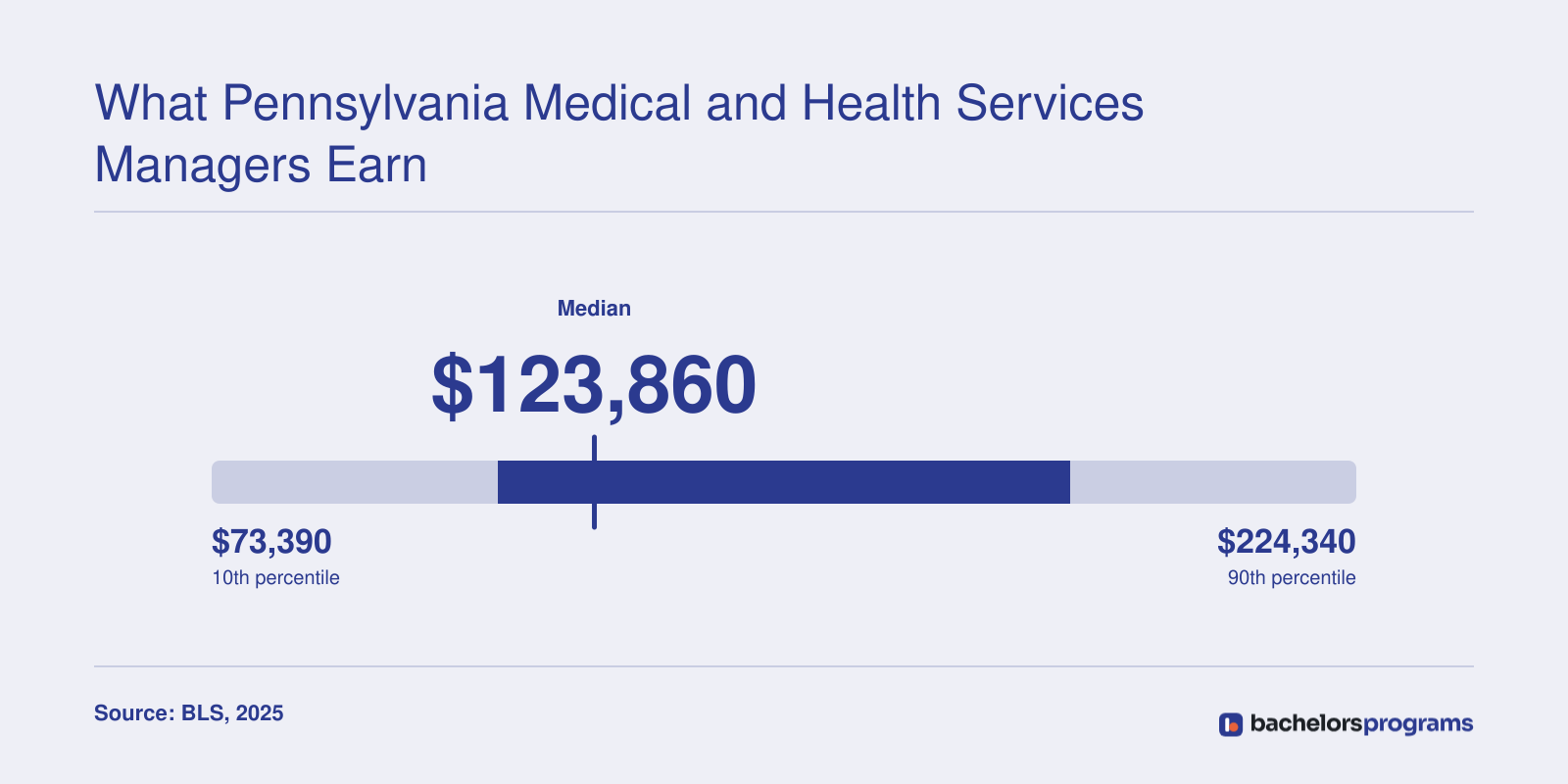
What Pennsylvania Medical and Health Services Managers Earn
Pennsylvania employed 20,800 medical and health services managers in May 2023, at a mean annual wage of $125,860 ($60.51 an hour), while the Philadelphia area averaged $149,810, according to the Bureau of Labor Statistics. The bar below shows the national pay spread as of May 2025. For current Pennsylvania figures, search the BLS Occupational Employment and Wage Statistics data for Medical and Health Services Managers (SOC 11-9111), then check whether the Philadelphia and Pittsburgh medians fall above or below the statewide median. Because these estimates are updated every year, compare them with salary surveys from ACHE, MGMA or HFMA, with local job postings, and with outcomes reported by your school's career services office.
Pennsylvania Nursing Home Administrator Licensure at a Glance
Compare Healthcare Administration programs on the data that matters
Explore more Business & Management majors or browse every field of study.
All Business & Management programs Browse every field of study