Best Healthcare Administration Schools in South Carolina
Compare 15 accredited Healthcare Administration programs in South Carolina at 12 colleges, with net price after aid, graduation rates, earnings and debt from IPEDS and the U.S. College Scorecard.

A bachelor's degree in healthcare administration in South Carolina costs anywhere from $11,386 a year after aid at Francis Marion University to $27,693 at South University-Columbia. The credential is most often a Bachelor of Science (B.S.) in Healthcare Administration.
Clemson University is the strongest overall pick, Francis Marion is the cheapest, Charleston Southern University offers a fully online route, and most entry-level roles need no license.
Titles vary more than prices suggest. Winthrop files the major under business, Clemson under health science, so the curriculum matters more than the label.
Key Points
- Clemson University ranks first among South Carolina healthcare administration schools.
- Francis Marion, Coastal Carolina and Winthrop cost under $15,500 yearly after aid.
- Most roles need only the degree; nursing home administrators need licensure.
Best Schools for a Bachelor's Degree in Healthcare Administration in South Carolina, Ranked
Clemson University is the best healthcare administration school in South Carolina for most students, combining a health services administration concentration with the resources of the state's leading public research university. The rest of the list spreads from Conway to Rock Hill, and several schools deliver the degree fully online for adults already working in healthcare. Each card below gives the format, city, average net price after aid and the institution's overall graduation rate; those last two figures are institution-wide averages, not numbers for the healthcare administration program alone.
Clemson University
#1Clemson, SC · $20,000 – $25,000/yr (est.)
Best for: Full-time students wanting campus faculty mentorship
Clemson is South Carolina's flagship public research university, and its route into the field runs through the B.S. in Health Science with a health services administration concentration. Students pair a public health core with a required business administration minor, so the degree sits between clinical public health and management rather than inside a business school. Campus-based coursework, faculty mentorship and collaborative projects suit students who want a full-time residential experience and a strong launch point for graduate study.
- Health services administration concentration inside a B.S. in Health Science
- Business administration minor required
- 120 to 121 credit hours total
- Built on five pillars of public health
- Administration courses layered onto a health science core
Coastal Carolina University
#2Conway, SC · $10,000 – $15,000/yr (est.)
Best for: Working clinicians holding a healthcare credential
Coastal Carolina University in Conway runs its health administration degree as a completion program, built for people who already hold a healthcare credential plus an associate or bachelor's degree. Courses are delivered at a distance through Moodle, and the school accepts up to 90 transfer credits, with up to 45 more awarded for technical discipline coursework. Coastal also takes part in the statewide South Carolina Public Health Preparedness Student Corps and appears among the institutions named in MUSC accelerated-pathway agreements.
- Completion program for students who already hold a healthcare credential
- 120 total credit hours
- Up to 90 transfer credits accepted
- Up to 45 credits awarded for technical discipline
- Distance learning delivered through the Moodle platform
- Capstone seminar required
- 2.0 GPA minimum for admission
- Prepares graduates for MBA or MHA study
Francis Marion University
#3Florence, SC · $11,000 – $22,000/yr (est.)
Best for: Allied health associate grads seeking advancement
Francis Marion University in Florence offers the most flexible structure here: a General Track open to any undergraduate and a Clinical Track for students arriving with an allied health associate's degree. A popular double major with Healthcare Informatics lets graduates connect clinical work to data-driven decisions, and the department also offers a minor and a collateral sequence for students in other fields. The university's Pee Dee partnerships with McLeod Health and Carolinas Hospital System support regional clinical and internship placements, and FMU participates in the South Carolina Public Health Preparedness Student Corps.
- Tracks: General Track and Clinical Track
- General Track is open to all undergraduates
- Clinical Track requires an allied health associate's degree
- Double major option in Healthcare Informatics
- Minor open to all majors; collateral for non-health majors
- Coursework spans management, leadership, research and practice
Newberry College
#4Newberry, SC · ~$22,000/yr (est.)
Newberry College delivers its healthcare administration degree entirely online, with a curriculum that leans on business fundamentals: finance, accounting, economics, marketing, human resources and health law, capped by a capstone. The private liberal arts college charges a flat per-credit rate and waives the application fee, which keeps the process light for adults returning to school. Students who already hold healthcare degrees, diplomas or certificates may be able to convert that training into life credit.
- $405 per credit hour
- 120 total credit hours
- 2.0 GPA minimum and no application fee
- Capstone course required
- Life credit possible for healthcare degrees, diplomas or certificates
- South Carolina Tuition Grant eligible
- Courses in healthcare finance, accounting, economics and health law
Charleston Southern University
#5Charleston, SC · ~$22,000/yr (est.)
Charleston Southern University in Charleston built its healthcare administration major for working adults moving out of clinical practice and into management. The accelerated seven-week terms are asynchronous, many students finish in under 24 months, and course materials are included in tuition. A faith-based perspective runs through the curriculum, which covers accounting, statistics, business law, ethics, healthcare policy and management.
- Fully online, asynchronous major
- 7-week accelerated courses
- Many students complete the degree in under 24 months
- Course materials included in tuition
- Faith-based perspective across the curriculum
- Coursework in accounting, statistics, business law, ethics and policy
Columbia College
#6Columbia, SC · ~$18,000/yr (est.)
Columbia College structures its healthcare administration degree around leadership, quality improvement, budgeting and community health, with concentrations in Community Healthcare and Organizational Management. Six start dates a year, seven-week courses and no fixed login times make it workable for people already on a shift schedule. The college is transfer-friendly and awards credit for EMT and paramedic training, and advisors help students shape the degree around prior coursework.
- Concentrations in Community Healthcare and Organizational Management
- Six start dates per year
- 7-week courses with no fixed login times
- Transfer up to 90 credits
- Credit awarded for EMT and paramedic training
- Free e-books for enrolled students
- Classes in leadership and quality and performance improvement
South University-Columbia
#7Columbia, SC · $25,000 – $30,000/yr (est.)
South University's Columbia campus offers a fully online healthcare management bachelor's that applies business concepts to the health services industry, covering leadership, financial management, delivery systems, law and ethics, marketing and strategic planning. The program holds accreditation from the Accreditation Council for Business Schools and Programs, and its admission bar is unusually open for a four-year degree. The degree runs 180 credits, well above most programs on this list, which is worth weighing against the sticker price.
- 180 total credit hours, including 96 in the major
- Fully online option available
- Accredited by the Accreditation Council for Business Schools and Programs
- 1.5 GPA minimum; SAT or ACT accepted below that threshold
- 40-credit elective pool drawn from ten courses
- Coursework in healthcare law, ethics, finance, marketing and strategy
College of Charleston
#8Charleston, SC · $13,000 – $38,000/yr (est.)
The College of Charleston pairs health services administration with a business-oriented core in leadership, financial and operational management, health policy and data analysis, and its location puts students within reach of more than 300 healthcare organizations and the Medical University of South Carolina. A 3+2 partnership lets qualified students earn the bachelor's and MUSC's Master of Health Administration in five years. Internships and faculty-mentored research are built in, and no separate application is needed to declare the major once you are admitted to the college.
- Accelerated 3+2 pathway to MUSC's Master of Health Administration
- Access to more than 300 healthcare organizations in Charleston
- Internships and faculty-mentored research
- Repeatable credit for workplace training
- No separate application needed to declare the major
Winthrop University
#9Rock Hill, SC · $15,000/yr (est. net price)
Winthrop University in Rock Hill houses healthcare management inside its College of Business and Technology, so students earn a business administration degree with a healthcare management option rather than a standalone health degree. Twenty-one semester hours of healthcare management coursework sit on top of the business core, and a minor is available for students majoring elsewhere. Internships and student organizations give the program a practical, employer-facing bent.
- 124 total credit hours
- 21 semester hours of healthcare management coursework
- Minor in healthcare management available
- Internships and student organizations
- Offered by the College of Business and Technology
Anderson University
#10Anderson, SC · ~$24,000/yr (est.)
Anderson University offers two routes into the field: a campus Bachelor of Business Administration with a healthcare management concentration, and an online B.S. in Health Care Management built for students with no prior degree. Both blend business coursework with health economics, policy, epidemiology and the legal and ethical questions that shape U.S. care. The online version runs in seven-week terms with six start dates a year and can be finished at an accelerated pace.
- Business core in accounting, economics, finance, management and marketing
- Health services management electives
- Coursework in health economics and policy, epidemiology and strategic management
- Legal and ethical issues in U.S. health care covered
- 42 semester hours of general education
- 121 total credit hours
- 7-week flexible format with six start dates per year
- No previous degree required
- Complete the degree at your own pace
- Finish early and add a free course at no cost
Cost & outcomes by school
Federal data for the highest-earning Healthcare Administration programs, independent of the ranking above. Earnings are this field's bachelor's graduates four years after completing where the Scorecard reports them, else the school's undergraduate median.
| School | Net price / yr | Grad rate | Earnings | Debt | Grads/yr | Format |
|---|---|---|---|---|---|---|
| Clemson University SC | $22,253 | 87% | $71,513 | $21,500 | — | Campus |
| Coastal Carolina University SC | $13,966 | 49% | $59,575 | $21,937 | 6 | Campus |
| Charleston Southern University SC | $21,666 | 47% | $57,253 | $26,471 | 8 | Online |
| College of Charleston SC | $18,960 | 66% | $56,416 | $23,250 | — | Campus |
| Francis Marion University SC | $11,386 | 43% | $51,005 | $30,231 | 43 | Campus |
| Newberry College SC | $21,656 | 45% | $48,040 | $26,805 | 3 | Online |
| Winthrop University SC | $15,343 | 57% | $47,185 | $26,975 | — | Campus |
| South University-Columbia SC | $27,693 | 23% | $46,885 | $39,675 | 8 | Online |
| Anderson University SC | $23,544 | 66% | $42,101 | $26,700 | — | Campus |
| Columbia College SC | $18,408 | 37% | $41,338 | $22,750 | 6 | Campus |
| Coker University SC | $20,286 | 40% | $40,117 | $26,000 | — | Campus |
| Columbia International University SC | $26,036 | 47% | $38,951 | $20,000 | — | Campus |
Sources: U.S. Department of Education. Net price, graduation rate, earnings and debt: College Scorecard (earnings and debt for this field's bachelor's graduates where reported, else school-wide); graduates: IPEDS. A dash means no figure is reported.
Cost, debt & payoff
Median earnings of this field's bachelor's graduates (4 yrs after completing, else the school's undergraduate median) vs. their median federal loan debt · U.S. College Scorecard
Across these programs the median graduate earns about $48,040 and finishes with roughly $26,700 in debt — a ratio that clears a common rule of thumb (keep debt below first-year salary). Net price and debt vary widely school to school, so check the per-school figures in the table above before you shortlist.
The 5 Most Affordable Bachelor's Programs in Healthcare Administration in South Carolina
Public universities post the lowest net prices for a healthcare administration bachelor's in South Carolina. Francis Marion University, Coastal Carolina University and Winthrop University all come in under $15,500 a year after aid. Columbia College, a private school, charges $22,214 in tuition and fees, but grants bring its net price down to $18,408, slightly below the College of Charleston's $18,960. Figures are from the U.S. Department of Education's IPEDS and College Scorecard data (2024). Median program debt appears where the Scorecard reports it.
| Rank | School | City | Sector | Program | In-State Tuition and Fees | Net Price After Aid | Median Program Debt |
|---|---|---|---|---|---|---|---|
| 1 | Francis Marion University | Florence | Public | Healthcare Administration | $11,160 | $11,386 | $30,231 |
| 2 | Coastal Carolina University | Conway | Public | Health Administration (Completion Program), B.S. | $11,640 | $13,966 | $21,937 |
| 3 | Winthrop University | Rock Hill | Public | B.S. in Business Administration, Healthcare Management option | $14,678 | $15,343 | N/A |
| 4 | Columbia College | Columbia | Private nonprofit | Healthcare Administration | $22,214 | $18,408 | N/A |
| 5 | College of Charleston | Charleston | Public | Health Services Administration and Management (HSAM) | $12,978 | $18,960 | N/A |
Online and Hybrid Bachelor's Options at South Carolina Schools
A fully online bachelor's degree in healthcare administration leads to the same credential as a campus-based one, but the two demand very different schedules.
Fully Online, Asynchronous Programs
Charleston Southern University offers its Bachelor of Science in Healthcare Administration fully online, with asynchronous classes and 7-week accelerated courses built for working adults.1 Columbia College runs a 100% online Bachelor of Arts in Healthcare Administration the same way: no set login times, 7-week courses, and six start dates a year in January, March, May, June, August and October. Columbia estimates about 10 hours of study a week, a figure the school says varies by student. Neither page states whether part-time enrollment is available. Newberry College lists its Health Care Management program as online at $405 per credit, and South University-Columbia offers its Bachelor of Science in Healthcare Management online, with some general education courses possibly taken at the Columbia campus.2
Hybrid and Completion Formats
Coastal Carolina University's Health Administration completion program delivers coursework through distance learning in Moodle, aimed at students who already hold a healthcare certification or license. Coker University's Healthcare Administration degree includes online courses developed with Rize Education and taught by faculty at participating institutions, but the page does not make clear whether the full degree is online, hybrid or campus-based.3
Where the Details Stop
South University-Columbia does not publish whether its online classes are synchronous or asynchronous, its term length, or whether part-time study is allowed.2 College of Charleston's Health Services Administration and Management page does not state a delivery format at all. Clemson University, Francis Marion University, Winthrop University and Anderson University list their programs as campus-based.
Questions to Ask Yourself
Are you a working adult with credits or an associate degree, or a first-time freshman?
Do you need scheduled live sessions, or can you manage fully asynchronous coursework?
Would you rather stay in South Carolina for clinical networking, or can you study from anywhere?
Admissions for a Bachelor's Degree in Healthcare Administration in South Carolina
Most applicants weighing a bachelor's degree in healthcare administration in South Carolina face one of two routes: freshman entry straight out of high school, where selectivity and GPA matter most, or transfer entry with credits already in hand, where what counts is how much of your prior coursework survives the evaluation.
Freshman entry and selectivity
Admission rates give useful context for how much your transcript has to carry. Clemson University is the most selective of the schools here, admitting roughly 38 percent of applicants, with Anderson University near 55 percent and the College of Charleston around 60 percent. Coastal Carolina University (about 75 percent) and Winthrop University (about 79 percent) sit in the middle. Francis Marion University, Newberry College, Columbia College and Charleston Southern University all admit the large majority of applicants, Charleston Southern above 95 percent.
Fewer programs publish a GPA floor. Coastal Carolina and Newberry both list a 2.0 minimum tied to the degree, and South University-Columbia publishes a 1.5 minimum along with a high school diploma or GED. The remaining programs do not post a program-specific GPA on their degree pages, so the university's general admission standard applies; ask the admissions office in writing rather than assuming a number.
Testing and transfer credit
South University-Columbia names the SAT and ACT among accepted exams. Elsewhere the program pages say nothing about testing, so the policy sits with central admissions and can change year to year; confirm it before you plan a test date.
Transfer pathways are where these programs differ most:
- Coastal Carolina: A completion program accepting up to 90 transfer credits, including up to 45 in a technical discipline, with core curriculum waived for students holding a prior degree. It requires a current healthcare certification or licensure.
- Columbia College: Up to 90 credits transfer in, and EMT or paramedic training can earn credit.
- Francis Marion: The Clinical Track is built for students who already hold an allied health associate degree; the General Track is open to any undergraduate.
- Newberry College: Awards life credit for prior healthcare credentials and charges no application fee.
- South University-Columbia: Designed for students transferring in with 24 or more credit hours.
Request a written credit evaluation before you deposit anywhere.
What a Healthcare Administration Bachelor's Costs in South Carolina
Public universities charge South Carolina residents far less tuition, but private colleges narrow the gap once aid is counted. In-state tuition and fees at the public schools here run from $11,160 at Francis Marion University to $15,554 at Clemson University, while out-of-state students pay $21,544 to $40,866 at those same campuses. Private colleges charge the same rate regardless of residency, from $22,214 at Columbia College to $34,970 at Anderson University.
Net price, the average yearly cost of attendance after grants, ranges from $11,386 (Francis Marion) to $22,253 (Clemson) at publics and from $18,408 (Columbia College) to $23,544 (Anderson) at privates.
Debt and Monthly Payments
Francis Marion healthcare administration graduates carry a median debt of $30,231, about $320 a month over 10 years. At Coastal Carolina University the median is $21,937, roughly $233 a month.
State Scholarships and Grants
These programs require South Carolina residency, U.S. citizenship or permanent residency, no felony and no student loan default.
- SC Tuition Grants: Need-based aid for full-time students (12+ credits) at eligible independent colleges such as Newberry College. File the FAFSA by August 1; amounts vary with family finances and renew for up to eight semesters.
- LIFE Scholarship: Up to $5,000 a year. Four-year freshmen need two of three: a 3.0 GPA, 1100 SAT or 22 ACT, top 30% class rank.
- Palmetto Fellows: Up to $6,700 in year one and $7,500 in years two through four for a 3.5 GPA, 1200 SAT or 25 ACT and top 6% rank. 2026-27 deadlines are May 1 (early) and July 15 (late).
- SC HOPE: Up to $2,800, freshman year only, for 3.0 GPA students who don't qualify for LIFE or Palmetto Fellows.
- SC WINS: Up to $5,000 a year at state technical colleges, a route for students earning an associate degree before a completion program like Coastal Carolina's.
The Four-Year Total
At current rates, four years of in-state tuition totals about $44,640 at Francis Marion and $62,216 at Clemson, versus $124,400 at Newberry and $139,880 at Anderson. Net price, which includes housing and living costs, puts four years at roughly $45,544 at Francis Marion compared with $86,624 at Newberry. For most South Carolina residents, a public school plus LIFE or Palmetto Fellows remains the lowest-cost path.
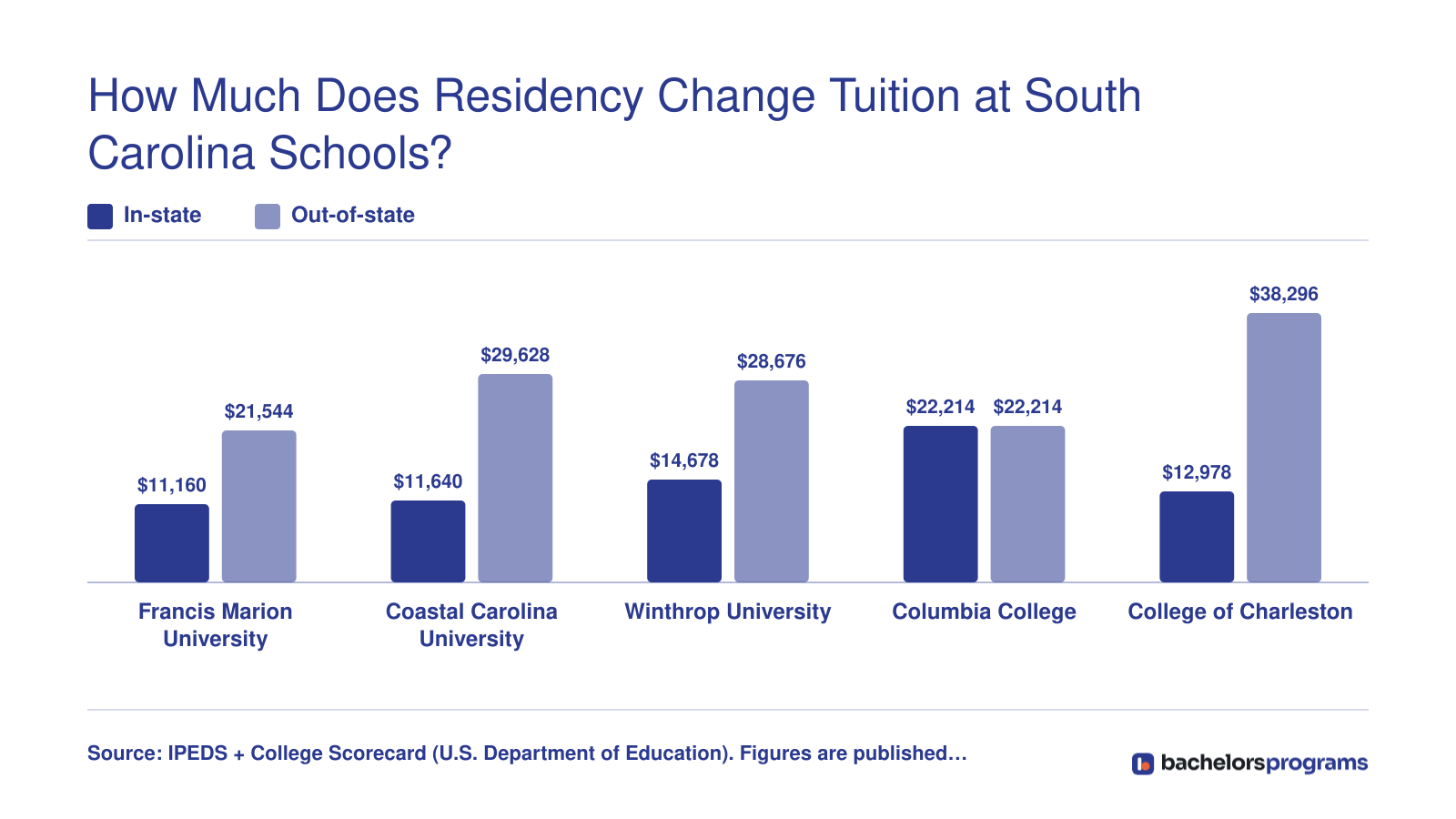
How Much Does Residency Change Tuition at South Carolina Schools?
At South Carolina's public universities, residency is the biggest single factor in your tuition bill. Out-of-state students at College of Charleston pay $38,296 in published tuition and fees, nearly three times the $12,978 in-state rate. Private Columbia College charges the same $22,214 to every undergraduate, so residency does not change its price.
Healthcare Administration Careers in South Carolina: Jobs and Pay
The numbers you want for a South Carolina job search in this field are scattered across federal, state and campus sources. Nationally, the Bureau of Labor Statistics counts 640,400 medical and health services managers in 2025, with a median annual wage of $123,860 as of May 2025, a 10th percentile of $73,390 and a 90th percentile of $224,340. The same source projects 24% growth from 2025 to 2035, about 155,100 added jobs and 62,300 openings a year. Every one of those figures is national, not South Carolina.
Start with the federal data
Open the Occupational Outlook Handbook entry for medical and health services managers (SOC 11-9111) for the overview, entry requirements and projections. Then go to the BLS OEWS wage pages and filter by state or metro area to see what employers in your part of the state pay. The projections matrix is a separate page, and its totals can differ slightly from the handbook because the two cover different slices of employment.
Move to state sources
Use the South Carolina Department of Employment and Workforce labor market information portal (lmi.sc.gov) and its QCEW wage releases for state and regional figures. Detail for this occupation varies by report and update cycle, so check the release date before you rely on a number. For scale, statewide average weekly wages across all occupations were $1,296 in the first quarter of 2026 and average annual wages were $60,959, but neither is a manager wage.1
Ask the schools directly
Pull up the program pages at Coastal Carolina, Francis Marion, College of Charleston, Winthrop and Anderson, then email career services or the program director and ask for placement rates and starting salaries from the last two graduating classes. Schools often hold this data even when they do not post it.
Use associations for benchmarks
Professional groups such as the Medical Group Management Association publish salary surveys and run job boards, and state chapters are where openings circulate first. Combine federal, state, campus and association sources, because no single current South Carolina wage and growth figure for this occupation is published in one place.
Related Articles
Common Questions About Healthcare Administration Bachelor's Programs in South Carolina
What is the best healthcare administration school in South Carolina?
Can I transfer an associate degree in healthcare administration into a South Carolina bachelor's program?
Is a bachelor's degree in healthcare administration worth the cost in South Carolina?
Does it matter whether the program is AUPHA-certified?
Compare Healthcare Administration programs on the data that matters
Explore more Business & Management majors or browse every field of study.
All Business & Management programs Browse every field of study