Best Information Technology Schools in South Carolina
Compare 14 accredited Information Technology programs in South Carolina at 12 colleges, with net price after aid, graduation rates, earnings and debt from IPEDS and the U.S. College Scorecard.
Studying information technology means learning to install, secure and manage the networks and data organizations depend on. In South Carolina, the common credential is the Bachelor of Science (B.S.) in Information Technology. In-state tuition and fees range from $10,730 at University of South Carolina Beaufort to $59,770 at Furman University.
Programs run on campus and online, and the ranking weighs College Scorecard cost and outcome data alongside ABET status, admissions requirements, state aid and career outcomes.
Focus varies too, from cybersecurity to health IT to business systems, and employers weigh internships and certifications alongside the diploma.
Key Points
- Francis Marion University posts the lowest average net price: $11,386 yearly.
- USC's Integrated IT graduates earn a median $87,069 five years out.
- Hybrid formats at Erskine and Newberry blend campus and online coursework.
Best Bachelor's in Information Technology Schools in South Carolina, Ranked
South Carolina's bachelor's degree in information technology options run from the state's flagship public university to small private colleges and a career-focused online provider. The entries below focus on how each program is structured, how it is delivered, and what each school does distinctively, so you can compare them side by side.
University of South Carolina
#1Columbia, SC · ~$23,000/yr (est.)
Best for: Online learners wanting a flagship campus
South Carolina's flagship public university in Columbia, with IT housed in the Molinaroli College of Engineering and Computing. The degree is applied rather than theoretical, and every student completes a required industrial internship along with a team capstone built around a real external business problem. Students can take the major entirely online or attend in person.
- Requires a 400-hour internship in an IT environment
- Choose 100% online delivery or the on-campus major
- Capstone teams solve problems for external business partners
- Business courses required alongside the IT core
- Classes meet in a cyberinfrastructure lab
- Covers agile development, networking and cybersecurity infrastructure
- Common roles: systems analyst, network manager, cyber security analyst
Bob Jones University
#2Greenville, SC · ~$17,000/yr (est.)
Best for: Faith-based learners targeting IT management
A private Christian university in Greenville whose IT major sits in the Department of Computer Science alongside computer science and cybersecurity offerings. The program frames technology work around the needs of businesses and ministries and applies biblical ethics to computing practice. IT majors can add a Certificate in Cybersecurity that builds on the networking and database courses they already take.
- Prepares students for industry certification
- Covers system, network and database administration
- IT majors can add the Certificate in Cybersecurity
- Built around the IT needs of businesses and ministries
- Applies biblical principles of ethics to computing
- Emphasis on problem solving and technical communication
Francis Marion University
#3Florence, SC · $11,000 – $22,000/yr (est.)
Best for: Health care IT hopefuls wanting a clinical focus
A public university in Florence that approaches IT through health care. Its Bachelor of Science with a major in Healthcare Informatics lets students pick an Information Technology specialization, and every major is automatically enrolled as a double major in Healthcare Administration. Graduates target clinical data, informatics and health IT consulting roles.
- Two specializations: Information Management or Information Technology
- IT track has students build and use software and hardware systems
- Automatic double major in Healthcare Administration
- 48 general education hours plus 30 informatics core hours
- 12 hours of track coursework, finished with a professional capstone
- Roles include clinical data analyst and health IT consultant
Coastal Carolina University
#4Conway, SC · $10,000 – $15,000/yr (est.)
A public university in Conway where the B.S. in Information Technology sits in the College of Science and Engineering. Students take the same classes with the same faculty whether they enroll on campus or fully online. The program is hands-on, with access to workstations, networking equipment, high-performance computing systems and a small-scale data center.
- Accredited by the Computing Accreditation Commission of ABET
- Same classes and faculty on campus or fully online
- Access to workstations, networking gear and a small-scale data center
- Systems Integration course serves as a comprehensive capstone project
- At least 24 upper-level credits must be completed at CCU
- Upper-level transfer credit only from ABET-accredited programs
- Graduates work as system administrators and network architects
University of South Carolina-Upstate
#5Spartanburg, SC · ~$14,000/yr (est.)
A public university in Spartanburg that awards a Bachelor of Arts in Information Technology, offered both in person and online. The 120-credit degree leans on informatics, project management, cloud services and cybersecurity coursework, and it trains students to supervise IT operations and personnel rather than only to administer systems. Applicants should aim for a GPA above 2.5.
- 120 total credit hours, offered on campus or fully online
- Coursework in cybersecurity, cloud services and computer networking
- Applicants should aim for a GPA above 2.5
- Covers database design, programming and project management
- Trains students to supervise IT operations and personnel
- Roles: business analyst, project manager, tech support specialist
Erskine College
#6Due West, SC · $17,000/yr (est. net price)
A small private liberal arts college in Due West with a B.S. in Information Technology delivered in a hybrid format. On-campus classes are paired with specialized online IT courses through a partnership with Rize Education, a national consortium of accredited institutions. Technical work sits alongside a liberal arts core that builds critical thinking for project management and technical leadership.
- Online IT courses delivered through the Rize Education consortium
- Prepares students for CompTIA A+ and Network+ exams
- A+ is usually taken at the end of sophomore year
- Coursework in web development, cloud computing and information security
- Core courses include PostgreSQL and Operating Systems and Architecture
Newberry College
#7Newberry, SC · ~$22,000/yr (est.)
A private liberal arts college in Newberry offering a B.S. in Information Technology in a hybrid format. Students combine on-campus classes with online courses delivered through the Rize Education consortium. The curriculum centers on managing systems, networks, software and hardware and on storing data for businesses and organizations, leading to support, network and server roles.
- Hybrid format: on-campus classes plus online courses via Rize Education
- Covers managing computer systems, networks, software and hardware
- Roles: IT support professional, network analyst, server engineer
- Coursework includes storing and managing organizational data
University of South Carolina Beaufort
#8Bluffton, SC · ~$15,000/yr (est.)
A public university in Bluffton whose B.S. in Information Science and Technology covers information processing and technology management. A separate cybersecurity option sits in the same department, and students get access to an on-campus cybersecurity lab and a student chapter of ACM. Coursework reaches into digital forensics, data analysis and software development.
- Cybersecurity option offered within the same department
- Coursework in digital forensics, information security and data analysis
- On-campus cybersecurity lab available to students
- Student chapter of ACM on campus
- Internships available to students
Furman University
#9Greenville, SC · ~$30,000/yr (est.)
A private liberal arts university in Greenville that awards a B.A. or B.S. in Information Technology through its computer science department. Students pair computing courses with a discipline concentration built from another field of study, arranged with advisors and department chairs. The department runs three main laboratories, private research workstations, 3D scanning and printing facilities, and a teaching theater.
- B.A. or B.S. in Information Technology, typically a four-year program
- Pair computing courses with a concentration in another discipline
- Three main computer laboratories plus private research workstations
- 3D scanning and printing facilities and a teaching theater
- Undergraduate research backed by NASA, Apple and Carnegie Mellon grants
Strayer University-South Carolina
#10Greenville, SC · ~$18,000/yr (est.)
A private, career-focused university with a South Carolina campus in Greenville and a fully online option. Its B.S. in Information Technology is built from 40 short courses and eight concentration options spanning artificial intelligence, cybersecurity, cloud computing and IT project management. Strayer also maintains employer partnerships and a benefit that makes every third course tuition-free.
- 40 courses, each 11 weeks long
- Eight concentrations, including AI, cybersecurity and cloud computing
- AI and cloud computing concentrations offered online only
- 58.5 credit hours in major courses, 36 in electives
- Transfer up to 28 classes
- Every third course tuition-free through the Learn and Earn benefit
- Fully online, with in-person hybrid options at select campuses
Cost & outcomes by school
Federal data for the highest-earning Information Technology programs, independent of the ranking above. Earnings are this field's bachelor's graduates four years after completing where the Scorecard reports them, else the school's undergraduate median.
| School | Net price / yr | Grad rate | Earnings | Debt | Grads/yr | Format |
|---|---|---|---|---|---|---|
| University of South Carolina SC | $22,811 | 79% | $84,720 | $23,250 | 285 | Online or campus |
| Bob Jones University SC | $16,641 | 65% | $82,391 | $16,585 | 8 | Campus |
| Strayer University-South Carolina SC | $17,979 | 17% | $82,304 | $37,500 | 26 | Online or campus |
| Furman University SC | $30,308 | 79% | $68,635 | $23,250 | — | Campus |
| University of South Carolina-Upstate SC | $13,557 | 43% | $67,286 | $27,500 | 54 | Online or campus |
| Coastal Carolina University SC | $13,966 | 49% | $63,247 | $27,000 | 24 | Online or campus |
| Erskine College SC | $16,525 | 45% | $53,459 | $27,000 | 1 | Hybrid |
| University of South Carolina Beaufort SC | $14,656 | 34% | $48,088 | $24,000 | 9 | Campus |
| Newberry College SC | $21,656 | 45% | $48,040 | $26,805 | 4 | Hybrid |
| Francis Marion University SC | $11,386 | 43% | $43,888 | $27,000 | 11 | Campus |
| Coker University SC | $20,286 | 40% | $40,117 | $26,000 | — | Online |
| South University-Columbia SC | $27,693 | 23% | $34,421 | $26,123 | — | Online |
Sources: U.S. Department of Education. Net price, graduation rate, earnings and debt: College Scorecard (earnings and debt for this field's bachelor's graduates where reported, else school-wide); graduates: IPEDS. A dash means no figure is reported.
Cost, debt & payoff
Median earnings of this field's bachelor's graduates (4 yrs after completing, else the school's undergraduate median) vs. their median federal loan debt · U.S. College Scorecard
Across these programs the median graduate earns about $50,774 and finishes with roughly $26,123 in debt — a ratio that clears a common rule of thumb (keep debt below first-year salary). Net price and debt vary widely school to school, so check the per-school figures in the table above before you shortlist.
Most Affordable Bachelor's in Information Technology Schools in South Carolina, Ranked
These schools offer the lowest-cost paths to a bachelor's degree in information technology among the schools ranked here, sorted by average annual net price after grants and scholarships. Francis Marion University comes in lowest at $11,386 a year. Erskine College, a private school, charges the same $36,710 sticker price to every student but falls to $16,525 after aid. Figures come from 2024 U.S. Department of Education IPEDS and College Scorecard data.
| Rank | School | City | Average Net Price (After Aid) | In-State Tuition and Fees | Program Format |
|---|---|---|---|---|---|
| 1 | Francis Marion University | Florence | $11,386 | $11,160 | Campus |
| 2 | University of South Carolina-Upstate | Spartanburg | $13,557 | $11,588 | Campus or fully online |
| 3 | Coastal Carolina University | Conway | $13,966 | $11,640 | Campus or fully online |
| 4 | University of South Carolina Beaufort | Bluffton | $14,656 | $10,730 | Campus |
| 5 | Erskine College | Due West | $16,525 | $36,710 | Hybrid |
How We Ranked South Carolina IT Bachelor's Programs
A program's sticker price tells you far less about an IT degree than what its graduates go on to earn.
Three Things Move a School Up or Down
Cost, outcomes and format drive the order. Cost weighs published tuition against the average net price students pay once grants and scholarships are counted. Outcomes weigh graduation and earnings after completion. Format asks a practical question: can a working student finish this degree online or at night without quitting a job?
Where the Numbers Come From
Most of the federal figures come from the College Scorecard, paired with program-level outcomes that schools and states publish. Three cautions apply to any comparison:
- Net price and graduation rate are institution-wide averages. They describe the whole university, not the IT department, so read them as context rather than a verdict on the major.
- Earnings are measured at a set window after completion. Early-career pay is a snapshot, not a lifetime projection. Read the figure as a comparison between schools rather than a forecast of your own first offer.
- Coverage varies. Where a program publishes no outcome figures, the ranking rests on cost and format, and the listing notes the gap instead of estimating a number.
Use the order as a starting point, then check each program's own pages for the details that matter to you.
Choosing a Bachelor's Degree in Information Technology: IT vs. Information Systems vs. Computer Science
ABET's Computing Accreditation Commission (CAC) accredits computing programs at the associate, bachelor's and master's levels, and it is the main quality seal to look for on a computing degree.1 Before checking accreditation, though, make sure the degree itself matches your goals.
IT, Information Systems and Computer Science at a Glance
- Information technology: Applied and hands-on. Expect networking, systems administration, cybersecurity, cloud and user support. Graduates keep an organization's technology running.
- Information systems: Business-focused. Coursework pairs technology with management, databases and analytics, preparing you to connect IT decisions to business goals.
- Computer science: Theory-heavy. Algorithms, programming, math and software engineering dominate, which suits students aiming to build software.
Program titles vary. The University of South Carolina offers an Integrated Information Technology, B.S., while the University of South Carolina Beaufort awards a Bachelor of Science in Information Science & Technology. Read each course list to see whether a program leans toward infrastructure, business or programming.
Which ABET Commission Applies
IT, information systems, computer science and cybersecurity programs generally fall under CAC. ABET's Engineering Technology Accreditation Commission (ETAC) covers engineering-technology programs, a separate category from most IT degrees. ABET accreditation also applies to individual programs, not whole institutions, so a university with one accredited program may have others that are not.1
Accreditation can matter to employers screening candidates, to graduate schools evaluating applicants and, in some cases, to credentialing or hiring processes that favor accredited degrees. It is not required to work in IT, but it is a meaningful signal of program quality.
Checking ABET Status for South Carolina IT Programs
ABET's Accredited Program Search lists the University of South Carolina, and the university's Integrated Information Technology, B.S. is accredited by the Computing Accreditation Commission. For the other schools here, including Coastal Carolina University, University of South Carolina-Upstate, Francis Marion University, Bob Jones University, Furman University, Newberry College, Erskine College, USC Beaufort and Strayer University-South Carolina, our review turned up no confirmed ABET listing for an IT bachelor's program. Treat that as unverified rather than as a confirmed absence.
Because accreditation status changes, search the program by name in ABET's Accredited Program Search and confirm with the department before you apply. If a program has no ABET listing, ask about regional accreditation, industry certifications built into the curriculum and graduate employment outcomes instead.
Online and Hybrid Bachelor's in IT Options at South Carolina Schools
Several South Carolina schools let you earn a bachelor's in information technology partly or fully online, and two of them, Erskine College and Newberry College, use a hybrid model that blends campus classes with online courses delivered through the Rize Education consortium. If you need a fully online path, start with the University of South Carolina, Coastal Carolina University, USC Upstate and Strayer University-South Carolina. Bob Jones University, Francis Marion University, USC Beaufort and Furman University deliver their IT programs on campus.
| School | Program | Format | Program Length | In-State Tuition and Fees (per year) | What to Know |
|---|---|---|---|---|---|
| University of South Carolina (Columbia) | Integrated Information Technology, B.S. | Fully online or on campus | 120 to 122 credit hours (2026-2027 bulletin) | $12,688 | Students who choose the online path may not enroll in face-to-face courses on the Columbia campus. Transfer applicants need a 2.75 GPA on all college-level coursework, and USC maintains named transfer tracks from two South Carolina technical colleges. |
| Coastal Carolina University (Conway) | Information Technology, B.S. | Fully online or on campus | N/A | $11,640 | ABET accredited through the Computing Accreditation Commission. The same faculty teach both formats. Students must take 24 upper-level credits at CCU, and transfer credit is accepted only from ABET programs. |
| University of South Carolina-Upstate (Spartanburg) | Information Technology | Fully online or on campus | 120 credit hours | $11,588 | Requires a 2.5 minimum GPA. Coursework covers cybersecurity, cloud computing and networking. |
| Strayer University-South Carolina (Greenville) | Bachelor of Science in Information Technology | Online and at select campuses | 40 courses | $13,920 | Students can transfer up to 28 classes. The program offers eight concentration options and accepts military benefits and employer reimbursement. |
| Erskine College (Due West) | Information Technology | Hybrid | N/A | $36,710 | Online IT courses are delivered through Rize Education. The program prepares students for the CompTIA A+ and Network+ certifications. |
| Newberry College (Newberry) | B.S. in Information Technology | Hybrid | N/A | $31,100 | Combines on-campus and online classes, with online courses delivered through the Rize Education consortium. |
Admissions Requirements for South Carolina IT Bachelor's Programs
Test-optional admissions have changed the application math at many South Carolina colleges, but IT programs still screen for math readiness and transfer GPA.
GPA and Test Policy
USC publishes the clearest numbers among the schools ranked here. Its online bachelor's in information technology asks for a 2.0 cumulative GPA in prior college coursework. The B.S. in Integrated Information Technology requires a 2.00 institutional GPA to stay in the major, while general transfer admission asks for 2.25. Applicants with fewer than 30 semester hours (or 45 quarter hours) attempted must also meet freshman entrance requirements; pass/fail and remedial courses do not count toward that threshold. USC does not state a separate SAT/ACT policy for the IT degree on the pages reviewed. For the other schools ranked here, IT-specific GPA cutoffs and test policies are not consistently published, so confirm with each admissions office.
Transfer Pathways and Credit Hours
USC maintains articulation agreements with two-year technical colleges in South Carolina and several private colleges. A two-year technical degree can feed into the Integrated Information Technology B.S., and at least one published pathway offers guaranteed admission for students who meet university-admission, major, and deadline requirements. That pathway requires a 2.75 GPA on all college-level coursework, higher than USC's general 2.25 transfer threshold. Credit applies course by course: the class needs a USC equivalent that also satisfies a major requirement, and grades of C- or better are generally required. A completed associate degree often covers about half of the 120 credits a bachelor's requires, but the exact total varies.
How Long It Takes
A bachelor's in information technology generally takes about 120 credits and four years of full-time study. Transfer students who enter with a completed associate degree often finish in two more years, though upper-level IT course sequencing can extend that. At USC, the 30-semester-hour threshold matters: below it, you are also evaluated as a freshman applicant.
Before You Apply
Contact the IT department's transfer counselor or admissions advisor before you submit an application. Ask for a written, course-by-course preview of how your credits will apply to the major, and confirm the current test policy and GPA cutoff in the same email. USC requires official transcripts and evaluates them after admission, so an early conversation can prevent repeated coursework.
What a Bachelor's in IT Costs in South Carolina
Francis Marion University offers the cheapest bachelor's in IT in South Carolina once aid is counted. In-state tuition and fees run about $11,160, and the average net price after grants and scholarships is $11,386. That is the lowest net price among the schools here. University of South Carolina Beaufort has the lowest sticker price at $10,730, but its average net price is higher at $14,656.
In-State vs. Out-of-State
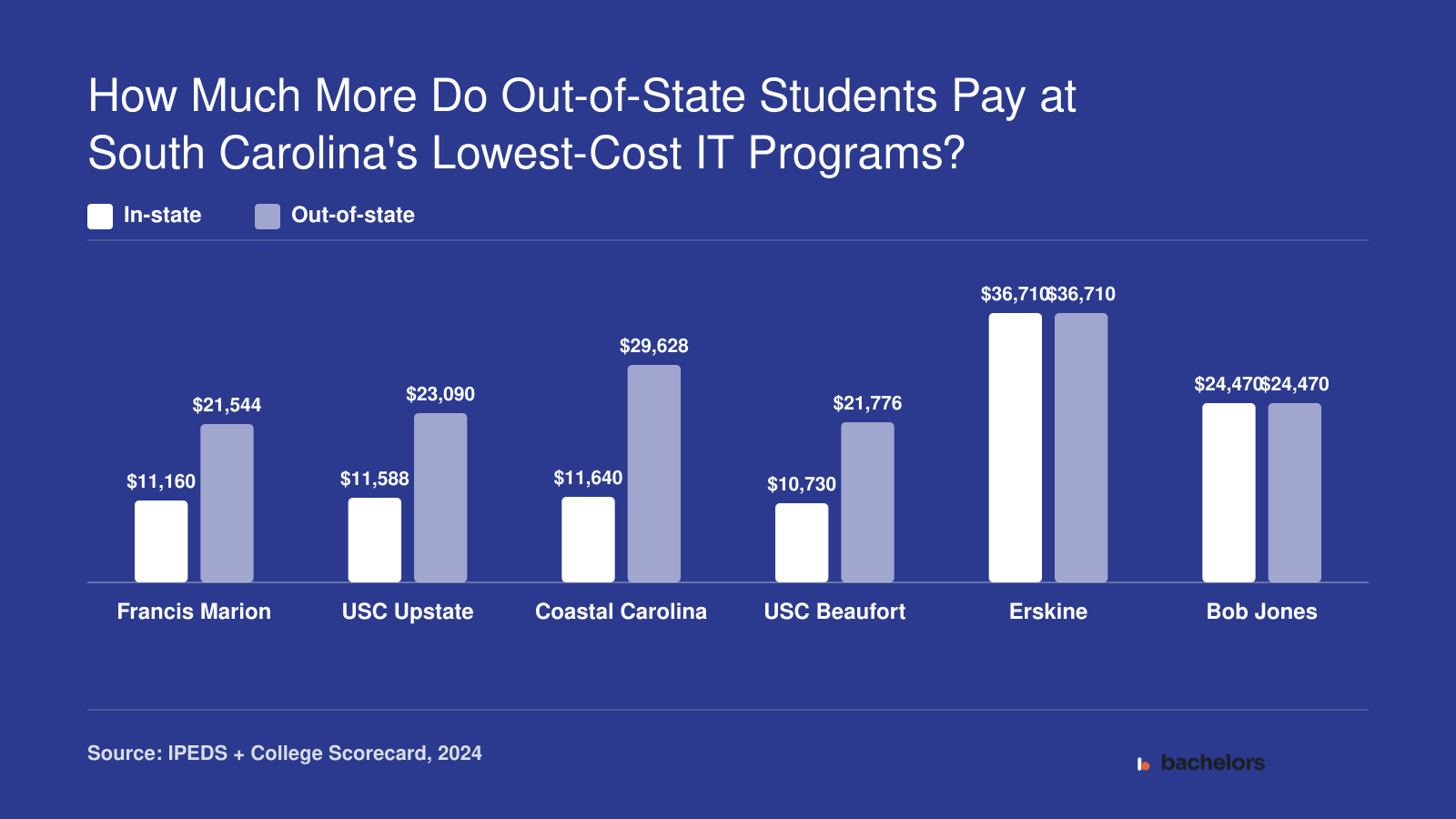
Residency matters at the public schools. Francis Marion charges about $21,544 for out-of-state students, and University of South Carolina-Upstate charges $23,090 (in-state $11,588). Coastal Carolina University has the widest gap, at $11,640 in-state and $29,628 out-of-state. Erskine College is private and charges $36,710 to everyone, though its average net price is $16,525.
Net price is an average across students who received aid. It is not a quote. Your own figure depends on your income, scholarships and enrollment, so run the numbers for each school before you compare.
South Carolina State Aid
These figures come from the SC Commission on Higher Education's 2026-27 materials. Most programs share basic rules: South Carolina residency, U.S. citizenship or permanent residency, degree-seeking enrollment, and no default on a state or federal loan.
- Palmetto Fellows: $6,700 for freshmen and up to $7,500 later, for up to eight semesters. It requires a 3.5 GPA, an SAT of 1200 or ACT of 25, and a top 6% class rank.1
- LIFE Scholarship: Up to $5,000 a year for eight semesters. You need two of three: a 3.0 GPA, an SAT of 1100 or ACT of 22, or a top 30% class rank.1 Renewal requires 30 credit hours.
- SC HOPE: Up to $2,800 for freshman year, for students who do not qualify for LIFE or Palmetto Fellows.2 It requires a 3.0 GPA.
- Need-based Grant: Up to $3,500 full-time or $1,750 part-time, awarded by each college.3 You must file the FAFSA and show need. Renewal requires a 2.0 GPA and 24 credit hours.
SC WINS is a workforce scholarship tied to technical colleges, so do not count on it for a bachelor's degree.
Debt at Graduation
Median debt among graduates school-wide is $22,310 at University of South Carolina-Upstate, $23,750 at Coastal Carolina, and $24,000 at University of South Carolina Beaufort. It is $27,000 at both Francis Marion and Erskine. These are school-wide medians, not IT-specific figures.
How Much More Do Out-of-State Students Pay at South Carolina's Lowest-Cost IT Programs?
South Carolina's public universities charge nonresidents about double the resident rate. Out-of-state tuition and fees run $10,384 more per year at Francis Marion University, $11,046 more at USC Beaufort and $11,502 more at USC Upstate. At Coastal Carolina University the gap is $17,988, so nonresidents pay about 2.5 times the in-state price. Erskine College ($36,710) and Bob Jones University ($24,470) are private and charge every student the same rate, so financial aid matters more than residency at those two schools. Schools appear in order of net price after aid, lowest first.
IT Careers and Salaries in South Carolina After a Bachelor's Degree
U.S. Bureau of Labor Statistics data show South Carolina software developers and information security analysts earning median wages above $116,000 (May 2023), while state workforce data count 57,250 computer and mathematical jobs as of May 2025. Charleston, Greenville and Columbia are the main hiring hubs, and Charleston posts the highest software developer pay of the three. South Carolina does not license IT professionals, but security roles often call for certifications such as CompTIA Security+ or, at the experienced level, CISSP.
| Occupation | Median Annual Wage (SC) | Employment (SC) |
|---|---|---|
| Information security analysts, statewide (May 2023) | $119,030 | 1,430 |
| Software developers, statewide (May 2023) | $116,790 | 11,810 |
| Computer and mathematical occupations, statewide (May 2025) | N/A | 57,250 |
| Software developers, Charleston-North Charleston metro (May 2023) | N/A ($59.75 median hourly; $122,340 mean annual) | 2,540 |
| Software developers, Greenville-Anderson-Mauldin metro (May 2023) | N/A ($48.83 median hourly; $109,230 mean annual) | 2,010 |
| Software developers, Columbia metro (May 2023) | N/A ($45.97 median hourly; $96,920 mean annual) | 1,270 |
Which South Carolina IT Programs Lead to the Highest Graduate Earnings?
University of South Carolina graduates of the Integrated Information Technology, B.S. post the highest median earnings in this comparison, at $87,069 five years after finishing, according to College Scorecard data published by the U.S. Department of Education. Strayer University-South Carolina and Bob Jones University follow closely, but both report small graduating classes, so their medians can shift more from one year to the next. Graduates of Coastal Carolina University and University of South Carolina-Upstate earn far more by year four than in their first year, which shows how quickly IT pay tends to grow with experience.
| Rank | School | City | Format | Median Earnings 1 Year After Graduation | Median Earnings 4 Years After Graduation | Median Earnings 5 Years After Graduation |
|---|---|---|---|---|---|---|
| 1 | University of South Carolina | Columbia | Campus and online | $68,597 | $84,720 | $87,069 |
| 2 | Strayer University-South Carolina | Greenville | Campus and online | $67,315 | $82,304 | $83,581 |
| 3 | Bob Jones University | Greenville | Campus | N/A | $82,391 | N/A |
| 4 | Coastal Carolina University | Conway | Campus and online | $38,602 | $63,247 | $69,074 |
| 5 | University of South Carolina-Upstate | Spartanburg | Campus and online | $49,999 | $67,286 | $59,007 |
Related Articles
Frequently Asked Questions About IT Schools in South Carolina
Quick answers to the questions students ask most about bachelor's degrees in information technology in South Carolina. Details on cost, admissions and online formats appear in the sections above.
What is the best IT school in South Carolina?
How long does it take to get an IT degree in South Carolina?
Which South Carolina IT programs are ABET accredited?
Can you get a bachelor's degree in information technology fully online in South Carolina?
What is the cheapest bachelor's in IT in South Carolina?
Compare Information Technology programs on the data that matters
Explore more Computers & IT majors or browse every field of study.
All Computers & IT programs Browse every field of study