Best Healthcare Administration Schools in South Dakota
Compare 3 accredited Healthcare Administration programs in South Dakota, with net price after aid, graduation rates, earnings and debt from IPEDS and the U.S. College Scorecard.

South Dakota's healthcare administration bachelor's options split two ways: a campus business degree in Vermillion or an online program run from Sioux Falls or Rapid City. Delivery differs; the credential does not.
A bachelor's degree in healthcare administration is the entry point to managing clinics, critical access hospitals and long-term care operations, and the South Dakota programs ranked here award it as a B.B.A., a BBA, or a bachelor's in healthcare management. Published tuition, net price after aid and the state's nursing home administrator requirements separate otherwise similar programs.
Rural hospitals and clinics here hire managers who handle budgets and staffing largely on their own.
Key Points
- University of South Dakota graduates earned a median $74,816 four years out.
- Campus learners choose Vermillion; online students look to Sioux Falls, Rapid City.
- A bachelor's degree exceeds South Dakota's associate-degree minimum for nursing home administrators.
Best Bachelor's Degree in Healthcare Administration Programs in South Dakota
South Dakota's bachelor's options in healthcare administration come in two shapes: a traditional campus B.B.A. in Vermillion and online degrees based in Sioux Falls and Rapid City. Each entry below names the credential, the published tuition and net price after aid, and the outcome figures reported for that school.
University of South Dakota
#1Vermillion, SD · ~$20,000/yr (est.)
Best for: Students who want a business school foundation
The University of South Dakota is the state's public flagship in Vermillion, and its health care administration degree is a B.B.A. inside the Beacom School of Business rather than a standalone health college. In-state tuition and fees run $9,432, the average net price after aid is $19,858, and the school-wide graduation rate is 60 percent. Health administration graduates report median earnings of $74,816 four years after completion, and business majors can extend into an accelerated B.B.A./M.B.A. or a 3+3 J.D.
- Bachelor of Business Administration, 120 total credit hours
- 75 major hours: 45-credit business core plus 27 in health services administration
- 3-credit internship, usually the summer between junior and senior year
- Electives include long-term care administration and patient safety
- Accelerated B.B.A./M.B.A. option; the MBA offers a health services administration track
- 3+3 J.D. concurrent program available to business majors
- 60 credits must be at the 300/400 level; 15 credits a semester advised to finish in four years
- On-campus delivery in Vermillion; the program does not lead to a professional license
California Intercontinental University
#2Sioux Falls, SD
Best for: Working adults needing self-paced online study
California Intercontinental University keeps a Sioux Falls address and delivers its healthcare administration bachelor's degree entirely online from that base. The BBA totals 120 credit hours at $438 per credit, or $60,705 for the full program, with e-books included in per-course tuition. It is built for working adults who want no campus visits, and financial aid and scholarships are available.
- 100% online BBA in Healthcare Administration; no campus visits required
- $438 per credit, or $60,705 for the full 120-credit program
- 15 credits of focused specialization coursework inside the degree
- Topics include healthcare systems, health policy statistics, and IT for healthcare
- Per-course tuition includes e-books
- Open to students with a high school diploma or GED
- Financial aid and scholarships available
- Designed for working professionals balancing career and study
National American University-Rapid City
#3Rapid City, SD · ~$31,000/yr (est.)
National American University's Rapid City location anchors an online Bachelor of Science in Healthcare Management built on a performance-based curriculum in healthcare law, finance, quality improvement, and strategic planning. In-state tuition and fees are $16,065 and the average net price after aid is $31,062. The program reports median earnings of $45,392 one year after completion and $52,803 four years out, and graduates who borrowed carry median program-level debt of $52,058.
- 100% online Bachelor of Science in Healthcare Management
- 180 total credit hours with a performance-based curriculum
- Two concentration options, including one for students with prior healthcare diplomas or associate degrees
- Final action research project or capstone applies what students learn
- Covers healthcare law, financial management, quality improvement, and strategic planning
- General education block transfer available
- Accredited by the Higher Learning Commission
- Prepares students for roles such as healthcare administrator and medical office manager
Cost & outcomes by school
Federal data for the highest-earning Healthcare Administration programs, independent of the ranking above. Earnings are this field's bachelor's graduates four years after completing where the Scorecard reports them, else the school's undergraduate median.
| School | Net price / yr | Grad rate | Earnings | Debt | Grads/yr | Format |
|---|---|---|---|---|---|---|
| University of South Dakota SD | $19,858 | 60% | $74,816 | $23,592 | 9 | Campus |
| National American University-Rapid City SD | $31,062 | — | $52,803 | $32,805 | 12 | Online |
| California Intercontinental University SD | — | — | — | — | 1 | Online |
Sources: U.S. Department of Education. Net price, graduation rate, earnings and debt: College Scorecard (earnings and debt for this field's bachelor's graduates where reported, else school-wide); graduates: IPEDS. A dash means no figure is reported.
How We Ranked South Dakota Bachelor's Programs
Healthcare administration hiring has shifted toward managers who can read a budget and a clinical workflow in the same afternoon, so program choice matters more than it did a decade ago.
What Counts
Every program on this list is a bachelor's degree, and only bachelor's degrees are ranked here. A Master of Health Administration, an MBA with a health concentration, or a graduate certificate never enters the comparison.
Four things carry the weight:
- Fit to the credential: the degree must be a bachelor's in healthcare administration or a clearly named equivalent, such as the B.B.A. in Health Care Administration at the University of South Dakota.
- Cost: published tuition and the net price students actually pay after gift aid.
- Outcomes: school-wide graduation rate, plus program-level earnings and debt when a school reports them.
- Format: campus, online, or hybrid, working adults need the delivery mode stated plainly, not assumed.
Why Cost and Outcomes Lead
Net price and outcomes carry the heaviest weight because they are the two numbers a reader cannot change after enrolling. A lower net price shortens the payback period, and a stronger graduation rate raises the odds you finish at all.
Caveats
Both the graduation rate and the net price are school-wide averages. They describe an institution's typical student, not a promise about your tuition bill or your timeline. Treat them as a comparison tool, not a quote.
Online and Hybrid Bachelor's Options at South Dakota Schools
South Dakota's ranked healthcare administration bachelor's programs split between fully online delivery and a campus-based route; the choice comes down to how coursework fits around the rest of your life, not to the quality of the credential.
Where the online options sit
California Intercontinental University, based in Sioux Falls, runs its BBA in Healthcare Administration entirely online at $438 per credit, with e-books included in per-course tuition, a 120-credit total, and coursework built for working professionals. National American University-Rapid City delivers its Healthcare Management bachelor's with 100% online coursework, a published tuition of $16,065, and general education block transfer for students arriving with prior college credit.
Online delivery from a South Dakota school also simplifies the money side: these programs publish one tuition rate rather than separate in-state and out-of-state prices, so residency does not change your bill. Student support arrives through advising and course platforms instead of a campus office, which rewards students who are comfortable asking for help directly.
The campus route in Vermillion
The University of South Dakota lists its Health Care Administration (B.B.A.) as an on-campus program at the Vermillion main campus: 120 credit hours, 75 in the major, and a required 3-credit internship. The internship places you with preceptors to observe how a healthcare organization runs and to complete administrative or research projects, and it is the strongest reason to pick Vermillion over an online degree. Treat it as a scheduling commitment and ask the department how placement is arranged before you enroll.
A quick rule of thumb
Working adults juggling a job or family tend to do better online, where coursework bends around shifts. First-time students who want faculty contact, a campus rhythm, and a structured internship usually get more from the Vermillion campus.
Related Articles
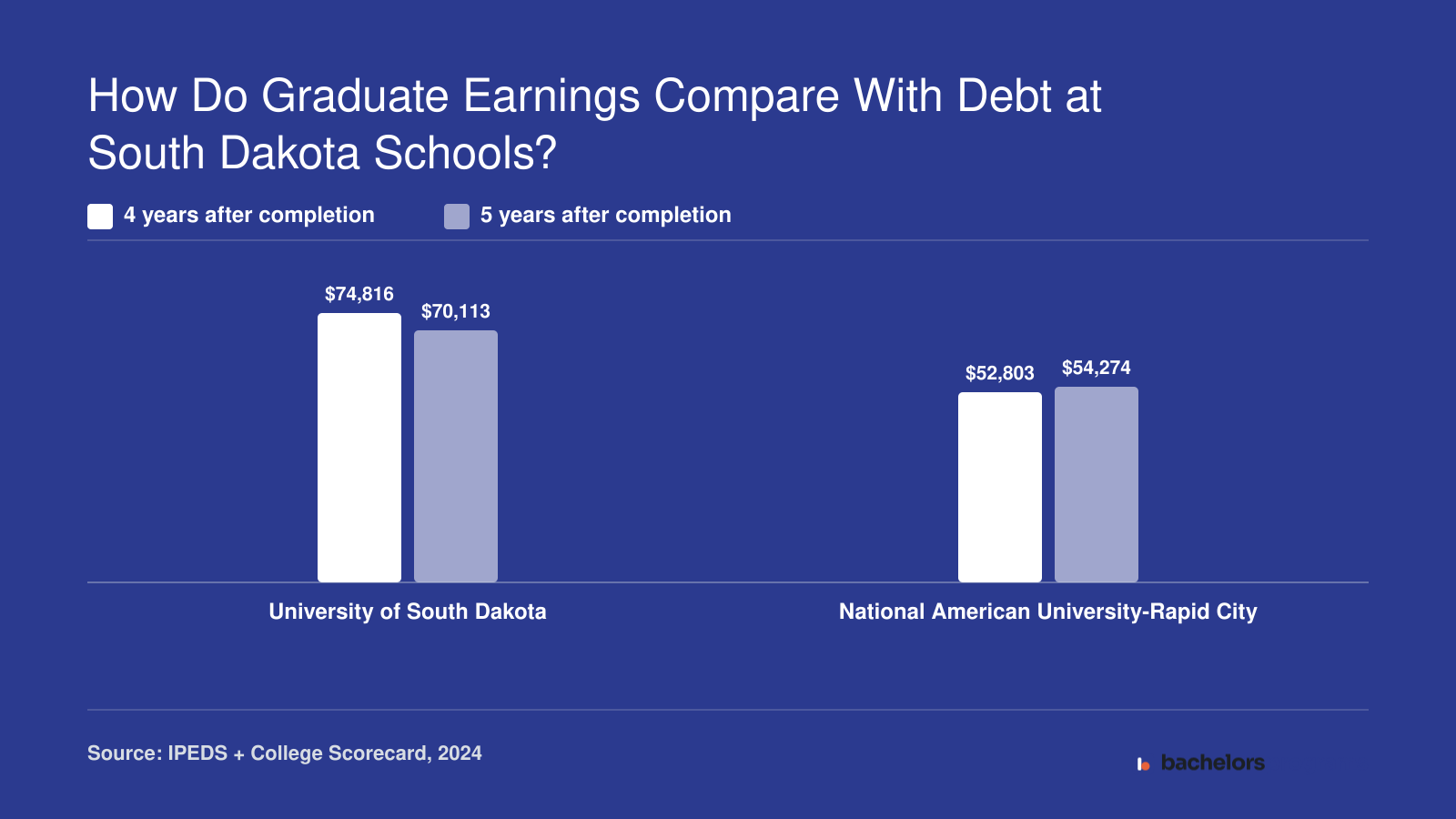
How Do Graduate Earnings Compare With Debt at South Dakota Schools?
Four years after completion, University of South Dakota's health care administration graduates earned a median $74,816. National American University-Rapid City's healthcare management graduates earned $52,803 over the same window. Graduates of the National American University-Rapid City program borrowed a median $32,805, while University of South Dakota's median debt of $23,592 covers bachelor's graduates of all majors rather than this program alone.
Accreditation for South Dakota Healthcare Administration Bachelor's Programs
Employers and transfer offices now check a school's institutional status before they read a transcript, so accreditation is a filter, not a formality. At the bachelor's level, the distinction that matters most is between institutional accreditation and program-level accreditation. Institutional accreditation, often called regional accreditation, is the campus-wide seal from an accreditor such as the Higher Learning Commission, and it is what makes federal financial aid, credit transfer, and most graduate admissions work. Program accreditation is narrower: AACSB, for example, evaluates a business school, not the healthcare administration major alone.
What the Schools Show
The public record is uneven. National American University and the University of South Dakota appear in Higher Learning Commission action records, which confirms institutional review activity but does not by itself certify a healthcare administration bachelor's program. The University of South Dakota's B.B.A. in Health Care Administration is a business degree, so AACSB is the program-level seal to look for. California Intercontinental University's program page is the place to confirm both layers. A school may hold a program accreditation without advertising it on the healthcare page, so absence there is not proof either way.
How to Verify
Go to the accreditor's own directory, not a logo on a recruitment page. Search the Higher Learning Commission directory for institutional status, then AACSB's accredited-school listing for business programs. Compare the exact degree name, campus, and online format. If a school publishes no program-level policy, ask admissions in writing and keep the reply with your application file.
Healthcare Administration Careers in South Dakota
Where the Jobs Are
South Dakota's healthcare employers are spread across the state, not clustered in one metro. Rural hospitals, critical access facilities, long-term care organizations, clinics, and public health agencies all hire people with business and operations training. Graduates open to working outside Sioux Falls or Rapid City will find management-track openings in smaller communities where the same title carries broader responsibility.
Entry-Level Roles for Bachelor's Graduates
- Practice coordinator: Runs scheduling, staffing, and front-office operations for a physician group or clinic.
- Patient services manager: Oversees registration, billing intake, and customer service in a hospital department.
- Health information supervisor: Manages records, privacy compliance, and data quality for a facility or system.
- Long-term care administrator-in-training: Works under a licensed nursing home administrator toward the state credential.
- Quality or population health analyst: Tracks measures, reporting, and care coordination for a hospital or clinic network.
What Recent Graduates Earn
Federal earnings data for these programs gives a realistic picture of the early trajectory. University of South Dakota graduates in health care administration reported median earnings of $74,816 four years after completing and $70,113 five years out. National American University-Rapid City graduates reported $45,392 one year after finishing, $52,803 at four years, and $54,274 at five years. Read those windows as snapshots of a career still in its early stages, not as a ceiling.
Experience Drives Advancement
A bachelor's degree in healthcare administration starts the career; experience decides how far you go. Department director, operations manager, and clinic administrator roles typically go to people with several years of supervisory work behind them, and many employers pair that experience with a graduate degree later. Treat the first job as the start of a ladder, and choose employers that promote from within and pay for additional training.
South Dakota Nursing Home Administrator Licensure at a Glance
Questions to Ask Yourself
Do you need a fully online format because of work or distance from campus?
Will you work in long-term care, where an administrator license may be required?
How much of the bill will state aid actually cover?
Healthcare Administration in South Dakota: Common Questions
What are the best healthcare administration schools in South Dakota?
How much does a healthcare administration degree cost in South Dakota?
Can you get a bachelor's degree in healthcare administration online in South Dakota?
What jobs can you get with a bachelor's in healthcare administration in South Dakota?
Compare Healthcare Administration programs on the data that matters
Explore more Business & Management majors or browse every field of study.
All Business & Management programs Browse every field of study