Best Information Technology Schools in South Dakota
Compare 3 accredited Information Technology programs in South Dakota, with net price after aid, graduation rates, earnings and debt from IPEDS and the U.S. College Scorecard.

Graduates of National American University-Rapid City's Bachelor of Science (B.S.) in Information Technology earn a median $52,129 one year out, per U.S. Department of Education data. In South Dakota, the choice comes down to programs in Rapid City, Sioux Falls, Kyle, or online study.
Price and focus vary. Oglala Lakota College lists tuition and fees of $2,684, while California Intercontinental University in Sioux Falls takes a narrower route through networking and systems security.
Students starting at a technical college face a separate question: how many credits a four-year program will accept. When employers weigh certifications as heavily as diplomas, how many credits transfer shapes the total cost.
Key Points
- Oglala Lakota College's average net price after aid is just $1,895.
- National American University-Rapid City IT graduates earn a $52,129 median after one year.
- No South Dakota license is required for IT; employers value CompTIA certifications.
Best Information Technology Schools in South Dakota: Our Ranked List
Three South Dakota based institutions appear in this year's ranked list, and each takes a different route to an IT bachelor's degree. One pairs a fully online B.S. with built-in certification prep and published graduate earnings, one anchors a cohort model in a reservation community, and one specializes in networking and systems security. The order below reflects program depth and student outcomes at each school.
National American University-Rapid City
#1Rapid City, SD · ~$31,000/yr (est.)
Best for: Career changers targeting IT certifications
National American University's Rapid City campus administers a fully online Bachelor of Science in Information Technology built on a 180-credit plan. Students choose a specialty in networking, web development, or information and network security, and coursework lines up with CompTIA and Cisco certification exams. The university also advertises corporate and government partnership rates that can work alongside employer tuition assistance, and it publishes post-completion earnings for IT graduates.
- 180 total credits: 64.5 major and support core, 57 general education
- Specialize in networking, web development, or information and network security
- Specialty area requires 27 credits and caps at 40.5 credits
- Courses embed CompTIA and TestOut certification materials
- Prepares for A+, Network+, Security+, Linux+, Cloud+ and CCNA 200-301
- Transfer credit accepted for prior IT training
- Accredited by the Higher Learning Commission
- Fully online delivery, no campus attendance required
Oglala Lakota College
#2Kyle, SD · ~$1,900/yr (est.)
Best for: Tribal-community students preferring on-campus cohorts
Oglala Lakota College sits on the Pine Ridge Indian Reservation in Kyle and awards its Bachelor of Science in Information Technology through the Department of Math, Science and Technology. Students apply to the department once they hold 28 to 43 credit hours, then join a cohort with an assigned IT faculty adviser and follow a posted four-year plan of study. The curriculum emphasizes operating systems and networking skills intended to serve the Pine Ridge area, and the college also offers an associate degree in IT.
- Four-year plan of study published for 2026-2027
- Apply to the Math, Science and Technology department after 28-43 credits
- Cohort structure with an assigned IT faculty adviser
- Core sequence includes IT 153, IT 273, IT 383 and IT 493a/493b
- Foundation in operating systems and networking for the Pine Ridge area
- Technology fee of $16 per credit hour, plus course lab fees
- Listed careers: database administrator, security analyst, network architect
- Also offers an A.A.S. in Information Technology
California Intercontinental University
#3Sioux Falls, SD
Best for: Security-focused learners preferring fully online study
California Intercontinental University maintains a Sioux Falls administrative and enrollment office while delivering its bachelor's programs entirely online. Its IT offering is a Bachelor of Engineering Information Technology in Networking and Systems Security, one of several bachelor's specializations the university lists. A business partnership program offers tuition reductions and waived application fees to employees of partner organizations, and admission runs through an online application and enrollment agreement.
- Concentration in networking and systems security
- All bachelor's programs delivered 100 percent online
- Online application followed by an enrollment agreement
- Partner-employee tuition reductions and waived application fees
Cost & outcomes by school
Federal data for the highest-earning Information Technology programs, independent of the ranking above. Earnings are this field's bachelor's graduates four years after completing where the Scorecard reports them, else the school's undergraduate median.
| School | Net price / yr | Grad rate | Earnings | Debt | Grads/yr | Format |
|---|---|---|---|---|---|---|
| National American University-Rapid City SD | $31,062 | — | $64,936 | $13,456 | 9 | Online |
| Oglala Lakota College SD | $1,895 | 9% | $22,517 | — | 8 | Campus |
| California Intercontinental University SD | — | — | — | — | 1 | Online |
Sources: U.S. Department of Education. Net price, graduation rate, earnings and debt: College Scorecard (earnings and debt for this field's bachelor's graduates where reported, else school-wide); graduates: IPEDS. A dash means no figure is reported.
How We Ranked South Dakota Bachelor's Programs in Information Technology
What data decides which South Dakota IT program lands first? The rankings draw on College Scorecard, the U.S. Department of Education's public dataset. We looked at four measures: net price, graduation rate, and program-level earnings and debt for graduates.
Two of those measures need a caveat. Graduation rate and net price are institution-wide averages. They describe everyone enrolled at a school, not just students in the information technology major, so a school's overall figure may not match what an IT student experiences. Earnings and debt are reported at the program level, so they speak more directly to the degree itself. That is why we gave them more weight than the institution-wide numbers.
What the list covers
The list includes only bachelor's programs at South Dakota-based schools, whether taught on campus or online. The pool is small. Only a limited group of schools in the state have an IT bachelor's program with enough federal data to compare, so the list is short by necessity. Better a short list than one padded with weaker fits.
Why we spell this out
Niche-style lists rarely disclose how their factors are weighted, which leaves readers guessing why one school outranks another. The inputs are stated plainly, along with what each one can and cannot tell you.
Choosing a Bachelor's Degree in Information Technology in South Dakota
The choice usually comes down to how fast you want to be working versus how far you want to climb. A bachelor's degree in information technology costs more time up front than a two-year credential, but it qualifies you for roles that stay out of reach without one.
IT, Information Systems, or Computer Science
A Bachelor of Science in Information Technology is the applied track: operating systems, networks, servers, security configuration, and the hands-on work of keeping infrastructure running. Information systems leans toward the business side, pairing technical coursework with management, process, and data use inside organizations. Computer science is the theory-heavy option, built around algorithms, mathematics, and software engineering. If you want to build applications from scratch, computer science fits better. If you want to run and secure the systems other people depend on, IT is the match.
Accreditation Worth Checking
Institutional accreditation is the baseline, and it is what makes federal aid and transfer credit possible. National American University-Rapid City is accredited by the Higher Learning Commission. Programmatic accreditation is a separate layer: ABET accredits individual computing programs rather than whole institutions, and its computing commission reviews bachelor's-level degrees specifically.1 We did not find ABET or ACBSP programmatic accreditation listed for the IT bachelor's programs at Oglala Lakota College, California Intercontinental University, or National American University-Rapid City.2 That is common for applied IT degrees and is not disqualifying, but it is worth asking each admissions office directly.
Specializations and Starting Points
Security and networking dominate the concentration options here. California Intercontinental University's bachelor's degree focuses on networking and systems security. National American University-Rapid City offers concentration choices with a 27-credit minimum in one specialty area and builds CompTIA and TestOut certification prep into the coursework. Oglala Lakota College grounds its program in operating systems and networking, and also offers an associate degree in information technology.
An associate degree makes sense if you need income sooner, are unsure the field suits you, or want to test coursework before committing. Go straight to the four-year degree if you already know you want security, architecture, or management roles, where a bachelor's is frequently the screening requirement.
Questions to Ask Yourself
Do you want hands-on networking and systems work, or software theory and algorithms?
Could you start at a technical college and transfer, or do you need a bachelor's degree from day one?
Do you need an online or hybrid schedule while working in Sioux Falls or Rapid City?
Does your target employer expect ABET-accredited coursework?
Related Articles
Online and Hybrid Bachelor's Options at South Dakota Schools
For most people considering a bachelor's degree in information technology in South Dakota, the choice comes down to two things: the structure and lab access of a campus program, and the ability to keep a full-time job while you study. The schools here fall cleanly on either side of that line, which makes the choice easier than it looks.
Who teaches IT online
National American University-Rapid City delivers its Bachelor of Science in Information Technology in a fully online format, with three concentration options, a 180-credit total, and CompTIA and TestOut certification prep built into the coursework. It also accepts transfer credit for prior IT training, which matters if you already hold certifications or completed coursework elsewhere.
California Intercontinental University, based in Sioux Falls, runs its Bachelor of Engineering Information Technology in Networking and Systems Security entirely online as well, with specializations available at the bachelor's level.
Oglala Lakota College takes the opposite approach. Its Bachelor of Science in Information Technology is a campus-based, cohort-structured program in Kyle, with an assigned IT faculty adviser and application after 28 to 43 credit hours. If you need a fully online path, this is not it.
Pricing that ignores your zip code
Residency-neutral pricing is the quiet advantage of the online route, and few comparison pages flag it. National American University-Rapid City lists the same tuition for in-state and out-of-state students, roughly $16,065 per year. Oglala Lakota College also charges one rate regardless of residency, about $2,684 per year, though you have to be in Kyle to use it.
A tip for working adults
Map your week before you map your degree. If you can protect two fixed evenings and a weekend block, online works. If your schedule shifts week to week, a cohort program's fixed deadlines supply the structure.
Cost of an IT Bachelor's Degree in South Dakota: Tuition and Net Price
Oglala Lakota College is the lowest-cost option here, with published tuition and fees of $2,684 for both in-state and out-of-state students and an average net price after aid of $1,895, according to U.S. Department of Education data. National American University-Rapid City shows the widest gap between sticker price and net price: its average net price of $31,062 runs $14,997 above its $16,065 in tuition and fees, because net price counts housing, books and other living costs minus grant aid, not tuition alone. Net price is an institution-wide average for aided students, so your own cost will depend on your family income, your aid package and where you live while you study.
| School | Location | Program | Format | Published In-State Tuition and Fees | Published Out-of-State Tuition and Fees | Average Net Price After Aid |
|---|---|---|---|---|---|---|
| Oglala Lakota College | Kyle, SD | Bachelor of Science in Information Technology | Campus | $2,684 | $2,684 | $1,895 |
| National American University-Rapid City | Rapid City, SD | Bachelor of Science in Information Technology | Online | $16,065 | $16,065 | $31,062 |
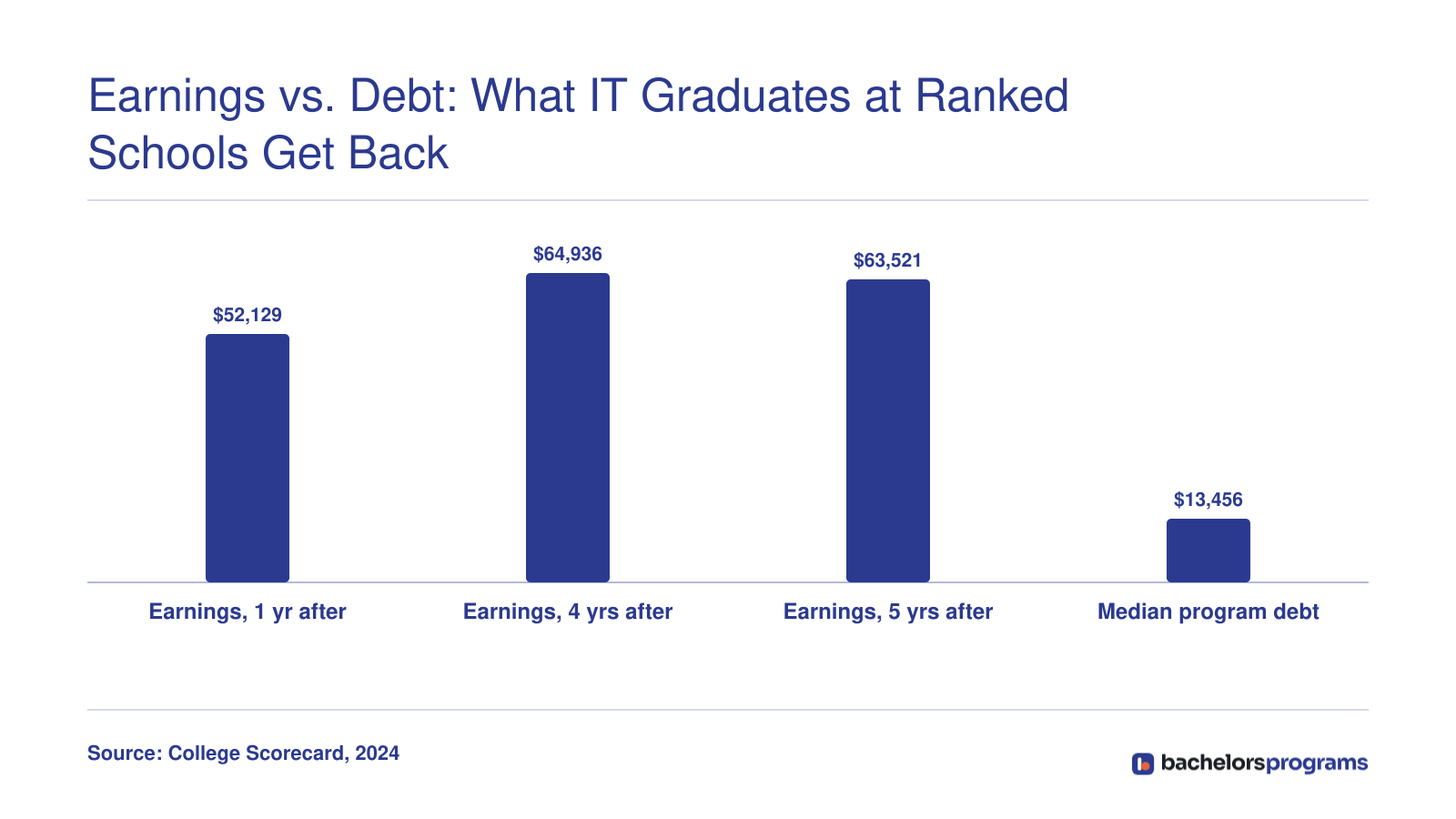
Earnings vs. Debt: What IT Graduates at Ranked Schools Get Back
National American University-Rapid City's B.S. in Information Technology graduates earn a median $52,129 one year after completion and $64,936 four years after, against median program debt of $13,456. That debt equals about 26% of first-year earnings, with a typical 10-year payment near $143 a month. Federal data does not report program-level earnings or debt for Oglala Lakota College or California Intercontinental University, and these figures come from a small graduating cohort.
Information Technology Careers and Licensure in South Dakota: Jobs and Wages
IT careers in South Dakota center on building, securing, and supporting the computer systems organizations rely on every day. A bachelor's degree in information technology typically points toward roles such as network administrator, information security analyst, computer user support specialist, and software developer.
Wage and Employment Data to Check
The Bureau of Labor Statistics publishes median annual wages and employment counts for each of these occupations through its Occupational Employment and Wage Statistics program. The most recent release is May 2025. It covers the state as a whole and two metro areas of interest to South Dakota students.
- Statewide: South Dakota figures for all four occupations, plus wage percentiles at the 10th, 25th, 75th, and 90th marks.1
- Sioux Falls: The BLS area is Sioux Falls, SD-MN, which includes Lincoln, McCook, and Minnehaha Counties.2 Because it spans both states, its numbers are not South Dakota-only.
- Rapid City: This area covers Custer and Meade Counties.2
We are not quoting specific dollar amounts here. Smaller areas sometimes have suppressed estimates for individual occupations, and the BLS tables are the place to confirm current numbers before you plan around them. Percentile ranges are useful because entry-level graduates often start closer to the lower end than the median.
Job Outlook and Employers
We do not have a verified 2025-2035 state projection to cite, so treat demand as something to check with the South Dakota Department of Labor. In general, IT work in the state tends to concentrate where large organizations run complex systems: health systems, banks and financial services firms, manufacturers, government agencies, and schools. Sioux Falls has the largest concentration of that employer mix, while Rapid City draws on healthcare, tourism, and the military community. Remote roles with out-of-state employers add options for graduates of online programs.
Licensing
IT is generally an unlicensed field. You do not need a state license to work as a network administrator, security analyst, support specialist, or developer. Employers may prefer optional industry certifications, which are covered in the next block.
Do You Need a License to Work in IT in South Dakota?
Frequently Asked Questions About South Dakota IT Schools
These answers summarize the main points from this guide so you can compare South Dakota options quickly. Confirm details with each school's admissions office before you apply.
Which South Dakota school is best for information technology?
Can you get a bachelor's degree in information technology online in South Dakota?
How much does an IT bachelor's degree cost in South Dakota?
Are South Dakota IT programs accredited?
What is the difference between information technology, information systems, and computer science degrees?
Compare Information Technology programs on the data that matters
Explore more Computers & IT majors or browse every field of study.
All Computers & IT programs Browse every field of study