Best Criminal Justice Schools in South Dakota
Compare 6 accredited Criminal Justice programs in South Dakota, with net price after aid, graduation rates, earnings and debt from IPEDS and the U.S. College Scorecard.
South Dakota sets a high school diploma as the minimum for police certification, yet its colleges keep enrolling criminal justice majors bound for corrections, probation, federal agencies and promotion. The degree most schools here award is the Bachelor of Science (B.S.) in Criminal Justice, offered on campus and, at some schools, online.
In-state tuition at the public options starts near $4,714; private tuition runs past $30,000, though net price after aid narrows the gap.
The degree is not a license. South Dakota certifies officers through its own academy, and graduates clear the same background check every recruit faces. What the degree changes is what comes after.
Key Points
- Sinte Gleska University charges $4,714 in tuition and fees, the lowest here.
- Median earnings one year out range from $38,858 to $45,720.
- South Dakota police certification requires a high school diploma, not a bachelor's.
Best Schools for a Bachelor's Degree in Criminal Justice in South Dakota
Seven South Dakota schools made this list, four private and three public, and four of them offer a bachelor's degree in criminal justice partly or entirely online. The range runs from a large public university with a 100% online path to a tribal college that teaches criminal justice inside a human services degree. Graduation rates below describe each school as a whole, not the criminal justice major.
Augustana University
#1Sioux Falls, SD · $20,000 – $25,000/yr (est.)
Best for: Pre-law students wanting hands-on internships
Augustana brought criminal justice back in fall 2024 after a nearly 35-year gap, and the rebuilt major pairs seven criminal justice courses with sociology, criminal law and statistics. Internships run through the Minnehaha County Juvenile Detention Center and State's Attorney, the South Dakota Department of Corrections and the South Dakota State Penitentiary. Pre-law is listed among the related pre-professional tracks, and students can study away in more than 70 countries. About 73% of Augustana students finish their degree.
- Major restored in fall 2024 after nearly 35 years off the books
- Seven criminal justice courses combined with sociology, criminal law and statistics
- Internships at the South Dakota State Penitentiary and Minnehaha County agencies
- Major and minor both offered through the Sociology Department
- Pre-law listed among related pre-professional programs
- Study away options in more than 70 countries
University of South Dakota
#2Vermillion, SD · ~$20,000/yr (est.)
Best for: Working adults needing a fully online degree
USD awards both a Bachelor of Arts and a Bachelor of Science in Criminal Justice, with a 100% online path for students who cannot come to campus. Majors process mock crime scenes, compete on mock trial teams that travel to regional and national tournaments, and intern with state and federal courts, law firms and law enforcement agencies. The Farber Fund pays up to $6,000 per eligible student for internships, study abroad and research. Graduates of this program reported a median of $58,046 four years after finishing, and about 60% of USD students complete a degree.
- Separate B.A. and B.S. tracks, plus a 100% online option
- Students process mock crime scenes and join traveling mock trial teams
- Farber Fund awards up to $6,000 for internships and study abroad
- Internships with state and federal courts, law firms and law enforcement
- More than 180 student organizations on campus
University of Sioux Falls
#3Sioux Falls, SD · $21,000/yr (est. net price)
Best for: Transfer students bringing associate degree credits
The University of Sioux Falls offers a Bachelor of Arts in Criminal Justice that covers the structures and processes of the justice system along with the social issues tied to crime. Credits from an associate degree roll straight into the bachelor's, and transfer credits from other accredited universities are accepted. Graduates of this program reported a median of $62,792 four years after finishing. About 63% of USF students complete a degree.
- Associate degree credits roll directly into the bachelor's program
- Transfer credits accepted from other accredited universities
- Coursework covers justice system structures and the social issues behind crime
Northern State University
#4Aberdeen, SD · $15,000 – $20,000/yr (est.)
Northern State's 120-credit criminology and criminal justice major covers policing, criminal law, courts, corrections and criminological theory, with an honors thesis option in policy analysis. Internship credit is available with the Aberdeen Police Department, the Brown County Sheriff's Office and Courthouse, the South Dakota Highway Patrol and the FBI. About 49% of Northern State students finish their degree.
- 120-credit major, about four years, on campus or fully online
- Internship credit with Aberdeen Police, Brown County Sheriff and Highway Patrol
- Spring 2026 pathways pair it with DSU cyber degrees in about four years
- Streamlined 4+1 route to DSU's M.S. in Cyber Defense
- Honors thesis option in policy analysis
- Priority admission to Northern's master's in counseling
Dakota Wesleyan University
#5Mitchell, SD · $15,000 – $20,000/yr (est.)
Dakota Wesleyan awards criminal justice degrees at the bachelor's and associate levels, and coursework reaches into forensic investigation, white collar crime, terrorism and homeland security, and wildlife law enforcement. A required capstone seminar covers emerging issues facing agencies, and internships have placed students with the South Dakota Division of Criminal Investigation, state's attorney offices, court services and the IRS. Graduates of this program reported a median of $53,634 five years after finishing. About 48% of Dakota Wesleyan students complete a degree.
- Bachelor's in four years, associate option in two
- Capstone seminar (CRJ 433) on emerging issues in the field
- Internships with the South Dakota Division of Criminal Investigation and IRS
- Courses in forensic investigation, white collar crime and terrorism
- Wildlife law enforcement coursework
- Associate in human services from Mitchell Technical College applies toward it
National American University-Rapid City
#6Rapid City, SD · ~$31,000/yr (est.)
National American University's Bachelor of Science in Criminal Justice requires 180 credits: a 58.5-credit criminal justice core, 60 open electives and a general education block that can transfer in whole. The core runs from introduction to criminal justice through criminal law, constitutional law and a capstone, and advanced protection courses can substitute for electives. Military benefits are accepted, and graduates commonly move into police, deputy sheriff, court clerk, correctional, probation and parole roles. Graduates of this program reported a median of $47,907 four years after finishing.
- 180 total credits, including a 58.5-credit criminal justice core
- Fully online, with military benefits accepted
- Capstone course plus advanced executive protection electives
- General education block transfer accepted
- Prepares for police, court clerk, parole and correctional roles
Sinte Gleska University
#7Mission, SD · ~$13,000/yr (est.)
Sinte Gleska University is a tribal college that offers criminal justice as a concentration inside its Bachelor of Arts in Human Services rather than as a standalone major. That structure suits students who want justice coursework folded into a broader human services degree. The college reports a graduation rate of about 15%.
- Criminal justice concentration inside the Bachelor of Arts in Human Services
- Concentration rather than a standalone criminal justice major
Cost & outcomes by school
Federal data for the highest-earning Criminal Justice programs, independent of the ranking above. Earnings are this field's bachelor's graduates four years after completing where the Scorecard reports them, else the school's undergraduate median.
| School | Net price / yr | Grad rate | Earnings | Debt | Grads/yr | Format |
|---|---|---|---|---|---|---|
| University of Sioux Falls SD | $21,383 | 63% | $62,792 | $23,250 | 24 | Online |
| Augustana University SD | $23,894 | 73% | $59,217 | $25,000 | 4 | Campus |
| University of South Dakota SD | $19,858 | 60% | $58,046 | $21,500 | 54 | Online or campus |
| Dakota Wesleyan University SD | $19,735 | 48% | $53,728 | $27,000 | 11 | Campus |
| National American University-Rapid City SD | $31,062 | — | $47,907 | $27,986 | 5 | Online |
| Northern State University SD | $15,812 | 49% | $47,618 | $22,320 | 11 | Online or campus |
Sources: U.S. Department of Education. Net price, graduation rate, earnings and debt: College Scorecard (earnings and debt for this field's bachelor's graduates where reported, else school-wide); graduates: IPEDS. A dash means no figure is reported.
Cost, debt & payoff
Median earnings of this field's bachelor's graduates (4 yrs after completing, else the school's undergraduate median) vs. their median federal loan debt · U.S. College Scorecard
Across these programs the median graduate earns about $55,887 and finishes with roughly $24,125 in debt — a ratio that clears a common rule of thumb (keep debt below first-year salary). Net price and debt vary widely school to school, so check the per-school figures in the table above before you shortlist.
How We Ranked South Dakota Criminal Justice Bachelor's Programs
Only bachelor's-level criminal justice programs are eligible here, and the ranking weighs what graduates actually get for their tuition rather than what a viewbook promises.
What Counts as Eligible
Every program ranked here is a bachelor's degree in criminal justice or a closely named equivalent, such as criminology and criminal justice, offered on a South Dakota campus or online by a school based in the state. Associate degrees, graduate certificates and academy training sit outside the scope, useful as those are later on.
What We Measure
The federal College Scorecard supplies the backbone: net price after aid, graduation rate, and program-level earnings and debt for graduates. Those outcome figures carry more weight than campus amenities or elective lists, because a criminal justice major usually wants a badge, a courtroom job or a corrections career, not a four-year tour of facilities.
Two caveats matter. Graduation rate and net price are institution-wide averages, not criminal justice program figures, so they describe the school more than the major. And the Scorecard is a snapshot that can lag a year or more behind the current catalog. Where a field is blank, the school has not published that number; it does not mean the number is zero.
Online and Hybrid Criminal Justice Bachelor's Options at South Dakota Schools
Online delivery is no longer an afterthought in South Dakota criminal justice education: the schools ranked here split fairly cleanly between those promoting a fully online route and those that teach on campus.
Fully Online Options
Yes, you can earn a bachelor's degree in criminal justice online from South Dakota schools. The University of South Dakota is the most established, advertising a "100% online option" for its Criminal Justice B.A. and B.S. alongside classes at the Vermillion main campus and in Sioux Falls. Coursework runs through the Desire2Learn platform, and students are expected to keep regular contact with instructors by email and through the system. Under NC-SARA, USD's online courses may be offered to residents of 49 states, the District of Columbia, Puerto Rico and the Virgin Islands, with California handled separately. Supervised field-study experiences are authorized in South Dakota.
Northern State University lists a fully online option for its criminology and criminal justice bachelor's degree. The University of Sioux Falls and National American University-Rapid City also list their criminal justice programs as online; National American requires a capstone.
Campus-Based Programs
Augustana University, Dakota Wesleyan University and Sinte Gleska University publish campus-based criminal justice programs with no online route listed. Sinte Gleska offers criminal justice as a concentration within its human services bachelor's program. Augustana, based in the sociology department, places interns at the South Dakota State Penitentiary and the Minnehaha County Juvenile Detention Center; Dakota Wesleyan requires both a capstone and a justice-related internship.
What to Confirm Before Applying
None of these program pages states whether online classes meet live at set times or run fully on your own schedule, or whether online students pay a different rate than on-campus students. Ask each admissions office directly, and ask whether any internship must be completed inside South Dakota.
Admissions Requirements: GPA, Test Policy, and Transfer Credit
Augustana University admits about 68% of applicants and the University of South Dakota nearly 99%, so admission to a South Dakota criminal justice bachelor's program is usually less about selectivity than about clearing a few published benchmarks. The real filters are core-course and GPA rules, and those are not printed on the criminal justice program pages.
GPA and Test Scores
Program pages for the criminal justice degrees here describe coursework, internships and delivery format, not a minimum GPA or an ACT/SAT cutoff. The University of South Dakota's page, for example, lists the B.A. and B.S. and the Vermillion, Sioux Falls and online formats without stating a GPA floor or test rule. For National American University-Rapid City and Sinte Gleska University, the available program information likewise lists no GPA floor or test requirement. The undergraduate admissions office is the authority here, so ask three questions: the minimum high school GPA for direct admission, whether the school is test-optional for the next entering class, and whether a test score can offset a GPA below the automatic threshold.
Transfer Credit and Associate Pathways
Transfer rules vary more than GPA rules. The University of Sioux Falls states that associate degree credits roll into its criminal justice bachelor's and that it accepts transfer credits from accredited universities. In practice, a general-education associate degree from a South Dakota community college tends to transfer more cleanly than an applied associate from a technical college, where law enforcement and corrections courses may land as electives rather than major credit.
What to Ask Before You Commit
Request a written, course-by-course credit evaluation before you enroll, not after. Ask whether your criminal justice courses will count toward the major or as free electives, whether upper-level major courses carry a residency requirement, and whether the school caps how many transfer credits it will apply to the major.
What a Criminal Justice Bachelor's Degree Costs in South Dakota
Public schools are the most affordable route to a criminal justice bachelor's in South Dakota: Sinte Gleska University ($4,714 in tuition and fees, $12,768 average net price) and Northern State University ($8,845 and $15,812) cost the least, while private Augustana University lists $40,160 in tuition but averages $23,894 after aid. Average net price is what students actually pay after grants and scholarships, and it is a school-wide average across all students rather than a criminal justice figure. For 2026-27 the Board of Regents charges residents $267.45 per credit at Northern State and $273.00 at the University of South Dakota, and state aid can lower costs further: the Opportunity Scholarship pays up to $7,500 over four years (one state page lists $6,500) to South Dakota residents with a 3.0 GPA, an ACT of 24 and the required high school courses who enroll at an eligible in-state school, the Needs-Based Scholarship awards $500 to $2,000, and Build Dakota's full ride covers high-need programs at the state's four technical colleges in exchange for three years of work in South Dakota.
| School | Type | In-state tuition and fees | Average net price after aid | Median debt, criminal justice grads | Median debt, all graduates |
|---|---|---|---|---|---|
| Sinte Gleska University | Public | $4,714 | $12,768 | N/A | N/A |
| Northern State University | Public | $8,845 | $15,812 | N/A | $22,320 |
| Dakota Wesleyan University | Private nonprofit | $33,790 | $19,735 | N/A | $27,000 |
| University of South Dakota | Public | $9,432 | $19,858 | $21,500 | $23,592 |
| University of Sioux Falls | Private nonprofit | $21,750 | $21,383 | $23,250 | $23,249 |
| Augustana University | Private nonprofit | $40,160 | $23,894 | N/A | $25,000 |
| National American University-Rapid City | Private for-profit | $16,065 | $31,062 | $27,986 | $29,020 |
Accreditation and Program Quality for South Dakota Criminal Justice Schools
Institutional accreditation from the Higher Learning Commission (HLC) is the quality marker that matters most when you choose a South Dakota criminal justice school.2 HLC accredits the college as a whole, and that status generally determines whether you can use federal financial aid and whether another school will accept your credits if you transfer.
What HLC Status Confirms
One ranked school has a documented accreditation action. In May 2026, HLC approved National American University-Rapid City's request to offer a B.S. in Criminal Justice in a reduced-credit format of 135 quarter credit hours. That action does not lay out the university's full accreditation standing, so look up every school you are seriously considering in the HLC directory before you apply.
No Program-Level Accreditation Exists
No agency accredits criminal justice programs. The Academy of Criminal Justice Sciences (ACJS) is not an accreditor. It offers a voluntary Program Endorsement that involves a self-study, a site visit, and review by a certified program reviewer.1 A program must meet at least 85 percent of the standards, including C.4, the one mandatory standard, which addresses faculty qualifications.1 Meeting at least 95 percent earns special recognition. Treat endorsement as a bonus, not a requirement.
Two Quick Quality Checks
- Faculty with field experience: Look for instructors who have worked in policing, courts, corrections, or victim services, not only in academia.
- Internship or capstone options: Confirm the program places students in agencies or requires a culminating project, since that is where classroom learning meets practice.
Related Articles
Do You Need a Degree to Become a Police Officer in South Dakota?
Does South Dakota require a bachelor's degree to become a police officer? No. The statewide minimum for basic certification, set by the South Dakota Law Enforcement Officers Standards and Training Commission, is a high school diploma or an equivalency certificate the commission accepts.1 A college degree is not part of that floor, and the commission's rules set no statewide preference for one.1 Individual agencies write their own recruitment standards, so a degree matters more at some departments than others.
The certification path, step by step
Most officers are hired first and certified afterward. The hiring agency runs a background investigation covering driving and criminal history, prior employment, personal references, credit reports and social media, and the candidate is interviewed in person. Applicants must be at least 21 at appointment, be U.S. citizens, pass a medical exam, and be fingerprinted by a law enforcement officer.1 Unlawful use of a prescribed drug, controlled substance or marijuana within the year before applying bars certification.1
Once hired, you complete the 520-hour Basic Certification Course within 12 months of appointment.2 The agency sponsors you, and academy cost is charged to neither the officer nor the agency.3 A written exam establishes state competence, and certification follows successful training.4 Officers already certified in another state may need about a week and a half of training instead of the full course.3
Where a degree still helps
A bachelor's degree in criminal justice can separate you in a competitive applicant pool, support promotion, and open non-patrol work such as investigations or probation. Corrections and probation positions often set their own education requirements, so read each posting rather than assuming the police standard applies.
South Dakota Law Enforcement Certification at a Glance
What Do South Dakota Criminal Justice Bachelor's Graduates Earn?
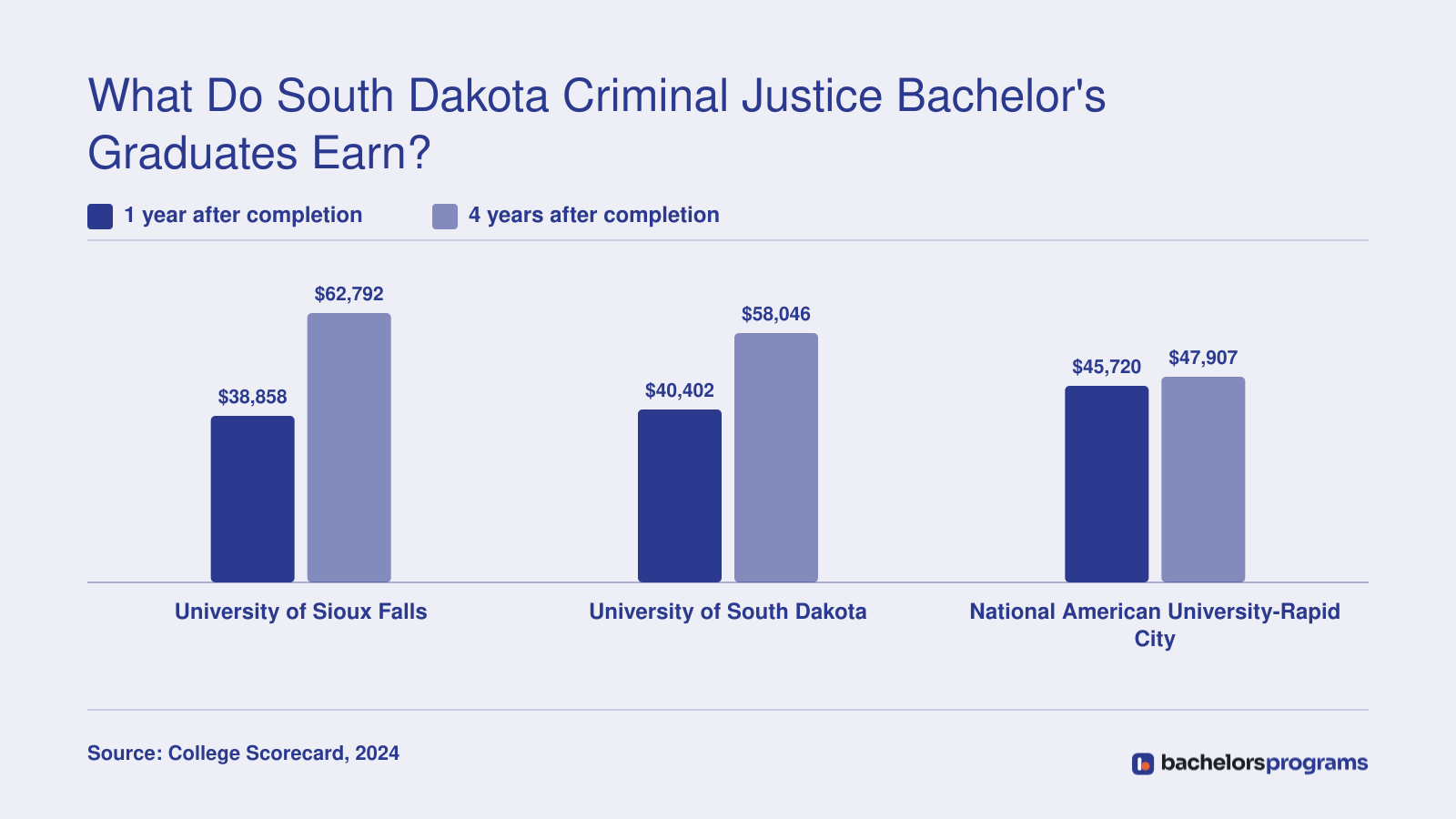
Federal data tracks median earnings for criminal justice bachelor's graduates at several South Dakota schools. One year after finishing, median earnings ranged from $38,858 at the University of Sioux Falls to $45,720 at National American University-Rapid City. Four years out, they ranged from $47,907 to $62,792, and Dakota Wesleyan University graduates earned $53,634 five years out. These figures cover all jobs graduates hold, in any field or state, so they measure real early-career pay rather than the typical wage for one occupation such as police officer and can differ from the occupational wages above.
Compare Criminal Justice programs on the data that matters
Explore more Criminal Justice & Law majors or browse every field of study.
All Criminal Justice & Law programs Browse every field of study