Best Healthcare Administration Schools in Wisconsin
Compare 19 accredited Healthcare Administration programs in Wisconsin at 15 colleges, with net price after aid, graduation rates, earnings and debt from IPEDS and the U.S. College Scorecard.

Healthcare administration is increasingly treated as a business discipline rather than a clinical sideline. Medical and health services managers earned a national median of $123,860 in May 2025, according to the Bureau of Labor Statistics.
Every school ranked here offers a bachelor's degree in healthcare administration at a Wisconsin institution, including online programs from Wisconsin-based schools. Most programs award the Bachelor of Science (B.S.) in Healthcare Administration; a few award a BBA or a BA.
Price divides the options most sharply. Published tuition runs from $8,700 at University of Wisconsin-Green Bay to $38,890 at Carroll University.
Key Points
- University of Wisconsin-Eau Claire graduates earn a median $83,643 five years out.
- University of Wisconsin-Green Bay in-state tuition is $8,700; Carroll's is $38,890.
- Running a Wisconsin nursing home requires a DSPS administrator license.
Best Bachelor's Degree in Healthcare Administration Schools in Wisconsin
These ten Wisconsin schools offer a bachelor's degree in healthcare administration or a closely related health management major, and they differ sharply in format, price, and how much real administrative experience they build into the degree. Net price after aid is an average for students who receive federal aid, not a quote for every applicant, so treat the figure shown as a starting point for comparison rather than a bill. Schools offering this program report institution-wide graduation rates from roughly 28% to 72%, a range that reflects each whole college rather than this major alone.
Herzing University-Kenosha
#1Kenosha, WI · ~$23,000/yr (est.)
Best for: Working adults with prior college credit
Herzing's Kenosha campus runs its Bachelor of Science in Healthcare Administration entirely online, with a curriculum built on healthcare finance, medical law and ethics, health policy, and information systems. Students choose a leadership or managed care concentration and finish with a capstone or internship, and eligible undergraduates can bank up to 12 graduate credits while enrolled. Up to 90 approved transfer credits are accepted, and the 120-credit program is paced for about 32 months.
- 100% online, 120 credits, about 32 months to finish
- $530 per credit tuition
- Two concentrations: leadership or managed care
- Transfer up to 90 approved credits
- Capstone or internship before graduation
- Earn up to 12 graduate credits while enrolled
- Rolling admissions with day or evening classes
- Enrollment fee waived
University of Wisconsin-Eau Claire
#2Eau Claire, WI · ~$17,000/yr (est.)
Best for: Future nursing home administrators
UW-Eau Claire treats health care administration as a business discipline, awarding a Bachelor of Business Administration with coursework in financial management, reimbursement, quality improvement, health policy, and aging. Its signature feature is a paid, 12-month administrative residency of about 50 weeks inside an affiliated health care organization, and graduates are eligible to sit for the Nursing Home Administrator licensure exam. The four-year track runs 120 credits with a 2.5 GPA requirement and a prerequisite business sequence.
- Paid, 12-month administrative residency (50 weeks)
- Prepares graduates for the Nursing Home Administrator licensure exam
- 120 credits; 2.5 GPA minimum
- Scholarships available; annual networking and interview fair
- Coursework in reimbursement, quality improvement, health policy
- Study abroad or national student exchange options
Carroll University
#3Waukesha, WI · $15,000 – $20,000/yr (est.)
Best for: Business-minded students drawn to healthcare
Carroll's health care administration major blends management and business coursework with the language of the field: policy, ethics, finance, informatics, and patient advocacy. Classes lean on group projects and real-world problem solving, internships are strongly encouraged, and the school notes that many students leave with a job offer already in hand. Students often pair the major with a minor in public health, communication, marketing, or Spanish, and the program also feeds Carroll's 3+3 Doctor of Physical Therapy track.
- Combines business and management courses with healthcare policy and ethics
- Internships encouraged; many students get offers before graduating
- Pairs with minors in public health, communication, marketing, or Spanish
- Foundation for Carroll's 3+3 Doctor of Physical Therapy track
- Interactive coursework built on group projects and problem solving
Viterbo University
#4La Crosse, WI · ~$21,000/yr (est.)
Viterbo runs its health care management major as an online degree completion program for people who already hold college credit, military credit, or verified prior learning, and most entrants arrive with 30 or more credits. The major takes 42 credits inside a 120-credit degree, covering health law and ethics, quality improvement, marketing, and health economics, with a Servant Leadership certificate built into the business core. Transfer agreements cover associate degree graduates of Western Technical College and Chippewa Valley Technical College.
- Online degree completion for students with prior college credit
- 42 credits in the major within a 120-credit degree
- Accepts military credit and prior learning credit
- 2.5 GPA in major courses; at least a C in each
- Servant Leadership certificate embedded in the business core
- Transfer agreements with Western Technical and Chippewa Valley Technical
- Requires English Composition and Oral Communication for admission
- Covers healthcare law, ethics, quality improvement, and economics
University of Wisconsin-Green Bay
#5Green Bay, WI · $13,000/yr (est. net price)
UW-Green Bay houses health care administration inside its Bachelor of Science in Organizational Leadership, where the Management in Health Systems emphasis is taught 100% online in accelerated, asynchronous courses. The curriculum is aimed squarely at working professionals: the structure of the U.S. health system, operations, budgeting and finance, health economics, population health, and social determinants. An applied associate degree carries at least 60 transferable credits, and the program offers two health systems certificates plus employer tuition reimbursement support.
- 100% online, asynchronous, accelerated courses
- Transfer at least 60 credits with an applied associate degree
- Coursework in population health and social determinants
- Budgeting, health economics, cost management, strategic planning
- Two health systems certificates offered
- Built for working professionals; employer reimbursement supported
Concordia University-Wisconsin
#6Mequon, WI · ~$36,000/yr (est.)
Concordia gives students two routes into the field: a campus Bachelor of Science in Healthcare Administration grounded in a faith-based commitment to patient dignity, and an online business administration degree with a healthcare management concentration. Neither requires an entrance exam, and both are test optional. The campus program covers finance, human resources, marketing, and research evaluation for students who want leadership without direct patient care, and it can be paired with a public health major, while the online route runs in eight-week terms and accepts up to 84 transfer credits.
- Campus program blending business, finance, HR, and marketing
- Test optional; no entrance exam required
- Faith-based approach to patient dignity and quality care
- Non-clinical pathway for students who want healthcare without patient care
- Can be paired with a public health bachelor's degree
- Prepares students to manage a department or an entire facility
- $450 per credit; $0 application fee
- Transfer up to 84 credits
- 8-week online courses, synchronous or asynchronous
- Starts in fall, spring, or summer
- Credit for professional and military training
- Select courses meet live via Zoom
- Also offered as a certificate and a minor
Herzing University-Brookfield
#7Brookfield, WI · ~$21,000/yr (est.)
Herzing's Brookfield campus offers the fully online Bachelor of Science in Healthcare Administration, built around healthcare finance, medical law and ethics, health policy, and information systems, with business analytics and project management layered in. Rolling admissions means there is no application deadline, up to 90 approved credits can transfer, and students may take up to 12 graduate credits while finishing the bachelor's. Capstone or internship options and ongoing career coaching round out the support.
- Transfer up to 90 approved credits
- Dual credit toward an MBA while enrolled
- $530 per credit
- 32-month, 120-credit program
- Rolling admissions with no application deadlines
- Lifelong career coaching provided
- 100% online with capstone or internship
- No prior healthcare degree required
Marian University
#8Fond Du Lac, WI · $20,000 – $25,000/yr (est.)
Marian offers health care administration in unusually flexible packaging: a campus Bachelor of Science, an accelerated online version with seven-week terms, and a Bachelor of Business Administration variant for students who want a heavier business core. Coursework runs through medical staff relations, patient care services, healthcare law, finance, and information systems, with a supervised internship on the campus track and clinical hours that online students can often complete at a current employer. Graduates are positioned for licensed nursing home administrator and certified medical manager roles, and small classes include visits to local care facilities.
- 120 credits; campus or online with 7-week accelerated terms
- 2.0 GPA minimum
- 120 clinical hours, with internship placements in all 50 states
- Internship can often be completed at a current employer
- Prepares students for licensed nursing home administrator roles
- Aligned with the Certified Medical Manager credential
- Small classes and visits to local care facilities
- 120 credits; 2.0 GPA minimum
- One internship required, part time or full time
- Case studies and small-group discussion
- Faculty with real-world business experience
- Field trips to healthcare facilities
- Path to nursing home administrator licensure
Ottawa University-Milwaukee
#9Brookfield, WI
Ottawa's Wisconsin campus delivers a Bachelor of Arts in Health Care Management with a clinical track designed for people who already hold a clinical license, registry, or technical associate degree. Those students can transfer at least 30 hours of clinical or laboratory coursework and move into the core, which covers planning and budgeting, health care law and ethics, digital health informatics, and a capstone seminar in applied management. The program runs online and prepares graduates for roles such as hospital manager, nursing home administrator, and physician practice manager.
- Clinical track for licensed or registered clinical professionals
- Transfer at least 30 hours of clinical or laboratory coursework
- Fully online with a required capstone
- Courses in health care law, budgeting, and digital health informatics
- Associate degree in a clinical field accepted
Herzing University-Madison
#10Madison, WI · $22,000/yr (est. net price)
Herzing's Madison campus delivers the Bachelor of Science in Healthcare Administration entirely online, with 120 credits covering healthcare finance, delivery systems, medical law and ethics, human resources, health informatics, and quality improvement. Students choose from two concentrations, finish with a capstone or internship, and can transfer up to 90 approved credits under rolling admissions. Virtual advising, tutoring, and career coaching support online learners, and a reduced military rate is available.
- $530 per credit; military rate of $250 per credit
- 32-month, 120-credit program
- Two concentration options
- Capstone project or internship required
- Transfer up to 90 approved credits
- Rolling admissions with a waived enrollment fee
- Higher Learning Commission accredited
- Virtual advising, tutoring, and library services
Cost & outcomes by school
Federal data for the highest-earning Healthcare Administration programs, independent of the ranking above. Earnings are this field's bachelor's graduates four years after completing where the Scorecard reports them, else the school's undergraduate median.
| School | Net price / yr | Grad rate | Earnings | Debt | Grads/yr | Format |
|---|---|---|---|---|---|---|
| Ottawa University-Milwaukee WI | — | — | $82,317 | $20,738 | 2 | Online |
| University of Wisconsin-Eau Claire WI | $16,550 | 64% | $80,564 | $21,850 | 36 | Campus |
| Viterbo University WI | $21,260 | 68% | $68,568 | $26,849 | 7 | Online |
| Carroll University WI | $15,193 | 71% | $66,689 | $26,500 | 16 | Campus |
| University of Wisconsin-Milwaukee WI | $15,014 | 49% | $65,400 | $28,000 | — | Hybrid |
| Rasmussen University-Wisconsin WI | — | 57% | $62,100 | $26,217 | — | Online |
| Concordia University-Wisconsin WI | $36,201 | 68% | $58,979 | $29,429 | 6 | Campus |
| University of Wisconsin-Green Bay WI | $13,369 | 48% | $57,471 | $25,000 | 22 | Campus |
| Carthage College WI | $26,565 | 64% | $56,950 | $26,000 | — | Campus |
| Wisconsin Lutheran College WI | $23,245 | 64% | $54,664 | $26,000 | — | Campus |
| Marian University WI | $21,937 | 44% | $53,501 | $25,000 | 9 | Campus |
| Herzing University-Kenosha WI | $23,066 | 72% | $51,098 | $37,778 | 4 | Online |
Sources: U.S. Department of Education. Net price, graduation rate, earnings and debt: College Scorecard (earnings and debt for this field's bachelor's graduates where reported, else school-wide); graduates: IPEDS. A dash means no figure is reported.
Cost, debt & payoff
Median earnings of this field's bachelor's graduates (4 yrs after completing, else the school's undergraduate median) vs. their median federal loan debt · U.S. College Scorecard
Across these programs the median graduate earns about $56,950 and finishes with roughly $26,000 in debt — a ratio that clears a common rule of thumb (keep debt below first-year salary). Net price and debt vary widely school to school, so check the per-school figures in the table above before you shortlist.
How We Ranked Wisconsin Healthcare Administration Schools
A school's overall record and a single program's results are two different things, and this list keeps them apart. Some figures describe the whole institution. Others describe one major. Knowing which is which keeps you from over-reading any one number.
The Factors We Weighed
- Net price after aid: What students typically pay once grants and scholarships are subtracted from the sticker price. This is an institution-wide figure, not specific to healthcare administration.
- Graduation rate: The share of students who finish at the school. It is also institution-wide, so it describes the campus as a whole. A single major's completion rate may differ.
- Earnings and debt: We use College Scorecard figures for graduates' pay and borrowing only where they are labeled as program-level. When a figure covers a broader group of graduates, we don't treat it as a measure of the healthcare administration major.
- Format: Whether the degree is offered on campus, online, or in a hybrid arrangement.
What the List Covers
Every program here is a bachelor's degree at a Wisconsin-based school. That includes campus programs and online programs run by Wisconsin institutions. Read the institution-wide numbers as context, and program-level earnings as the closer signal of what a graduate of that major may earn. Compare schools on several measures together rather than leaning on one.
Most Affordable Bachelor's Programs in Wisconsin
The table below orders Wisconsin healthcare administration bachelor's programs by average net price, meaning what students typically pay per year after grants and scholarships, based on IPEDS and College Scorecard (2024) data from the U.S. Department of Education. The University of Wisconsin-Green Bay has the lowest net price and the lowest in-state tuition shown. Carroll University's $38,890 sticker price drops to a net price of $15,193, close to what students pay at the public UW campuses.
| School | City | Program | In-State Tuition and Fees | Average Net Price | Median Debt at Graduation |
|---|---|---|---|---|---|
| University of Wisconsin-Green Bay | Green Bay | Management in Health Systems | $8,700 | $13,369 | $18,500 |
| Bryant & Stratton College-Wauwatosa | Wauwatosa | Health Services Administration | $20,288 | $14,858 | $21,549 |
| University of Wisconsin-Milwaukee | Milwaukee | Health Care Administration | $10,398 | $15,014 | $23,000 |
| Carroll University | Waukesha | Health Care Administration | $38,890 | $15,193 | $27,000 |
| University of Wisconsin-Eau Claire | Eau Claire | Health Care Administration, Comprehensive Major | $9,642 | $16,550 | $20,909 |
Highest-Earning Bachelor's Programs in Wisconsin
The earnings below come from the College Scorecard, published by the U.S. Department of Education, and reflect bachelor's graduates of each school's healthcare administration or management program. Among the ranked schools, the University of Wisconsin-Eau Claire reports the highest median at $83,643 five years after graduation, and Ottawa University-Milwaukee follows closely at $82,317 four years out. Because the Scorecard measures schools at different points after graduation, read the latest-earnings column alongside the years shown, and weigh median debt and tuition against pay.
| School | City | Format | Median Earnings 1 Year After Graduation | Latest Median Earnings | Years After Graduation (Latest) | Median Program Debt | Annual In-State Tuition |
|---|---|---|---|---|---|---|---|
| University of Wisconsin-Eau Claire | Eau Claire | Campus | $71,692 | $83,643 | 5 | $21,850 | $9,642 |
| Ottawa University-Milwaukee | Brookfield | Online | $75,385 | $82,317 | 4 | $20,738 | $13,296 |
| Viterbo University | La Crosse | Online | $46,945 | $68,568 | 4 | $26,849 | $34,250 |
| Concordia University-Wisconsin | Mequon | Campus | $49,799 | $67,977 | 5 | $29,429 | $35,470 |
| University of Wisconsin-Milwaukee | Milwaukee | Hybrid | $46,739 | $67,413 | 5 | $28,000 | $10,398 |
Related Articles
Online and Hybrid Healthcare Administration Bachelor's Options at Wisconsin Schools
An online or hybrid bachelor's degree in healthcare administration covers the same business and health-systems coursework as a campus program, but delivers some or all of it online instead of in a classroom. Wisconsin schools use three formats.
Campus, Online, and Hybrid Formats
Carroll University, Concordia University-Wisconsin, Marian University, and the University of Wisconsin-Eau Claire are listed as campus programs. Eau Claire adds a paid, 12-month administrative residency, so it is the most hands-on option here. The three Herzing University campuses (Kenosha, Brookfield, Madison), Viterbo University, and Ottawa University-Milwaukee are listed as online. The University of Wisconsin-Green Bay is listed as campus but describes its Management in Health Systems program as 100% online and asynchronous. The University of Wisconsin-Milwaukee lists its Health Care Administration B.S. (120 credits) as hybrid and online, with full-time or part-time enrollment.
Pacing, Live Sessions, and Start Dates
Universities of Wisconsin online programs are generally asynchronous, with no mandatory log-in times, though assignments and exams can carry deadlines. Semester-based courses typically run about 15 weeks across fall, spring, and summer terms. Confirm with UWM whether every course in its bachelor's is asynchronous, since that is not clearly stated. Herzing advertises rolling admissions and a 32-month path, and Herzing-Madison has listed a September start. UW Flexible Option offers a self-paced, competency-based Health Sciences bachelor's with monthly starts and 12-week subscription periods.1 It is a related health degree, not a healthcare administration major.2 Online coursework generally needs no campus visits unless a program includes hands-on or clinical components.
Who Each Format Suits
- Working adults: Asynchronous or self-paced online study fits shift work. Green Bay and Herzing both emphasize employer reimbursement.
- Transfer students: Viterbo is built as a degree-completion program, and most entrants bring 30 or more credits. Herzing accepts up to 90 transfer credits and Green Bay at least 60.
- Recent high-school graduates: Campus formats at Carroll, Concordia, Marian, and Eau Claire add internships, advising, and in-person networking.
A Practical Check for Flexibility
Before applying, ask for a sample syllabus and the term calendar. Look for fixed-time meetings, proctored exams, set deadlines, and any required internship or capstone hours. A program is truly flexible only if those fit your work schedule.
Admissions Requirements: GPA, Test Policy, and Transfer Credit
Public campuses publish shared, system-wide rules, while the private and career-focused schools here set their own terms and often state them less clearly. Check each school's admissions page before you apply, because policies change.
Universities of Wisconsin Campuses
- University of Wisconsin-Milwaukee: The B.S. in Health Care Administration requires a cumulative UWM GPA of at least 2.5, finished prerequisites, and set grades in required courses before you apply to the major. The admissions page does not list a separate minimum GPA for initial undergraduate admission. Testing is optional. No transfer-credit maximum is published, and students with outside credits are sent to advising.
- University of Wisconsin-Eau Claire and University of Wisconsin-Green Bay: Both follow the system-wide test-optional policy.1 Minimum GPA and transfer-credit limit: No published policy.
Universities of Wisconsin undergraduate admission is test-optional from Spring 2026 through Summer 2028, which covers Fall 2026 entry.1
Private and Career-Focused Schools
For the schools below, minimum GPA, test policy, and transfer-credit limit: No published policy.
- Herzing University-Kenosha, Herzing University-Brookfield, and Herzing University-Madison
- Carroll University
- Viterbo University
- Concordia University-Wisconsin
- Marian University
- Ottawa University-Milwaukee
- Bryant & Stratton College-Wauwatosa
"No published policy" does not mean no requirements. It means we found nothing stated, so we are not guessing. Ask the admissions office directly about GPA expectations and whether a test score is needed.
A Note for Transfer Students
If you are bringing credits from a community college or another school, request an official credit evaluation from each program before you commit. UWM does not publish a credit cap, and for most schools here the limit is unstated. Ask which of your courses count toward the healthcare administration major, since credits that transfer only as electives may not shorten your path.
Cost of a Healthcare Administration Bachelor's Degree in Wisconsin
Published Tuition vs. Net Price
In-state tuition at the University of Wisconsin campuses here runs far below the private schools. University of Wisconsin-Green Bay lists $8,700 and University of Wisconsin-Eau Claire $9,642. Carroll University lists $38,890, Viterbo University $34,250 and Marian University about $35,000. Herzing University's Kenosha, Brookfield and Madison campuses list $13,450.
Average net price after aid narrows the gap. It is approximate, and it is built on a broader cost estimate than tuition alone, so it can run higher than tuition at public schools. Green Bay averages $13,369 and Eau Claire $16,550. Carroll averages $15,193, well under its sticker price, while Viterbo ($21,260) and Marian ($21,937) land higher. Herzing-Brookfield averages $20,514 and Herzing-Kenosha $23,066. Treat these as planning figures, not quotes.
Wisconsin State Aid
Three programs run through the Wisconsin Higher Educational Aids Board (HEAB). All require a FAFSA.
- Wisconsin Grant: For Wisconsin residents enrolled at least part-time at a UW, technical college, or tribal institution; private colleges are not covered. For 2026-27 the maximum is $3,700 and the minimum $1,000, prorated by enrollment (12 credits counts as full-time).1 Students with a higher Student Aid Index (6,751 to 10,000) may receive $1,000 only if funds remain.1 Eligibility is capped at 10 semesters.2
- Talent Incentive Program (TIP) Grant: For first-time freshmen with significant need and a non-traditional or educationally disadvantaged background, such as first-generation status. Initial awards run $600 to $1,800, and aid offices nominate recipients.3 It can be used at UW campuses, technical colleges, tribal colleges and nonprofit independent colleges.4
- Higher Education Grant: Need-based aid for undergraduates at UW, technical and tribal institutions. HEAB sets the maximum each year, and a firm 2026-27 amount was not confirmed, so check HEAB directly.
A Wisconsin Grant is worth more against UW tuition than against a private school's, but TIP can help at either kind.
One Practical Step
File the FAFSA as early as it opens each year. State grant funds are limited, and students who file late can miss out even when they qualify.
Healthcare Administration Careers and Pay in Wisconsin
Medical and health services managers earned a national median of $123,860 a year in May 2025, according to the Bureau of Labor Statistics.1 The lowest 10% earned under $73,390 and the highest 10% earned over $224,340.1 Those are national figures. Wisconsin-specific percentiles for this occupation are best confirmed with the state Department of Workforce Development, since pay shifts with employer size and region.
Demand and Employers
Nationally, about 62,300 openings a year are projected for these managers from 2025 to 2035, with employment growing 24%.1 Wisconsin's health care sector is a large employer base in its own right: private health care employment was about 342,000 in August 2026, or 11.1% of all state jobs.2
Nationally, hospitals employ the largest share of these managers (28%), ahead of physicians' offices (13%), nursing and residential care facilities (9%), and outpatient care centers (7%).1 Graduates in Wisconsin should expect the same mix: hospital systems, clinics, long-term care and senior living operators, and outpatient providers. The University of Wisconsin-Eau Claire program ties directly to nursing home administration, with a paid, 12-month administrative residency.
Starting Pay Versus the Manager Median
The $123,860 median describes experienced managers. A bachelor's degree usually opens coordinator, supervisor, or assistant administrator roles first, and those pay well below it. Scorecard earnings for recent graduates show the gap:
- University of Wisconsin-Eau Claire: about $71,692 one year after completion and $80,564 four years out, with median debt of $21,850.
- University of Wisconsin-Green Bay: about $41,306 one year out and $57,471 four years out, with median debt of $25,000.
Is It Worth It?
For most students, yes, with realistic expectations. Debt in the low to mid $20,000s is manageable against earnings that climb after graduation, and the national pay range leaves room to move into management. The payoff depends on moving up. Plan on gaining experience, and consider a long-term care or clinical-operations path if you want a faster route to a licensed leadership role.
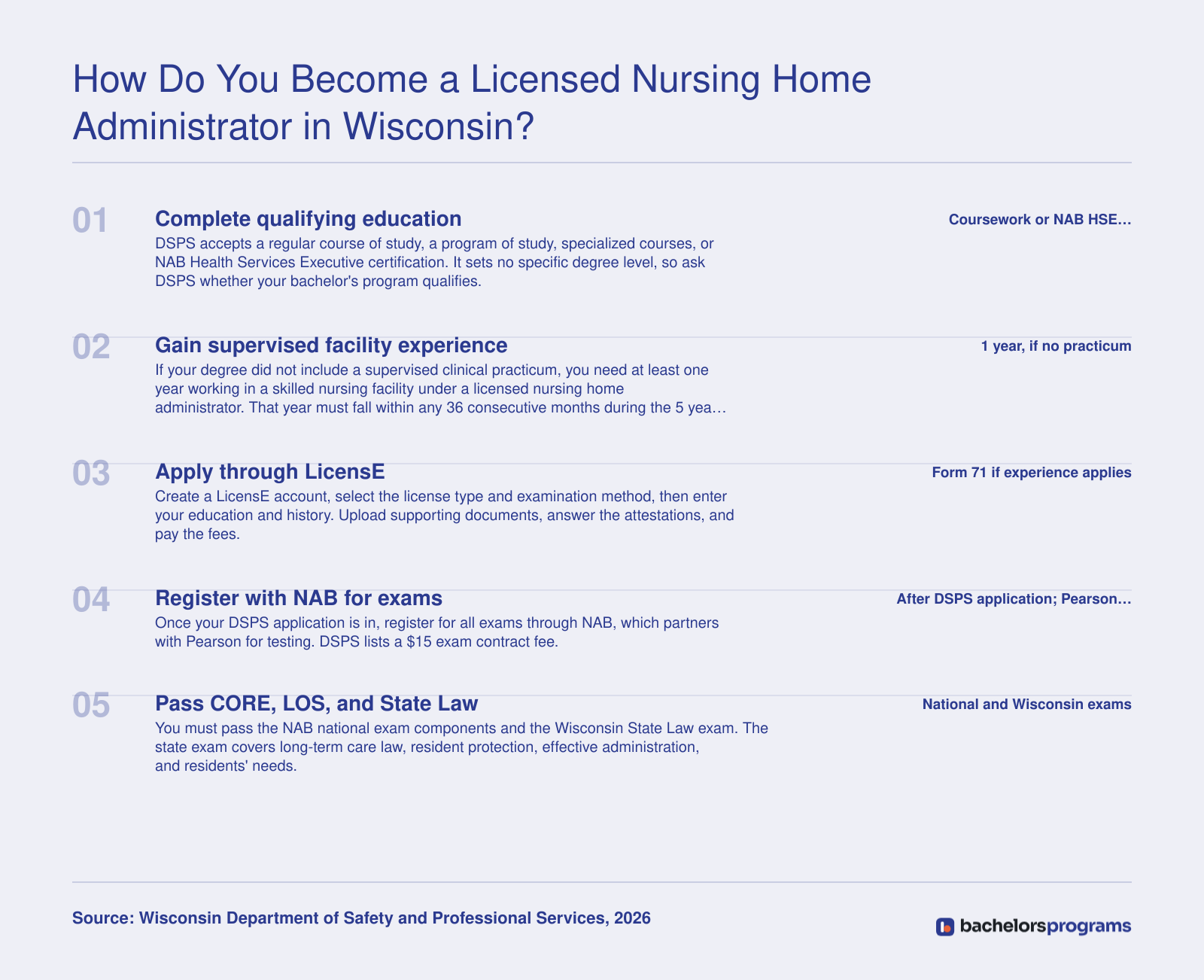
How Do You Become a Licensed Nursing Home Administrator in Wisconsin?
Most healthcare administration jobs in Wisconsin, such as clinic, billing, or hospital department roles, do not require a state license. Running a nursing home does. The steps below follow the Wisconsin Department of Safety and Professional Services (DSPS) process as published for 2026. Confirm the details with DSPS before you apply, because its materials frame some requirements in slightly different ways.
Frequently Asked Questions About Healthcare Administration Schools in Wisconsin
These answers cover the questions Wisconsin students ask most often about bachelor's degrees in healthcare administration. Each one points back to the ranking and cost data earlier on this page.
What is the best healthcare administration school in Wisconsin?
Can you get a healthcare administration bachelor's degree online in Wisconsin?
How much does a healthcare administration degree cost in Wisconsin?
Does a bachelor's degree in healthcare administration need CAHME accreditation?
Compare Healthcare Administration programs on the data that matters
Explore more Business & Management majors or browse every field of study.
All Business & Management programs Browse every field of study