Best Recreation Management Degree Programs
Compare 150+ accredited Recreation Management programs at 140+ colleges, with net price after aid, graduation rates, earnings and debt from IPEDS and the U.S. College Scorecard.
Recreation management has moved well beyond city pools and summer camps. A bachelor's degree in recreation management now leads to work in public parks, community programming, outdoor adventure, therapeutic recreation and tourism, and the programs behind it vary sharply in cost and early pay.
Among the schools ranked here, yearly net price runs from $9,288 to $21,315. Median earnings one year after graduation run from $29,862 to $47,596.
Every program covered here is undergraduate only; none awards a graduate degree. Starting salaries are modest, so school choice, concentration and internship experience carry real financial weight, and public recreation employers often look for accredited programs.
Key Points
- First-year median pay runs $39,157 (Cal Poly) to $47,596 (BYU).
- Fully online options include Utah, Arizona State and Penn State World Campus.
- COAPRT accreditation covers the program, while CPRP certification covers you.
Best Recreation Management Schools: Our Top 10 Ranked
Every school below awards a bachelor's degree in recreation management or a close equivalent, and all delivery formats were eligible, so campus, hybrid and online options appear together. Each entry notes where the program sits within the university, what the required internship looks like, and how the school performs on institution-wide completion. Figures come from federal data and reflect the most recent year available.
Brigham Young University
#1Provo, UT · $15,000 – $20,000/yr (est.)
Best for: Faith-based students drawn to therapeutic recreation
Brigham Young University is a private institution in Provo, Utah, and its recreation offering centers on therapeutic recreation and management rather than general parks administration. The school graduates 81% of students, and the 21-to-1 student-faculty ratio puts most coursework in structured lecture and lab settings. Tuition is $6,688 in state and out of state, among the lowest sticker prices in this ranking, and the program runs entirely on campus.
- Therapeutic recreation and management focus
- Coursework spans recreation management and parks and recreation
- Delivered on campus in Provo, Utah
- About 105 bachelor's degrees awarded in the field
University of Illinois Urbana-Champaign
#2Champaign, IL · ~$14,000/yr (est.)
Best for: Aspiring community recreation managers at large universities
The University of Illinois Urbana-Champaign runs a recreation department founded in 1940, and its Recreation, Sport & Tourism degree carries a dedicated Recreation Management concentration. The school graduates 85% of students, and the degree is built on 128 credit hours with at least 40 upper-division hours. Tuition runs $14,975 in state and $36,804 out of state, with an average net price near $14,355 after aid.
- Recreation Management concentration inside the BS in Recreation, Sport & Tourism
- 128 total credit hours, 40 of them upper-division
- 12-hour internship paired with a 1-hour orientation course
- Three concentrations include sport management and tourism management
- Concentration adds parks, experience design and community engagement courses
- Department founded at Illinois in 1940; 12 hours of restricted electives
California Polytechnic State University-San Luis Obispo
#3San Luis Obispo, CA · ~$17,000/yr (est.)
Best for: Hands-on learners who thrive on fieldwork
California Polytechnic State University in San Luis Obispo places recreation study inside its Experience and Event Management degree, and the Sport and Recreation Management concentration is accredited by the Council on Accreditation of Parks, Recreation, Tourism and Related Professions. The school graduates 86% of students. The polytechnic culture shows up in a required internship of at least 400 clock hours over 10 weeks or more, and tuition is $13,596 in state and $34,665 out of state.
- COAPRT-accredited program
- Sport and Recreation Management concentration, 18 units
- 400-hour internship over at least 10 weeks
- Four career tracks, including adventure sport and nonprofit recreation
- 120 total units with a required capstone
- Coursework in grant funding, event planning and sport ethics
Florida International University
#4Miami, FL · ~$9,000/yr (est.)
Florida International University in Miami is the most flexible entry near the top of this ranking, with the program offered both on campus and online. Students pick a Parks and Recreation Management track or a Sport Management track inside a 120-credit degree. The school graduates 74% of students, and tuition is $4,721 in state and $16,529 out of state, with an average net price around $9,288.
- Parks and Recreation Management track or Sport Management track
- 120 credits, four years of full-time study
- Offered both on campus and online
- Prepares for direct service, supervisory and management roles
- Housed in the College of Arts, Sciences, and Education
Florida State University
#5Tallahassee, FL · ~$11,000/yr (est.)
Florida State University in Tallahassee houses recreation and tourism management in the Dedman College of Hospitality, so the degree carries a strong operations and visitor-services flavor. Students complete 120 credit hours, including 39 hours in the major, and must log 1,000 hours of hospitality work experience plus a credit internship. The school graduates 86% of students, and tuition is $4,640 in state and $19,084 out of state.
- B.S. in Recreation and Tourism Management, 120 credit hours
- 39 hours of major coursework
- 1,000 hours of hospitality work experience required
- Credit internship (HFT 3941) plus a 12-hour college core
- Upper-division admission needs 52 semester hours and a 2.0 GPA
- Study abroad and global exchange options
- Core courses in parks, recreation and sports administration
North Carolina State University at Raleigh
#6Raleigh, NC · $9,000 – $33,000/yr (est.)
North Carolina State University in Raleigh runs a parks, recreation and tourism management degree with a pronounced natural-resource and community-wellbeing angle. The program is accredited by the Council on Accreditation of Parks, Recreation, Tourism and Related Professions and includes a 10-week internship plus a weeklong field experience in the Great Smoky Mountains. The school graduates 85% of students; tuition is $6,535 in state and $30,583 out of state.
- Recreation and Park Management concentration
- 42 hours of core coursework across tourism, leadership and fiscal management
- 15 hours of concentration electives such as outdoor leadership and environmental education
- 10-week internship with a park, recreation, event or tourism organization
- Weeklong Great Smoky Mountains field experience
- Study abroad and faculty-supervised research opportunities
Indiana University-Bloomington
#7Bloomington, IN · $12,000 – $42,000/yr (est.)
Indiana University Bloomington folds recreation into its Department of Health & Wellness Design, awarding a Bachelor of Science in Health & Wellness Design with a major in Parks, Recreation, & the Outdoors. The major spans 75 credits, ending in a 12-credit professional internship that opens after 320 hours of field experience. The school graduates 80% of students, and tuition is $10,622 in state and $40,369 out of state.
- 75-credit major with a 24-credit focus area
- 12-credit professional internship after 320 field experience hours
- Coursework in interpretation, tour guiding and place-making design
- Fieldwork placements in public, nonprofit and private settings
- 120 total credit hours; 2.0 GPA required to graduate
- Department posts more than 1,500 job openings a year
California State University-Long Beach
#8Long Beach, CA · $7,000 – $20,000/yr (est.)
California State University, Long Beach offers a Bachelor of Arts in Recreation with two concentrations, one in Parks and Recreation Management and one in Sustainable Coastal Tourism and Outdoor Recreation. The internship alone is worth 6 to 12 units, giving students a long runway in an agency or outdoor organization. The school graduates 69% of students, and tuition is $6,084 in state and $18,684 out of state, with an average net price near $10,440.
- Two concentrations: Parks and Recreation Management; Sustainable Coastal Tourism and Outdoor Recreation
- Internship worth 6 to 12 units
- Core courses in programming, evaluation and research in leisure services
- Concentration covers facility operations, advanced event management and financing leisure services
- Prepares for coordinator, supervisor, director and park ranger roles
Texas A&M University-College Station
#9College Station, TX · ~$21,000/yr (est.)
Texas A&M University in College Station delivers recreation study through its hospitality school, with an Event, Tourism and Recreation Management track inside the Bachelor of Science in Hospitality, Hotel Management and Tourism. Coursework emphasizes experience design, data-driven decisions, service quality and risk management, aimed at attractions, resorts and lodging. The school graduates 84% of students, and tuition is $9,092 in state and $36,169 out of state.
- Event, Tourism and Recreation Management track
- 120 total credit hours over four years
- Courses offered in person, with some in distance formats
- Coursework in experience design, service quality and risk management
- Prepares for attractions, restaurants, resorts and lodging careers
San Diego State University
#10San Diego, CA · $15,000/yr (est. net price)
San Diego State University awards a Bachelor of Science in Recreation Administration through the L. Robert Payne School of Hospitality and Tourism Management, and the program bills itself as relatively small and personable. Three concentrations let students aim at outdoor resources, recreation systems or sustainable tourism, and named employers include Vail Resorts and the City of Coronado. The school graduates 76% of students; tuition is $8,728 in state and $21,328 out of state.
- Outdoor Resource Management concentration
- Coursework in wilderness and the leisure experience
- Careers such as park ranger, naturalist and park interpreter
- Internships and study abroad listed as academic experiences
San Diego State University
#11San Diego, CA · $15,000/yr (est. net price)
- 51 total credit hours, with no minor required
- 12-unit internship in recreation management
- 33 upper-division major units plus 15 units of selected electives
- 3 units of supervised field work
- 24 units of preparation coursework
Cost & outcomes by school
Federal data for the highest-earning Recreation Management programs, independent of the ranking above. Earnings are this field's bachelor's graduates four years after completing where the Scorecard reports them, else the school's undergraduate median.
| School | Net price / yr | Grad rate | Earnings | Debt | Grads/yr | Format |
|---|---|---|---|---|---|---|
| California Polytechnic State University-San Luis Obispo CA | $16,665 | 86% | $90,768 | $18,500 | — | Campus |
| University of Illinois Urbana-Champaign IL | $14,355 | 85% | $81,054 | $19,500 | — | Campus |
| San Jose State University CA | $13,760 | 69% | $78,988 | $15,000 | — | Campus |
| George Mason University VA | $17,915 | 68% | $76,343 | $19,500 | 6 | Campus |
| Brigham Young University UT | $15,564 | 81% | $75,790 | $11,069 | — | Campus |
| Texas A&M University-College Station TX | $21,315 | 84% | $72,097 | $17,804 | — | Campus |
| California State University-East Bay CA | $9,320 | 48% | $71,401 | $16,544 | — | Online or campus |
| DePaul University IL | $30,902 | 68% | $68,751 | $23,168 | — | Online or campus |
| San Francisco State University CA | $12,278 | 50% | $68,077 | $15,371 | — | Campus |
| University of Utah UT | $16,200 | 65% | $67,170 | $19,000 | — | Online or campus |
| San Diego State University CA | $15,364 | 76% | $64,909 | $15,000 | — | Campus |
| California State University-Sacramento CA | $9,338 | 56% | $64,876 | $15,000 | — | Campus |
Sources: U.S. Department of Education. Net price, graduation rate, earnings and debt: College Scorecard (earnings and debt for this field's bachelor's graduates where reported, else school-wide); graduates: IPEDS. A dash means no figure is reported.
Cost, debt & payoff
Median earnings of this field's bachelor's graduates (4 yrs after completing, else the school's undergraduate median) vs. their median federal loan debt · U.S. College Scorecard
Across these programs the median graduate earns about $51,756 and finishes with roughly $21,500 in debt — a ratio that clears a common rule of thumb (keep debt below first-year salary). Net price and debt vary widely school to school, so check the per-school figures in the table above before you shortlist.
What a Bachelor's Degree in Recreation Management Covers
A bachelor's degree in recreation management is a four-year professional degree built around hands-on practice, not just classroom theory. Most programs require about 120 credits, split between general education, core recreation coursework and a senior internship or practicum that commonly runs 400 or more hours.
Core Courses You Can Expect
Course titles differ by school, but the core usually covers the same ground:
- Program planning: Designing events, classes and activities for a specific community or audience.
- Recreation leadership: Supervising staff and volunteers, running groups and managing risk.
- Facility and park management: Operating and maintaining parks, aquatic centers, community centers and similar sites.
- Budgeting and finance: Building budgets, tracking revenue and pursuing grants and fees.
- Inclusive and adapted recreation: Making programs accessible for people with disabilities and diverse needs.
Why Degree Titles Vary
The same field goes by several names. You will see parks and recreation management, recreation and leisure studies, sport and recreation management, and recreation and tourism management. The differences matter. Parks and recreation management usually points toward public agencies, nonprofits and outdoor settings. Recreation and tourism programs lean toward resorts, travel and hospitality. Sport-focused degrees often tilt toward the athletics business, with more emphasis on marketing, event operations and sport organizations than on public parks.
Read Past the Program Name
Because titles are not standardized, a name alone will not tell you what you are getting. Open the curriculum and compare the actual course list. Check how many internship hours are required, whether the school helps place you with an employer, and whether electives let you specialize in areas like therapeutic recreation, outdoor leadership or event management. Two programs with nearly identical titles can prepare you for very different careers.
How We Ranked Bachelor's Recreation Management Programs
Ranking recreation management programs means comparing schools on what shapes a graduate's life after the diploma: what the degree costs, what it pays and whether students finish. These are the factors behind the order above.
What We Looked At
- Affordability: Average net price after grants and scholarships, plus published in-state and out-of-state tuition.
- Program outcomes: Early-career earnings and median loan debt for graduates of each school's recreation program, drawn from the U.S. Department of Education's College Scorecard.
- Student success: The university's overall graduation and first-year retention rates.
- Program activity: How many bachelor's degrees the program awards.
- Flexibility: Whether coursework is offered on campus, online or in a mix.
Why Outcomes Outweigh Prestige
A well-known name doesn't pay rent. Earnings and debt figures tied to the recreation major itself say more about your likely return than a university's overall reputation, which is why program-level numbers outweighed brand recognition.
Limits to Keep in Mind
Net price averages what aided students pay, so your own bill could land higher or lower depending on family income and residency. Graduation rates describe the whole university rather than the recreation department. Some smaller programs, including the tracks at Florida State and Texas A&M, have graduating classes too small for earnings figures to be released, so weigh those schools on cost and completion instead.
COAPRT accreditation gets its own section below. Status can change, so confirm current standing with the program before applying.
Most Affordable Recreation Management Programs by Net Price
Net price is the average amount students actually paid in a year after grants and scholarships, based on 2024 U.S. Department of Education data, so your own cost will depend on your family income and financial aid package. CUNY Lehman College has the lowest net price at $3,148, and graduates of the Fresno State and BYU-Idaho programs carry median debt that works out to about $149 and $132 a month on a standard 10-year repayment plan. Payments that small are manageable against first-year median earnings that range from $27,961 to $41,484 across these programs.
| School | Location | Average Net Price | In-State Tuition and Fees | Median Program Debt | Est. Monthly Loan Payment (10-Year) | Median Earnings 1 Year After Graduation |
|---|---|---|---|---|---|---|
| CUNY Lehman College | Bronx, NY | $3,148 | $7,410 | N/A | N/A | $41,484 |
| California State University-Fresno | Fresno, CA | $7,000 | $7,350 | $14,061 | $149 | $32,697 |
| Brigham Young University-Idaho | Rexburg, ID | $8,221 | $4,800 | $12,421 | $132 | $27,961 |
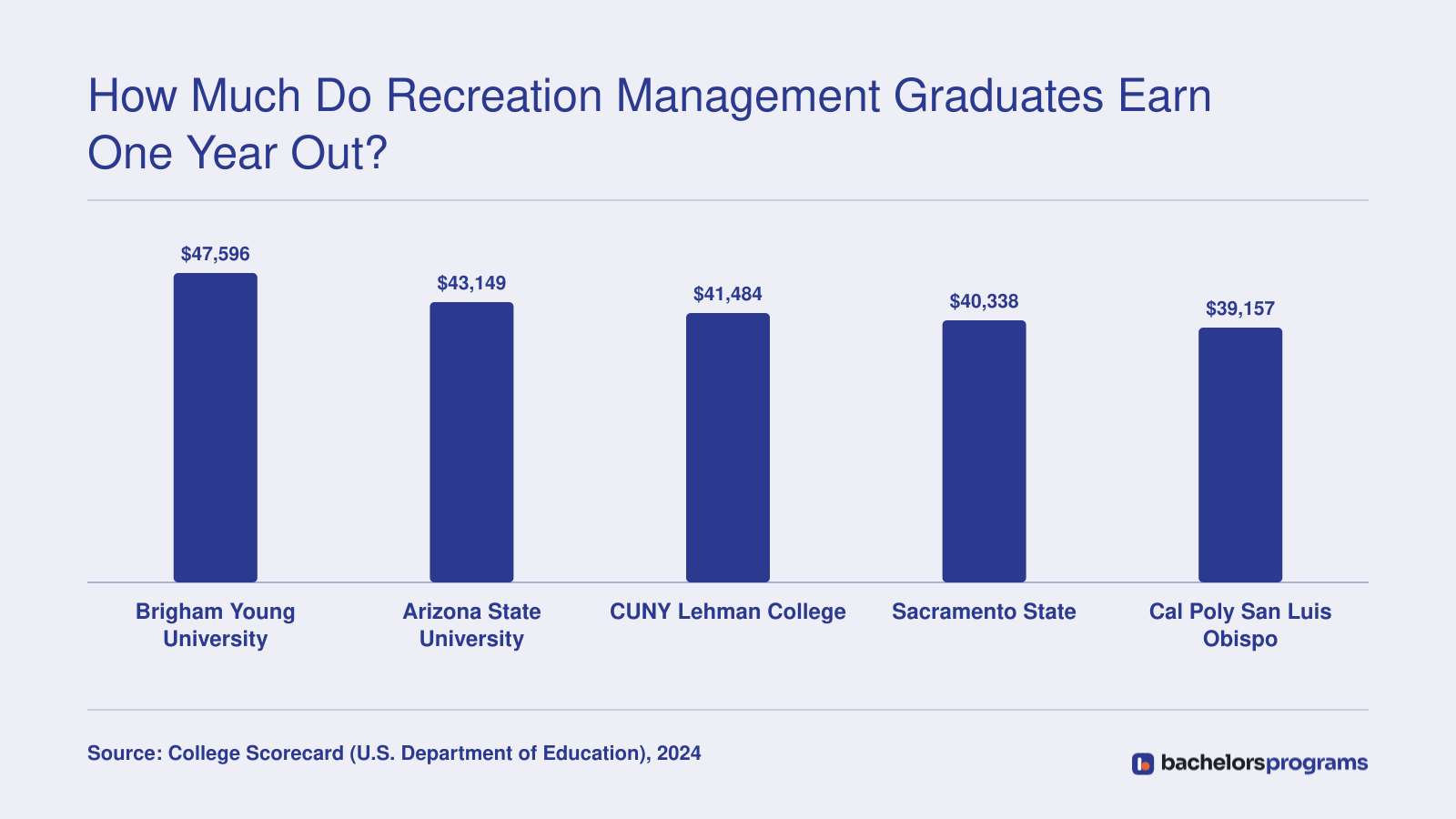
How Much Do Recreation Management Graduates Earn One Year Out?
Median earnings one year after finishing the program run from $39,157 at Cal Poly San Luis Obispo to $47,596 at Brigham Young University among the top-earning bachelor's programs here. Starting pay in recreation management is modest compared with many other fields, so treat these figures as a floor that tends to rise with experience. Program choice matters, and so does internship placement: a strong field placement with a park agency, therapeutic setting or sports organization can shape your first offer as much as the degree itself.
COAPRT Accreditation and CPRP Certification: Why They Matter
COAPRT accreditation applies to a degree program. The CPRP applies to you. One signals that a recreation management program meets a professional standard; the other is the credential you earn after meeting education and exam requirements. Knowing how the two connect makes it easier to compare programs, because the right one can shorten your path to certification.
What COAPRT Reviews
COAPRT is the Council on Accreditation of Parks, Recreation, Tourism and Related Professions, a body under the National Recreation and Park Association. It accredits baccalaureate programs in parks, recreation, tourism, sport management, event management, therapeutic recreation and leisure studies across the United States, its territories, Canada and Mexico.1 Its review looks at learning outcomes, internship requirements, faculty qualifications and the program's own assessment process, not just the course list.
Within the ranking above, California Polytechnic State University-San Luis Obispo and North Carolina State University at Raleigh list COAPRT accreditation for their recreation programs. Status can change, so confirm any program directly on the COAPRT directory before you apply.
What the CPRP Changes
Graduates of a COAPRT-accredited bachelor's program can sit for the CPRP exam immediately, or in their final semester before the internship or degree is finished; certification is issued once they pass and document graduation.2 Applicants without that accredited degree generally need qualifying full-time experience first; NRPA sets the exact requirement.2 NRPA also publishes the exam format and fee schedule, and both can change, so check the current candidate handbook before you apply.
Once certified, you renew on a two-year cycle by earning 2.0 CEUs and filing a recertification application, or by retaking the exam.3 The 2026 renewal fee is $75 for NRPA members and $85 for nonmembers.4
CPRE and a Final Check
CPRE is the senior executive credential. Applicants must hold a current CPRP, or one that expired within two years, and document professional full-time manager experience that varies by education: three years with a master's or higher, six with a bachelor's outside recreation or park resources, eight with an associate degree, or ten with a high school diploma or equivalency. It is valid for three years.
Before you commit, check the COAPRT directory and verify the program's accreditation status yourself.
Related Articles
Online, Hybrid and On-Campus Recreation Management Options
Do online parks and recreation degrees actually exist at the bachelor's level?
Yes. Several of the schools ranked here list fully online bachelor's programs, including the University of Utah, Arizona State University, Penn State World Campus and Oregon State University Ecampus. Bowling Green State University lists online, hybrid and on-campus formats for its resort and attraction management degree, so working students can choose a pace that fits.1
How Online Students Handle the Internship
Every accredited recreation management program requires field experience, and distance students almost always complete it close to home. Utah requires an internship for every student, typically over the summer.3 Penn State World Campus pairs online coursework with an internship, and Eastern Kentucky's program includes 615 internship and service-learning hours.2 If you already work for a park district, a YMCA or an attractions operator, ask early whether your current job can satisfy part of the requirement.
Transfer Credits and Completion Tracks
Recreation management is unusually transfer-friendly. Eastern Kentucky accepts up to 90 transfer credits from accredited institutions while requiring 120 total credits.2 Bowling Green maintains articulation agreements with Lorain County Community College, Tri-C and Columbus State, where students finish general education and then complete the final two years.1 Penn State World Campus runs three semesters a year, which can shorten time to graduation for students carrying a full course load.4
On-Campus Versus Online Trade-Offs
On-campus study brings field labs, outdoor coursework and direct contact with the agencies that hire locally. Online study trades some of that for schedule control, worth a lot if you already work in recreation and cannot relocate.
Questions to Ask Yourself
Do you picture yourself running a city park system, leading outdoor trips, or delivering clinical therapeutic recreation?
Do you want to sit for the CPRP exam right after you graduate?
Can you complete a full-time, semester-long internship, or do you need to stay near home?
Therapeutic Recreation Pays More Than Many Readers Expect
If you are weighing concentrations, the clinical therapeutic recreation track carries a clear pay advantage.
Recreation Management programs by state
Compare Recreation Management programs on the data that matters
Explore more Business & Management majors or browse every field of study.
All Business & Management programs Browse every field of study