Best Information Technology Schools in Michigan
Compare 14 accredited Information Technology programs in Michigan, with net price after aid, graduation rates, earnings and debt from IPEDS and the U.S. College Scorecard.
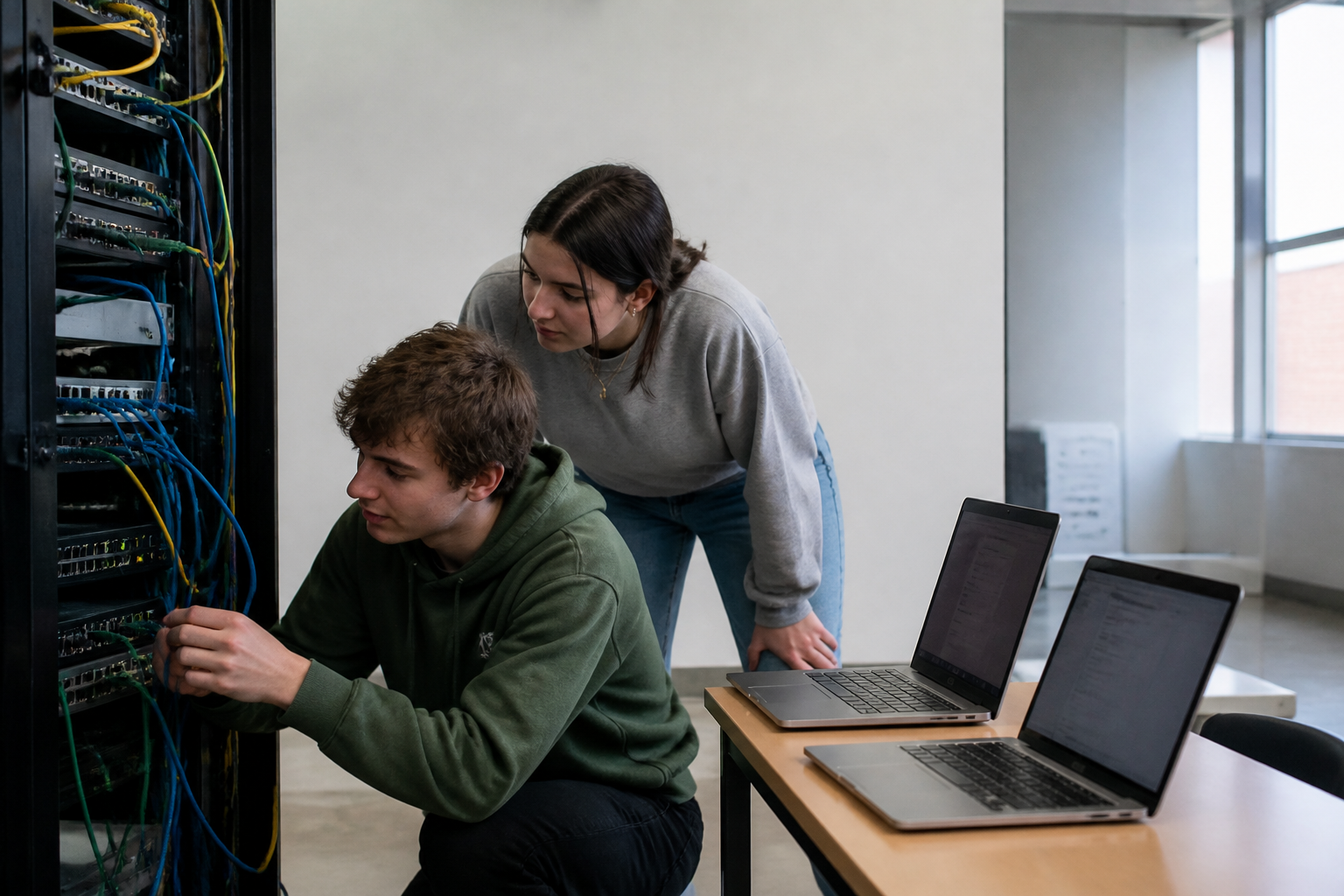
A bachelor's degree in information technology teaches the practical side of computing: networks, servers, security, and the systems an organization runs on. Michigan schools most often award the Bachelor of Science (B.S.) in Information Technology.
In-state tuition at the schools below runs from about $3,480 a year at Bay Mills Community College to roughly $35,000 at Andrews University, and reported earnings two years after graduation vary widely too. The ranking covers Michigan campuses and online programs at Michigan-based schools. Cost and earnings rarely point to the same school, and that gap shapes every comparison here.
Key Points
- Ferris State and Walsh College offer fully online IT bachelor's degrees.
- Bay Mills Community College posts one of the lowest net prices here.
- Michigan Achievement Scholarship aid can lower what in-state students actually pay.
Best Bachelor's in Information Technology Schools in Michigan, Ranked
Michigan's information technology bachelor's programs range from large public research universities in Detroit and Mount Pleasant to small private and tribal colleges, and several can be completed partly or fully online. Each entry below notes the credential offered, the tracks or concentrations available, and the details that most affect a first-year or transfer applicant.
Andrews University
#1Berrien Springs, MI · $10,000 – $15,000/yr (est.)
Best for: Faith-based campus learners seeking IT concentrations
A private Christian university in Berrien Springs, Andrews offers a BS in Computing with an information technology concentration inside a faith-based campus setting. Students take a broad computing core before specializing in IT, data analytics or applied computer science, and the program points toward roles in app and AI development. The university serves a mix of undergraduate and graduate students on a single southwest Michigan campus.
- Three concentrations: Applied Computer Science, Data Analytics and Information Technology
- Focus on designing IT solutions for connected organizations
- Skill areas include coding, data protection, data analysis and data science
- Program cites app and AI development career paths
- 2025-2026 bulletin available with full requirements
Wayne State University
#2Detroit, MI · ~$13,000/yr (est.)
Best for: Detroit-area transfer students with prior credits
Wayne State is Detroit's large public research university, and its information technology bachelor's sits inside the College of Engineering with a required business minor. The degree pairs 69 credits of technical coursework with the university's wider resources in the state's largest metro, giving students access to internships and employers downtown. Admission is test optional for first-year applicants, and transfer students can bring unlimited credits as long as 30 are earned at Wayne State.
- 120 credits, with 69 in computer science, engineering, math and communication
- Business minor courses are mandatory
- Coursework in networking, system administration, databases and web applications
- Unlimited transfer credits accepted, but 30 must be earned at WSU
- SAT and ACT scores optional for first-year applicants
- Deadlines: Aug. 1 fall, Dec. 1 winter, April 1 spring/summer
Oakland University
#3Rochester Hills, MI · $9,000/yr (est. net price)
Best for: Students wanting an industry-sponsored capstone project
Oakland University in Rochester Hills runs its information technology bachelor's through the School of Engineering and Computer Science, with nine tracks spanning cybersecurity, game development, software engineering and AI. The degree finishes with a workplace internship or an industry-sponsored design project rather than a purely classroom capstone. The 2014 Engineering Center houses the IT labs, and the campus sits within reach of metro Detroit's corporate technology employers.
- ABET-accredited through the Computing Accreditation Commission
- Nine tracks, including cybersecurity, game development and AI in IT
- Ends in a workplace internship or an industry-sponsored design project
- Core covers database design, information security and networks
- Engineering Center, opened in 2014, houses the IT labs
Grand Valley State University
#4Allendale, MI · $15,000 – $20,000/yr (est.)
Grand Valley State University in Allendale delivers its information technology bachelor's through the Department of Information Sciences and Technologies, with face-to-face instruction and some courses available online. The department runs dedicated computer labs and a CIS computing club, and offers named scholarships for IT students. Program materials report that 79% of graduates receive job offers before graduation.
- 125 total credit hours
- Face-to-face classes at the Allendale campus, with some courses online
- Coursework in cyber digital forensics, system security and usability design
- Named IT scholarships include the Initech Global Diversity in Technology award
- Department labs and a CIS Computing Club on campus
- Program reports 79% receive job offers before graduation
Central Michigan University
#5Mount Pleasant, MI · $18,000/yr (est. net price)
Central Michigan University in Mount Pleasant offers both a BA and a BS in information technology, with rolling admissions and a capstone built on a real-world IT problem. The major is unusually flexible in size, running 24 to 55 credit hours depending on the track and prior coursework. Students can build a custom track with an advisor and choose electives across business, art, education and public administration.
- Major runs 24 to 55 credit hours depending on the track
- Tracks in data communications and networking, database and multimedia design
- Web application development track and a custom track built with an advisor
- Capstone tackles a real-world IT problem
- Rolling fall admission with Dec. 1 priority scholarship consideration
- Next start dates: January 11, 2027 and August 30, 2027
Ferris State University
#6Big Rapids, MI · ~$9,000/yr (est.)
Ferris State University in Big Rapids takes a certification-heavy approach, requiring students in its Computer Information Technology program to pass CompTIA A+ plus two additional industry certifications to graduate. The degree combines a business core with hands-on administration coursework and can be completed on campus, online, or in a mixed format. Ferris sets modest GPA thresholds for admission, making it accessible to students with a mid-range high school record.
- 81 credits: a 30-credit business core plus 51 credits in the major
- Must pass CompTIA A+ plus two more certifications to graduate
- Certification choices include Network+, Linux+, Security+ and CCNA
- 2.50 high school GPA for new students, 2.35 for transfer applicants
- Fully online completion option admits 48 transferable credits
- Accredited by the Accreditation Council for Business Schools and Programs
University of Michigan-Flint
#7Flint, MI · $15,000 – $28,000/yr (est.)
UM-Flint's College of Innovation and Technology offers a bachelor's in information technology with two capstone courses built around problems supplied by industry partners. In-state students from lower-income households are automatically considered for the Go Blue Guarantee, which covers tuition. The Flint campus keeps admission at the university's standard first-year or transfer level, with no separate program application to declare the major.
- Two hands-on capstone courses built around industry problems
- No additional program-specific admission requirements to declare the major
- Automatic Go Blue Guarantee consideration for lower-income in-state students
- Internships with College of Innovation and Technology industry partners
- Coursework in programming, data management, networking, mobile systems and security
Walsh College
#8Troy, MI
Walsh College in Troy is a business-focused institution serving working adults, and its information technology bachelor's is built for flexible scheduling. Students can take classes online at any time, join live virtual sessions, or attend in person, and the college states the program can be finished in as little as one year with transfer credit. Transfer credits are accepted, and financial aid and scholarships are available.
- General Information Technology major
- Classes online anytime, live virtual Zoom sessions, or in person in Troy
- College states the program can be completed in as little as one year
- Transfer credits accepted through a simple transfer process
- Coursework in coding, cybersecurity, cloud computing and IT infrastructure
- Financial aid and scholarships available
Eastern Michigan University
#9Ypsilanti, MI · $15,000 – $20,000/yr (est.)
Eastern Michigan University in Ypsilanti offers a four-year, 76-credit information technology bachelor's with a senior design project that builds a working IT solution. Admission can require a secondary application to the program, though a B- or better in the introductory IT course admits students directly. Eastern Michigan charges the same undergraduate tuition regardless of state residency, which removes the usual out-of-state surcharge.
- 76 credits across a four-year program
- Senior design project builds a working IT solution
- B- or better in IT 101 admits students without a secondary application
- Coursework in virtualization, cloud computing, security and network administration
- ABET criteria cited for program objectives and student outcomes
- Scholarships available
Bay Mills Community College
#10Brimley, MI · ~$3,100/yr (est.)
Bay Mills Community College in Brimley offers a bachelor's in computer information systems with a strong hands-on infrastructure focus. Coursework runs through Linux and Windows Server, Active Directory, routing and switching, and automation with Python and Ansible. It is the smallest institution on this list and a tribal college, and its associate program feeds directly into the bachelor's.
- Labs in Linux and Windows Server, Active Directory and group policy
- Routing, switching, DHCP, DNS, VLANs and subnetting
- Aligned with CompTIA Network+ and Cisco CCNA objectives
- Python and Ansible automation, Infrastructure as Code, version control
- Virtualization, cloud computing and Internet of Things coursework
- Associate program leads into the bachelor's at BMCC
Cost & outcomes by school
Federal data for the highest-earning Information Technology programs, independent of the ranking above. Earnings are this field's bachelor's graduates four years after completing where the Scorecard reports them, else the school's undergraduate median.
| School | Net price / yr | Grad rate | Earnings | Debt | Grads/yr | Format |
|---|---|---|---|---|---|---|
| Wayne State University MI | $12,766 | 58% | $104,630 | $18,750 | 176 | Campus |
| Grand Valley State University MI | $16,317 | 67% | $94,330 | $24,250 | 138 | Campus |
| Walsh College MI | — | — | $91,273 | $14,566 | 43 | Online or campus |
| Oakland University MI | $9,120 | 58% | $90,737 | $26,000 | 182 | Campus |
| Eastern Michigan University MI | $15,407 | 46% | $90,620 | $21,501 | 6 | Campus |
| Ferris State University MI | $8,624 | 47% | $85,131 | $27,209 | 9 | Online or campus |
| Michigan Technological University MI | $14,182 | 68% | $78,198 | $24,990 | — | Campus |
| Central Michigan University MI | $17,597 | 59% | $73,112 | $27,000 | 21 | Campus |
| Lawrence Technological University MI | $32,918 | 61% | $69,151 | $27,000 | 6 | Campus |
| Adrian College MI | $25,368 | 48% | $55,504 | $27,000 | — | Campus |
| University of Michigan-Flint MI | $7,007 | 40% | $53,230 | $25,000 | 8 | Campus |
| Andrews University MI | $12,547 | 72% | $53,187 | $26,000 | 3 | Campus |
Sources: U.S. Department of Education. Net price, graduation rate, earnings and debt: College Scorecard (earnings and debt for this field's bachelor's graduates where reported, else school-wide); graduates: IPEDS. A dash means no figure is reported.
Cost, debt & payoff
Median earnings of this field's bachelor's graduates (4 yrs after completing, else the school's undergraduate median) vs. their median federal loan debt · U.S. College Scorecard
Across these programs the median graduate earns about $75,655 and finishes with roughly $25,000 in debt — a ratio that clears a common rule of thumb (keep debt below first-year salary). Net price and debt vary widely school to school, so check the per-school figures in the table above before you shortlist.
How We Ranked Michigan's Bachelor's Programs in Information Technology
The best IT school in Michigan depends on what you need most: the lowest cost, the strongest earnings, or the right format. No single school wins on every measure, so the ranking combines several College Scorecard measures and leaves you to read the results against your own priorities.
What Goes Into the Ranking
Three inputs carry the most weight, and each is simple to interpret.
- Earnings and debt: Program-level figures show what graduates of the specific IT major earn and borrow, which says more than a school-wide average.
- Net price after aid: This is what students pay on average once grants and scholarships are subtracted from the sticker price, and it is often far lower than published tuition.
- Selectivity: Admissions competitiveness shows how hard it is to get in, which helps you sort realistic options from reaches.
Limits You Should Know About
Some figures describe the whole institution, not the IT major. Graduation rate is a school-wide average, so a program at Michigan Technological University or Wayne State University may graduate students at a different pace than the campus overall. Net price works the same way. It blends every undergraduate's aid package, so treat it as an approximation. Your own price depends on family income, residency, and the aid you qualify for.
Scope and Data
Only bachelor's programs at Michigan-based schools were considered, whether delivered on campus or online. Program names vary, from Information Technology to Computer Information Technology to Computing, so the list reflects the major each school actually offers. All figures come from the latest College Scorecard snapshot, which lags current-year tuition and pay. Confirm current costs and requirements with each school before you apply.
Lowest-Cost Michigan Bachelor's Programs in Information Technology
These Michigan schools post the lowest average net price, the amount families typically pay after grants and scholarships, among the IT bachelor's programs ranked here. Bay Mills Community College, a tribal college in Brimley, charges the same low rate to in-state and out-of-state students. Andrews University's private sticker price drops by roughly two-thirds once aid is applied. Figures come from IPEDS and the College Scorecard (U.S. Department of Education, 2024 data).
| School | City | Program | Format | In-State Tuition and Fees | Out-of-State Tuition and Fees | Average Net Price | Median Graduate Debt |
|---|---|---|---|---|---|---|---|
| Bay Mills Community College | Brimley | Computer Information Systems | Campus | $3,480 | $3,480 | $3,073 | N/A |
| University of Michigan-Flint | Flint | BS in Information Technology & Informatics | Campus | $14,704 | $28,320 | $7,007 | $25,000 |
| Ferris State University | Big Rapids | Computer Information Technology | Campus and online | $14,778 | $14,778 | $8,624 | $21,000 |
| Oakland University | Rochester Hills | Bachelor of Science in Information Technology | Campus | $15,262 | $23,188 | $9,120 | $22,750 |
| Andrews University | Berrien Springs | BS in Computing (Information Technology concentration) | Campus | $35,056 | $35,056 | $12,547 | $26,000 |
Online and Hybrid Bachelor's in Information Technology Options at Michigan Schools
Ferris State University and Walsh College both publish a fully online option for their information technology bachelor's degrees. You can earn the degree from a Michigan school without ever sitting in a campus classroom.
Fully Online Options
- Ferris State University (Big Rapids): The Computer Information Technology program runs on campus and online. The online completion path accepts up to 48 transfer credits and asks for a 2.35 transfer GPA, which makes it a workable route for someone arriving with an associate degree.
- Walsh College (Troy): The B.S. in Information Technology is offered online and on campus, with both synchronous and asynchronous course options. If you need live instruction at a set hour, ask which courses run that way; if you need to study at 11 p.m., ask which ones do not.
Neither school publishes a separate online rate on the pages reviewed. Walsh lists one tuition figure for Michigan residents and nonresidents alike, and Ferris does the same. Confirm the billing with admissions before you build a budget.
Where the Campus Programs Sit
Andrews University, Wayne State University, Oakland University, Grand Valley State University, Central Michigan University, University of Michigan-Flint, Eastern Michigan University and Bay Mills Community College list their information technology programs as campus-based. A hybrid course may still appear in a given term, but plan on attending in person for most of your coursework.
What to Ask Before You Commit
- Are online sections taught by the same faculty who teach on campus?
- Does the online track include the capstone or internship requirement?
- Is there a residency requirement for upper-level courses?
Admission Requirements for Michigan IT Bachelor's Programs
Admission to a Michigan IT bachelor's program mostly follows each university's general rules. A few programs add their own GPA bar. Policies change, so treat what follows as a starting point and confirm on each school's admissions page.
Broad-Access Schools
Most schools with a reported admission rate admit a large majority of applicants. Scorecard rates run from about 70% at University of Michigan-Flint to about 91% at Ferris State, with Wayne State, Andrews, Grand Valley State, Eastern Michigan, Oakland and Central Michigan between those two. Walsh College and Bay Mills Community College report no admission rate.
- Wayne State: Lists no entrance exam requirement and a test-optional approach. It also lists unlimited transfer credits.
- University of Michigan-Flint: Lists no extra admission requirements for the IT major.
- Central Michigan: Uses rolling admissions.
- Eastern Michigan: A B- in IT 101 waives the secondary application to the program.
- Ferris State: Lists a 2.5 GPA minimum and a 2.35 GPA for transfers. Its program listing also mentions an SAT or ACT entrance exam, so verify the current test policy.
Programs With a Stated GPA
Michigan Technological University's Information Technology BS publishes a 2.75 GPA minimum and accepts transfer coursework graded C (2.0) or better. It requires 30 semester credit hours in residence out of 123 total.
Where Nothing Is Published
For Andrews, Oakland, Grand Valley State, Walsh and Bay Mills, we found no program-specific GPA minimum or test policy. Walsh describes its transfer process as simple but gives no credit cap in the material we reviewed. Where a school is silent, ask admissions directly rather than assume. Test-optional status can also differ between general admission and scholarship consideration.
Transfer Tip for Community College Students
Before you enroll in community college courses, ask your target school for its course-equivalency list. Prioritize introductory programming, first-year writing and college math, and earn at least a C in each, since C is the common floor for transfer credit.1 Then confirm how many credits the program will accept, and how many you must complete in residence.2 Ferris State's online completion route, for example, admits 48 transfer credits. Matching courses to the major early keeps general-education credit from turning into unused electives.
Cost of a Bachelor's Degree in Information Technology in Michigan
Michigan has rebuilt much of its state aid around a single program, the Michigan Achievement Scholarship, and that changes what a bachelor's degree in information technology really costs.
Sticker Price vs. Net Price
In-state tuition ranges from $3,480 at Bay Mills Community College to $35,056 at Andrews University. Most of the public universities here cluster between about $14,700 and $16,300. Net price, which is sticker cost minus grant aid, tells a different story:
- University of Michigan-Flint: $14,704 tuition, $7,007 net price.
- Ferris State University: $14,778 tuition, $8,624 net price.
- Oakland University: $15,262 tuition, $9,120 net price.
- Andrews University: $35,056 tuition, $12,547 net price.
- Wayne State University: $15,190 tuition, $12,766 net price.
- Eastern Michigan University: $16,240 tuition, $15,407 net price.
Grand Valley State University's net price of $16,317 sits slightly above its tuition because net price also counts housing and other costs. All of these are institution-wide averages, not figures for IT majors specifically.
What Students Borrow
Median debt for graduates, also measured school-wide, runs from $21,000 at Ferris State to $26,000 at Andrews. Wayne State sits at $21,250, Oakland at $22,750, Grand Valley at $24,500, and UM-Flint and Eastern Michigan at $25,000. Pell Grant share shows how many students need need-based help: about 68% at Wayne State, 66% at UM-Flint, 65% at Eastern Michigan, 62% at Ferris State, 56% at Oakland and Andrews, and 49% at Grand Valley.
Michigan State Aid
- Michigan Achievement Scholarship: Up to $5,500 a year for up to five years, or $27,500 total. For 2026-27 that splits into a $2,500 minimum plus a $3,000 last-dollar award. You need a high school diploma or equivalent earned in 2023 or later, a current FAFSA, a Student Aid Index of $30,000 or less, Michigan residency, and full-time undergraduate enrollment within 15 months of finishing high school. The final eligibility date is August 6, 2027.
- Michigan Competitive Scholarship: Requires a 2.0 cumulative GPA and, for the Class of 2017 and later, an SAT score of at least 1200. Confirm the current award amount with MiStudentAid.
- Tuition Incentive Program: Phase I covers certificate or associate study for Medicaid-eligible students, up to 80 semester or 120 term credits. Phase II supports bachelor's study for up to 30 months after the student completes 56 transferable credits, a certificate, or an associate degree.
Get Your Actual Award
File the FAFSA first, since each program above depends on it. Then ask each school's financial aid office for a personalized award letter, because that letter, not the averages above, shows what you would pay.
Questions to Ask Yourself
Do you need an online or hybrid format, or can you attend a campus in Michigan?
Would you rather specialize in cybersecurity, networking, or software, and does the school offer that track?
Does the net price after aid fit your budget, given the typical starting earnings for each program?
Accreditation and Specializations: Cybersecurity, Networking, and Software
School-level and program-level accreditation are two separate checks, and a third applies only if cybersecurity is your goal.
Three Layers to Verify
- Regional accreditation: The Higher Learning Commission (HLC) accredits Michigan institutions, and it affects federal aid and credit transfer. Michigan Technological University's 2026 catalog lists HLC accreditation. Confirm every other school in the HLC directory.
- ABET: ABET accredits individual programs, not whole schools. Michigan Tech's B.S. in Information Technology holds ABET Computing Accreditation Commission accreditation, as do its computer science and software engineering degrees. Oakland University and Eastern Michigan University both describe their IT bachelor's as ABET accredited. Ferris State's program carries business-school accreditation from the Accreditation Council for Business Schools and Programs, which is not ABET.
- NSA/DHS CAE-CD: This designation recognizes cybersecurity education at regionally accredited institutions. Our research did not confirm it for any school here, so check the official list before you count on it.
How the Tracks Differ
- Cybersecurity: Expect coursework in system security, forensics and risk strategy. Grand Valley State University includes cyber digital forensics, Andrews University has a data and systems security focus, and Walsh College teaches cybersecurity strategy. Baker College names cybersecurity in its program title. Typical targets are security analyst and cybersecurity specialist roles.
- Networking: Labs center on routers, switches, server administration and vendor certifications. Bay Mills Community College prepares students for CompTIA Network+ and Cisco CCNA, Ferris State builds toward Network+, Security+ and CCNA, and Central Michigan University offers a networking track. Jobs include network administrator, systems administrator and IT support.
- Software: The emphasis shifts to programming, databases and web or app development. Central Michigan has a web application development track, and Andrews highlights app and AI development. Students who want a pure engineering path can look at Michigan Tech's separate software engineering degree.
Check Status Yourself
Use the ABET accredited program search, the NSA National Centers of Academic Excellence directory and the HLC directory. Accreditation status can change, so confirm each one before you apply.
Information Technology vs. Computer Science vs. Information Systems: Which Fits You?
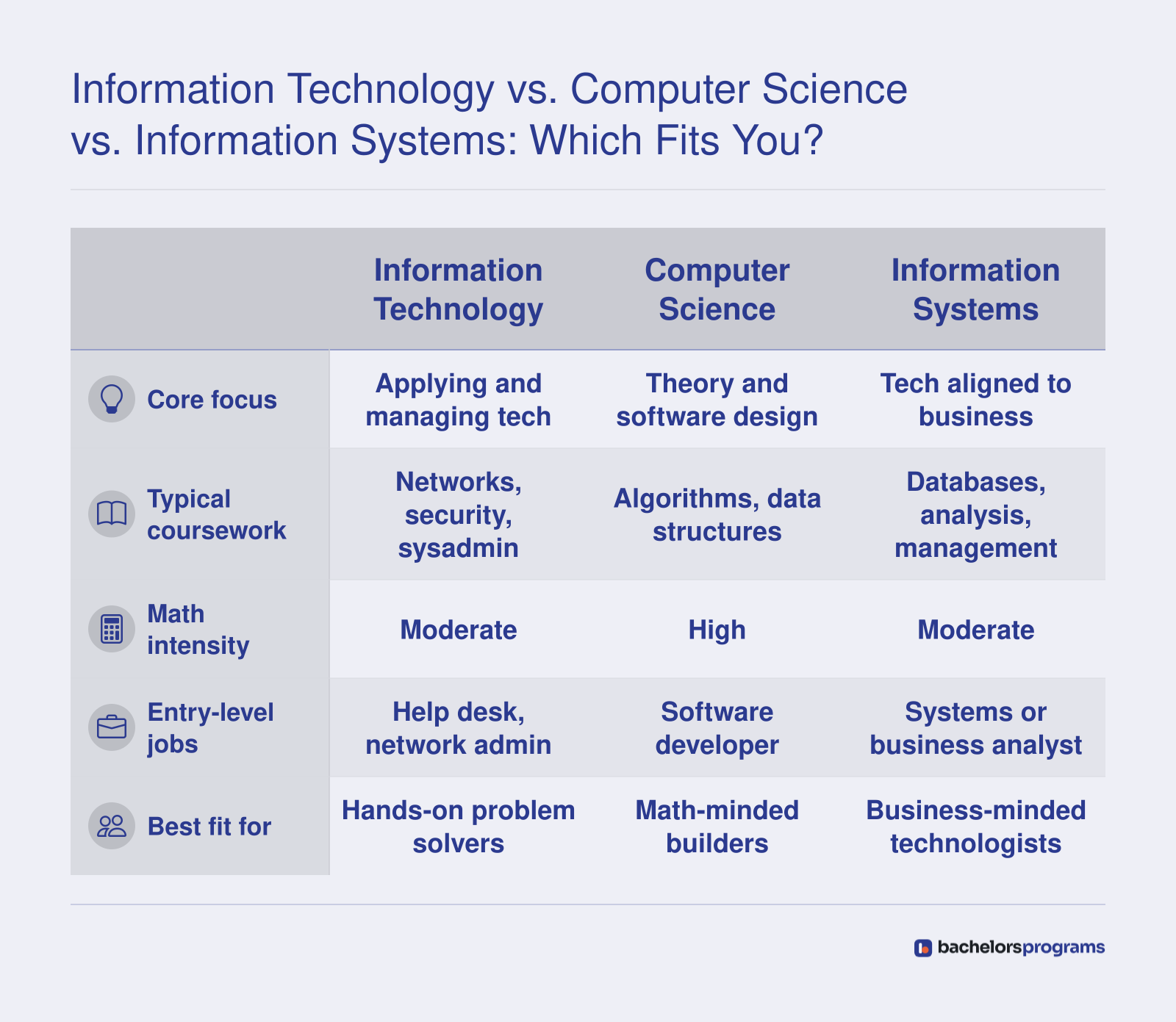
A bachelor's in information technology centers on applying and managing technology for organizations, while computer science leans toward theory and software, and information systems ties technology to business. Program names vary at Michigan schools: University of Michigan-Flint pairs IT with informatics, Ferris State University uses Computer Information Technology, and Bay Mills Community College offers Computer Information Systems. Read each curriculum before assuming what a title covers.
Related Articles
Common Questions About Michigan IT Bachelor's Programs
These answers cover the questions readers ask most often. Where a detail depends on a specific school, check that school's current catalog before you apply.
Is an information technology degree worth it in Michigan?
Can you earn a bachelor's degree in information technology online from a Michigan school?
Do I need IT certifications on top of a bachelor's degree?
Can I start at a Michigan community college and transfer into a B.S. in Information Technology?
Compare Information Technology programs on the data that matters
Explore more Computers & IT majors or browse every field of study.
All Computers & IT programs Browse every field of study