Best Information Technology Schools in North Carolina
Compare 18 accredited Information Technology programs in North Carolina at 15 colleges, with net price after aid, graduation rates, earnings and debt from IPEDS and the U.S. College Scorecard.

A bachelor's degree in information technology is a four-year program in networks, databases, security and systems support. In North Carolina, employers in the Research Triangle and Charlotte's banking corridor hire IT analysts and network administrators from these programs.
Most schools here award a Bachelor of Science (B.S.) in Information Technology, though the labels vary. NC State places IT inside business administration, UNC Charlotte offers an IT concentration in a B.A., and East Carolina University pairs IT with cybersecurity.
Every program here is a bachelor's at a North Carolina school, offered on campus or online. Costs differ as well: in-state tuition and fees at the public campuses run from $3,648 at UNC Pembroke to $8,799 at NC State.
Key Points
- UNC Pembroke posts the lowest average net price after aid: $10,260.
- NCCU's online IT degree requires a 2.0 GPA and 24 transfer credits.
- North Carolina doesn't license IT work, so stacked certifications matter.
Best Schools for a Bachelor's Degree in Information Technology in North Carolina
Every school below awards a bachelor's degree in information technology, or a computing degree with an IT concentration, at a North Carolina campus. Each entry notes what the program actually covers, how many concentrations it opens up, and how the school's undergraduates fare overall, so you can compare programs on substance rather than name recognition alone.
North Carolina State University at Raleigh
#1Raleigh, NC · $9,000 – $33,000/yr (est.)
Best for: Business-focused students targeting analyst roles
North Carolina State University is the largest public research campus in the state, and its IT coursework sits inside the Poole College of Management. Students earn a business degree carrying 46 credits of IT work, including SQL, networking, systems analysis and a capstone, which suits anyone who wants to sit between technologists and business units. The university reports a graduation rate of about 85%, and its Raleigh location puts students near one of the Southeast's densest technology employment markets.
- 120 total credit hours, including a business strategy capstone
- IT concentration carries 46 credits: 34 core business, 12 IT
- IT requirements chosen from database management, networking or systems development
- IT electives include web development, systems analysis and an IT capstone
- Coursework in SQL, UI design, cybersecurity and software development
- IT and consulting clubs, plus internships across industries
- Graduates work as IT analysts, data analysts and systems analysts
- IT jobs projected to grow 13% through 2030
University of North Carolina at Charlotte
#2Charlotte, NC · $15,000 – $20,000/yr (est.)
Best for: Students wanting applied computing over theory
UNC Charlotte is the largest university in the Charlotte metro and houses this program in its College of Computing and Informatics. The degree is deliberately applied: students study the usability, security and reliability of IT infrastructures rather than heavy theoretical math, and take electives in another discipline that a second major or minor can satisfy. The university reports a graduation rate of about 69%, and eligible students can add the Computing and Informatics Honors Program.
- 120 credit hours, on campus in the College of Computing and Informatics
- Focus on the usability, security and reliability of IT infrastructures
- Applied computing emphasis rather than theoretical or mathematical work
- Electives taken in a non-computer-science discipline, or via a second major or minor
- Strong technical writing and communications component
- Honors program option for eligible students
- Prepares graduates for IT project and product management roles
University of North Carolina Wilmington
#3Wilmington, NC · $7,000 – $24,000/yr (est.)
Best for: Cybersecurity-focused students wanting a validated track
UNC Wilmington's IT degree is an interdisciplinary major shared by the Department of Computer Science and the Congdon School of Supply Chain, Analytics, and Information Systems. Six concentrations let students shape the degree, and the cybersecurity concentration is validated under the NSA's National Centers of Academic Excellence in Cybersecurity. The program is DHS STEM designated, and the university reports a graduation rate of about 71%.
- Six concentrations, including cloud computing and networking, cybersecurity and criminology
- Cybersecurity concentration validated by the NSA's National Centers of Academic Excellence
- Interdisciplinary major shared by computer science and the Congdon School
- DHS STEM designated; F1 students can apply for a 24-month OPT extension
- Courses include databases, platform technologies, web application development and interfaces
- Internships available and undergraduate research encouraged
- Alumni work as systems analysts, computer engineers, consultants and information scientists
East Carolina University
#4Greenville, NC · ~$16,000/yr (est.)
East Carolina University's information and cybersecurity technology program sits in the College of Engineering and Technology and has held an NSA National Center of Academic Excellence in Cyber Defense designation since 2005. Students work hands-on with Cisco routers and switches and with Microsoft and Red Hat server environments, and a required internship plus a two-semester capstone keep the degree applied. The university reports a graduation rate of about 63%.
- Required internship plus a two-semester professional capstone
- Students can earn up to seven professional certifications
- NSA National Center of Academic Excellence in Cyber Defense since 2005
- Hands-on work with Cisco routers and switches in the Cisco Networking Academy
- Microsoft Academic Alliance and Red Hat Academy server environments
- 4+1 pathways available for a faster master's
- Covers internetworking, client-server systems and IT fundamentals
University of North Carolina at Greensboro
#5Greensboro, NC · $11,000/yr (est. net price)
UNC Greensboro offers one of only two bachelor's information science programs at a North Carolina public university, and this concentration leans on instructional design and workforce development rather than pure networking. Students complete internships and an original research capstone with faculty mentorship available. The university reports a graduation rate of about 56%.
- One of only two bachelor's information science programs at NC public universities
- Internships plus an original research capstone
- Faculty mentorship available to undergraduates
- Coursework in technology training, knowledge management and user education
- Affiliated minor in videogaming and esports
- Prepares students for instructional design, UX design and corporate training roles
North Carolina A & T State University
#6Greensboro, NC · ~$11,000/yr (est.)
North Carolina A&T State University is a land-grant HBCU in Greensboro whose computer systems technology department built its reputation on mainframe administration and networking. The IT degree mixes programming, operating system and network administration with general education and math beyond pre-calculus, and corporate partners include IBM, Cisco, Red Hat and Bank of America. The university reports a graduation rate of about 57%.
- Department niche is mainframe administration and computer networking
- Coursework in system administration, disk storage, network security and mobile computing
- Math beyond pre-calculus required
- Prepares students for computer networking certification
- Department says certification can add $20K to a starting salary
- Corporate partners include IBM, Cisco, Red Hat, Bank of America and Verizon
- Careers: network engineer, systems analyst, information security analyst
Winston-Salem State University
#7Winston-Salem, NC · $10,000 – $15,000/yr (est.)
Winston-Salem State University is an HBCU in the Piedmont Triad that runs its IT degree in a hybrid format, with classes on campus and some coursework online. Students can finish in four years full- or part-time and can add a 4+1 track that folds a master's in computer science and information technology into one extra year. The university reports a graduation rate of about 47%.
- Hybrid format: classes on campus with some online coursework
- Four-year plan with full-time and part-time options
- 5-year BS to MS (4+1) track in computer science and information technology
- 20:1 student-to-faculty ratio
- Coursework in system administration, data communications and web programming
- ABET computing accreditation cited by the university
- Ideas Lab, a multidisciplinary creative hub on campus
University of North Carolina at Pembroke
#8Pembroke, NC · ~$10,000/yr (est.)
UNC Pembroke is a public university in the Sandhills region with a small, lab-oriented IT department and a Cyber Defense Education Center. Undergraduates choose between a general track and a cybersecurity track, and the department supports an ACM student chapter plus a minor in software application development. The university reports a graduation rate of about 44%, and it participates in the state's NC Promise tuition plan, which sets undergraduate tuition at $500 a semester for in-state students and $3,500 for out-of-state students.
- Two tracks: general IT or cybersecurity
- Cybersecurity track covers secure system design, ethical hacking and digital forensics
- Labs and specialized facilities at the Cyber Defense Education Center
- General track covers systems analysis, data management and web development
- ACM student chapter runs programming challenges
- Minor in software application development available
- Internships and practical projects built into the coursework
Campbell University
#9Buies Creek, NC · $25,000/yr (est. net price)
Campbell University is a private university in Buies Creek, southeast of Raleigh, with a security-focused IT program. The degree pairs information assurance, privacy and safe computing with tracks in information security and information management, and the curriculum emphasizes business ethics. The university reports a graduation rate of about 61%.
- Two tracks: information security and information management
- Four-year degree covering information assurance and safe computing
- Coursework in information privacy, internet safety and intelligence distribution
- Emphasizes business ethics, integrity and honesty
- Listed careers include systems analyst, network architect and corporate security officer
Lenoir-Rhyne University
#10Hickory, NC · $21,000/yr (est. net price)
Lenoir-Rhyne University is a private university in Hickory with a B.A. in information technology that leaves room for electives and a second major. Students pick a concentration in analytics or web programming and finish with a capstone and a comprehensive senior exam. Internships have placed students at Apple, Google, CommScope and Corning, and the university reports a graduation rate of about 48%.
- 45 to 49 credit major inside a 120-credit minimum
- Concentrations in analytics (6 hours) or web programming (9 hours)
- Capstone project plus a comprehensive senior exam
- Core covers Java, networks, databases, security and project management
- Internships at Apple, Google, CommScope and Corning
- Students attend TechEd and SAP Sapphire conferences
- Honors track: 3.0 cumulative and 3.2 major GPA, plus an original thesis
- Transfer route from Catawba Valley Community College
Cost & outcomes by school
Federal data for the highest-earning Information Technology programs, independent of the ranking above. Earnings are this field's bachelor's graduates four years after completing where the Scorecard reports them, else the school's undergraduate median.
| School | Net price / yr | Grad rate | Earnings | Debt | Grads/yr | Format |
|---|---|---|---|---|---|---|
| East Carolina University NC | $15,739 | 63% | $90,197 | $26,853 | 50 | Campus |
| North Carolina Central University NC | $15,359 | 42% | $88,053 | $31,000 | 38 | Online or campus |
| University of North Carolina at Charlotte NC | $15,435 | 69% | $83,018 | $20,000 | 117 | Campus |
| Strayer University-North Carolina NC | — | 33% | $82,304 | $37,500 | 27 | Online |
| University of North Carolina Wilmington NC | $20,109 | 71% | $71,964 | $26,000 | 28 | Campus |
| Campbell University NC | $24,516 | 61% | $71,497 | $25,000 | 15 | Online or campus |
| North Carolina State University at Raleigh NC | $17,303 | 85% | $68,758 | $20,121 | — | Campus |
| Winston-Salem State University NC | $13,479 | 47% | $63,562 | $25,000 | 6 | Hybrid |
| University of North Carolina at Pembroke NC | $10,260 | 44% | $53,022 | $24,447 | 30 | Campus |
| Pfeiffer University NC | $19,076 | 35% | $51,562 | $26,163 | 9 | Campus |
| University of North Carolina at Greensboro NC | $10,965 | 56% | $48,160 | $22,858 | — | Campus |
| Methodist University NC | $24,704 | 44% | $48,050 | $27,000 | 11 | Online or campus |
Sources: U.S. Department of Education. Net price, graduation rate, earnings and debt: College Scorecard (earnings and debt for this field's bachelor's graduates where reported, else school-wide); graduates: IPEDS. A dash means no figure is reported.
Cost, debt & payoff
Median earnings of this field's bachelor's graduates (4 yrs after completing, else the school's undergraduate median) vs. their median federal loan debt · U.S. College Scorecard
Across these programs the median graduate earns about $70,128 and finishes with roughly $26,508 in debt — a ratio that clears a common rule of thumb (keep debt below first-year salary). Net price and debt vary widely school to school, so check the per-school figures in the table above before you shortlist.
Most Affordable Bachelor's in IT Schools in North Carolina
The University of North Carolina at Pembroke has the lowest average net price after aid in this comparison at $10,260, followed by North Carolina A & T State University and the University of North Carolina at Greensboro. Net price comes from the U.S. Department of Education's IPEDS and College Scorecard (2024) data and is reported separately for public and private schools. It is an average for aided students covering tuition, fees, books and living costs minus grants, so treat it as a planning benchmark rather than an exact quote. Sticker tuition can mislead in both directions: Livingstone College, a private school in our directory, lists $18,296 in tuition but averages $13,479 after aid, while every public school here posts a net price above its in-state tuition because housing and other expenses are included.
| School | City | Sector | Program | In-State Tuition and Fees | Average Net Price After Aid |
|---|---|---|---|---|---|
| University of North Carolina at Pembroke | Pembroke | Public | Information Technology | $3,648 | $10,260 |
| North Carolina A & T State University | Greensboro | Public | Bachelor of Science in Information Technology | $6,813 | $10,846 |
| University of North Carolina at Greensboro | Greensboro | Public | Information Science, B.S. (Information Technology Training and Development Concentration) | $7,661 | $10,965 |
| Winston-Salem State University | Winston-Salem | Public | Information Technology | $6,126 | $13,479 |
| Livingstone College | Salisbury | Private | Computer Information Systems | $18,296 | $13,479 |
Online and Hybrid Bachelor's in Information Technology Options at North Carolina Schools
Online delivery is no longer the exception in North Carolina IT programs, but the billing rules around it are still uneven. Among the schools ranked here, most list their bachelor's degree in information technology as campus-based, while a few publish a formal online or hybrid option and others split enrollment between both.
Formats at the Schools Here
North Carolina Central University is the clearest online path: its B.S. in Information Technology runs online and on campus, with concentrations in cybersecurity, data analytics and ICT. North Carolina A & T and Campbell University each list their programs as available in both formats, and Winston-Salem State describes its information technology degree as hybrid. North Carolina State, UNC Charlotte, UNC Wilmington, East Carolina, UNC Greensboro, UNC Pembroke and Lenoir-Rhyne list campus-based programs, several with labs, internships and certification prep built into the coursework.
Who Benefits From Which Format
Online suits working adults and community college transfers who need to keep a job or stay near home; NCCU accepts as few as 24 transfer credits toward the 120 required. Campus study pays off where a program leans on physical infrastructure: East Carolina's router and switch labs and required internship, UNC Pembroke's cyber defense labs, and the employer ties that internships build.
Does Online Tuition Differ by Residency?
At NCCU it does: online IT students pay $361 per credit in state and $433 out of state, and the program page states no additional fees, subject to change. UNC Pembroke charges a discounted distance-education rate to resident undergrads who have declared an online major, while nonresidents pay standard out-of-state rates; an on-campus program keeps on-campus fees even when courses move online. At NC State, distance-education tuition is $280.46 per credit for residents, billed by program and registration rather than by individual course.1 NC A & T's main-campus tuition is $3,646 in state and $18,128 out of state for 2026-2027, plus $3,273 in required fees, and taking an online course alone does not change that billing.
Admission Requirements for North Carolina Bachelor's in IT Programs
North Carolina Central University (NCCU) sets a 2.0 minimum GPA on college coursework for its online Bachelor of Science in Information Technology, and it asks for at least 24 transferable credit hours. Applicants must also be eligible to return to the last institution they attended. That is the clearest published standard among the schools covered here, and it shows the program is built mainly for transfer students and adult learners rather than first-year applicants.
GPA, Test Policy and Transfer Credit by School
NCCU's admissions page does not say whether SAT or ACT scores are required, waived or disregarded for this program, so confirm that with the admissions office before you apply. It does state that additional transfer credits can significantly reduce the hours you still need to graduate.
For NC State, UNC Charlotte, UNC Wilmington, East Carolina, UNC Greensboro, NC A&T, Winston-Salem State, UNC Pembroke, Campbell, Lenoir-Rhyne, Pfeiffer and Livingstone, we could not confirm a program-specific minimum GPA, test policy or transfer-credit rule from an official undergraduate IT admissions page. Treat each school's general undergraduate admissions page as the authority, and ask admissions staff directly about IT-specific requirements. One detail that does appear: Lenoir-Rhyne's honors track in information technology asks for a 3.0 GPA and a 3.2 GPA in the major.
A revised Comprehensive Articulation Agreement (CAA) took effect in Spring 2026.1 It covers the Associate in Arts (A10100) and Associate in Science (A10400) degrees, and it includes several protections for transfer students:
- Grade threshold: CAA coursework counts when you earn a C- or higher.1
- General education: A General Education Waiver is included.
- Class standing: Eligible students transfer in at junior level.
- Admission: The agreement includes a Transfer Assured Admissions Policy.
The CAA is a statewide framework. It does not guarantee a program-specific IT articulation agreement at any one university, and no course-by-course map for NCCU's online program is confirmed. Ask the receiving school for a degree plan before you choose electives at the community college, and note that applied science associate degrees fall outside the CAA.
One Way to Strengthen Your Application
Show hands-on technical work. Build a small project, such as a home network lab, a simple database-driven site or a documented security exercise. Pair it with an earned entry-level certification and a short write-up of what you built. Admissions reviewers for IT majors can see practical initiative that a GPA alone does not show, and the work gives you something concrete to discuss in a personal statement or interview.
Cost of a Bachelor's in Information Technology in North Carolina
In-state tuition and fees at the public universities ranked here run from about $3,650 at UNC Pembroke to roughly $8,800 at North Carolina State University at Raleigh, while out-of-state rates on the same campuses climb from about $7,650 to nearly $32,850. Those sticker numbers matter less than the average net price a student actually pays after grants and scholarships, which at these schools falls between roughly $10,300 and $17,300. Private tuition looks starker still: Livingstone College lists about $18,300 and Pfeiffer University about $35,100, yet their average net prices land near $13,500 and $19,100.
Aid reliance is the norm, not the exception
At Winston-Salem State University, roughly 79 percent of undergraduates receive Pell Grants; the share is about 73 percent at North Carolina A & T State University and about 77 percent at North Carolina Central University. Even at UNC Charlotte and East Carolina University, more than half of undergraduates are Pell recipients. Median federal debt for graduates who borrowed stays modest: about $20,100 at North Carolina State University at Raleigh, $21,500 at UNC Charlotte, $22,750 at East Carolina, $25,000 at UNC Pembroke and Winston-Salem State, and $27,000 at NC A&T. These are institution-wide figures covering all majors, not IT alone.
North Carolina aid programs worth checking
- Federal Pell Grant: up to $7,395 for the 2026-27 award year, and year-round enrollment can make up to 150 percent of a scheduled award available.1 Eligibility turns on financial need calculated from your FAFSA.2
- NC Need-Based Scholarship: the state's need-based grant for North Carolina residents attending eligible in-state colleges, administered by the N.C. State Education Assistance Authority. Confirm current award amounts, deadlines, and enrollment conditions there before you count on it.
- NC Promise: a fixed low tuition rate at participating UNC System campuses. The UNC System sets which campuses take part and the current per-year rate, so verify both before you apply.
Ask each financial aid office about scholarships for IT majors as well; departmental awards often go unclaimed because no one asks.
Compare net price, not sticker price
Run each school's net price calculator with your real family numbers, then file the FAFSA as soon as it opens for your entry year. Early filing puts you ahead of state and campus aid deadlines that are often first-come, first-served.
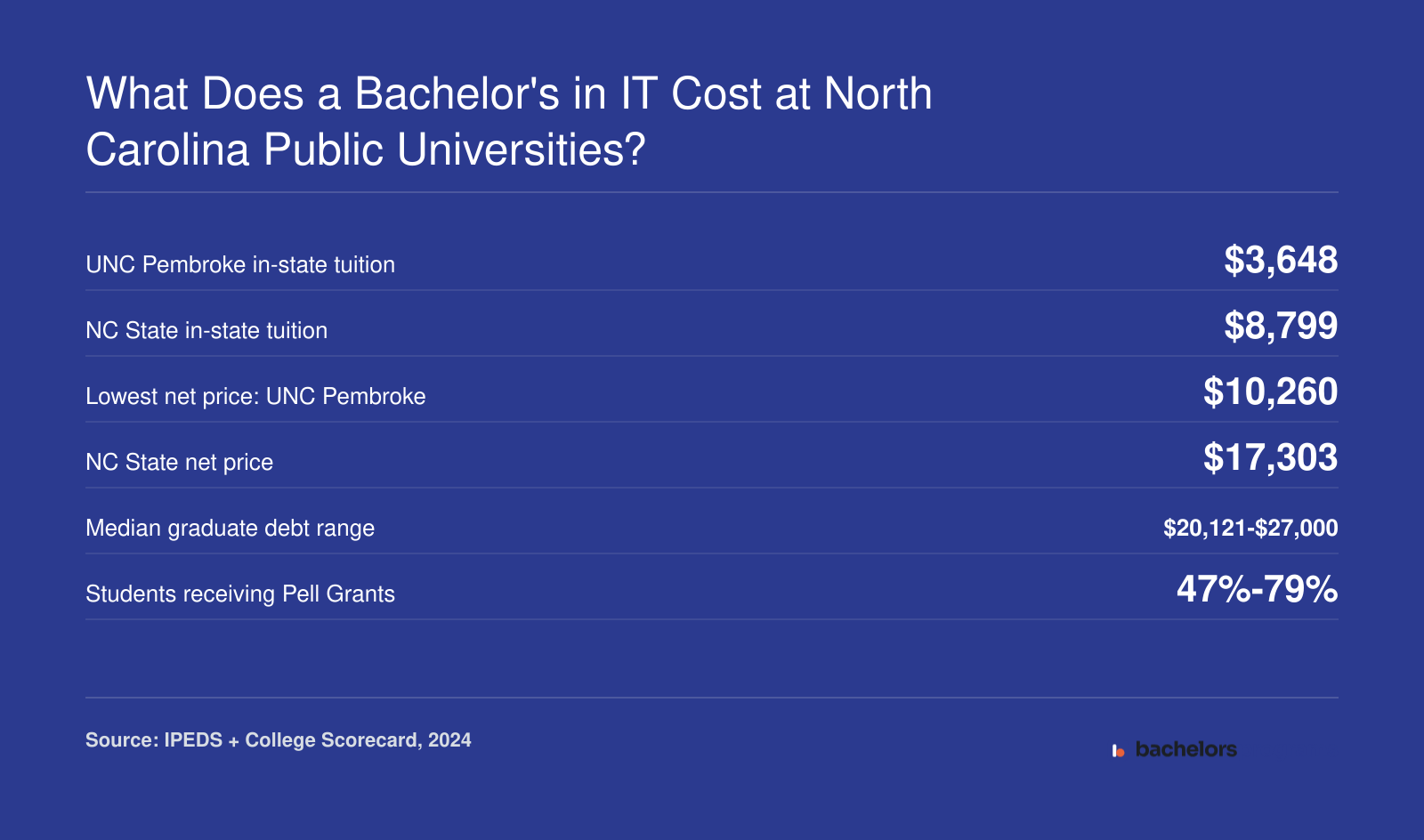
What Does a Bachelor's in IT Cost at North Carolina Public Universities?
These figures show the cost spread across the ranked University of North Carolina System campuses with full federal data, from UNC Pembroke at the low end to NC State at the high end. Net price is what students actually pay after grants and scholarships, so it runs well above sticker tuition once fees, housing and other costs are added.
Accreditation: How to Evaluate Accredited IT Schools in North Carolina
Accreditation is something you verify yourself, and two separate checks matter: one for the school and one for the program. Neither result stands in for the other.
Step 1: Confirm Institutional Accreditation
Search the SACSCOC directory for each North Carolina school you are considering. Then open the school's own accreditation page to read its status and any recent disclosures. UNC Asheville, for example, states publicly that SACSCOC accredits it to award baccalaureate degrees and one master's degree.2 Look for that same kind of plain statement from every school on your list.
Step 2: Check Programmatic Accreditation
ABET accredits programs, not whole institutions, and U.S. programs must be offered by regionally accredited institutions.1 Use the ABET accredited program search4, filter by the computing commission and North Carolina, and confirm the specific bachelor's program is listed, not just the school. Be careful with names. ABET's 2026-2027 computing criteria name information technology at the associate level3, so a bachelor's program may be titled or accredited differently, or not carry ABET accreditation at all. Programmatic status can also differ from one degree to the next: UNC Asheville's ABET-accredited program is a joint engineering program in Mechatronics, not IT.
Step 3: Cross-Check With the School
Contact admissions or the program office and ask three questions:
- Status: Is this exact bachelor's program accredited today?
- Accreditor: Which body granted it?
- Review date: When was the most recent review?
Step 4: Use Neutral Sources
Compare what you find with BLS.gov occupational and education guidance to see what employers in your target role typically expect. Professional associations in computing can also help you judge program quality and career paths. A missing ABET listing is not automatically a red flag, but it should prompt more questions.
Related Articles
Information Technology Salaries in North Carolina
Occupational wage data answers a different question than graduate earnings data. It does not describe what alumni of one program earn. It describes what everyone holding a job title earns across a whole regional economy. The Bureau of Labor Statistics' May 2025 estimates for the Raleigh-Cary metro give the most detailed North Carolina picture available for three IT roles that a bachelor's degree in information technology leads into.1
Raleigh-Cary: Wages and Employment
- Network and computer systems administrators: 2,730 employed, $107,070 mean annual wage
- Information security analysts: 2,510 employed, $132,540 mean annual wage
- Computer user support specialists: 5,320 employed, $67,510 mean annual wage
These are mean figures, not medians. A mean gets pulled upward by senior and management pay in a metro with a dense enterprise and research employer base, so a typical mid-career salary often lands below the number shown. For national context, BLS median pay for the same three roles in May 2025 was $99,1302, $129,1803 and $61,8604 respectively. Statewide medians for these occupations and Charlotte-Concord-Gastonia figures were not in the estimate set used here, so treat the Raleigh-Cary numbers as a strong local benchmark rather than a statewide average.
How This Relates to Graduate Earnings
Program-level graduate earnings, the figures reported for individual bachelor's degree programs, are the median pay of former students working a set number of years after finishing, whatever their job title. They usually run below occupational means because they include recent graduates and people in support-level roles. A first IT job in North Carolina tends to start nearer the user support range and move toward the analyst figures after several years and a specialization.
Reading the Numbers Together
Use graduate earnings to compare programs against each other. Use occupational wages to see where a role can lead once experience accumulates. Neither number predicts an individual offer, and both shift with metro, employer size and certification.
IT Career Paths, Hubs and Certifications in North Carolina
IT careers in North Carolina run on demonstrated skills and stacked credentials, not a professional license. The state licenses plenty of fields; information technology is not one of them.
Entry Roles and Job Hubs
Most graduates start in IT support, help desk, or technician roles, then move into junior systems administration, network administration, or cybersecurity analysis. Openings cluster in the Research Triangle (Raleigh, Durham, Chapel Hill) and Charlotte. The Triangle leans on software, biotech, universities, and state government; Charlotte runs on banking and financial services. Both markets hire steadily for security and cloud work.
Certifications That Complement the Degree
With no state board exam standing between a graduate and an IT job, employers screen on vendor certifications instead.
- CompTIA A+ and Security+: support work and security fundamentals.
- Cisco CCNA: networking and infrastructure roles.
- AWS certifications: cloud platforms and administration.
These complement rather than replace a bachelor's degree in information technology: the degree supplies breadth across systems, databases, and security, while a certification proves command of a specific platform. Many postings list both.
Internships and Co-ops
An internship or co-op is the fastest route to a first role, and North Carolina employers frequently convert interns into entry-level hires. Students at campuses in Raleigh and Charlotte can often work part time during the academic year; others can target summer placements. Earning one certification before graduation, usually A+ for support roles, gives a resume something concrete to pair with coursework. Ask each program about its internship office before enrolling.
Common Questions About IT Degrees in North Carolina
These answers draw on the school data and cost figures covered earlier on this page. Programs, tuition and online availability can change, so confirm details on each school's program page before you apply.
What is the best school for information technology in North Carolina?
Can you get a bachelor's degree in information technology online in North Carolina?
How much does an information technology degree cost in North Carolina?
What is the average salary with an information technology degree in North Carolina?
Which North Carolina colleges offer cybersecurity concentrations in IT?
Compare Information Technology programs on the data that matters
Explore more Computers & IT majors or browse every field of study.
All Computers & IT programs Browse every field of study