Best Cybersecurity Schools in North Carolina
Compare 23 accredited Cybersecurity programs in North Carolina at 17 colleges, with net price after aid, graduation rates, earnings and debt from IPEDS and the U.S. College Scorecard.

Net price after aid across North Carolina's cybersecurity bachelor's programs runs from $7,892 a year at Fayetteville State University to $24,704 at Methodist University, a spread wide enough to change which school a student can realistically attend. Most of these programs award the Bachelor of Science (B.S.) in Cybersecurity, though several fold the coursework into a computer science or information technology degree.
That price gap is the practical tension. The credential name on the transcript is close to identical from one campus to the next, so the decision turns on what a family can pay, whether classes meet online or in a lab, and how much of the curriculum is hands-on rather than lecture.
Key Points
- In-state tuition and fees run $3,648 to $7,579 at the public universities.
- Nonresidents pay only $4,000 more at Fayetteville State and UNC Pembroke.
- Community college transfers use statewide agreements, though none target cybersecurity specifically.
Top 10 North Carolina Schools for a Bachelor's Degree in Cybersecurity
The ten programs below were not put in order by brochure copy. Federal data on what students actually pay after aid and how many finish, plus program-level details on what gets taught, set the order. Each entry lists the school, the credential it awards, how the program is delivered, and the sticker and net prices a North Carolina student is most likely to face.
Appalachian State University
#1Boone, NC · $8,000 – $25,000/yr (est.)
Best for: Mountain-region students wanting in-person labs
Appalachian State University in Boone runs its cybersecurity major across two mountain campuses, giving students in western North Carolina an in-person option that does not require a move to a metro. The curriculum pairs a broad general education core with hands-on work in networking, programming, ethical hacking and cyber forensics. A 2026 Chancellor's Innovation Scholars project is funding a cybersecurity clinic in Hickory, which should give students more applied, community-facing project work tied to regional workforce needs.
- Bachelor of Science in Cybersecurity, 120 credit hours total
- 34 major credit hours, including 31 core and 3 elective
- Core covers networking, programming, ethical hacking, forensics
- Also covers database management, IT audit, security management
- Classes taught at both the Boone and Hickory campuses
- Most sections in person, with some online course options
- Internship option built into the major
University of North Carolina Wilmington
#2Wilmington, NC · $7,000 – $24,000/yr (est.)
Best for: Engineering-minded students in coastal NC
UNC Wilmington approaches security from the engineering side, nesting a cybersecurity concentration inside an interdisciplinary intelligent systems engineering degree. Students take a heavy 71-hour engineering core and finish with a two-course capstone sequence. The university is an academic participant in the North Carolina Partnership for Cybersecurity Excellence, which links campus work to state government and industry partners.
- Cybersecurity concentration inside the B.S. in Intelligent Systems Engineering
- Concentration requires 12 credit hours within an 83-hour degree
- Engineering core totals 71 hours across four years
- Covers cryptography, network security and malware analysis
- Also examines AI used to predict and prevent vulnerabilities
- Required courses include Secure Programming Foundations
- Two capstone courses, ISE 461 and ISE 462, required
- Six hours of electives in cryptography, reverse engineering, cyber operations
Fayetteville State University
#3Fayetteville, NC · $4,400 – $8,000/yr (est.)
Best for: Military-connected adults needing a fully online degree
Fayetteville State University pairs the lowest published tuition in this group with a fully online route to the degree, a combination that matters for adult learners and military-connected students near Fort Bragg. The curriculum covers network security, penetration testing and digital forensics, and the university is a historically Black institution with a long-standing technology footprint in the Sandhills.
- Bachelor of Science in Cyber Security
- 100% online option, described as the first online program in the UNC system
- NC Promise pricing puts in-state tuition at $500 per semester
- Coursework covers network security, penetration testing, digital forensics
- Also covers information, computer, web and software security
- Includes ethical and legal issues in security
- Prepares for analyst, engineer, architect, consultant and forensic roles
Methodist University
#4Fayetteville, NC · $20,000 – $25,000/yr (est.)
Methodist University in Fayetteville offers the concentration in Cybersecurity and Information Assurance through its computer information technology degree, and students can take it on campus or entirely online. The online format runs in eight-week terms and accepts a large block of transfer credit, which shortens the path for students arriving with prior college work. Classes emphasize malware analysis, penetration testing and forensics alongside risk management and legal issues.
- Concentration in Cybersecurity and Information Assurance
- Offered through the BS in Computer Information Technology
- Available 100% online or on campus in Fayetteville
- Eight-week course terms; up to 93 transfer credits accepted
- 124 total credit hours; completion possible in about 3.5 years
- Covers malware analysis, penetration testing, computer forensics
- Prepares for CEH, Security+ and Cloud+ certification exams
- SACSCOC accredited
North Carolina State University at Raleigh
#5Raleigh, NC · $9,000 – $33,000/yr (est.)
NC State runs its security concentration inside an ABET-accredited computer science degree, so graduates carry both the engineering credential and 21 hours of focused security coursework. The program leads the statewide North Carolina Partnership for Cybersecurity Excellence, and students and faculty worked with Cisco and the state IT department on an AI security tool for small businesses. Concentration students can apply for the CyberCorps Scholarship for Service, and the campus sits next to Research Triangle Park employers.
- Computer Science (BS) with a Cybersecurity concentration
- ABET-accredited by the Computing Accreditation Commission
- 121 total credit hours, 21 of them in cybersecurity
- Courses include Computer Security and Network Security
- Restricted electives in cryptography, software security, privacy
- Security capstone sponsored by an industry partner
- CyberCorps Scholarship for Service open to concentrators
- Entry through the Engineering First-Year curriculum and CODA application
University of North Carolina at Charlotte
#6Charlotte, NC · $15,000 – $20,000/yr (est.)
UNC Charlotte has taught cybersecurity for more than 25 years and holds the NSA and Department of Homeland Security Center of Academic Excellence designation in both cyber defense education and research. The concentration sits inside the computer science degree, and the department backs it with several research labs and scholarship money at the undergraduate level. Students join the 49th Security Division club, an ISACA student chapter and a WiCyS chapter.
- B.S. in Computer Science with a Concentration in Cybersecurity
- Designated a Center of Academic Excellence in Cyber Defense Education and Research
- More than 25 years of cybersecurity teaching at the university
- CyberCorps Scholarship for Service available to undergraduates
- Research centers include CyberDNA and the Center for Cybersecurity Analytics
- Student groups include the 49th Security Division and WiCyS chapter
- Annual cybersecurity symposium hosted on campus
East Carolina University
#7Greenville, NC · ~$16,000/yr (est.)
East Carolina University runs the major in two formats, a fully online degree completion track for working professionals and an on-campus version with required lab work, internship and capstone. On either route the coursework lines up with CompTIA Security+ and Cisco CCNA certification objectives, and the on-campus program keeps a cyber defense competition team. In 2026 the program partnered with the North Carolina National Guard Cyber Security Response Force on a student showcase and Hack the Box competition.
- BS in Information and Cybersecurity Technology, Cybersecurity concentration
- Online completion track: 120 credit hours, $424 per credit in-state
- Online admission requires 24 transferable credits and a 2.0 GPA
- On-campus version adds required internship and capstone
- Coursework covers forensics, incident response, network security
- Includes ethical hacking and penetration testing in hands-on labs
- Aligns with CompTIA Security+ and Cisco CCNA objectives
- On-campus program fields a cyber defense competition team
University of North Carolina at Pembroke
#8Pembroke, NC · ~$10,000/yr (est.)
UNC Pembroke keeps the cybersecurity major as a standalone Bachelor of Science rather than a concentration, taught through the Department of Mathematics and Computer Science. The university's Cyber Defense Education Center is built around partnerships with defense organizations and technology companies, covering curriculum advising, internships, recruiting, scholarships and sponsored labs. That makes it a practical choice for students aiming at southeastern North Carolina employers and the defense sector.
- Standalone Bachelor of Science in Cybersecurity
- Campus-based program in the Department of Mathematics and Computer Science
- Cyber Defense Education Center supports internships and recruiting
- Partnerships with defense organizations and technology companies
- Center also connects students to scholarships and competitions
- Sponsored laboratories available to students
Campbell University
#9Buies Creek, NC · $25,000/yr (est. net price)
Campbell University delivers its cybersecurity degree through the Adult & Online Education division, aimed squarely at adult learners who need flexibility. Students can study 100% online or at extended North Carolina campuses including Camp Lejeune and Fort Bragg, with accelerated eight-week terms throughout. The curriculum blends security topics with criminal justice and homeland security coursework, and a capstone and internship round out the practical side.
- B.S. in Cybersecurity, 124 credit hours
- 100% online or at extended campuses including Camp Lejeune and Fort Bragg
- Accelerated eight-week terms designed for adult learners
- Covers programming, ethical hacking, network security, digital forensics
- Curriculum also includes criminal justice and homeland security
- Capstone projects and internships included
- Transfer credits accepted
Gardner-Webb University
#10Boiling Springs, NC · ~$18,000/yr (est.)
Gardner-Webb University built its cybersecurity curriculum around the NCAE-C guidelines for cyber defense programs, the federal standard that also underpins the NSA's academic designations. The whole degree runs online with a mix of live and recorded sessions, and the school accepts up to 90 transfer credits, including credit for work experience. Courses run in eight-week terms, which lets a student with substantial prior credit finish quickly.
- 120 credit hours, fully online
- Curriculum follows NCAE-C cyber defense guidelines
- Up to 90 transfer credits accepted, including credit for job experience
- Eight-week terms with synchronous and asynchronous options
- Coursework covers digital forensics, cryptography, security risk analysis
- Aligns with CompTIA industry certifications
- Target roles include risk analyst, forensic analyst and security engineer
Cost & outcomes by school
Federal data for the highest-earning Cybersecurity programs, independent of the ranking above. Earnings are this field's bachelor's graduates four years after completing where the Scorecard reports them, else the school's undergraduate median.
| School | Net price / yr | Grad rate | Earnings | Debt | Grads/yr | Format |
|---|---|---|---|---|---|---|
| North Carolina State University at Raleigh NC | $17,303 | 85% | $68,758 | $20,121 | — | Campus |
| University of North Carolina at Charlotte NC | $15,435 | 69% | $57,289 | $21,500 | — | Campus |
| East Carolina University NC | $15,739 | 63% | $55,146 | $22,750 | — | Online |
| University of North Carolina Wilmington NC | $20,109 | 71% | $54,967 | $19,500 | — | Campus |
| Campbell University NC | $24,516 | 61% | $54,886 | $22,500 | — | Online |
| Appalachian State University NC | $16,836 | 75% | $51,836 | $20,231 | — | Hybrid |
| Pfeiffer University NC | $19,076 | 35% | $51,562 | $26,163 | — | Campus |
| Methodist University NC | $24,704 | 44% | $48,050 | $27,000 | 2 | Online |
| Gardner-Webb University NC | $17,674 | 55% | $48,039 | $24,222 | — | Online |
| Belmont Abbey College NC | $24,639 | 47% | $47,937 | $26,000 | — | Hybrid |
| Guilford College NC | $22,270 | 46% | $47,590 | $26,000 | — | Campus |
| Lenoir-Rhyne University NC | $20,689 | 48% | $45,543 | $26,000 | — | Campus |
Sources: U.S. Department of Education. Net price, graduation rate, earnings and debt: College Scorecard (earnings and debt for this field's bachelor's graduates where reported, else school-wide); graduates: IPEDS. A dash means no figure is reported.
Cost, debt & payoff
Median earnings of this field's bachelor's graduates (4 yrs after completing, else the school's undergraduate median) vs. their median federal loan debt · U.S. College Scorecard
Across these programs the median graduate earns about $47,937 and finishes with roughly $25,813 in debt — a ratio that clears a common rule of thumb (keep debt below first-year salary). Net price and debt vary widely school to school, so check the per-school figures in the table above before you shortlist.
Which NC Schools Hold NSA Cyber Defense Designations
The NSA/DHS National Centers of Academic Excellence in Cyber Defense (CAE-CD) label is an institutional stamp.1 A school earns it by mapping its cybersecurity curriculum to national standards and showing faculty and program depth to federal reviewers.2 It is open to regionally accredited institutions offering cybersecurity credentials at the associate, bachelor's, and graduate levels.2 For an undergraduate, it signals that at least part of a school's cyber coursework has been measured against a federal benchmark, useful when comparing programs or talking with employers.
What the Label Does Not Promise
It is not a scholarship. Four-year CAE institutions have been eligible to apply for the Department of Defense Information Assurance Scholarship and the NSF Scholarship for Service, but applying is not winning, and no aid is automatic.3 Nor does the designation cover every major, course, or online section a school runs.1 Treat it as one quality signal among several, next to lab work, internships, and graduation rates.
Where North Carolina Stands
The NSA's 2026 overview counts nine North Carolina institutions holding a CAE-CD designation4, but the public summary does not name all of them, and older designations do not renew themselves. NSA materials have identified North Carolina State University at Raleigh and UNC Charlotte as CAE institutions, with references dating to 2014,5 so check the current NSA list and confirm with each department. Where the designation applies, it is flagged in the ranked list that follows.
Cheapest Cybersecurity Bachelor's Programs in North Carolina
Net price is an approximate, institution-wide average of what students actually paid after grants and scholarships, drawn from IPEDS and College Scorecard (2024) data. It is not a quote for any one student or program. Fayetteville State University, which credits NC Promise for its low in-state tuition, comes in at $7,892 on average, about half the roughly $15,400 to $15,700 at UNC Charlotte and East Carolina University. Public UNC System schools hold in-state tuition between $3,648 and $7,361, while private Chowan University lists $27,910 but averages $14,086 after aid.
| School | City | Sector | Program | Format | In-State Tuition & Fees | Out-of-State Tuition & Fees | Average Net Price After Aid |
|---|---|---|---|---|---|---|---|
| Fayetteville State University | Fayetteville | Public | Cyber Security (BS) | Campus and online | $4,353 | $8,353 | $7,892 |
| University of North Carolina at Pembroke | Pembroke | Public | Bachelor of Science in Cybersecurity | Campus | $3,648 | $7,648 | $10,260 |
| Chowan University | Murfreesboro | Private nonprofit | Cybersecurity, B.S. | Campus | $27,910 | $27,910 | $14,086 |
| University of North Carolina at Charlotte | Charlotte | Public | B.S. in Computer Science with Concentration in Cybersecurity | Campus | $7,239 | $22,492 | $15,435 |
| East Carolina University | Greenville | Public | BS in Information and Cybersecurity Technology | Online | $7,361 | $23,638 | $15,739 |
Online and Hybrid Paths to a Cybersecurity Degree at NC Schools
Delivery format describes where the coursework happens: entirely through a browser, partly in a classroom, or fully on campus. North Carolina schools use all three formats, and the labels are not interchangeable, so check delivery before you apply.
How the programs sort out
- Fully online: Methodist University and Campbell University both run their cybersecurity majors 100% online, Campbell also teaching at its Camp Lejeune and Fort Bragg locations. Gardner-Webb University offers a fully online option with both live and self-paced courses. East Carolina University's cybersecurity concentration is online and asynchronous, though its information and cybersecurity technology degree also has an on-campus pathway.
- Online or on campus: Fayetteville State University lists a 100% online option alongside its classroom program.
- Hybrid: Appalachian State University teaches most classes in person at Boone and Hickory, with some coursework delivered online.
- On campus: North Carolina State University, UNC Charlotte, UNC Wilmington and UNC Pembroke keep their programs classroom-based.
Terms, pacing and price
Methodist runs eight-week terms with full- and part-time enrollment across 124 credits: about 3.5 years at a steady pace, or three to five years depending on course load. Its 2026-27 online rate is $445 per credit, roughly $55,180 in tuition before fees and subject to change, while active duty, Reserve and National Guard students pay $250 per credit, near $31,000 before transfer credit and aid. Campbell and Gardner-Webb also use accelerated eight-week terms, and Gardner-Webb accepts up to 90 transfer credits. ECU's 120-credit online plan averages about 3.5 years at $456 per credit in-state, roughly $54,720 before transfer credits; North Carolina residents must confirm in-state status through the state's residency service, and ECU publishes a separate nonresident online rate, so students outside North Carolina can enroll.
Who should choose online
Online suits working adults, military families and community college transfers who cannot relocate. The trade-off is real: virtual labs replace hands-on equipment, and you miss the research centers, student security clubs and recruiter visits that campus programs build around.
Related Articles
Transferring to a Four-Year NC School: A Step-by-Step Checklist
Most two-year students in North Carolina transfer through statewide agreements. Confirm each item below with your target school, because no statewide agreement is written specifically for cybersecurity.
- Earn the right associate degreeThe revised Comprehensive Articulation Agreement, effective Spring 2026, covers only the Associate in Arts and Associate in Science, so an applied science associate degree usually needs a separate school-specific agreement to transfer.
- Know which articulation agreement appliesThe Comprehensive Articulation Agreement governs transfer to the state's 16 public universities, and private campuses that take part in the Independent Comprehensive Articulation Agreement follow a comparable framework.
- Check credit transfer limitsEligible graduates with 60 approved semester hours receive at least 60 hours of credit after admission, but technical IT and security courses may not all count toward a cybersecurity major.
- Meet the GPA thresholdBoth agreements require at least a 2.0 GPA, and the public-university agreement lists C- as the minimum transfer grade while the independent agreement requires a C.
- Look for program-specific pathwaysEast Carolina University has a cybersecurity transfer agreement for active-duty, National Guard, Reserve and qualified family students, and Fayetteville State University's Bronco Benefit guarantees admission to eligible students from 15 participating community colleges.
- Time your applicationMap your remaining courses against the 2026-2027 public-university transfer guides early, keeping in mind that not every major at every school has its own guide.
- Plan for financial aid carryoverAid does not follow you automatically, so add your new school to your FAFSA and contact its financial aid office before you enroll.
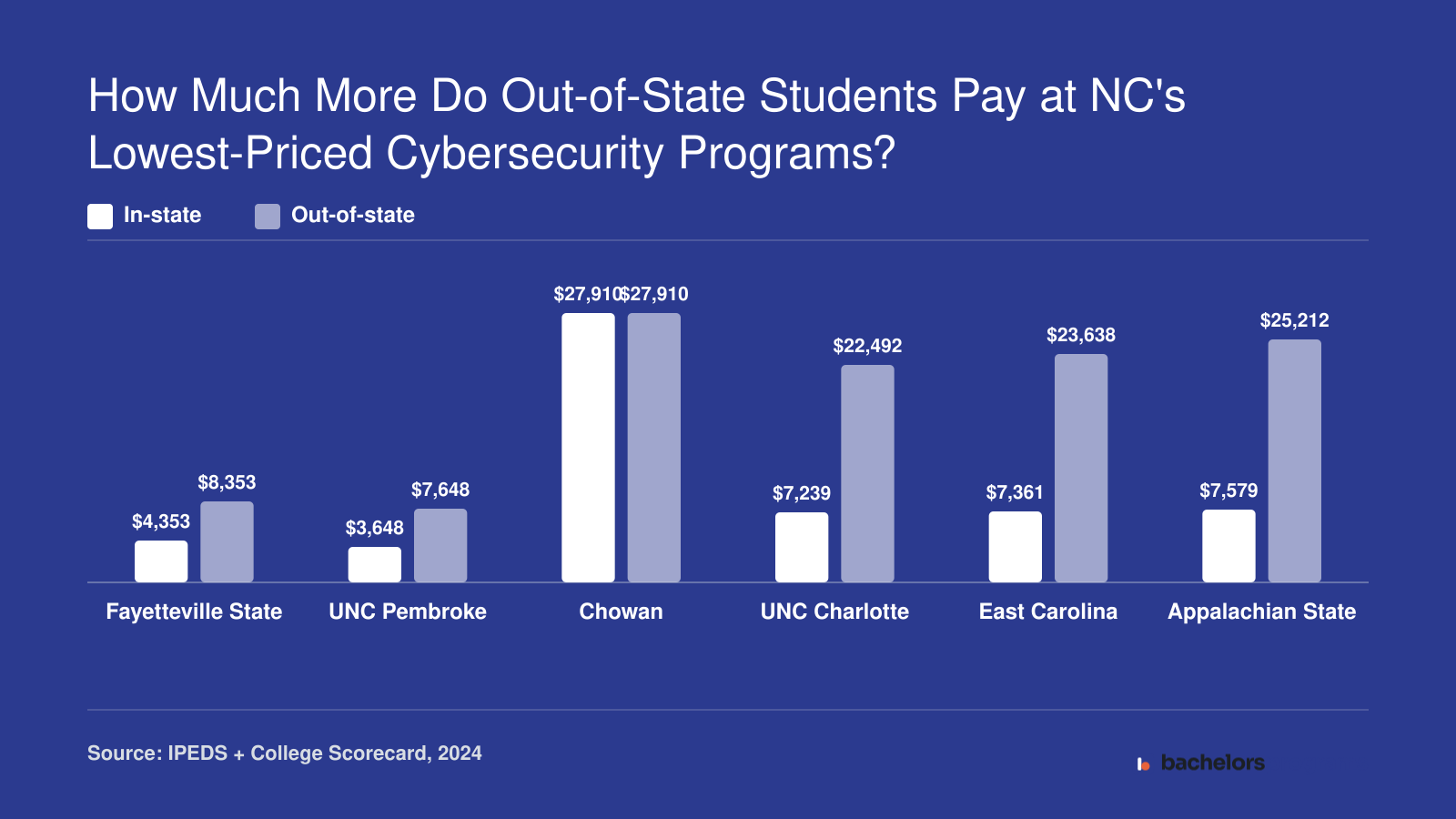
How Much More Do Out-of-State Students Pay at NC's Lowest-Priced Cybersecurity Programs?
North Carolina residents pay $3,648 to $7,579 a year in tuition and fees at the public universities below. Nonresidents pay $4,000 more at Fayetteville State and UNC Pembroke, and $15,253 to $17,633 more at UNC Charlotte, East Carolina and Appalachian State. Chowan University, a private school, charges every student the same $27,910 regardless of residency.
Quick Answers About NC Cybersecurity Bachelor's Programs
These answers cover the questions students ask most often when comparing a bachelor's degree in cybersecurity in North Carolina. Figures are reported 2026 rates and can change, so confirm current details on each school's program page.
Which colleges in North Carolina offer cybersecurity bachelor's degrees?
What does a four-year cybersecurity bachelor's degree cost at NC schools?
What is the salary for a cybersecurity bachelor's degree graduate in North Carolina?
Are there online cybersecurity bachelor's degrees from North Carolina schools?
How can I tell whether a North Carolina school is a good fit for cybersecurity?
What should I know about cybersecurity at UNC Wilmington?
Does a cybersecurity career in North Carolina require a state license?
Does an NSA CAE designation matter when choosing a school?
Compare Cybersecurity programs on the data that matters
Explore more Computers & IT majors or browse every field of study.
All Computers & IT programs Browse every field of study