Best Computer Science Schools in Rhode Island
Compare 13 accredited Computer Science programs in Rhode Island at 7 colleges, with net price after aid, graduation rates, earnings and debt from IPEDS and the U.S. College Scorecard.

Two computer science graduates from Rhode Island schools can enter the workforce with first-year median earnings more than $90,000 apart, federal data show, from roughly $60,000 at the low end to $151,000 at the top.
Brown University, the University of Rhode Island, Rhode Island College, Providence College, Roger Williams University and Johnson & Wales University each award a bachelor's degree in computer science, as a Bachelor of Science (B.S.) or a Bachelor of Arts (B.A.). Average net price after grants and scholarships ranges from $9,478 to $48,523.
Cost and earnings do not move together, and neither does the admissions bar. That spread, more than the curriculum itself, separates one program from the next.
Key Points
- Rhode Island College charges residents $11,300; Brown lists $71,412 in tuition.
- Brown computer science graduates earn a $151,065 median one year out.
- Johnson & Wales University runs a fully online computer science bachelor's.
Best Computer Science Schools in Rhode Island, Ranked
Six Rhode Island institutions award a bachelor's degree in computer science, from an Ivy League research department in Providence to a fully online program built for working adults. Each card below pairs the school's profile with the federal data on its computer science bachelor's graduates, including median earnings four years after finishing where that figure is reported. Graduation rates are institution-wide rather than program-specific, and across these six schools they range from roughly 48% to 96%.
Brown University
#1Providence, RI · $25,000 – $30,000/yr (est.)
Best for: Research-driven students seeking AI lab experience
Brown University awards the A.B. and the Sc.B. in computer science through its Department of Computer Science, a department that mixes theory with applied work in artificial intelligence, robotics, security, graphics and systems. Undergraduates can add joint concentrations such as applied mathematics and computer science or computer science and economics, and a paid summer research award supports faculty-student projects. The department added a prerequisite course ahead of some upper-level offerings for fall 2026 and has capped seats in several courses. Computer science bachelor's graduates reported median earnings of $214,479 four years after finishing.
- A.B. and Sc.B. degree options in the same department
- Coursework spans AI, robotics, security, graphics and networks
- Calculus and linear algebra prerequisites for the concentration
- Introductory sequence starts at CSCI 0111, 0150 and 0170
- Capstone course required, with an honors thesis option
- Research credit available through CSCI 1970
- Study abroad opportunities available
- Concurrent fifth-year master's option for continuing students
- Joint Sc.B. pairing applied mathematics with computer science
- Admits through the undergraduate A.B. and Sc.B. pathways
- Joint concentration linking computer science with economics
- Economics coursework runs alongside the computer science core
- Counts toward the 30 courses the university requires for graduation
University of Rhode Island
#2Kingston, RI · ~$21,000/yr (est.)
Best for: Rhode Island residents seeking funded cohort support
The University of Rhode Island awards the computer science bachelor's as both a B.S. and a B.A. on its Kingston campus, with the B.S. requiring 120 credits and at least 56 in computer science while the B.A. leaves room for a minor or second major. The department's Pathways to Success in Computer Science program covers tuition, books, a summer stipend, campus housing and meals for a small cohort of undergraduates each year, and connects them with local employers. Both degrees are campus-based and share a core sequence in data structures, algorithms and software engineering.
- 120 credits to graduate, at least 56 of them in computer science
- Core includes CSC 211, 212, 301, 305, 340, 411 and 412
- CSC 499 capstone completes the degree
- Major admission needs CSC 110 and 211 with a 2.00 GPA in CSC and math
- Mathematics, science and writing requirements built into the curriculum
- Published four-year course sequence for planning
- 36 to 51 credits in computer science within a 120-credit degree
- 30 credits must be at the 300 level or above
- Core CSC courses plus programming electives
- MTH 180 and writing courses required
- 2.00 GPA in CSC and math courses, plus CSC 110 and 211, to enter
Rhode Island College
#3Providence, RI · $9,000/yr (est. net price)
Best for: Cost-conscious students choosing B.A. or B.S.
Rhode Island College awards both a B.A. and a B.S. in computer science on its Providence campus, built on a shared core of object-oriented design, data structures, algorithms, operating systems, programming languages and software engineering. The B.S. adds coursework in mathematics, science, ethics and writing, while the B.A. leaves space for a minor or a double major, and the B.A. paired with a cybersecurity minor holds an NSA cyber defense designation. Computer science bachelor's graduates reported median earnings of $83,259 four years after finishing.
- Shared core in data structures, algorithms and software engineering
- B.S. adds mathematics, science, ethics and writing courses
- B.A. leaves room for a minor or a second major
- Electives include AI, cybersecurity, networks and databases
- B.A. plus a cybersecurity minor is an NSA-designated cyber defense program
- Nine General Education categories, at least 40 credits
- $50 application fee, waived on Apply for RIC Free Day
Providence College
#4Providence, RI · ~$49,000/yr (est.)
Providence College awards a B.S. in computer science on its Providence campus through its mathematics and computer science department, with coursework spanning networks, databases, operating systems, algorithms and hardware organization from the CPU up. Students can take special topics courses, pursue independent study and work on faculty research, and the degree feeds both software development and systems roles and graduate study. Computer science bachelor's graduates reported median earnings of $69,195 one year after finishing.
- B.S. delivered on the Providence campus
- Coursework in networks, databases, operating systems and algorithms
- Hardware organization studied from CPU to components
- Special topics courses and independent study available
- Undergraduate research with faculty
- Prepares students for software developer, systems analyst and engineer roles
- Also readies graduates for graduate study in computing
Roger Williams University
#5Bristol, RI · ~$38,000/yr (est.)
Roger Williams University in Bristol awards the computer science B.S. and a B.A., with the B.S. carrying ABET accreditation and a heavier mathematics load while the B.A. is built for interdisciplinary combinations. Classes run 15 to 20 students, and seniors build software for real clients in a capstone. Concentrations include data science and intelligent and autonomous systems, and students work in dedicated software, virtual reality and advanced technology labs.
- ABET-accredited B.S. program
- Classes of 15 to 20 students
- Senior capstone builds software for real clients
- Tracks: Intelligent and Autonomous Systems
- B.S. emphasizes software engineering with a strong math component
- A B.A. option allows interdisciplinary study
- Labs include software, BIM and virtual reality, and advanced technology
- Internships supported through the career center
- Machine learning course required
- Four electives chosen from AI, bioinformatics, business analytics and more
- Open to computer science majors
- Specialization courses cannot be reused elsewhere
Johnson & Wales University
#6Providence, RI · ~$20,000/yr (est.)
Johnson & Wales University delivers its computer science B.S. fully online from a Providence-based institution, with 7- or 15-week courses and two paths: a 91-credit fast-track that can finish in about three years and a 121-credit standard route. The curriculum covers programming, data structures, algorithms, information security and networking, and every student completes an internship or directed experiential education. Transfer credit evaluations are typically completed within 48 hours, and a tuition savings scholarship is available.
- Fully online delivery with 7- or 15-week course lengths
- 91-credit fast-track option and 121-credit standard option
- $495 per credit tuition
- 19:1 student-to-faculty ratio
- Internship or directed experiential education required
- Transfer credit evaluation typically within 48 hours
- Roles in software development, cybersecurity and IT
- Tuition savings scholarship available
Cost & outcomes by school
Federal data for the highest-earning Computer Science programs, independent of the ranking above. Earnings are this field's bachelor's graduates four years after completing where the Scorecard reports them, else the school's undergraduate median.
| School | Net price / yr | Grad rate | Earnings | Debt | Grads/yr | Format |
|---|---|---|---|---|---|---|
| Brown University RI | $25,184 | 96% | $214,479 | $11,500 | 286 | Campus |
| Providence College RI | $48,523 | 86% | $87,054 | $27,000 | 33 | Campus |
| Rhode Island College RI | $9,478 | 48% | $83,259 | $22,801 | 31 | Campus |
| Roger Williams University RI | $37,999 | 69% | $70,266 | $26,940 | 15 | Campus |
| University of Rhode Island RI | $21,440 | 73% | $69,743 | $22,250 | — | Campus |
| Johnson & Wales University RI | $31,027 | 55% | $43,418 | $26,000 | 7 | Hybrid |
| Johnson & Wales University RI | $20,252 | — | $43,418 | $26,000 | 9 | Online |
Sources: U.S. Department of Education. Net price, graduation rate, earnings and debt: College Scorecard (earnings and debt for this field's bachelor's graduates where reported, else school-wide); graduates: IPEDS. A dash means no figure is reported.
Cost, debt & payoff
Median earnings of this field's bachelor's graduates (4 yrs after completing, else the school's undergraduate median) vs. their median federal loan debt · U.S. College Scorecard
Across these programs the median graduate earns about $70,266 and finishes with roughly $26,000 in debt — a ratio that clears a common rule of thumb (keep debt below first-year salary). Net price and debt vary widely school to school, so check the per-school figures in the table above before you shortlist.
How We Ranked Rhode Island Bachelor's Programs
Reputation rankings and outcome-based rankings answer different questions. U.S. News-style lists lean heavily on peer opinion and graduate-level research standing, which tells you little about what a bachelor's student gets out of a program. The more practical question is what happens to undergraduates who enroll.
What the Ranking Uses
The order of the schools here draws on three kinds of evidence:
- Outcomes: College Scorecard data on graduation, debt and earnings after students leave.
- Net price: What students typically pay after grants and scholarships, not the published sticker price.
- Selectivity: How competitive admission is, which hints at the peer group you will study with.
Read the Numbers as Estimates
Net price and graduation rate are institution-wide averages. They cover every undergraduate at a school, not only computer science majors, so treat them as approximate. A student's own cost depends on aid, residency and the program chosen. Use these figures to compare schools, then confirm details with each school's financial aid office.
Scope of the List
The ranking covers bachelor's programs based in Rhode Island, both on campus and online. The list is short because the state has few options, which is exactly why each one deserves a close look. Brown University, the University of Rhode Island, Rhode Island College, Providence College, Roger Williams University and Johnson & Wales University each bring a different mix of size, cost and style of instruction.
Bachelor's Degree in Computer Science: B.A. vs. B.S. at Rhode Island Schools
A bachelor's degree in computer science comes in two common forms, the Bachelor of Arts (B.A.) and the Bachelor of Science (B.S.). The B.S. is usually heavier on math, science and technical electives. The B.A. typically leaves more room for a minor or double major.
Who Offers Which
The University of Rhode Island awards both, and its requirements show the split clearly. Both degrees share the same math and statistics sequence (MTH 141, MTH 180 and STA 409, 10 credits) and 120 total credits. The B.S. then adds a 44-credit computer science core, a required specialization (General Computer Science, Artificial Intelligence or Cybersecurity) and a 4-credit capstone. The B.A. has a 36-credit core, no specialization and more elective space.
Rhode Island College also offers both. The two tracks share the same CS courses and electives, but the B.S. adds math, science, ethics and writing, while the B.A. is the one that accommodates double majors and minors. Confirm exact math credit counts for each track with the department.
Brown University offers A.B. and Sc.B. options, its own names for the arts and science versions. Roger Williams University lists both a B.S. and a B.A., with an ABET-accredited B.S. Providence College and Johnson & Wales University list a Bachelor of Science. Check each school's current catalog for math requirements and concentrations, since those details vary.
Computer Science vs. Computer Information Systems
Computer science centers on theory, algorithms and software engineering: how software and systems are designed and built. Computer information systems (CIS) is more applied, focusing on using technology to solve business problems. Every program here is titled Computer Science, so look past the label. Johnson & Wales, for example, frames its online B.S. around career-focused software, cybersecurity and IT preparation. A program whose course list is heavy on data structures, operating systems and discrete math is the theory-oriented kind.
A Quick Rule of Thumb
- Choose the B.S. if: you want the deepest technical grounding, a specialization such as AI or cybersecurity, or a path toward graduate study or research.
- Choose the B.A. if: you want to pair computing with another field, such as business, design or a language, without giving up a solid CS core.
Online and Hybrid Computer Science Bachelor's Options at Rhode Island Schools
Working adults weigh the structure of a campus program against the flexibility of studying around a job, and Rhode Island's options split along that line.
Fully Online: Johnson & Wales University
One school here offers a fully online computer science bachelor's degree. Johnson & Wales University delivers its Computer Science B.S. 100% online through JWU Online, using Canvas, recorded lessons, projects, discussion boards, and Zoom meetings at a student's request. The traditional format requires 121 credits. A 91-credit accelerated pathway is described as a three-year degree, usually finished in six semesters without summer classes, and it includes 600 hours of Work-Integrated Learning. Courses run in 7 or 15 week terms. The three-year program is also approved for in-person study at the Providence campus.
Hybrid and Evening: Rhode Island College
The Computer Information Systems B.S. at Rhode Island College lists in-person, online, hybrid, day, and evening options. Those are formats within the degree. The college's program information does not establish that the entire bachelor's can be completed online, so confirm that with the department before you plan around it. No accelerated schedule is identified.
Campus-Based Programs
Brown University, Providence College, and Roger Williams University are listed as on-campus programs. The University of Rhode Island offers both a B.A. and a B.S. in Computer Science, but its undergraduate pages do not describe online, hybrid, evening, or accelerated delivery. That means the format is not established, not that it is ruled out, so ask the department directly.
Which Format Is Most Flexible?
For most working adults, the JWU online degree is the most flexible choice, especially the 91-credit pathway if you want to finish sooner and can handle a heavier course load. If you would rather sit in a classroom after work, Rhode Island College's evening and hybrid options are the closest local fit.
Admissions Requirements for Rhode Island Computer Science Programs
What GPA and test scores do you need to get into a computer science bachelor's program in Rhode Island? There is no single statewide answer. Each school runs its own first-year review, and a separate computer science cutoff is not universal. At the University of Rhode Island, the published entering first-year middle range is 3.7 to 4.1, recalculated on core courses from grades 9 through 11 with honors and AP weight. That is a general admission profile, not a CS minimum. URI also requires a 2.00 minimum GPA for transfer into the B.S. computer science major and for graduation, with both major and cumulative GPAs held to that line.
Test Policy and AP Credit
URI is test optional. Applicants who submit SAT or ACT scores must send them electronically, using SAT code 3919 or ACT code 3818. AP Computer Science A credit is clear: a score of 4 earns CSC 110. AP, IB and Joint Services transcripts are accepted electronically, though URI does not publish an IB Computer Science equivalency on the same chart. A transfer-credit listing for Rhode Island College reports credit for AP exams at scores of 3 and above, including 4 credits for CSCI 211 for AP CS A, with a maximum of 8 credits per exam.1
Transfer Credit and What to Verify
For transfer into URI's B.S. in computer science, applicants need CSC 110 and CSC 211 and a cumulative 2.00 across required CSC and math courses. URI's 2025-26 policy caps credit from two-year institutions at 60 credits, though that limit is not specific to CS. Brown, Providence College, Roger Williams University and Johnson & Wales University each publish their own first-year and credit rules. Where a school publishes no CS-specific admission policy, its general first-year requirements apply. Check test policy, AP limits and transfer equivalencies on the program page before applying, and keep course syllabi ready for review.
Related Articles
Cost of a Computer Science Bachelor's Degree in Rhode Island
Published tuition and fees range from $11,300 for Rhode Island residents at Rhode Island College to $71,412 at Brown University. Average net price after grants and scholarships narrows that gap: Brown falls to $25,184, and Rhode Island College stays the most affordable option here at $9,478. These figures come from the most recent federal IPEDS and College Scorecard data, cover the whole institution rather than total cost of attendance, and should be confirmed with each school. The University of Rhode Island notes that its 2026-27 rates are estimates subject to change, says eligible Rhode Island residents are considered for the Rhode Island Promise scholarship, and offers four-year merit awards that renew with full-time enrollment of 12 credits and a 2.8 GPA.
| School | Sector | In-State Tuition and Fees | Out-of-State Tuition and Fees | Average Net Price After Aid |
|---|---|---|---|---|
| Rhode Island College | Public | $11,300 | $27,299 | $9,478 |
| Johnson & Wales University | Private nonprofit | $13,365 | $13,365 | $20,252 |
| University of Rhode Island | Public | $16,942 | $37,146 | $21,440 |
| Brown University | Private nonprofit | $71,412 | $71,412 | $25,184 |
| Roger Williams University | Private nonprofit | $44,418 | $44,418 | $37,999 |
| Providence College | Private nonprofit | $63,550 | $63,550 | $48,523 |
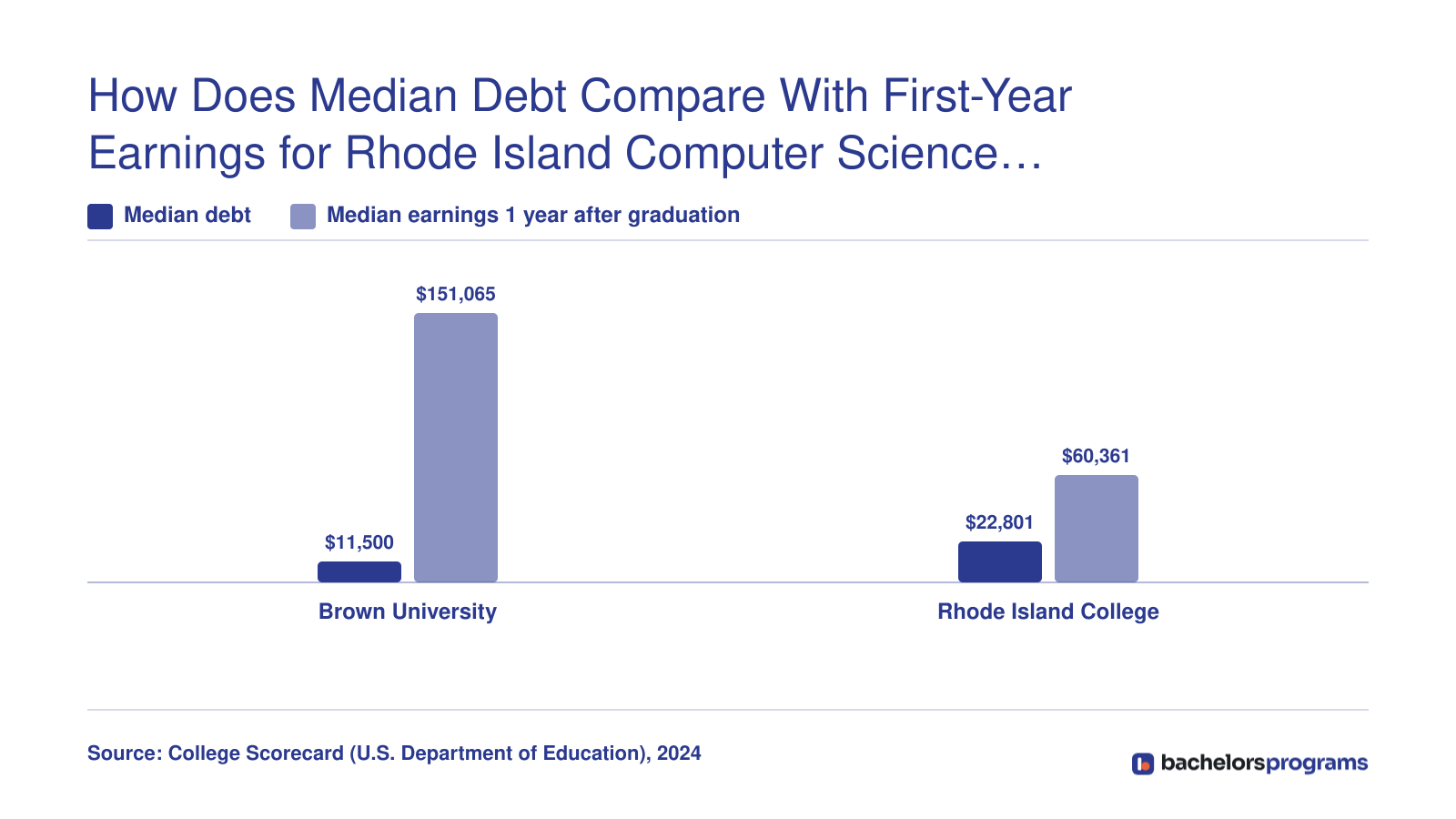
How Does Median Debt Compare With First-Year Earnings for Rhode Island Computer Science Graduates?
For computer science bachelor's graduates, first-year median earnings are about 13 times median debt at Brown University ($151,065 vs. $11,500) and about 2.6 times at Rhode Island College ($60,361 vs. $22,801), measured one year after completion. Federal data report both program-level figures only for these two schools, so University of Rhode Island, Providence College, Roger Williams University and Johnson & Wales University are left out of this chart. Caption: when one year of pay is several times what you borrowed, the degree can pay for itself quickly, and the wider the gap, the faster the payoff.
Computer Science Careers and Earnings in Rhode Island
Computer and mathematical occupations in Rhode Island paid a median annual wage of $87,360 in May 20241, state occupational wage data show, while the national median for software developers, quality assurance analysts and testers reached $134,040 in May 2025. For anyone choosing a program, those two figures frame the range: a broad Rhode Island median across many computer roles, and a national benchmark for the largest software job family.
What Rhode Island Computer Roles Pay
State wage data put computer systems analysts at a median of $51.51 per hour and network and computer systems administrators at $51.75 per hour. Data scientists posted the highest hourly median in the group at $61.71, followed by information security analysts at $51.04 and web developers at $38.431. These are hourly medians, not annual salaries; multiply by a full-time schedule to approximate a yearly figure. Demand across these roles is steady rather than explosive, and the state does not isolate software developers as a single occupation in its current projection window, so treat any single growth percentage with caution.
Who Hires Computer Science Graduates in Rhode Island
Defense and advanced manufacturing anchor the state's technical hiring: Electric Boat, RTX, Northrop Grumman, BAE Systems and Leonardo DRS all recruit software, systems and embedded engineers. Health technology and insurance draw on the same talent pool through CVS Health, Care New England, Lifespan, Amica and FM Global, while Infosys and Citizens add enterprise software and IT roles. Cybersecurity work runs through financial services, insurers and defense contractors rather than a single industry.
No License, but Two Different Earnings Signals
Rhode Island does not require a state license to work as a software developer, and most computer science roles have no licensure pathway at all. Employers hire on demonstrated skill, projects and interviews. That makes salary data easy to misread. Occupation wages from the Bureau of Labor Statistics describe everyone in a job category, regardless of degree. Program-level earnings reported through the federal College Scorecard describe graduates of a specific institution, at every career stage, including those who left the field. Keep the two separate and use program earnings as one signal, not a forecast.
Choosing the Right Rhode Island Computer Science School
The most consequential change in computer science education right now is not a new programming language but the sharper split between program-level and institution-level accreditation. Families comparing computer science programs now ask about it before they apply.
Match the School to Your Situation
- Research-focused: Brown University pairs an A.B. and an Sc.B. in computer science with a 6:1 student-faculty ratio and a 95.7% graduation rate. Its net price after aid is $25,184, so the research depth comes at a premium.
- Budget-conscious: Rhode Island College offers both a B.A. and a B.S. in computer science at $11,300 in-state tuition and a net price near $9,478. Its program carries an NSA Cyber Defense designation, which suits students who want security coursework without a private-college price.
- Working adult: Johnson & Wales University delivers its B.S. in computer science online at $495 per credit, with 7- or 15-week courses and transfer credit evaluation in 48 hours.
- Transfer student: The University of Rhode Island publishes a 2.00 GPA transfer requirement and names CSC 110 and CSC 211 as prerequisites, details worth checking before you submit an application.
Providence College, with an 11:1 student-faculty ratio and an 85.8% graduation rate, is a smaller-campus option for students who want closer faculty contact without a research university's scale.
Program vs. Institution Accreditation
ABET accredits programs, not whole colleges.1 Its Computing Accreditation Commission reviews associate, bachelor's, and master's programs, and a U.S. program must sit inside a regionally accredited institution before ABET will consider it.2 In Rhode Island, the regional accreditor is the New England Commission of Higher Education, or NECHE.
At the schools ranked here, URI is listed in ABET's program search for a computing program, and Roger Williams University describes its B.S. in computer science as ABET-accredited.3 For any program, ask the department to identify the specific accredited degree and confirm it in ABET's online directory before you enroll. Regional accreditation covers the institution; it does not certify the computer science curriculum, and program accreditation does not replace the institution-level review.
Rhode Island Computer Science Degree FAQs
These answers cover the questions students ask most when comparing a bachelor's degree in computer science at Rhode Island schools. Figures come from published 2026-27 tuition pages and national rankings, so confirm details with each school before you apply.
What is the best college for computer science in Rhode Island?
How much does a computer science degree cost in Rhode Island?
Is a BA or BS in computer science better?
Are there online bachelor's degrees in computer science in Rhode Island?
What is the difference between computer science and computer information systems?
Compare Computer Science programs on the data that matters
Explore more Computers & IT majors or browse every field of study.
All Computers & IT programs Browse every field of study