Best Cybersecurity Schools in Rhode Island
Compare 4 accredited Cybersecurity programs in Rhode Island, with net price after aid, graduation rates, earnings and debt from IPEDS and the U.S. College Scorecard.

In Rhode Island, cybersecurity hiring usually turns on the Bachelor of Science (B.S.) in Cybersecurity rather than a stack of vendor certificates. The Rhode Island-based schools that award it cover the same core, network defense through digital forensics, and run it on campus, with online coursework as a supplement.
Cost separates them faster than curriculum does. In-state public tuition and private rates sit far apart, and the community college transfer route into Rhode Island College is the main lever for shrinking the bill. Information security analyst demand is not the constraint. Price and schedule are, and a student lives with both for four years.
Key Points
- Rhode Island College offers the lowest net price here, about $9,500 yearly.
- Roger Williams cybersecurity graduates borrow a median $26,000, roughly $276 monthly.
- Expect hands-on campus labs: every program here is delivered in person.
Best Cybersecurity Schools in Rhode Island: Ranked Bachelor's Programs
Rhode Island keeps a short list: four institutions in the state enroll undergraduates in a bachelor's-level cybersecurity program, and all four appear below. Each is a standalone cybersecurity major rather than a concentration tucked inside a general computer science degree, and each is delivered on campus, in Providence, Bristol, and East Greenwich. Read the cards for program-level detail such as labs, internships, and transfer pathways, then compare the published cost and completion figures side by side.
Rhode Island College
#1Providence, RI · $9,000/yr (est. net price)
Best for: Community college transfers continuing in cybersecurity
Rhode Island College runs its Bachelor of Science in Cybersecurity through the Department of Computer Science and Information Systems, and majors work inside the Institute for Cybersecurity & Emerging Technologies, a regional center of excellence with a cyber range classroom. Ground was broken in October 2026 on a $73 million academic and technology building that will house the institute, with occupancy planned for 2029. Coursework covers cryptography, secure scripting, network and system security, digital forensics, and law and ethics.
- Bachelor of Science housed in Computer Science and Information Systems
- Coursework spans cryptography, digital forensics, and law and ethics
- Majors work at the Institute for Cybersecurity & Emerging Technologies
- Cyber range classroom for hands-on defense exercises
- Cybersecurity minor open to students in other majors
- Paid cybersecurity apprenticeship with Citizens for eligible transfers
- $50 application fee, plus a Northeast Neighbors out-of-state discount
Roger Williams University
#2Bristol, RI · ~$38,000/yr (est.)
Best for: Hands-on learners wanting a guaranteed internship
Roger Williams University offers a B.S. in Cybersecurity & Networking built around hands-on practice: TCP/IP networking, digital forensics, and penetration testing, backed by a guaranteed internship that often turns into a job offer. The Bristol campus program holds National Security Agency Center of Academic Excellence in Cyber Defense designation through 2028 and gives students access to the FANS lab along with preparation for industry credentials. An accelerated track and a 3+3 Law option let students move faster or pair the technical degree with a law degree.
- B.S. in Cybersecurity & Networking, a four-year undergraduate major
- NSA Center of Academic Excellence in Cyber Defense through 2028
- Guaranteed internship, with placements such as Dell SecureWorks
- Hands-on work in TCP/IP networking, digital forensics, and penetration testing
- FANS lab stocked with industry-standard security tools
- Exam preparation for credentials such as CompTIA A+ and CISSP
- Accelerated program option and a 3+3 Law pathway
- Offered as both a major and a minor
New England Institute of Technology
#3East Greenwich, RI · ~$36,000/yr (est.)
Best for: Career changers wanting an accelerated schedule
New England Institute of Technology structures its Bachelor of Science in Cybersecurity as a reduced-credit, year-round program that runs 24 consecutive months across three academic years, with 135 to 140 quarter credits standing in for roughly 90 semester credits. Students train in the Cyberbit Simulation Range and dedicated labs on network security and ethical hacking, incident response and digital forensics, cloud and infrastructure security, and policy and compliance.
- Three academic years delivered over 24 consecutive months
- 135 to 140 quarter credits, equivalent to about 90 semester credits
- Year-round accelerated class schedule
- Cyberbit Simulation Range and dedicated security labs
- Ethical hacking, incident response, cloud security, and compliance coursework
- Prepares students for CompTIA Security+, CCNA, and MCSA exams
- Artificial intelligence added to the Cybersecurity Engineering curriculum
- Applications take about 20 minutes; federal aid eligible
Johnson & Wales University
#4Providence, RI · ~$31,000/yr (est.)
Johnson & Wales University's Providence campus awards a Bachelor of Science in Cybersecurity, listed as Cyber Threat Intelligence & Defense, from a program designated a National Security Agency Center of Academic Excellence in Cyber Defense Education. Students work in a dedicated Cybersecurity Center with 28 workstations, forensic debugging software, and penetration testing tools, and the curriculum reaches into cyberlaw, network security, active cyber defense, software reverse engineering, and wireless networking. Labs, competitions, and projects with outside businesses round out the hands-on side, and the program shares ground with the university's criminal justice offerings.
- B.S. in Cybersecurity with a Cyber Threat Intelligence & Defense focus
- NSA-designated Center of Academic Excellence in Cyber Defense Education
- Cybersecurity Center with 28 workstations and penetration testing tools
- Courses include Cyberlaw, Network Security, and Active Cyber Defense
- Cybersecurity competitions and projects with outside businesses
- Sample coursework in software reverse engineering and wireless networking
- Curriculum aligned with NSA cyber defense standards
Cost & outcomes by school
Federal data for the highest-earning Cybersecurity programs, independent of the ranking above. Earnings are this field's bachelor's graduates four years after completing where the Scorecard reports them, else the school's undergraduate median.
| School | Net price / yr | Grad rate | Earnings | Debt | Grads/yr | Format |
|---|---|---|---|---|---|---|
| Roger Williams University RI | $37,999 | 69% | $70,266 | $26,000 | 16 | Campus |
| Rhode Island College RI | $9,478 | 48% | $56,318 | $20,500 | 1 | Campus |
| New England Institute of Technology RI | $36,483 | 60% | $48,684 | $16,668 | — | Campus |
| Johnson & Wales University RI | $31,027 | 55% | $43,418 | $26,000 | — | Campus |
Sources: U.S. Department of Education. Net price, graduation rate, earnings and debt: College Scorecard (earnings and debt for this field's bachelor's graduates where reported, else school-wide); graduates: IPEDS. A dash means no figure is reported.
Cost, debt & payoff
Median earnings of this field's bachelor's graduates (4 yrs after completing, else the school's undergraduate median) vs. their median federal loan debt · U.S. College Scorecard
Across these programs the median graduate earns about $52,501 and finishes with roughly $23,250 in debt — a ratio that clears a common rule of thumb (keep debt below first-year salary). Net price and debt vary widely school to school, so check the per-school figures in the table above before you shortlist.
How We Sized up Rhode Island's Bachelor's Degrees in Cybersecurity
Comparing cybersecurity degrees comes down to two things: the numbers schools must publish, and the catalog details no federal dataset captures. We used both.
The Federal Numbers
From the most recent College Scorecard release, we looked at average net price, completion and retention rates, and, where it is reported for a given major, the typical earnings and federal loan debt of graduates from that field of study. Two of those figures deserve a caveat. Net price and graduation rate describe the whole institution, not the cybersecurity program inside it, so a school's completion rate says how well its undergraduates finish in general, not how many cybersecurity majors walk across the stage. Treat them as context for the campus, not a verdict on the degree.
Standalone Degree Versus Concentration
The second filter is what the credential actually says. A standalone Bachelor of Science in Cybersecurity, like the one at Rhode Island College, builds the full major around security coursework. A computer science degree with a cybersecurity concentration or minor spends most of its credits on general computing and layers security on top. Both can lead to the same first job, and the broader computing core can be an advantage if you later move into software or systems work. But hiring managers scanning a resume read the degree title first, and a program named for the field signals depth in it. Titles at Roger Williams University, New England Institute of Technology and Johnson & Wales University each frame the field a little differently, so read the required courses, not just the name.
We did not score NSA Center of Academic Excellence designation, though it is worth knowing about. We cover which Rhode Island schools hold it in the section on formats below.
Online, Hybrid and Evening Study, Plus NSA CAE Status
Online flexibility and in-person labs pull in different directions, and Rhode Island's programs lean heavily toward the labs. Every program in our data is delivered on campus, so none of these schools offers a fully online bachelor's degree in cybersecurity.
Delivery Formats
- Rhode Island College: Campus program (Cybersecurity BS). Its cyber range classroom is a reason to be on site.
- Roger Williams University: In-person B.S. in Cybersecurity & Networking, with an accelerated option listed.
- New England Institute of Technology: Campus program on a year-round accelerated schedule, built to finish in about 24 months.
- Johnson & Wales University: Campus program in Cyber Threat Intelligence & Defense.
None of these schools publishes a part-time or evening track for the cybersecurity bachelor's in our data. New England Tech's year-round calendar comes closest to a flexible pace, but it compresses full-time study rather than spreading it out. Ask each admissions office directly about evening sections.
What NSA CAE-CD Status Means
CAE-CD stands for Cyber Defense. The National Security Agency grants it to regionally accredited institutions with cybersecurity programs at the associate, bachelor's or graduate level. For bachelor's programs, the 2025 requirements map coursework to 22 Knowledge Units: 3 foundational, 5 technical or non-technical core, and 14 optional. A designation can cover a specific program or an entire institution, so check which one applies.
Roger Williams University states that its program holds CAE-CD designation through 2028. Johnson & Wales University describes its program as NSA-designated, though the track is not specified in our data. We found no designation claim for Rhode Island College or New England Tech. Confirm any claim on the NSA's own designee list. Note that CAE-R is a research designation, not the same as Cyber Defense.
Practical Takeaways
Working adults should treat these as daytime, on-campus commitments unless a school confirms otherwise in writing. Out-of-state students hoping to study online will not find a fully online option here, so plan to relocate or commute. Rhode Island College does advertise a Northeast Neighbors out-of-state tuition discount, which can soften the cost of moving.
Admissions Requirements: GPA, Test Policy and Deadlines
Use this checklist to compare first-year requirements before you apply. Rhode Island College publishes the most detailed policy for its B.S. in Cybersecurity. Confirm every other school's rules directly with its admissions office.
- Rhode Island College: GPARIC sets no minimum GPA for general admission. A cumulative GPA of 3.5 or higher on a 4.0 scale applies only to Early Action and priority merit-scholarship consideration.
- Rhode Island College: test policyTest optional. The SAT and ACT are not required for admission, but you may submit scores if you choose.
- Rhode Island College: high school courseworkYou need at least 18 college-preparatory units: 4 English, 2 of the same foreign language, 3 math (Algebra I, Algebra II and Geometry), 2 history or social science, 2 lab science and 5 additional college-prep units. The math sequence is the key preparation for cybersecurity coursework.
- Rhode Island College: deadlinesDecember 15 for Early Action and priority merit consideration. December 15 for spring admission starting in January. March 15 for Regular Decision, with rolling review after that date.
- Rhode Island College: after you enrollThe cybersecurity degree map requires a 2.0 overall GPA to complete the degree. This is a graduation standard, not an admission cutoff.
- Roger Williams University, New England Institute of Technology and Johnson & Wales UniversityThis guide did not verify the 2026 GPA expectations, testing policies or deadlines for these schools. Check each admissions page or call the admissions office before you plan your application.
- Selectivity signalLook up each school's admission rate on the federal College Scorecard. It shows how competitive entry is likely to be.
Transferring From CCRI to RIC or URI for a Cybersecurity Bachelor's
Starting at a community college saves money, but only if the credits you earn actually count toward the major. For Rhode Island College's Cybersecurity BS, they can, if you join the agreement early.
The CCRI and RIC Joint Admissions Agreement
RIC lists the Cybersecurity BS as an option under its Joint Admissions Agreement with CCRI, which is built on an approved CCRI associate degree. The agreement is narrow. It is for first-time college students who join before earning 30 college-level credits, not counting developmental courses. Credits from another college make you ineligible.
If you qualify, the terms are specific:
- Admission: Conditional acceptance, with the RIC application fee waived.
- GPA: A cumulative 2.4 or higher on the approved degree, plus an intent-to-enroll form.
- Money: Up to 30% off RIC tuition, based on your CCRI GPA.
- Support: One-on-one advising along the way.
Credit Limits and Timeline
The RIC/URI agreement guarantees at least 32 credits toward general education, and 60 credits toward your bachelor's if you follow the Transition Plan and keep meeting with an advisor. RIC's general policy is broader: up to 90 transfer credits from a regionally accredited school, for comparable courses with a C or higher. RIC also lists a transfer-plan guarantee at a 2.0 GPA, but it does not clearly say how that relates to the 2.4 requirement, so confirm which applies to you.
RIC describes these plans as 2+2, meaning two years at CCRI and two at RIC. No completion timeline is guaranteed for cybersecurity. Course sequencing, placement, and developmental work can all stretch it. RIC's Computer Science enrollment under the agreement is currently suspended, so do not assume it as a fallback.
URI and What Is Not Published
RI Transfers is the state source for how courses are accepted and programs articulate between CCRI, RIC and URI. The 32 and 60 credit guarantees are tied to the RIC/URI agreement. Course-by-course maps and URI's own cybersecurity credit limits and GPA terms are not published in the materials we reviewed, so ask URI directly.
One Practical Tip
Meet a transfer advisor before you pick CCRI electives, ideally in your first semester. A wrong elective can cost you a semester, and advising is built into the agreement.
Related Articles
What a Bachelor's Degree in Cybersecurity Costs in Rhode Island
Rhode Island College is the most affordable place in Rhode Island to earn a bachelor's degree in cybersecurity: in-state tuition and fees run about $11,300, and the average net price after aid is roughly $9,500 a year, according to 2024 IPEDS and College Scorecard data. The private schools charge every student the same sticker price, and Johnson & Wales University shows the widest gap between that price and what aided students actually pay: about $42,400 listed versus an average net price near $31,000, a difference of roughly $11,400. New England Institute of Technology posts the lowest median graduate debt here, about $16,700, while Roger Williams University has the highest sticker price and the highest average net price.
| School | In-State Tuition & Fees | Out-of-State Tuition & Fees | Average Net Price (approx.) | Median Graduate Debt (all majors) |
|---|---|---|---|---|
| Rhode Island College (public) | $11,300 | $27,299 | $9,478 | $20,500 |
| Johnson & Wales University (private) | $42,419 | $42,419 | $31,027 | $26,000 |
| New England Institute of Technology (private) | $37,275 | $37,275 | $36,483 | $16,668 |
| Roger Williams University (private) | $44,418 | $44,418 | $37,999 | $26,940 |
What Rhode Island Information Security Analysts Earn
A bachelor's degree in cybersecurity points most graduates toward information security analyst roles, and Rhode Island pays solidly for that work.
What Graduates Earn Versus What They Borrow
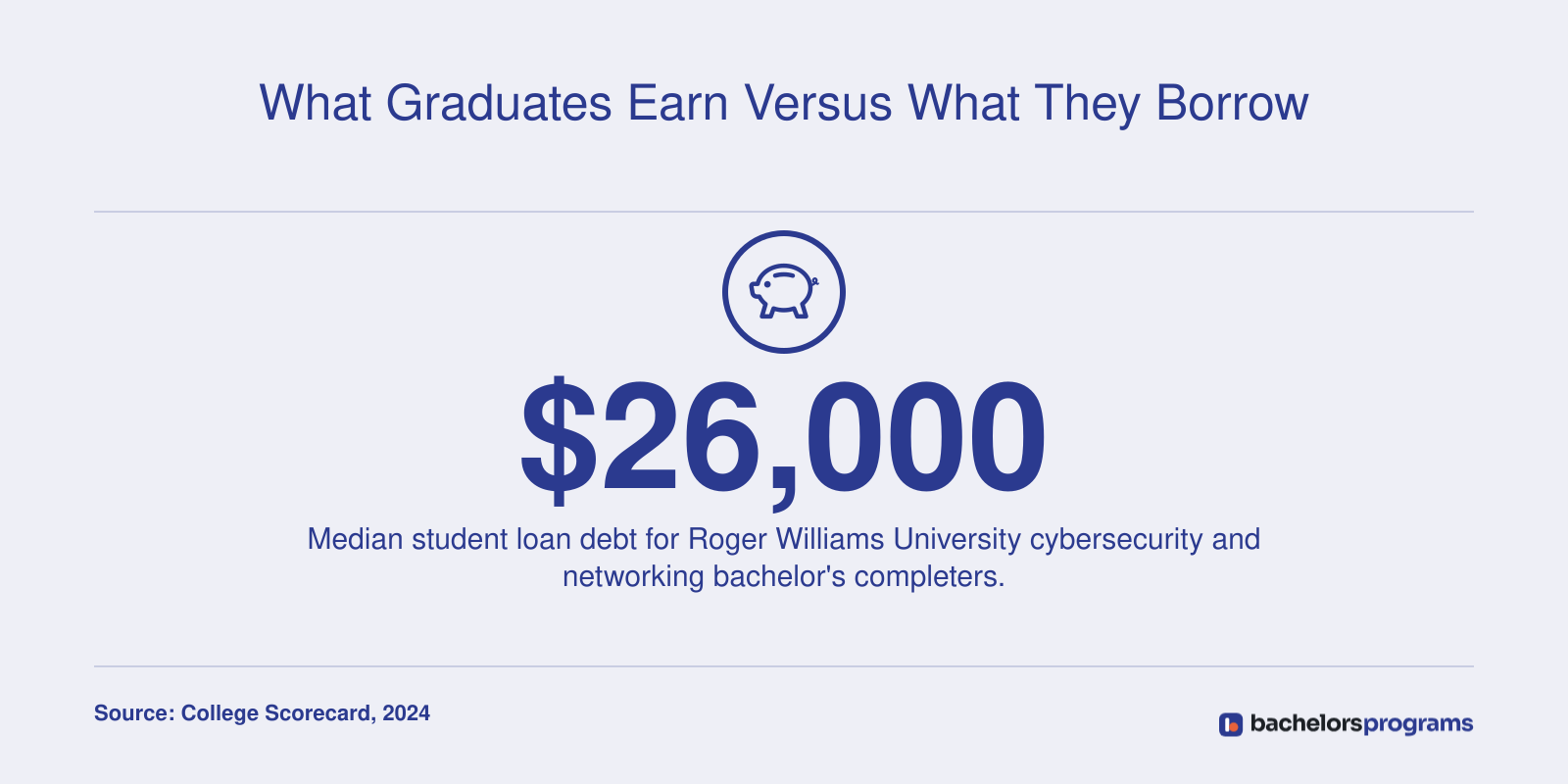
Roger Williams University is the school here where College Scorecard publishes program-level borrowing for its cybersecurity bachelor's graduates: a median of $26,000, or roughly $276 a month on a standard 10-year repayment plan. Scorecard has not reported program-level earnings for these Rhode Island cybersecurity degrees, so weigh this debt against the state salary data elsewhere on this page rather than against school-wide earnings figures. Treat these numbers as medians from College Scorecard, not guarantees. The Roger Williams figure comes from a small group of completers, which makes it noisy from one year to the next.
Questions to Ask Yourself
Do you want a dedicated cybersecurity major or a broader computing degree with security coursework?
Can you realistically make the drive to campus every week?
Are you aiming at defense or federal contracting work that may require a security clearance?
Rhode Island Cybersecurity Degree Questions, Answered
These answers cover the questions Rhode Island students ask most about cybersecurity bachelor's degrees, from transfer rules to clearances. Details come from Rhode Island College's published program and transfer pages, so confirm current terms with the school before you apply.
Does Rhode Island College offer a bachelor's degree in cybersecurity?
Can CCRI credits transfer to RIC for a cybersecurity degree?
Do I need a bachelor's degree to get a cybersecurity job in Rhode Island, or are certifications enough?
Do Electric Boat and Naval Undersea Warfare Center jobs require a security clearance?
Can I study for a cybersecurity bachelor's part-time while working in Rhode Island?
Is a computer science degree with a security focus as good as a standalone cybersecurity degree?
Compare Cybersecurity programs on the data that matters
Explore more Computers & IT majors or browse every field of study.
All Computers & IT programs Browse every field of study