Best Healthcare Administration Schools in Rhode Island
Compare 5 accredited Healthcare Administration programs in Rhode Island, with net price after aid, graduation rates, earnings and debt from IPEDS and the U.S. College Scorecard.

Which Rhode Island school has the best bachelor's degree in healthcare administration? Only a handful offer one, and the standard award is the Bachelor of Science (B.S.) in Healthcare Administration. Rhode Island College is our pick, and the ranked list below shows how Bryant University, Salve Regina University and Johnson & Wales University compare.
Price drives most of the decision. Rhode Island College lists $11,300 in annual tuition and fees, while Bryant and Salve Regina list more than $50,000.
Most graduates still enter through hospitals, clinics and long-term care, where internships often count for more than the name on the diploma.
Key Points
- Public Rhode Island College averages $9,478 a year after aid.
- Salve Regina University graduates earned a $70,320 median four years after completion.
- Most healthcare administration jobs need no license; nursing home administrators do.
Best Healthcare Administration Schools in Rhode Island: Our Ranked List
Rhode Island College is our pick for the best healthcare administration school in Rhode Island, because it offers the state's most direct route to a dedicated Bachelor of Science in Healthcare Administration at a public-university price. Bryant University fits students who want healthcare management folded into a business degree, Salve Regina adds a required internship and community-health work, and Johnson & Wales delivers the same bachelor's degree in healthcare administration fully online. The right answer depends on whether you need in-state tuition, a business-heavy concentration, or a schedule you can complete from anywhere.
Rhode Island College
#1Providence, RI · $9,000/yr (est. net price)
Best for: In-state students wanting a dedicated major
Rhode Island College is a public institution in Providence, and its Bachelor of Science in Healthcare Administration is the state's most direct route into the field. The interdisciplinary major draws courses from 18 academic departments and pairs a required internship with an integrative capstone, while the college's Institute for Education in Healthcare keeps the program tied to regional workforce needs. In-state tuition is a fraction of what the private options on this list charge, and eligible Rhode Island students can use the Hope Scholarship toward junior and senior year tuition.
- Bachelor of Science in Healthcare Administration on a Providence campus
- Interdisciplinary major drawing coursework from 18 academic departments
- Required internship plus an integrative capstone
- Covers health policy, management, human resources, finance and information systems
- Minor option lets students in other majors explore the field
- Home to the college's Institute for Education in Healthcare
- Rhode Island juniors and seniors may qualify for Hope Scholarship tuition
Bryant University
#2Smithfield, RI · ~$41,000/yr (est.)
Best for: Business-minded students eyeing hospital leadership
Bryant University is a private, business-focused university in Smithfield where healthcare is studied through a Healthcare Management and Strategy concentration taken alongside a business major. Students take healthcare economics, supply chain and analytics courses and apply them in a practicum and consulting projects with hospitals, biotech firms and insurers. It is the strongest fit for students who want a business credential with a healthcare specialty rather than a standalone healthcare administration major.
- Concentration taken alongside a business major, not a standalone degree
- Coursework in healthcare economics, regulation and supply chain
- Data analytics and innovation built into the healthcare track
- Practicum and consulting projects with hospitals, biotech and insurers
- Sample courses include Economics of Health and Medical Care
- Graduates move into hospital administration, consulting and insurance
- Pathway to Brown University's public health master's for eligible graduates
Salve Regina University
#3Newport, RI · ~$37,000/yr (est.)
Best for: Hands-on learners drawn to community outreach
Salve Regina University is a private university in Newport whose Bachelor of Science in Healthcare Administration blends business with nursing, social work and sociology. A required internship and a capstone that culminates in the Seahawk Tank business plan competition give students applied experience before they graduate. The university's health and wellness mobile outreach unit, which serves underserved Rhode Island communities, adds community-health exposure beyond the classroom.
- Bachelor of Science in Healthcare Administration
- Interdisciplinary curriculum blends business, nursing and social work
- Required internship in the field before graduation
- Capstone includes the Seahawk Tank business plan competition
- Option to add a certification in healthcare quality
- Explores health policy, ethics and disease prevention
- Prepares students for clinical director and practice administrator roles
Johnson & Wales University
#4Providence, RI · ~$20,000/yr (est.)
Johnson & Wales University is a private university based in Providence that delivers its Bachelor of Science in Healthcare Administration through JWU Online. The degree is built for working and remote students, with 7- and 15-week course terms and a roughly four-year timeline, plus an internship or directed experiential component. Coursework covers quality improvement, health policy, healthcare law, and the finance and marketing foundations that hospital and clinic administrators rely on.
- Fully online Bachelor of Science in Healthcare Administration
- About four years to complete, with 7- or 15-week course terms
- $495 per credit for online undergraduate tuition
- Coursework in quality improvement, health policy and healthcare law
- Internship, directed experiential education or study abroad option
- Transfer credit evaluated within 48 hours
- Career Catalyst Scholarship cuts tuition 20% for eligible students
Cost & outcomes by school
Federal data for the highest-earning Healthcare Administration programs, independent of the ranking above. Earnings are this field's bachelor's graduates four years after completing where the Scorecard reports them, else the school's undergraduate median.
| School | Net price / yr | Grad rate | Earnings | Debt | Grads/yr | Format |
|---|---|---|---|---|---|---|
| Bryant University RI | $41,219 | 80% | $90,008 | $26,849 | — | Campus |
| Salve Regina University RI | $36,967 | 77% | $70,320 | $27,000 | 4 | Campus |
| Rhode Island College RI | $9,478 | 48% | $57,195 | $24,705 | 17 | Campus |
| Johnson & Wales University RI | $31,027 | 55% | $43,418 | $26,000 | — | Campus |
| Johnson & Wales University RI | $20,252 | — | $43,418 | $26,000 | — | Online |
Sources: U.S. Department of Education. Net price, graduation rate, earnings and debt: College Scorecard (earnings and debt for this field's bachelor's graduates where reported, else school-wide); graduates: IPEDS. A dash means no figure is reported.
Cost, debt & payoff
Median earnings of this field's bachelor's graduates (4 yrs after completing, else the school's undergraduate median) vs. their median federal loan debt · U.S. College Scorecard
Across these programs the median graduate earns about $57,195 and finishes with roughly $26,000 in debt — a ratio that clears a common rule of thumb (keep debt below first-year salary). Net price and debt vary widely school to school, so check the per-school figures in the table above before you shortlist.
How to Choose a Bachelor's Degree in Healthcare Administration in Rhode Island
Salve Regina University is the only school here that points to an IACBE credential: its business and economics department holds IACBE accreditation, though the program page does not extend that to the healthcare administration major on its own.
Accreditation
CAHME accredits mostly graduate programs, and none of the program pages here list CAHME status for a bachelor's degree. Rhode Island College and Johnson & Wales University (Providence) do not publish IACBE or AUPHA status, and Salve Regina's pages are silent on CAHME and AUPHA. Bryant University offers healthcare as a concentration within its business curriculum, so ask which accreditation covers that track.
Internships and Practicums
- Rhode Island College: An internship is required (HCA 467, in the final semester).
- Johnson & Wales: An internship of at least 6 credits is required, with 9 or 12 credits possible when electives allow.
- Salve Regina: An internship is required, but its credit value and length are not published on the program pages.
- Bryant: No internship requirement is published for the concentration.
Curriculum and Questions to Ask
Look for coursework in health policy, finance, long-term care, and operations. Rhode Island College describes an interdisciplinary curriculum drawing on 18 majors, with a capstone, and a major of 72 to 78 of the 120 total credits. Ask each admissions office how internship sites are found, which courses cover finance and policy, and how transfer credit applies.
Some schools lay out combined pathways: Johnson & Wales describes a B.S./MPH in as little as 5 years, Salve Regina a combined route within 5 years, and Rhode Island College publishes a pathway document worth confirming as current.
Quick Decision Criteria
- Accreditation: Match the credential to your goals, and verify it with the school.
- Experience: Prefer a published internship credit value and placement support.
- Focus: Choose the curriculum that fits your target setting, such as hospitals or long-term care.
- Flexibility: Check format, transfer rules, and any combined-degree option.
Online and Hybrid Bachelor's Options at Rhode Island Schools
Delivery formats vary: a fully online program runs every course remotely, a hybrid mixes campus and online classes, a campus program meets in person, and a degree-completion program is built for students who already hold college credit. Johnson & Wales University is the Rhode Island-based school here with a fully online B.S. in Healthcare Administration through JWU Online, and its accelerated course terms and fast transfer credit review suit transfer students and working adults. Bryant University, Rhode Island College, and Salve Regina University list their programs as campus-based, and we found no online, hybrid, or dedicated degree-completion bachelor's in healthcare administration at any of them; because formats change, confirm each listing on the school's current program page before applying.
| School | Program | Delivery Format | Location | Notes for Transfers and Working Adults |
|---|---|---|---|---|
| Bryant University | Healthcare Management and Strategy concentration (bachelor's) | Campus | Smithfield, RI | Concentration within a bachelor's degree; no online bachelor's version found |
| Rhode Island College | Healthcare Administration B.S. | Campus (confirm on current program page) | Providence, RI | Program page does not state delivery format; includes an internship and an integrative capstone, with courses drawn from 18 majors |
| Salve Regina University | Healthcare Administration B.S. | On campus | Newport, RI | 48 months; internship required; the school's online healthcare administration certificate is not a bachelor's degree |
| Johnson & Wales University (campus) | Healthcare Administration B.S. | Campus | Providence, RI | 121 credits; 48 months; minimum 6-credit internship |
| Johnson & Wales University (JWU Online) | B.S. in Healthcare Administration | Fully online | Providence, RI | $495 per credit; courses run 7 or 15 weeks; transfer credit evaluation within 48 hours; spring start; dedicated online admissions associate |
Admission Requirements: GPA, Test Policy, and Transfer Credit
Getting into a Rhode Island healthcare administration bachelor's program is less about competition than about clearing a published GPA floor, and transfer applicants carry the heavier burden of proof.
What the GPA Floors Actually Are
Rhode Island College publishes the clearest numbers of the group. A transfer applicant who has earned 24 or more college credits in a diversified program needs a minimum 2.00 GPA to be considered.1 First-year applicants see a friendlier picture: the college's incoming class profile lands around a 3.2 high school GPA, though Rhode Island College presents that as a description of who enrolls, not as a hard cutoff. Bryant University, Salve Regina University and Johnson & Wales University each route admission through their own undergraduate offices, so where a school posts no numeric floor, treat any secondhand figure as unverified and get it confirmed in writing.
Test-Optional Status
Rhode Island College is test-optional, not test-blind: SAT or ACT scores are not required, and submitting them is your choice. That has held through the 2025-2026 cycle and is the stance to plan around.1 Strong scores help; without them, admissions weighs your transcript and college coursework.
Transfer Credits and Age Limits
Rhode Island College accepts up to 90 transfer credits and grants credit for regionally accredited coursework completed with at least a C, while keeping final authority over what counts.1 The major department decides how those credits apply to the Healthcare Administration BS, so a course that transfers may still land as an elective. Credits more than 10 years old may be accepted at the admissions office's discretion.
The Easiest Door for Transfers
Rhode Island College is the most transfer-friendly of the group: a 2.00 floor at 24 credits, a 90-credit ceiling, and grade and age rules published where you can read them before applying. Get each course's status toward the major confirmed in writing before you pay a deposit.
Related Articles
Cost of a Healthcare Administration Bachelor's Degree in Rhode Island
Sticker price and what students actually pay differ sharply: public Rhode Island College lists $11,300 in annual tuition and fees and averages $9,478 after aid, while private Johnson & Wales University, Salve Regina University and Bryant University post average net prices from $20,252 to $41,219. Net price and median debt below are institution-wide figures for all undergraduates, not for the healthcare administration program alone. The 2026-27 cost of attendance adds housing, books and other expenses to tuition. Rhode Island residents should file the FAFSA every year to be considered for the need-based Rhode Island State Grant, which public colleges and participating private nonprofit colleges award under their own rules, in amounts that vary by school and by annual state funding. Residents who finish a Rhode Island high school, home school or GED program before age 19 and enroll full time at the state's community college the following term may qualify for Rhode Island Promise, which also requires a FAFSA, at least six credits each fall and spring, and a cumulative GPA of 2.5 or higher. The RISLA Access Scholarship is another option for residents who completed a Rhode Island high school, recognized home study or GED program. Tip: earning an associate degree with Promise support and then transferring into a bachelor's degree in healthcare administration can reduce how many years you pay four-year rates.
| School | Sector | Program Format | Annual Tuition and Fees | Average Net Price After Aid (Institution-Wide) | Total Cost of Attendance (2026-27) | Median Debt at Graduation (Institution-Wide) |
|---|---|---|---|---|---|---|
| Rhode Island College | Public | Campus | $11,300 in-state | $9,478 | $32,668 | $20,500 |
| Johnson & Wales University | Private | Online | $13,365 | $20,252 | $68,226 | $26,000 |
| Salve Regina University | Private | Campus | $50,100 | $36,967 | $80,048 | $27,000 |
| Bryant University | Private | Campus | $52,677 | $41,219 | $77,883 | $26,849 |
Careers and Wages With a Bachelor's in Healthcare Administration in Rhode Island
Start with SOC code 11-9111, the federal category for medical and health services managers. Look it up to see what the job pays and how fast the field is growing, and read the numbers at the source rather than trusting a secondhand figure.
Check the federal data
Open the BLS Occupational Employment and Wage Statistics pages for Rhode Island and for the Providence-Warwick, RI-MA metro area. Look up 11-9111 and read the percentile wages, not just the average. For a yardstick, the metro's all-occupation average hourly wage was $33.31 in May 2025, against $33.54 nationally.1 Then read the BLS Occupational Outlook Handbook entry for national outlook context.
Verify school outcomes
Contact career services at Rhode Island College, Salve Regina University, Johnson & Wales University, and Bryant University (healthcare management and strategy concentration). Ask each for graduation and employment data, internship placements, and a list of employer partners. Get answers in writing, and be wary of placement claims that name no source.
Read the local job market
Browse the career portals of the state's major systems. Lifespan (now operating under a newer name, so search both) handled 46% of inpatient discharges in 2023, and Care New England handled 32%.2 CharterCARE is the only for-profit system among them. Add the large long-term care operators. Search entry-level titles such as practice coordinator, patient access representative, administrative fellow, and operations assistant. A Cranston search on Indeed showed 50 entry-level admin listings, but those are general administrative roles, so filter for healthcare to see real demand.
Your action checklist
- Confirm wages: Check current wage and hiring data on BLS.gov for the state and the metro.
- Compare postings: Save live listings from each system and note required degrees and experience.
- Join the field early: Contact ACHE, MGMA, or HFMA for local chapters and salary resources.
- Interview locally: Request informational interviews with Rhode Island employers to test whether entry-level demand matches what you read online.
How Much Do Healthcare Administration Graduates Earn in Their First Years?
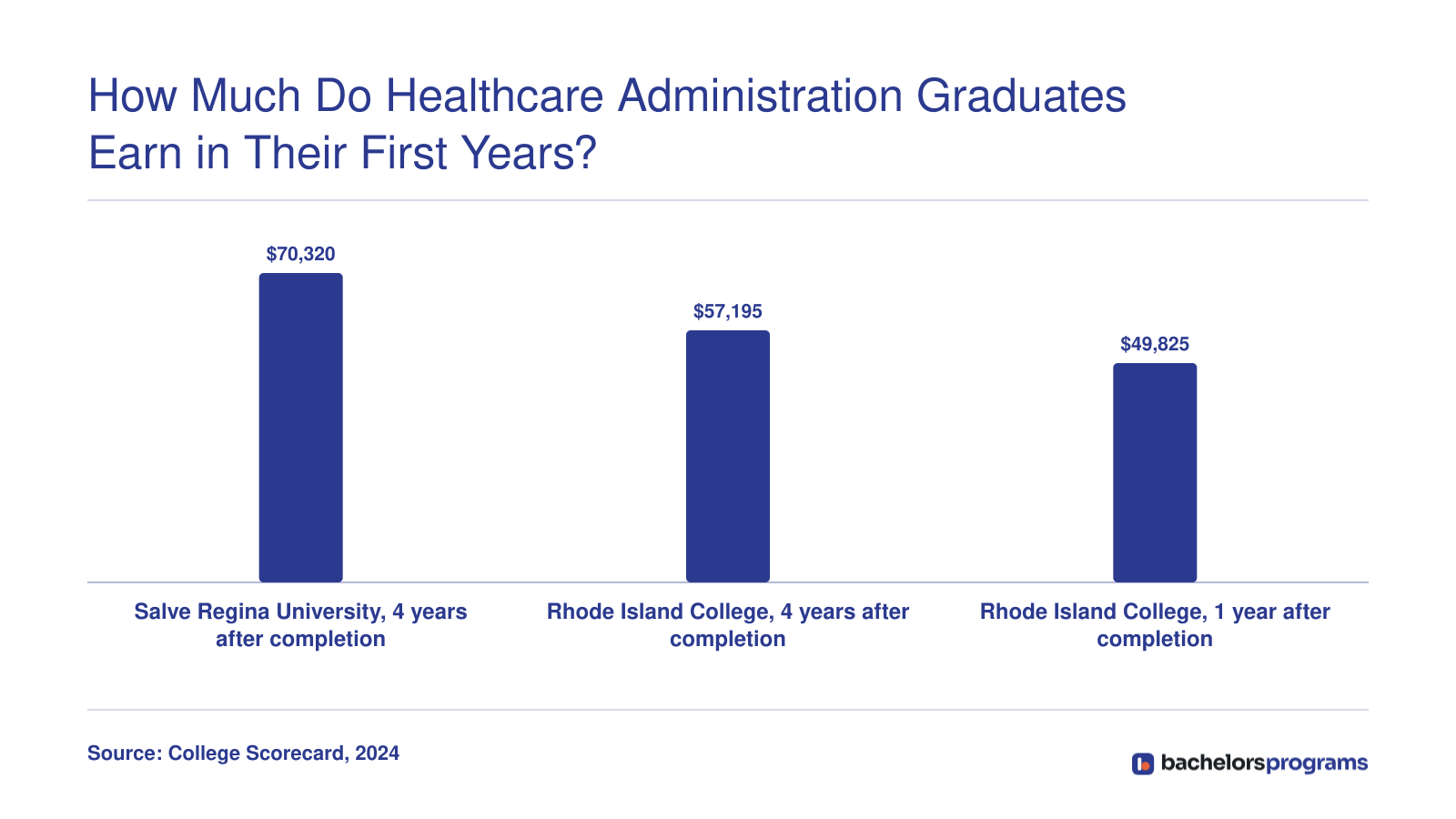
Rhode Island College's healthcare administration bachelor's graduates earned a median of $49,825 one year after completion, rising to $57,195 four years after completion. Salve Regina University graduates reported a median of $70,320 four years after completion. That climb suggests pay builds with experience in the field, though small graduating classes mean these program-level figures can shift from one year to the next.
Rhode Island Licensure for Healthcare Administrators
Most graduates want to start work right after commencement, but one corner of the field requires a state license first. Most healthcare administration jobs need no license at all. Nursing home administrators are the exception in Rhode Island, and the assisted living administrator role carries its own certification.
Nursing Home Administrator License
The Rhode Island Department of Health issues this license under rule 216-RICR-40-05-32, amended effective July 2, 2026. Applicants must be at least 18 and of good moral character. The main requirements:
- Education: A bachelor's degree in health care administration from an accredited institution, or any bachelor's degree plus at least 15 credit hours covering the five required content areas (resident care management, personnel, financial, environmental, and governance and management).
- Training: An administrator-in-training period of at least 350 hours within 12 months at a licensed nursing facility, supervised by an administrator holding an active Rhode Island license.
- Exam: The NAB national examination, with a minimum passing score of 113 on the Department's application.2
The application also asks for proof of age, two good-moral-character letters, a Rhode Island Attorney General's BCI background check, official transcripts, and a curriculum vitae.2 Apply through the Department of Health.1
Other Roles and Entry-Level Jobs
Assisted living residence administrators hold a certification under 216-RICR-40-05-18. It lasts two years and requires a Department-approved exam plus 80 hours of field experience within 12 months. Eligibility comes through approved training, a health-related degree, or a current nursing home administrator license.
Entry-level roles such as department coordinator, patient services representative, or practice office assistant do not require a license. A bachelor's degree from Rhode Island College, Bryant University, Salve Regina University, or Johnson & Wales University can keep either licensed path open later.
Earning a Bachelor's Degree in Healthcare Administration: Which Path Fits You?
Choosing among the bachelor's programs here comes down to where you are starting from: a first-time freshman, a student with credits from another college, or a working adult who needs to keep a job while finishing the degree. The right pick looks different for each.
If You Are a First-Time Student
Rhode Island College is the natural first stop. As the public option, it carries the lowest in-state tuition of the schools on this list, and its B.S. in Healthcare Administration sits in Providence, close to the state's hospital and clinic employers. Bryant University makes sense if you want a business-heavy curriculum (its concentration is Healthcare Management and Strategy) and can use financial aid to close the gap between a private sticker price and what you actually pay. Salve Regina University fits a smaller, cohort-style campus in Newport.
If You Are Transferring
Ask for a written credit evaluation before you deposit anywhere. The question that matters is whether your health administration and business courses transfer as major requirements or land in elective credit, which can add a semester or more.
If You Are a Working Adult
Look hardest at part-time schedules and at schools offering an online or hybrid completion route, then confirm whether required internship hours can be scheduled around your shift.
Three Next Steps
- Compare net price, not tuition: run each school's net price calculator so room, fees and grant aid are baked in.
- Confirm accreditation and internship: ask where the program's accreditation sits and whether a practicum is required or arranged for you.
- Check transfer credit in writing: get the evaluation on letterhead before you commit.
Frequently Asked Questions About Healthcare Administration Schools in Rhode Island
These answers summarize the main questions students ask when comparing bachelor's degree options in Rhode Island. Details such as tuition, delivery format, and requirements can change, so confirm them with each school before you apply.
What is the best healthcare administration school in Rhode Island?
How much does a healthcare administration degree cost in Rhode Island?
Can you get a bachelor's degree in healthcare administration online in Rhode Island?
Are there CAHME-accredited healthcare administration programs in Rhode Island?
Do you need a license to work as a healthcare administrator in Rhode Island?
Compare Healthcare Administration programs on the data that matters
Explore more Business & Management majors or browse every field of study.
All Business & Management programs Browse every field of study