Best Communications Degree Programs in Maryland
Compare 21 accredited Communications programs in Maryland at 15 colleges, with net price after aid, graduation rates, earnings and debt from IPEDS and the U.S. College Scorecard.

A bachelor's degree in communications in Maryland sits close to the work. The Baltimore-Washington corridor puts students within commuting distance of federal agencies, PR firms, nonprofits and newsrooms that hire writers, media planners and public affairs staff. Most schools award the Bachelor of Arts (B.A.) in Communications, though several title it communication studies or strategic communication.
Cost separates these programs more than prestige does. Published in-state tuition at Maryland's public universities runs from $8,229 to $13,256 a year, and average net price after aid stays under $17,000 at the public campuses.
Key Points
- Morgan State University charges the lowest in-state tuition here, at $8,229.
- University of Maryland Global Campus offers the clearest fully online path.
- Nationally, public relations specialists earned a $74,750 median wage in 2025.
Best Maryland Schools for a Bachelor's Degree in Communications, Ranked
A bachelor's degree in communications in Maryland can mean a large research university with a Washington, D.C., internship pipeline or a small private college where students run an on-campus agency. The ten schools below all award a Bachelor of Arts or Bachelor of Science in communications or a closely related credential, and each card gives the city, the format, the specializations on offer, an approximate after-aid price and the share of students the school graduates within six years.
University of Maryland-College Park
#1College Park, MD · $16,000/yr (est. net price)
Best for: Public relations and political communication hopefuls
The flagship campus in College Park runs one of Maryland's largest communication departments, split between general Communication Studies and four named specializations. Students work through a six-part core, can add a double major in information science, and draw on internships around Washington, D.C.; graduates have landed at Edelman, NBCUniversal, iHeartMedia and Booz Allen Hamilton. The school graduates about 89 percent of its students within six years, and the after-aid average price is roughly $15,700, which varies by student.
- Communication Studies plus four named specializations
- Specializations: health and science, media and digital, political, PR
- Public relations specialization holds CEPR certification as of 2026
- Six-part major: foundations, methods, society, theory, applied, electives
- C- or better required in every course counted toward the major
- Double major with Information Science available
- Internship placements include Edelman and the Washington Nationals
- Employers include Booz Allen Hamilton and the U.S. Department of the Interior
University of Maryland-Baltimore County
#2Baltimore, MD · $15,000 – $20,000/yr (est.)
Best for: Baltimore double majors sharing credits
UMBC in Baltimore keeps its media and communication studies degree tightly structured: 120 credits overall, at least 37 inside the major, a required internship and a capstone senior seminar. Students may share up to nine credits with a second major or minor, and qualified students can move into an accelerated bachelor's-to-master's route. The school graduates about 70 percent of its students within six years, and the after-aid average price is roughly $16,500.
- 120 credits total, at least 37 in the major
- 22-credit core ending in a capstone senior seminar
- Required 3-credit internship plus 12 elective credits
- Six electives in media courses, six interdisciplinary
- Up to 9 credits shared with another major or minor
- Minimum 2.0 GPA and a C in every major course
- Accelerated bachelor's to master's option
- Foreign language study encouraged to the 202 level
Towson University
#3Towson, MD · ~$17,000/yr (est.)
Best for: Advocacy and leadership track seekers
Towson's communication studies department sits just outside Baltimore and organizes the Bachelor of Arts around three elective tracks: Public Discourse and Advocacy, Identity and Culture, and Leadership and Organizational Communication. Coursework runs through persuasion, intercultural communication, health communication and social protest, with capstone, internship and study abroad options. The school graduates about 69 percent of its students within six years, and the after-aid average price is roughly $17,400.
- Three elective tracks: public discourse, identity and culture, leadership
- 42 units required in Communication Studies
- 120 total credit hours with a published four-year plan
- BA option adds foreign language study
- Capstone and internship options available
- Coursework in persuasion, health and intercultural communication
- Study abroad and independent study opportunities
Salisbury University
#4Salisbury, MD · ~$18,000/yr (est.)
Salisbury's communication major offers five concentrations, from media production and multimedia journalism to public relations and strategic communication. Production classes meet in an 18,500-square-foot Integrated Media Center with an HD video studio, a 24-track audio suite and 15 video editing rooms. Students earn credit for internships and practica, and admitted students can pair the B.A. with a master's in public communication in five years. The school graduates about 68 percent of its students within six years, at an after-aid average near $17,700.
- Concentrations: media production, media studies, multimedia journalism, PR
- 18,500-square-foot Integrated Media Center with HD video studio
- 24-track audio recording studio and 15 video editing suites
- Combined B.A. and M.A. in public communication in five years
- Credit awarded for internships and practica
- Lambda Pi Eta honor society chapter
Loyola University Maryland
#5Baltimore, MD · ~$31,000/yr (est.)
Loyola University Maryland is a private Jesuit campus in Baltimore, and its communication and media major is built for students who want portfolio work rather than pure theory. Specializations run through digital media and design, advertising and public relations, journalism, and media and society, ending in a senior capstone on real client projects. Student media include the Greycomm studio, WLOY Radio and Apprentice House Press. The school graduates about 79 percent of its students within six years, and the after-aid average price is roughly $30,600.
- Four concentration options including digital media and design
- Internship for credit available
- Senior capstone working with real clients
- Student media: Greycomm studio, WLOY Radio, Apprentice House Press
- Mac labs equipped with Adobe Creative Suite
- Interdisciplinary major with studio arts available
- 39 credit hours across 13 courses
- Four introductory, eight intermediate, three specialization courses
- Includes a diversity-justice designated course
- Internship course counts as an elective, up to 6 credits
- Double specialization possible
- 13 courses, 39 credit hours total
- Media writing, digital tools and multimedia storytelling
- Electives in business journalism, sports writing and copy editing
- Radio storytelling and documentary production options
- Senior capstone course required
Stevenson University
#6Owings Mills, MD · ~$27,000/yr (est.)
Stevenson University in Owings Mills runs a communication studies program grounded in speaking, writing and persuasion, with a student-run communications and design studio, The Mill Agency, handling client work. Students can take the B.A. track with two semesters of a foreign language or use the bachelor's-to-master's option to finish both degrees in five years. The school graduates about 68 percent of its students within six years, and the after-aid average price is roughly $26,500.
- Capstone course required
- Student-run communications and design agency, The Mill Agency
- Courses in persuasion, conflict resolution, organizational communication
- BA track adds two semesters of foreign language
- Bachelor's to master's option finishes both degrees in five years
- Professional minors let students tailor the degree
Mount St. Mary's University
#7Emmitsburg, MD · $20,000 – $25,000/yr (est.)
Mount St. Mary's is a small Catholic liberal arts campus in Emmitsburg, and its communication major leans on writing, public speaking and ethical persuasion. Students specialize in public relations, journalism or creative writing, work on WMTB radio and the Mountain Echo newspaper, and finish with a senior seminar. The school graduates about 65 percent of its students within six years, and the after-aid average price is roughly $22,700.
- Concentrations in public relations, journalism and creative writing
- Broadcast on WMTB radio and write for the Mountain Echo
- Senior seminar capstone required
- Internship opportunities available
- Alumni work at Disney and iHeartMedia
- Students present at national communication conferences
Frostburg State University
#8Frostburg, MD · $10,000 – $26,000/yr (est.)
Frostburg State University's communication studies degree is a Bachelor of Science in strategic communication, built around messaging, relationship building and organizational communication. The Communication Leadership Lab gives students practice facilitating campus discussions, and coursework builds a portfolio for public relations, social media and marketing roles. The school graduates about 50 percent of its students within six years, and the after-aid average price is roughly $16,700.
- Bachelor of Science in strategic communication
- Tracks: Strategic Communication Leadership, Strategic Social Media
- Communication Leadership Lab for facilitating campus discussions
- Portfolio and career skills built into coursework
- Prepares students for PR, social media and marketing roles
- Networking with regional and national employers
Hood College
#9Frederick, MD · ~$21,000/yr (est.)
Hood College in Frederick offers a Bachelor of Arts in Communication Arts through its Delaplaine School of Business and Communication, with coursework in writing, research, interviewing and editing across media platforms. Every student completes an internship, with recent placements at National Geographic, WBAL-TV and Sirius XM, and the campus has a broadcast studio and computer labs. Many students pair the major with business, psychology or English. The school graduates about 57 percent of its students within six years, at an after-aid average near $20,900.
- Internship required for all students
- Placements at National Geographic, WBAL-TV and Sirius XM
- New broadcast studio and computer labs
- Student-run Blazer Radio and campus newspaper
- Combine with business administration, psychology or English
- Coursework in writing, research, interviewing and editing
Goucher College
#10Baltimore, MD · ~$22,000/yr (est.)
Goucher College in Baltimore combines communication and media studies with hands-on production: TV studio, field video, audio and new media classes, plus a required internship of two to four credits. Past interns have gone to the BET Network, The Washington Post and HBO Documentaries, and the campus supports a radio station, a digital media site and a student newspaper founded in 1913. The school graduates about 57 percent of its students within six years, and the after-aid average price is roughly $22,500.
- 2-4 credit internship required of all majors
- Past placements: BET Network, The Washington Post, HBO
- TV studio, field video, audio and new media production classes
- Campus radio, digital media site and The Quindecim newspaper
- Study abroad at Macquarie University or University of Westminster
- Dual-degree and accelerated pathways with Columbia and Johns Hopkins
Cost & outcomes by school
Federal data for the highest-earning Communications programs, independent of the ranking above. Earnings are this field's bachelor's graduates four years after completing where the Scorecard reports them, else the school's undergraduate median.
| School | Net price / yr | Grad rate | Earnings | Debt | Grads/yr | Format |
|---|---|---|---|---|---|---|
| University of Maryland-College Park MD | $15,678 | 89% | $74,402 | $17,250 | 266 | Campus |
| Loyola University Maryland MD | $30,574 | 79% | $71,948 | $27,000 | 59 | Campus |
| University of Maryland Global Campus MD | $22,063 | 33% | $67,181 | $23,000 | 140 | Online |
| Notre Dame of Maryland University MD | $19,169 | 50% | $65,344 | $22,666 | — | Campus |
| Towson University MD | $17,413 | 70% | $63,292 | $17,989 | 90 | Campus |
| Stevenson University MD | $26,505 | 69% | $62,079 | $26,000 | 10 | Campus |
| University of Baltimore MD | $13,868 | 38% | $61,335 | $23,250 | — | Campus |
| University of Maryland-Baltimore County MD | $16,467 | 70% | $60,957 | $20,500 | 63 | Campus |
| Mount St. Mary's University MD | $22,655 | 65% | $57,669 | $26,312 | 9 | Campus |
| Hood College MD | $20,873 | 57% | $57,089 | $25,000 | 10 | Campus |
| Salisbury University MD | $17,743 | 68% | $56,048 | $21,250 | 122 | Campus |
| Bowie State University MD | $19,298 | 38% | $54,537 | $22,985 | — | Campus |
Sources: U.S. Department of Education. Net price, graduation rate, earnings and debt: College Scorecard (earnings and debt for this field's bachelor's graduates where reported, else school-wide); graduates: IPEDS. A dash means no figure is reported.
Cost, debt & payoff
Median earnings of this field's bachelor's graduates (4 yrs after completing, else the school's undergraduate median) vs. their median federal loan debt · U.S. College Scorecard
Across these programs the median graduate earns about $57,669 and finishes with roughly $24,250 in debt — a ratio that clears a common rule of thumb (keep debt below first-year salary). Net price and debt vary widely school to school, so check the per-school figures in the table above before you shortlist.
Most Affordable Communications Bachelor's Programs in Maryland
Average net price, what students pay after grants and scholarships, gives a truer picture of cost than sticker tuition. All of these public universities keep average net price under $17,000 a year, and University of Baltimore ($13,868) and Morgan State University ($14,985) come in lowest. Morgan State also has the lowest in-state tuition and fees at $8,229, while University of Maryland-College Park pairs a $15,678 net price with an 89% graduation rate.
| School | City | Communications Program | In-State Tuition and Fees | Out-of-State Tuition and Fees | Average Net Price | Graduation Rate |
|---|---|---|---|---|---|---|
| University of Baltimore | Baltimore | Digital Communication | $9,992 | $23,984 | $13,868 | 38% |
| Morgan State University | Baltimore | Bachelor of Science in Strategic Communication | $8,229 | $19,124 | $14,985 | 41% |
| University of Maryland-College Park | College Park | Bachelor of Arts in Communication | $11,809 | $41,186 | $15,678 | 89% |
| University of Maryland-Baltimore County | Baltimore | Media and Communication Studies, B.A. | $13,256 | $31,275 | $16,467 | 70% |
| Frostburg State University | Frostburg | Communication Studies | $10,220 | $25,814 | $16,715 | 50% |
Related Articles
Online and Hybrid Communications Bachelor's Options at Maryland Schools
A fully online communications bachelor's and a campus-based one lead to the same credential, but they fit different lives.
Fully Online at UMGC
University of Maryland Global Campus is the clearest fully online option among the ranked Maryland schools. Its Bachelor of Arts in Communication Studies is delivered fully online, with selected hybrid courses also available, and requires 120 credits. Up to 90 credits may transfer, which suits students arriving with prior college work. Online tuition is $337 per credit for Maryland residents, $499 for out-of-state students and $250 for military students, and other fees may apply. UMGC is institutionally accredited by the Middle States Commission on Higher Education, reaffirmed November 20, 2025. UMGC publishes no discipline-specific accreditation for this program, so plan on institutional accreditation only.
Hybrid and Campus Formats
The communications programs at the ranked Maryland schools in our data are campus-based, and several build studios, labs and internships directly into the degree. Students who want that equipment plus local newsroom or agency placements should plan for an in-person schedule in College Park, Baltimore, Towson, Salisbury or Frostburg.
A Quick Rule of Thumb
- Working adults and transfer students: a fully online program with generous transfer credit.
- Career changers building a portfolio: a campus program with a required internship.
- Commuters near a campus: a hybrid mix of online and in-person courses.
- Cost check: compare per-credit online rates with in-state campus tuition before you commit.
Admission Requirements for Maryland Communications Bachelor's Programs
Admission to a communications bachelor's program in Maryland is a two-step process: you get into the university, then you meet the major's own grade rules. The pieces are mostly standard, an online application, transcripts and any test scores the school asks for, and each school's admissions page confirms current deadlines and requirements.
How Selective the Schools Are
Federal Scorecard admission rates show a wide range. University of Maryland-College Park admits about 45% of applicants, while Loyola University Maryland admits about 75%, University of Maryland-Baltimore County about 72%, and Towson University about 82%. Salisbury University (about 87%) and Frostburg State University (about 89%) are the most open here. Pell Grant share runs from roughly 26% at Loyola to about 60% at UMBC and 59% at Frostburg.
Within the major, UMBC lists a 2.0 GPA minimum and a C in major courses, and College Park requires a C- or better in major courses. Entrance GPA and SAT/ACT policies were not confirmed for most of these schools, so check each admissions page rather than guess.
Transfer Credit and Community College Pathways
Maryland's public four-year institutions generally cannot deny direct transfer to students with an associate degree, or 56 semester hours and a 2.0 GPA. Credit from a community college is capped at 70 credits, and ARTSYS is the state tool for checking how courses transfer.
- Towson University: Its 2+2 plans pair 60 community college credits with 60 at Towson, with listed agreements including Mass Communication AA (Fall 2026). Plans not listed run through ARTSYS.
- Salisbury University: Transfer students must complete four communication courses on campus.
- University of Maryland Global Campus: It requires a 2.0 GPA and no major course below a C. It accepts up to 70 community college credits and 90 total toward the 120 needed, with 30 completed at UMGC.
A Practical Tip
For transfer students, University of Maryland Global Campus is the most flexible, thanks to its generous credit limits and 2.0 threshold. Among the selective-admission campuses, Towson's documented 2+2 plans make it the clearest route from a community college. Frostburg and Salisbury, with the highest admission rates here, are strong backups.
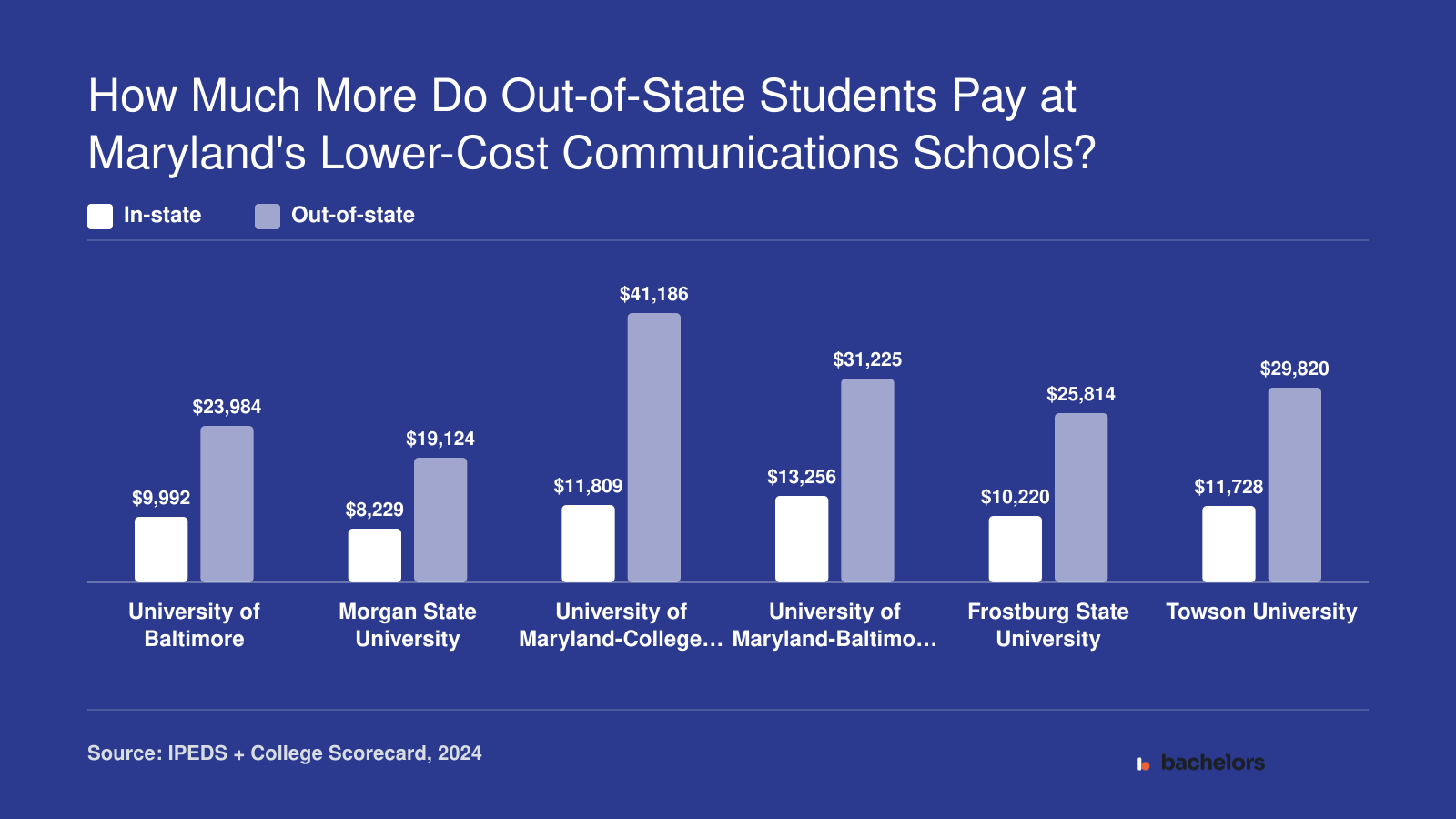
How Much More Do Out-of-State Students Pay at Maryland's Lower-Cost Communications Schools?
Each school in this chart is a public Maryland university, so state residents pay far less than nonresidents. Published in-state tuition and fees run from $8,229 at Morgan State University to $13,256 at University of Maryland-Baltimore County. Out-of-state rates range from $19,124 to $41,186. The widest gap is at University of Maryland-College Park, where nonresidents pay about $29,400 more per year. Private colleges typically charge one published rate regardless of residency, so this in-state discount is mainly a public-university advantage for Maryland residents.
Cost of a Communications Bachelor's Degree in Maryland
The price a Maryland school advertises and the price your family actually pays are rarely the same number, and the gap is widest at private colleges. Comparing a school's advertised price with what your family would actually pay is the fastest route to an honest budget for the degree.
Sticker Price vs. Net Price
In-state tuition and fees at Maryland's public universities are modest. Morgan State University lists $8,229, Salisbury University $11,084, the University of Maryland-College Park $12,008 and UMBC $13,256. Private schools start much higher: Notre Dame of Maryland University charges $43,360 and Hood College $47,700.
Average net price after grants and scholarships narrows that spread considerably. It runs from $13,868 at the University of Baltimore to $20,873 at Hood. Hood's sticker price is roughly four times UMD's tuition, yet its net price is only about $5,200 higher.
Maryland Grants for In-State Students
- Guaranteed Access (GA) Grant: The state's top need-based award, worth up to $18,000 for 2026-27 (minimum $400). You must enroll full time (12 credits per semester), be under 26 at first award and meet the initial income limit of $39,000 for a family of four. The renewal limit is $45,000, and renewal in later years depends on credit completion.
- Educational Assistance Grant: Need-based aid for full-time, degree-seeking students who have not already earned a bachelor's degree.
- 2+2 Transfer Scholarship: Aimed at transfer students. The 2026-27 application closed October 15, 2026.
For 2026-27, the GA Grant and Educational Assistance Grant required a FAFSA or MHEC One-App listing a Maryland college by March 1, 2026, plus an MDCAPS account and documents by August 1. Funds are awarded until they run out, so file early each cycle. The Maryland Next Generation Scholars Grant is not a college award. It funds nonprofits serving students in grades 7 through 12.
Debt and a Realistic Budget
Median debt for communications graduates ranges from $17,250 at UMD to $24,250 at Frostburg State University. At net prices between $13,868 and $20,873 a year, plan on roughly $55,000 to $83,500 over four years before state grants are applied.
Communications Careers and Job Outlook in Maryland
Public relations specialists earned a median of $74,750 nationally in 2025, and the Bureau of Labor Statistics projects roughly 23,000 openings in the field each year from 2025 to 2035.1 Those national figures set the demand picture for communications graduates in Maryland.
Where the Jobs Are
Entry roles cluster in three lanes: public relations and account work at agencies, digital and social media roles, and corporate or internal communication. In the Baltimore, Washington corridor, hiring tends to concentrate in organizations built on clear messaging, including federal agencies and their contractors, hospital and health systems, universities, nonprofits, and the PR and marketing agencies that serve them. First jobs usually carry titles like assistant account executive, social media coordinator, content specialist, communications assistant or internal communications associate. Writing samples and internships carry real weight at this stage, often more than GPA.
What the Pay Data Shows
In its May 2025 national wage survey, BLS reports a mean annual wage of $84,120 for public relations specialists across 283,380 jobs, alongside a 2025 median of $74,750.2 Projected growth from 2025 to 2035 is 2%, with most of those annual openings replacing workers who leave rather than filling new positions.1 For media and communication occupations as a group, the May 2025 median was $74,250, against $50,980 for all occupations, with about 88,500 openings a year over the same projection window.3 These are national numbers. BLS also publishes state and metro cuts of the same survey; those are the figures to weigh a Maryland offer against.
No License Required
Maryland does not license communications professionals. There is no state exam, no license to renew and no continuing education mandate attached to the field. Employers screen on portfolios, internships and platform fluency instead.
Two Different Numbers
Program-level earnings reported elsewhere on this page describe alumni of those programs, many of them early in their careers. Occupational wages describe everyone holding the job, including people with a decade of experience. Read them as separate signals, not as a forecast of each other.
How We Ranked Maryland Communications Programs
Every program on this list earned its place through published federal data and the schools' own program pages, not reputation or editorial preference.
Where the numbers come from
Program details (course requirements, concentrations, delivery format, campus location) come straight from each school's catalog and department pages. Only bachelor's programs were considered. Associate degrees, certificates and graduate study are excluded, even at schools that offer them.
How we defined communications
Communications is treated as its own field here, distinct from journalism and from broadcast or film production majors. A degree in communication studies, media and communication, strategic communication or communication arts qualified. A standalone journalism or mass media production major did not, even where the two share a department, because the coursework and career paths diverge.
Caveats worth knowing
Net price and graduation rate are institution-wide averages. They describe the school, not the communications department specifically, and a major's outcomes can differ from the campus figure. Scorecard earnings data is also incomplete at the program level: some Maryland communications programs have no published figure, usually because too few graduates completed in the reporting window. Where a number is missing, we ranked on what was available rather than estimate.
Maryland Communications Degree FAQs
These answers cover the questions Maryland students ask most about a bachelor's degree in communications, from online study and cost to licensure and transfer credit.
Can you earn a communications bachelor's degree online in Maryland?
How much does a communications degree cost in Maryland?
Is communications a licensed field in Maryland?
What is the difference between a communications degree and a journalism or media degree?
Can community college credits transfer into a Maryland communications bachelor's program?
Compare Communications programs on the data that matters
Explore more Communications & Media majors or browse every field of study.
All Communications & Media programs Browse every field of study