Best Graphic Design Schools in Maryland
Compare 12 accredited Graphic Design programs in Maryland, with net price after aid, graduation rates, earnings and debt from IPEDS and the U.S. College Scorecard.

A bachelor's degree in graphic design in Maryland carries published tuition of $8,229 a year at Morgan State University and $56,800 a year at Maryland Institute College of Art. That spread frames the decision. Maryland's options span public universities, private art and design colleges, and online programs from Maryland-based schools, and the credential is usually a B.A. or B.S. in graphic design or a B.F.A. with a design concentration.
Admission often turns on a portfolio review, not grades alone. Location matters as much as the name on the diploma: Morgan State places students in internships at the National Gallery of Art and the Smithsonian American Art Museum.
Key Points
- Published in-state public tuition runs $8,229 to $13,256 a year.
- University of Maryland Eastern Shore averages $13,338 a year after aid.
- Maryland Institute College of Art requires 10 to 15 recent artworks.
Best Bachelor's Degree in Graphic Design Programs in Maryland: Ranked
Maryland's graphic design Bachelor's programs range from a dedicated Baltimore art college to public research universities with competitive portfolio gates. Each entry below awards a Bachelor of Science (B.S.) or Bachelor of Arts (B.A.) in Graphic Design or a closely named equivalent, such as a B.F.A. in Design with a graphic design concentration. The order reflects graduation and retention strength, net price after aid, and the depth of each program's design curriculum.
University of Maryland-Baltimore County
#1Baltimore, MD · $15,000 – $20,000/yr (est.)
Best for: Test-optional applicants seeking a public research campus
UMBC is a public research university in Catonsville, just outside Baltimore, and it houses design in the Department of Visual Arts within the College of Arts, Humanities, and Social Sciences. The B.F.A. in Design lets students pick from five concentrations, and the graphic design path centers on visual communication and using words and images to solve problems for specific audiences. Visual arts graduates report a $62,894 median salary, and 119 of them work as graphic designers, with Under Armour and T. Rowe Price among the top employers.
- NASAD-accredited program in the Department of Visual Arts
- Five concentration options, including Graphic Design
- Standardized test scores optional for applicants
- $62,894 median earnings reported for visual arts graduates, 2011 to 2026
- 119 graduates work as graphic designers; Under Armour a top employer
- UX design graduates report a $75,000 median salary
- Apply through the Common App; arts applicants may face extra steps
Stevenson University
#2Owings Mills, MD · ~$27,000/yr (est.)
Best for: Students wanting a required design internship
Stevenson University in Owings Mills runs a career-focused design program that awards either a Bachelor of Science or a Bachelor of Arts in Graphic Design. Students complete a required internship and a senior capstone, and some get client-facing experience through The Mill Agency, a student-run studio. Portfolio-based Visual Arts Scholarships and a four-plus-one pathway to a master's degree add options for incoming and continuing students.
- Required internship through GDES 390 or SOD 390
- Portfolio-based Visual Arts Scholarships for freshmen and transfers
- Student-run Mill Agency gives client project experience
- Senior capstone required
- Coursework covers typography, web design, and design history
- Four-plus-one pathway to a master's in as little as five years
- Adobe AI features integrated into design coursework
Maryland Institute College of Art
#3Baltimore, MD · ~$43,000/yr (est.)
Best for: Art-school seekers wanting deep studio immersion
MICA is Baltimore's dedicated art and design college, and its graphic design major is among the largest studio programs in the state, with roughly 300 majors and 25 faculty who all practice professionally. A three-year core sequence in design is paired with electives in UI/UX, motion graphics, packaging, and font design. Juniors and seniors also take pre-professional coursework with working designers, and a senior degree project caps the degree.
- Three-year sequence of core design courses
- About 300 majors and 25 faculty who are practicing designers
- Roughly 50 classes per semester, including 10 to 15 electives
- Electives in UI/UX, motion graphics, packaging, and font design
- Required typography courses paired with studio work
- Senior degree project required
- Pre-professional experiences for juniors and seniors
Morgan State University
#4Baltimore, MD · $10,000 – $15,000/yr (est.)
Morgan State University, a historically Black university in Baltimore, offers graphic design as a concentration inside its B.A. in Fine Arts. The program leans on creative problem solving with Adobe Creative Cloud, typography, desktop publishing, and marketing skills, and places interns at the National Gallery of Art and Smithsonian museums in nearby Washington. A juried senior portfolio review stands between students and graduation.
- 120 credits total, with 41 in the Fine Art track
- Juried Senior Portfolio Review required to graduate
- Training in Adobe Creative Cloud, typography, and desktop publishing
- Internships at the National Gallery of Art and Smithsonian museums
- 2.0 GPA in the major; no major grade below C
Bowie State University
#5Bowie, MD · ~$19,000/yr (est.)
Bowie State University, a historically Black university in Prince George's County, teaches graphic design inside its Visual Communication and Digital Media Arts major, where the Advertising Design concentration covers branding, typography, print and multimedia campaigns, and package design. Students enter as pre-majors, pass a sophomore portfolio review, then finish with an off-campus internship and a senior thesis exhibition. The campus sits between Washington and Baltimore, which puts agencies in both cities within reach.
- 120 to 123 semester hours required
- Portfolio of at least ten artwork examples for admission
- Pass VCDM 219 Portfolio Review and Assessment by sophomore year
- 80 to 100 hour off-campus internship through VCDM 491
- Senior thesis exhibition capstone through VCDM 498
- 12 credits of art and design history
- Internship can be completed virtually or in a hybrid format
University of Maryland Eastern Shore
#6Princess Anne, MD · ~$13,000/yr (est.)
The University of Maryland Eastern Shore, a historically Black university on the Eastern Shore, offers graphic design through its B.A. in Applied Design with a Graphic Illustration concentration. The track blends traditional drawing and painting with digital work in departmental computer labs, and graduates move into design and illustration roles, start their own companies, or continue to graduate study. Art majors can also live in the campus Art Loft.
- One of three concentrations, alongside Commercial Photography and Sequential Arts
- Combines traditional drawing and painting with digital lab work
- Builds observational drawing and painting skills
- Art Loft housing available for art majors
University of Maryland-College Park
#7College Park, MD · $16,000/yr (est. net price)
The University of Maryland, College Park is the state's flagship campus, and its graphic design concentration sits inside the B.A. in Studio Art. Admission is competitive and limited to about 20 new students a year, so students typically apply after completing foundation coursework and may re-apply once. The sequence runs from intermediate principles through interactive design and three-dimensional graphic design to a portfolio course, with an internship elective available.
- 60 credits in the major, including 21 in foundation and studio electives
- Competitive portfolio review admits about 20 students each year
- Applicants may re-apply once if not admitted
- 12 credits of art history or theory required
- Sequence covers interactive design and three-dimensional graphic design
- No grade below C- counts toward the major
- Graphic design internship elective offered
Towson University
#8Towson, MD · ~$17,000/yr (est.)
Towson University's B.F.A. in Art + Design with a Graphic Design concentration requires 120 units, 60 of them in concentration coursework, and starts with a 21-unit foundation in digital tools, drawing, and two- and three-dimensional process. Studio electives stretch into letterpress, bookbinding, exhibit design, and metals, and a sample four-year plan maps the sequence. It is a screened program, so students must pass a graphic design review before taking Graphic Design II.
- 120 units, with 60 in concentration coursework
- 21-unit foundation in digital tools, drawing, and 2D/3D process
- Screened program: pass review before Graphic Design II
- Courses include Typography I and II, Package Design, and Design for the WWW
- Studio electives in letterpress, bookbinding, exhibit design, and metals
- Internship, portfolio course, and BFA project required
- Sample four-year plan maps the full course sequence
Salisbury University
#9Salisbury, MD · ~$18,000/yr (est.)
Salisbury University offers graphic design as a track inside its B.F.A. in Art, with 78 hours in art and a 16-credit design sequence built on Graphic Design II, III, and a Graphic Design Agency course. Students pass Junior Review and present work at Senior Exhibition, where a faculty committee reviews the portfolio. Internships and independent study can be arranged by proposal to the department chair.
- 120 credits overall, with 78 hours in art
- 16-credit graphic design track built on Graphic Design II and III
- Graphic Design Agency course provides project experience
- Junior Review and Senior Exhibition required
- Faculty committee reviews the portfolio at Senior Exhibition
- Art courses must be completed with a C or better
- 30 of the last 37 credits must be taken at Salisbury
McDaniel College
#10Westminster, MD · ~$22,000/yr (est.)
McDaniel College, a private liberal arts college in Westminster, offers graphic design as a specialization within its Art major. Students build portfolios shown in the Rice Gallery, take digital imaging coursework in Photoshop and Illustrator, and visit design agencies on field trips. Alumni who work as designers and art directors at Under Armour and Disney return each year for career-planning talks, and the McDaniel Commitment guarantees two experiential learning opportunities.
- Portfolio and senior exhibition required
- Capstone portfolios shown in the Rice Gallery in Peterson Hall
- Coursework in Digital Imaging with Photoshop and Illustrator
- Graphic Design II includes field trips to art agencies
- Alumni career talks from designers at Under Armour and Disney
- McDaniel Commitment guarantees two experiential learning opportunities
Cost & outcomes by school
Federal data for the highest-earning Graphic Design programs, independent of the ranking above. Earnings are this field's bachelor's graduates four years after completing where the Scorecard reports them, else the school's undergraduate median.
| School | Net price / yr | Grad rate | Earnings | Debt | Grads/yr | Format |
|---|---|---|---|---|---|---|
| University of Maryland-College Park MD | $15,678 | 89% | $82,860 | $19,000 | — | Campus |
| Towson University MD | $17,413 | 70% | $64,390 | $18,718 | — | Campus |
| Mount St. Mary's University MD | $22,655 | 65% | $64,072 | $25,391 | — | Campus |
| Salisbury University MD | $17,743 | 68% | $61,515 | $21,000 | — | Campus |
| McDaniel College MD | $21,916 | 63% | $60,663 | $25,000 | — | Campus |
| Frostburg State University MD | $16,715 | 50% | $55,493 | $21,105 | — | Campus |
| Stevenson University MD | $26,505 | 69% | $55,419 | $27,000 | 18 | Campus |
| University of Maryland-Baltimore County MD | $16,467 | 70% | $53,363 | $20,250 | 22 | Campus |
| Morgan State University MD | $14,985 | 41% | $50,698 | $27,250 | 15 | Campus |
| University of Maryland Eastern Shore MD | $13,338 | 35% | $47,697 | $27,000 | 17 | Campus |
| Maryland Institute College of Art MD | $42,729 | 72% | $45,436 | $26,842 | 108 | Campus |
| Bowie State University MD | $19,298 | 38% | $33,841 | $22,985 | 30 | Campus |
Sources: U.S. Department of Education. Net price, graduation rate, earnings and debt: College Scorecard (earnings and debt for this field's bachelor's graduates where reported, else school-wide); graduates: IPEDS. A dash means no figure is reported.
Cost, debt & payoff
Median earnings of this field's bachelor's graduates (4 yrs after completing, else the school's undergraduate median) vs. their median federal loan debt · U.S. College Scorecard
Across these programs the median graduate earns about $55,456 and finishes with roughly $23,993 in debt — a ratio that clears a common rule of thumb (keep debt below first-year salary). Net price and debt vary widely school to school, so check the per-school figures in the table above before you shortlist.
Most Affordable Maryland Graphic Design Bachelor's Programs
The net price gap among Maryland's lowest-cost graphic design options is narrow. University of Maryland Eastern Shore averages $13,338 a year after aid, about $3,100 less than University of Maryland-Baltimore County at $16,467. Net price and graduation rates come from U.S. Department of Education IPEDS and College Scorecard data (2024) and cover each school's full undergraduate population, so treat them as institution-wide averages, not an exact quote for your aid package or a measure of the graphic design major alone.
| School | City | Program | Average Net Price After Aid (per year) | In-State Tuition and Fees (per year) | Schools Offering This Program Have Graduation Rates Of |
|---|---|---|---|---|---|
| University of Maryland Eastern Shore | Princess Anne | Graphic Illustration | $13,338 | $9,076 | 35% |
| Morgan State University | Baltimore | Graphic Design | $14,985 | $8,229 | 41% |
| University of Maryland-College Park | College Park | B.A. in Studio Art with a concentration in Graphic Design | $15,678 | $11,809 | 89% |
| University of Maryland-Baltimore County | Baltimore | Bachelor of Fine Arts in Design | $16,467 | $13,256 | 70% |
| Frostburg State University | Frostburg | Art and Design, Bachelor of Fine Arts (B.F.A.) | $16,715 | $10,220 | 50% |
Maryland Graphic Design Bachelor's Programs With the Highest Graduate Earnings
These figures come from small graduating classes and can swing year to year (UMBC's median falls from four to five years out, for example), so treat them as a rough guide; the University of Maryland-College Park's graphic design concentration does not yet have program-level earnings reported.
| School | Program | Median Earnings 1 Year After Finishing | Median Earnings 4 Years After Finishing | Median Earnings 5 Years After Finishing | Median Program Debt at Graduation | Estimated Monthly Loan Payment (10-Year Plan) |
|---|---|---|---|---|---|---|
| Stevenson University | Graphic Design | $27,969 | $55,419 | $54,362 | $27,000 | $286 |
| Maryland Institute College of Art | Graphic Design | $27,246 | $45,436 | $51,848 | $27,000 | $285 |
| University of Maryland-Baltimore County | Bachelor of Fine Arts in Design (Graphic Design concentration) | $34,020 | $53,363 | $38,986 | $20,250 | $215 |
| Bowie State University | Visual Communication and Digital Media Arts (Advertising Design concentration) | N/A | $33,841 | N/A | N/A | N/A |
Online and Hybrid Graphic Design Bachelor's Options at Maryland Schools
On campus, you get studios and in-person critique. Online, you get flexibility and a program built around work and family schedules. You can complete bachelor's-level graphic design coursework online through a Maryland-based school, but the degree titles are related fields rather than a plain graphic design major.
How the Formats Compare
The programs at the schools here, including MICA, Stevenson, Towson, and Salisbury, are taught on campus. Their studio sequences, portfolio reviews, and capstone shows assume you are in the building. The online and hybrid options sit in related design fields:
- B.S. in Web & Digital Design (fully online): A Maryland public university offers this 120-credit degree with focus areas in web design, digital design, or augmented/virtual reality.1 The curriculum touches graphic design, motion graphics, animation, and digital media.
- B.S. in Graphic Communication (online, select hybrid courses): Offered by the same university, also 120 credits. It covers graphic design, visual communication, illustration, animation, brand identity, and portfolio development.2
- B.S. in Web and Digital Design (hybrid): UMBC offers this at Shady Grove, combining hybrid courses there with online courses.
What Online Students Trade Off
Studio access is the biggest gap. You will not have shared print equipment, large-format output, or a classmate working beside you. Expect to supply your own computer and licensed design software, so check each program's current technical requirements before you enroll. Critiques usually move to recorded presentations, shared files, and video calls. That suits digital work well, but it is a different experience from pinning prints on a wall.
Even so, the portfolio-development coursework in these programs is real. Employers tend to judge a designer on the portfolio, not the delivery format.
Who These Options Suit
Transfer students with an associate degree can slot into the 120-credit structure and finish without relocating. Working adults can keep a job while studying part-time. The Shady Grove hybrid track fits students in the Washington suburbs who want some face-to-face time. If you want a traditional fine arts studio experience, the campus programs at the schools here are the better match.
Related Articles
Admissions for Maryland Graphic Design Bachelor's Programs: GPA, Tests, Portfolios, and Transfers
Does MICA require a portfolio for graphic design? Yes. Maryland Institute College of Art asks every applicant for 10 to 15 recent artworks that show artistic interests, technical skills, ideas, and experience.1 MICA does not state a minimum high school GPA, and SAT or ACT scores are optional. You can send them if you believe they strengthen your application.
Portfolio Expectations at Other Ranked Schools
Portfolio timing varies. Some schools review your work before you enter the major, and one reviews it at the end of the degree.
- University of Maryland-College Park: Entry to the graphic design concentration runs through a competitive portfolio review. About 20 students are admitted per year, and graphic design courses are limited to admitted majors.
- Bowie State University: Students start as pre-majors, then submit a portfolio for admission. Behance is the preferred format, and transfer students have one year to submit.
- Salisbury University: A faculty committee reviews portfolios for the B.F.A. graphic design track.
- Towson University: The graphic design concentration uses screened program admission.
- Morgan State University: You must pass a juried senior portfolio review to finish the degree.
- UMBC: Applicants file the Common App plus a separate Visual and Performing Arts application.
- Stevenson University: Portfolios count toward its Visual Arts Scholarships.
The program pages for McDaniel College and University of Maryland Eastern Shore publish no GPA, test, or portfolio policy for entry, so ask their admissions offices directly.
GPA, Test Policy, and Selectivity
UMBC and MICA are test-optional.
Campus-wide admission rates show the level of competition. UMBC and Bowie State admit about 72 percent, MICA 77 percent, McDaniel 78 percent, Stevenson 79 percent, Towson and Morgan State 82 percent, and Salisbury 87 percent. UMES admits about 96 percent. A portfolio-screened major can be harder to enter than the university itself.
A community college A.F.A. or A.A.S. in graphic design is a common path into a bachelor's degree. At least one community college graphic design program reports transfer agreements with Frostburg State, MICA, Salisbury, and Stevenson.2
At MICA, the fine print matters:
- You need at least 12 college credits to apply as a transfer.
- No more than 60 credits transfer, including AP, IB, and dual enrollment.
- Courses ordinarily need a C or better.
- Your prior GPA does not carry over; you build a new one.
- Studio credit and placement depend on portfolio review, so design courses may not transfer one for one.
Salisbury also requires a C or better in art courses. Before you enroll, ask your target school how it evaluates studio coursework.
NASAD Accreditation: Which Maryland Graphic Design Bachelor's Programs Are Accredited
A NASAD stamp can tip a choice between two otherwise similar programs, but in Maryland it narrows the field more than most prospective students expect, and says nothing about whether a program fits your portfolio goals.
Which Programs Are Accredited
Checked against NASAD's directory of accredited institutional members, the verified Maryland names are:
- Maryland Institute College of Art (MICA), Baltimore: B.F.A. in Graphic Design, listed as an accredited institutional member.
- University of Maryland, Baltimore County (UMBC), Baltimore County: B.F.A. in Design with a Graphic Design focus, an accredited institutional member since October 2024.
Other schools on this list, including the University of Maryland, College Park and Salisbury University, appear in transfer advising materials as offering graphic design study, but the directory does not establish institutional membership or program approval for them. Membership also does not always mean a bachelor's degree; some Maryland members award graphic design credentials only at the associate level.
What the Credential Signals
NASAD reviews curriculum, faculty, facilities and program structure against national standards for art and design education. Membership tells you a program has been examined from the outside and that its degree is recognized within the field. It does not guarantee teaching quality, portfolio outcomes, internship access or earnings, and Maryland does not require it for practicing graphic designers.
Baseline and Verification
Regional accreditation is the baseline every student should confirm, since it governs federal aid and credit transfer; NASAD membership sits on top of it. To check status yourself, search each institution by name in NASAD's online directory, confirm the specific degree is listed rather than just the institution, and ask the department when it was last reviewed. Statuses change, and department pages usually update faster than third-party lists.
Cost of a Graphic Design Bachelor's in Maryland: Tuition, Net Price, and Aid
How much does a graphic design degree cost in Maryland? At a public university, published tuition for Maryland residents runs from $8,229 to $13,256 a year, while out-of-state students pay $19,124 to $41,186. The private schools here publish $40,560 to $56,800. Those are sticker prices, and the number that matters is net price: tuition, fees, books, and living costs minus grant aid. Averaged across aided students, net price falls between $13,338 and $19,298 at the public schools and between $21,916 and $42,729 at the private ones.
The Public-Private Gap
Private sticker prices look three to five times higher than public in-state tuition, but aid closes much of that distance. McDaniel's average net price of $21,916 sits far closer to the public range than its $52,081 published tuition suggests. Treat a net price as a sector-wide average for students who received aid, not a quote for your household. Run each school's net price calculator with your own income and savings before you compare offers.
Maryland Aid That Lowers the Bill
- Guaranteed Access Grant: $100 to $18,000 a year1, covering calculated need up to that cap for Maryland residents under 26 whose family income is at or below 130% of federal poverty guidelines.2 You must enroll full time (at least 12 credits) and hold no bachelor's degree.3
- Senatorial Scholarship: $400 to $14,086 for Maryland residents enrolled full time (12 credits) or part time (6 to 11 credits).4 There is no single statewide income cutoff or deadline; your own state senator's office sets the terms.
- Community College Promise: a last-dollar award of up to $5,000, or actual tuition and mandatory fees after federal and state aid, whichever is less. It funds community college study, which makes it a transfer route into a graphic design bachelor's rather than a four-year award.
Stacking Aid Without Losing It
File the FAFSA and the state's MHEC One-App by March 1 to be considered for the Guaranteed Access Grant, and submit supporting documents by August 1.5 School grants and private scholarships can layer on top of state need-based aid, but some institutional awards shrink when outside money arrives. Ask each financial aid office how it treats outside scholarships before you accept an offer.
How Does Published Tuition Compare With Net Price at Maryland Graphic Design Schools?
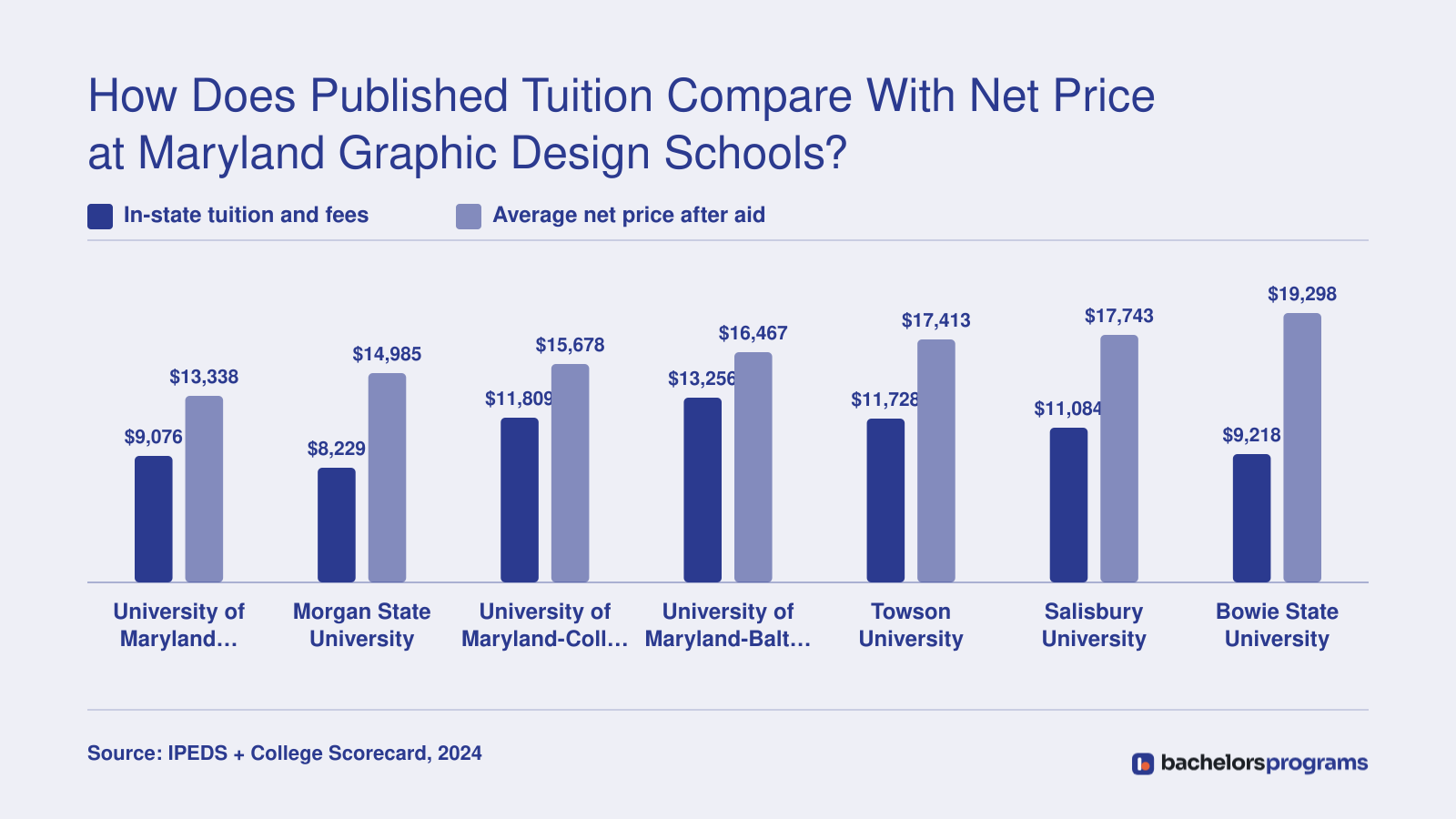
Published in-state tuition and fees at these Maryland public universities run from $8,229 at Morgan State University to $13,256 at University of Maryland-Baltimore County, yet average net price is higher at every one. Net price adds housing, food, books, and other costs of attendance, then subtracts grant and scholarship aid. It is an institution-wide average for all undergraduates, not a figure specific to graphic design majors. The widest gap is at Bowie State University, where the $19,298 net price sits $10,080 above its $9,218 tuition.
Graphic Design Careers and Salaries in Maryland
A graphic designer builds the visual pieces an organization uses to communicate: logos, packaging, signage, annual reports, campaign assets, social graphics, and the layout work behind both print and screen. The federal government tracks the job under occupation code 27-10241, and the figures below describe designers already working, not new graduates specifically.
What Maryland pays
Federal wage data from May 2023 counted about 3,230 graphic designers employed in Maryland, roughly 1.2 jobs per 1,000 in the state.2 In the Baltimore-Columbia-Towson metro, about 1,550 designers earned a mean wage of $29.08 an hour, or $60,490 a year.3 The Washington-Arlington-Alexandria metro, which spans DC, Virginia, Maryland, and West Virginia, is both larger and better paid: roughly 5,470 designers with a mean of $40.49 an hour, or $84,210 a year.4 That metro also has a higher concentration of design jobs than the nation as a whole, while Baltimore's concentration sits slightly below average. Living in Maryland and commuting into the DC market is one way to raise that ceiling.
Who hires designers here
Maryland's employer mix tracks the national industry picture for this occupation. Specialized design firms and advertising and public relations agencies are the two largest employers nationally, paying mean annual wages of $68,110 and $63,270 respectively.4 Consulting organizations pay comparably at $68,920, which matters in a state with heavy federal contracting work. Printers ($46,290) and publishers ($53,700) pay less.4 Maryland's hospital systems, universities, state and county agencies, and the in-house marketing teams at large employers add steady salaried work alongside agency and freelance paths.
Adjacent roles and licensure
Many design graduates move toward UX/UI design, art direction, or front-end web development. These sit in different federal occupation categories with their own wage data, and designers who build interface and coding skills generally compete for higher-paying listings than print-focused roles. Graphic design carries no state license in Maryland, so no exam or board approval stands between you and employment. Your portfolio does the gatekeeping instead.
One caution on numbers: the wage figures above describe everyone working in the occupation across all experience levels. The graduate earnings shown earlier on this page come from federal records tied to specific Maryland programs and specific years after graduation. They answer different questions, and averaging them together will mislead you.
How We Ranked Maryland Graphic Design Schools
College rankings come in two kinds: those that show their sources and those that show only a number. The ranking below belongs to the first group.
What Went Into the Pool
Any bachelor's program in graphic design or a closely related studio major was eligible, on-campus or online, as long as the school itself is based in Maryland. Graduate programs, certificate tracks, and institutions headquartered elsewhere were set aside.
The Data Behind Each Ranking
Two federal sources supply the numbers: IPEDS, the Department of Education's integrated postsecondary data system, and the College Scorecard. The affordability table sorts on net price, the average cost remaining after grants and scholarships are applied. The earnings table sorts on median earnings for graduates of the specific program, paired with median debt where the school reports it. The main ranking weighs net price, graduation rate, and program-level earnings and debt together.
Where the Numbers Stop
Graduation rate and net price are institution-wide figures, not graphic-design-only figures, so a school's overall profile can look stronger or weaker than its art department alone. Earnings windows also differ by school: one graduating class may be measured a year after completion while another is measured several years out. Read those tables as a starting comparison, not a verdict on any single program.
Check the Details Yourself
Rankings that cite no sources ask you to take their word for it. You should not have to. Before you apply, confirm admissions requirements, portfolio expectations, transfer credit rules, and current NASAD accreditation status directly with each school's own art or design department, since programs and policies change between publication cycles.
Compare Graphic Design programs on the data that matters
Explore more Arts & Design majors or browse every field of study.
All Arts & Design programs Browse every field of study