Best Communications Degree Programs in Michigan
Compare 34 accredited Communications programs in Michigan at 21 colleges, with net price after aid, graduation rates, earnings and debt from IPEDS and the U.S. College Scorecard.
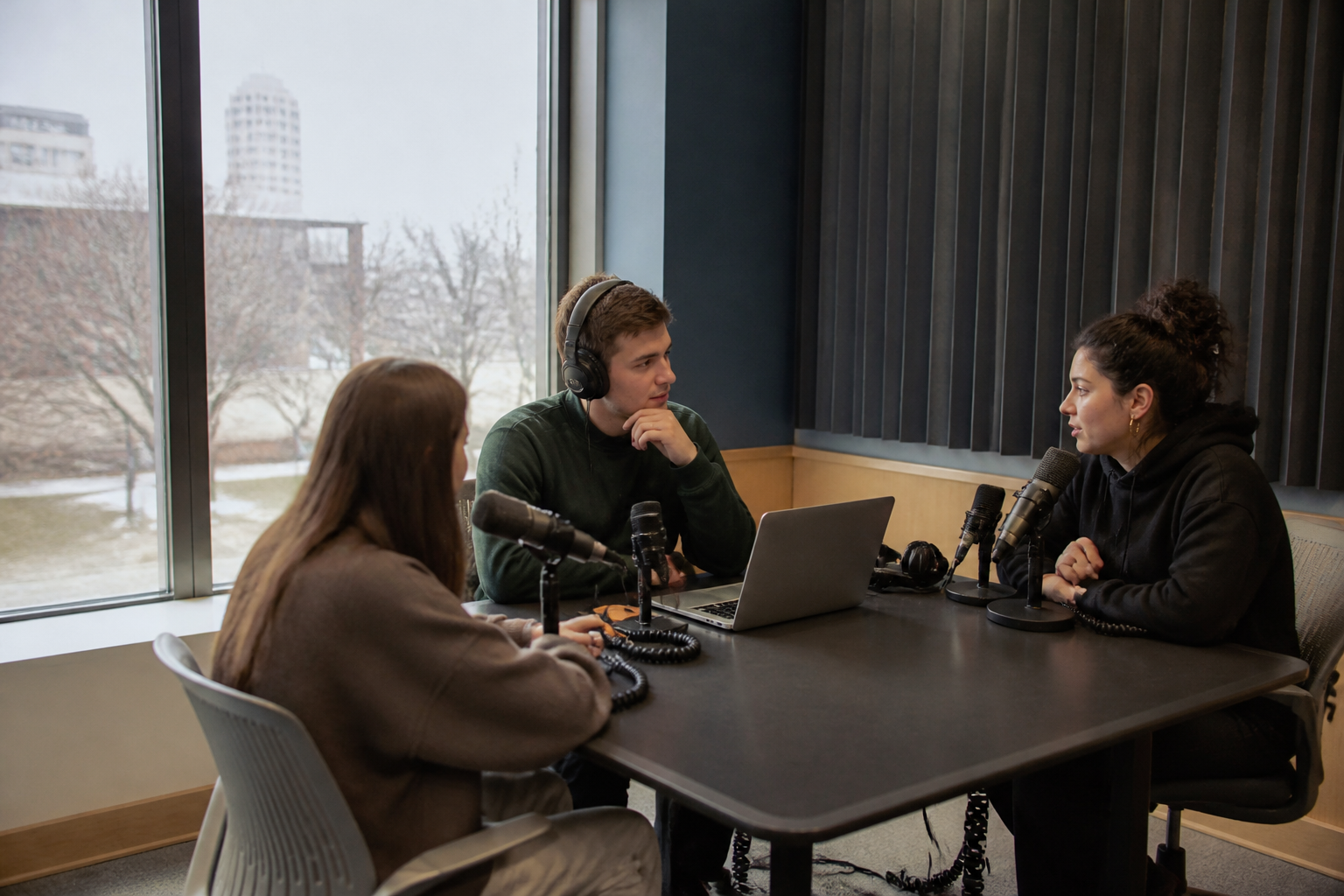
The Bachelor of Arts (B.A.) in Communications carries the same name at a large public communication college and at a small private liberal arts department, yet the two differ sharply on net price, class size and internship access. The bachelor's degree in communications is Michigan's generalist route into public relations, media production, journalism and corporate writing. Campus and online programs at Michigan-based schools share a core of writing, research, media law and a portfolio-building practicum, though costs and hiring markets vary. Admission generally follows each university's first-year standards. Because Michigan does not license communications work, employers hire on portfolio evidence, making net price the variable worth comparing hardest.
Key Points
- Michigan State's B.A. in Communication tops the list with seven concentrations.
- University of Michigan-Flint had the lowest net price in 2024 data.
- Western Michigan's public relations concentration has run fully online since fall 2021.
Best Bachelor's Degree in Communications Programs in Michigan, Ranked
The strongest bachelor's degree in communications in Michigan is Michigan State University's Bachelor of Arts in Communication, which pairs seven concentrations with internship and scholarship support inside a large, well-resourced communication college. Below are the ten Michigan programs that lead this ranking, each with its city, format, in-state tuition, net price after aid, and the share of students the school graduates.
Michigan State University
#1East Lansing, MI · $16,000 – $44,000/yr (est.)
Best for: Students wanting seven concentration choices
Michigan State University in East Lansing runs one of the largest communication departments in the country, and its communication college gives undergraduates access to internships, scholarships, and a student-run communication association. Students choose among seven concentration options, from intercultural and health communication to organizational communication, and build research, persuasion, and presentation skills that transfer to corporate, nonprofit, government, and advocacy work. It is the most comprehensive communications option in the state for students who want a big university with a defined path inside it.
- Seven concentration options, including health and organizational communication
- Internships in professional communication fields encouraged
- Scholarships available to communication majors
- Undergraduate Communication Association open to majors
- Coursework spans interpersonal through mediated communication
- Prepares students for corporate, nonprofit, and government roles
- Career center planning support built into the degree
- Seven concentration options, including intercultural and health communication
- Internships in professional settings encouraged
- Scholarships and financial aid available
- Undergraduate Communication Association active on campus
- Training in persuasion, leadership, and presentation
- Career center support for corporate, nonprofit, and government paths
Michigan Technological University
#2Houghton, MI · $10,000 – $15,000/yr (est.)
Best for: Media-minded students in a STEM setting
Michigan Technological University in Houghton offers a communication degree inside a research-heavy technological university, which suits students who want media and writing skills positioned next to science and engineering. The program centers on film, digital media, and writing and speaking, with major courses averaging 20 to 30 students. The Humanities Internship Program helps students land internships, and film and media work is showcased through the 41 North Film Festival and Cin-Optic Enterprise projects.
- Interdisciplinary liberal arts degree at a research university
- Focus on film, digital media, writing, and speaking
- Major courses average 20 to 30 students
- Humanities Internship Program helps place students
- Films shown at the 41 North Film Festival
- Cin-Optic Enterprise completes about 10 media projects a year
- Minors available in journalism, media production, and writing
Andrews University
#3Berrien Springs, MI · $10,000 – $15,000/yr (est.)
Best for: Faith-based learners eyeing public relations
Andrews University in Berrien Springs is a private Seventh-day Adventist institution with a communication degree built around media studies, new media technology, and speech communication. Students pick between Communication Studies and Public Relations concentrations and take a 120-credit curriculum that ties ethics and cultural literacy into the coursework. Classes are small and interactive, and graduates move into corporate communication, public relations, public affairs, or graduate study.
- Two concentrations: Communication Studies or Public Relations
- 120 total credit hours for the degree
- Coursework in media studies, new media technology, and speech
- Crisis communications and media writing covered
- Professional portfolio built during the program
- Ethics and faith integrated across the curriculum
- Prepares for corporate communication or public relations roles
University of Detroit Mercy
#4Detroit, MI · ~$15,000/yr (est.)
University of Detroit Mercy gives communication students a Detroit campus with a working media ecosystem around it. The communication studies degree offers focus areas in electronic media, journalism, public relations and advertising, or general speech, and students can work on the student newspaper The Varsity News or Detroit Mercy Radio. Small classes and a required internship culture have sent graduates to Ford Motor Company, Crain Communications, and Automotive News.
- Focus areas in electronic media, journalism, public relations and advertising, or general speech
- 120 total credit hours with a 36-credit major
- Student-run newspaper The Varsity News and Detroit Mercy Radio
- Animation and Voice Acting course offered
- Electronic music production projects
- Internships encouraged, including at Detroit television outlets
- Graduates hired at Ford, Crain Communications, and Automotive News
- Concentration in electronic media with a digital media focus
- News writing and social media strategy coursework
- Documentary film production and animation courses available
- Hands-on video projects and internships
- Small class sizes with faculty guidance
- Journalism concentration inside the 36-credit major
- News writing and digital media skills
- Social media strategies covered
- Ethics emphasized alongside practical projects
- Portfolio submission required for minors
- Concentration in public relations and advertising
- Principles of Public Relations and Advertising Campaigns courses
- Public Relations Writing and Social Media Strategies
- Real-world client projects and internship opportunities
- Ethics and research methods built into the track
Wayne State University
#5Detroit, MI · ~$13,000/yr (est.)
Wayne State University sits in Detroit and offers communication and media studies alongside a separate public relations major, giving students a choice between a theory-rich degree and a practice-focused one. The communication studies major is 42 credits with a required capstone, and the public relations major is 45 credits with a senior project; both draw on Detroit media organizations for internships. An AGRADE pathway lets strong students start a master's early, and an honors thesis option is available.
- 42 total credit hours with a required capstone
- Hands-on skills in presentation, content creation, and research
- Coursework in media literacy, intercultural, and organizational communication
- Electives in film, debate, leadership, and conflict resolution
- AGRADE pathway shortens time to a master's degree
- Honors program with a senior thesis option
- 45 credit hour major with a senior capstone project
- Core courses in PR fundamentals and writing
- Ethics, research methods, and mass communication coursework
- Evening classes available at the Macomb extension center
- Some online course availability
- Two-year completion path for community college transfers
- PRSSA student organization on campus
Oakland University
#6Rochester Hills, MI · $9,000/yr (est. net price)
Oakland University in Rochester Hills builds its communication degree around public speaking, storytelling, conflict resolution, and strategic messaging, with a capstone and plenty of room to tailor coursework. Students get practical experience through student-run media including WXOU radio, OUTV, and The Oakland Post, and the campus sits inside a major media market with partnerships at media firms, agencies, and nonprofits. Faculty come from marketing, public relations, broadcast, and digital media backgrounds.
- Capstone required for the major
- Student-run radio, TV, and newspaper on campus
- Located in a major media market
- Partnerships with media firms, agencies, and nonprofits
- Courses in public speaking, interpersonal communication, and advocacy
- Faculty from marketing, PR, broadcast, and digital media
- Internships with media companies and PR firms
Grand Valley State University
#7Allendale, MI · $15,000 – $20,000/yr (est.)
Grand Valley State University in Allendale offers a Bachelor of Arts or Bachelor of Science in communication studies, letting students pick the degree shape that fits their goals. The program covers communication theory, media studies, and interpersonal communication, and it is delivered face to face on the Allendale campus. A combined bachelor's and master's track lets qualified students accelerate into graduate work in communications.
- Bachelor of Arts or Bachelor of Science options
- Coursework in communication theory, media studies, and interpersonal communication
- Face-to-face delivery on the Allendale campus
- Combined BA/BS and MS pathway in communications
- Emphasis on critical thinking and ethical communication
- Projects and presentations build practical skills
Aquinas College
#8Grand Rapids, MI · ~$17,000/yr (est.)
Aquinas College in Grand Rapids runs a communication department with three paths: the communication major, a communication major with theatre emphasis, and a business administration and communication dual major. Students practice public speaking in a dedicated communication lab with feedback from upper-level peers, and funded summer research fellowships let undergraduates work alongside faculty. Nearly 100 students have been inducted into Lambda Pi Eta since 2019, and graduates move into advertising, broadcasting, public relations, law, human resources, and teaching.
- Three program paths, including theatre emphasis and a business dual major
- Communication lab for public speaking practice
- Funded summer research fellowships with faculty
- Lambda Pi Eta honor society chapter on campus
- Dual major concentrations in international business, management, or marketing
- Graduates enter advertising, broadcasting, PR, law, and HR
Western Michigan University
#9Kalamazoo, MI · $15,000 – $20,000/yr (est.)
Western Michigan University in Kalamazoo offers communication studies with a broad base in theory and practice, plus a separate communication major with six concentration options and a 120-credit structure. Students build skills in team building, conflict resolution, leadership communication, and public speaking, with electives flexible enough to add minors or a second major. The School of Communication's Clifford Center provides audio and video production facilities, and the Student Media Group includes WIDR-FM.
- Focus on media, public relations, and organizational communication
- Skills in team building, conflict resolution, and leadership
- Public speaking and intercultural communication coursework
- Elective flexibility for minors or a double major
- Clifford Center offers audio and video production facilities
- Internships encouraged with faculty from industry backgrounds
- Six concentration options
- 120 total credit hours
- Nonprofit Leadership Alliance certificate option
- Student Media Group includes WIDR-FM
- Public Relations Organization membership available
- Accelerated graduate degree program available
- C or better required in all major coursework
Madonna University
#10Livonia, MI · $15,000 – $20,000/yr (est.)
Madonna University in Livonia frames communication studies around public advocacy and ethical, civic-minded speaking. The curriculum builds public speaking, teamwork, persuasion, and argument construction skills while examining how verbal and nonverbal symbols create meaning across private, public, and mediated settings. Students take internships with local, state, and national organizations, and the program offers study abroad in Ireland and Poland or Prague.
- Concentration options including public advocacy and organizational communication
- Skills in public speaking, teamwork, persuasion, and argument
- Internships with local, state, and national organizations
- Study abroad in Ireland and Poland or Prague
- Career paths in journalism, public relations, marketing, and HR
- Minor or certificate option in Career Communication
Cost & outcomes by school
Federal data for the highest-earning Communications programs, independent of the ranking above. Earnings are this field's bachelor's graduates four years after completing where the Scorecard reports them, else the school's undergraduate median.
| School | Net price / yr | Grad rate | Earnings | Debt | Grads/yr | Format |
|---|---|---|---|---|---|---|
| Michigan Technological University MI | $14,182 | 68% | $78,198 | $24,990 | 5 | Campus |
| University of Detroit Mercy MI | $15,232 | 67% | $71,030 | $23,250 | 5 | Campus |
| Lawrence Technological University MI | $32,918 | 61% | $69,151 | $27,000 | 9 | Campus |
| Michigan State University MI | $19,680 | 81% | $60,807 | $25,250 | 295 | Campus |
| Madonna University MI | $17,755 | 60% | $59,058 | $23,000 | 2 | Campus |
| Wayne State University MI | $12,766 | 58% | $57,335 | $25,000 | 25 | Campus |
| Oakland University MI | $9,120 | 58% | $55,662 | $22,000 | 62 | Campus |
| Central Michigan University MI | $17,597 | 59% | $55,353 | $27,000 | 18 | Campus |
| Ferris State University MI | $8,624 | 47% | $54,735 | $21,000 | — | Campus |
| Albion College MI | $14,301 | 62% | $54,300 | $27,000 | 39 | Campus |
| Alma College MI | $20,694 | 63% | $53,947 | $27,000 | 9 | Campus |
| Saginaw Valley State University MI | $10,775 | 48% | $53,825 | $26,722 | 31 | Campus |
Sources: U.S. Department of Education. Net price, graduation rate, earnings and debt: College Scorecard (earnings and debt for this field's bachelor's graduates where reported, else school-wide); graduates: IPEDS. A dash means no figure is reported.
Cost, debt & payoff
Median earnings of this field's bachelor's graduates (4 yrs after completing, else the school's undergraduate median) vs. their median federal loan debt · U.S. College Scorecard
Across these programs the median graduate earns about $54,518 and finishes with roughly $24,176 in debt — a ratio that clears a common rule of thumb (keep debt below first-year salary). Net price and debt vary widely school to school, so check the per-school figures in the table above before you shortlist.
How We Ranked Michigan Communications Schools
The ranking weighs outcomes and price rather than course catalogs, which is how prospective students now compare communications degrees.
What we looked at
The order reflects four things: net price, graduation rate, program-level earnings and debt, and the formats a school offers. Campus, hybrid, and online options are all eligible, as long as the program is a bachelor's degree at a Michigan school.
Institution-wide versus program-level figures
The numbers come at two levels, and the difference matters when you read them.
- Institution-wide: Net price and graduation rate describe the whole school, not the communications major. A university with a strong overall graduation rate may still see different results within one department.
- Program-level: Earnings and debt are tied to graduates of the specific communications program, which makes them a closer read on what the degree itself leads to. Where a school has no program-level figure for a measure, we leave it out rather than substitute a guess.
Reading net price correctly
Net price averages what students actually paid after grants and scholarships. Your own cost will differ based on family income, merit aid, residency, housing, and how many credits you carry. Use it to compare schools against each other, then run each school's own calculator for a personal estimate.
Most Affordable Communications Bachelor's Programs in Michigan
These Michigan communications programs are sorted by average net price, the yearly cost after grants and scholarships, from U.S. Department of Education IPEDS and College Scorecard data for 2024. University of Michigan-Flint, in our directory, has the lowest net price in this comparison at $7,007, and ranked pick Oakland University combines a $9,120 net price with a 58% graduation rate. Andrews University is private with a $35,056 sticker price, but aid brings its average net price down to $12,547.
| School | Location | Type | Program | In-State Tuition & Fees | Average Net Price | Graduation Rate | Median Earnings 10 Years After Entry (All Programs) |
|---|---|---|---|---|---|---|---|
| University of Michigan-Flint | Flint | Public | Communication Studies | $14,704 | $7,007 | 40% | $53,230 |
| Ferris State University | Big Rapids | Public | Communication | $14,778 | $8,624 | 47% | $54,735 |
| Oakland University | Rochester Hills | Public | Communication, B.A. | $15,262 | $9,120 | 58% | $58,612 |
| Saginaw Valley State University | University Center | Public | Bachelor of Arts in Communication | $12,930 | $10,775 | 48% | $51,955 |
| Andrews University | Berrien Springs | Private | Communication BA | $35,056 | $12,547 | 72% | $53,187 |
Related Articles
Online and Hybrid Communications Bachelor's Programs at Michigan Schools
Western Michigan University's public relations concentration has run fully online since fall 2021, one of the few clearly documented remote routes to a communications bachelor's from a Michigan school. Among the programs ranked here, most communications degrees are still listed as campus-based, so a fully remote option takes some digging.
What the Delivery Formats Look Like
Western Michigan's Strategic Communication, Public Relations B.A. appears as an online program in program directories1, and the public relations concentration is the piece delivered remotely. Eastern Michigan University offers hybrid and fully online formats across its catalog and defines HyFlex courses as simultaneous in-person and online attendance, though its public relations bachelor's is described as on-campus3, so confirm the mode for the specific major. Michigan State publishes a standard worth borrowing: hybrid means at least half of required coursework online2, paired with scheduled in-person contact. Apply that test when a program page is vague about how much of the degree you can finish remotely.
Who Benefits Most
Online or hybrid study helps most when you hold a full-time job, transfer with credits that need flexible scheduling, or live outside Michigan and want a Michigan-credentialed degree. The coursework, credit totals, and accreditation typically match the campus version.
Every online and hybrid option described here belongs to a Michigan-based school. If you live elsewhere, check whether your state's licensing or employer rules affect internships and field placements before you enroll.
Admissions Requirements for Michigan Communications Bachelor's Programs
Michigan communications programs admit applicants on the university's general first-year standards, not on a separate major-level bar, and several of the schools ranked here publish no communications-specific GPA minimum or SAT/ACT rule at all.1
What the Schools Publish
For the B.A. in Communications and its equivalents at Michigan State, Wayne State, Grand Valley State, Oakland, Western Michigan, Michigan Tech and the private colleges ranked here, admission runs through the university's undergraduate admissions review. Where a school publishes no major-specific GPA or test policy, treat the university's general requirements as the real bar, and confirm the test policy for the current application cycle on the admissions page before you apply, because test-optional language is revised year to year.2 Some programs also admit students to the major only after prerequisite courses, so the first-year standard is not the whole story.
How Selective These Programs Are
Most of the schools ranked here are broadly accessible, and the federal data shows it:
- Madonna University: about 63 percent of applicants are admitted, the lowest rate among the schools ranked here.
- Michigan Technological University: about 92 percent of applicants are admitted, the highest rate among the schools ranked here.
- Wayne State University: roughly 68 percent of undergraduates receive Pell Grants, the highest share among the schools ranked here, with Madonna close behind at about 65 percent.
At that level of access, a solid high school record in English, speech and writing carries more weight than a standout test score.
Transfer Credit
Transfer coursework is evaluated course by course, and you should expect to supply transcripts and, for communications courses, syllabi that show comparable content.3 Ask early which courses can count toward the major rather than toward general electives. The Michigan Transfer Agreement sets the statewide 30-credit general education block that participating Michigan colleges accept.
Michigan Grants and Scholarships That Lower the Price
Michigan's aid has moved away from pandemic-era workforce programs toward need-based awards that hinge on the FAFSA.
Michigan Achievement Scholarship
For Michigan high school graduates in the Class of 2023 and later, this is the state's headline award for a bachelor's degree in communications. It pays up to $5,500 a year, capped at $27,500 across up to five years, and works at participating public universities, private colleges, and baccalaureate programs at community colleges.1 Eligibility requires a Student Aid Index of $30,000 or less on that year's FAFSA, Michigan residency since July 1 of the prior year, and enrollment within 15 months of graduation.2 State materials note there is no GPA requirement to begin receiving it, and estimate that roughly 7 in 10 graduates qualify.3 That estimate describes eligibility, not a guarantee of an individual award.
Tuition Incentive Program (TIP)
TIP starts earlier. Students identified through Michigan Medicaid eligibility can use it toward a certificate or associate degree, taking at least six credits a semester, if they enroll within four years of high school graduation.4 Phase I tops out at 80 semester credits, covers only courses inside the program of study, and identification alone does not guarantee payment.5 After 56 semester credits, Phase II can extend support at a four-year Michigan school.6
Futures for Frontliners
This pandemic-era program covered tuition for essential workers and is closed to new applicants. Ask Michigan Student Aid what now serves the students it once reached.
Amounts and rules change with each state budget. File the FAFSA every year and confirm current terms with Michigan Student Aid before counting on an award. Stacked together, these programs can pull the net price of a Michigan communications degree well below the published sticker price.
Communications Careers and Salary Outlook in Michigan
Communications is not a licensed field, so Michigan requires no state license to work in public relations, marketing, editing or technical writing; your bachelor's degree, portfolio and internship experience carry the weight with employers. In the May 2023 U.S. Bureau of Labor Statistics estimates for Michigan, marketing managers led both in pay ($137,060 median) and in jobs (8,130). Public relations specialists (7,730) and market research analysts (7,530) were close behind in hiring, and market research analysts were the one role where Michigan's median edged past the national figure. The graduate earnings in the program tables above reflect pay early in a career, so compare them with entry-level roles such as public relations specialist rather than with manager wages, which usually take years of experience to reach.
| Occupation | Michigan Median Annual Wage | Michigan Employment | National Median Annual Wage |
|---|---|---|---|
| Marketing managers | $137,060 | 8,130 | $158,280 |
| Public relations and fundraising managers | $117,090 | 2,390 | $134,760 |
| Technical writers | $73,710 | 1,090 | $79,960 |
| Market research analysts | $68,730 | 7,530 | $68,230 |
| Editors | $60,380 | 1,520 | $75,020 |
| Public relations specialists | $58,160 | 7,730 | $66,240 |
Common Questions About Communications Degrees in Michigan
These answers draw on the figures and findings covered earlier on this page. Where the available data is limited, the answers say so and point you to each school's own pages for current details.
What is the best communications degree in Michigan?
How much does a communications degree cost in Michigan?
Can you get a communications bachelor's degree online from a Michigan school?
Is a communications degree worth it in Michigan?
Compare Communications programs on the data that matters
Explore more Communications & Media majors or browse every field of study.
All Communications & Media programs Browse every field of study