Best Communications Degree Programs in Pennsylvania
Compare 112 accredited Communications programs in Pennsylvania at 67 colleges, with net price after aid, graduation rates, earnings and debt from IPEDS and the U.S. College Scorecard.

Two communications programs in Pennsylvania can carry the same degree title and differ by tens of thousands of dollars. In-state tuition runs $20,644 at Penn State's University Park campus and $41,790 for out-of-state students there, while net price after aid at Slippery Rock lands near $19,600.
The credential is typically a Bachelor of Arts (B.A.) in Communications, delivered on campus or online, and the concentration (public relations, journalism, digital media production) shapes a first job more than the title on the diploma.
Selectivity is the other divide: Penn admits about 5% of applicants, and Saint Joseph's University - Philadelphia admits close to 89%.
Key Points
- University of Pennsylvania admits about 5%; Saint Joseph's admits nearly 89%.
- Communications jobs in PR and marketing require no Pennsylvania state license.
- Highest early-career earnings belong to University of Pennsylvania communications graduates.
Best Bachelor's in Communications Schools in Pennsylvania: Top 10 Ranked
These ten Pennsylvania colleges and universities award bachelor's degrees in communications, from large public research universities to small private colleges. Each entry notes the concentration options, credit requirements, and hands-on experience built into the degree, since campus setting and program size shape the experience as much as the curriculum does.
University of Pennsylvania
#1Philadelphia, PA · $29,000/yr (est. net price)
Best for: Students wanting research-intensive media study
The University of Pennsylvania runs its communication major through the Annenberg School, pairing media theory with research methods and data science coursework. Students can pursue an honors thesis or study abroad, and the major added four concentration areas for fall 2026. Entry to the major is competitive even after students finish the prerequisite courses, which makes this the most selective option on the list.
- 34 credit hours in the major
- Research methods course required
- Internship for credit and independent study available
- Honors thesis and study abroad options
- Four concentration areas, updated for fall 2026
- Advanced seminars taught by faculty researchers
- 14-course major curriculum within 34 course units
- Capstone thesis required
- Internships and field experiences included
- Focus on public policy and public service
- Double majors possible with pre-approval
- Honors option for high achievers
Pennsylvania State University
#2University Park, PA · ~$33,000/yr (est.)
Best for: Students wanting a statewide campus network
Penn State's Bachelor of Arts in Communications mixes media production skills with critical analysis of mass media, covering public relations, journalism, advertising, and design. The degree runs across the Commonwealth campus system, so location matters: seven campuses are scheduled to close after spring 2027 and are no longer admitting new students. Entry to the major requires a 2.0 cumulative GPA and third-semester standing.
- 120 total credit hours
- Small classes with faculty who have professional experience
- High-technology laboratories for hands-on media work
- Coursework spans public relations, journalism, advertising, graphic design
- Digital Journalism option offered at some campuses
- Requires 2.0 GPA and third-semester standing for major entry
- Strong location for media internships
Villanova University
#3Villanova, PA · $40,000 – $45,000/yr (est.)
Best for: Pre-law students drawn to rhetorical studies
Villanova's communication department builds its major around theory, research, and a capstone, with eight concentrations including journalism, media production, public relations and advertising, and rhetorical studies. Students can also design their own concentration. Journalism, media production, and PR students complete internships, and the rhetorical studies path is a common route into law school.
- Eight concentrations, from journalism to rhetorical studies
- Capstone course required of all majors
- Internships required in journalism, media production, and PR
- Advanced research course required
- Students may design their own concentration
- Rhetorical studies track suits pre-law study
Drexel University
#4Philadelphia, PA · $39,000/yr (est. net price)
Drexel's communication major runs on a 120-credit degree with concentrations in public relations and in journalism and media studies, plus optional co-op placements of up to three six-month terms. Qualified students can also pursue an accelerated bachelor's and master's pathway. The Philadelphia location puts internships with media companies, sports teams, and PR agencies within reach.
- 120 total credits with two concentration options
- Each concentration requires 33 credits
- Co-op options from one to three six-month placements
- Accelerated bachelor's and master's pathway available
- Coursework in campaign planning, crisis communication, social media
- Minors and double majors available
Temple University
#5Philadelphia, PA · $23,000 – $39,000/yr (est.)
Temple's Lew Klein College offers a flexible Bachelor of Arts in Communication Studies with 124 credits and several concentration options, including communication and entrepreneurship. Students can study abroad at Temple Japan or in more than 20 other destinations, and internships count toward the degree. The Philadelphia setting gives students access to major media outlets, and the program runs an active chapter of the Lambda Pi Eta honors society.
- 124 total credit hours
- Tracks: Communication and Entrepreneurship, Contemporary Media Environments, Global and Community Engagement
- At least 42 communication studies credits
- Study abroad at Temple Japan and 20+ global destinations
- Internships and field experiences available
- Lambda Pi Eta national honor society chapter
West Chester University of Pennsylvania
#6West Chester, PA · $20,000 – $25,000/yr (est.)
West Chester's communication studies major lets students take a general degree or focus electives in public, relational, or organizational communication. Coursework leans practical, from search engine optimization and strategic social media to video production and writing for broadcast. Student media includes The Quad newspaper, WCUR radio, the forensics and debate team, and a PRSSA chapter, and faculty lead study trips to Ireland and London.
- General degree option or focused electives
- Focus areas in public, relational, and organizational communication
- Faculty-led study abroad in Ireland and London
- Forensics speech and debate team, PRSSA, The Quad, WCUR radio
- Courses in search engine optimization and strategic social media
- Video production and broadcast writing coursework
Saint Joseph's University - Philadelphia
#7Philadelphia, PA · ~$30,000/yr (est.)
Saint Joseph's communication studies major requires 120 credits, a capstone, and six core courses, with concentrations in film and television or journalism alongside a general track. Two one-credit career preparation courses help students build a portfolio and internship plan before senior year. The Beautiful Social program pairs classes with local nonprofits for media analysis and production work.
- 120 total credit hours with a senior capstone
- Tracks: general communication, film and television, journalism
- Six 3-credit core courses plus two 1-credit career prep courses
- Internship eligibility requires junior standing and 2.5 GPA
- Independent study requires a 3.0 GPA
- Beautiful Social partners students with local nonprofits
- Coursework includes podcasting and health communication
Slippery Rock University of Pennsylvania
#8Slippery Rock, PA · ~$20,000/yr (est.)
Slippery Rock's Bachelor of Science in Strategic Communication and Media takes a production-first approach, with concentrations in digital media production, advertising, and integrated marketing communication. Students work in modern computer labs and media production spaces, and the internship program has placed students at ABC Television and Fortune 100 companies. WSRU-TV and The Rocket give students published clips and broadcast experience before graduation.
- Covers social media, video, web development, and user interaction
- Hands-on coursework in modern computer labs
- Internships including placements at ABC Television
- Award-winning student media: WSRU-TV and The Rocket
- Senior capstone builds a digital portfolio
- Graduates hired at firms such as American Eagle Outfitters
- 54 required credits in the concentration
- Emphasis on targeted messaging for multiple platforms
- Prepares students for agency and client-side roles
- Senior capstone seminar required
- Ethical communication standards covered
- Allows a minor or second major alongside the degree
- Focus on marketing strategy for 21st-century campaigns
- Professional Advisory Board support and networking
- Applied curriculum with media production spaces
- Digital portfolio development in the capstone
- Co-curricular opportunities with student organizations
Elizabethtown College
#9Elizabethtown, PA · $27,000/yr (est. net price)
Elizabethtown College's communication major is small by design, with concentrations in digital media production, journalism, and public relations. Students build a portfolio through student-run media including JayFirm, ECTV40, and WWEC radio, then complete a capstone project for a real client. Small classes and faculty mentoring are the selling points here, and recent graduates include an Emmy winner and a sports PR vice president.
- Tracks: Digital Media Production, Journalism, Public Relations
- Skills in graphic design, video and audio production, media writing
- Student-run JayFirm, ECTV40, and WWEC radio
- Senior capstone project for a real client
- Internships with local companies
- Portfolio built from classwork and internships
- Small classes with faculty mentors
University of Scranton
#10Scranton, PA · $33,000/yr (est. net price)
The University of Scranton's communication major requires 120 credits, at least 39 of them in the department, and a senior capstone in organizational communication. The curriculum emphasizes speaking, writing, theory, and leadership communication, and the department strongly recommends a 3- to 6-credit internship. A separate track in communication and the law serves students headed to law school.
- 120 total credits, at least 39 in the department
- Five core department courses required
- Organizational Communication capstone in year four
- Internship of 3 to 6 credits strongly recommended
- Core includes public speaking, communication theory, business communication
- Prepares students for communication strategy and leadership roles
- Track designed for students preparing for law school
- Emphasis on writing, persuasion, and debate
- Examines legal and ethical issues in communication
- Built on a Jesuit liberal arts foundation
Cost & outcomes by school
Federal data for the highest-earning Communications programs, independent of the ranking above. Earnings are this field's bachelor's graduates four years after completing where the Scorecard reports them, else the school's undergraduate median.
| School | Net price / yr | Grad rate | Earnings | Debt | Grads/yr | Format |
|---|---|---|---|---|---|---|
| Carnegie Mellon University PA | $31,944 | 94% | $114,862 | $21,750 | — | Campus |
| University of Pennsylvania PA | $28,699 | 97% | $114,266 | $15,000 | 80 | Campus |
| Drexel University PA | $38,509 | 78% | $84,648 | $25,325 | — | Campus |
| Villanova University PA | $43,756 | 92% | $81,497 | $26,228 | 159 | Campus |
| Thomas Jefferson University PA | $28,928 | 69% | $77,449 | $14,744 | 9 | Campus |
| Immaculata University PA | $24,258 | 71% | $75,701 | $27,000 | — | Hybrid |
| University of Scranton PA | $32,568 | 80% | $74,652 | $27,000 | 14 | Campus |
| Widener University PA | $25,759 | 68% | $70,920 | $27,000 | 5 | Campus |
| Washington & Jefferson College PA | $25,002 | 70% | $68,066 | $27,000 | 14 | Campus |
| Gwynedd Mercy University PA | $27,483 | 57% | $67,145 | $25,000 | 1 | Campus |
| University of Pittsburgh-Johnstown PA | $18,202 | 56% | $66,125 | $24,250 | — | Campus |
| University of Pittsburgh-Bradford PA | $15,350 | 48% | $66,125 | $24,250 | — | Campus |
Sources: U.S. Department of Education. Net price, graduation rate, earnings and debt: College Scorecard (earnings and debt for this field's bachelor's graduates where reported, else school-wide); graduates: IPEDS. A dash means no figure is reported.
Cost, debt & payoff
Median earnings of this field's bachelor's graduates (4 yrs after completing, else the school's undergraduate median) vs. their median federal loan debt · U.S. College Scorecard
Across these programs the median graduate earns about $54,366 and finishes with roughly $26,000 in debt — a ratio that clears a common rule of thumb (keep debt below first-year salary). Net price and debt vary widely school to school, so check the per-school figures in the table above before you shortlist.
5 Most Affordable Communications Bachelor's Programs in Pennsylvania
These communications bachelor's programs are sorted by average net price, which is what students paid after grants and scholarships, according to IPEDS and College Scorecard data from the U.S. Department of Education (2024). The state-owned universities in Bloomsburg, Indiana and California have the lowest in-state tuition. Cedar Crest College and Mercyhurst University list higher sticker prices but still come in under $20,000 a year after aid. The earnings column covers graduates in all majors at each school, so treat it as a campus-wide benchmark rather than a figure for communications graduates alone.
| School | Location | Program | Format | In-State Tuition & Fees | Average Net Price | Graduation Rate | Median Earnings 10 Years After Entry (All Majors) |
|---|---|---|---|---|---|---|---|
| Commonwealth University of Pennsylvania | Bloomsburg, PA | Communication Studies (BA) | Campus and online | $11,046 | $15,699 | 54% | $52,416 |
| Indiana University of Pennsylvania | Indiana, PA | Communications Media, BS | On campus | $11,380 | $16,804 | 56% | $51,019 |
| Pennsylvania Western University | California, PA | Communication | On campus | $11,436 | $18,256 | 52% | $47,295 |
| Cedar Crest College | Allentown, PA | Communication | On campus | $46,314 | $18,659 | 60% | $59,460 |
| Mercyhurst University | Erie, PA | Communication | On campus | $45,770 | $19,444 | 60% | $47,452 |
What You Will Study in a Bachelor's Degree in Communications
Communications bachelor's degrees in Pennsylvania share a name but not a curriculum, and the concentration a school actually offers matters more than its overall name recognition.
Four Concentrations, Four Kinds of Students
- Advertising and public relations: Campaign planning, brand strategy, media buying and client work. Suits students who want agency or corporate marketing roles and are comfortable presenting.
- Journalism: Reporting, interviewing, media law, ethics and editing. Suits students aiming at newsrooms and trade publications, and it is the track professional accreditation most often covers.
- Broadcast and film: Production, studio and field work, scripting and editing for the screen. Suits students who want to be behind a camera rather than writing memos.
- Digital media: Social platforms, content strategy, analytics and web production. Suits students who want to build audiences and measure results.
Accreditation: Two Levels, Two Questions
Regional accreditation is the floor. The Middle States Commission on Higher Education accredits Pennsylvania institutions as a whole, which is what makes a degree eligible for federal aid and graduate admission. Program accreditation is separate. The Accrediting Council on Education in Journalism and Mass Communications reviews professional journalism and mass communication degrees, and it lists only the degrees and concentrations a school submits for review.3
Among the schools ranked here, Pennsylvania State University holds ACEJMC accreditation for its advertising and public relations bachelor's degree, reaccredited in 2026, and Temple University's journalism program has held it since 1971.1 ACEJMC counts three accredited programs in Pennsylvania.4 Other programs, including Duquesne University's, have no ACEJMC listing, which is common for communication studies departments that never apply.2
Confirm the Major on the Catalog Page
Check the degree name and the catalog before assuming a major exists. A program titled Bachelor of Arts in Communication Studies, with a core of theory, research methods and a capstone, is a true major. A short list of electives housed in another department is a related classification.
Online and Hybrid Communications Bachelor's Options at Pennsylvania Schools
Where the Online Route Runs
Every communications program in our data for the schools ranked here is listed as a campus-based bachelor's degree, Temple University's Communication Studies among them. The online route at a Pennsylvania school runs through Penn State World Campus, which in 2026 lists 39 online bachelor's degrees in total, four of them in communications:
- B.A. in Strategic Communications, 120 credits
- B.A. in Digital Journalism and Media, 120 credits
- B.A. in Organizational and Professional Communication, 120 credits
- B.S. in Organizational and Professional Communication, 120 credits, with an analytical emphasis for legal, health-administration and business settings
What the Online Format Involves
Penn State lists all four as fully online and says online communications students never need to come to campus to complete coursework. That is the most specific in-person answer the sources give. None of the four is presented as a hybrid mixing required campus sessions with remote work, so plan on remote delivery end to end.
Cost Rules Can Differ
Do not assume a campus tuition rate applies to an online seat. Pennsylvania in-state rates at the main campuses in our data run from $10,568 to $23,011, and Penn State's own campus figures are $20,644 in state and $41,790 out of state. World Campus sets tuition separately for online programs, and the net price figures published for a school usually describe its residential student body. Ask an online admissions counselor for the per-credit rate and the estimated net price for your program before you compare it with a campus offer.
Related Articles
Admission Requirements for Pennsylvania Communications Bachelor's Programs
Selectivity divides Pennsylvania communications schools more sharply than any single published requirement. Scorecard admission rates run from about 5% at the University of Pennsylvania to nearly 89% at Saint Joseph's University - Philadelphia.
Selectivity at a Glance
- Most selective: Penn (5.4%) and Villanova (27.0%).
- Moderately selective: Penn State (60.6%) and Slippery Rock (71.5%).
- Broadly accessible: West Chester (78.4%), Elizabethtown (77.9%), Drexel (79.4%), Temple (80.4%), Scranton (81.2%) and Saint Joseph's (88.8%).
GPA and Test Policies
Penn's undergraduate admissions page publishes no minimum high-school GPA. The 2.0 GPA tied to the Communication major applies to students already enrolled, not to first-year applicants. For 2026, Penn requires the SAT or ACT from first-year and transfer applicants, with a hardship waiver available. An older page describing a test-optional policy through fall 2023 is outdated, so rely on the current one.
Penn State's admissions page sets no minimum GPA and no test-score requirement. Every first-year applicant may apply test-optional. Without scores, reviewers weigh grades in academic courses, honors, AP or IB coursework, essays, activities and other achievements.
Portfolios
Neither Penn's Annenberg pages nor Penn State's campus communications pages establish a portfolio requirement for admission. Penn State's online Strategic Communications B.A. does allow up to six communications credits through credit-by-portfolio, but that is a credit option, not an entry requirement, and the award is not guaranteed.
Transfer Credit
Penn's Annenberg transfer page is the most detailed. Transfer students must first be admitted to the College of Arts and Sciences, and Annenberg does not pre-evaluate credit. After enrollment, credit can be awarded for similar courses passed with a C or better, and a current syllabus is required. Marketing, literature, public speaking and journalistic writing courses may not count, and online or practical media-production courses may not receive credit. Only three communication transfer credits count toward the major, and students admitted to Penn as external transfers cannot transfer again within the university.
Penn State's online program lists a transfer-credit limit that varies by student.
Schools Without a Confirmed Policy
For Villanova, Drexel, Temple, West Chester, Saint Joseph's, Slippery Rock, Elizabethtown and Scranton, the admissions pages reviewed did not yield a confirmed GPA, test, portfolio or transfer policy. Treat those points as unpublished until you check each school's undergraduate admissions page directly.
How Much Do Pennsylvania Residents Save at Public Communications Schools?
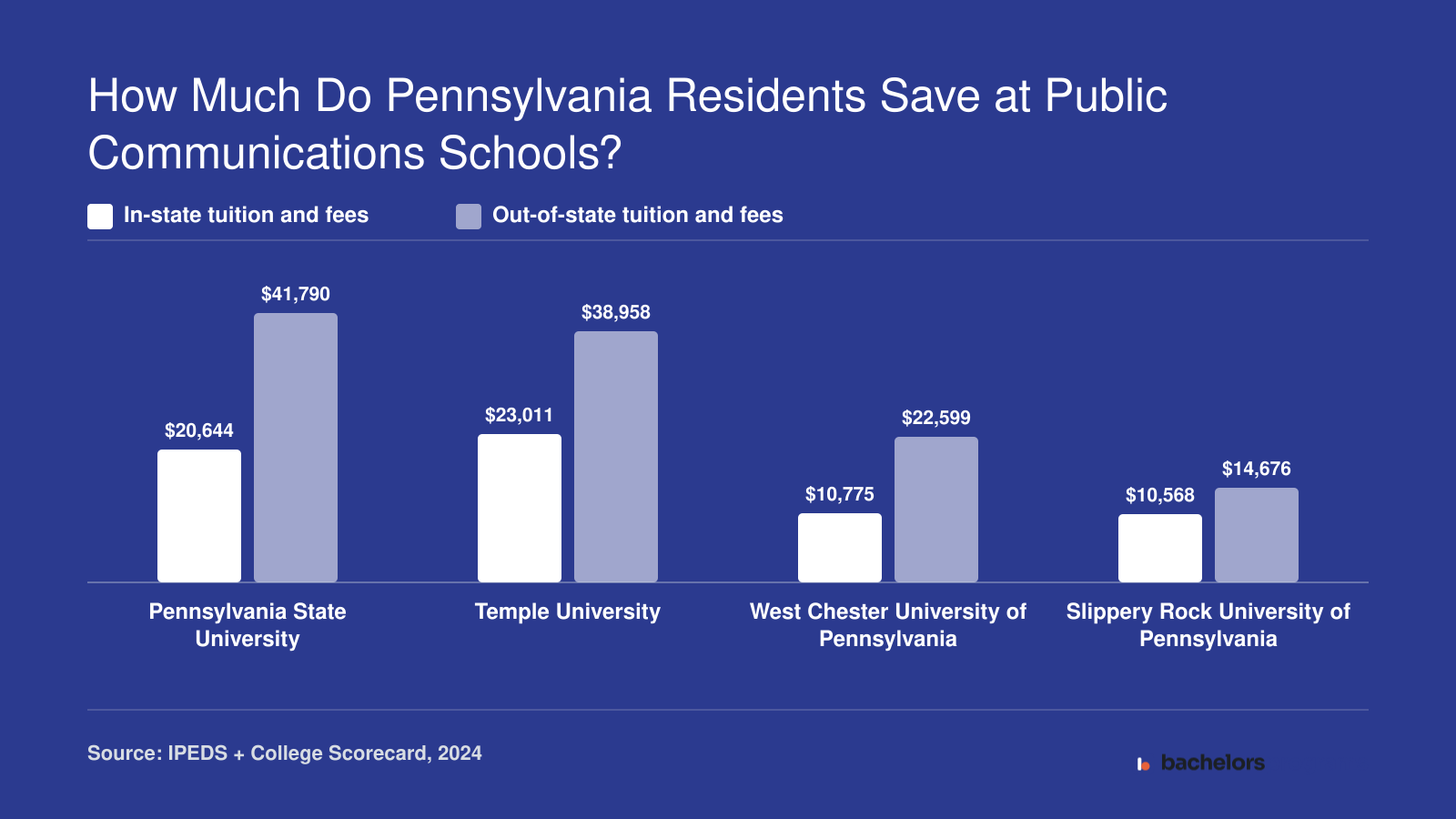
At the public universities ranked here, Pennsylvania residents pay far less than out-of-state students for the same bachelor's degree in communications. That price gap is the main reason PA residents save at public campuses. Penn State's out-of-state rate runs about $21,146 higher than its in-state rate, and Temple's runs about $15,947 higher. The gap is smaller at West Chester (about $11,824) and Slippery Rock (about $4,108).
Communications Jobs and Salaries in Pennsylvania
A communications bachelor's degree in Pennsylvania leads most reliably to public relations, marketing, editing, reporting and media production, and none of those roles requires a state license.
Where Communications Jobs Cluster
Philadelphia, Pittsburgh and Harrisburg hold most of the state's communications employment. Philadelphia concentrates advertising and public relations agencies, publishers, corporate headquarters and nonprofit communications teams. Pittsburgh leans toward marketing, health care systems, technology firms and regional media. Harrisburg is the public affairs center, where government agencies, advocacy groups and trade associations hire press officers, writers, legislative communicators and campaign staff. Each metro rewards a different portfolio: creative and account work in Philadelphia, brand and content roles in Pittsburgh, and policy and public affairs writing in Harrisburg.
No License, but Proof of Work
Pennsylvania does not license communications professionals, and typical public relations, marketing, editing, reporting and production roles carry no state credential requirement. Employers screen on writing samples, internships, clips and campaign results, so build a portfolio before you graduate.
What the Work Pays
Communications is a cluster of occupations rather than one job title, so compare any Pennsylvania offer against the national median for that specific role. May 2025 figures provide the baseline: - Public relations specialists: $74,7501 - Editors: $77,9202 - News analysts, reporters and journalists: $62,2003 - Market research analysts and marketing specialists: $78,7605 - Advertising and promotions managers: $133,6604
Philadelphia and Pittsburgh employers tend to compete with national pay scales, while smaller Pennsylvania markets may offer less for the same title. Check local postings and cost of living rather than assuming one statewide rate.
Projected Demand Through 2035
The U.S. Bureau of Labor Statistics projects 7% growth for market research analysts and marketing specialists and 6% for advertising and promotions managers from 2025 to 2035.4 Public relations specialists are projected to grow 2%, while editors are projected to decline 1%. That mix favors graduates who pair writing with analytics, content strategy, paid media or campaign management. Traditional newsroom editing is the softest lane, so broaden your skills rather than relying on a single job title.
Early-Career Earnings at the Top PA Communications Program
The University of Pennsylvania posts the highest early-career earnings figure in our data for Pennsylvania communications bachelor's graduates.
Compare Communications programs on the data that matters
Explore more Communications & Media majors or browse every field of study.
All Communications & Media programs Browse every field of study