Best Cybersecurity Schools in Pennsylvania
Compare 63 accredited Cybersecurity programs in Pennsylvania at 48 colleges, with net price after aid, graduation rates, earnings and debt from IPEDS and the U.S. College Scorecard.

The first real decision is public or private. A Pennsylvania bachelor's degree in cybersecurity costs less at a state campus, where in-state tuition pairs with PHEAA grant money; private colleges counter with merit awards that pull net price close.
The credential is consistent: a Bachelor of Science (B.S.) in Cybersecurity, or a computing degree with a security concentration, built on networking, operating systems, cryptography and a forensics or policy elective.
What separates programs is the layer outside the core: a staffed lab, certification vouchers, an internship pipeline into Pittsburgh or Philadelphia employers.
Key Points
- Robert Morris University's Cybersecurity B.S. runs both on campus and online.
- Philadelphia leads Pennsylvania in security analyst pay, per May 2025 BLS data.
- Compare schools by net price after aid, not sticker tuition.
Best Bachelor's Degree in Cybersecurity Programs in Pennsylvania, Ranked
These ten programs stand out among the 29 Pennsylvania institutions and 39 programs reviewed for 2026, judged by what a security student actually gets: concentration depth, lab and certification support, and the price likely to be paid after aid. Each card lists net price after aid and the school's overall graduation rate, framed as the share of students the school graduates, so the two numbers can be compared side by side. Net price is an institution-wide average across all undergraduates, not a quote for the cybersecurity major, so treat it as a comparison tool rather than a bill.
Slippery Rock University of Pennsylvania
#1Slippery Rock, PA · ~$20,000/yr (est.)
Best for: Pennsylvania residents seeking public university value
Slippery Rock is a public university in western Pennsylvania whose cybersecurity major sits in the Computer Science department of the College of Engineering and Science. The B.S. in Cybersecurity divides into concentrations such as secure software development and security governance, and a cybersecurity minor lets students in other computing majors add security coursework.
- Bachelor of Science in Cybersecurity with a Secure Software Development concentration
- Secure coding, vulnerability analysis and defensive programming coursework
- Covers threat modeling and security testing for software systems
- Prepares graduates for application security and secure development roles
- Housed in the Computer Science department, College of Engineering and Science
- Other concentrations include security governance, information technology and computer science
- Cybersecurity minor available
- Bachelor of Science in Cybersecurity with a Security Governance concentration
- Computing minor available to pair with the cybersecurity major
- Certificate programs also offered in the department
York College of Pennsylvania
#2York, PA · $15,000 – $20,000/yr (est.)
Best for: Management-minded students eyeing security leadership
York College of Pennsylvania is a private college in the south-central part of the state, and its Cybersecurity Management degree leans toward the management side of the field rather than pure engineering. Students choose a concentration in strategy, operational security, intelligence analysis or criminal justice, and the 121-credit program blends technology with business and behavioral science coursework.
- 121 credit hours including general education and major coursework
- Minimum 2.0 GPA requirement
- Concentrations in Strategy, Operational Security, Intelligence Analysis and Criminal Justice
- Blends technology, management and behavioral sciences
- Prepares students for government and private-sector security careers
- Freshman year carries 31 credits; later years run about 30 each
Carlow University
#3Pittsburgh, PA · $20,000 – $25,000/yr (est.)
Best for: Career changers wanting a low-code entry point
Carlow University is a private Catholic university in Pittsburgh's Oakland neighborhood, and its cybersecurity degree is built for students who want a route into the field without a heavy coding load. The low-code, skills-first curriculum adds a career navigation course early and prepares students for entry-level certifications such as CompTIA Security+.
- 120-credit Bachelor of Science in Cybersecurity designed as a four-year degree
- Low-code, skills-first curriculum with interactive labs and group projects
- Five concentration options, including network security and digital forensics
- Prepares students for CompTIA Security+, Certified Ethical Hacker and GIAC Security Essentials
- Early Career Navigation course taken in the first year
- Two start dates per year and no application fee
- Coursework covers threat identification, network protection and digital ethics
Indiana University of Pennsylvania
#4Indiana, PA · $11,000 – $16,000/yr (est.)
Indiana University of Pennsylvania gives cybersecurity unusual statewide reach: its Institute for Cybersecurity leads a Department of Defense funded consortium that connects more than 30 Pennsylvania colleges and K-12 districts. The B.S. in Computer Science-Cybersecurity holds a National Center of Academic Excellence in Cyber Defense Education designation, and students can add digital forensics, network security or a criminology minor.
- 120-credit Bachelor of Science in Computer Science-Cybersecurity
- Tracks in digital forensics or network security, plus a criminology minor option
- Designated a National Center of Academic Excellence in Cyber Defense Education
- Small classes with hands-on work in dedicated computer classrooms
- Capstone course built around a team project
- DoD Cyber Service Academy scholarship opportunities
- Internship assistance and research project opportunities
- Start terms in fall, winter, spring or summer
Seton Hill University
#5Greensburg, PA · ~$22,000/yr (est.)
Seton Hill University is a private Catholic university in Greensburg, and it pairs a 120-credit cybersecurity major with a liberal arts core. An internship and a capstone are both required, and the coursework runs from forensics and network security to cybercrime analysis and policy, which suits students who want an investigative or compliance angle.
- 120-credit Bachelor of Science in Cybersecurity
- Coursework in computer forensics, network security, cybercrime analysis and policy
- Capstone project plus a required internship
- Prepares students for security analyst, consultant and architect roles
- Project-based learning with an option to add certifications
- Liberal arts curriculum runs alongside the major
La Salle University
#6Philadelphia, PA · ~$19,000/yr (est.)
La Salle University, in northwest Philadelphia, deliberately front-loads shared courses: first-year cybersecurity, computer science and information technology students take the same programming, networking and database classes. That lets a student change majors as late as the first semester of sophomore year without losing progress, rare flexibility in a technical degree.
- Bachelor of Science in Cybersecurity covering network security, cryptography and ethical hacking
- Application design, network architecture and mathematical algorithms in the curriculum
- First-year programming, networking and database courses shared with CS and IT majors
- Majors can switch among computer science, IT and cybersecurity into sophomore year
- Prepares graduates for penetration testing, security engineering and incident response
Mercyhurst University
#7Erie, PA · $19,000/yr (est. net price)
Mercyhurst University in Erie runs a lab-heavy cyber security program built on cyber ranges, client projects and a partnership with EC-Council Academia. Cyber threat intelligence, cyber law and policy are part of the curriculum, so the degree reaches beyond tools and into how security decisions get made.
- Bachelor of Science in Cyber Security with labs, client projects and cyber ranges
- Coursework in ethical hacking, network security and digital forensics
- Partnership with EC-Council Academia and certification opportunities
- Access to a cyber lab and a networks operations center
- Cyber law and policy topics included in the curriculum
- 4+1 program options and a student Cyber Security Club
Robert Morris University
#8Moon Township, PA · ~$23,000/yr (est.)
Robert Morris University, in Moon Township outside Pittsburgh, has the most explicitly technical training setup in this group: a dual-room lab with Kali Linux for offensive work and a Windows security operations center for defense. The degree is accredited by ABET's Computing Accreditation Commission and holds a National Center of Academic Excellence in Cyber Defense designation.
- 120 credits: 69 major, 39 core and 12 open electives
- Accredited by the Computing Accreditation Commission of ABET
- National Center of Academic Excellence in Cyber Defense designation
- Coursework in ethical hacking, penetration testing, network and mobile forensics
- Also covers data security, cryptography, cyberlaw and incident response
- Dual-room lab: Kali Linux for offense, Windows operations center for defense
- Minimum 2.75 GPA for admission; SAT and ACT optional
- Capstone required; NSF CyberCorps Scholarship for Service funding available
University of Pittsburgh-Bradford
#9Bradford, PA · ~$15,000/yr (est.)
The Bradford campus of the University of Pittsburgh teaches cybersecurity as a concentration inside the B.S. in Computer Information Systems and Technology rather than as a standalone major. Students take at least 12 credits of security coursework, covering forensics, intrusion detection, network security and ethical hacking, on top of a broad IT core.
- Bachelor of Science in Computer Information Systems and Technology
- Cybersecurity and Digital Forensics concentration of at least 12 credits
- Courses in digital forensics, intrusion detection, network security and ethical hacking
- Core coursework in programming, networking and systems administration
- Capstone project and internship opportunity included
- 120-credit curriculum with hands-on emphasis
- Application Software Development concentration within the 120-credit degree
- Statistics course required within the degree
- Internship component and capstone project required
- Four-year suggested plan published in the catalog
Commonwealth University of Pennsylvania
#10Bloomsburg, PA · ~$16,000/yr (est.)
Commonwealth University was formed by consolidating several Pennsylvania state universities, and its Bloomsburg campus houses this program. The Digital Forensics and Cybersecurity B.S. is evidence oriented: students learn to recover deleted data, stress-test systems and respond when a breach happens, using professional forensics software and hardware.
- Bachelor of Science in Digital Forensics and Cybersecurity at the Bloomsburg campus
- Students recover deleted evidence, test system security and respond to breaches
- Hands-on training with professional forensics software and hardware
- Designated a National Center of Academic Excellence
- Internship opportunities available
- Scholarships available to students in the program
Cost & outcomes by school
Federal data for the highest-earning Cybersecurity programs, independent of the ranking above. Earnings are this field's bachelor's graduates four years after completing where the Scorecard reports them, else the school's undergraduate median.
| School | Net price / yr | Grad rate | Earnings | Debt | Grads/yr | Format |
|---|---|---|---|---|---|---|
| Robert Morris University PA | $23,003 | 66% | $90,206 | $26,948 | 54 | Hybrid |
| Drexel University PA | $38,509 | 78% | $84,648 | $25,325 | — | Online |
| Immaculata University PA | $24,258 | 71% | $75,701 | $27,000 | — | Online |
| Duquesne University PA | $37,730 | 78% | $74,742 | $26,244 | 9 | Campus |
| University of Scranton PA | $32,568 | 80% | $74,652 | $27,000 | 11 | Campus |
| Commonwealth University of Pennsylvania PA | $15,699 | 55% | $73,289 | $25,000 | 57 | Campus |
| La Salle University PA | $19,409 | 57% | $67,416 | $25,000 | — | Campus |
| University of Pittsburgh-Greensburg PA | $17,945 | 40% | $66,125 | $24,250 | — | Campus |
| University of Pittsburgh-Bradford PA | $15,350 | 48% | $66,125 | $24,250 | 2 | Campus |
| Temple University PA | $28,198 | 75% | $63,727 | $24,395 | 5 | Campus |
| Pennsylvania State University-Penn State Fayette- Eberly PA | $14,596 | 39% | $63,435 | $25,000 | — | Campus |
| Pennsylvania State University-Penn State DuBois PA | $17,428 | 34% | $63,435 | $25,000 | — | Campus |
Sources: U.S. Department of Education. Net price, graduation rate, earnings and debt: College Scorecard (earnings and debt for this field's bachelor's graduates where reported, else school-wide); graduates: IPEDS. A dash means no figure is reported.
Cost, debt & payoff
Median earnings of this field's bachelor's graduates (4 yrs after completing, else the school's undergraduate median) vs. their median federal loan debt · U.S. College Scorecard
Across these programs the median graduate earns about $62,101 and finishes with roughly $25,125 in debt — a ratio that clears a common rule of thumb (keep debt below first-year salary). Net price and debt vary widely school to school, so check the per-school figures in the table above before you shortlist.
The Most Affordable Cybersecurity Bachelor's Programs in Pennsylvania
If "best" means the smallest bill, these programs come out ahead on net price (the average yearly cost after grants and scholarships), based on 2024 federal data from IPEDS and the College Scorecard. Sticker price and net price can point in opposite directions: Holy Family University lists the highest tuition in this table at $35,330 but has the lowest net price at $13,143, while Commonwealth University of Pennsylvania has the lowest in-state tuition at $11,046 and a net price of $15,699. Net prices across these programs fall within about $3,700 of each other, so compare financial aid offers, not tuition alone.
| School | Program | Format | In-State Tuition & Fees | Net Price After Aid |
|---|---|---|---|---|
| Holy Family University (Philadelphia) | Cybersecurity and IT Management, B.A. | Hybrid | $35,330 | $13,143 |
| Penn State Fayette, Eberly (Lemont Furnace) | B.S. in Cybersecurity Analytics and Operations | Campus | $14,408 | $14,596 |
| University of Pittsburgh-Bradford (Bradford) | B.S. in Computer Information Systems and Technology, Cybersecurity and Digital Forensics concentration | Campus | $14,770 | $15,350 |
| Commonwealth University of Pennsylvania (Bloomsburg) | B.S. in Digital Forensics and Cybersecurity | Campus, with online and hybrid delivery options listed | $11,046 | $15,699 |
| Indiana University of Pennsylvania (Indiana) | B.S. in Computer Science-Cybersecurity | Campus | $11,380 | $16,804 |
How the Rankings Work, and What an NSA Center of Academic Excellence Designation Means
Every program on the list leads to a four-year bachelor's credential in cybersecurity or a closely related computing field, at a school based in Pennsylvania, and campus and online formats both count.
What the list covers, and what it leaves out
Associate degrees, certificate-only tracks, and graduate programs sit outside the scope. A school qualifies on the strength of its bachelor's offering in cybersecurity or a related computing major, not on reputation or marketing spend. Because a Pennsylvania-based campus can enroll an online student in another state, distance options appear alongside traditional ones. Graduation rate and average net price are institution-wide figures, not cybersecurity-major figures, so treat them as context rather than a verdict on the program.
Where the NSA designation fits
The National Security Agency names National Centers of Academic Excellence in Cyber Defense (CAE-CD) and Cyber Research (CAE-R).1 CAE-CD applies to regionally accredited schools teaching cybersecurity at the associate, bachelor's, and graduate levels; CAE-R is reserved for doctoral research universities and military academies.2 A designation means the institution completed an in-depth assessment against federal requirements, and it can make the school eligible for Department of Defense scholarship programs, including CyberCorps: Scholarship for Service.3 It does not guarantee funding for any individual student, and CAE-CD status lasts five academic years before the school must reapply.3 Check current status on the NSA's official list, and check whether the designation covers the campus and program you would actually attend.1
Online and Hybrid Bachelor's in Cybersecurity Paths at Pennsylvania Schools
Where the flexible formats are
Most cybersecurity bachelor's programs at Pennsylvania schools center on campus, so flexible formats take some sorting. Robert Morris University is the clearest pick for distance learners because its Cybersecurity B.S. runs on campus or fully online. Commonwealth University of Pennsylvania lists face-to-face, online, and hybrid delivery for its Digital Forensics and Cybersecurity major. Slippery Rock University of Pennsylvania, Carlow University, and Mercyhurst University use hybrid formats that blend online coursework with campus time.
Penn State's Cybersecurity Analytics and Operations degree, taught at Penn State Fayette and Penn State Schuylkill, also comes in a fully online version. Penn State offers a second online option as well: Security and Risk Analysis with an Information and Cybersecurity option. Both require 120 credits, and online terms run 12 to 15 weeks, three semesters a year.
What the online Penn State route costs
For Fall 2026 through Summer 2027, students taking 11 or fewer credits pay $644 per credit until they reach 60 total credits, then $692. Full-time students taking 12 to 19 credits pay $7,833 per semester, rising to $8,455 past the 60-credit mark. Ask admissions whether living outside Pennsylvania changes your rate.
Hands-on work from a distance
Ask how labs and internships work before you enroll. The online analytics and operations degree includes CYBER 262 Cyber-Defense Studio, a three-credit practical course, and its internship can be done online or in person. The Security and Risk Analysis option also includes an internship. Among hybrid programs, Mercyhurst trains students on cyber ranges, while Carlow builds in interactive labs and group projects.
Related Articles
Questions to Ask Yourself
Do I need a fully online format, or can I be on campus for labs and clubs?
Does my target employer care about an NSA Center of Academic Excellence designation?
Will I transfer community college credits, and will the school count them toward the major?
Is my net price after the PA State Grant within reach without heavy borrowing?
Information Security Analyst Pay in Pennsylvania and Its Metro Areas
Security pay in Pennsylvania tracks the regional economy closely, and the gap between Philadelphia and the rest of the state is wide. These are May 2025 Bureau of Labor Statistics wage estimates for information security analysts, as published in O*NET's Pennsylvania wage listings.
Statewide Wages
Across Pennsylvania, the median annual wage for information security analysts is $117,770. The 10th percentile, a reasonable stand-in for entry-level pay, is $67,840, and the 90th percentile reaches $170,870.
Wages by Metro Area
- Philadelphia-Camden-Wilmington: median $132,560, 10th percentile $75,830, 90th percentile $186,530.
- Pittsburgh: median $103,630, 10th percentile $66,500, 90th percentile $158,140.
- Allentown-Bethlehem-Easton (Lehigh Valley): median $107,300, 10th percentile $71,900, 90th percentile $163,040.
- Harrisburg-Carlisle: median $100,780, 10th percentile $70,450, 90th percentile $155,230.
- Scranton-Wilkes-Barre: median $100,210, 10th percentile $63,140, 90th percentile $173,770.
Philadelphia's median sits about $14,800 above the statewide figure. Every other metro listed here has a median near or below $108,000. Keep in mind that the Philadelphia and Lehigh Valley areas are defined across state lines, so their figures cover the full metro area, not only the Pennsylvania side.
How This Differs From Graduate Earnings
These wages cover everyone working in the occupation, including experienced analysts, so they are not the same as the recent-graduate earnings in the Scorecard figures above. Expect new bachelor's graduates to start nearer the lower percentiles.
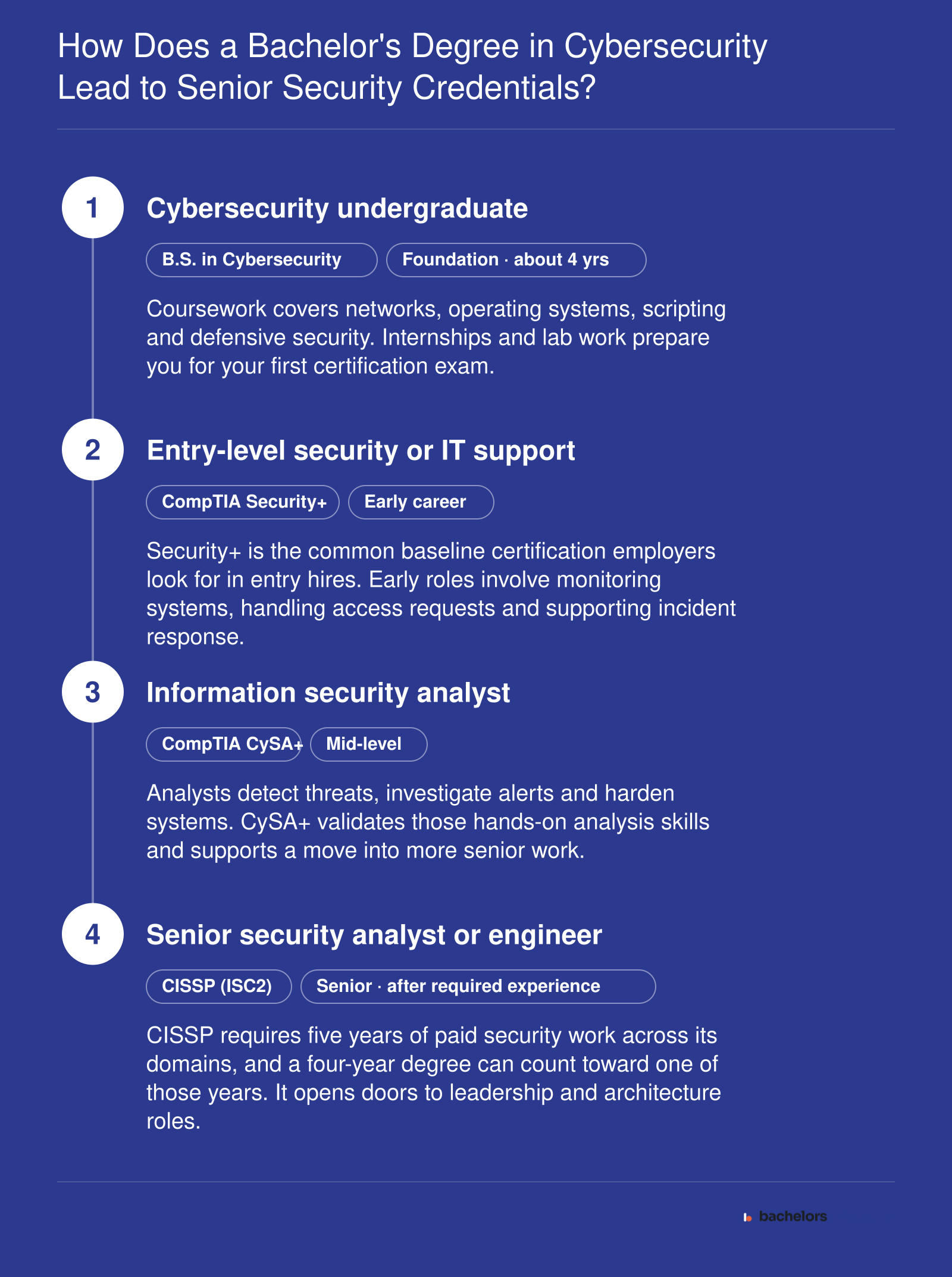
How Does a Bachelor's Degree in Cybersecurity Lead to Senior Security Credentials?
A bachelor's degree is the starting point, not the finish line. Most security careers build in stages, with an industry certification marking each step up. The path below shows a common progression for Pennsylvania graduates.
Pennsylvania Cybersecurity School Questions, Answered
These answers cover the questions prospective students ask most about studying cybersecurity at the bachelor's level in Pennsylvania. For school-by-school detail, use the ranking and cost sections above.
What is the best cybersecurity school in Pennsylvania?
Can you earn a bachelor's degree in cybersecurity online from a Pennsylvania school?
What is the average cybersecurity salary in Pennsylvania?
Does a school need an NSA Center of Academic Excellence designation for you to land a cybersecurity job?
Can community college credits transfer into a Pennsylvania cybersecurity bachelor's program?
Is a cybersecurity bachelor's degree worth it compared with certifications alone?
Compare Cybersecurity programs on the data that matters
Explore more Computers & IT majors or browse every field of study.
All Computers & IT programs Browse every field of study