Best Communications Degree Programs in Tennessee
Compare 33 accredited Communications programs in Tennessee at 20 colleges, with net price after aid, graduation rates, earnings and debt from IPEDS and the U.S. College Scorecard.

A bachelor's degree in communications in Tennessee is a broad credential with sharply different price tags. Tennessee schools award either a B.A. or a B.S. in communications, and the distinction matters less than the track: communication studies leans toward people, organizations and rhetoric, while mass communication leans toward media production and journalism.
The practical tension is cost and payoff. Net price after aid ranges from about $8,000 to over $40,000 across Tennessee communications programs, and median earnings four years out vary by thousands of dollars as well. Admissions rules and transfer credit policies differ too.
The work itself is steady but competitive, and Tennessee wages for communications roles cluster below the national median. Where a school's graduates land is often a function of internships, not the diploma.
Key Points
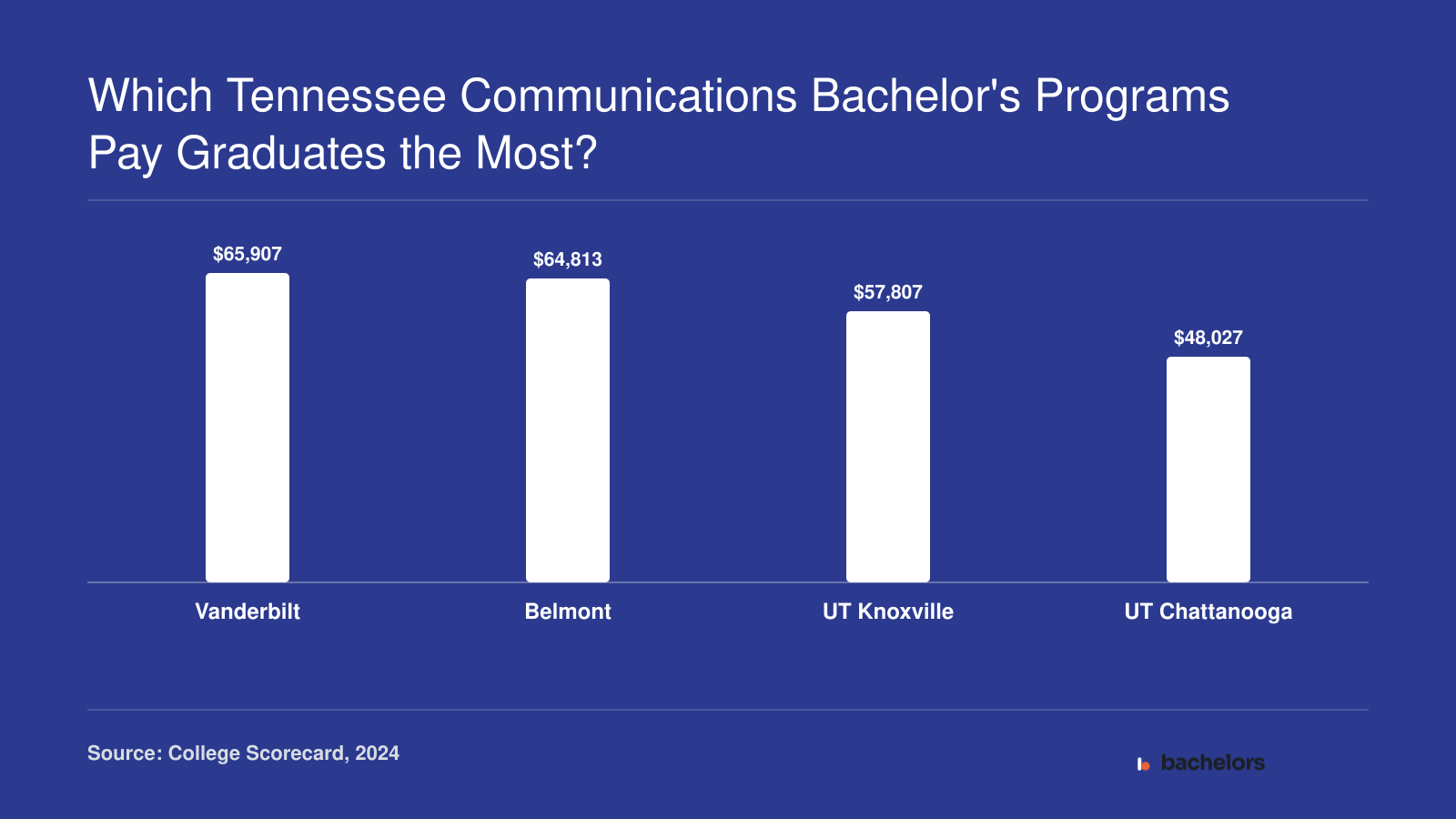
- Vanderbilt communications graduates earned a $65,907 median five years out.
- At Belmont, median program debt was $18,128 against $64,813 earnings.
- Lane College offers mass communication, while Belmont adds corporate communication.
Best Bachelor's Degree in Communications Schools in Tennessee, Ranked
The top of this list is separated by two things: accredited, career-focused communication programs and a net price that does not bury graduates in debt. Vanderbilt and UT Knoxville lead on selectivity and breadth, while Middle Tennessee State, UT Chattanooga, and East Tennessee State combine recognized programs with some of the state's lowest costs after aid. Every school below enrolls undergraduates in a communications bachelor's on campus, online, or both.
Vanderbilt University
#1Nashville, TN · ~$16,000/yr (est.)
Best for: Future law and policy students
Vanderbilt University's communication studies program sits inside one of the country's most selective private universities, and the small annual cohort reflects that. The curriculum is organized around argumentation and advocacy, public discourse and deliberation, and culture, theory, and critique, which makes it a natural fit for students aiming at law, policy, or graduate study. Class sizes are small and the department pairs every major with faculty advising. It is the most expensive option on this list by a wide margin, though the university's net price after aid is markedly lower than published tuition.
- 30 total credit hours in the major
- Four areas of study including Argumentation and Advocacy
- Also covers Public Discourse and Deliberation
- Coursework in Culture, Theory, and Critique
- 18-credit minor available alongside the major
- Independent study options for advanced students
- Courses in social media and digital communication
- Faculty advising built into the program
The University of Tennessee-Knoxville
#2Knoxville, TN · ~$19,000/yr (est.)
Best for: Transfer students in East Tennessee
UT Knoxville is the largest public research university on this list and the anchor of communication study in East Tennessee. Undergraduate majors take a communication studies track with coursework in theory, research methods, organizational communication, and close relationships, plus an honors concentration for research-minded students. In fall 2025 the university added a fully online Bachelor of Science in Communication and Information designed for transfer students, with asynchronous courses spanning advertising, public relations, journalism and media, and information sciences. In-state applicants pay a fraction of the sticker price of the private options here.
- Coursework in communication theory and research methods
- Honors concentration available for research-focused students
- Small student-to-instructor ratio
- Industry meet-and-greets and guest speakers
- Student organizations and alumni networking
- Communication studies minor available
- Prepares for government, nonprofit, and business roles
- Financial aid available
Freed-Hardeman University
#3Henderson, TN · $22,000/yr (est. net price)
Best for: Faith-based campus learners in West Tennessee
Freed-Hardeman is a small private university in Henderson, west of Jackson, where communication majors choose between public relations and speech communication concentrations. The program leans on practical production: students write PR plans, manage social media, build a required digital portfolio, and work at the campus radio station WFHU. A senior seminar capstone and internship requirement round out the degree. Classes are small and the curriculum is grounded in Christian values, which suits students who want a faith-based campus with hands-on media work.
- Concentration in Public Relations
- Courses in PR writing, branding, and crisis communication
- Digital portfolio required for graduation
- Internship and hands-on experience built in
- Senior seminar capstone required
- Access to campus radio station WFHU
- Small class sizes with experienced faculty
- Ethical communication grounded in Christian values
- Concentration in Speech Communication
- Public speaking and interpersonal communication focus
- Critical thinking development across the major
- Communication theories course required
- Senior seminar included in the degree plan
- Field lab experience available
- Digital portfolio requirement
- Four-year degree plans published
Middle Tennessee State University
#4Murfreesboro, TN · ~$13,000/yr (est.)
Middle Tennessee State is the largest producer of communication graduates in the state and one of the best values on this list. The Bachelor of Science or Bachelor of Arts in Communication runs on campus in Murfreesboro and online, with a general track and an organizational communication concentration covering grant writing, training, and communication auditing. Students get experiential learning in the community, undergraduate research with faculty, and internships with local and national employers. The journalism unit is separately accredited, and the department supports active clubs including a debate team and a communication studies honor society.
- Available on campus and online
- Concentration available in Organizational Communication
- Experiential learning projects in the community
- Undergraduate research with faculty
- Internships with local and national employers
- Communication Studies Club and Debate Club
- Organizational concentration covers grant writing and training
- Preparation for media, business, nonprofit, and government work
Union University
#5Jackson, TN · ~$27,000/yr (est.)
Union University is a private Christian institution in Jackson offering communication studies as a major leading to either a Bachelor of Arts or a Bachelor of Science. Students work with faculty to build a personalized course of study around their career goals, and the curriculum trains them to write, produce, present, and engage across multiple platforms. Graduates move into public relations, media, and organizational communication. A minor in communication studies is also available, and requirements are published in the current catalogue with separate curriculum guides for the BA and BS.
- Major leads to either a BA or a BS
- Two concentration options
- Taught in person on campus
- Faculty help design a personalized course of study
- Separate curriculum guides for BA and BS tracks
- Prepares for PR, media, and organizational communication
- Communication Studies minor also offered
- Grounded in a Christ-centered environment
East Tennessee State University
#6Johnson City, TN · ~$16,000/yr (est.)
East Tennessee State offers two routes into the field: a Bachelor of Science in Media and Communication with a radio-TV-film concentration, and a Bachelor of Arts in communication studies. The media track is production-heavy, with 39 credit hours in the concentration, a capstone, and hands-on work at student-operated radio and television stations. The communication studies track builds a liberal arts foundation with a foreign language requirement and room for a minor. Both are campus-based in Johnson City and priced among the lower options in the state.
- 120 total credit hours with 39 in the concentration
- Hands-on work at student-run radio and TV stations
- Coursework in media writing, audio, and video-film
- Emphasis on history, law, and ethics
- Capstone course required
- Minor required for the degree
- Transfer credit accepted up to 12 hours
- 2.0 GPA minimum to continue
- Bachelor of Arts degree with 120 total credits
- 36 major requirement credits
- 15-credit core plus 21-credit concentration
- Foreign language requirement
- 18 to 24 credit minor required
- Communication research and culture electives
- Major field test included
- Department advising available
Belmont University
#7Nashville, TN · ~$33,000/yr (est.)
Belmont's location in Nashville puts communication majors inside one of the South's busiest media and healthcare markets, and the university builds its curriculum around that. Corporate communication students take 128 credit hours with a 30-hour major core covering reputation management, crisis communication, and employee relations, plus internships and hands-on projects. A separate communication studies track offers electives in interpersonal and rhetorical contexts and access to a student-run strategic communication agency and a speech and debate team. Faculty advising is one-on-one, and earnings for graduates are among the strongest in the state.
- Bachelor of Arts or Science, 128 total credit hours
- 30 hours of major requirements plus 12 elective hours
- Coursework in reputation and crisis communication
- Covers employee relations and change management
- Internship opportunities included
- Hands-on projects and customizable career tracks
- On-campus program in Nashville
- Standard university admissions process
- Five core courses in the major
- Electives in interpersonal and rhetorical contexts
- One-on-one faculty advisor assigned
- Student-run strategic communication agency
- Speech and Debate Team on campus
- Pathway to health communication careers
The University of Tennessee-Chattanooga
#8Chattanooga, TN · ~$14,000/yr (est.)
UT Chattanooga's Bachelor of Science in Communication blends a liberal arts foundation with practical media training, and the journalism and mass communication unit holds national accreditation. Core courses cover media writing, multimedia journalism, mass communication law, and ethics, followed by a senior seminar and a required internship or directed project. Students shape the degree with electives in sports writing, podcasting, screenwriting, film production, design, and public relations. It sits among the lower-priced public options on this list and draws students from across southeast Tennessee.
- Core coursework in media writing and multimedia journalism
- Mass communication law and ethics required
- Internship or directed project required
- Senior Seminar capstone course
- Focus areas in journalism, PR, film, design, and storytelling
- Hands-on film and video production courses
- Electives in sports writing, podcasting, and screenwriting
- Scholarships and financial aid available
Trevecca Nazarene University
#9Nashville, TN · $17,000/yr (est. net price)
Trevecca Nazarene runs three communication bachelor's routes on its Nashville campus: communication studies, interpersonal communication, and multimedia journalism. Communication studies majors can earn either a BA or a BS and complete a career internship, research methods coursework, and a senior project. The multimedia journalism track is built around hands-on production with industry-standard equipment, professional portfolio building, and access to the Nashville media market. Small classes and a Christ-centered community define the experience, and net price after aid is among the more moderate of the private schools here.
- BA or BS degree options
- Career internship included in the degree
- Personal faculty advisor assigned
- Capstone or senior project required
- Core coursework includes research methods
- Customizable program of study
- Small class sizes with experienced faculty
- Preparation for PR, HR, marketing, and event roles
- Focus on interpersonal and nonverbal communication
- Senior project required
- Career internship required
- Courses on intercultural communication and social influence
- Research methods included
- Builds presentation and critical thinking skills
- On-campus format in Nashville
- Christian community environment
- Bachelor of Science degree
- Hands-on production with industry-standard equipment
- Professional portfolio building
- Internship opportunities available
- Access to the Nashville media market
- Courses in media writing, ethics, and multimedia production
- Senior project required
- Small class sizes with faculty mentorship
Austin Peay State University
#10Clarksville, TN · ~$10,000/yr (est.)
Austin Peay State is the most affordable public option on this list, and its communication media program is built around getting students on equipment immediately. Majors choose among broadcast media, journalism, and sports communication concentrations, with live sports production through the Austin Peay Sports Network and work in small classes from the first semester. The journalism concentration covers professional writing, communication law, and multimedia reporting for print, online, and broadcast outlets. Studios, real-world gear, and industry-experienced faculty let students leave with a portfolio rather than just a transcript.
- Concentration in Broadcast Media
- Three concentration options across the department
- Hands-on training from the first day
- Small class sizes
- Theory and practice combined
- Prepares for television, radio, and digital media roles
- Access to studios and professional equipment
- Portfolio-building coursework
- Concentration in Journalism
- Hands-on learning and student media participation
- Internship opportunities available
- Professional writing skill development
- Communication law studies
- Online news organization training
- Print publication skills
- Multimedia journalism focus
- Concentration in Sports Communication
- Live sports production experience
- Austin Peay Sports Network participation
- Producing and directing skills
- Announcing training
- Radio and television production
- Four years of hands-on experience
- Award-winning program
Cost & outcomes by school
Federal data for the highest-earning Communications programs, independent of the ranking above. Earnings are this field's bachelor's graduates four years after completing where the Scorecard reports them, else the school's undergraduate median.
| School | Net price / yr | Grad rate | Earnings | Debt | Grads/yr | Format |
|---|---|---|---|---|---|---|
| Vanderbilt University TN | $15,846 | 94% | $91,565 | $14,000 | 22 | Campus |
| The University of Tennessee-Knoxville TN | $18,976 | 74% | $57,394 | $19,611 | 124 | Campus |
| Union University TN | $27,171 | 66% | $53,990 | $20,714 | 6 | Campus |
| Southern Adventist University TN | $24,345 | 49% | $53,723 | $24,500 | 4 | Campus |
| Lipscomb University TN | $24,739 | 72% | $52,267 | $21,253 | — | Campus |
| Lincoln Memorial University TN | $20,406 | 50% | $49,956 | $20,000 | 1 | Campus |
| Belmont University TN | $33,147 | 71% | $48,737 | $18,128 | 34 | Campus |
| Tennessee Tech TN | $14,246 | 58% | $48,501 | $15,650 | — | Campus |
| The University of Tennessee-Chattanooga TN | $14,265 | 50% | $48,212 | $20,147 | 117 | Campus |
| Freed-Hardeman University TN | $21,574 | 71% | $47,485 | $21,500 | 4 | Campus |
| Carson-Newman University TN | $20,251 | 53% | $46,614 | $19,235 | 5 | Campus |
| Tennessee Wesleyan University TN | $14,836 | 48% | $45,989 | $20,000 | — | Campus |
Sources: U.S. Department of Education. Net price, graduation rate, earnings and debt: College Scorecard (earnings and debt for this field's bachelor's graduates where reported, else school-wide); graduates: IPEDS. A dash means no figure is reported.
Cost, debt & payoff
Median earnings of this field's bachelor's graduates (4 yrs after completing, else the school's undergraduate median) vs. their median federal loan debt · U.S. College Scorecard
Across these programs the median graduate earns about $45,155 and finishes with roughly $21,274 in debt — a ratio that clears a common rule of thumb (keep debt below first-year salary). Net price and debt vary widely school to school, so check the per-school figures in the table above before you shortlist.
Cheapest Bachelor's Degree in Communications Programs in Tennessee
Net price is the average a school's full-time undergraduates actually pay after grants and scholarships, and it is calculated across the whole institution, so treat it as an approximate guide to your own cost rather than a quote for the communications major. In-state tuition and fees are the published sticker price. Median debt reflects borrowing by communications bachelor's graduates specifically and is marked N/A where federal data from IPEDS and the College Scorecard (2024) does not report it for that program.
| School | City | Program | Net Price After Aid | In-State Tuition & Fees | Median Debt (Communications Grads) | Format |
|---|---|---|---|---|---|---|
| Austin Peay State University | Clarksville | Communication Arts | $9,735 | $9,006 | $23,175 | On campus |
| Lane College | Jackson | Mass Communication | $10,904 | $11,790 | N/A | On campus |
| Middle Tennessee State University | Murfreesboro | Communication | $13,359 | $10,266 | $22,795 | On campus (online option listed) |
| Tennessee Tech | Cookeville | Communication | $14,246 | $11,376 | N/A | On campus |
| The University of Tennessee-Chattanooga | Chattanooga | B.S. in Communication | $14,265 | $10,448 | $20,147 | On campus |
Communication Studies vs. Mass Communication: Which Bachelor's Track Fits You?
Communication studies asks how people talk to each other. Mass communication asks how messages reach an audience through media. Both lead to a bachelor's degree, but the coursework, portfolio and first jobs differ.
Communication Studies: People and Organizations
This track is built around theory: interpersonal, organizational, health and intercultural communication. Expect courses in argument, persuasion, group dynamics and public speaking rather than cameras or newsrooms. Vanderbilt University's Communication Studies major is built around areas such as Argumentation and Advocacy and Public Discourse and Deliberation. Trevecca Nazarene University offers Interpersonal Communication alongside Communication Studies. Belmont University's Corporate Communication program covers crisis communication, reputation management and employee relations. The University of Tennessee-Knoxville points its Communication Studies graduates toward government, nonprofit and business roles.
Typical first jobs:
- Corporate or internal communications specialist
- Training or human resources coordinator
- Nonprofit outreach or development associate
Mass Communication: Media and Production
This track centers on journalism, public relations, advertising and media production, and you graduate with a portfolio of stories, campaigns or video. East Tennessee State University's Media and Communication degree includes a Radio-TV-Film concentration with work at student-run stations. Austin Peay State University offers a Broadcast Media concentration. The University of Tennessee-Chattanooga, whose program is ACEJMC accredited, lets students focus on journalism, PR, film, design or storytelling. Freed-Hardeman University has a Public Relations concentration, Trevecca offers Multimedia Journalism, and Lane College's program is titled Mass Communication outright.
Typical first jobs:
- Reporter or multimedia producer
- Public relations or social media specialist
- Video editor or broadcast production assistant
A Quick Rule of Thumb
Pick the track by the job you want in your first year after graduation. If you picture yourself writing press releases, editing video or covering a beat, mass communication gives you the clips employers ask to see. If you see yourself in HR, training, advocacy or internal communications, communication studies builds the reasoning and speaking skills those roles reward. Still undecided? Broad majors such as Communication at Middle Tennessee State University or Communication Studies at Union University, which offers both BA and BS curriculum guides, let you sample both sides before you specialize.
Online and Hybrid Communications Bachelor's Options at Tennessee Schools
Can you finish a bachelor's degree in communications online from a Tennessee school without setting foot on campus? Yes, though the options are narrower than the campus field, and "online" here means a Tennessee-based university awarding the degree, not an out-of-state provider with a Tennessee mailing address.
Who teaches online, and who doesn't
Most communications majors at Tennessee schools are built around campus life: studios, student-run stations, in-person capstones and internships with Nashville, Knoxville or Chattanooga employers. Vanderbilt, Union, Freed-Hardeman, Belmont, Trevecca, ETSU, UT Chattanooga, and Austin Peay all deliver their communications majors on campus. Middle Tennessee State lists its Communication B.S. as available both on ground and online, which makes it the hybrid-friendly choice among the state schools. The University of Tennessee-Knoxville offers the clearest fully online path: a Bachelor of Science in Communication and Information, delivered asynchronously with no live class sessions, so coursework fits around a work schedule.
Asynchronous delivery and completion time
Asynchronous means you watch, read and submit on your own schedule within weekly deadlines, not at a set hour. Neither Tennessee school publishes a fixed finish date for its online track. At UT Knoxville, how long you take depends on your academic history and how many of your prior credits actually apply to the major, so two students starting the same term can graduate a year apart.
Transfer credit and the adult-learner pathway
UT Knoxville's online degree is structured as degree completion, aimed at Tennesseans who started college and stopped. Admission asks for a cumulative GPA of at least 2.0 and at least one transferable credit earned after high school. Up to 120 credits may transfer toward the 120-credit degree, subject to approval. Students arriving with an AA, AS, AFA, or AS in Teaching from a public Tennessee community college follow a defined pathway of 60 additional credits at UT Knoxville, including 48 in communication and information.1 Tennessee Transfer Pathways associate degrees qualify, and you can finish without relocating.1
What online costs
UT Knoxville prices its online program per credit rather than by the semester: $490 per credit for Tennessee residents and $565 per credit for out-of-state students. Budget separately for online support and library fees, which the university lists for its online offerings.
Related Articles
Questions to Ask Yourself
Do you qualify for the Tennessee HOPE Scholarship as a recent high school graduate?
Are you an adult returning to finish a bachelor's degree?
Would a lower-priced public university beat a private college once aid is applied?
Can you keep the award for all four years?
Communications Careers and Salaries in Tennessee
Communications pay in Tennessee is not one number. It is a set of federal estimates published occupation by occupation and metro by metro, so the number that matters depends on the job title and the city you choose. Here is how to pull current numbers yourself.
Start with the federal wage tables
Open BLS.gov and find the Occupational Employment and Wage Statistics (OEWS) page, which publishes state and metro tables each May. The May 2025 edition was released in 2026, so confirm which edition you are reading before you compare years. Filter the area to Tennessee, then repeat for Nashville, Memphis, Knoxville, and Chattanooga.1 Match these occupation titles: public relations specialists; writers and authors; editors; news analysts, reporters, and journalists; and market research and marketing specialists.
Decide what to compare
For each occupation and metro, record four things: the median annual wage, the employment count, the 10th and 25th percentiles, and the 75th and 90th percentiles. A new bachelor's graduate should weight the lower percentiles, because those describe entry into the field better than the median does. Compare each metro against the statewide figure, then against the other three metros.
Add state and professional sources
The Tennessee Department of Labor and Workforce Development publishes state wage data and 2025-2035 projections. Professional associations supply context and occasional salary surveys: PRSA for public relations, SPJ for journalism, AMA for marketing. Career pages for the programs ranked here often name employers and starting salaries recent graduates reported, regional detail the federal tables do not capture.
Read the numbers carefully
A wage estimate is not a job offer. Metro figures pool every industry and experience level, and a high median in a small occupation can rest on a handful of people. Pair the wage with the employment count before drawing a conclusion, and confirm whether the number you found is a mean or a median.
A Headline Wage for Communications Work in Tennessee
Public relations is one of the most common career paths for communications graduates.
Which Tennessee Communications Bachelor's Programs Pay Graduates the Most?
Five years after finishing, communications bachelor's graduates from Vanderbilt University earned a median of $65,907. Belmont University followed at $64,813, The University of Tennessee-Knoxville at $57,807 and The University of Tennessee-Chattanooga at $48,027. Median program debt was $18,128 at Belmont, $19,611 at UT Knoxville and $20,147 at UT Chattanooga, well below a year of graduates' typical pay at each. Lipscomb University, in our directory, reports a different window for its Strategic Communication graduates: $52,267 four years after finishing, with median debt of $21,253, so it is not charted alongside the five-year figures.
Tennessee Communications Degree FAQs
These answers draw on the school comparisons, costs, and earnings figures covered above. Costs and earnings are estimates, so confirm current numbers with each school before you apply.
What is the best college for communications in Tennessee?
What is the cheapest way to get a communications degree in Tennessee?
Can you get a bachelor's degree in communications online from a Tennessee school?
How much do communications majors make in Tennessee?
Do you have to pick communication studies or mass communication before applying?
Compare Communications programs on the data that matters
Explore more Communications & Media majors or browse every field of study.
All Communications & Media programs Browse every field of study