Best Communications Degree Programs in Texas
Compare 90 accredited Communications programs in Texas at 56 colleges, with net price after aid, graduation rates, earnings and debt from IPEDS and the U.S. College Scorecard.

Choosing a public flagship over a private campus can move the sticker price by more than $55,000 a year in Texas. The University of Texas at Austin charges residents $11,688 in tuition and fees; Southern Methodist University charges $67,040. The standard credential in the field is the Bachelor of Arts (B.A.) in Communications.
Large publics, small privates and online routes all compete, so fit matters as much as rank. The cheapest and highest-earning options sit side by side, each with its online access, admissions rules and costs spelled out.
Early pay varies: UT Austin communication graduates earn a median of $43,848 one year out, while UTRGV graduates earn $26,748, with an average net price of $4,831.
Key Points
- UT Austin earns the top spot among Texas communications schools.
- UTSA offers a 100 percent online Bachelor of Arts in Communication.
- Grants and scholarships cut deeply into Trinity University's $53,676 tuition.
Best Bachelor's in Communications Programs in Texas: Our Top 10 Ranked
The University of Texas at Austin is the strongest communications school in Texas for most students, and it takes the top spot here on the strength of its Moody College programs and the professional reach they carry. Texas A&M and Trinity follow, one for a broad liberal arts communication degree built around a required minor and one for small-cohort media training that starts in the first semester. Every card below gives you the same set of facts, so you can compare public and private, large and small, on equal terms.
The University of Texas at Austin
#1Austin, TX · ~$20,000/yr (est.)
Best for: Corporate and political communication aspirants
Moody College of Communication is the flagship option on this list, pairing a 120-hour communication studies degree with five career-aligned tracks and required methods and career preparation courses. Students can shape the major around corporate, political, health or intercultural communication, and the college's scale supports a deep internship and alumni network. It is the strongest all-around choice for students who want a large research university with a direct line into media, government and public affairs work.
- Five tracks: corporate, global/intercultural, human relations, political, strategic
- 120 total credit hours, with 36 to 48 hours in communication studies
- Three hours of methods coursework plus three hours of career preparation
- Language and culture requirement built into the degree
- Capped at 9 communication hours per semester; one minor or certificate maximum
- Cannot double major in Communication and Leadership
Texas A&M University-College Station
#2College Station, TX · ~$21,000/yr (est.)
Best for: Rhetoric-focused students adding a language minor
Texas A&M offers both a B.A. and a B.S. in communication through the same department, and the B.A. deliberately stretches beyond a single media skill set. Students take speaking, rhetoric, theory and research methods coursework alongside a required minor and four semesters of foreign language, which can be completed in class or abroad. It suits students who want a broad liberal arts base with room for a second field of study.
- B.A. and B.S. in communication offered by the same department
- Minor required for the B.A.
- Four semesters of foreign language, in class or through study abroad
- Coursework in speaking, rhetoric, communication theory and research methods
- Named careers include political strategist, sports analyst and PR professional
Trinity University
#3San Antonio, TX · $20,000 – $25,000/yr (est.)
Best for: Hands-on media students wanting small classes
Trinity is a private liberal arts university where communication is one of the most popular majors, and the department runs something like a small newsroom. Apprenticeships at the campus radio station, TV station and student newspaper begin in the first semester, backed by HD production facilities and dedicated computer labs. Courses span journalism, advertising, public relations, film, media law and even game app design, so students leave with both critical analysis and technical production experience.
- One of Trinity's most popular majors
- Apprenticeships at KRTU radio, TigerTV and the Trinitonian start first semester
- HD television and radio stations plus Dell and Apple computer labs
- Coursework spans journalism, advertising, PR, media effects, film and web design
- Junior-year department scholarships in PR, journalism and visual communication
- Honors thesis available for qualified students
University of Houston
#4Houston, TX · $10,000 – $23,000/yr (est.)
The University of Houston splits its undergraduate communication offerings into communication studies and strategic communication, giving students a clear choice between theory-driven and campaign-driven work. Communication studies covers film and media studies or interpersonal communication, while strategic communication trains students in advertising, public relations and corporate messaging through the Valenti School. It is a large public option with a deep internship footprint in one of the country's biggest media markets.
- Tracks: Film and Media Studies, Interpersonal Communication
- 120 total credit hours, including 27 hours of communication studies
- Coursework in communication theory, cinema history and media effects
- Electives such as television history, short film practicum and social aspects of film
- Professional internship and independent study options
- Tracks: Advertising, Public Relations, Integrated and Organizational/Corporate Communication
- Housed in the Jack J. Valenti School of Communication
- Coursework combines public relations, advertising, marketing and theory
- Organizational track covers conflict resolution, teamwork and intercultural skill
- Prepares storytellers for corporate, nonprofit and government settings
The University of Texas Rio Grande Valley
#5Edinburg, TX · under $5,000/yr (est.)
UTRGV's communication studies degree is built around persuasion, public speaking and interpersonal communication, with an explicit law school pathway and a bilingual, bicultural emphasis that fits the region's media, health care and public sector employers. Tuition Advantage covers tuition and mandatory fees for families earning $125,000 or less, which changes the cost math considerably. The university also lists a separate B.A. in Mass Communication for students who want a heavier media production focus.
- Coursework includes persuasion, public speaking and interpersonal communication
- Persuasion highlighted as preparation for law school
- Career paths include print and broadcast journalism, PR and press secretary roles
- Tuition Advantage covers tuition and mandatory fees for families earning $125,000 or less
- Bilingual, bicultural and biliterate emphasis
The University of Texas at San Antonio
#6San Antonio, TX · $9,000 – $22,000/yr (est.)
UTSA offers a single B.A. in Communication that can be finished entirely online or on campus, with concentration options in public relations, digital communication and health communication or a general track. A capstone, an internship and a second language experience are required, so the degree keeps a practical core even in the online format. It is a sensible pick for working students and transfer students who want a Texas public university without relocating.
- Tracks: Public Relations, Digital Communication, Health Communication, or general
- 120 credit hours, 39 of them upper division
- Capstone course and internship in communication required
- COLFA second language experience required
- Gateway courses require a C- or better, with a two-attempt limit
- Available 100 percent online or on campus
- Honors in Communication available
Southern Methodist University
#7Dallas, TX · ~$41,000/yr (est.)
SMU houses a B.A. in Corporate Communication and Public Affairs, a degree built for students aiming at corporate, nonprofit or political communication rather than newsrooms. Four specializations let students lean toward public affairs, organizational communication, nonprofit and arts leadership, or social innovation and arts entrepreneurship, with core courses in rhetoric, professional communication and financial communication. Small cohorts and a Washington semester give the program an outsized professional network for its size.
- Four specializations, from public affairs to nonprofit and arts leadership
- Core courses include Rhetoric, Community, and Public Deliberation
- Also Business and Professional Communication and Financial Communication
- Internships in Dallas, Washington, D.C., New York and London
- 12 students a year join the Hilltop on the Hill program in Washington
- Pre-law and honors classes available in the division
University of North Texas
#8Denton, TX · $11,000 – $21,000/yr (est.)
UNT's communication studies degree is organized into three broad areas, from interpersonal, digital and organizational communication to culture and public discourse to performance studies. Courses in storytelling, argumentation and intercultural communication keep the work applied, and internships reach organizations such as Clear Channel and ESPN Radio. The department's nationally recognized debate team and tight-knit teaching culture make it a strong fit inside a large public university.
- Three areas: interpersonal and organizational, culture and discourse, performance
- 120-credit, four-year program
- Courses such as Storytelling, Argumentation and Intercultural Communication
- Nationally recognized debate team
- Internships with organizations such as Clear Channel and ESPN Radio
The University of Texas at Arlington
#9Arlington, TX · ~$14,000/yr (est.)
UT Arlington's communication B.A. is one of the broadest in the state, with concentration options running from advertising and broadcasting to journalism, public relations and web-focused communication technology. Students get video and audio production facilities, service-learning projects and internships across the DFW media market, plus optional certificates in digital media and professional communication. It rewards students who want to sample several media disciplines before committing to one.
- Six concentration options, including advertising, broadcasting, journalism and PR
- Certificates in Digital Media and Professional Communication
- Video and audio production facilities on campus
- Internships across the DFW Metroplex, the fifth-largest U.S. media market
- UTA Hispanic Media Initiative and UTA News en Español
- Service-learning projects, campaigns and study abroad
University of St Thomas
#10Houston, TX · ~$19,000/yr (est.)
The University of St. Thomas keeps its communication major compact: 33 credits, including a capstone and required courses in media literacy, digital storytelling, and media, society and technology. A joint B.A. in Drama/Communication lets students combine performance with media production, and portfolio work grows out of productions, student films and digital projects. It suits students who want a small, discussion-driven program grounded in a liberal arts and Catholic intellectual tradition.
- 33 credits in the major: 24 required plus 9 electives
- Required courses in Media Literacy, Digital Storytelling and Media, Society, and Technology
- Capstone course in communication required
- 120 credit hours, including 36 upper-division hours
- Joint B.A. in Drama/Communication available
- Portfolio built through productions, student films and digital media projects
- Grounded in the Catholic intellectual tradition
Cost & outcomes by school
Federal data for the highest-earning Communications programs, independent of the ranking above. Earnings are this field's bachelor's graduates four years after completing where the Scorecard reports them, else the school's undergraduate median.
| School | Net price / yr | Grad rate | Earnings | Debt | Grads/yr | Format |
|---|---|---|---|---|---|---|
| Southern Methodist University TX | $40,892 | 84% | $78,354 | $19,500 | 41 | Campus |
| The University of Texas at Austin TX | $19,857 | 89% | $72,210 | $19,500 | 171 | Campus |
| The University of Texas at Dallas TX | $18,267 | 76% | $68,227 | $18,000 | — | Campus |
| Texas A&M University-College Station TX | $21,315 | 84% | $64,533 | $15,750 | 465 | Campus |
| The University of Texas at Arlington TX | $13,951 | 54% | $63,199 | $15,808 | 122 | Campus |
| Austin College TX | $21,107 | 67% | $61,296 | $24,500 | 13 | Campus |
| Concordia University Texas TX | $23,131 | 45% | $60,883 | $21,852 | 10 | Hybrid |
| The University of Texas Permian Basin TX | $12,723 | 40% | $60,805 | $17,515 | 31 | Campus |
| Trinity University TX | $23,464 | 84% | $59,494 | $25,392 | 47 | Campus |
| Baylor University TX | $41,104 | 80% | $58,915 | $23,250 | 306 | Campus |
| The University of Texas at El Paso TX | $9,403 | 50% | $58,451 | $18,000 | 16 | Campus |
| Texas Tech University TX | $19,070 | 69% | $58,196 | $21,600 | 195 | Campus |
Sources: U.S. Department of Education. Net price, graduation rate, earnings and debt: College Scorecard (earnings and debt for this field's bachelor's graduates where reported, else school-wide); graduates: IPEDS. A dash means no figure is reported.
Cost, debt & payoff
Median earnings of this field's bachelor's graduates (4 yrs after completing, else the school's undergraduate median) vs. their median federal loan debt · U.S. College Scorecard
Across these programs the median graduate earns about $50,859 and finishes with roughly $21,655 in debt — a ratio that clears a common rule of thumb (keep debt below first-year salary). Net price and debt vary widely school to school, so check the per-school figures in the table above before you shortlist.
Cheapest Bachelor's in Communications Programs in Texas
These are the lowest average net prices for a bachelor's degree in communications at Texas public universities, based on 2024 IPEDS and College Scorecard data from the U.S. Department of Education. UTRGV and UTSA are both ranked schools, and UTRGV advertises tuition coverage for families earning $125,000 or less. Texas A&M International University and University of Houston-Downtown appear in our directory, and Lamar University, a school outside this page's list, is included for its comparable price.
| School | City | Program | Format | In-State Tuition and Fees (per year) | Average Net Price (per year) | Median Graduate Debt | Median Earnings 1 Year After Graduation (communications grads) |
|---|---|---|---|---|---|---|---|
| Texas A & M International University | Laredo | Bachelor of Arts with a Major in Communication | Campus | $7,894 | $3,637 | $15,000 | $22,430 |
| The University of Texas Rio Grande Valley | Edinburg | Bachelor of Arts in Communication Studies | Campus | $9,987 | $4,831 | $12,950 | $26,748 |
| Lamar University | Beaumont | Bachelor of Science in Communication | Campus | $8,905 | $9,366 | $21,250 | $32,556 |
| University of Houston-Downtown | Houston | Bachelor of Arts in Communication Studies | Campus | $7,708 | $10,542 | $18,750 | $34,123 |
| The University of Texas at San Antonio | San Antonio | Bachelor of Arts in Communication | Online | $9,011 | $10,836 | $20,500 | $34,314 |
Online and Hybrid Bachelor's in Communications Options at Texas Schools
For a fully online communications bachelor's degree from a Texas school, The University of Texas at San Antonio is the clearest choice among the schools ranked here. Its Bachelor of Arts in Communication runs in a 100 percent online format. It offers three concentration options across 120 total credit hours, with a required capstone and an Internship in Communication course.
Who Offers What
- Fully online: UTSA's B.A. in Communication. The University of North Texas also offers a fully online Bachelor of Applied Arts and Sciences (B.A.A.S.) with a Media Innovation specialization, which covers strategic communications, media management, public relations practices, and journalism.1
- Campus-based: The University of Texas at Austin, Texas A&M University-College Station, Trinity University, University of Houston, The University of Texas Rio Grande Valley, Southern Methodist University, The University of Texas at Arlington, and University of St Thomas list their communications bachelor's programs as on-campus. UNT's B.A. in Public Relations, B.A. in Communication Studies, and journalism degrees are campus programs too.
- Hybrid: We could not confirm a formal hybrid track at any of the schools ranked here. Ask advisors whether individual courses run online.
The UNT Online Route
UNT built the B.A.A.S. mainly for transfer students and others with existing college credit.2 Up to 84 of its 120 required hours may transfer in.2 UNT publishes online tuition of $330 per semester credit hour for 2026-2027.3 The degree is an applied arts and sciences credential with a media specialization, not a standalone major titled communications or public relations.
How to Judge an Online Program
- Residency pricing: Ask whether online students pay in-state or out-of-state rates. We could not confirm a separate online per-credit rate for UTSA, so check with its business office before you enroll.
- Internship expectations: Online students still need hands-on experience. Find out whether you can complete internships in your own city and who arranges the placement.
- Same degree: Confirm that the online diploma carries the same name, faculty, and requirements as the campus version.
We could not confirm current online availability for Sam Houston State University's communication studies bachelor's, so verify the delivery format with the school before applying.
Admissions for a Bachelor's Degree in Communications in Texas
The Acceptance Rate Question
UT Austin publishes an overall admit rate of about 27%, and that university-wide number is routinely mistaken for a communications figure. It is not one. The college reports no separate acceptance rate, and it publishes no college-specific freshman GPA or SAT/ACT target either, so an "average admit" profile you find online describes the university, not the major.
What the Schools Actually Publish
- UT Austin: freshmen enter the communication college in the fall only.1 Internal-transfer applicants need a 2.0 GPA in the college and a 2.0 at UT; students adding communication as a second major need 30 resident hours, a 2.75 UT and communication GPA, fewer than four long semesters, and no more than 60 resident hours completed by the end of the term.2
- Texas A&M: the Communication B.S. transfer sheet for 2026-2027 requires a 3.00 transfer GPA, at least 24 transferable hours (75 maximum), a C or better in every course counted, and one full post-high-school fall or spring semester of 12 or more transferable hours. Communication is eligible as a second-choice major.
Automatic admission in Texas is decided by each university's admissions office, not the communications department, so confirm the current-year threshold with the campus you are applying to. Where a school publishes no freshman GPA or test policy for the major, assume the general university rule applies and ask an admissions counselor to confirm it in writing.
Transfer Credit and Major Requirements
UT Austin accepts no more than 12 semester hours of transfer credit toward communication major requirements, and advertising and public relations applicants need ADV 318J with a B or better before they can be considered.3 Texas public institutions share a common core curriculum, so core courses finished at a Texas community college usually transfer as a block. Verify each course against the receiving school's degree audit, since credit can transfer without counting toward the major. Several of the schools ranked here publish no portfolio, audition, or writing-sample requirement for the communications major.
Strengthening a Competitive Application
Take a writing-intensive or media production course early and beat the posted minimum: a GPA floor usually makes you eligible rather than admitted, and outcomes vary by semester and major. Work on the student newspaper, the campus radio station, or a public relations internship, and keep three to five finished pieces in a portfolio you can attach to an application or bring to a transfer meeting. Aim for the fall term, when these programs admit.
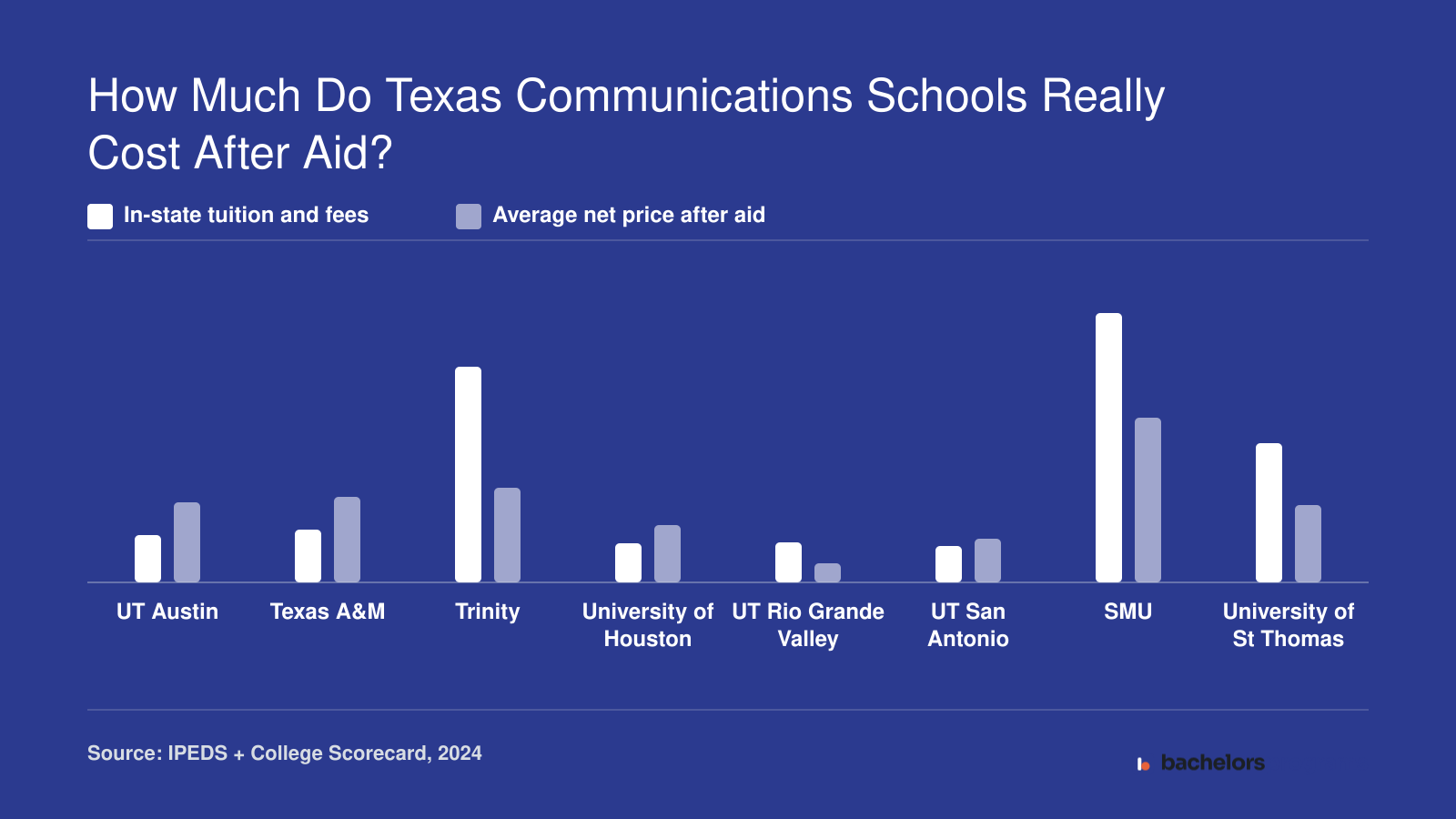
How Much Do Texas Communications Schools Really Cost After Aid?
Average net price counts tuition plus housing, books and living costs, minus grants and scholarships, so it can land above in-state tuition at public universities. Aid closes the gap most at private schools: Trinity University drops from $53,676 in tuition to a $23,464 net price, Southern Methodist University from $67,040 to $40,892, and University of St Thomas from $34,634 to $19,359. Among public schools, UT Rio Grande Valley's net price of $4,831 falls below its $9,987 tuition, while Texas A&M's $21,315 net price sits well above its $13,154 tuition, a sign that aid covers less of the full bill there.
Related Articles
Communications Careers and Salaries in Austin, Dallas-Fort Worth, Houston, and San Antonio
Employers in Texas increasingly hire communications graduates for content, audience analytics, and digital marketing work rather than only traditional press and publicity roles. That shift shapes both the job titles and the pay.
What the Metro Wage Data Shows
The May 2023 federal wage estimates give a useful but incomplete picture. In Austin-Round Rock, market research analysts and marketing specialists earned a median of about $77,800 a year across roughly 7,950 jobs.1 In San Antonio-New Braunfels, the same occupations had a median near $63,900 (about 4,160 jobs), while public relations specialists had a median near $58,900 (about 2,110 jobs).2 Comparable metro figures for Dallas-Fort Worth and Houston were not part of the data used here, so check current federal wage tables for those two markets before setting salary expectations.
These medians cover workers at every experience level. The graduate-earnings figures in the table above reflect early-career pay measured a few years after finishing a bachelor's degree, so expect them to sit below the metro medians. Treat the May 2023 numbers as a mid-career reference point, not a starting salary.
Licensure and What Employers Look For
Texas does not license communications professionals. Hiring managers weigh portfolios, writing samples, campaign work, and internships. Programs with strong local ties, such as Southern Methodist University's corporate communication major in Dallas or the University of Houston's strategic communication track, can help you land those internships while still enrolled.
Common Entry Paths by Metro
- Public relations and corporate communications: Coordinator or assistant roles at agencies and company headquarters. Dallas-Fort Worth and Houston draw many corporate employers, with energy and healthcare especially visible in Houston.
- Marketing and content: Social media, email, and content specialist jobs. Austin's technology and startup scene is a major source of these openings.
- Market research and analytics: Analyst roles that reward comfort with data. Austin and San Antonio both show sizable employment in this category.
- Media and public affairs: Production, broadcast, government, and nonprofit communications. Austin's state agencies and San Antonio's healthcare, military, and tourism sectors hire here.
Whichever path you choose, build a portfolio early and complete at least one internship before graduation.
Common Questions About Communications Degrees in Texas
What is the best communications school in Texas?
Are there online communications degree programs in Texas?
Is a B.A. in communications worth it in Texas?
Do I need ACEJMC accreditation to get hired in public relations or advertising?
Compare Communications programs on the data that matters
Explore more Communications & Media majors or browse every field of study.
All Communications & Media programs Browse every field of study