Best Communications Degree Programs in Vermont
Compare 6 accredited Communications programs in Vermont, with net price after aid, graduation rates, earnings and debt from IPEDS and the U.S. College Scorecard.

A bachelor's degree in communications in Vermont usually means choosing between a broad liberal arts route and a production-heavy one, and the price gap between them is real. At the University of Vermont, the B.S. in Public Communication pairs writing and design coursework with a research base; Vermont State University's B.A. in Communications puts students in studios and newsrooms, with an internship built in. That split, theory on one side and reel-building on the other, drives most of the decision.
The B.A. is the common credential in the field, though Vermont schools label it differently.
Employers in Chittenden County and around Montpelier hire from both. What separates graduates is usually portfolio depth, not the degree title on the transcript.
Key Points
- Saint Michael's College averages a $25,239 net price against $51,450 sticker.
- Champlain College offers the online route; others teach communications on campus.
- VSAC manages Vermont state grants plus more than 150 private scholarships.
Best Bachelor's Degree in Communications Programs in Vermont, Ranked
Six Vermont institutions award a bachelor's degree in communications, and the differences that matter most come down to price after aid, how much production work you actually get to do, and whether the program fits a campus-based or an online life. The top of this list favors schools that pair a clear communications curriculum with strong completion rates, then layers in what each does best: a media lab, four concentration tracks, or a fully online path. Net prices below reflect what students pay after grant aid at each school overall.
Saint Michael's College
#1Colchester, VT · $25,000 – $30,000/yr (est.)
Best for: Journalism-focused students wanting a small liberal arts setting
A private liberal arts college in Colchester, minutes from Burlington, where communications sits inside a broad humanities education rather than a standalone media school. The B.A. in Digital Media and Communications organizes learning around media studies, digital media art, journalism and global media, so students can tilt toward reporting, production or analysis. The college has added 2026 affordability measures aimed at Vermont families, including a tuition match to UVM in-state rates and free tuition for eligible households, with fees, room and board billed separately. Institution-wide, 73 percent of students graduate, and graduates of this program earned a median of $59,313 four years after finishing.
- Learning outcomes grouped under media studies, digital media art, journalism, global media
- Media analysis, message design and audience research coursework
- Newswriting, reporting and documentary storytelling across platforms
- Visual art and multimedia production for a working portfolio
- Comparative media systems and international audience study
- Program requirements and a sample degree map published separately
Norwich University
#2Northfield, VT · $22,000/yr (est. net price)
Best for: Hands-on film and video production learners
A private university in Northfield with a residential, structured campus and a media lab stocked with cameras and editing workstations. Communications, Design, and Media Arts is an interdisciplinary B.S. that draws on Global Humanities and the School of Architecture and Art, with Digital Media Production I and II in year two and an internship built into year three. A humanities capstone closes the degree with research, production and a public presentation, and student media includes WNUB, the Chameleon and the Guidon. Institution-wide, 60 percent of students graduate, and graduates of this program earned a median of $65,497 four years after finishing.
- Interdisciplinary major spanning Global Humanities and Architecture and Art
- Digital Media Production I and II in year two; internship in year three
- First-year students use cameras and editing workstations in the Media Lab
- Humanities capstone with research, production and a public presentation
- Coursework in writing, design, photography, film, digital media and media strategy
- Berlin Maymester option offered in June 2027
- Student media outlets include WNUB, the Chameleon and the Guidon
- Graduates enter film and video, social media, graphic design, PR and sports marketing
Vermont State University
#3Randolph, VT · $15,000 – $20,000/yr (est.)
Best for: Budget-minded students wanting multiple concentration tracks
Vermont's public university, carrying the lowest in-state tuition of any program ranked here and a communications major built for students who want options. The B.A. in Communications pairs a theory and media-analysis core with four concentrations (Cinema, Broadcast Journalism, Print Journalism and Content Creation) plus a general track for students who prefer breadth. Internships, practicum courses and partnerships with community organizations supply the experiential side, and a senior project caps the degree. Institution-wide, 47 percent of students graduate, and graduates of this program earned a median of $47,035 four years after finishing.
- Four concentrations: Cinema, Broadcast Journalism, Print Journalism, Content Creation
- General Communications degree option for students who skip a concentration
- Core in theory plus sociological and critical analysis of media
- Communications concentration requires 30 credits, 9 at the 3000 and 4000 level
- Senior Project in Communications worth 3 to 4 credits
- Internships, practicum courses and community organization partnerships
- Minors in Communications, Cinema, Broadcast Journalism and Print Journalism
Champlain College
#4Burlington, VT · ~$36,000/yr (est.)
A private, career-focused college in Burlington whose online division runs one of the few fully online communications degrees based in Vermont. The B.S. in Marketing and Communication is 120 credits delivered in 7-week terms, two courses at a time, which puts completion at roughly three years and four months. Up to 90 transfer credits are accepted (the average student brings 40), and students finish with a marketing capstone plus a HubSpot Inbound Marketing Certification. Institution-wide, 65 percent of students graduate, and graduates of this program earned a median of $49,508 four years after finishing.
- 120 credits, fully online, two courses per 7-week term
- Complete in about 3 years and 4 months
- Accepts up to 90 transfer credits; average student transfers 40
- 2026-27 tuition of $342 per credit, $250 per credit for servicemembers
- Coursework in visual storytelling, public relations, SEO and digital marketing
- 6-credit marketing capstone; 2.5 GPA recommendation for admission
- HubSpot Inbound Marketing Certification; optional Google Analytics and Ads credentials
- Prior learning credit for work experience; classes run in Canvas
University of Vermont
#5Burlington, VT · $19,000 – $46,000/yr (est.)
The state's flagship public research university in Burlington and the largest institution on this list. Its B.S. in Public Communication is a campaign-focused degree: students learn to design and run communication that serves the public interest, choosing among Communication Design, Community Media and Journalism, or Strategic Communication. Internships carry academic credit, coursework spans applied media studies, documentary film, social media and socially responsible marketing, and alumni work at Adobe, WIRED and Ben & Jerry's. Institution-wide, 79 percent of students graduate, the highest rate among the schools ranked here.
- Three concentrations: Communication Design, Community Media and Journalism, Strategic Communication
- Curriculum centered on campaigns that serve the public interest
- Applied media studies, journalism, documentary film, social media, responsible marketing
- Academic credit available for internships
- Alumni work at Adobe, WIRED, Ben & Jerry's and other organizations
- On-campus, full-time program emphasizing teamwork and leadership
Landmark College
#6Putney, VT · $55,000 – $60,000/yr (est.)
A private college in Putney built specifically for students who learn differently, with a 7-to-1 student-faculty ratio and deliberately small, structured classes. The B.A. in Communication and Leadership runs 121 credits, including 42 in the major, a guided leadership practicum and a capstone, with upper-level work in journalism, marketing, media and management. Credit-bearing internships run from sports broadcasting to social media and TV production, and partners include Hasbro, Broad Futures and Neurodiversity Pathways. Institution-wide, 43 percent of students graduate, and the college carries the highest net price of the schools ranked here.
- 121 credits: 42 in the major, 34 general education, 45 electives
- Includes 12 elective credits at the 3000 and 4000 level
- Guided leadership practicum and capstone both required
- Coursework in team-based communication and leadership and change
- Credit-bearing internships in sports broadcasting, social media, TV production, event planning
- Partners include Hasbro, Broad Futures and Neurodiversity Pathways
- Upper-level courses in business, journalism, marketing, media and management
Cost & outcomes by school
Federal data for the highest-earning Communications programs, independent of the ranking above. Earnings are this field's bachelor's graduates four years after completing where the Scorecard reports them, else the school's undergraduate median.
| School | Net price / yr | Grad rate | Earnings | Debt | Grads/yr | Format |
|---|---|---|---|---|---|---|
| Norwich University VT | $22,257 | 60% | $65,497 | $27,000 | 4 | Campus |
| University of Vermont VT | $19,343 | 79% | $62,472 | $20,951 | — | Campus |
| Saint Michael's College VT | $25,239 | 73% | $59,313 | $26,250 | 13 | Campus |
| Champlain College VT | $35,860 | 65% | $49,508 | $26,814 | 8 | Online |
| Vermont State University VT | $18,212 | 47% | $47,035 | $15,000 | 9 | Campus |
| Landmark College VT | $56,954 | 43% | $29,813 | $17,500 | 13 | Campus |
Sources: U.S. Department of Education. Net price, graduation rate, earnings and debt: College Scorecard (earnings and debt for this field's bachelor's graduates where reported, else school-wide); graduates: IPEDS. A dash means no figure is reported.
Cost, debt & payoff
Median earnings of this field's bachelor's graduates (4 yrs after completing, else the school's undergraduate median) vs. their median federal loan debt · U.S. College Scorecard
Across these programs the median graduate earns about $54,411 and finishes with roughly $23,601 in debt — a ratio that clears a common rule of thumb (keep debt below first-year salary). Net price and debt vary widely school to school, so check the per-school figures in the table above before you shortlist.
Vermont State B.A. vs. UVM B.S. in Public Communication: How They Compare
Vermont State University and the University of Vermont take different routes to a bachelor's degree in communications. Vermont State's B.A. leans toward hands-on media production, with a required internship and student-run outlets. UVM's B.S. in Public Communication blends design, journalism and strategic communication, built around public-facing client work. The table below draws on each school's own program pages. Check details such as total credits and full course lists with each admissions office, since the schools change them over time.
| Feature | Vermont State University: Communications B.A. | University of Vermont: Public Communication B.S. |
|---|---|---|
| Credential | Bachelor of Arts (B.A.) | Bachelor of Science (B.S.) |
| Concentrations | Broadcast Journalism, Cinema, Content Creation, Print Journalism | Communication Design, Community Media & Journalism, Strategic Communication |
| Core focus | Applied media production: visual and digital storytelling, reporting, writing for publication and multiplatform content | Communication, media, design, journalism and strategic writing aimed at public-facing work |
| Representative course work | Introduction to Media and Communications, Visual Storytelling, Race, Gender, and Sexuality in Media, Elements of Production | Graphic design and branding, reporting and audio/video storytelling, public relations, marketing and campaigns, depending on concentration |
| Internship | At least one internship required before graduation | Academic credit available for internships. The school describes internships as common, but its program pages do not list them as a universal requirement |
| Example placements | ESPN, NESN, NECN and local affiliates (Broadcast); The Rutland Herald, Seven Days, VTDigger, Salon.com (Print); Senator Bernie Sanders' office, Vermont radio, Casella, the university marketing office (Content Creation) | Nonprofit, business and community partners through service-learning and client projects |
| Student media and portfolio work | News7 broadcast practicum; student-led Content Lab serving community clients; portfolio work across the degree | Professional portfolio built through course projects and client work |
| Capstone | Capstone included in the B.A. | Real-client capstone with actual campaign work |
| Best fit for | Students aiming for newsrooms, broadcast, film or content production | Students drawn to design, PR, marketing or community-centered journalism |
Questions to Ask Yourself
Do you want hands-on production, like broadcast, video, and content creation, or strategy, messaging, and design?
Do you want community journalism built into the core of the degree rather than offered as an elective?
Would you rather study at a larger research university or a smaller campus with easier access to equipment and studios?
Online and Hybrid Communications Bachelor's Options at Vermont Schools
Online bachelor's degrees now cover most majors, but communications in Vermont still runs on campus studios, newsrooms and hands-on production work. Champlain College is the online exception. Every other school here teaches its communications bachelor's on campus.1
Delivery Format by School
- Champlain College: The B.S. in Marketing and Communication runs fully online on 7-week terms, with classes held in Canvas.
- Vermont State University: The Communications B.A. is taught in person at Castleton and Lyndon. Broadcast Journalism is based at Lyndon and Cinema at Castleton, with most required courses on campus.
- University of Vermont: The Public Communication B.S. is campus-based in Burlington.
- Saint Michael's College, Norwich University, Landmark College: Each delivers its communications bachelor's on campus.1
The schools' program pages do not describe a formal hybrid version of any of these degrees. A campus program may include an occasional online course, but that is not a degree you can finish remotely.
What This Means for Working Adults
If you work full time or live far from Burlington, Castleton or Lyndon, Champlain is the realistic Vermont-based path. Its online program accepts up to 90 transfer credits, awards prior learning credit for work experience, and reports that the average student transfers in 40 credits. Community college coursework can shorten your timeline, so gather transcripts early. Champlain pairs marketing with communication, a combination that suits business-facing roles more than broadcast or journalism work.
Confirm Format Before You Apply
Delivery details can change between catalog years. Before applying, ask admissions three questions: what share of required courses can be taken online, whether internships or practicums require on-site attendance, and whether the format differs by concentration. Get the answers in writing.
Admissions Requirements: GPA, Test Policy, and Portfolio Expectations
Vermont communications programs range from rolling admission to genuinely selective review, and the published requirements differ sharply from school to school.
Vermont State University
Vermont State admits about 81.7% of applicants. Its published first-year standard is a high-school "B" average (3.0, or 85%), and applicants without a conventional GPA are evaluated individually. SAT and ACT scores are optional and considered if submitted. The Accuplacer applies to certain health programs such as nursing and radiologic science, not to communications. Most programs use rolling admission, and the December 1 priority date covers select programs like dental hygiene and nursing. No portfolio requirement is published for the Communications B.A.
University of Vermont
UVM admits about 65.3% of applicants. It publishes no minimum GPA, but admitted students typically fall between 3.5 and 3.8. The university is test-optional, and applicants who submit no scores stay eligible for merit scholarships. One reported cycle put test-optional applicants at 55%.
For fall 2027 entry, Early Action and Early Decision I applications are due November 1, 2026, with materials complete by November 13. Regular Decision and Early Decision II close January 15, and late applications are considered only if space remains. Check the deadline page for when supplemental materials are due. UVM publishes no portfolio requirement for Public Communication.
Other Vermont Schools
- Champlain College: Admits about 82.9%. The online Bachelor of Science in Marketing and Communication lists a 2.5 GPA minimum.
- Saint Michael's College: Admits about 84.5%.
- Norwich University: Admits about 74.4%.
- Landmark College: Admits about 49.4%.
The sources reviewed do not cover GPA, test policy, deadlines or portfolio expectations for Saint Michael's, Norwich or Landmark, so confirm those with each admissions office before you apply.
The Takeaway
By admit rate, Saint Michael's, Champlain and Vermont State are the easiest to enter, and Vermont State's rolling review and 3.0 benchmark make it the most predictable. UVM is the most competitive of the larger schools, with early deadlines that reward applying in the fall. Landmark's lower admit rate marks it as the most selective by the numbers.
Transfer Credit and A.A.-to-B.A. Pathways Into a Vermont Communications Degree
Transferring into a bachelor's degree in communications in Vermont works best when you plan your courses before you apply. Here is how each route handles incoming credit.
- Vermont State University Communications B.A.The B.A. is offered in person at Castleton and Lyndon. The Registrar's Office evaluates transfer credit after you are admitted and maps it to the B.A.'s requirements. The online Transfer Credit Evaluation System helps you research courses but does not replace that review. Ask early how your associate-level communications courses will count.
- Vermont Transfer GuaranteeThis applies if you finish an associate degree at a community college in the Vermont State Colleges System, which shares a common transcript with Vermont State. Eligibility requires the associate degree and a GPA of 2.0, 2.5, or 3.0, depending on the receiving college. Vermont State's threshold is 2.0. The 2+2 maps guarantee only 60 more credits after the associate degree. The same system also lists 30 pathways to junior status at UVM, so check whether one fits Public Communication.
- University of Vermont Transfer RulesUVM accepts comparable courses from accredited institutions completed with a C (2.0) or better. Grades of C- or lower, pass/fail, and audited courses do not transfer. Courses are reviewed one by one, generally against a two-thirds content overlap. Lower overlap may earn generic credit. Credits transfer but grades do not, so transfer grades never enter your UVM GPA. Official evaluation takes 3–5 business days after admission.
- Protect Your CreditsSave every syllabus and earn at least a C in each course. Avoid pass/fail options. Have official transcripts sent directly from your college. Treat preapproval as provisional, because UVM does not guarantee it. At Vermont State, send catalog details to [email protected] and confirm any substitutions with your faculty advisor.
Related Articles
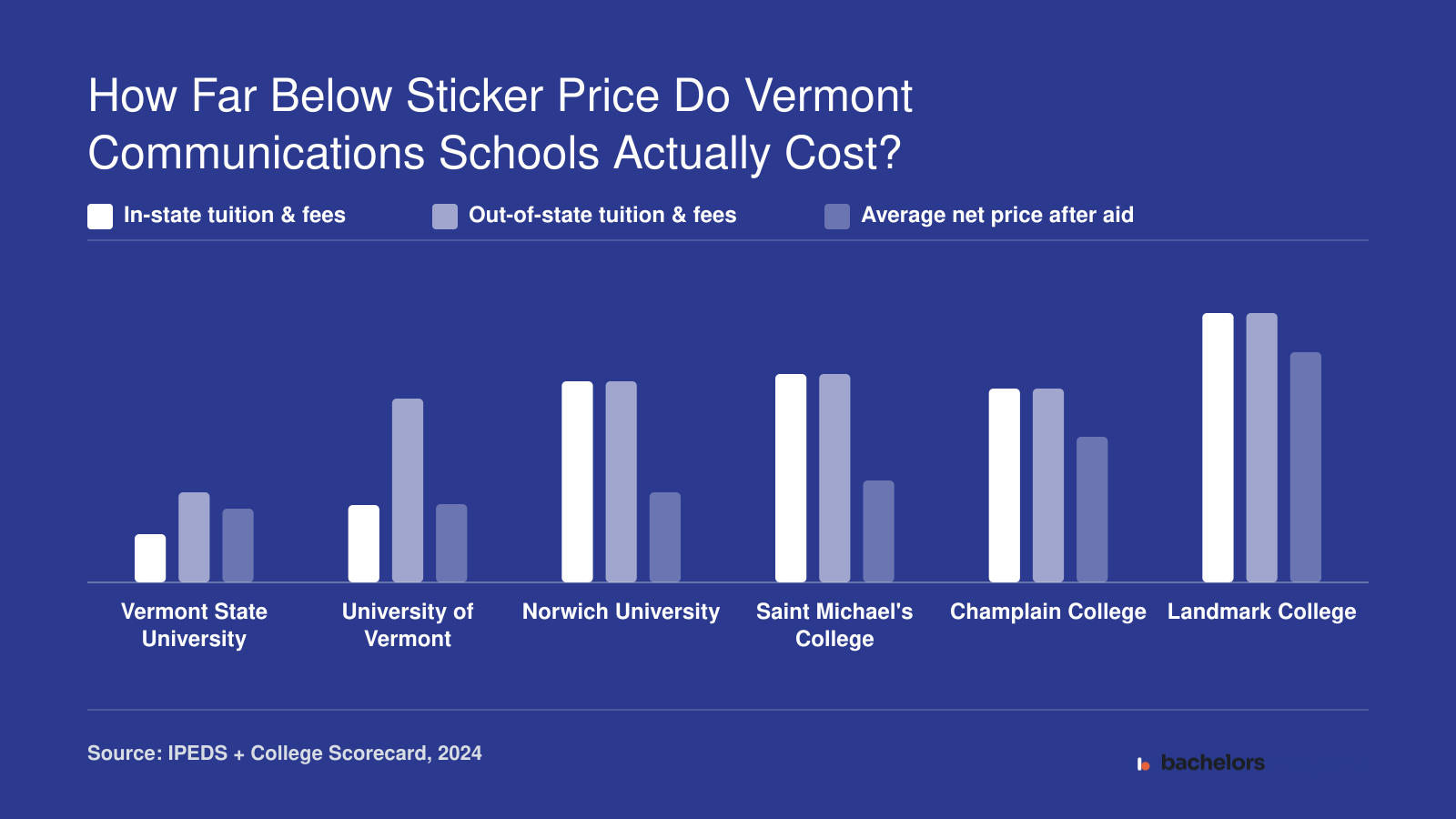
How Far Below Sticker Price Do Vermont Communications Schools Actually Cost?
For most families, the gap between sticker price and net price is the real story. At Saint Michael's College, the average net price after grants and scholarships is $25,239, about half the published $51,450 in tuition and fees. Net price covers the full cost of attendance, including housing, minus aid, so at public schools like Vermont State University it can land above in-state tuition alone.
Vermont Grants and Scholarships for Bachelor's Students
For Vermont residents, the Vermont Student Assistance Corporation (VSAC) is the hub for state grant money and more than 150 privately funded scholarships. Filing the FAFSA each year opens federal grants, state grants, scholarships, and college or university grants, and several Vermont programs pay out on a first-come, first-served basis. Students pursuing a bachelor's degree in communications at the schools ranked here should file early, because funds are limited.
| Aid Program | Who Qualifies | Award Details | Where to Apply |
|---|---|---|---|
| Vermont Grant (VSAC) | Vermont residents accepted or enrolled full-time or part-time in an undergraduate degree or certificate program approved for federal Title IV aid. Applicants generally must not already hold a bachelor's degree. | Awards have ranged from $1,000 to $15,350 per academic year (2025-26). The amount depends on financial situation, total cost of attendance, available funding, and when you apply. | File the FAFSA every school year and complete VSAC's Vermont Grant application. Funds are awarded first-come, first-served while they last. |
| VSAC-Assisted Scholarships | Generally Vermont residents who are U.S. citizens or eligible non-citizens. Military applicants must list Vermont as their home of record. Individual scholarships may add school, major, geographic, financial-need, academic, or service requirements. | More than 150 scholarships open to Vermont residents unless a description says otherwise. Awards are competitive and funding is limited. | Complete VSAC's Unified Scholarship Application and submit any required documents. The FAFSA is also required when financial need is a criterion. Start searching 9 to 12 months before the academic year. |
| Federal Pell Grant | Undergraduates enrolled or accepted in an eligible degree program who do not already have a bachelor's or professional degree and are not incarcerated or subject to involuntary post-incarceration commitment. | N/A | File the FAFSA. VSAC identifies it as the starting point for federal, state, and college grants. |
| Vermont Grants for Adult Learners | Income-eligible students who complete both the FAFSA and the Vermont Grant application. | Income-based state grant support. Funds are limited and can run out during the year. | Complete the FAFSA and the Vermont Grant application through VSAC before funds are depleted. |
What Communications Jobs Pay in Vermont
Vermont's communications wages vary more by role than by geography. The state is small enough that most communications jobs cluster in Chittenden County and around Montpelier, so the figures here describe what Vermont employers reported in recent federal wage surveys. All are median annual wages, meaning half of workers in that role earned more and half earned less.
Where the Money Is
Public relations specialists make up the largest group of communications workers in Vermont, with roughly 1,150 positions statewide and a median wage of $58,140.1 Writers and authors report the highest median at $69,990, though the field is tiny, about 30 jobs,3 so openings are scarce and often freelance or remote.
Producers and directors, who handle video, broadcast, and event production, number around 200 in Vermont with a median of $52,830.2 News analysts, reporters, and journalists earn a median of $45,170 across about 130 jobs1, the lowest of the group but also the most public-facing.
Demand and Outlook
Public relations specialists are projected to grow about 2% from 2025 to 2035, slower than the national average but steady.4 Journalism remains the tightest market, which is why many Vermont graduates pair reporting skills with PR, marketing, or content work.
Pay is only part of the picture. Vermont's cost of living sits below Boston or New York, and remote positions with out-of-state employers are common in media and writing roles, letting graduates earn larger-market pay while living in state. Internships in Burlington and Montpelier are the most reliable path to a first offer.
Compare Communications programs on the data that matters
Explore more Communications & Media majors or browse every field of study.
All Communications & Media programs Browse every field of study