Best Speech Pathology Schools in Georgia
Compare 6 accredited Speech Pathology programs in Georgia, with net price after aid, graduation rates, earnings and debt from IPEDS and the U.S. College Scorecard.

A bachelor's degree in speech pathology is a four-year pre-professional program in how people produce, hear and process language. Georgia students usually earn a Bachelor of Science (B.S.) in Speech Pathology, though schools label the major Speech Pathology, Speech-Language Pathology or Communication Sciences and Disorders (CSD). Expect coursework in phonetics, anatomy of speech and hearing, language development and audiology, plus clinical observation hours.
The degree does not qualify you to practice. Licensure as a speech-language pathologist in Georgia requires a master's degree, so the bachelor's is the step that prepares you for graduate admission.
That gap matters because admission to the major varies widely, from a 2.0 GPA minimum at one school to a 3.4 at another.
Key Points
- Valdosta State University posts the lowest average net price here, $10,945.
- At $6,022, Georgia Southern University charges the lowest in-state tuition.
- Georgia SLP licensure requires a master's; the bachelor's is the first step.
Best Bachelor's Degree in Speech Pathology Schools in Georgia
Georgia has seven bachelor's-level routes into speech pathology, and they differ sharply in what the degree is called, how hard it is to get into the major, and how much supervised observation you log before applying to graduate school. Several public universities admit students to the major through a separate competitive application after general admission, so the GPA cutoff and the deadline matter as much as the campus. Every degree listed here is pre-professional: Georgia licensure as a speech-language pathologist requires a master's degree, and the bachelor's is the step that gets you there.
University of Georgia
#1Athens, GA · ~$14,000/yr (est.)
Best for: Cohort learners targeting graduate school
The University of Georgia runs the most selective undergraduate route into the field in the state: roughly 60 to 80 students are admitted to each Communication Sciences and Disorders cohort after a major application and a timed writing sample. Classes meet in the same building as the UGA Speech and Hearing Clinic, so students see clinical work up close from the first year. It carries the highest graduation rate in this group and suits applicants who want a large research public university with a well-worn line into graduate study.
- Cohort model admits about 60 to 80 students per year
- 3.4 GPA minimum plus required prerequisite courses
- Submit the education major application and a timed writing sample
- Classes held in the same building as the UGA Speech and Hearing Clinic
- Student chapter of NSSLHA with reading buddy volunteering
- Built as preparation for graduate study in speech-language pathology
Georgia State University
#2Atlanta, GA · $9,000 – $25,000/yr (est.)
Best for: Atlanta commuters combining majors across fields
Georgia State takes an unusual route: the major is a Bachelor of Interdisciplinary Studies in Speech, Language, and Hearing Sciences, so students pair a 42-credit major with a field of study and an allied studies area that must span at least three disciplines. The downtown Atlanta location sits close to the city's hospital and school systems, and an Audiology Assistant Certificate option gives the degree a second use if graduate school is delayed. It fits students who want a big urban university and room to build a second area of expertise alongside communication disorders.
- 120 credit hours, 42 of them in the major
- 18-hour field of study plus a 15-credit allied studies area
- Coursework must span at least three disciplines
- Up to 25 clinical observation hours before graduation
- Audiology Assistant Certificate available alongside the major
- Recommended minors include speech, neuroscience and linguistics
- World language requirement through the 1002 level
Georgia Southern University
#3Statesboro, GA · $15,000 – $20,000/yr (est.)
Best for: Pre-professionals wanting hands-on observation hours
Georgia Southern's Communication Sciences and Disorders degree is taught at the Armstrong-Savannah campus rather than in Statesboro, which makes it the coastal option on this list. The 123-credit plan folds 25 ASHA-verified observation hours and 10 volunteer hours into the undergraduate years, and entry is tied to regular university admission and eligibility for college math and English rather than a separate competitive major application. Students who want a plainly specified path with periodic benchmark checks and steady advising should look closely.
- 123 credits: 42 Core IMPACTS, 18 field of study, 33 major
- Taught at the Armstrong-Savannah campus, not in Statesboro
- 25 ASHA-verified observation hours plus 10 volunteer hours
- Admission requires eligibility for MATH 1001 and ENGL 1101
- Keep a 2.0 GPA with a C or better in every required course
- A grade below C can be repeated only once
- Periodic benchmark assessments track progress
University of West Georgia
#4Carrollton, GA · $13,000/yr (est. net price)
West Georgia names the major Speech-Language Pathology on the transcript, and the Carrollton program mixes seated, hybrid and some fully online courses, which is rare for a clinically oriented field. At 123 credits with 25 hours of guided observation, it is built as a pre-professional degree and says so, moving students toward graduate study without pretending the bachelor's is enough to practice. It is the most schedule-flexible public option in this group for students who need part of their coursework at a distance.
- 123 credit hours including 25 hours of guided observation
- Seated, hybrid and some fully online coursework
- Covers phonetics, child language disorders and audiology
- Adds counseling and cultural diversity in communication disorders
- Pre-professional: a master's is required to practice
- Fall, spring and summer start terms
Piedmont University
#5Demorest, GA · $21,000/yr (est. net price)
Piedmont is the small private liberal arts option: a 121-credit Communication Sciences and Disorders degree on a residential campus in Demorest, with free electives that make a second major or a minor realistic. An assessment clinic on campus lets undergraduates start logging clinical hours that carry into graduate work, and the university runs both a BS/MS integrated track and a two-year master's for its own graduates. It rewards students who want close faculty contact and a defined cohort rather than a large lecture hall.
- 121 credit hours with free electives for a minor
- Assessment clinic on the Demorest campus
- Undergraduate clinical hours count toward graduate requirements
- BS/MS integrated pathway plus a two-year master's option
- Coursework spans audiology, linguistics and fluency disorders
- Pre-professional degree; licensure requires a master's degree
Valdosta State University
#6Valdosta, GA · $10,000 – $15,000/yr (est.)
Valdosta State has trained communication disorders students for decades, and its on-campus clinic gives undergraduates supervised observation with an audiological suite, 11 therapy rooms and a voice and speech science lab. The 126-credit Bachelor of Science in Education is explicitly a step toward a master's rather than a license, and the ASHA student chapter plugs students into the professional network early. For readers in south Georgia, it is the closest comprehensive option in this group.
- 126 credit hours
- On-campus speech and hearing clinic serving the community
- 11 therapy rooms, an audiological suite and a voice and speech science lab
- Observation hours and writing assignments built into coursework
- ASHA student chapter on campus
- Prepares students for the master's required for certification
Augusta University
#7Augusta, GA · $8,000 – $25,000/yr (est.)
Augusta University approaches the field through health care rather than education: the Pre-Speech Language Pathology concentration sits inside the Bachelor of Science in Health Services in the College of Allied Health Sciences, with its first students entering in fall 2025. That makes it the newest pathway on this list, and one embedded in an academic health center, with a speech-language pathology master's program on the same campus. It rewards students who want an interprofessional health sciences degree and an internal route to graduate school.
- Part of the BS in Health Services in the College of Allied Health Sciences
- College reports 80 to 85 percent employment at graduation
- College reports student retention above 95 percent
- Speech-language pathology master's program launched in fall 2025
Cost & outcomes by school
Federal data for the highest-earning Speech Pathology programs, independent of the ranking above. Earnings are this field's bachelor's graduates four years after completing where the Scorecard reports them, else the school's undergraduate median.
| School | Net price / yr | Grad rate | Earnings | Debt | Grads/yr | Format |
|---|---|---|---|---|---|---|
| University of Georgia GA | $13,936 | 90% | $67,975 | $17,421 | 71 | Campus |
| Valdosta State University GA | $10,945 | 42% | $55,426 | $22,053 | 28 | Campus |
| Georgia Southern University GA | $15,267 | 55% | $53,236 | $21,250 | 53 | Campus |
| Piedmont University GA | $20,599 | 47% | $49,130 | $25,000 | 13 | Campus |
| Augusta University GA | $13,787 | 49% | $48,472 | $20,500 | — | Campus |
| University of West Georgia GA | $12,786 | 44% | $45,806 | $21,000 | 30 | Campus |
Sources: U.S. Department of Education. Net price, graduation rate, earnings and debt: College Scorecard (earnings and debt for this field's bachelor's graduates where reported, else school-wide); graduates: IPEDS. A dash means no figure is reported.
Cost, debt & payoff
Median earnings of this field's bachelor's graduates (4 yrs after completing, else the school's undergraduate median) vs. their median federal loan debt · U.S. College Scorecard
Across these programs the median graduate earns about $51,183 and finishes with roughly $21,125 in debt — a ratio that clears a common rule of thumb (keep debt below first-year salary). Net price and debt vary widely school to school, so check the per-school figures in the table above before you shortlist.
How We Ranked Georgia Speech Pathology Schools
Schools earn their place here through measurable factors, not name recognition. Each one matters to a student weighing a bachelor's degree in speech pathology, and each has limits worth knowing.
What We Looked At
Only bachelor's-level programs at Georgia-based schools were considered. Graduate programs are not ranked here.
- Net price: What students typically pay once grants and scholarships are counted, a truer number than the sticker price.
- Graduation rate: How many undergraduates actually finish, a sign of how well a school supports them.
- Selectivity: How competitive admission is, which helps you judge your odds.
- Program outcomes: Earnings and debt for graduates of the specific major, used only when a figure is published for that program.
- Delivery format: Whether you attend on campus, fully online, or in some combination.
What the Numbers Can and Cannot Tell You
Both measures describe the whole institution, not the speech pathology program alone. A school's overall rate may be higher or lower than what students in this major experience. Net price is also approximate. Your own cost depends on family income, residency, aid eligibility and the housing you choose.
The data also has limits. Some programs have no published earnings or debt figures, usually because too few graduates are reported. In those cases we left the figure out rather than estimate it.
Treat the rankings as a starting point. Confirm current costs, admission requirements and program details with each school before you apply.
Compare Georgia Speech Pathology Schools Side by Side
The table below compares each school's bachelor's program on cost, completion and outcomes, using 2024 IPEDS and College Scorecard figures from the U.S. Department of Education. Georgia Southern University posts the lowest in-state tuition at $6,022, Valdosta State University has the lowest average net price at $10,945, and the University of Georgia leads on graduation rate and earnings. Earnings and debt reflect all students at each school, not speech pathology graduates alone.
| School | Location | Program Name | Sector | In-State Tuition & Fees | Average Net Price | Graduation Rate | Median Earnings 10 Years After Entry | Median Graduate Debt |
|---|---|---|---|---|---|---|---|---|
| University of Georgia | Athens, GA | BSEd in Communication Sciences and Disorders | Public | $11,450 | $13,936 | 90% | $68,726 | $18,500 |
| Georgia State University | Atlanta, GA | Speech, Language, and Hearing Sciences | Public | $8,664 | $15,931 | 53% | $47,384 | $20,903 |
| Georgia Southern University | Statesboro, GA | Communication Sciences and Disorders | Public | $6,022 | $15,267 | 55% | $53,236 | $23,250 |
| University of West Georgia | Carrollton, GA | Bachelor of Science in Education with a Major in Speech Pathology | Public | $6,088 | $12,786 | 43% | $49,587 | $23,970 |
| Piedmont University | Demorest, GA | Communication Sciences and Disorders | Private nonprofit | $31,700 | $20,599 | 47% | $49,130 | $25,000 |
| Valdosta State University | Valdosta, GA | Bachelor of Science in Education with a Major in Communication Disorders | Public | $6,124 | $10,945 | 42% | $49,361 | $24,779 |
| Augusta University | Augusta, GA | Pre-Speech Language Pathology | Public | $8,414 | $13,787 | 49% | $48,472 | $20,500 |
Related Articles
Cost of a Speech Pathology Bachelor's Degree in Georgia
Which Georgia School Costs the Least?
Valdosta State University has the lowest average net price among the schools ranked here, at $10,945 a year after grants and scholarships. In-state tuition and fees come to $6,124, against $17,836 for out-of-state students. Georgia Southern University ($6,022) and the University of West Georgia ($6,088) post slightly lower in-state sticker prices, but their average net prices are higher.
- Valdosta State University: $6,124 in-state, $17,836 out-of-state, $10,945 average net price
- University of West Georgia: $6,088 in-state, $17,800 out-of-state, $12,786 net price
- Augusta University: $8,414 in-state, $24,734 out-of-state, $13,787 net price
- University of Georgia: $11,450 in-state, $31,688 out-of-state, $13,936 net price
- Georgia Southern University: $6,022 in-state, $17,734 out-of-state, $15,267 net price
- Georgia State University: $8,664 in-state, $24,840 out-of-state, $15,931 net price
- Piedmont University (private): $31,700 for all students, $20,599 net price
Net price is an average, not a quote. At the public universities it reflects in-state students who receive aid. At private Piedmont it covers aided students regardless of residency. Your actual cost depends heavily on family income, and lower-income households often pay well below these averages. Published tuition can also trail current 2026-27 rates, so confirm with each school's bursar.
Institution-wide median debt at graduation ranges from $18,500 at UGA to $25,000 at Piedmont. These figures cover all majors, not speech pathology alone.
HOPE and Zell Miller for Speech Pathology Majors
Both Georgia Student Finance Commission scholarships apply to a speech pathology or CSD bachelor's at these Georgia schools. HOPE requires a 3.0 HOPE GPA in core high school courses plus Georgia's rigor requirements.1 In college, you must hold a 3.0 at the end of each spring semester and at 30, 60 and 90 attempted semester hours.2 Zell Miller requires a 3.3 at those same checkpoints and has tougher initial qualifications.4
For 2025-26 at public universities, Zell Miller covers full standard tuition up to 15 hours per term, while HOPE pays a fixed per-term amount toward standard tuition.1 At an eligible private school like Piedmont, both paid $2,985 per full-time semester.1 Mandatory fees, housing and books remain your responsibility.
Watch the limits. Awards stop at 127 combined paid hours, and eligibility expires seven or ten years after high school graduation, depending on your circumstances.3 Georgia Southern's program alone requires 124 credit hours, so a late change of major could exhaust your aid. If your GPA drops below the line, you can regain each award only once.
Practical Tip
Compare net price rather than sticker price, and start with the lowest-cost public options. Enter your family's numbers in each school's cost calculator, then factor in HOPE or Zell Miller to see what you would actually pay.
Online and Hybrid Speech Pathology Bachelor's Options at Georgia Schools
Speech pathology remains one of the more campus-bound bachelor's fields, because observation hours, clinic access and hands-on lab work are hard to move online. Georgia follows that pattern: we could not confirm a fully online bachelor's at any school in the state.
What Each School Offers
- Georgia Southern University: The Communication Sciences and Disorders major is taught in person on the Armstrong campus in Savannah, and students are expected to attend.1 No hybrid or part-time track is identified.
- University of West Georgia: The B.S.Ed. in Speech Pathology is the most flexible. Students can finish it entirely face-to-face, and course delivery varies among face-to-face, hybrid and online depending on which sections you pick. That is not the same as a fully online degree.
- University of Georgia, Valdosta State, Georgia State and Augusta University: These are listed as campus-based programs. We could not confirm hybrid, online or part-time options on official pages, so check directly. Valdosta State's degree is a four-year pre-professional curriculum.2
- Piedmont University: The program is listed as campus-based, and the integrated five-year B.S./M.S. track is built around full-time study on the Demorest campus.
What to Ask Before You Enroll
A "hybrid" label can mean very different things, so put these questions to the admissions office:
- Is the entire major available online, or only general education and prerequisite courses?
- How are clinical observation hours completed, and can they be done near home?
- Which labs or clinic sessions require you to be on campus, and how often?
- Can you enroll part-time without losing your place in a cohort? UGA, for example, admits limited cohorts.
- Which courses transfer in, and are core major courses excluded?
If You Need Flexibility
Where no online option exists, the practical routes are part-time enrollment where a school allows it, a hybrid course mix at West Georgia, or completing general education credits first and transferring into the major. Confirm each path in writing, since policies change. Licensure still requires a master's degree, so whatever format you choose should keep you on track for graduate admission.
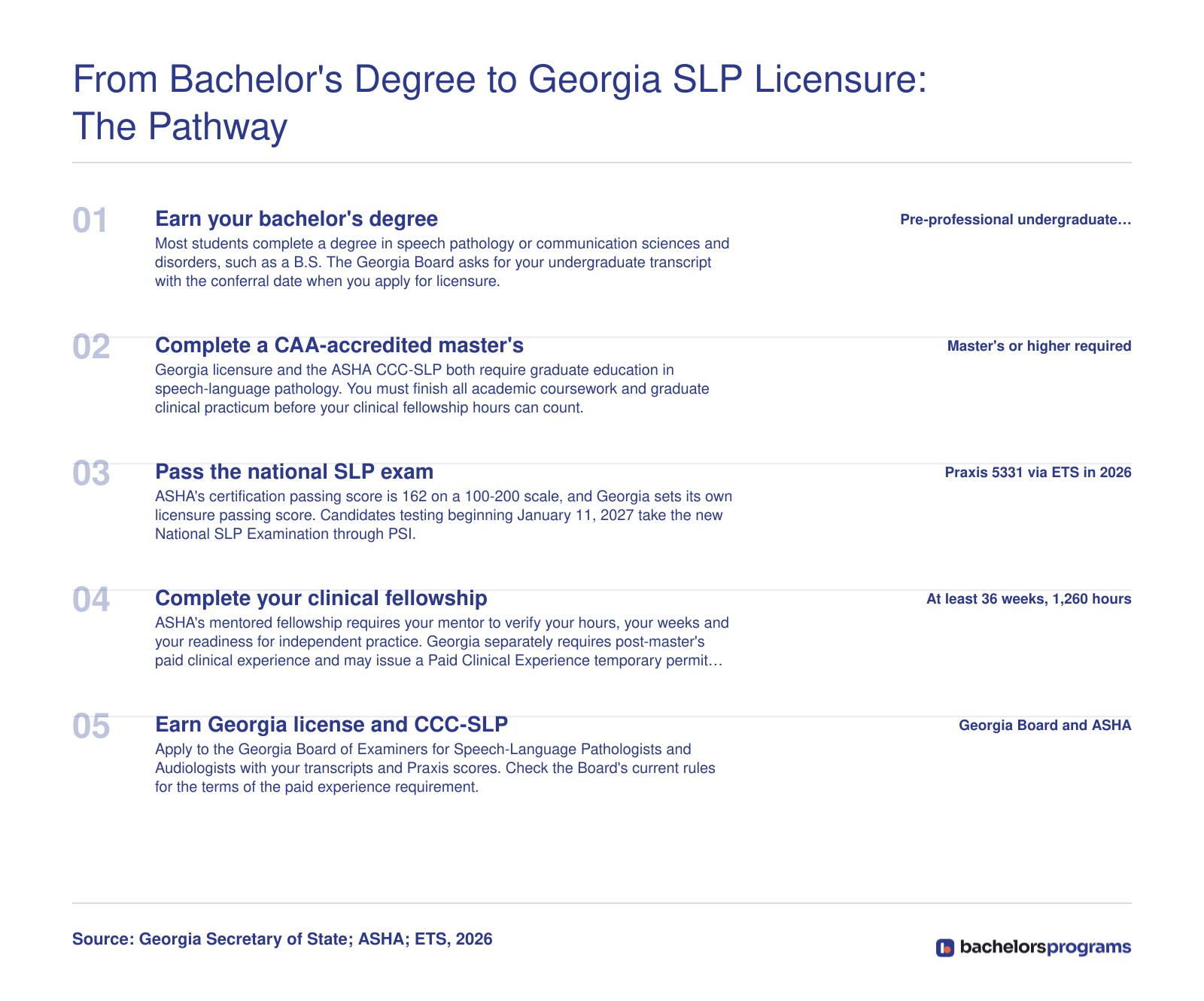
From Bachelor's Degree to Georgia SLP Licensure: The Pathway
Licensure as a speech-language pathologist in Georgia requires a master's degree or higher, so the bachelor's degree is the pre-professional step, not the finish line. A bachelor's in speech pathology or communication sciences and disorders builds your undergraduate foundation and prepares you to apply to graduate study. On its own, it does not qualify you for a Georgia SLP license or the ASHA CCC-SLP.
Speech Pathology Careers in Georgia: Jobs, Wages and Five-Year Pathways
Where Georgia SLPs Work, and What They Earn
Speech-language pathologists in Georgia work in public schools, hospitals, outpatient and rehabilitation clinics, early-intervention programs, skilled nursing facilities and private practices. These wages are May 2025 estimates for the licensed occupation itself, not earnings of bachelor's graduates.1
- Median: $96,760 per year, or $46.52 per hour
- Mean: $93,470 per year, or $44.94 per hour
- Low end: $59,800 per year, or $28.75 per hour
- High end: $125,550 per year, or $60.36 per hour
The national median for the same occupation is $97,870.2 Georgia's reported median sits slightly above its mean; treat the two as separately reported figures, not as points on a scale. Pay varies by setting, with school-year contracts and hospital or clinic schedules producing different annual totals.
What a Bachelor's Degree Alone Can Do
A bachelor's degree in speech pathology is the pre-professional step, not the license. The Bureau of Labor Statistics lists a master's degree as the typical entry-level education for the occupation2, and Georgia licensure as a speech-language pathologist requires one.
At the bachelor's level, graduates move into support and adjacent roles, including:
- SLP assistant or aide: Available where state credentialing and employer requirements are met, and always under supervision.
- Therapy and rehabilitation aide: Common in clinics, hospitals and long-term care.
- Special-education paraprofessional or early-intervention assistant: School and home-based settings serving children with communication needs.
- Behavioral-health technician: Only where separate employer or certification requirements are satisfied.
- Intake, patient services or care coordination: Administrative paths into clinical settings.
- Research assistant or accessibility support: Laboratory, university and disability-services work.
Duties, supervision and credentials vary by employer. Georgia does not publish separate wage figures for these support roles, so expect pay below the licensed SLP numbers above.
Five-Year and Accelerated Pathways
Several Georgia schools fold the graduate step into the undergraduate years, useful context for planning, not an endorsement. Piedmont University runs an integrated five-year bachelor's-plus-master's pathway alongside a separate two-year master's, and reports that 10 of 12 Class of 2025 graduates were employed before graduation, or 83%.3 The University of Georgia says students may earn the bachelor's and master's in five years, entering with a communication sciences and disorders degree or equivalent. The University of West Georgia offers an accelerated bachelor's-to-master's route that shares 12 credit hours between the B.S.Ed. and M.Ed.
Demand and Next Steps
The Bureau of Labor Statistics continues to project rising demand for speech-language pathologists across the country over the 2025 to 2035 window, driven by early identification of communication disorders and an aging population.2 For Georgia students, the practical sequence is a bachelor's degree, then a master's, then the state license.
Compare Speech Pathology programs on the data that matters
Explore more Communications & Media majors or browse every field of study.
All Communications & Media programs Browse every field of study