Best Cybersecurity Schools in Georgia
Compare 24 accredited Cybersecurity programs in Georgia at 21 colleges, with net price after aid, graduation rates, earnings and debt from IPEDS and the U.S. College Scorecard.

A two-year technical college credential and a four-year bachelor's degree in cybersecurity lead to different job titles, and in Georgia the gap shows up in both price and pay. Most programs award a Bachelor of Science (B.S.) in Cybersecurity, though some schools fold the major into computer science, information technology or information systems.
The ranked list below covers Georgia-based campus and online programs, weighed on cost, earnings and completions. The cheapest and highest-earning programs follow, along with online options, admissions, aid, CAE status and Georgia careers.
Tuition and program names vary from school to school, so what the curriculum covers matters more than what the diploma is called.
Key Points
- Kennesaw State delivers its 120-credit B.S. in Cybersecurity fully online.
- Nonresidents pay roughly triple in-state tuition at Kennesaw State and Savannah State.
- Georgia's technical college cybersecurity transfer agreement runs through July 1, 2027.
Best Cybersecurity Schools in Georgia: Top 10 Bachelor's Degree in Cybersecurity Programs
Ten Georgia schools make this list, and their cybersecurity bachelor's degrees do not all look alike. One delivers the major fully online, another nests it inside a computer science degree, and a third builds it on an information technology core. Each entry below gives the format, the in-state tuition, the average net price after aid, and the graduation rate of the school that offers the program.
Kennesaw State University
#1Kennesaw, GA · ~$15,000/yr (est.)
Best for: Working adults needing a fully online degree
Kennesaw State University delivers its Bachelor of Science in Cybersecurity fully online through the Coles College of Business, a 120-credit degree with tracks in Systems Security, Network Security, and Cyber Crime and a National Center of Academic Excellence in Cyber Defense Education designation. In-state tuition is $4,560 a year, average net price after aid is about $15,048, and schools offering this program have graduation rates of 52%. KSU reported 87 bachelor's completions in cybersecurity in 2022.
- Fully online, 120 credit hours
- Tracks in Systems Security, Network Security or Cyber Crime
- General education and lower division major requirements
- Upper division technical core plus security core
- Capstone course required
- No program-specific admission requirements
- Designated National Center of Academic Excellence in Cyber Defense Education
- Housed in the Coles College of Business
University of North Georgia
#2Dahlonega, GA · ~$10,000/yr (est.)
Best for: Campus-focused students in North Georgia
The University of North Georgia runs its Bachelor of Science in Cybersecurity on campus through the Mike Cottrell College of Business, built on a 42-hour core and 30 hours of major coursework in computer security, forensics, and network security, capped by a cyber capstone. In-state tuition is $4,373 a year, average net price after aid is about $9,823, and schools offering this program have graduation rates of 37%.
- Campus-based, 120 credit hours
- 42-hour core curriculum plus 18 hours in Area F
- 30 hours of major requirements
- 15 to 18 hours of minor or elective coursework
- Required courses in computer security, forensics and network security
- Cyber capstone project required
- No D grades accepted in computer science or cybersecurity courses
- 9 hours of 3000-4000 level electives
Georgia Southern University
#3Statesboro, GA · $15,000 – $20,000/yr (est.)
Best for: IT majors adding a security certificate
Georgia Southern University offers a Bachelor of Science in Information Technology with a Cybersecurity Specialization, mapping advanced IT and security courses to NSA Center of Excellence knowledge units and allowing students to add an undergraduate cybersecurity certificate that is noted on the transcript. In-state tuition is $4,488 a year, average net price after aid is about $15,267, and schools offering this program have graduation rates of 55%.
- Four-year campus program
- Coursework aligned to NSA Center of Excellence knowledge units
- Optional undergraduate cybersecurity certificate noted on transcript
- Certificate courses include ethical hacking and network security
- Covers information systems security fundamentals
- Center for Applied Cyber Education advisors help students choose among five cyber programs
Albany State University
#4Albany, GA · ~$12,000/yr (est.)
Albany State University awards a Bachelor of Science in Computer Science with an Information Assurance concentration covering cybersecurity, risk management, and data protection, alongside Business and Mathematics alternatives. In-state tuition is $4,176 a year, average net price after aid is about $11,898, and schools offering this program have graduation rates of 31%. The department emphasizes research opportunities and hands-on projects.
- Information Assurance concentration covers cybersecurity and risk management
- Alternative Business and Mathematics concentrations
- Coursework spans programming, data structures and artificial intelligence
- Cryptography and algorithm design in the mathematics track
- Research opportunities and hands-on projects
- Prepares graduates for industry, government or advanced study
Savannah State University
#5Savannah, GA · ~$8,000/yr (est.)
Savannah State University offers a Bachelor of Science in Computer Science Technology with a Cyber Security Concentration, a 122-credit program that pairs computer science fundamentals with engineering technology and security coursework in ethical hacking, cyber forensics, and network defense. In-state tuition is $4,176 a year, average net price after aid is about $8,172, and schools offering this program have graduation rates of 28%. Savannah State reported 9 bachelor's completions in the field in 2022.
- 122 total credit hours, campus-based
- 60-hour major with a 23-hour Cyber Security Concentration
- Information security fundamentals and network defense courses
- Ethical hacking and penetration testing coursework
- Cyber forensics and countermeasures courses
- Grade of C or better required in major courses
Reinhardt University
#6Waleska, GA · $24,000/yr (est. net price)
Reinhardt University teaches its Bachelor of Science in Cybersecurity on campus in Waleska, pairing a core in network security, ethical hacking, cybercrime governance, and security operations with a capstone, an internship opportunity, and a required minor. Tuition is $28,164 a year, average net price after aid is about $24,425, and schools offering this program have graduation rates of 44%. Reinhardt reported 2 bachelor's completions in the field in 2022.
- Campus-based in Waleska, Georgia
- Coursework in network security, ethical hacking and security operations
- Capstone project required
- Cybersecurity internship opportunity
- Related minor required for breadth
- Prepares students for analyst and technical specialist roles
University of Georgia
#7Athens, GA · ~$14,000/yr (est.)
At the University of Georgia, cyber security is one of eight areas of emphasis inside the Bachelor of Science in Computer Science, requiring at least 12 hours including the Cyber Security course and filling the rest with electives in operating systems, computer networks, and distributed computing. In-state tuition is $10,034 a year, average net price after aid is about $13,936, and schools offering this program have graduation rates of 90%. The emphasis is noted on the student's transcript.
- 12 credit hours minimum for the emphasis
- Requires CSCI 4250 Cyber Security
- Electives include operating systems, networks and distributed computing
- Emphasis noted on the student transcript
- Declared through the Athena portal
- One of eight emphasis areas in the computer science major
Georgia College & State University
#8Milledgeville, GA · $9,000 – $30,000/yr (est.)
Georgia College & State University awards a Bachelor of Business Administration in Management Information Systems with a Networking & Security Management concentration that points toward roles such as cybersecurity analyst, information security officer, and IT compliance manager. The university reports alumni average $69,000 five years after graduation and that more than half finish with no student debt. In-state tuition is $7,696 a year, average net price after aid is about $20,686, and schools offering this program have graduation rates of 64%.
- Three concentration options
- Networking & Security Management concentration
- Alumni report average salary of $69,000 five years after graduation
- Over 50% of department graduates finish without student debt
- Career paths include cybersecurity analyst and IT compliance manager
- Also offers enterprise systems and project management tracks
Mercer University
#9Macon, GA · ~$24,000/yr (est.)
Mercer University's Bachelor of Science in Cybersecurity on the Macon campus requires at least 57 semester credit hours: 28 in a core spanning programming, security experimentation, network security and protocols, and cybercrime investigation and forensics, 18 in electives, and 11 in mathematics. A departmental honors track requires a 3.50 major GPA and a research project with a publishable written report. Tuition is $31,265 a year, average net price after aid is about $23,847, and schools offering this program have graduation rates of 70%.
- 57 credit hours minimum in the major
- 28 core credits including network security and forensics
- 18 elective credits and 11 mathematics credits
- Departmental honors track available
- Honors requires a 3.50 GPA and approved research proposal
- Research directed by two faculty members
Augusta University
#10Augusta, GA · $8,000 – $25,000/yr (est.)
Augusta University's School of Computer and Cyber Sciences offers campus-based Bachelor of Science degrees in Cybersecurity and in Cybersecurity Engineering, with labs covering network defense, penetration testing, digital forensics, and cloud computing. The programs are validated against CAE Cyber Defense criteria, and Augusta expanded its U.S. Army Cyber Center of Excellence partnership in 2026 and opened a Cyber Resiliency Center serving Georgia schools, hospitals, and manufacturers. In-state tuition is $7,064 a year, average net price after aid is about $13,787, and schools offering this program have graduation rates of 49%.
- CAE Cyber Defense validated program
- Hands-on labs in networking, programming and cloud computing
- Coursework in network defense, penetration testing and incident response
- Digital forensics and malware analysis topics
- Prepares students for analyst and architect roles
- Engineering-track cybersecurity degree
- ABET engineering accreditation alignment
- Coursework in malware analysis and defensive cyber operations
- Covers cyber intelligence, policy, ethics and law
- Prepares students for security engineer and analyst roles
Cost & outcomes by school
Federal data for the highest-earning Cybersecurity programs, independent of the ranking above. Earnings are this field's bachelor's graduates four years after completing where the Scorecard reports them, else the school's undergraduate median.
| School | Net price / yr | Grad rate | Earnings | Debt | Grads/yr | Format |
|---|---|---|---|---|---|---|
| University of Georgia GA | $13,936 | 90% | $68,726 | $18,500 | — | Campus |
| Mercer University GA | $23,847 | 70% | $58,354 | $24,199 | — | Campus |
| Georgia College & State University GA | $20,686 | 64% | $58,140 | $22,250 | — | Campus |
| Kennesaw State University GA | $15,048 | 52% | $57,552 | $23,833 | 156 | Online |
| Georgia Southern University GA | $15,267 | 55% | $53,236 | $23,250 | — | Campus |
| University of North Georgia GA | $9,823 | 37% | $50,135 | $17,750 | — | Campus |
| Valdosta State University GA | $10,945 | 42% | $49,361 | $24,779 | — | Campus |
| Clayton State University GA | $8,365 | 40% | $49,179 | $25,706 | — | Campus |
| Augusta University GA | $13,787 | 49% | $48,472 | $20,500 | — | Campus |
| Georgia Gwinnett College GA | $15,844 | 22% | $47,730 | $20,076 | — | Online or campus |
| Truett McConnell University GA | $22,227 | 38% | $46,700 | $23,439 | — | Hybrid |
| Reinhardt University GA | $24,425 | 44% | $46,541 | $23,900 | 4 | Campus |
Sources: U.S. Department of Education. Net price, graduation rate, earnings and debt: College Scorecard (earnings and debt for this field's bachelor's graduates where reported, else school-wide); graduates: IPEDS. A dash means no figure is reported.
Cost, debt & payoff
Median earnings of this field's bachelor's graduates (4 yrs after completing, else the school's undergraduate median) vs. their median federal loan debt · U.S. College Scorecard
Across these programs the median graduate earns about $46,621 and finishes with roughly $23,867 in debt — a ratio that clears a common rule of thumb (keep debt below first-year salary). Net price and debt vary widely school to school, so check the per-school figures in the table above before you shortlist.
What Separates a Strong Georgia Cybersecurity Program From a Weak One
A cybersecurity program earns a second look when the price you pay lines up with what its graduates actually earn, and the schools below sit at different points on that balance.
The Five Signals
- Net price after aid: what a first-year student pays on average after grants and scholarships, which matters more than the sticker tuition.
- Earnings: median pay for graduates a few years out, measured for the program rather than the whole campus.
- Completions: how many students complete the credential.
- Selectivity: admission rates that show how competitive entry to each program is.
- Accreditation: regional accreditation for the institution, plus any computing-specific recognition the program holds.
Where the Numbers Stop
Graduation rate and net price describe the whole institution, not the cybersecurity major alone, and net price is a sector average rather than a quote for your situation. Earnings cover graduates who received federal aid, so they describe part of the alumni base, not all of it. Use each figure as a reason to call an advisor, not as a verdict.
What Counts Here
Only bachelor's programs at Georgia-based schools were considered, whether you sit in a classroom in Dahlonega or Statesboro or take the same degree online. Graduate certificates and master's tracks fall outside this page.
Lowest-Cost Bachelor's in Cybersecurity Programs in Georgia
Sorted by average net price after grants and scholarships (U.S. Department of Education, IPEDS and College Scorecard 2024 data), these public Georgia programs offer the lowest sticker-to-net costs for a cybersecurity bachelor's, with in-state tuition and fees near or below $6,200 a year at each one. Net prices run from $8,172 at Savannah State University to $11,898 at Albany State University, a gap of $3,726 per year, or roughly $14,900 over a four-year degree. Because net price includes living costs beyond tuition, compare your own aid offers against these averages before committing.
| School | City | Program | In-State Tuition & Fees (per year) | Average Net Price After Aid (per year) | Format |
|---|---|---|---|---|---|
| Savannah State University | Savannah | Computer Science Technology (Cyber Security concentration) | $5,750 | $8,172 | Campus |
| Clayton State University | Morrow | Computer Science, BS (Cybersecurity concentration) | $5,180 | $8,365 | Campus |
| University of North Georgia | Dahlonega | Cybersecurity (B.S.) | $5,285 | $9,823 | Campus |
| Valdosta State University | Valdosta | Computer Information Systems, Cyber Security Track | $6,124 | $10,945 | Campus |
| Albany State University | Albany | B.S. in Computer Science (Information Assurance concentration) | $5,656 | $11,898 | Campus |
Online and Hybrid Bachelor's in Cybersecurity Options at Georgia Schools
Yes, you can earn a bachelor's degree in cybersecurity entirely online from a school based in Georgia. Kennesaw State University's official program page describes its Bachelor of Science in Cybersecurity as offered fully online. It requires 120 credit hours, admits students in fall and spring, and is built as a four-year path. The page does not list any required campus visits.
Fully Online and Flexible-Format Programs
- Kennesaw State University: Fully online B.S. in Cybersecurity, with Systems Security, Network Security and Cyber Crime tracks.
- Georgia Southern University: A campus-based cybersecurity specialization at Statesboro sits alongside a fully online Bachelor of Information Technology with a cybersecurity concentration, delivered through the University System of Georgia's eMajor program.
- Columbus State University: 2026 listings show its B.S. in Cybersecurity in on-campus, hybrid and online formats.
- Middle Georgia State University: 2026 listings disagree on whether its IT Cyber Forensics concentration is fully online or online combined with campus attendance, so confirm directly.
- Herzing University-Atlanta and American InterContinental University-Atlanta: Both are listed as online, though neither has published whether any in-person component applies.
Campus-Based Programs
The University of North Georgia, Albany State, Savannah State, Reinhardt, the University of Georgia, Georgia College & State University, Mercer and Augusta University deliver their cybersecurity bachelor's programs on campus. Augusta stands out for hands-on lab facilities and is the only Georgia institution the NSA designates as a Center of Academic Excellence for Cyber Operations.
Choosing a Format
Working adults, military-connected students who may relocate, and career-changers holding full-time jobs usually get the most from a fully online program like Kennesaw State's. Students who want face-to-face lab work and faculty access may prefer a campus program. Before enrolling online, ask each school whether labs, proctored exams or orientation require you to be on site.
Transferring From a Georgia Associate Degree to a Cybersecurity Bachelor's
Georgia's two-year technical system and its public university system have a statewide cybersecurity articulation agreement that runs from July 1, 2026, to July 1, 2027. Use these checks before you apply.
- Confirm your associate degree qualifiesThe agreement covers the AAS in Cybersecurity and the AAS in Cyber Forensics Technology. More programs may be added. Middle Georgia State University also lists an articulation for an AAS in Computer, so ask which bachelor's it leads to.
- Meet the receiving school's admission rulesThe agreement does not guarantee admission. You must finish the required coursework, stay in good academic standing and meet the university's own admission requirements, including any GPA minimum it sets.
- Check how your courses will countThe university evaluates each course. Credit may apply one-for-one or as a combination of courses. If there is no match, you receive elective credit instead.
- Review your general-education creditsApproved general-education courses transfer under the statewide course transfer chart. Core IMPACTS courses earn full credit in the matching area when the credit hours line up.
- Ask about upper-division limitsEach university sets its own cap on transferred 3000- and 4000-level credit. Get the course-by-course equivalencies in writing before you enroll.
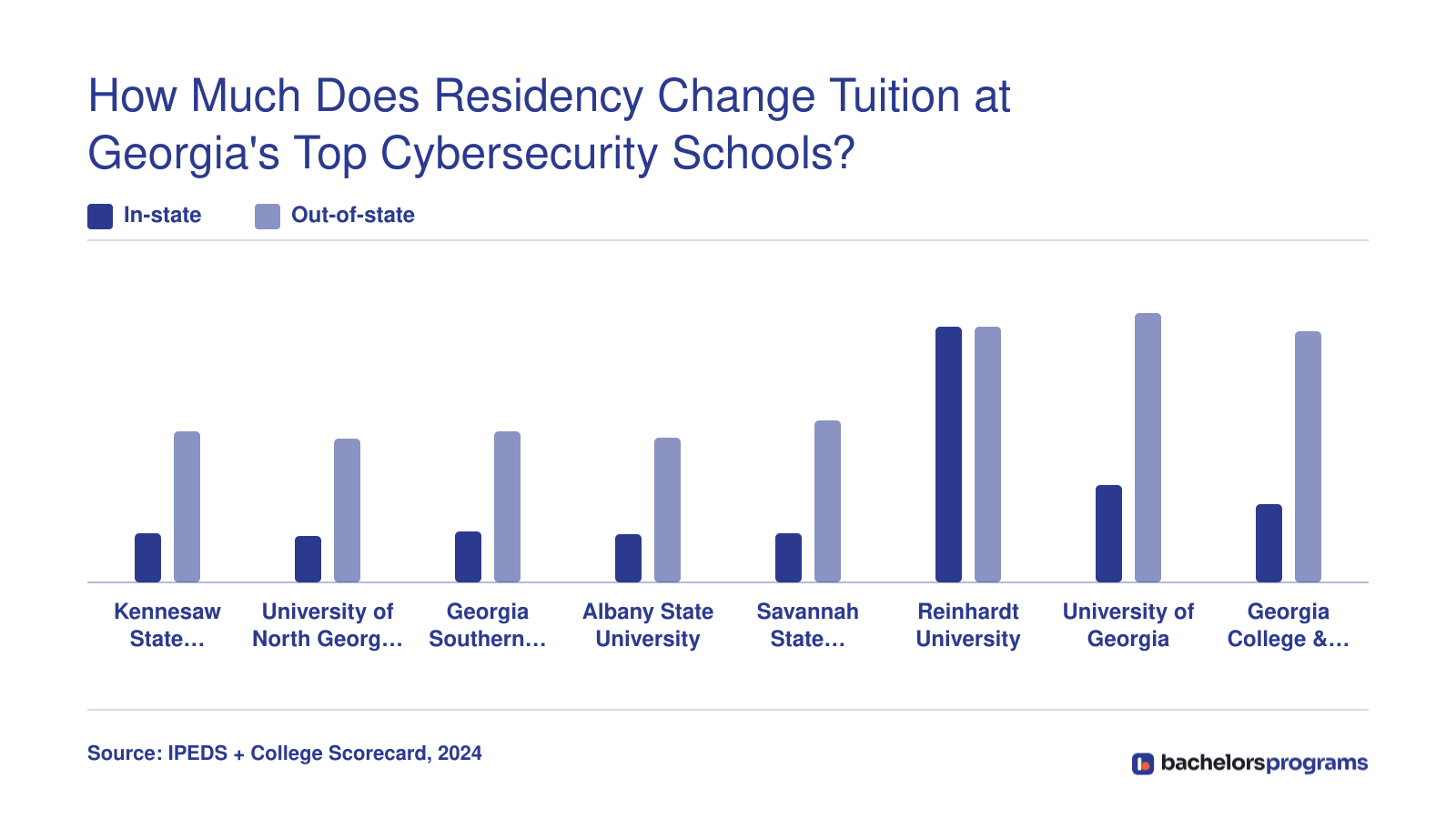
How Much Does Residency Change Tuition at Georgia's Top Cybersecurity Schools?
Residency can decide what a bachelor's degree in cybersecurity costs in Georgia. At public schools such as Kennesaw State, Savannah State and Georgia College & State University, out-of-state students pay roughly three times the in-state rate for annual tuition and fees. Reinhardt University, a private school, charges $30,074 regardless of where you live, so it has no residency gap.
Questions to Ask Yourself
Can you attend classes on a campus, or does your life require a fully online format?
Do you plan to apply for CyberCorps funding or aim for a federal career?
Are you starting at a Georgia technical college, and will your credits transfer?
How much will in-state pricing and HOPE eligibility change your shortlist?
Related Articles
Compare Cybersecurity programs on the data that matters
Explore more Computers & IT majors or browse every field of study.
All Computers & IT programs Browse every field of study