Best Speech Pathology Schools in Maryland
Compare 4 accredited Speech Pathology programs in Maryland, with net price after aid, graduation rates, earnings and debt from IPEDS and the U.S. College Scorecard.
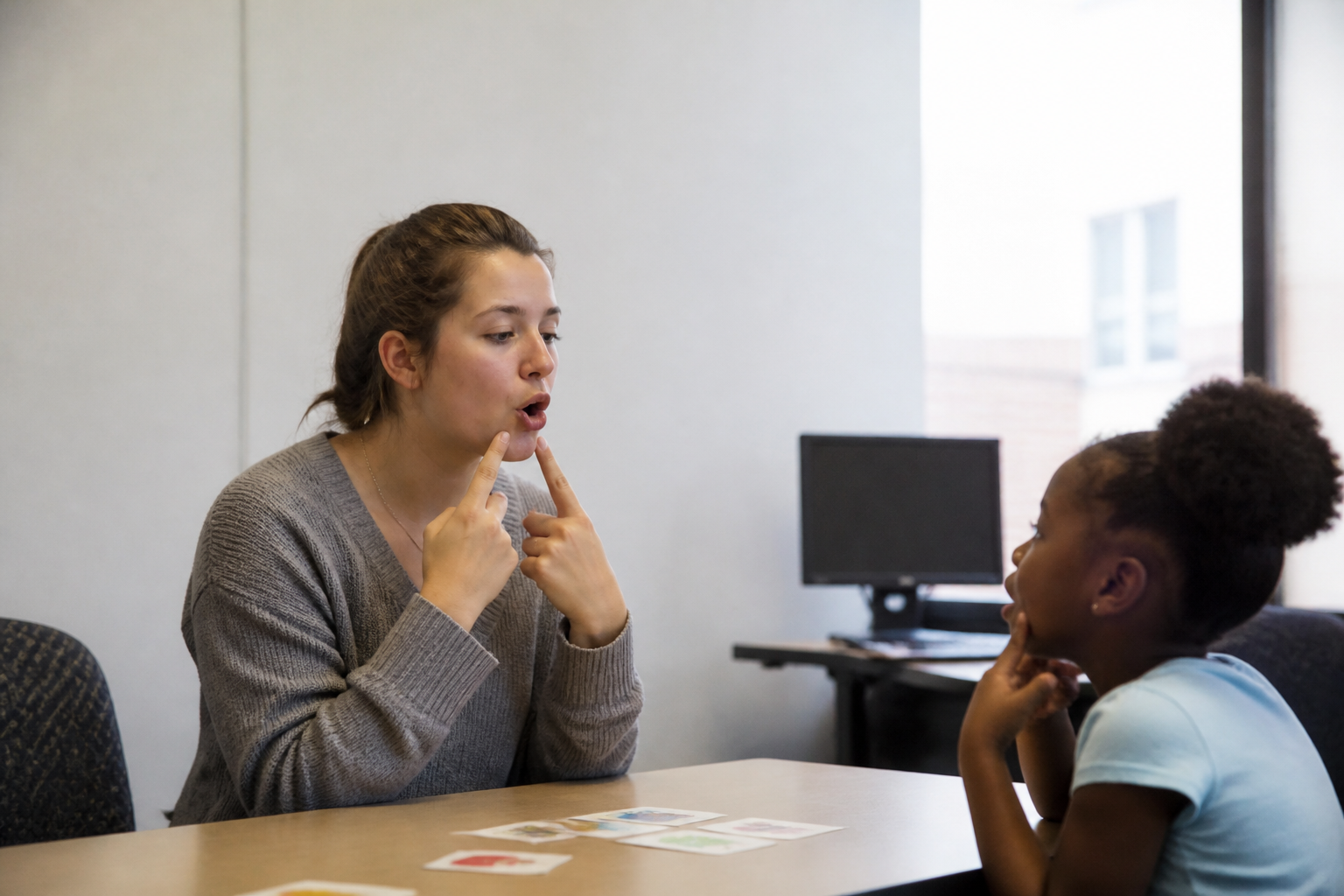
What does a bachelor's degree in speech pathology in Maryland actually qualify you to do? It is the first step toward helping people with speech, language and swallowing challenges, not the finish line. Practicing as a speech-language pathologist in the state requires a master's degree, so the undergraduate years are pre-professional.
The common credential is the Bachelor of Science (B.S.) in Speech Pathology, though schools label the major Speech Pathology, Speech-Language Pathology or Communication Sciences and Disorders (CSD). Some programs sit inside hearing sciences departments, which can blur comparisons.
Only a handful of undergraduate programs feed a graduate pipeline with limited seats, so the major you choose matters less than what comes after it.
Key Points
- Maryland speech-language pathologist licensure requires a master's degree, not a bachelor's.
- UMD calls its major Hearing and Speech Sciences; Loyola uses Speech-Language-Hearing Sciences.
- Every bachelor's program ranked here is taught on campus in Maryland.
Best Bachelor's Degree in Speech Pathology Schools in Maryland
Each card below names the major exactly as the college names it, then gives the school's net price after aid, its graduation rate, how selective it is and whether you would study on campus or online. All four of these Maryland programs are campus-based, and every one of them is a pre-professional bachelor's rather than a route to a license on its own.
Women's Institute of Torah Seminary and College
#1Baltimore, MD · $10,000 – $15,000/yr (est.)
Best for: Small faith-based liberal arts setting
A small private college in Baltimore, Women's Institute of Torah Seminary and College pairs a Bachelor of Arts in Communication Sciences & Disorders with a required Jewish studies core. The major carries a concentration in speech-language pathology and audiology and runs 120 credits, 36 of them in the major, with coursework in anatomy and physiology, audiology and language development plus supervised clinical observation. It is a campus-based program with a 94 percent graduation rate and near-open admission at a 98 percent admit rate. Net price after aid comes to about $11,700, the lowest of the four schools here.
- Concentration in speech-language pathology and audiology
- 120 total credits, including 36 credits in the major
- Coursework in anatomy and physiology, audiology and language development
- Includes supervised clinical observation opportunities
- Combines communication sciences with Jewish studies coursework
- Statistics and biology required alongside the communication disorders courses
- Curriculum includes courses required for ASHA certification
- Prepares graduates to apply to speech-language pathology master's programs
University of Maryland-College Park
#2College Park, MD · $16,000/yr (est. net price)
Best for: Research-minded pre-professional students
The largest public research university in the state, Maryland offers a pre-professional Hearing and Speech Sciences major built to feed graduate study rather than to license graduates to practice. Students complete 20 supervised observation hours before the HESP 418 practicum, with HESP 417 strongly recommended for anyone applying to graduate school, and undergraduates can join faculty research labs or the HESP Honors Program. The school's graduation rate is 89 percent against a 45 percent admit rate, and net price after aid is about $15,700 for this campus-based program.
- Pre-professional major that does not lead to SLP or audiology licensure
- 20 supervised observation hours required before the HESP 418 practicum
- HESP 417 strongly recommended for students headed to graduate school
- Covers communication processes and disorders across the lifespan
- Foundation in basic sciences, anatomy and physiology, math and statistics
- Undergraduates can join HESP faculty research labs and the HESP Honors Program
- Recent graduates work as speech-language pathology assistants and ABA therapists
- Built-in prerequisites for most HESP graduate programs
Towson University
#3Towson, MD · ~$17,000/yr (est.)
Best for: Students wanting early clinical practicum
Towson University, just north of Baltimore, runs a Bachelor of Science in Speech-Language Pathology and Audiology as a pre-professional, cohort-based degree. Roughly 70 students are admitted each year, more than 80 percent of classes are taught by full-time faculty, and the final year includes clinical practicum at the campus Speech & Language Center or Hearing & Balance Center. The school's graduation rate is 69 percent with an 82 percent admit rate, and net price after aid is about $17,400 for this campus-based program.
- Pre-professional program designed to prepare students for graduate study
- Cohort-based structure with roughly 70 students admitted each year
- More than 80 percent of classes taught by full-time faculty
- Final-year practicum at the campus Speech & Language Center or Hearing & Balance Center
- Covers foundational knowledge in both speech-language pathology and audiology
- Double major possible within four years
- Screened major that admits top applicants
Loyola University Maryland
#4Baltimore, MD · ~$31,000/yr (est.)
Loyola University Maryland is a private Jesuit university in Baltimore whose Bachelor of Arts in Speech-Language-Hearing Sciences starts major coursework in the first year. Students observe at the on-campus Loyola Clinical Centers, complete service-learning, and finish with senior field placements in schools, rehabilitation centers and hospitals. The school's graduation rate is 79 percent and it admits about 75 percent of applicants. Net price after aid runs about $30,600 for this campus-based program.
- Coursework in the major begins in the first year
- Clinical observations at the on-campus Loyola Clinical Centers
- Senior-year field placements in schools, rehabilitation centers and hospitals
- Service-learning built into courses
- Covers typical and atypical development and disorders across the lifespan
- Jesuit, family-centered approach to working with clients
- Prepares students to apply to graduate programs in speech-language pathology or audiology
Cost & outcomes by school
Federal data for the highest-earning Speech Pathology programs, independent of the ranking above. Earnings are this field's bachelor's graduates four years after completing where the Scorecard reports them, else the school's undergraduate median.
| School | Net price / yr | Grad rate | Earnings | Debt | Grads/yr | Format |
|---|---|---|---|---|---|---|
| Towson University MD | $17,413 | 70% | $72,365 | $21,180 | 36 | Campus |
| Loyola University Maryland MD | $30,574 | 79% | $72,055 | $27,000 | 31 | Campus |
| University of Maryland-College Park MD | $15,678 | 89% | $69,033 | $21,500 | 56 | Campus |
| Women's Institute of Torah Seminary and College MD | $11,673 | 100% | — | — | 3 | Campus |
Sources: U.S. Department of Education. Net price, graduation rate, earnings and debt: College Scorecard (earnings and debt for this field's bachelor's graduates where reported, else school-wide); graduates: IPEDS. A dash means no figure is reported.
Cost, debt & payoff
Median earnings of this field's bachelor's graduates (4 yrs after completing, else the school's undergraduate median) vs. their median federal loan debt · U.S. College Scorecard
Across these programs the median graduate earns about $72,055 and finishes with roughly $21,500 in debt — a ratio that clears a common rule of thumb (keep debt below first-year salary). Net price and debt vary widely school to school, so check the per-school figures in the table above before you shortlist.
Compare Maryland Speech Pathology Bachelor's Programs Side by Side
Read each row left to right: start with in-state tuition, net price after aid and admission rate to see what a program costs and how hard it is to get into, then move to graduation rate, completions, earnings one year after completion and median debt to judge outcomes. The public universities, University of Maryland-College Park and Towson University, charge in-state tuition near $11,800, while Loyola University Maryland lists $57,150. Aid narrows that gap to a net price of $30,574 at Loyola, compared with $15,678 at UMD and $17,413 at Towson. UMD graduates the most students in the field (73 completions) and posts the highest early earnings at $31,105, while Towson admits the largest share of applicants at 82 percent.
| School | Program name | In-state tuition and fees | Average net price | Admission rate | Graduation rate (institution-wide) | Bachelor's completions | Median earnings (one year after completion) | Median debt at completion |
|---|---|---|---|---|---|---|---|---|
| University of Maryland-College Park | Hearing and Speech Sciences (HESP) | $11,809 | $15,678 | 44.8% | 88.6% | 73 | $31,105 | $21,500 |
| Towson University | Speech-Language Pathology and Audiology | $11,728 | $17,413 | 82.0% | 69.5% | 66 | $23,463 | $21,180 |
| Loyola University Maryland | Speech-Language-Hearing Sciences | $57,150 | $30,574 | 75.5% | 79.2% | 60 | Not reported | $27,000 |
Online and Hybrid Bachelor's Options at Maryland Schools
What the Ranked Programs Offer
These bachelor's programs are taught on campus. Our records list Women's Institute of Torah Seminary and College, the University of Maryland-College Park (Hearing and Speech Sciences), Towson University (Speech-Language Pathology and Audiology) and Loyola University Maryland (Speech-Language-Hearing Sciences) as campus-based. We checked the schools' current program pages, and they describe in-person study. None of them offers a fully online or hybrid bachelor's degree. A page that never says "campus only" is not proof of an online option, so confirm format with admissions before you apply.
Two nearby offerings are easy to mistake for online degrees. UMD's HESPIE is online, runs about 15 months across 8 courses, and is a non-degree post-baccalaureate program for people who already hold a bachelor's. Towson's second bachelor's in the field is also campus-based: full time, two years, fall start only.
Why These Programs Stay on Campus
This major leans on hands-on learning. Students take anatomy and physiology, audiology and language disorders courses in person. Many programs build in clinical observation, and Towson and Loyola describe on-campus clinical centers. Loyola adds a senior-year field experience. Those components are hard to deliver remotely.
A Practical Workaround
If you need flexibility, split the degree. Prerequisites and general education, such as statistics, biology and English, can often be completed online at a community college or another accredited school before you transfer. Ask the admissions office at your target school which courses it accepts, because transfer policies vary. Then plan to finish the major's core and clinical coursework on campus.
Admissions: GPA, Test Policy and Transfer Credit
Many schools admit you to the university first and to the major second, so check both sets of rules. The University of Maryland-College Park publishes the most detail. For Towson University, Loyola University Maryland and Women's Institute of Torah Seminary and College, confirm each item on the school's own admissions page.
- GPA expectationsUMD Hearing and Speech Sciences requires at least a 2.0 overall GPA and a 2.0 across all major and supporting courses. No separate entry GPA for the major appears in the sources reviewed. Towson, Loyola and Women's Institute: no policy published in the sources reviewed.
- SAT/ACT test policyUMD is test-optional through the Spring and Fall 2027 admission cycles, and applicants choose whether to submit scores. Towson, Loyola and Women's Institute: no policy published in the sources reviewed.
- Transfer credit rulesUMD transfer applicants need at least 12 semester hours (18 quarter hours) earned after high school at a regionally accredited college. Those with fewer than 30 semester hours (45 quarter hours) should also send high school records. UMD reviews grades in all college-level courses. At each Maryland public community college, completing the courses in UMD's articulated programs with acceptable grades guarantees transfer with no loss of credit.
- Prerequisite coursesFor best transfer consideration at UMD, complete English Composition and a college-level math course equivalent to MATH107 or general-education fundamental math.
- Staying in the majorUMD's Hearing and Speech Sciences major requires 49 credits: 33 in the major and 16 in supporting courses. You must keep the 2.0 averages throughout.
- Application timingCheck each school's admissions calendar directly. No deadline policy was published in the sources reviewed for this page.
Related Articles
Cost of a Speech Pathology Bachelor's Degree in Maryland
Sticker Price vs. Net Price
Published tuition and what families actually pay are different numbers. Net price is an institution-level estimate of cost after grants and scholarships, covering all undergraduates at the school rather than speech pathology majors alone. It also includes housing and other costs, so the total can exceed tuition.
Public and Private Schools Compared
The two public universities here show a wide in-state and out-of-state gap:
- University of Maryland-College Park: $11,809 in-state tuition and fees, $41,186 out-of-state, and an average net price of $15,678.1
- Towson University: $11,728 in-state, $29,820 out-of-state, with a net price of $17,413.2
The private schools price differently. Loyola University Maryland lists $57,150, but its average net price falls to $30,574 after institutional aid. Women's Institute of Torah Seminary and College lists $9,780 for all students, with a net price of $11,673. Maryland residents at the public campuses get the biggest discount. Tuition increases for in-state undergraduates across the University System of Maryland were capped at 4.0% for FY 20263, so budget for modest yearly rises.
Maryland State Aid
The Maryland Office of Student Financial Assistance, part of the Maryland Higher Education Commission, runs the state programs.4 Most require Maryland residency, enrollment at an eligible Maryland institution, and an on-time application.
- Howard P. Rawlings Guaranteed Access: need-based aid for students from limited-income families who finish high school and enroll at an eligible Maryland school.4
- Rawlings Educational Assistance Grant: need-based aid for residents attending part- or full-time, renewed with satisfactory academic progress.
- Other options: the Part-Time Grant, Distinguished Scholar awards, and Delegate and Senatorial Scholarships. The legislative scholarships use a separate application through a legislator's office.
To apply for 2026-27, file the FAFSA at StudentAid.gov, then create an account in MDCAPS to track state aid.4 Students who cannot file the FAFSA can use the MHEC One-App (MSFAA). Award amounts, income limits and deadlines change yearly, so confirm them with MHEC before you apply.
Debt After Graduation
Program-level figures for bachelor's graduates show median debt of $21,500 at University of Maryland-College Park, $21,180 at Towson and $27,000 at Loyola. Those balances translate to estimated payments of about $228, $225 and $286 a month on a standard 10-year repayment plan. Women's Institute of Torah Seminary and College does not report a comparable figure. Remember that graduate study is required for licensure, so debt from the bachelor's may be followed by more borrowing later.
Careers in Maryland and Speech-Language Pathologist Licensure
Licensure as a speech-language pathologist in Maryland requires a master's degree.2 The bachelor's is the pre-professional step: it builds the foundation for graduate study and, for some graduates, leads to a licensed assistant role.
What the Maryland Board Requires
The Maryland Board of Examiners for Audiologists, Hearing Aid Dispensers and Speech-Language Pathologists issues the SLP license.1 Applicants need a master's degree from a program with the Board's required coursework and supervised training, good moral character, and a score of 600 on the Praxis Speech-Language Pathology exam.3 Before the clinical fellowship, candidates obtain a Limited License to practice under supervision. Unless the Board grants an exception, the fellowship must begin within two years of finishing academic and practicum requirements and be completed within 24 months, with at least nine months of full-time work at 30 hours a week.2 Applicants who passed the exam more than five years before applying face an added Board-approved condition, such as three of the prior five years in practice.3
How Long It Takes
- Years 1 to 4: bachelor's coursework in speech pathology or CSD, including observation and practicum hours.
- Years 5 and 6: the master's degree.
- After graduation: Limited License and the clinical fellowship, usually 9 to 12 months of supervised full-time work, capped at 24.
Plan on roughly seven years from freshman year to independent practice.
Entry-Level Roles for Bachelor's Holders
The clearest licensed route is the speech-language pathology assistant (SLPA). A bachelor's in speech-language pathology is one qualifying pathway. Under 2026 rules, bachelor's students complete 25 observation hours and 75 clinical-practice hours through their institution or a cooperating program4; Board application materials state that clinical hours are not required for graduates of approved SLPA programs.5 A Limited License is required before supervised practice, and full licensure calls for at least nine months of supervised practice, a supervisor's competency checklist, the Maryland law and regulations exam at 75 percent, and a $100 fee.5 Application materials also reference graduating within five years before applying.5 Beyond the SLPA title, bachelor's holders work in school and rehabilitation support positions.
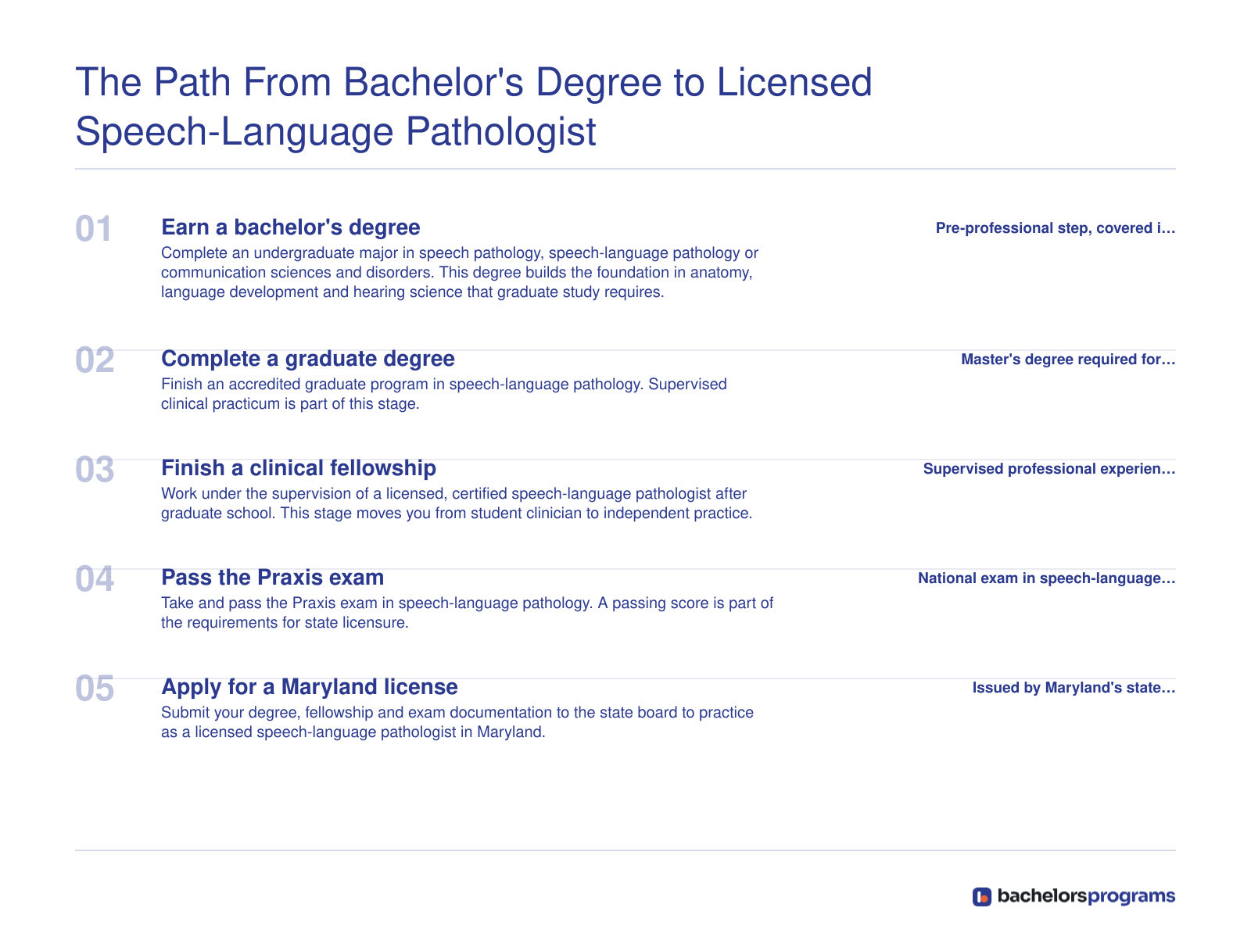
The Path From Bachelor's Degree to Licensed Speech-Language Pathologist
In Maryland, a bachelor's degree in speech pathology is the pre-professional first step. Licensure as a speech-language pathologist requires a master's degree. The steps below show the order of the full path, and this article covers only the first one.
What Speech-Language Pathologists Earn in Maryland
This is the wage for licensed speech-language pathologists in Maryland, not the earnings of new bachelor's graduates.
Common Questions About Speech Pathology Degrees in Maryland
These answers draw on Maryland Department of Health licensing requirements, ASHA career guidance, and the University of Maryland graduate catalog. Details vary by school and student, so confirm specifics with each admissions office.
How long does it take to become a speech-language pathologist in Maryland?
Are there online speech pathology programs at Maryland schools?
Can I transfer from a Maryland community college into a speech pathology bachelor's program?
Can I work in the field with only a bachelor's degree in speech pathology?
Compare Speech Pathology programs on the data that matters
Explore more Communications & Media majors or browse every field of study.
All Communications & Media programs Browse every field of study