Best Speech Pathology Schools in Massachusetts
Compare 12 accredited Speech Pathology programs in Massachusetts, with net price after aid, graduation rates, earnings and debt from IPEDS and the U.S. College Scorecard.
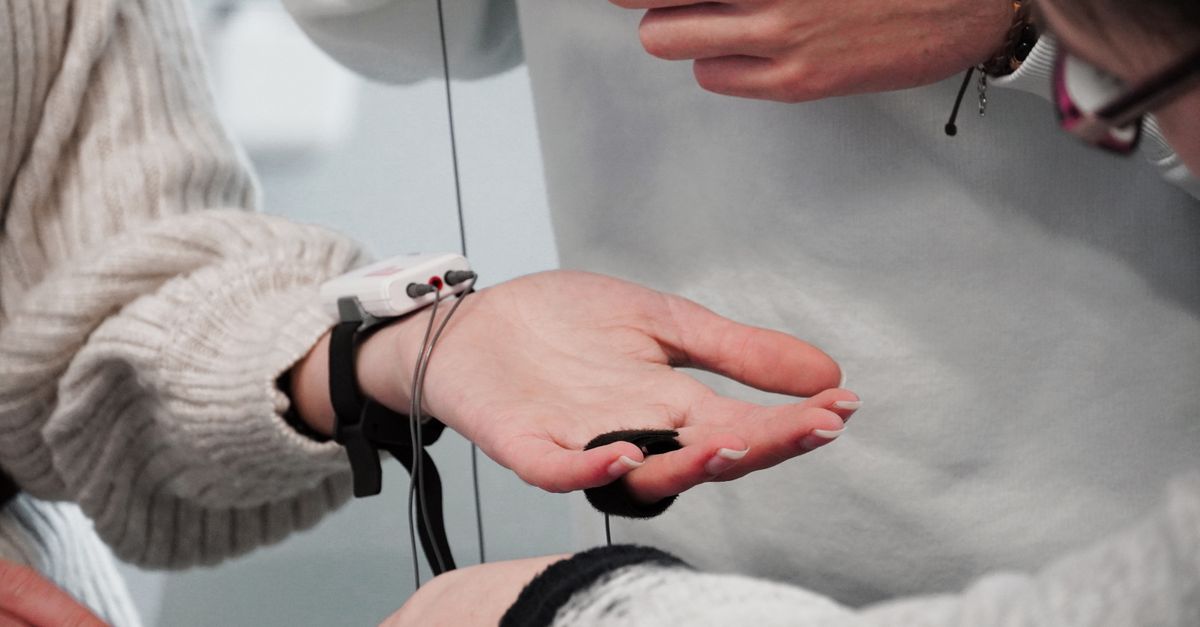
In Massachusetts, the study of communication disorders starts with a bachelor's degree in speech pathology, taken on campus or online at a Massachusetts-based school. The common credential is the Bachelor of Science (B.S.) in Speech Pathology, though schools label the major Speech Pathology, Speech-Language Pathology or Communication Sciences and Disorders (CSD).
One constraint shapes the decision. Massachusetts licenses speech-language pathologists only at the master's level, so the bachelor's is the pre-professional step: the phonetics, speech anatomy and audiology coursework graduate programs expect to see on a transcript.
Cost and selectivity separate these programs far more than the degree title does. Public and private net prices can sit tens of thousands of dollars apart for the same four years, and the ranked profiles below weigh that price against graduate outcomes.
Key Points
- Massachusetts SLP licensure requires a master's; the bachelor's is pre-professional.
- Worcester State and Bridgewater State carry the lowest net prices after aid.
- At UMass Amherst, out-of-state students pay about $22,700 more yearly.
Best Bachelor's Degree in Speech Pathology Programs in Massachusetts
These are the ten bachelor's programs in speech pathology, speech-language pathology and communication sciences and disorders offered by Massachusetts colleges and universities. Each card uses the school's own name for the major along with the details that matter most to undergraduates: credit loads, clinical observation and practicum hours, and what the degree actually prepares you to do. The schools offering these programs have institution-wide graduation rates of roughly 53% to 89%, and net prices after aid vary widely, so compare on total cost before you apply.
Boston University
#1Boston, MA · $20,000 – $25,000/yr (est.)
Best for: Students pairing speech science with linguistics
Boston University's bachelor's in Speech, Language and Hearing Sciences sits in a department that also trains master's and doctoral students in the same field, so undergraduates share faculty and resources with students further along the pipeline. Majors can add a joint major in Linguistics or an undergraduate minor, and the coursework is framed as pre-professional education in communication sciences and disorders. The department also runs an accredited MS-SLP program and a PhD, which gives students a clear view of the graduate path ahead.
- B.S. in Speech, Language and Hearing Sciences
- Joint major with Linguistics through Arts and Sciences
- Undergraduate minor in speech, language and hearing sciences
- Coursework framed as pre-professional communication sciences training
- Department also runs MS-SLP and PhD programs in the same field
- Combined MS-SLP/PhD pathway exists within the department
University of Massachusetts-Amherst
#2Amherst, MA · $20,000 – $25,000/yr (est.)
Best for: In-state students planning graduate school
UMass Amherst presents the major squarely as academic preparation for graduate school rather than an entry credential, and says so on the program page. The 56-credit sequence runs through speech and hearing anatomy, neuroscience, phonetics, language science, audiology and aural rehabilitation, with extra coursework in sound theory, child development and statistics. Students build a four-year plan with an advisor, and practicum or clinical observation electives add supervised contact with the field.
- 56-credit major, formerly called Communication Disorders
- Required courses in speech and hearing anatomy, phonetics, audiology
- Neuroscience for speech and language and hearing science in the core
- Practicum and clinical observation electives available
- Program states it does not qualify graduates for SLP or audiology jobs
- Advising on course sequence is required; four-year schedule suggested
- Extra requirements include theory of sound, child development, statistics
Stonehill College
#3Easton, MA · ~$33,000/yr (est.)
Best for: Small-campus learners who want close advising
Stonehill's Communication Sciences & Disorders major is a small, teaching-focused program at a liberal arts college south of Boston. Students complete internships with ASHA-certified practitioners in school and charter settings, and some pursue summer research through the college's undergraduate research program. Graduates have been accepted into SLP master's programs around the region, and the college holds preferred-admission arrangements with partner graduate programs for qualified seniors.
- B.S. in Communication Sciences & Disorders, plus an undergraduate minor
- Internships with ASHA-certified practitioners at school and charter sites
- Summer research available through the SURE program
- Small class sizes emphasized in program materials
- Preferred admission pathway to select SLP master's programs
- Graduates have been accepted into SLP master's programs in the region
Worcester State University
#4Worcester, MA · ~$13,000/yr (est.)
Worcester State pairs its bachelor's with a working on-campus clinic, so undergraduates observe live therapy sessions rather than only reading about them. A competitive 4+1.5 B.S./M.S. track lets strong students begin graduate coursework while still enrolled, and the department has been teaching the subject for more than 50 years. Classes are small, faculty mentoring is a stated priority, and graduates move into assistant and early-intervention roles or on to graduate study.
- B.S. in Speech-Language-Hearing Sciences, formerly Communication Sciences and Disorders
- On-campus center runs a speech-language clinic and a hearing clinic
- Undergraduates observe live therapy sessions at the clinics
- Competitive 4+1.5 B.S./M.S. track allows early graduate coursework
- Coursework includes phonetics, speech science, fluency and cognitive-communication disorders
- Entry roles include audiology assistant and speech-language pathology assistant
- Departmental honors available; small classes and faculty mentoring
Emerson College
#5Boston, MA · $45,000 – $50,000/yr (est.)
Emerson's Communication Disorders major is compact: 40 credits across 10 courses, which leaves room for Emerson's other requirements and a minor. Students can complete the 25 guided clinical observation hours that graduate programs expect and add a minor in Hearing and Deafness, with an ASL course introducing Deaf Culture. The coursework leans into culturally sustaining practice for multilingual and multicultural caseloads, and graduates often work as SLP or audiology assistants before or alongside graduate study.
- 40-credit major built from 10 courses
- Students can earn the 25 guided clinical observation hours graduate programs require
- ASL course introduces Deaf Culture; minor in Hearing and Deafness available
- Prepares students for the ASHA certification pathway through graduate study
- Entry roles cited: SLP assistant, audiologist assistant, rehabilitation aide
- Culturally sustaining frameworks for multilingual practice emphasized
- Some courses offered only in fall or spring
Gordon College
#6Wenham, MA · ~$25,000/yr (est.)
Gordon offers the major inside a Christian liberal arts framework, and the college describes itself as the only Christian college in New England to offer it. Students take anatomy, phonetics, language development and clinical methods, add 25 clinical hours, and complete internships in schools or clinics. Advising is personalized, an NSSLHA chapter is active on campus, and graduates go on to graduate study or to assistant-level roles.
- B.S. in Communication Sciences and Disorders with a faith-integrated curriculum
- College describes itself as the only Christian college in New England with the major
- 25 clinical hours plus internships in schools and clinics
- Coursework in anatomy, phonetics, language development and clinical methods
- NSSLHA student chapter on campus
- Personalized faculty advising emphasized
- Prepares graduates for SLP or audiology assistant roles as well as graduate study
Springfield College
#7Springfield, MA · ~$31,000/yr (est.)
Springfield College houses the major in its School of Health Sciences, which gives the degree a clinical, health-professions feel. The 120-credit program carries 63 credits in the major, a practicum of at least six credits, and requirements in clinical phonetics, audiology, speech and hearing science and aural rehabilitation. Students can aim at graduate school in speech-language pathology or audiology, or at Massachusetts licensure as a speech-language pathology assistant.
- 120-credit degree with 63 credits in the major
- Clinical practicum of at least 6 credits required
- 40-credit core curriculum alongside major requirements
- Supervised fieldwork, service learning and mentored research
- Prepares for graduate study or Massachusetts SLP assistant licensure
- Major courses include clinical phonetics, audiology, speech and hearing science
- Housed in the School of Health Sciences
College of Our Lady of the Elms
#8Chicopee, MA · ~$18,000/yr (est.)
Elms College offers a Bachelor of Arts in Speech-Language Pathology Assistant, a degree built directly around the assistant role rather than general pre-professional study, alongside a communication sciences and disorders option. Students work in a campus speech and hearing lab, can join the local NSSLHA chapter, and start learning how to support licensed therapists with treatment. The college reports that most of its graduates continue on to graduate study.
- B.A. in Speech-Language Pathology Assistant
- Degree options include BA-CSD and BA-SLPA tracks
- Campus student speech and hearing lab
- Local NSSLHA chapter students can join
- Program reports a 97% graduate school placement rate
- Graduates qualified to support speech therapists with treatment
Bridgewater State University
#9Bridgewater, MA · $16,000/yr (est. net price)
Bridgewater State's Communication Sciences and Disorders BS is a compact major: 30 required credits plus six elective credits inside a 120-credit degree. The department pairs a clinical strategies course with a practicum so students prepare before they work with clients, and electives reach into augmentative communication, autism and the neurological bases of speech and language. It is a public-university route aimed squarely at students planning an MS in speech-language pathology.
- 30 required credits plus 6 elective credits in the major
- 120 earned credit hours required for the degree
- Clinical strategies and clinical practicum must be taken together
- Electives include AAC, autism and the family, neurological bases, aural rehabilitation
- Sign Language I and II recommended as free electives
- Aural rehabilitation and neurological bases recommended for future MS students
Springfield College-Regional, Online, and Continuing Education
#10Springfield, MA
This Springfield College unit enrolls students in the same Communication Sciences and Disorders bachelor's, listed under the college's regional, online and continuing education arm. The 120-credit degree includes a 40-credit core curriculum, at least six credits of clinical practicum, and supervised fieldwork or mentored research. It suits students who want the Springfield curriculum through a different enrollment route, and prospective applicants should confirm how and where courses meet before applying.
- 120 credits including a 40-credit Core Curriculum
- Clinical practicum must total at least 6 credits
- Prepares for graduate study or Massachusetts SLP assistant licensure
- Supervised fieldwork, service learning and mentored research
- Housed in the School of Health Sciences
- Confirm meeting format and location with the college before applying
Cost & outcomes by school
Federal data for the highest-earning Speech Pathology programs, independent of the ranking above. Earnings are this field's bachelor's graduates four years after completing where the Scorecard reports them, else the school's undergraduate median.
| School | Net price / yr | Grad rate | Earnings | Debt | Grads/yr | Format |
|---|---|---|---|---|---|---|
| Northeastern University MA | $30,915 | 91% | $92,538 | $24,250 | 22 | Campus |
| Northeastern University MA | — | — | $92,538 | $24,250 | — | Campus |
| Boston University MA | $24,402 | 89% | $83,238 | $23,250 | 10 | Campus |
| Stonehill College MA | $33,016 | 76% | $77,745 | $25,000 | 1 | Campus |
| University of Massachusetts-Amherst MA | $22,383 | 83% | $63,620 | $22,375 | 78 | Campus |
| Emerson College MA | $49,180 | 77% | $61,496 | $26,000 | 20 | Campus |
| Worcester State University MA | $13,381 | 62% | $58,126 | $20,564 | 9 | Campus |
| Gordon College MA | $24,883 | 69% | $52,119 | $26,250 | 4 | Campus |
| Bridgewater State University MA | $16,383 | 53% | $50,059 | $24,009 | 48 | Campus |
| Springfield College MA | $30,587 | 74% | $48,036 | $26,250 | 10 | Campus |
| Springfield College-Regional, Online, and Continuing Education MA | — | — | $48,036 | $26,250 | 4 | Campus |
| College of Our Lady of the Elms MA | $17,545 | 68% | $41,831 | $27,000 | 28 | Campus |
Sources: U.S. Department of Education. Net price, graduation rate, earnings and debt: College Scorecard (earnings and debt for this field's bachelor's graduates where reported, else school-wide); graduates: IPEDS. A dash means no figure is reported.
Cost, debt & payoff
Median earnings of this field's bachelor's graduates (4 yrs after completing, else the school's undergraduate median) vs. their median federal loan debt · U.S. College Scorecard
Across these programs the median graduate earns about $59,811 and finishes with roughly $24,625 in debt — a ratio that clears a common rule of thumb (keep debt below first-year salary). Net price and debt vary widely school to school, so check the per-school figures in the table above before you shortlist.
Most Affordable Bachelor's Degree in Speech Pathology Programs in Massachusetts
These are the lowest-cost options among the schools ranked here, ordered by average net price after grants and scholarships, based on U.S. Department of Education data from IPEDS and the College Scorecard (2024). Worcester State University and Bridgewater State University offer the lowest net prices. Private schools such as Boston University and Elms College list much higher sticker tuition, but aid narrows the gap considerably.
| Rank | School | City | Program | Average Net Price After Aid | Tuition and Fees (In-State) | Format |
|---|---|---|---|---|---|---|
| 1 | Worcester State University | Worcester | Speech-Language-Hearing Sciences | $13,381 | $11,786 | Campus |
| 2 | Bridgewater State University | Bridgewater | Communication Sciences and Disorders | $16,383 | $11,808 | Campus |
| 3 | College of Our Lady of the Elms | Chicopee | Speech-Language Pathology Assistant | $17,545 | $43,325 | Campus |
| 4 | University of Massachusetts-Amherst | Amherst | Speech, Language, and Hearing Sciences | $22,383 | $17,772 | Campus |
| 5 | Boston University | Boston | Bachelor of Science in Speech, Language & Hearing Sciences | $24,402 | $68,102 | Campus |
Compare Massachusetts Speech Pathology Bachelor's Programs Side by Side
This table lines up the schools ranked here on selectivity, student outcomes, class size and published in-state tuition, using 2024 federal data from IPEDS and the College Scorecard. Boston University pairs the lowest acceptance rate with the highest graduation and retention rates, while Bridgewater State and Worcester State post the lowest in-state tuition. Each program appears under the school's own major name, so Communication Sciences and Disorders, Speech-Language-Hearing Sciences and similar titles all lead to the same pre-professional bachelor's step.
| School | Location | Major Name | Type | Acceptance Rate | Graduation Rate | First-Year Retention | Student-to-Faculty Ratio | Annual In-State Tuition |
|---|---|---|---|---|---|---|---|---|
| Boston University | Boston | Speech, Language & Hearing Sciences (B.S.) | Private | 11% | 89% | 95% | 10:1 | $68,102 |
| University of Massachusetts-Amherst | Amherst | Speech, Language, and Hearing Sciences | Public | 60% | 83% | 92% | 17:1 | $17,772 |
| Stonehill College | Easton | Communication Sciences & Disorders | Private | 66% | 76% | 84% | 12:1 | $56,370 |
| Worcester State University | Worcester | Speech-Language-Hearing Sciences | Public | 88% | 61% | 78% | 16:1 | $11,786 |
| Emerson College | Boston | Communication Disorders | Private | 51% | 77% | 87% | 14:1 | $57,056 |
| Gordon College | Wenham | Communication Sciences and Disorders | Private | 69% | 69% | 84% | 10:1 | $30,700 |
| Springfield College | Springfield | Communication Sciences and Disorders | Private | 72% | 74% | 81% | 11:1 | $44,974 |
| College of Our Lady of the Elms | Chicopee | Speech-Language Pathology Assistant | Private | 85% | 68% | 76% | 11:1 | $43,325 |
| Bridgewater State University | Bridgewater | Communication Sciences and Disorders | Public | 88% | 53% | 75% | 17:1 | $11,734 |
| Springfield College-Regional, Online, and Continuing Education | Springfield | Communication Sciences and Disorders | Private | N/A | N/A | N/A | 9:1 | $19,887 |
Five Massachusetts Programs With the Highest Graduate Earnings
These figures are program-level median earnings for bachelor's graduates in speech pathology and related majors, drawn from the U.S. Department of Education's College Scorecard. Boston University graduates lead this group. Worcester State University pairs the second-highest median with the lowest in-state tuition shown. Emerson College's figure is measured four years after graduation, while the others are measured five years out, so compare them with that difference in mind.
| School | Program | Median Earnings | Measured | Median Graduate Debt (All Majors) | In-State Tuition and Fees |
|---|---|---|---|---|---|
| Boston University (Boston) | Bachelor of Science in Speech, Language & Hearing Sciences | $71,937 | 5 years after graduation | $23,250 | $68,102 |
| Worcester State University (Worcester) | Speech-Language-Hearing Sciences | $61,578 | 5 years after graduation | $19,500 | $11,786 |
| Emerson College (Boston) | Communication Disorders | $61,496 | 4 years after graduation | $23,000 | $57,056 |
| University of Massachusetts-Amherst (Amherst) | Speech, Language, and Hearing Sciences | $59,695 | 5 years after graduation | $22,763 | $17,772 |
| College of Our Lady of the Elms (Chicopee) | Speech-Language Pathology Assistant | $54,871 | 5 years after graduation | $25,000 | $43,325 |
Related Articles
Online and Hybrid Bachelor's Options at Massachusetts Schools
No bachelor's degree in speech pathology in Massachusetts runs entirely online. Every bachelor's program at these schools is listed as campus-based, and the fully online undergraduate route here is a certificate, not a degree.1
Where the online coursework is
Springfield College offers its Speech-Language Pathology Undergraduate Certificate entirely online and asynchronously: 18 credits across six 3-credit courses, with assignment deadlines but no required regular meeting time. Optional synchronous sessions may be offered. At two courses per semester, most students finish in about one calendar year, and new starts open each September and January. Admission requires only a high school diploma, with no prerequisites and no application fee. Students enrolled elsewhere can take it, and some add electives to collect the observation hours Massachusetts requires for speech-language pathology assistant licensure.
Hybrid and in-person components
Gordon College describes its Communication Sciences and Disorders major as a hybrid format, so ask which classes meet on campus and which run remotely. Springfield College's Communication Sciences and Disorders B.S. is a traditional undergraduate program with a 45-credit residency requirement, including 15 of the last 30 credits, plus a clinical practicum, which limits how much of the degree can be assembled online or through transfer credit. Observation and fieldwork hours are earned in clinics and schools, in person.
Verify the format before you apply
Delivery changes between catalog years, and a program that reads as remote on a website may still require campus visits. Email the program and ask four things: which courses meet in person, whether asynchronous sections have fixed exam windows, how clinical placements are arranged near your home, and whether certificate credits roll into the bachelor's degree.
Admissions for Massachusetts Speech Pathology Bachelor's Programs
Getting into a speech pathology bachelor's program in Massachusetts depends less on one statewide bar than on matching your record to each school's selectivity. Boston University's admit rate is the lowest published here, roughly 11%; Worcester State and Bridgewater State post the highest, about 88% each. UMass Amherst sits near 60%, with Stonehill, Emerson, Gordon, Springfield and Elms between those ends. A record that is competitive at one campus can be a reach at another.
GPA and Testing
UMass Amherst publishes the clearest transfer guidance: applicants are typically expected to have a 2.7 college GPA or higher, though review is holistic and some majors set higher or additional requirements. It publishes no freshman minimum or typical admitted GPA for Speech, Language, and Hearing Sciences, and the program page does not state a current SAT/ACT policy. The other schools, Boston University, Stonehill, Worcester State, Emerson, Gordon, Springfield College, Elms, Bridgewater State and Springfield College-Regional, Online, and Continuing Education, publish no major-specific GPA or testing rule in the materials reviewed here. Their general undergraduate admissions policies govern. Confirm test-optional status on each admissions site rather than assuming it carries across the major. UMass lists no prerequisite courses for the major.
Transfer Credit and MassTransfer
Massachusetts public colleges share a transfer framework. Applicants with 12 to 23 transferable credits generally need a 2.5 college GPA; those with 24 or more generally need a 2.0.1 Students with up to 23 credits may instead qualify with a 2.0 plus a qualifying high school transcript. MassTransfer's 34-credit General Education Foundation requires a 2.0 and a C or better in each course.2 Only college-level work transfers, and grades themselves do not. UMass's 2.7 expectation is higher, and the university does not confirm that the statewide thresholds apply unchanged to this major. Transfer credit review for the private colleges and for the online division is not described on the program pages reviewed, so ask each admissions office for a written evaluation before you deposit.
A Practical Transfer Tip
If you start at a community college, build your schedule around the MassTransfer foundation early and keep every grade at a C or better. That protects both the 2.0 threshold and the 34-credit block. Treat 2.7 as the safer target for UMass rather than the statewide 2.0 minimum. Then compare the net cost of finishing at a four-year campus with the cost of your first two years; the cost section below explains how in-state tuition and net price after aid change that math.
How Much Does Residency Change Tuition at Massachusetts Speech Pathology Schools?
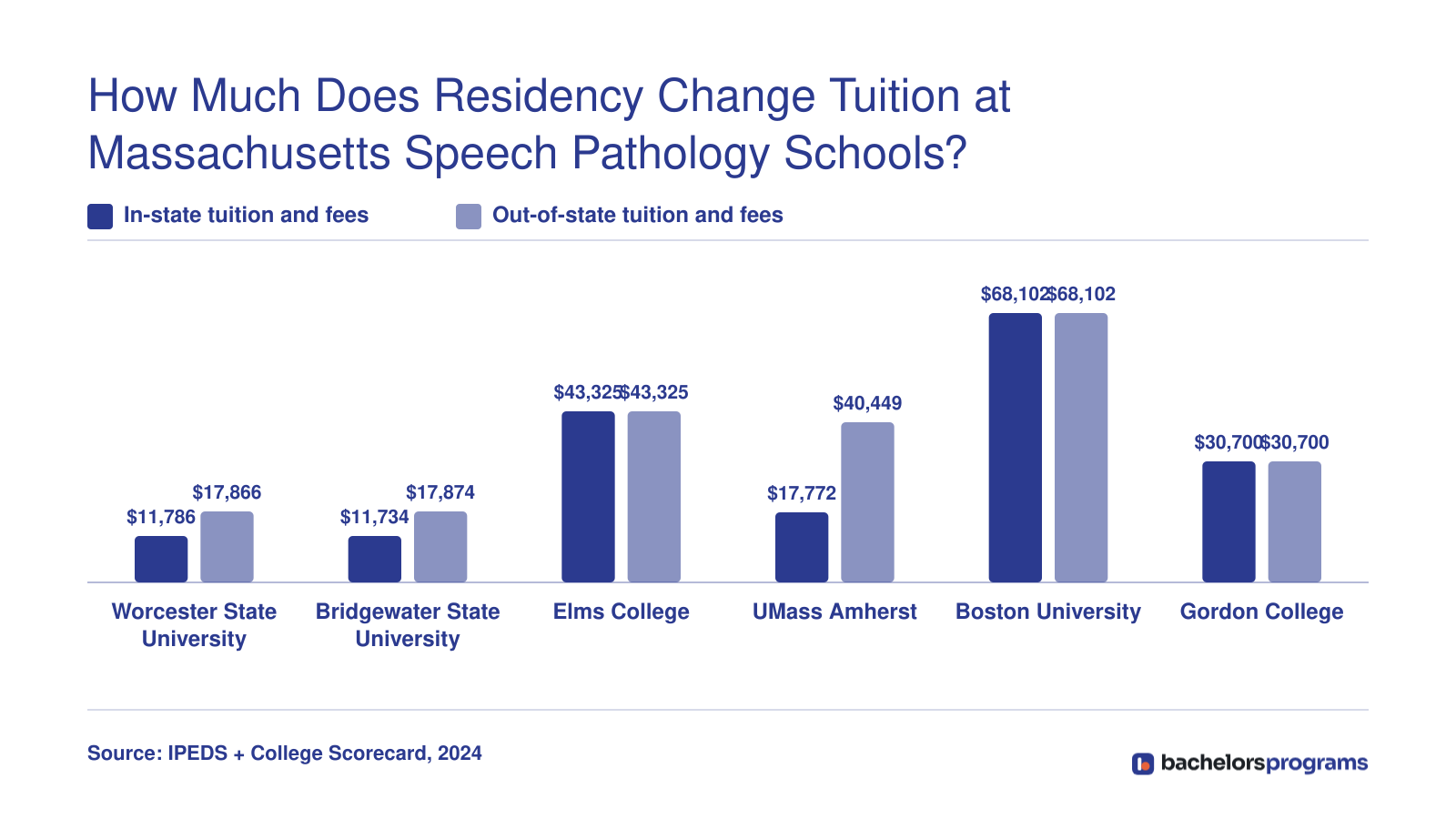
Residency matters most at the public universities. Out-of-state students pay roughly $6,100 more per year in tuition and fees at Worcester State and Bridgewater State, and about $22,700 more at UMass Amherst. Private schools such as Boston University, Gordon College and Elms College charge every undergraduate the same published rate, so out-of-state applicants pay no residency premium there. Their sticker prices start higher, though, so compare net price after aid before ruling a school in or out.
Cost of a Speech Pathology Bachelor's Degree in Massachusetts
In Massachusetts, sticker price and what families actually pay after aid can diverge sharply, and that gap matters more than public versus private.
Sticker Price vs. Net Price
Public schools post the lowest in-state tuition and fees: about $11,786 at Worcester State University, $11,808 at Bridgewater State University and $17,772 at UMass Amherst. Average net price after aid at those three runs roughly $13,381, $16,383 and $22,383. Private schools list far higher prices, but aid narrows the gap considerably. College of Our Lady of the Elms lists $43,325 yet averages about $17,545 after aid, and Boston University drops from $68,102 to roughly $24,402. Emerson College ($49,180) and Stonehill College ($33,016) stay among the highest net prices here. Treat net price as an approximate average, since your own aid package may differ.
Debt and Monthly Payments
For speech pathology graduates, median debt ranges from about $20,564 at Worcester State to $27,000 at Elms, with estimated 10-year monthly payments of $218 to $286. At Worcester State, that $218 payment sits against median first-year program earnings of $34,142, a manageable ratio for an entry-level start.
Massachusetts Aid Programs
- MASSGrant: State-funded need-based aid for eligible students at community colleges, state universities and UMass campuses.1 Award amounts and income rules vary, so confirm current terms.
- Commonwealth Commitment: Start at a Massachusetts community college, submit the participation form before earning 15 credits, enroll full time (12 credits), keep a 3.00 GPA, and finish your associate degree within five semesters.2 You then transfer within one year and complete the bachelor's within two years. Benefits include a tuition freeze, a 10% rebate, a waived application fee and eligibility for the MassTransfer Tuition Credit.3 Admission to the speech pathology major itself still depends on space.
- MassTransfer: Credit pathways and tuition benefits for community college students moving to a state university or UMass campus.
All three require Massachusetts residency. Apply by filing the FAFSA, then check deadlines with the state's financial aid office.
Ways to Cut the Bill
- Transfer in: Complete general education at a community college, then move to Worcester State, Bridgewater State or UMass Amherst through MassTransfer.
- Compare net price, not tuition: A private school's aid offer can undercut its sticker price by tens of thousands.
- Ask about program scholarships: Worcester State and Gordon College both note scholarships for this major.
Massachusetts Licensure Path: Where the Bachelor's in Speech Pathology Fits
The Massachusetts Board of Registration of Speech-Language Pathologists and Audiologists licenses both speech-language pathologists (SLPs) and speech-language pathology assistants (SLPAs). Here is where a bachelor's degree fits on each path.
- Earn the bachelor's degree (pre-professional step)A major in speech pathology, speech-language pathology or communication sciences and disorders builds the foundation for both licenses. It can also qualify you for SLPA licensure on its own.
- Meet an SLPA education pathwayThe Board accepts a bachelor's major in speech-language pathology or audiology, or a bachelor's plus a Board-approved assistant certificate. It also accepts any associate, bachelor's or advanced degree plus 18 semester credit hours in the field, including 6 in speech, language or hearing disorders.
- Complete 20 observation hoursSLPA applicants submit transcripts and proof of 20 hours of observation by a licensed SLP or audiologist.
- Work under SLP supervisionLicensed SLPAs must stay in good standing and practice under a licensed SLP's supervision, as set out in 260 CMR 10.00.
- Full SLP licensure comes laterLicensure as a speech-language pathologist in Massachusetts requires a master's degree. Under 260 CMR 2.00, applicants also meet clinical, supervised-practice and exam requirements and show good moral character.
- Fees and renewalBoth licenses carry a $68 application fee and renew every two years for $68. SLPs licensed in another state may apply through reciprocity.
- Source noteThese requirements come from the Massachusetts Board of Registration of Speech-Language Pathologists and Audiologists. Confirm current rules on Mass.gov before applying.
Careers and Pay for Speech Pathology Graduates in Massachusetts
Licensed speech-language pathologists and bachelor's-level graduates work in the same field, but they sit at very different points on the pay scale. In Massachusetts, the license requires a master's degree, so a bachelor's degree in speech pathology prepares you for support roles now and graduate study later. Knowing both sets of numbers keeps your expectations realistic.
Roles Open to Bachelor's Graduates
Several Massachusetts programs point graduates toward specific entry-level work:
- Speech-language pathology assistant (SLPA): College of Our Lady of the Elms offers a dedicated SLPA bachelor's track. Worcester State University and Emerson College both list assistant roles among graduate careers. Review the licensure checklist above for the steps Massachusetts sets for assistants.
- Early intervention and school support: Worcester State names early intervention as a career path. School districts and early intervention programs also employ support staff who work alongside speech clinicians.
- Audiology assistant: Worcester State and Emerson both list this role.
- Related human services: Disability support, case management and rehabilitation aide work all draw on coursework in communication and human development.
What Licensed SLPs Earn in Massachusetts
According to the Bureau of Labor Statistics, Massachusetts employed about 5,000 speech-language pathologists as of May 2024, the most recent state estimate.1 The median annual wage was $101,790, and the top 10 percent earned $128,610 or more.1 These figures describe the licensed occupation, not bachelor's-level jobs. BLS does not publish a separate state series for SLPAs, so ask employers directly about assistant pay.
What Bachelor's Completers Earn
College Scorecard reports median earnings for graduates of each school's speech pathology bachelor's program, a separate measure from occupation wages. These completers may include people in support roles as well as those who moved on to graduate study.
- Worcester State University: $34,142 one year after completion and $58,126 four years after.
- University of Massachusetts-Amherst: $30,693 one year after completion and $63,620 four years after.
- College of Our Lady of the Elms: $31,890 one year after completion and $41,831 four years after.
- Emerson College: $61,496 four years after completion.
- Boston University: $71,937 five years after completion.
Plan for first-year earnings in the low $30,000s. The larger gains in this field typically follow graduate school and licensure, which is why most programs here frame the bachelor's as a pre-professional step.
How We Ranked Massachusetts Speech Pathology Schools
Every school listed here met the same bar: federal data first, school sources second, and no program included unless we could confirm a bachelor's degree exists at that institution.
What Goes Into the Ranking
We start with the U.S. Department of Education's College Scorecard, using the most recent release available at the time of writing in 2026. From it we pull cost figures (published tuition and average net price after grant aid), student outcomes (graduation rate and reported earnings for graduates), and completions data showing which institutions award degrees in communication sciences and disorders and related fields. We then verify program-level availability directly on each school's own pages, confirming the degree is offered at the bachelor's level and noting whether it runs on campus, online, or in a hybrid format.
Where the Data Has Limits
Be skeptical of any ranking that pretends federal data is precise at the program level. Graduation rate and net price are institution-wide averages covering all undergraduates, not just students in speech pathology or communication disorders. Earnings figures, where published, reflect a broad field category rather than a single major, and for some programs they are not reported at all. We cross-check tuition, admissions requirements, and program format against each school's published materials and leave a figure out rather than estimate it.
Who Is Eligible
Only undergraduate programs at Massachusetts institutions are considered, whether delivered on campus in Boston, Worcester, Amherst, or elsewhere in the state, or online from a Massachusetts-based school. Graduate programs are out of scope for the ranking.
Compare Speech Pathology programs on the data that matters
Explore more Communications & Media majors or browse every field of study.
All Communications & Media programs Browse every field of study