Best Speech Pathology Schools in Tennessee
Compare 6 accredited Speech Pathology programs in Tennessee, with net price after aid, graduation rates, earnings and debt from IPEDS and the U.S. College Scorecard.
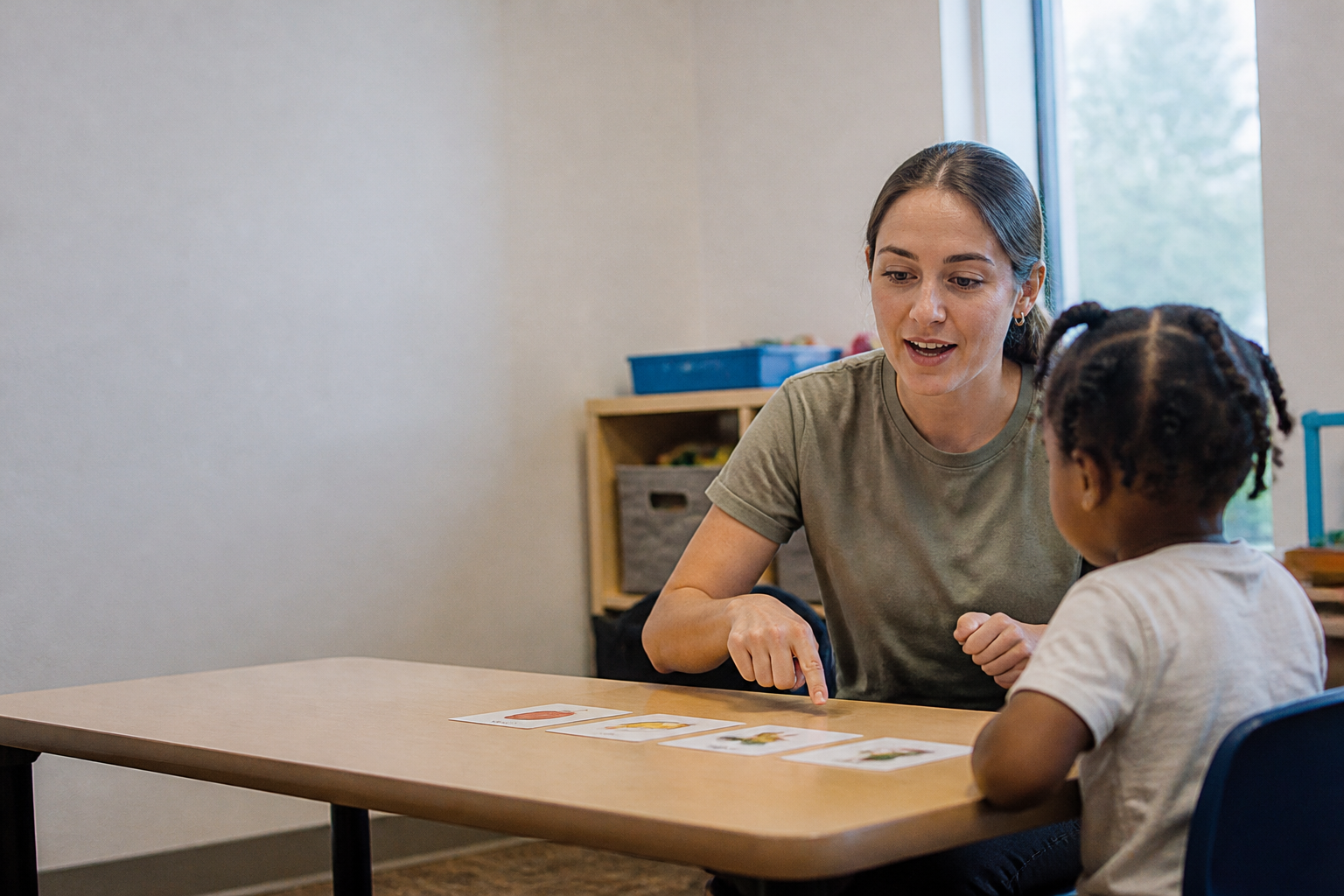
A bachelor's degree in speech pathology in Tennessee is a four-year foundation in phonetics, speech anatomy and audiology that stops short of the license: state licensure as a speech-language pathologist requires a master's degree. The common credential is the Bachelor of Science (B.S.) in Speech Pathology, though campuses label the major Speech-Language Pathology or Communication Sciences and Disorders.
The tradeoff is clinical access against price. Campus clinics let undergraduates observe early; net price after aid at public options runs below private ones.
Demand rises with school caseloads and an aging population, but the bachelor's alone leads mainly to support roles such as SLP assistant. Graduate admission is a separate gate.
Key Points
- South College offers its communication sciences and disorders bachelor's 100% online.
- Yearly net price runs about $13,400 at MTSU to $24,700 at Lipscomb.
- Practicing as a Tennessee speech-language pathologist requires a master's degree and license.
Best Bachelor's in Speech Pathology Schools in Tennessee
The six institutions below all offer an undergraduate route into speech-language pathology or audiology. Two entries describe the same joint degree from its two partnering campuses, so students comparing them can see each side's admission rules and tuition arrangements. Campus programs come first, with the state's fully online option last for readers who need flexibility. Institution-wide, the schools offering this program report graduation rates between about 42% and 74%.
The University of Tennessee-Knoxville
#1Knoxville, TN · ~$19,000/yr (est.)
Best for: Future audiologists wanting a joint health-sciences track
A public flagship whose undergraduate route into the field is a joint Bachelor of Science in Audiology and Speech Pathology, awarded with the University of Tennessee Health Science Center. Students complete three years of general education and major prerequisites, then a final year of speech pathology coursework delivered by health science center faculty on the Knoxville campus.
- Joint 3+1 program with the University of Tennessee Health Science Center
- Three years at UT Knoxville, final year of major coursework through UTHSC
- Admission requires a 3.0 GPA and a B or better in AUSP 300
- Includes a clinical observation course
- 120 to 122 credit hours total
- Prepares students for graduate study in speech-language pathology or audiology
Freed-Hardeman University
#2Henderson, TN · $22,000/yr (est. net price)
Best for: Hands-on learners seeking an on-campus clinic
A private university where undergraduates train inside the program's own speech and hearing clinic rather than waiting until graduate school for client contact. Students deliver evaluation and treatment for articulation, language, fluency, voice and autism-related communication needs, supervised by faculty who hold ASHA certification and Tennessee state licenses. The clinic includes a sound-attenuated audiology suite for hearing screenings, and faculty also train students in LSVT Loud, a voice treatment approach used with Parkinson disease.
- Undergraduates deliver services in the program's on-campus clinic
- Faculty are ASHA certified and hold Tennessee state licenses
- Training in LSVT Loud for speech and voice disorders in Parkinson disease
- Sound-attenuated audiology suite for hearing screenings
- Clinic runs September through November and February through April
- No charge for clinical services and no physician referral needed
Middle Tennessee State University
#3Murfreesboro, TN · ~$13,000/yr (est.)
Best for: Aspiring speech-language pathology assistants
A public university offering a Bachelor of Science in Speech-Language Pathology and Audiology with an on-campus clinic where undergraduates log 100 supervised clinical hours. What sets it apart is a speech-language pathology assistant pathway: a 100-hour practicum that lets graduates enter the workforce directly as SLP assistants instead of moving straight into graduate school. Students also run an active NSSLHA chapter, and Georgia residents can qualify for in-state tuition rates.
- 100 supervised clinical hours in the on-campus clinic
- Speech-language pathology assistant path with a 100-hour practicum
- Prepares graduates for SLP assistant work or graduate study
- Award-winning NSSLHA chapter and Student Ambassador Program
- In-state tuition rates for Georgia residents
- Coursework in assessment and intervention for children and adults
The University of Tennessee Health Science Center
#4Memphis, TN
A public health science center that co-awards the joint Bachelor of Science in Audiology and Speech Pathology with the University of Tennessee, Knoxville. Students spend their first 90 credit hours building general education and major prerequisites, then take 15 credits each semester of the senior year through the health science center, with all courses taught on the Knoxville campus. Admission requires a 3.0 GPA and a B or better in the introductory course, and tuition is the same at both campuses.
- Joint B.S. awarded with the University of Tennessee, Knoxville
- 90 credit hours completed before full admission to the program
- 3.0 GPA minimum and a B or better in ASP 300
- 15 credits each semester in the senior year
- Courses taught on the Knoxville campus
- Tuition is the same at both campuses
- Master's degree or Doctor of Audiology required for certification
Lipscomb University
#5Nashville, TN · ~$25,000/yr (est.)
A private university offering the field's undergraduate major in both Bachelor of Arts and Bachelor of Science forms, which lets students pair speech pathology coursework with a broader liberal arts or science emphasis. The curriculum is built toward ASHA certification standards and Tennessee licensure requirements and includes early clinical experiences. The department also runs leveling tracks for people who already hold a bachelor's degree in another discipline and need the communication sciences prerequisites.
- Bachelor of Arts and Bachelor of Science options
- Early clinical experiences built into the curriculum
- Aligned with ASHA certification standards and Tennessee licensure
- Coursework in phonetics, speech anatomy and swallowing disorders
- Prepares students to apply for SLP assistant registration
- Leveling track for students who hold a bachelor's in another field
South College
#6Knoxville, TN · $18,000/yr (est. net price)
A private college whose Bachelor of Science in Communication Sciences and Disorders is delivered fully online, making it the flexible option for working adults and students who do not live near a campus. Coursework blends anatomy, physiology, acoustics and neuroscience with evidence-based practice, and adds case studies, clinical observation and applied projects to connect theory to real settings. Graduates are positioned for master's-level study in speech-language pathology or audiology.
Cost & outcomes by school
Federal data for the highest-earning Speech Pathology programs, independent of the ranking above. Earnings are this field's bachelor's graduates four years after completing where the Scorecard reports them, else the school's undergraduate median.
| School | Net price / yr | Grad rate | Earnings | Debt | Grads/yr | Format |
|---|---|---|---|---|---|---|
| The University of Tennessee Health Science Center TN | — | — | $59,407 | $7,500 | 94 | Campus |
| The University of Tennessee-Knoxville TN | $18,976 | 74% | $59,347 | $16,394 | 94 | Campus |
| Middle Tennessee State University TN | $13,359 | 54% | $56,781 | $15,097 | 31 | Campus |
| Lipscomb University TN | $24,739 | 72% | $55,541 | $19,500 | — | Campus |
| Freed-Hardeman University TN | $21,574 | 71% | $47,485 | $21,500 | 2 | Campus |
| South College TN | $17,858 | 42% | $36,642 | $18,668 | — | Online |
Sources: U.S. Department of Education. Net price, graduation rate, earnings and debt: College Scorecard (earnings and debt for this field's bachelor's graduates where reported, else school-wide); graduates: IPEDS. A dash means no figure is reported.
Cost, debt & payoff
Median earnings of this field's bachelor's graduates (4 yrs after completing, else the school's undergraduate median) vs. their median federal loan debt · U.S. College Scorecard
Across these programs the median graduate earns about $56,161 and finishes with roughly $17,531 in debt — a ratio that clears a common rule of thumb (keep debt below first-year salary). Net price and debt vary widely school to school, so check the per-school figures in the table above before you shortlist.
Compare the Top Tennessee Schools Side by Side
These figures come from 2024 IPEDS and College Scorecard data published by the U.S. Department of Education. Admission and graduation rates cover each institution as a whole, while completions, earnings (measured four years after completion) and median debt describe the speech pathology program itself. Middle Tennessee State University has the lowest net price at $13,359 a year, and The University of Tennessee-Knoxville is both the most selective (41.6% admission rate) and the leader in institution-wide graduation (73.9%). UT Knoxville and UTHSC each report 74 program completions, the largest count here, because the two campuses jointly award the bachelor's degree. Among programs that report outcomes, UTHSC posts the highest median earnings ($59,407) and the lowest median debt ($7,500).
| School | Type | Format | Net Price (per year) | Admission Rate | Graduation Rate (institution-wide) | Program Completions | Program Median Earnings (4 yrs after completion) | Program Median Debt |
|---|---|---|---|---|---|---|---|---|
| The University of Tennessee-Knoxville | Public | Campus | $18,976 | 41.6% | 73.9% | 74 | $59,347 | $16,394 |
| Freed-Hardeman University | Private nonprofit | Campus | $21,574 | 59.7% | 70.8% | N/A | ||
| Middle Tennessee State University | Public | Campus | $13,359 | 69.1% | 53.7% | 37 | $56,781 | $15,097 |
| The University of Tennessee Health Science Center | Public | Campus | N/A | N/A | N/A | 74 | $59,407 | $7,500 |
| Lipscomb University | Private nonprofit | Campus | $24,739 | 67.7% | 72.2% | N/A | ||
| South College | Private for-profit | Online | $17,858 | N/A | 42.1% | N/A |
Online and Hybrid Bachelor's Options at Tennessee Schools
South College is the one school ranked here whose official program page states that its bachelor's in speech, language, and hearing sciences is available 100% online, and it lists both Knoxville and Nashville locations for students who want a Tennessee campus connection.1
Fully online, hybrid and campus, in plain terms
- Fully online: Coursework, discussions and exams happen remotely. You do not relocate to attend class.
- Campus: You attend scheduled classes on a physical campus, in this field often alongside labs and supervised observation.
- Hybrid: Part remote, part in person. Among the Tennessee schools on this page, the program pages reviewed do not designate a bachelor's in speech pathology as hybrid, so confirm any hybrid claim in writing before you count on it.
The rest of the schools here run the major on campus. The University of Tennessee, Knoxville and UTHSC award the BS in Audiology and Speech Pathology jointly, and UTK states all courses are taught on the Knoxville campus, with the final 30 hours delivered through UTHSC in the senior year. Middle Tennessee State University lists its BS in Speech-Language Pathology and Audiology as "On Ground."2 Lipscomb University describes its Communication Sciences and Disorders program as in person3; its fully online leveling courses fill prerequisite gaps for graduate study rather than standing in for a bachelor's degree. Freed-Hardeman University builds its CSD program around its on-campus clinic.
Clinical hours may still be in person
Observation and lab work are part of this field, and no program page reviewed promises they can be completed remotely. Ask before you enroll.
The quick rule
Choose an online bachelor's only when the school's own program page confirms a bachelor's-level online path, then verify it again with an admissions counselor.
Admissions: GPA, Test Policy and Transfer Credit
Getting into a speech pathology major in Tennessee often means clearing two gates: admission to the university, then admission to the major itself.
- The University of Tennessee-Knoxville: No single first-year minimum GPA is established, and the 2026 test-optional policy should be confirmed on the admissions page. Transfer applicants with 24 or fewer transferable hours are reviewed holistically, with no universal minimum stated.1 Coursework from accredited institutions is accepted, and transfer GPA is evaluated preliminarily after you apply and officially after you are admitted.1 A 3.0 or higher with an AA, AS, AFA or AST from a regionally accredited community college guarantees admission, but only to non-competitive majors.2 Competitive majors require prerequisites and departmental review.
- The University of Tennessee Health Science Center: The BS in Audiology and Speech Pathology is a joint program. Students complete 90 credit hours before taking their final 30 at UTHSC. Full admission requires a B or better in ASP 300 and a cumulative 3.0 after at least 90 hours, including transfer credit, and UTHSC states no exceptions.3 Students also need a 2.0 minimum in the final year and at least 30 hours at the institution.3 Earning the bachelor's does not guarantee graduate admission.
Other Schools on This List
Freed-Hardeman University, Middle Tennessee State University, Lipscomb University and South College each offer a communication sciences and disorders or speech-language pathology bachelor's. No published minimum GPA, test policy, transfer credit rule or major-specific prerequisite turned up for these four. Check each admissions page and ask the department directly rather than assume it matches the UT rules above.
Practical Tips for Applicants
- Aim for a 3.0 or better from the start. Both the UTK transfer guarantee and the UTHSC full-admission rule use that number, and a B in ASP 300 is a firm bar.
- Community college transfers should earn the associate degree and pick courses that mirror the first two years of the major, introduction to communication disorders, phonetics, anatomy and physiology, then confirm which ones transfer.
- Count your hours. Joint-program timing depends on reaching 90 hours before the final 30, so a missed course can delay your start.
- Treat the bachelor's as the pre-professional step. Licensure as a speech-language pathologist in Tennessee requires a master's degree, and graduate admission is a separate application.
Related Articles
What a Bachelor's in Speech Pathology Costs in Tennessee
Net price after aid runs from about $13,400 a year at Middle Tennessee State University to about $24,700 at Lipscomb University. Treat these as average net prices across all students at each school, not a quote for your own bill. Your own bill depends on income, aid and enrollment.
Public vs. Private Costs
The public universities sit at the low end. Published in-state tuition and fees are about $10,300 at Middle Tennessee State and about $13,800 at The University of Tennessee-Knoxville. Net prices there are about $13,400 and $19,000. Out-of-state tuition at both is over $31,000, so residency matters.
The private schools publish higher sticker prices but discount them. Freed-Hardeman University lists about $25,600 in tuition and fees, with a net price near $21,600. South College lists about $18,500, with a net price near $17,900. Lipscomb lists about $40,600, which falls to about $24,700 after aid. The gap between sticker and net price is widest at Lipscomb, so compare net figures, not brochures.
Tennessee Aid in Plain Terms
- HOPE Scholarship: A lottery-funded award for Tennessee residents attending eligible in-state colleges. Eligibility generally rests on a minimum high school GPA or ACT score.
- Tennessee Promise: Covers community college or technical college tuition left after other grants, for recent high school graduates. It is a path into a transfer plan, not a direct award at a four-year school. Students must meet application, FAFSA, mentoring and community service requirements.
- Tennessee Student Assistance Award (TSAA): A need-based state grant for residents with financial need as shown on the FAFSA. Funds are limited, so file early.
Check current amounts and deadlines with the Tennessee Student Assistance Corporation before you budget.
What Students Actually Borrow
Many students here rely on need-based aid. Pell Grant recipients make up about 68% of undergraduates at Middle Tennessee State and South College, about 53% at Tennessee-Knoxville, about 49% at Freed-Hardeman and about 41% at Lipscomb.
Program-level debt is published for only some schools. In the most recent federal College Scorecard figures for this field (reported through 2022), bachelor's completers at Middle Tennessee State had median debt of about $15,100, or roughly $160 a month on a 10-year plan. At Tennessee-Knoxville, median debt was about $16,400, or roughly $174 a month.
One Way to Save
Start at a community college, perhaps through Tennessee Promise, and transfer after the first two years. Confirm with your target school's advisor that your credits count toward the speech pathology or communication sciences and disorders major, including any prerequisite courses.
Careers and Licensure in Tennessee
A bachelor's degree in speech pathology is a pre-professional step, not a license to practice. Tennessee requires a state license from the Board of Communication Disorders and Sciences before anyone works as a speech-language pathologist, and that license requires a master's degree.1 The bachelor's is what gets you into graduate school and into support roles in the meantime.
The Tennessee Licensure Sequence
The full path runs in this order:
- Complete a bachelor's in speech pathology, speech-language pathology, or communication sciences and disorders.
- Earn a master's in speech-language pathology from an accredited institution.
- Complete at least 400 clock hours of supervised clinical practicum.2
- Pass the Praxis Speech-Language Pathology exam (8188), with a current score sent directly to the Board by ETS.2
- Finish a clinical fellowship: 9 months full-time or 18 months half-time.
- Apply to the Board with official transcripts sent directly from the institution and a $160 application fee.2
Once licensed, speech-language pathologists complete at least 10 hours of continuing education each calendar year.3 The Board's office is at 665 Mainstream Drive in Nashville.
ASHA Certification and CAA Accreditation
The Council on Academic Accreditation (CAA) is ASHA's accreditor for graduate programs in the field, which is why the master's degree is the step that counts. ASHA's own credential is the Certificate of Clinical Competence in Speech-Language Pathology, or CCC-SLP. Tennessee accepts the CCC-SLP as proof for some Board requirements, and holders must have ASHA send official verification directly to the Board. It is not a blanket substitute for the other steps, including the Praxis, so confirm your situation with the Board directly.
Bachelor's-Level Roles in Tennessee
- Speech-language pathology assistant: Registration with the Board is required, using application form PH-3776, along with a bachelor's degree and an approved pathway.4 In health care settings, ASHA's summary lists 100 field hours and limits one licensed supervisor to three assistants at a time.4 Assistants also complete at least 5 hours of continuing education each year.3
- School-based assistant: State guidance for school service personnel lists several routes, including the ASHA assistant credential, a specified bachelor's degree, Tennessee registration, or a speech-language pathology assistant program degree.5
- Classroom or clinic support: Special education paraprofessional positions and clinic intake or therapy-support roles put you alongside licensed providers and build hours toward graduate school.
- Early intervention aide: Support work with young children under the supervision of licensed clinicians.
Assistant requirements are not identical across health care and school settings. Check with the Board before you enroll in a program or accept a position.
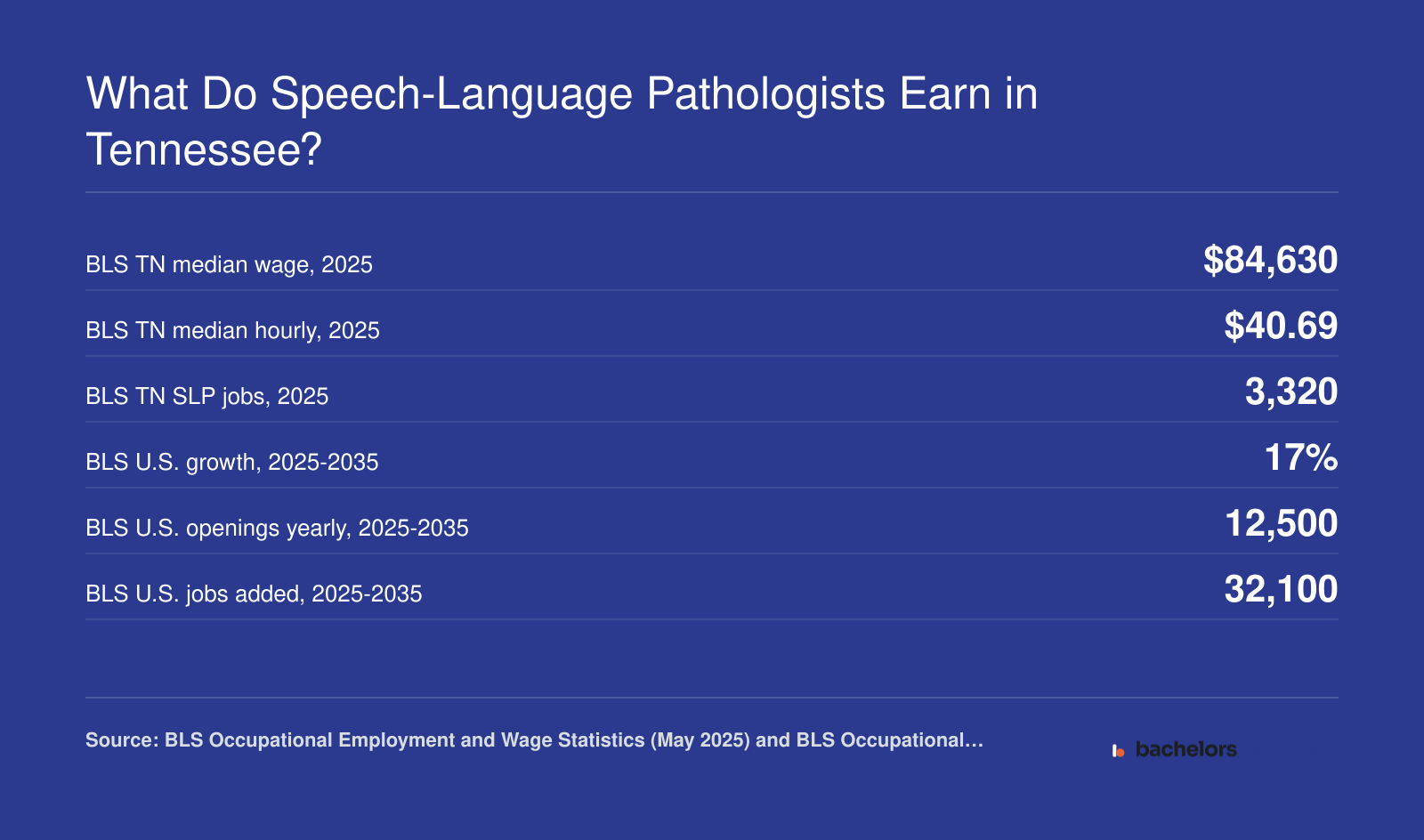
What Do Speech-Language Pathologists Earn in Tennessee?
These figures describe the speech-language pathologist occupation. They are not the graduate earnings shown in the comparison table above. Tennessee wages and job counts cover wage-and-salary workers only, and the growth figures are national projections, not Tennessee estimates.
Compare Speech Pathology programs on the data that matters
Explore more Communications & Media majors or browse every field of study.
All Communications & Media programs Browse every field of study