Best Public Health Schools in Tennessee
Compare 10 accredited Public Health programs in Tennessee, with net price after aid, graduation rates, earnings and debt from IPEDS and the U.S. College Scorecard.

After grant aid, a public health bachelor's in Tennessee can cost a family about $10,701 a year at UT Martin or $33,147 at Belmont University. The degree is a Bachelor of Science (B.S.) in Public Health, offered on campus, online, or in a hybrid format.
Each school is compared on net price, graduation rate, program-level earnings, CEPH status, and format, with state aid covered in the cost section.
East Tennessee State University, Middle Tennessee State University, Tennessee State University, the University of Tennessee, Knoxville, and the University of Memphis all hold CEPH accreditation. If a program does not list accreditation, ask the department before you apply.
Key Points
- The University of Tennessee-Martin posts the lowest average net price here.
- Tennessee State University's in-state tuition and fees run just $8,616 yearly.
- Online public health credits at UT Knoxville cost residents $490 each.
Best Bachelor's in Public Health Schools in Tennessee, Ranked
The ten programs below make up our ranking of bachelor's degrees in public health in Tennessee, spanning public flagships, private universities, and fully online options. Each card shows an approximate average net price after aid, the school-wide graduation rate rather than a program-specific figure, the city, the format, and the concentrations a student can choose. One short takeaway line on each entry explains who that program tends to fit best.
The University of Tennessee-Knoxville
#1Knoxville, TN · ~$19,000/yr (est.)
Best for: Students wanting a flagship research campus
Tennessee's flagship public university hosts a CEPH-accredited Bachelor of Science in Public Health built around a Population Health Sciences concentration. The curriculum spans 11 foundational domains, from epidemiology and biostatistics to health policy and global health, and every student completes a 120-hour applied practice internship. A 2.8 GPA keeps students in good standing, and an accelerated five-year path lets strong students begin an MPH during their senior year. It is the broadest research-university option on this list for students weighing pre-med or graduate study.
- CEPH-accredited BSPH with a Population Health Sciences concentration
- 11 foundational knowledge domains, from epidemiology to health policy
- 120-hour applied practice internship chosen around career interests
- 21 credit hours of core public health coursework
- 12 credit hours in the Population Health Sciences concentration
- 2.8 GPA minimum to progress and stay in the program
- Accelerated five-year bachelor's to MPH pathway
- Prepares for public health agencies, pre-med, and allied health
Middle Tennessee State University
#2Murfreesboro, TN · ~$13,000/yr (est.)
Best for: Working students mixing online and campus classes
Middle Tennessee State University runs one of the state's most flexible public health degrees, teaching the same CEPH-accredited curriculum on campus in Murfreesboro and fully online. Students take biostatistics, epidemiology, environmental health, and program planning, then complete a 180-hour community health internship for six credits. Pre-med, pre-PA, and pre-nursing tracks are built in, and an accelerated bachelor's-to-master's option shortens the road to an MPH. The university also participates in a statewide wellness initiative that trains student health ambassadors for community prevention work.
- CEPH-accredited, offered on campus and fully online
- 180-hour community health internship worth 6 credits
- Tracks for pre-med, pre-PA, and pre-nursing students
- Accelerated bachelor's-to-MPH option
- Coursework in biostatistics, epidemiology, and program planning
- Prepares for health educator and prevention coordinator roles
East Tennessee State University
#3Johnson City, TN · ~$16,000/yr (est.)
Best for: Future health educators pursuing certification eligibility
East Tennessee State University has one of the longest-running undergraduate public health programs in the country, and its Community Health concentration leads to eligibility for the Certified Health Education Specialist exam. Coursework mixes theory with hands-on practice in program planning, community data, and health behavior, and faculty have earned national recognition for curriculum and community service. ETSU students have landed placements in state health department internship cohorts, including analytics work. An accelerated BSPH-to-MPH pathway is available for students who want to continue.
- CEPH-accredited, with a Community Health concentration
- Prepares students to sit for the CHES credentialing exam
- Accelerated BSPH-to-MPH pathway
- Two Delta Omega awards for innovative curriculum
- 2024 Harrison C. Spencer Award for outstanding community service
- Placements in state health department internship cohorts
University of Memphis
#4Memphis, TN · $10,000 – $15,000/yr (est.)
The University of Memphis offers a CEPH-accredited BSPH with no prerequisites to declare, which makes it unusually easy to switch into public health after starting college. Students complete 120 credit hours with fieldwork in local health organizations and a capstone, plus coursework in health data analytics, program evaluation, and the social determinants of health. One-on-one advising and room for up to two minors let students build a pre-health or policy-focused degree. The School of Public Health is active in Memphis community partnerships, from food security work to a summer program introducing high schoolers to the field.
- CEPH-accredited; no prerequisites needed to declare the major
- 120 credit hours with fieldwork in local health organizations
- Capstone experience required for graduation
- Up to two minors can be added to broaden skills
- Dedicated one-on-one academic and faculty advising
- Accelerated path to the MPH
Belmont University
#5Nashville, TN · ~$33,000/yr (est.)
Belmont University's private, Nashville-based program pairs a science-heavy public health core with a 400-hour internship, the longest field requirement among the schools ranked here. Students can collaborate with the Tennessee Department of Health, take electives in politics, philosophy, or additional sciences, and follow a pre-health track toward medical school, PA school, or an MPH. Admissions are test-optional with a $50 application fee, and the campus sits in a city dense with healthcare employers.
- 400-hour internship tailored to career goals
- Collaborations with the Tennessee Department of Health
- Test-optional admissions with a $50 application fee
- Pre-health track for medical, PA, and MPH study
- Public Health Student Association and travel abroad options
The University of Tennessee Southern
#6Pulaski, TN · ~$13,000/yr (est.)
The University of Tennessee Southern in Pulaski launched the first undergraduate public health program in the UT system, and it is built around applied practice. A capstone course requires 135 hours of supervised field experience, and coursework covers evidence-based research, policy development, and health communication with diverse populations. The university reports that about 97% of its students qualify for some form of aid and that 75% of Tennessee residents may attend tuition-free through UT Promise and related programs. A public health minor is open to students in other majors.
- First undergraduate public health program in the UT system
- 135 hours of supervised field experience in the capstone
- Public Health minor open to students in other majors
- Reports about 97% of students qualify for some form of aid
- Reports 75% of Tennessee residents may attend tuition-free
- Coursework in evidence-based research and policy development
Baptist Health Sciences University
#7Memphis, TN · ~$11,000/yr (est.)
Baptist Health Sciences University in Memphis takes a healthcare-workforce approach, letting public health majors choose among community health, health administration, health informatics, and pre-health professions concentrations. Students complete a capstone internship or research project and learn alongside nursing and allied health majors through interprofessional coursework. A community health worker certification and a 4+1 MBA in Healthcare Management add credential options on top of the bachelor's degree. The program runs in a hybrid format for students who want some campus presence in Memphis.
- Concentrations in community health, health administration, health informatics, pre-health
- Capstone internship or research project required
- Community health worker certification available
- 4+1 MBA in Healthcare Management pathway
- Interprofessional education alongside other health majors
- Hybrid format based in Memphis
Tennessee State University
#8Nashville, TN · $9,000 – $22,000/yr (est.)
Tennessee State University, a historically Black university in Nashville, has offered a CEPH-accredited BSPH since 2019. The campus program focuses on how health departments, hospitals, community agencies, and insurers work to improve outcomes and control costs, with field experiences that may require background checks. TSU students serve as health ambassadors through a state wellness initiative aimed at disparities in chronic disease, mental health, and infant mortality. The degree also feeds into TSU's speech pathology master's program.
- CEPH-accredited; approved to offer the BSPH in 2019
- Campus-based program in Nashville
- Pathway to TSU's speech pathology master's program
- Some internships require background checks
- Health ambassadors through a state wellness initiative
- Prepares for roles in health departments, hospitals, and community agencies
The University of Tennessee-Martin
#9Martin, TN · $11,000/yr (est. net price)
The University of Tennessee at Martin houses public health inside its Health and Human Performance degree, so majors take a broad 120-credit program with a 42-credit concentration. A 12-hour supervised internship and a Major Field Exit Exam round out the degree. It suits students who want population health training close to home, with electives that support pre-professional or certification goals.
- Public Health concentration within Health and Human Performance
- 42 credit hours in the concentration, including a 12-hour internship
- Core courses in epidemiology and public health microbiology
- Electives across biology, sociology, nutrition, and social work
- Expanded in fall 2026 to six regional centers across West and Middle Tennessee
- 2.0 GPA minimum and a Major Field Exit Exam to graduate
Strayer University-Tennessee
#10Nashville, TN · ~$12,000/yr (est.)
Strayer University's Tennessee campus in Nashville administers a fully online Bachelor of Science in Health Services Administration with a Public Health concentration, designed for working adults. The curriculum covers biostatistics, epidemiology, disease prevention, outbreak investigation, and emergency management, with 11-week courses and 40 courses total. Students can transfer up to 28 classes and use no-cost general education courses to lower the bill, and one-on-one academic coaches provide support. The university is accredited by the Middle States Commission on Higher Education.
- 100% online, with 11-week courses
- Public Health concentration within Health Services Administration
- 40 courses total; transfer up to 28 classes
- No-cost general education courses available
- Covers biostatistics, epidemiology, and emergency management
- Accredited by the Middle States Commission on Higher Education
Cost & outcomes by school
Federal data for the highest-earning Public Health programs, independent of the ranking above. Earnings are this field's bachelor's graduates four years after completing where the Scorecard reports them, else the school's undergraduate median.
| School | Net price / yr | Grad rate | Earnings | Debt | Grads/yr | Format |
|---|---|---|---|---|---|---|
| Baptist Health Sciences University TN | $11,212 | 40% | $72,529 | $29,500 | 1 | Hybrid |
| The University of Tennessee-Knoxville TN | $18,976 | 74% | $60,249 | $20,500 | 20 | Campus |
| Belmont University TN | $33,147 | 71% | $55,930 | $20,500 | 15 | Campus |
| East Tennessee State University TN | $15,983 | 53% | $52,543 | $22,299 | 15 | Campus |
| University of Memphis TN | $12,397 | 51% | $48,458 | $23,300 | 11 | Campus |
| Middle Tennessee State University TN | $13,359 | 54% | $46,320 | $27,000 | 11 | Online |
| The University of Tennessee-Martin TN | $10,701 | 53% | $44,213 | $21,024 | — | Campus |
| Tennessee State University TN | $15,796 | 34% | $42,730 | $27,000 | 12 | Campus |
| Strayer University-Tennessee TN | $11,645 | — | $40,092 | $40,621 | — | Online |
| The University of Tennessee Southern TN | $12,798 | 37% | $38,924 | $21,500 | 2 | Campus |
Sources: U.S. Department of Education. Net price, graduation rate, earnings and debt: College Scorecard (earnings and debt for this field's bachelor's graduates where reported, else school-wide); graduates: IPEDS. A dash means no figure is reported.
Cost, debt & payoff
Median earnings of this field's bachelor's graduates (4 yrs after completing, else the school's undergraduate median) vs. their median federal loan debt · U.S. College Scorecard
Across these programs the median graduate earns about $47,389 and finishes with roughly $22,800 in debt — a ratio that clears a common rule of thumb (keep debt below first-year salary). Net price and debt vary widely school to school, so check the per-school figures in the table above before you shortlist.
How We Ranked Tennessee Bachelor's Degree in Public Health Schools
No single source ranks Tennessee's public health bachelor's programs, so comparing them takes real work. Families end up stitching together a tuition page, a PDF brochure, and a hand-me-down opinion about which campus has the stronger program.
What We Compare
Four things drive the order. First, what graduates actually do: federal data on earnings and employment after completion, read as closely as the reporting allows toward public health graduates rather than the whole university. Second, net price, meaning what students pay after grant aid, not the sticker tuition. Third, accreditation, since a program housed in a school with public health accreditation carries more weight with employers and graduate admissions committees. Fourth, format, because a working student in Memphis may need an online or hybrid path while a traditional-age student wants a lab, a fieldwork placement and an internship coordinator.
Where the Numbers Have Limits
Graduation rates and net price are reported for the entire institution, not the public health major, so a strong university average can mask a weaker department, and the reverse. Earnings figures describe a band of graduates rather than one program's outcome. Treat each number as a starting question, not a verdict.
Who This List Covers
Only bachelor's programs at Tennessee schools are included, whether taught on campus or online. Graduate study is a different market with different rankings. The comparison exists because official university pages describe one school at a time, and national public health rankings concentrate on master's and doctoral programs, leaving undergraduates without a like-for-like view. Several of the schools here also serve adult learners through online delivery, and those formats are judged on the same four factors as a traditional campus program.
Cheapest Bachelor's in Public Health Programs in Tennessee
These schools are ordered by average net price, which is the typical yearly cost after grants and scholarships are subtracted, based on U.S. Department of Education data. The UT Martin campus program comes in lowest, while the University of Memphis has the lowest in-state sticker price among the public universities listed after UT Martin. Tuition figures are annual published rates and can change each year, so confirm current costs with each school's bursar before you budget.
| School | City | Format | In-State Tuition and Fees (Annual) | Out-of-State Tuition and Fees (Annual) | Average Net Price (Annual) |
|---|---|---|---|---|---|
| The University of Tennessee-Martin | Martin | Campus | $10,560 | $16,600 | $10,701 |
| Baptist Health Sciences University | Memphis | Hybrid | $13,796 | $13,796 | $11,212 |
| Strayer University-Tennessee | Nashville | Online | $13,920 | $13,920 | $11,645 |
| University of Memphis | Memphis | Campus | $10,728 | $15,384 | $12,397 |
| The University of Tennessee Southern | Pulaski | Campus | $10,924 | $10,924 | $12,798 |
Related Articles
Online and Hybrid Bachelor's in Public Health Options at Tennessee Schools
At the University of Tennessee, Knoxville, one online public health credit costs $490 for Tennessee residents and $565 for out-of-state students in 2026, and the degree requires 120 credits. Those rates are estimates published before fees, so online is not automatically cheaper.
Programs you can finish remotely
- University of Memphis: the B.S. in Public Health is fully online.
- UT Knoxville: the Public Health major, Population Health Sciences concentration, runs asynchronously through Vols Online with no live sessions.1
- Middle Tennessee State University: the CEPH-accredited B.S. in Public Health is offered on campus and online.
- East Tennessee State University: lists its B.S. in Public Health, Community Health concentration, as online and on campus.
- Baptist Health Sciences University: a hybrid public health bachelor's with four concentration options.
- Strayer University-Tennessee: a fully online B.S. in Health Services Administration with a public health concentration.
Only UT Knoxville publishes a clear resident versus nonresident online rate. Memphis does not list a separate online tuition figure, so ask before you budget.
Fieldwork and advising
The internship does not disappear online. Middle Tennessee State requires 180 hours for six credits, at 30 site hours per credit, and points students to faculty and Handshake to find a community organization. UT Knoxville requires an applied practice experience tied to your goals but does not say who secures the site. Memphis assigns a dedicated academic advisor and a faculty mentor, plus career office support.
The Tennessee Department of Health accepts eligible in-state and out-of-state interns, matches interests to agency needs, and holds affiliation agreements with several Tennessee schools. Expect an application, a preceptor, a contract and training. No school promises placement, so start site hunting a semester early.
Campus-only options
Belmont University teaches its B.S.P.H. in person and requires a 400-hour internship.2 UT Southern, Tennessee State University and UT Martin also appear as campus programs in our data.
Cost of a Bachelor's in Public Health in Tennessee: Tuition, Net Price and State Aid
Public universities in Tennessee can keep a public health bachelor's within reach, but only the price after grant aid shows the real cost.
What the tuition numbers say
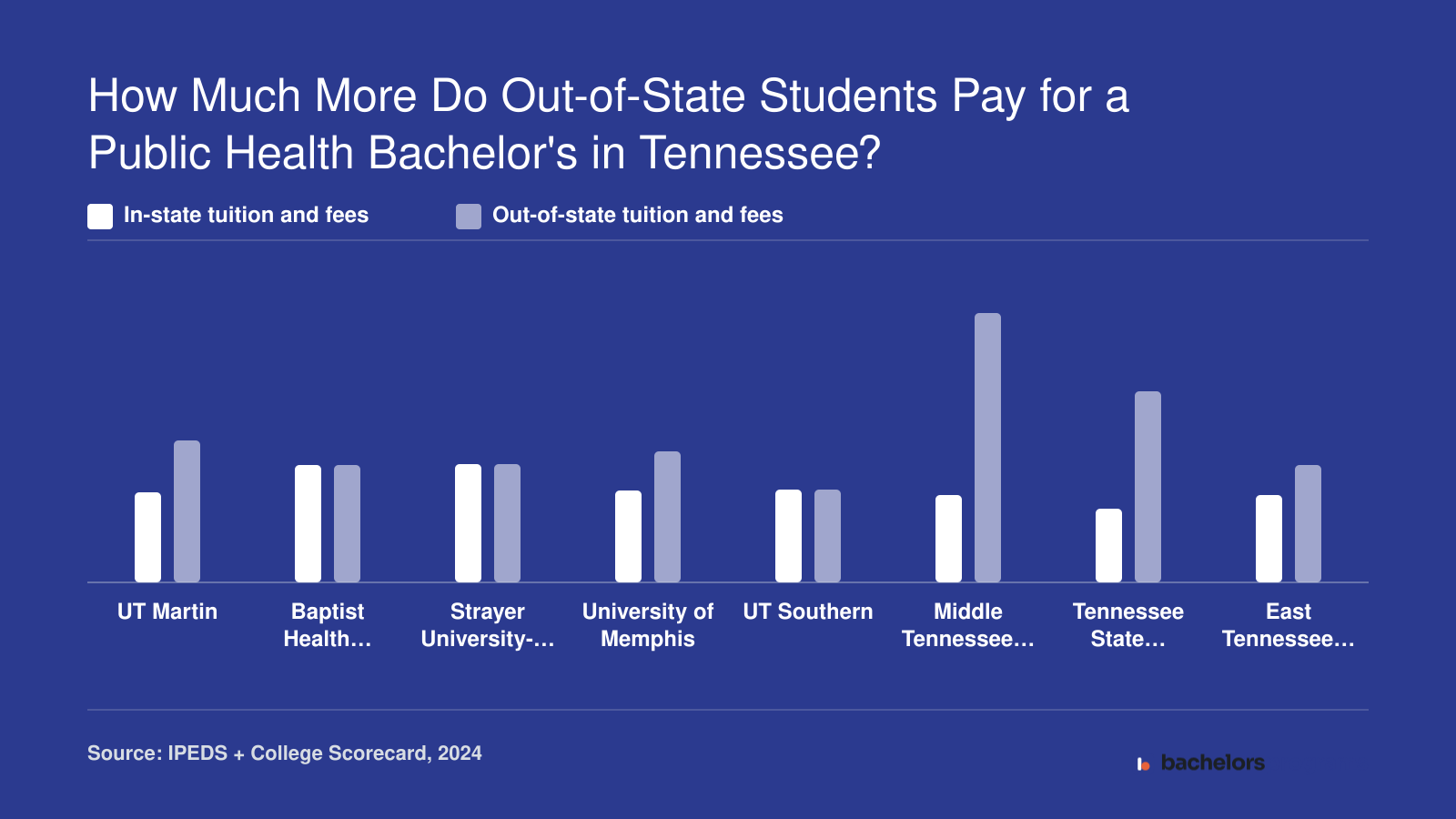
Among the public schools ranked here, in-state tuition runs from $8,616 a year at Tennessee State University to $13,812 at The University of Tennessee-Knoxville, with Middle Tennessee State University at $10,266, East Tennessee State University at $10,472, the University of Tennessee-Martin at $10,560, the University of Memphis at $10,728 and The University of Tennessee Southern at $10,924. Out-of-state rates climb sharply: MTSU charges $31,574 to nonresidents and UT Knoxville $33,256, while UT Martin ($16,600), ETSU ($14,522) and Tennessee State ($22,416) stay lower.
Net price after aid is the number that matters. UT Martin's students pay about $10,701 on average, followed by Baptist Health Sciences University ($11,212), Strayer University-Tennessee ($11,645), Memphis ($12,397), UT Southern ($12,798), MTSU ($13,359), Tennessee State ($15,796), ETSU ($15,983) and UT Knoxville ($18,976). Belmont University, a private university, is the outlier at $33,147 against a $42,540 tuition.
The state programs that matter
- HOPE Scholarship: the one that follows a Tennessee high school graduate straight into a four-year public health program in state. Merit based, tied to high school GPA and test scores, and awarded annually by the Tennessee Student Assistance Corporation, which resets amounts each year.
- Tennessee Promise: last-dollar tuition support at community and technical colleges, paired with mentoring and service requirements. For this major it matters as a transfer route rather than a four-year award.
- Tennessee Reconnect: for adults returning to college without a degree, also community college focused, so again a transfer path into a bachelor's.
- Dual Enrollment Grant: lets high school students earn college credit early, which is the cheapest way to clear general education requirements.
How to stack aid
File the FAFSA early. HOPE and the federal Pell Grant can both apply, and state dollars generally pay after other gift aid. Then ask each public health department what departmental scholarships exist and whether an outside award will shrink your institutional grant, because some schools reduce need-based aid dollar for dollar and others let you keep both.
How Much More Do Out-of-State Students Pay for a Public Health Bachelor's in Tennessee?
Residency matters most at Middle Tennessee State University, where out-of-state tuition and fees of $31,574 run $21,308 above the $10,266 in-state rate. Tennessee State University offers the lowest in-state price in this comparison at $8,616 a year. The University of Tennessee Southern, Baptist Health Sciences University and Strayer University-Tennessee charge the same rate regardless of residency.
Common Questions About Public Health Bachelor's Programs in Tennessee
These answers draw on the accreditor's listings and the schools' own program pages. Details such as admission requirements and course formats can change, so confirm them with the school before you apply.
Which Tennessee public health school is best for undergraduate students?
Which Tennessee public health programs are CEPH-accredited?
Can you get a bachelor's degree in public health online in Tennessee?
Can I start at a community college with Tennessee Promise and transfer into a public health bachelor's program?
Compare Public Health programs on the data that matters
Explore more Healthcare majors or browse every field of study.
All Healthcare programs Browse every field of study